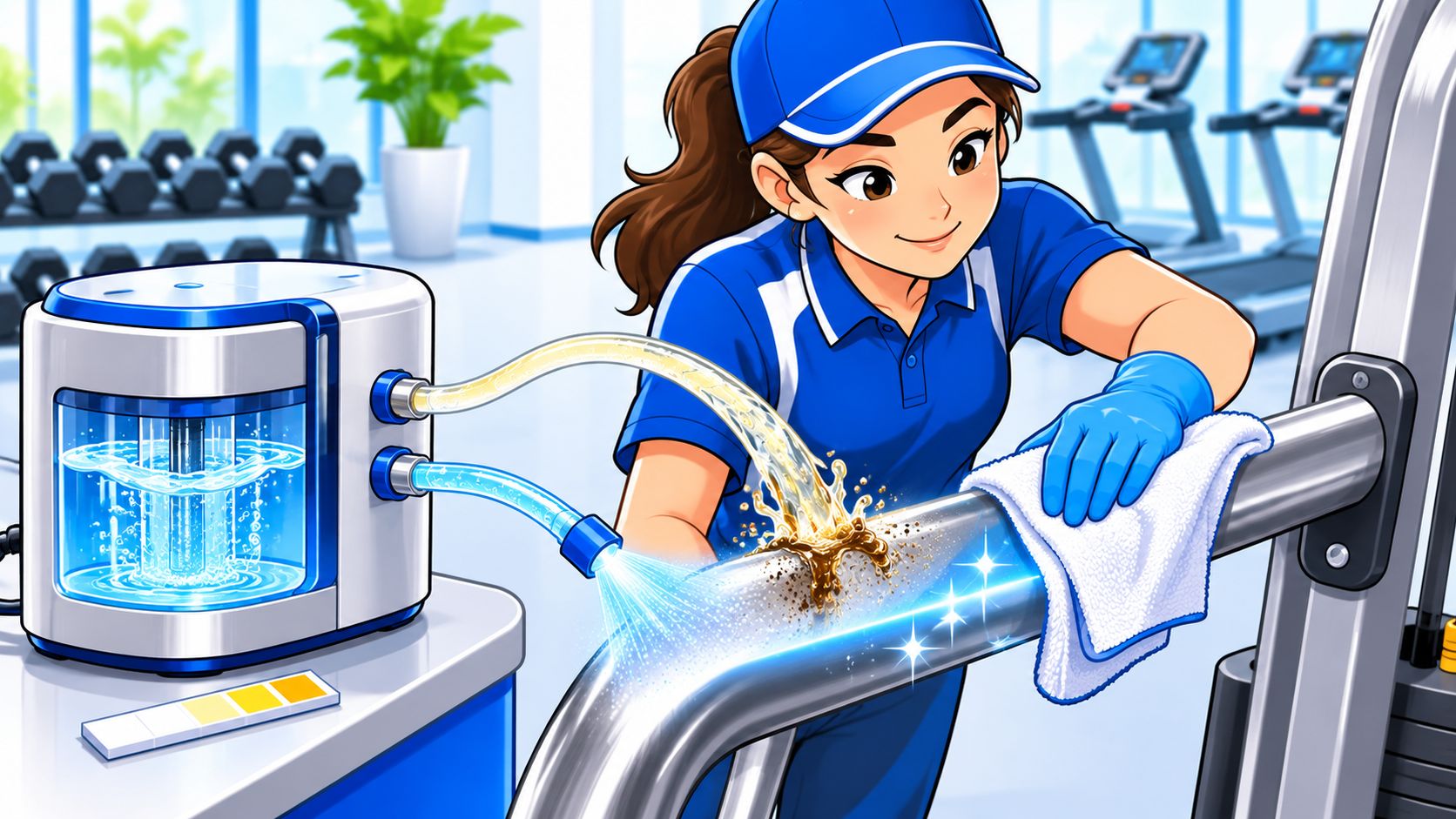
A 2005 surface study found that neutral electrolyzed water containing 63 mg/L of active chlorine reduced Escherichia coli, Listeria monocytogenes, Pseudomonas aeruginosa, and Staphylococcus aureus by more than 7 log CFU/mL within 5 minutes on stainless steel and glass, with results comparable to sodium hypochlorite at 62 mg/L, according to a review from the U.S. National Library of Medicine. That's a 10-million-fold reduction in a solution that starts as salt water. The number reframes the whole topic: electrolyzed water isn't a gentle rinse or a wellness trend. It's an electrochemically generated sanitizer whose results depend on measurable chemistry, not on the generator's marketing copy.
Facility managers see three streams from an electrolysis unit, and each one has a different job. Mixing them up costs staff time and leaves surfaces under-treated. The practical path is to match the water type to the task, then verify concentration and contact time at the point of use. That discipline, more than the machine itself, decides whether cleaning with electrolyzed water works in a gym, office, school, or retail space.
Which Electrolyzed Water Type Fits Which Task
Three water types come out of an electrolysis system, and they're not interchangeable. Acidic electrolyzed water is the disinfecting stream. Alkaline electrolyzed water lifts grease and particulate soil, so it's a cleaning step, not a disinfecting step. Neutral electrolyzed water sits in the middle, and its strength is set by the free chlorine concentration rather than by pH alone.
Here's the comparison buyers need before they look at any generator:
| Water type | pH and ORP | Active agent | Best job |
|---|---|---|---|
| Acidic electrolyzed water | pH below 2.7; ORP above +1,100 mV | Hypochlorous acid | Disinfecting hard, nonporous surfaces |
| Neutral electrolyzed water | Near neutral pH; ORP set by generator | Free chlorine (under 1 to 20 mg/L in a 2019 comparison; 63 mg/L in the 2005 surface study) | Low-residue sanitizing where chlorine is verified |
| Alkaline electrolyzed water | pH 10.0-11.5; ORP about -800 to -900 mV | Not a disinfecting agent | Degreasing and soil removal before disinfecting |
The chemistry explains the split. In acidic electrolyzed water, the anode generates a solution typically characterized by pH below 2.7, ORP above +1,100 mV, and hypochlorous acid (HOCl) as the active species. Near neutral pH, HOCl stays largely un-ionized, which lets it slip through microbial cell walls and oxidize membrane components, disrupting cellular function. That mechanism is why the U.S. National Library of Medicine review reports that antimicrobial performance depends on the interaction of pH, oxidation-reduction potential (ORP), and available chlorine, not on water alone.
The oxidant sponge rule: Every bit of organic soil in the water or on the surface consumes some of the reactive chlorine. The more soil, the less disinfectant reaches the microorganism.
The 2005 study gives a useful benchmark. Neutral electrolyzed water at 63 mg/L active chlorine cut all four test organisms by more than 7 log in 5 minutes on both stainless steel and glass, matching sodium hypochlorite at 62 mg/L. That's a controlled-surface result, not a guarantee for a soiled gym bench. Published research associates active-chlorine concentrations above roughly 20 ppm with effective microbial inactivation, but a manager shouldn't treat that as a sanitizing specification. The validated hard-surface procedures covered later in this article use 165-200 mg/L for disinfection claims.
Alkaline electrolyzed water has reported pH values of 10.0-11.5 and ORP values around -800 to -900 mV, which support soil removal and equipment cleaning. But this stream should never be treated as the disinfecting step. The default rule for a busy facility is straightforward: clean with the alkaline stream where soil is heavy, then sanitize with the acidic stream at a verified concentration and contact time.
Generator settings are not proof of output. Salt concentration, water temperature, flow rate, and electrode condition all shift the chemistry. Measure free chlorine and pH at the point of use, record the reading, and only then apply the solution as a sanitizer or disinfectant. A chlorine test kit costs less than one failed health inspection.
Cleaning, Sanitizing or Disinfecting Claims to Verify
A facility's intended claim should determine what it buys. Generating hypochlorous acid on site does not establish that the resulting solution can sanitize or disinfect every surface. The claim depends on the organisms, application conditions, and supporting efficacy information.
- Cleaning removes soil and organic matter with soap or detergent. It doesn't make a kill claim.
- Sanitizing reduces bacteria to a specified level. A sanitizing claim alone doesn't establish effectiveness against viruses.
- Disinfecting claims a kill against named organisms under specific label conditions, including contact time and surface type.
The NHS Scotland report found similar bacterial reductions between neutral electrolyzed water and sodium hypochlorite on surfaces, but concluded that evidence was insufficient to support replacing chlorine-releasing agents in healthcare-environment decontamination. Comparable results under test conditions therefore need careful interpretation before a facility changes its program.
The report also describes U.S. regulatory treatment of on-site generators as pesticidal devices. Buyers should distinguish the generator's regulatory status from the efficacy evidence supporting a particular application. A device designation alone does not establish which organisms the generated solution will kill.

The Procurement Checklist
Before first use, match the proposed task to the product label or application-specific efficacy documentation:
- Organism list on the label: Identify the bacteria, viruses, spores, or mold covered by the claim. Don't extend that claim to unlisted organisms.
- Registration number: For U.S. registered disinfectant products, check the EPA registration number. An establishment number is not a registration, and a generator's device status is a separate issue.
- Concentration and pH record: Identify the required free chlorine level and pH range, then check that the facility's records demonstrate those conditions.
- Expiration and storage rules: Confirm how long the generated solution or packaged product remains effective under the specified storage conditions.
- Staff training records: Document who checked concentration, applied the solution, and maintained the required wet contact time on the specified surface.
For EPA registered disinfecting wipes, check each product's organism list and contact time. Similar active ingredients do not make sanitizer and disinfectant claims interchangeable. The WipesBlog guide on reading the EPA registration number helps managers distinguish registration information when comparing packaged products with on-site generation.
Keep chemical selection tied to the task: guidance on choosing safer exterior cleaning chemicals concerns exterior cleaning, while sanitizing and disinfecting decisions require their own application-specific evidence. Procurement should establish both what the solution can do and whether staff can consistently meet its operating conditions.
How to Disinfect High-Touch Surfaces with Electrolyzed Water
Hard-surface disinfection with electrolyzed water is a sequence, not a spray-and-walk-away step. A 2023 peer-reviewed study in Food and Function found electrochemically generated HOCl at 165 mg/L effective against Salmonella enterica, Pseudomonas aeruginosa, and Staphylococcus aureus on hard surfaces when kept wet for 10 minutes under clean conditions. When a 5% serum-albumin soil load was present, 200 mg/L was required. Proteinaceous soil consumes reactive chlorine and shields microorganisms, so the same generator output that disinfects a clean surface can fail on a dirty one.

The Six-Step Disinfection Routine
- Remove visible soil with a detergent or alkaline pass. Organic matter consumes the disinfectant before it reaches the surface. Skip this and the disinfection step is running blind.
- Wipe off residue so the sanitizer meets the surface itself. A film of cleaning product can neutralize the HOCl.
- Check the solution with a chlorine test kit and record the reading. Electrolysis output changes with salt concentration, water temperature, flow rate, and operating conditions.
- Apply enough solution, by spray or saturated wipe, to keep the entire surface visibly wet. A light mist leaves dry spots where microorganisms survive.
- Hold the surface wet for the validated time. For the 2023 study, that's 10 minutes at 165 mg/L on a clean hard surface, or 10 minutes at 200 mg/L under soil load.
- Let the surface air dry rather than wiping it early. Early wiping shortens the contact time and voids the disinfection claim.
Labeled disinfectant wipes follow the same wet-contact logic. Contact time is the period a treated surface must remain visibly wet, and labeled times differ from product to product, so staff should follow the contact time printed on each label rather than assuming one standard duration. Staff should use enough product to keep the entire hard, nonporous surface wet for the labeled duration, and check the label before standardizing procedures across products. A wipe that evaporates too quickly or is used on a visibly dirty surface without prior cleaning may not deliver the claimed disinfection performance. The WipesBlog guide to disinfecting high-touch surfaces walks through the same routine with packaged wipes for teams that want a ready-to-use option.
| Surface condition | Concentration reported | Wet contact time |
|---|---|---|
| Clean hard nonporous surface | 165 mg/L electrochemically generated HOCl | 10 minutes |
| Visibly soiled, serum-type soil load | 200 mg/L electrochemically generated HOCl | 10 minutes |
| Neutral electrolyzed water, 2005 surface study | 63 mg/L active chlorine | 5 minutes for more than 7 log reduction on stainless steel and glass |
| Labeled disinfectant wipes on hard surfaces | Per product label | Per product label |
A short verification routine closes each shift: test the solution, log the reading with time and operator, and spot-check one surface that was disinfected to confirm it was held wet. Ten minutes of dwell time on a gym door handle is a different job than the shorter hold a labeled wipe calls for, and the log should show which one was used.
Where Electrolyzed Water Falls Short on Real Surfaces
Roughly 1.5-3.5 log reductions against organisms such as Salmonella, Listeria, and E. coli are reported for electrolyzed water, but the same Oxford Academic review also finds limited efficacy against biofilms and porous surfaces. That distinction matters. A reduction on a clean, smooth coupon says little about a textured gym mat, a grout line, or a seat that has absorbed body oils. Electrolyzed water works like a verified-parameter tool. Soil, pH, free chlorine, and wet contact time decide results more than the generator does.
Those log reductions are useful, but they are not sterilization. The practical question is whether the active chlorine can reach the organism while the surface stays wet long enough. On a hard, smooth surface, that question has a manageable answer. On a porous or heavily handled surface, the answer depends on preparation as much as chemistry.
| Surface | Expected performance | Fix |
|---|---|---|
| Smooth nonporous touchpoints (stainless steel, glass, sealed plastic) | High when soil is removed and wet contact is met | Follow the standard procedure |
| Grout and tile joints | Reduced; organisms can shelter | Scrub with a brush, then re-apply and hold wet |
| Upholstery and fabric seats | Limited; porous material | Use a product labeled for fabric, not a surface claim |
| Rubber gym flooring and textured mats | Reduced; texture traps soil | Clean first and check the material on the label |
| Equipment seams, grips and frames | Reduced where biofilm forms | Degrease with the alkaline stream, then disinfect |
| Vehicle interiors at dealerships | Reduced on porous trim and cabins that carry soil; confirm each material before relying on a hard-surface claim | Clean visible soil first, then use only a product labeled for that material and dwell time |
"Chemical-free-feeling" does not mean "soil-proof."
Wiping action changes the outcome. A light pass leaves organisms sheltered in texture, seams, and crevices. Grout needs mechanical work: scrub with a brush, re-apply the solution, and hold it wet. Upholstery is a material mismatch when a hard-surface claim is used on fabric. Equipment seams need degreasing before disinfecting, because residue protects organisms and limits contact.
The decision rule is the same across schools, gyms, warehouses, waiting rooms, offices, and retail spaces: remove visible soil first, then verify concentration, coverage, and wet contact time. If any of those four steps is skipped, electrolyzed water underperforms no matter how clean it feels or how little odor it leaves.
Operating an Electrolyzed Water Program
An electrolyzed water program succeeds on monitoring, not on trust in the generator. Here's the operational control sequence a manager can turn into a shift checklist.
- Log free chlorine, pH, and ORP at point of use. Record the time, date, and operator at each shift. Check the test kit against a reference solution before relying on it, because expired strips read low and send staff chasing a problem that isn't there.
- Control the inputs the generator can't correct for itself. Salt concentration, water temperature, flow rate, and feed-water quality all change output. A hard-water supply scale the electrodes and shifts pH. Set the feed-water spec, measure it, and stick to it.
- Schedule electrode and cell maintenance. Inspect and clean electrodes at the manufacturer's interval, record sensor calibration, and replace parts before readings drift. A worn electrode produces a solution that tests fine on pH but carries less hypochlorous acid.
- Set a maximum hold time from your own test data. Generated solutions lose active chlorine over time and in warm or open containers. Label each batch with its generation time, and retest before use if it sits beyond the hold window.
- Train staff on the clean, verify, disinfect sequence. Confirm the handling requirements and personal protective equipment on the product label or safety data sheet. Keep training records, because a regulator will ask who measured what and when.
- Define the stop rule. Any reading outside the validated range means the batch is not used for disinfecting claims until it's retested or regenerated. No exceptions.
The stop rule is the one that keeps facilities honest. If the free chlorine reads 12 ppm when the disinfecting procedure requires 165 mg/L, the equipment doesn't force anyone to stop. The manager does. Write that rule into the log sheet, and the whole program becomes audit-ready.
Facility Plans for Gyms, Offices, Schools and Retail
Gyms are the clearest case for point-of-use wipes. Public health guidance calls for cleaning and disinfecting exercise equipment between patrons, and it recommends placing disposable sanitizing wipes at each station so patrons can wipe surfaces before and after exercising. That makes gym equipment wipes a visible control at the point of use, not a supply kept at the front desk. The placement matters as much as the chemistry: a wipe within arm's reach gets used during the short window between users, while a wipe across the room gets skipped.
For studios and multi-location fitness owners, the same placement logic extends to scheduling and member communication. A manager can review Fitness GM scenarios for studio owners to see how wipe-station placement and cleaning cadence map onto peak class hours and equipment turnover. Yoga mats are the exception to the smooth-surface rule: shared, textured mats need to be cleaned first, then treated with yoga mat wipes, because the texture traps soil and soil consumes active chlorine before it reaches the organisms, as covered in the surfaces section.
Offices, schools, and retail follow the same high-touch logic with different fixtures.
| Facility | High-touch points | Cadence | Where wipes go |
|---|---|---|---|
| Gym or fitness center | Free weights, cardio machines, handles, locker room, phones | Between patrons and at peak hours | Gym equipment wipes at every station |
| Office | Desks, pens, elevator buttons, touchpads, restroom fixtures | Scheduled rounds plus spot cleaning | Dispensers near shared printers and kitchens |
| School | Desks, door handles, stair rails, shared tablets | Daily, with extra rounds after illness | Classroom doors and shared device carts |
| Restaurant (non-food-contact surfaces) | Host stand, POS screens, restroom fixtures | Between seatings and at close | Dispensers at host stand and restrooms |
| Retail store | Shopping carts, counters, fitting-room doors, card terminals | More often during peak traffic | Dispensers near entrances and checkout |
The office row follows routine-cleaning guidance for shared fixtures like counters, elevator buttons, and restroom surfaces, with spot cleaning when traffic rises. Schools target door handles, stair rails, desks, and shared tablets, and they plan deep cleaning for stretches when the building can sit empty, since a facility that does not house people overnight can wait before starting a full disinfection pass. Restaurants appear only for non-food-contact surfaces such as host stands and restroom fixtures, because food-contact rules add a rinse step that changes the procedure and the product claim it requires.
The facility plan doesn't need every surface on every round. It needs the highest-touch points on a schedule, a verified wet contact time at each one, and visible wipe stations that make the routine obvious to staff and patrons alike.
Decide Whether Electrolyzed Water Fits Your Program
Four questions settle whether electrolyzed water is ready for a disinfecting claim in a given facility.
- Do staff run a soil-removal step before any disinfecting? If not, active chlorine is being spent on dirt instead of microorganisms.
- Can they measure free chlorine and pH at point of use and log the results? No test, no validated claim.
- Does the label for each product cover the organisms your facility must address? A food-contact sanitizer isn't automatically a viral disinfection claim.
- Can you document wet contact time for each surface type? Porous and textured surfaces need their own verified procedure.
A "no" on any question means electrolyzed water can still serve as a low-residue cleaning step, but it shouldn't carry a disinfection claim. Soil load, pH, free chlorine, and wet contact time decide results more than the generator does. For facility managers and business owners, the operating case is practical: compare the monthly cost of wipe stations against the cost of one closed day or a cycle of sick leave, then use the logged cleaning schedule as evidence of care. WipesBlog.com publishes sanitation and disinfection articles for these readers, breaking down the science of sanitation into simple, actionable insights. It covers the latest trends, regulations, and best practices, with guidance for schools, gyms, warehouses, waiting rooms, and other customer-facing settings.
The mission is to help organizations understand how disinfectant wipes contribute to better health outcomes, operational efficiency, and customer satisfaction. The simplest next step is a daily wipe routine for the highest-touch points, documented so the cleaning schedule becomes visible to staff and customers. Start with one high-traffic area. Cleanliness compounds.
Prioritize cleanliness today. Add a daily wipe routine for door handles, equipment, and shared surfaces, and make the cleaning schedule visible to everyone who walks through the door.
Leave a Reply