Thursday night's class ends at 8:40. The gloves go into the gym bag, the bag goes into the car, and nobody opens it again until Saturday morning, when the inside of that glove smells like a wet dog. Nothing about that sequence is unusual. A boxing glove is foam wrapped in leather or a synthetic shell with one small opening, and it spends its working life holding a sweaty hand, so the inside never gets a real chance to dry.
Most glove advice treats that as a personal problem. In a commercial gym it is an operational one. A single pair of club gloves can pass through several different hands in one evening, and the person who decides whether they get wiped between users is usually a coach or front-desk staffer, not the athlete. Two rules carry the routine below. A glove that stays wet is a glove that smells, whatever you clean it with. And disinfectant wipes earn their place only where the label supports the surface: useful on the shell, useless for drying out soaked foam. Drying is the step that does that job, and it is the step most gyms skip.
Clean and Dry Boxing Gloves After Every Session
The five minutes after a session decide whether the glove smells next Saturday. In a busy gym, those five minutes belong to the coach or the closer, not the athlete who just peeled the gloves off. Wipe the shell and leave the lining damp, and you've handled the visible dirt and nothing else.
Boxfit's equipment care notes lay out the working order plainly: get the wraps off, take the gloves out of the bag, open the wrist closures fully, then wipe both the exterior and the accessible lining with a clean, slightly damp cloth, using only a small amount of mild soap and never saturating the padding (Boxfit equipment care guide).
Here is the same sequence as a floor card, taped inside the equipment cupboard where the shared gloves live.

- Get the wraps off first. Hand wraps absorb a lot of perspiration and push it straight into the glove's lining. Unwrap and drop them in the wash pile before the gloves get handled, not after.
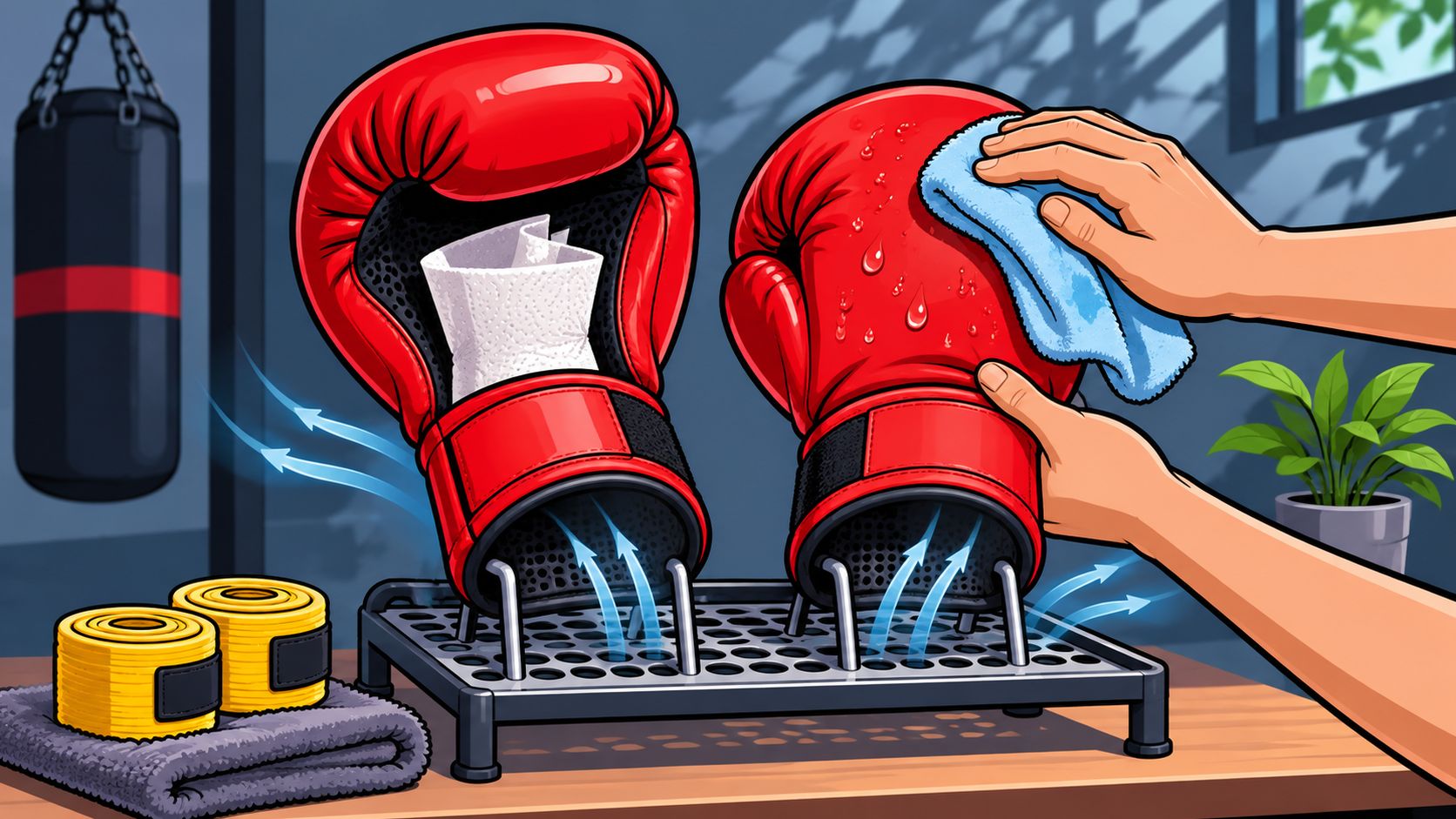
- Open both wrist closures to full width. Folding the strap back on itself doesn't count. The cuff is the only opening the glove has, so pull it wide and hold it open while the glove dries.
- Wipe the shell, thumb and wrist closure. Those three areas see the most contact, and the thumb channel picks up whatever the glove brushes against, including faces. Use a slightly damp cloth to lift the salt and skin oil; a soaking one only pushes moisture into the stitching.
- Wipe the lining you can reach. Push the cloth down into the finger channel and around the thumb, where sweat pools. The outside can look immaculate while the inside stays soaked.
- Use a small amount of mild soap, and wring the cloth out hard. Mild soap or an equipment-safe cleaner is enough on material-compatible gloves. A cloth that drips puts water into foam that takes days to release it.
- Stuff crumpled paper towel inside and change it later. Paper draws the first flush of moisture out of the hand compartment. Swap it after a few hours so the glove isn't resting against damp paper all night.
- Prop it cuff-up, unpacked, in cool moving air. A shaded corner with a fan beats a sealed bag every time. Leave it out until fully dry, ideally overnight.
Drying is the step that gets skipped, so build it into the close-down. Whoever racks the shared gloves does the wipe-down and props them open before leaving, and the same person owns the dryness check when they come back in.
The dryness check
Feel the padding the next morning, not the shell. Knuckle padding should feel cool and dry to the back of your hand, with no damp smell at the cuff. A glove that feels dry at the lining can still hold water in the foam, so if there's any doubt, give it more open hours rather than zipping it away.
Heat and water are the two ways people ruin good gloves. Washing machines, full immersion, radiators, hair dryers and direct sunlight all cause damage that doesn't reverse: deformed padding, weakened adhesives, leather that dries unevenly and cracks. None are faster than air in a ventilated room, and all of them cost you a pair.
Nothing in the routine needs a specialist product. Mild soap, water and a clean cloth do the work, and the same principle holds across sports gear: this guide to safe at-home cleaning supplies covers which household cleaners lift grime without attacking the surface underneath. Save the disinfectant wipes for the hard surfaces their labels cover; the glove routine runs on soap, airflow and time.
Cleaning Versus Disinfecting Boxing Gloves
The most common mistake on a gym floor is treating a wipe as the whole job. A staffer runs a disinfectant wipe over the outside of a glove, drops it in the basket, and the glove goes out again the next evening. That's a surface pass, not a clean, and it isn't what the tub's label promises.
The CDC separates the two steps for a reason. Visibly dirty surfaces are cleaned first with detergent or soap and water, then disinfected with an EPA-registered product, an appropriately diluted bleach solution, or an alcohol solution containing at least 70% alcohol (CDC cleaning and disinfection guidance).
Sweat and skin oil count as soil. Cleaning is what removes them. Disinfection kills what's left, and it only works on a surface that's already clean. Skip the first step and the second one is working blind. In a shared-glove program, that gap is the difference between a hygiene routine and a wipe-bucket ritual.
What a wipe can and cannot do
Disinfectant wipes are built for hard, nonporous surfaces: bench frames, dumbbell handles, bag chains, door handles, mat edges, the hook your gloves hang from. Padded gear is absorbent and textured, which puts it outside what a typical wipe label covers.
That distinction matters when you're buying. Compare products on registered claims rather than marketing copy. Before a tub goes on a purchase order, check each product's EPA registration number, the surfaces it's registered for, and the contact time it requires, on the label or in the EPA's pesticide product search. A wipe registered only for hard nonporous surfaces stays off the gloves, no matter how convenient the tub.
Clean first, disinfect second, and only on a surface the label names. Any other order is theatre.
On the glove itself, the maker's care label comes first. A damp cloth with a small amount of mild soap on the exterior and the reachable lining is the treatment. Reserve any disinfectant step for materials the product label specifically names, and don't let a wipe stand in for the full job on padded gear. A disinfection claim is only worth making where a label supports that surface.
Frequency, Shared Gloves and Gym Protocols
Scan the row that matches your glove and how many hands it passes through in a day.
| Glove or Accessory | Cleaning Method | Frequency | Drying Before Reuse |
|---|---|---|---|
| Personal training gloves | Wipe exterior and lining, then dry | After every session | Overnight, unpacked |
| Shared class gloves | Clean first, then disinfect where the product label allows | Between every user where feasible | Overnight, on separate hooks |
| Leather competition gloves | Damp cloth and mild soap, no soaking | After every session | Overnight, away from heat |
| Synthetic training gloves | Damp cloth on exterior and lining | After every session | Overnight, unpacked |
| Hand wraps | Wash | After every session | Fully dry before next use |
The logic is simpler than the table. The CDC's baseline for shared sports objects and protective equipment is cleaning and disinfection before and after use, or at least between uses by different individuals, and it notes that facilities which can't disinfect every pair between rounds should cut down on sharing, assign gloves to individuals and document cleaning between classes (CDC guidance on shared equipment).
Where athletes have cuts, abrasions or a skin infection, that matters more rather than less. Damaged skin plus contaminated shared gear is the combination worth designing out.
Count the hands, not the pairs. If a glove touches two people in one evening, it needs a between-user step that evening.
A five-line protocol for shared gloves
- Classify every pair. Shared or personal, marked on the cuff. Personal gloves get wiped and dried; shared gloves get the two-step treatment plus a dry.
- Require a barrier. Hand wraps or thin inner gloves on every shared pair. It cuts how much sweat reaches the lining and gives the next user a clean layer against their skin.
- Quarantine the wet and the smelly. One crate, out of member reach, for anything damp or odorous. Nothing goes back on the rack until it's dry.
- Clean the surrounds between users. Bench pads, bag chains, wall padding and the hook, all of it. Those are hard surfaces, so they're exactly where your wipes belong.
- Log it. A sign-off sheet per class turns "someone usually does it" into a record a manager can check.
Where facility protocols actually fail
Contact time is the usual culprit. An EPA-registered wipe label requires the hard, nonporous surface to be thoroughly wetted and to stay visibly wet for the stated contact time; one label specifies a one-minute wet-contact period, while another approved label requires 10 minutes for certain virus and bacteria claims (EPA-registered wipe label). A quick pass that flashes dry in eight seconds moved some dirt and nothing more.
Three habits fix that. Use enough wipes to keep the surface wet for the full time rather than one wipe stretched over a bench. Pre-clean heavy soil, which most labels require anyway. And bin the wipe afterwards instead of reusing it on the next surface.
Placement decides whether any of this happens at 9pm on a busy night. CDC guidance for gyms and fitness centers calls for cleaning and disinfecting equipment between patrons, and recommends supplying disposable wipes so people can clean free weights and machines before and after use (CDC guidance for fitness facilities). For a boxing gym that means gym equipment wipes in every zone, not only at reception: a gym wipe dispenser by the bag rack, another by the pads shelf, and bulk gym wipes ordered against the class schedule instead of a monthly guess.
Shared gear rules cross disciplines. Clubs running grappling classes alongside boxing need a written kit list before anyone steps on the mat, and a kids' jiu jitsu gear checklist shows how to set that expectation at the door. Mat edges and wall padding sit on the same rota, and wipes to disinfect gym equipment only count when the surface stays wet for the label time, which is the same rule when you're cleaning wrestling mats between sessions.
WipesBlog is written for facility managers who want practical guidance and for business owners who want a cleaner customer experience, and glove policy is exactly where those two priorities meet.
Fixing Odor, Damp Padding and Stiff Leather
Members don't report a hygiene failure. They report a smell, a white patch or a cracked knuckle, so diagnosis starts with the symptom in front of you.
| Symptom | Likely Cause | Fix |
|---|---|---|
| Sour or musty smell after a session | Sweat trapped in foam and lining | Wipe the lining, then air-dry overnight with cuffs open |
| White or green fuzz inside | Stored damp or sealed in a gym bag | Dry fully and ventilate; replace the glove if fuzz returns |
| Stiff or cracked leather | Heat drying or direct sunlight | Dry at room temperature and condition the leather |
| Collapsed or lumpy padding | Soaked, machine-washed or over-wet | Stop washing; replace the glove once padding no longer holds shape |
| Smell persists after cleaning | Bacteria deep in the lining | Replace the glove; do not soak it |
Odor is a moisture problem wearing a smell. Sweat moves through the lining into the foam, the foam holds it, and the cuff stays strapped shut around all of it. That is absorbent material, body temperature and a steady supply of skin cells and sweat salts, and it explains why wiping the outside of a shared pair has never fixed a smelly glove. In a class bin, the same cycle runs across every pair on the rack each night.
Fuzz is the visual version of the same failure. White or green growth inside means the glove went into a bag damp or sat in one for days. Dry it fully, ventilate it, and watch the lining over the next fortnight.
Leather and padding are less forgiving. Stiff, cracked leather comes from heat or direct sun, and collapsed padding comes from soaking or a washing machine. Neither recovers.
When to retire a pair
A smell that responds to cleaning usually fades after a full drying cycle or two, so judge by the dryness check rather than a stopwatch. Leather damage and collapsed padding are permanent. A glove that still smells after careful lining cleaning and several days of open drying has saturated foam, and saturated foam does not come back.
Retirement rule: if the glove still smells after careful cleaning and full drying, replace it. Soaking it won't fix a saturated foam core.
The step most often skipped is the one that prevents all of this: drying before storage. Foam that holds moisture is also the root of persistent locker room smell, and the fix starts with removing the water, not adding fragrance. I would rather see a dedicated drying rack at the exit than a second disinfectant station, because a dry glove rarely needs rescuing.
Stains sit outside this routine. Ink, sunscreen or grass on wraps and other fabric kit is laundry work, the same category of problem as removing sunscreen stains from golf shirts, and it belongs in the wash pile rather than on the glove. Padded gear gets judged on three things: dryness, lining condition and whether the padding still holds its shape.
Set a Weekly Glove Cleaning Routine Today
Start Monday. A routine that survives a busy week is short enough to get done.
- After every session, run the post-session sequence: wraps off, cuffs open, exterior and lining wiped, glove dried unpacked overnight.
- Between users, disinfect shared gear only where the product label covers that surface, and keep it wet for the full contact time.
- Every week, inspect padding and stitching on every pair, and check that wipe stock covers the class schedule with a spare margin. Running out midweek is how protocols die.
- Every month, retire anything with collapsed padding, cracked leather or a smell that won't clear after full drying.
Dry every glove completely before it goes back in the bag. Everything else in this routine is a supporting act.
One action for today: count the pairs in use, compare your wipe stock against next week's classes, and add a daily check-off for lining dryness. That gives you a number, a supply figure and an audit trail by Friday.
Cleanliness is a decision you make once and then maintain, and disinfectant wipes make the between-user step realistic on a busy floor. Build them into the daily routine, and if you supply gyms, schools, offices or janitorial clients, put them in the offering as a scheduled line item rather than an afterthought. Compare products on their registered claims, order bulk so staff never ration them, and make the dry glove the standard your facility is known for.
Leave a Reply