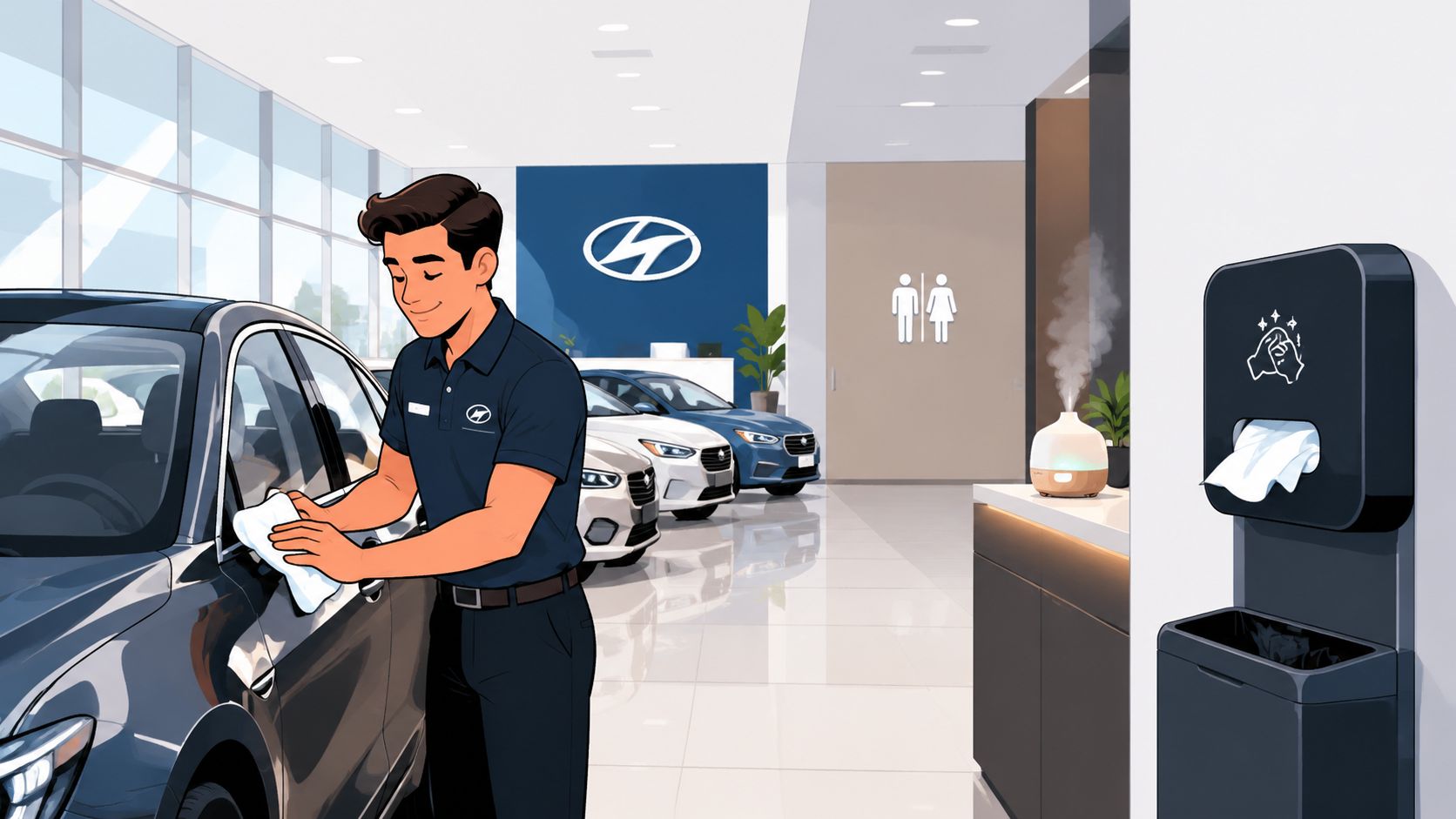
Saturday traffic exposes a dealership's real cleaning standard. A couple steps out of a test drive, a coffee ring sits on the F&I desk, fingerprints cover the iPad, and a child has just pressed every touchscreen in reach. The showroom may still look polished from the entrance, but customers notice the surfaces they touch, the air they breathe, and whether staff respond quickly.
A clean car dealership now needs more than bright floors and shiny vehicle hoods. Dealership reviews mentioning personal health and safety increased 100x after the pandemic began, and dealership hygiene became a key driver of negative sentiment, according to Widewail's automotive reputation report update. Cleanliness is tied to perceived safety, professionalism, willingness to wait for service, and confidence in returning.
That makes sanitation an operating issue, not a background janitorial task. The following system separates customer-facing areas from service and support zones, assigns ownership, and connects each cleaning action to reputation, customer satisfaction, and dealership throughput.
What a Clean Car Dealership Actually Looks Like in 2026
The common assumption is that a dealership is clean when the floor shines. That standard is too shallow. A polished floor beside a contaminated touchscreen, sticky door pull, or neglected restroom tells customers the store cares more about presentation than discipline.
In Q1 2026, U.S. dealerships generated about 1.15 million reviews across a panel of more than 18,000 franchise rooftops, while the average franchise store received 12.3 reviews per month, down from 13.04 in Q4 2025, according to the BBB automotive review report. Communication was the largest complaint category at 44.2% of negative reviews, but facility conditions, including cleanliness, comfort, and hospitality, still sit inside the customer experience those reviews describe.
The standard customers can feel
A modern showroom should show evidence of active care. Reception staff should wipe shared tablets between users. F&I desks should be free of rings, crumbs, fingerprints, and abandoned paperwork. Demo vehicles should have clean steering wheels, seatbelt buckles, door pulls, and touchscreens after every handoff.
Restrooms need neutral air, stocked supplies, dry counters, and fixtures without visible residue. A customer lounge should feel comfortable enough for a service conversation, not like a waiting room that staff have stopped seeing.
Practical rule: If customers can see the cleaning action, touch the surface, or smell the result, that task belongs in the customer-experience budget.
A specialist can help. A provider experienced in professional car lot cleaning understands that vehicle presentation, glass, walkways, customer areas, and service operations require different methods.
Why appearance belongs in the P&L
Cleanliness won't guarantee a sale, a positive review, or a stronger service-return rate. It does influence whether customers feel comfortable entering, waiting, asking questions, and handing over a vehicle. Those behaviors affect the conditions under which sales and service teams work.
Treat floors as a daily operating task, not a restoration project. Machine-assisted cleaning suits large-format tile, resin, and polished concrete, while tyre marks need targeted solvent or alkaline degreasers. Abrasive methods can damage coatings, and skipped product-specific maintenance can reduce gloss and increase labor time, as outlined in automotive dealership showroom cleaning guidance.
Mapping the High-Touch Danger Zones Buyers Notice
A cleaning plan fails when it lists rooms instead of contact points. Customers don't touch “the showroom.” They touch the entry handle, coffee station, display screen, chair arm, pen, tablet, steering wheel, seatbelt, key fob, restroom faucet, and service counter.
Assign each zone to a role and define what happens after visible soil is removed. The disinfectant must keep the hard, non-porous surface visibly wet for the full label contact time. One representative EPA label specifies a 1-minute wet time, requiring enough wipes to maintain visible wetness throughout that period, as shown in the EPA disinfectant wipe label.
| Zone | High-Touch Surface | Frequency | Dwell Time |
|---|---|---|---|
| Entry and reception | Door handles, counter edge, pens, touchscreen | At opening, during shift changes, and after visible contamination | Follow product label, including the representative 1-minute wet time where applicable |
| Coffee and lounge area | Beverage handles, tables, chair arms, tablets | At opening and repeatedly during busy periods | Keep visibly wet for the full label time |
| F&I office | Pens, iPad, keyboard, mouse, desk edge, chair arms | Between customer appointments and at closing | Follow the product label |
| Demo vehicle | Steering wheel, gear selector, door pulls, seatbelt, seat controls, keys | After every test drive or handoff | Follow the product label |
| Children's area | Tablets, game controls, table edges, chair arms | After each active use and during routine rounds | Follow the product label |
| Service write-up | Counter, signature pen, tablet, keys, card terminal | Between customers and at closing | Follow the product label |
| Restrooms | Handles, faucets, flush controls, counters, dispensers | At opening, during routine checks, and at closing | Follow the product label |
| Shuttle van | Door pulls, armrests, seatbelt buckles, payment or sign-in surfaces | After passenger cycles and at closing | Follow the product label |
Put ownership beside the task
The porter owns entryways, lounge surfaces, and restrooms. Sales consultants own the demo vehicle immediately after use. The F&I manager owns the desk and shared electronics. The service advisor owns the write-up counter and key handoff area.
The CDC environmental cleaning guidance lists desks, keyboards, phones, counters, handles, light switches, rails, toilets, faucets, and sinks among high-touch surfaces that should be cleaned at least daily. A dealership with repeated customer contact should build on that baseline with event-based cleaning after test drives, appointments, and shuttle runs.
Clean soil before disinfecting
Wipes aren't a substitute for removing grime. Clean visible soil first, then use an appropriate disinfectant and respect the dwell time. The CDC cleaning and disinfection guidance supports that sequence.
A sixty-second wipe of a test-drive steering wheel or F&I pen earns more goodwill than twenty minutes polishing a service-bay floor that customers never enter. Back-stage floors still matter for safety and throughput, but the contact points above deserve the fastest response.
Daily, Weekly, and Monthly Cleaning Schedules That Hold Up
A Tuesday schedule reveals whether a dealership has a system or merely good intentions. At opening, the porter resets the showroom, empties waste, cleans entry glass, checks restrooms, and runs the machine over the main floor. Sales staff inspect vehicles before the first appointments, not after a customer points out a dirty cup holder.
At midday, the detailer rotates through demo cars. Each vehicle gets a focused wipe of the steering wheel, gear selector, handles, seatbelt, touchscreen, and keys after use. The F&I manager clears the desk between appointments, while the service advisor resets the write-up counter after every customer exchange.
The closing team completes a final sweep of F&I, restrooms, reception, lounge surfaces, and demo vehicles. The GM or closing manager signs the checklist. A schedule that isn't posted in the break room and attached to a named person will eventually become a stack of unchecked boxes.

Build the cadence around the work
Use the cleaning schedule framework as a starting point, then adapt it to traffic patterns and handoffs.
- Daily: Clean floors, entry glass, desks, restrooms, lounge surfaces, touchscreens, keyboards, handles, and demo-vehicle contact points. Remove waste and replenish wipes, paper products, and soap.
- Weekly: Clean interior glass at least twice weekly, with extra attention in high-contact areas. Scrub showroom floors, vacuum display-vehicle upholstery, clean lounge furniture, and wipe HVAC vents.
- Monthly: Shampoo or extract carpets, deep-clean restroom fixtures, neutralize odors in service loaners, inspect floor coatings, and refresh lot markings when maintenance requires it.
The schedule should also include condition-based work. Strip and reseal showroom floors when coating integrity is compromised, not just because a calendar reminder appears. Replenish protective coats according to manufacturer specifications, or the surface will lose gloss and become harder to maintain.
A porter may own the morning reset, but accountability remains with the department manager. The F&I manager signs the office section. The service manager signs the write-up and shuttle sections. The GM reviews exceptions at the next operating meeting.
Front-Stage Versus Back-Stage Hygiene Priorities
Stop distributing labor evenly by square footage. The showroom may occupy less space than the service operation, yet customers form their strongest cleanliness judgment in the areas they see, touch, and smell.
Front-stage zones include the showroom, reception, F&I offices, customer lounge, restrooms, and demo vehicles. These areas influence public reviews, comfort, customer satisfaction, and the willingness to continue a sales or service conversation. Back-stage zones include technician bays, parts counters, storage, shuttle vehicles, and service-drive work areas. They protect safety, workflow, equipment condition, and technician morale.
| Zone | Stage | Labor Share | Cleaning Frequency | Primary KPI |
|---|---|---|---|---|
| Showroom entry and display floor | Front-stage | Prioritize by visibility and traffic | Daily, with spot cleaning throughout the day | Cleanliness audit and review mentions |
| F&I desks and shared electronics | Front-stage | High priority despite small footprint | Between appointments and at closing | Customer satisfaction feedback |
| Demo vehicles | Front-stage | High priority during sales activity | After every test drive or handoff | Vehicle-readiness pass rate |
| Lounge and restrooms | Front-stage | High priority during open hours | Opening, routine rounds, and closing | Deficiency count and comfort feedback |
| Service write-up counter | Back-stage with customer exposure | High priority at intake | Between customer interactions and at closing | Service-flow complaints |
| Shuttle vans | Back-stage with customer exposure | Match passenger use | After passenger cycles and at closing | Handoff readiness |
| Technician bays and shop floors | Back-stage | Match soil, safety, and workflow needs | Daily maintenance with deeper work as required | Safety and throughput observations |
| Parts and storage areas | Back-stage | Maintain operational order | Routine shift and scheduled deep cleaning | Search time and housekeeping exceptions |
The labor-share column should be set by the GM after observing traffic and risk. Don't use a fixed percentage because it sounds precise. The correct rule is simpler: if a customer touches it, sees it, or smells it, budget for front-stage attention first.
The operational tradeoff
A spotless lounge won't compensate for an oily service drive that slows vehicle intake. Likewise, a clean technician bay won't repair the impression created by a dirty demo vehicle. The answer isn't to neglect either side. It's to separate the objectives.
Front-stage cleaning protects reputation and customer confidence. Back-stage cleaning protects service throughput, safe work, vehicle handling, and staff retention. Review both in the same meeting, but don't judge them with the same KPI.
Turning Disinfecting Wipes Into a Visible Sanitation Program
A tub of wipes hidden in a supply closet is an inventory item, not a sanitation program. Customers need to see that staff clean the surfaces they're about to use.
Start with placement. Put countertop dispensers at reception and every F&I desk. Place a clearly marked station near each demo vehicle. Keep wall-mounted units at service write-up counters and showroom entrances, where staff can reach them without leaving the customer.
Make the standard visible
Use a short routine:
- Clean the soil. Remove crumbs, dust, grease, and visible residue before disinfection.
- Apply enough product. The surface must remain visibly wet for the label's full contact time.
- Wait, then finish. Don't wipe the disinfectant away early unless the product label directs that method.
- Record the zone. Staff initial a simple log by station, shift, or vehicle.
- Reset the station. Refill canisters before they become empty.
Choose EPA registered disinfecting wipes that match the surfaces in your store. Product selection should account for label claims, contact time, compatibility with leather and touchscreens, and canister durability in greasy service environments. Don't use a product on vehicle materials unless its label and manufacturer guidance support that use.
A five-minute huddle beats an annual training event. The porter demonstrates one correct wipe-down. A sales manager shows how to clean a demo vehicle between drives. The F&I manager practices the handoff. Staff then use one consistent sentence, such as, “I just sanitized this for you.” The wording matters less than the visible action and timing.
Pair wipes with the broader environment
Wipes handle contact surfaces. They don't replace floor care, restroom cleaning, ventilation maintenance, or odor control. For facilities reviewing air and environmental options, an eco cleaning solution for air can be considered separately from the surface-disinfection program.
For commercial supply planning, compare commercial disinfecting wipes by label requirements, packaging, dispenser compatibility, and the locations where employees will use them. A product that sits in storage won't improve the customer experience.
Scent, Restrooms, and the New Expectation of Feeling Safe
Customers often decide whether a dealership feels cared for before a salesperson finishes the greeting. They read the room through scent, restroom condition, clutter, air quality, and the cleanliness of shared surfaces. Floor shine helps, but it's rarely the strongest signal once a customer starts moving through the facility.
Use a neutral scent strategy. Light citrus or clean cotton through a timed diffuser can support a fresh environment, but heavy fragrance usually creates suspicion that the dealership is covering something up. The target is odor neutrality, not a perfume cloud.
Restrooms need a named inspection rhythm
Restroom checks should cover every stall, handle, flush control, faucet, counter, dispenser, and floor edge. Assign the inspection to a porter or facilities lead, log the result, and record the corrective action instead of relying on a vague “restroom checked” box.
A clean restroom also changes the customer lounge experience. People are more likely to stay comfortable during a service discussion when the entire facility feels controlled. That can support longer, calmer conversations, but don't confuse a pleasant environment with a guaranteed close.
Seasonal work should follow complaint patterns and building conditions. Extract carpet when tracked-in soil becomes a recurring issue. Clean vents when dust accumulation affects appearance or air quality. Address loaner-vehicle odors when they appear, rather than waiting for a monthly date that ignores what customers are reporting.
A restroom failure is rarely isolated. It tells the customer that nobody is checking the details.
The same principle applies to gyms, offices, schools, restaurants, and retail stores. Their high-touch surfaces differ, but the operating rule is shared: clean visible soil, disinfect contact points correctly, and verify the work where customers can experience the result.
Measuring Results and Building a 90-Day Cleanliness Plan
A GM can't manage “looks better” at a Monday meeting. The dealership needs a small set of repeatable measures that connect cleaning activity to customer experience and operating discipline.
Use four core KPIs:
- Cleanliness audit score: Review the same zones with the same pass or fail standards.
- High-touch ATP swab pass rate: Use ATP testing where available, with a documented sampling method and consistent interpretation.
- Restroom deficiency count: Record unclean fixtures, empty dispensers, odor complaints, and missed checks.
- Cleanliness mention rate: Track positive and negative cleanliness references in CSI comments and public reviews.
Don't invent a target that the baseline can't support. Audit first, then set improvement targets for the next review period. Every KPI needs an owner. The facilities lead owns audits, the porter lead owns completion, sales owns demo vehicles and F&I presentation, and the service manager owns customer-facing fixed-ops zones.
Use a short audit form
A useful audit doesn't inspect everything equally. It samples the surfaces that shape customer judgment:
| Audit Point | Pass Standard | Evidence |
|---|---|---|
| Showroom entry glass | No visible fingerprints, streaks, or soil | Pass or fail, with photo when failed |
| F&I pen and desk edge | Clean, dry, and ready for the next customer | Pass or fail, with responsible owner |
| Service desk counter | No visible residue, clutter, or neglected shared items | Pass or fail, with corrective action |
| Demo steering wheel | Clean and disinfected after the latest handoff | Pass or fail, tied to vehicle and shift |
| Restroom fixtures | Handles, faucets, flush controls, and counters clean and supplied | Pass or fail, with inspection time |
Photos matter because they stop arguments about whether a surface was acceptable. The audit should also record the product used, the person completing the task, and any surface that requires a different cleaning method.
Roll out the program in phases
| Phase | Days | Key Actions | KPI to Track |
|---|---|---|---|
| Baseline and mapping | 1 to 30 | Audit zones, map touchpoints, assign owners, identify supply gaps | Baseline audit score and deficiency count |
| Training and standardization | 31 to 60 | Run shift huddles, standardize products, install dispensers, post checklists | Completion rate and ATP pass rate |
| Public-facing rollout | 61 to 90 | Add visible stations, staff scripts, signage, scent controls, and reporting cadence | Cleanliness mentions and customer feedback |
Disinfecting wipes are a highly effective tool because they combine speed, contact-time control, and visible action. Stock them at showroom entries, F&I desks, service write-up counters, and every demo vehicle so staff can clean between customers without abandoning the floor.
Choose EPA-registered disinfectant wipes with a contact time that fits the operation, including products with a 1-minute or less dwell time where the label supports it. Verify surface compatibility, select fragrance options that fit the dealership's neutral scent policy, and use canisters that can withstand service-bay handling. The label controls the process, so staff must follow its required wet time and use directions.
Pair bulk supply for back-stage work with branded countertop canisters in customer-facing zones. That division makes replenishment easier and gives staff a practical way to clean in front of customers without carrying an awkward container from room to room.
Review the program monthly. Compare audit results with CSI comments and Google reviews, then identify whether failures came from staffing, placement, training, product choice, or an unrealistic frequency. The goal isn't to claim that every clean surface creates a sale. The goal is to show the GM where sanitation supports trust, reduces friction, protects vehicle handoffs, and keeps the dealership operating to its stated standard.
For product selection and validation practices, consult the third-party testing guidance before standardizing a wipe across the facility. For customer-facing and fitness operations, WipesBlog.com also discusses sanitation practices for shared touchpoints and equipment surfaces.
Start this week with one front-stage audit, one back-stage audit, and a complete touchpoint map. Put disinfecting wipes where staff and customers can use them, train every department on correct dwell time, and review the results in the next GM meeting. A clean car dealership isn't created by a bigger checklist. It's built by assigning the right action to the right person, at the right contact point, every day.
Leave a Reply