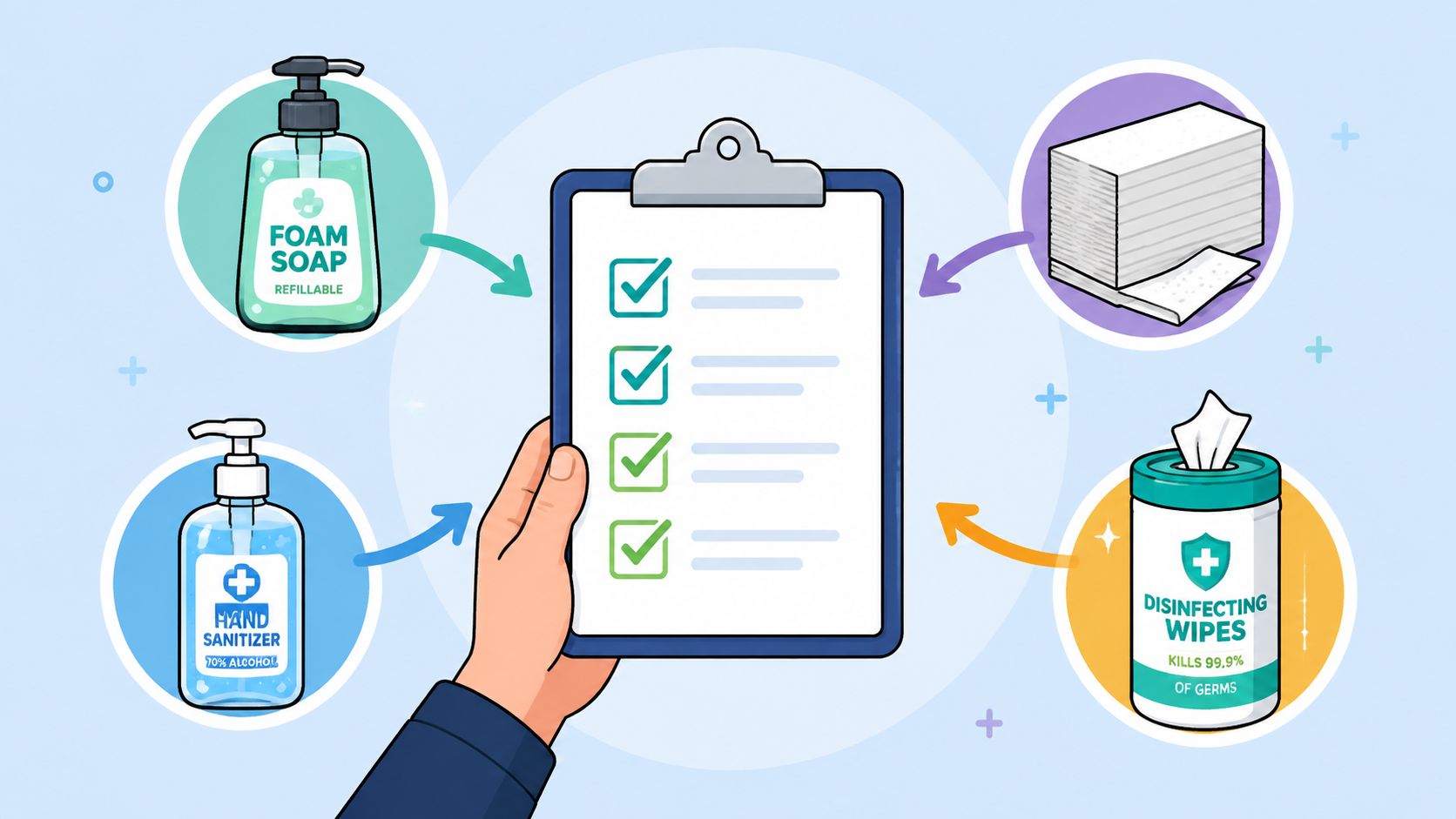
A busy gym manager starts the morning with a familiar problem. The restroom dispensers need attention, members are wiping down treadmills with whatever product is available, and a supplier's “bulk savings” offer is sitting in the inbox. The price looks attractive until someone asks the harder questions: Who cleans the dispenser? How often is the refill container changed? Does the wipe remain wet long enough to work? What happens when demand spikes before the next delivery arrives?
Bulk hygiene products can lower purchasing friction and keep commercial facilities supplied, but the format, chemistry, substrate, storage method, and refill procedure determine whether they improve operations or create new liabilities. A low unit price doesn't compensate for contaminated dispensers, ineffective wipes, excess labor, or a hygiene complaint that damages customer trust.
This guide approaches procurement from the floor upward. It covers refill systems, disinfectant wipes, gym equipment cleaning wipes, inventory controls, facility-specific requirements, and the sales conversation that helps customers understand value beyond price.
When Bulk Hygiene Products Become a Liability
A mid-sized fitness center manager recently reviewing a routine inspection report may recognize the uncomfortable scenario. The soap dispensers were full, the purchasing records showed regular deliveries, and staff had been topping off partially empty units with fresh product. Yet the inspection identified the dispensers themselves as a bacterial contamination concern.
“Topping off” looks efficient because it avoids emptying, washing, and resetting a dispenser. In practice, old product can remain inside the container while new product is added on top. Residue and moisture create conditions where biofilm can develop. The dispenser then becomes part of the contamination pathway rather than a reliable hygiene barrier.
Guidance discussed for healthcare and facility settings warns that manually replenishing certain bulk dispensers can create contamination concerns, and some guidance discourages topping off those systems. National Hotel Supplies' comparison of bulk dispensers and single-use plastic addresses this operational issue directly. The lesson isn't that every bulk format is unsafe. It's that bulk hygiene products depend on controlled handling, not merely the size of the container.
The hidden total cost
Open-system refills can offer an appealing cost per gallon. They also require a defined maintenance routine:
- Emptying: Staff must remove remaining product before adding new material.
- Cleaning: The container and dispensing components need appropriate cleaning and drying.
- Inspection: Teams should check for residue, damaged seals, clogged pumps, and leaks.
- Documentation: Managers need a record of changes, especially in regulated or customer-facing areas.
The labor may be invisible in the purchase order, but it still appears in payroll, missed cleaning rounds, and inconsistent execution. A dispenser that looks full can create false confidence if nobody verifies how it was filled.
Practical rule: Evaluate the dispenser, refill container, chemical, and maintenance procedure as one system. Never approve a product based only on its bulk price.
The same principle applies to wipes. A bucket or canister that loses moisture, uses an unsuitable substrate, or stays open between shifts can undermine the intended cleaning process. For gyms, offices, restaurants, and public venues, the procurement question is therefore broader than “How much does this case cost?” It is “What will this system cost to operate correctly, and what risk appears when staff follow the easiest shortcut?”
The Scale of Institutional Hygiene Procurement
Institutional demand has turned hygiene supplies into operating infrastructure. The global personal hygiene market was valued at USD 612.90 billion in 2025 and is projected to reach USD 784.00 billion by 2034, with a forecast CAGR of 2.69% from 2026 to 2034, according to IMARC Group's personal hygiene market analysis. That ecosystem includes soaps, tissues, wipes, and related sanitation products used across hotels, airports, gyms, rental properties, and event venues.
A separate market estimate places cleaning and hygiene products at USD 32,123.1 million in 2024, with a projection of USD 43,313.8 million by 2033 and a 3.4% CAGR from 2025 to 2033. Disposable hygiene products were estimated at USD 240.62 billion in 2025 and are projected to reach USD 354.82 billion by 2033, growing at a 5.0% CAGR from 2026 to 2033, as summarized by World Metrics' hygiene products industry data.
These figures describe a structural shift from fragmented household purchasing toward organized institutional supply chains. A multi-site operator now has to coordinate product specifications, dispenser compatibility, delivery schedules, storage, staff training, and site-level usage. Centralized buying can simplify that work, but a poor standardization decision can also spread the same weakness across every location.
What the market means for buyers
| Facility sector | Typical procurement concern | Primary product categories |
|---|---|---|
| Healthcare and care environments | Documented efficacy, contact time, substrate compatibility | Disinfectants, wipes, hand hygiene products |
| Hospitality and short-term rentals | Guest perception, fast replenishment, compact storage | Soap, tissues, surface wipes, dispensers |
| Education | High-touch cleaning, straightforward staff procedures | Sanitizing wipes, surface cleaners, paper products |
| Commercial offices | Predictable consumption and visible touchpoint hygiene | Hand sanitizer, restroom supplies, disinfectant wipes |
| Gyms and fitness centers | Sweat, frequent equipment contact, rapid turnover | Gym equipment wipes, dispenser systems, hand hygiene products |
The table intentionally avoids unsupported budget averages. Costs vary by building size, traffic, service model, and product specifications. Procurement teams should build their own baseline from invoices and consumption records rather than rely on a generic sector benchmark.
Packaging and shipping also matter. Large orders of wipes, soap, tissue, and dispensers require protection from leaks, crushing, and weather exposure. Teams reviewing distribution options may find MSP Packaging courier bags for bulk orders useful when assessing how outer packaging supports reliable delivery.
The best negotiation position comes from knowing usage by site, not just asking for a larger discount. A supplier should be able to explain lead times, substitutions, documentation, batch information, dispenser compatibility, and what happens during a stock interruption.
Choosing Between Refill Formats and Cartridge Systems
Three dispensing approaches dominate facility hygiene procurement: open-system pour-in refills, sealed cartridge systems, and concentrated dilution. Each can work, but they solve different operational problems.

Open-system pour-in refills
Open systems usually have the lowest purchase price per volume. A staff member pours product from a bulk container into the dispenser, which makes the format attractive in low-traffic zones and back-of-house areas.
The trade-off is procedural. Staff must prevent spills, avoid topping off, clean the container, protect the refill opening, and keep records where required. The system also creates more opportunities for contact with the product and dispenser interior. If a site doesn't have dependable janitorial coverage, the apparent savings can disappear into inconsistent maintenance.
Closed-loop cartridges
A sealed cartridge snaps into a compatible dispenser and limits exposure during installation. The format generally reduces handling steps and makes changeovers easier to audit. It fits high-turnover public restrooms, transport hubs, and guest-facing spaces where reliability matters more than the lowest possible refill price.
Cartridges usually cost more per use than open formats. That premium may be justified when the alternative is frequent cleaning, product loss, dispenser downtime, or contamination risk. The right comparison is not cartridge price versus bulk liquid price. Compare cost per successful dispensing cycle, including labor and failure response.
Concentrated dilution
Concentrates reduce storage demands and can offer strong cost control when a facility has trained janitorial staff, suitable measuring equipment, and a documented mixing process. They fit larger back-of-house operations where the team can control water quality, dilution accuracy, labeling, and batch handling.
They aren't a shortcut. An incorrectly diluted product may fail to perform, damage surfaces, or create a safety issue. The concentrate should arrive with clear instructions and current safety documentation, and staff should have a simple method for verifying the mixed solution.
Selection heuristic: Use sealed cartridges where public reliability and contamination control dominate, concentrates where trained staff can manage dilution, and open refills only where traffic is modest and maintenance is consistently supervised.
Don't standardize one format across every zone. A high-use restroom, staff kitchenette, gym floor, and storage room have different exposure patterns and different tolerance for service interruptions. A tiered approach usually performs better than a single-format mandate.
Facility-Specific Selection Criteria
A product that works well in a corporate office may be a poor fit for a gym or airport. Procurement should begin with traffic, contact behavior, soil load, service access, and compliance requirements, then match those conditions to the chemical, wipe substrate, dispenser, and refill format.
| Facility type | Primary products | Dispenser format | Key procurement priority |
|---|---|---|---|
| Transportation hub | Hand hygiene products, surface disinfectants, disposable wipes | High-capacity or touchless systems | Fast service, uptime, and easy auditing |
| Fitness center | Gym equipment wipes, hand sanitizer, restroom products | Accessible wipe stations and sealed dispensers | Sweat removal, rapid replenishment, and cross-contamination control |
| Event space | Portable wipes, sanitizer, restroom consumables | Mobile stations and adaptable cartridges | Surge readiness and quick deployment |
| Educational campus | Disinfectant wipes, soap, tissues, surface cleaners | Simple systems for distributed rooms | Clear procedures and consistent supply |
| Corporate office | Hand hygiene, surface wipes, restroom and kitchen products | Fixed dispensers and convenient stations | Visible availability and predictable consumption |
Fitness centers
Members touch treadmills, dumbbells, resistance machines, benches, lockers, door handles, and water-fountain controls throughout the day. Stock wipes for gym equipment near the areas where members finish a set, not only at the reception desk. If the wipe is too dry, too small, difficult to pull, or incompatible with the equipment surface, users will skip it.
A gym wipe dispenser should protect the remaining wipes from drying out and allow staff to check stock quickly. Choose a substrate that removes sweat and organic soil without leaving damaging residue. Keep a separate product for floors or restroom surfaces when the equipment wipe isn't labeled for those applications.
Airports and event venues
Transportation hubs and event spaces face variable demand and difficult service windows. Touchless hand hygiene dispensers reduce shared contact, while portable stations let teams reposition supplies as queues and gathering points change. Event operators should plan for rapid deployment, collection, cleaning, and restocking after each program rather than treating stations as permanent fixtures.
Schools and offices
Educational campuses need straightforward products that different teams can use consistently across classrooms, reception areas, staff rooms, and shared technology. Offices benefit from visible placement near entrances, kitchens, meeting rooms, and shared devices. In both settings, instructions should explain what the product is for without encouraging unsafe mixing or overuse.
For healthcare-adjacent environments, select EPA registered disinfecting wipes for the specific intended use and verify the label's contact time. The CDC advises using an EPA-registered product for the known germ when applicable, cleaning with soap and water first, and keeping the surface wet for the full label contact time. CDC facility cleaning and disinfection guidance also advises handwashing with soap and water for 20 seconds after disinfecting.
Wipe Substrate Science and Procurement Specs
A disinfectant wipe is a delivery tool, not just a wet sheet. The active ingredient, substrate, surface, soil load, and test method all influence the result. A buyer who compares only the liquid formula may miss the material variable that determines how evenly the solution is released and how organisms move across surfaces.
A controlled study found that hydrogen-peroxide formulations were the most efficacious overall. It also found that material choice had limited impact for potent disinfectants but could reduce performance for some quaternary-ammonium products at low use concentrations. The study's test methods produced different results, with EN16615-15 showing better efficacy results than ASTM E2967-15, so specifications should identify the exact validation standard rather than accept a generic kill claim. The PubMed study on disinfectant formulation, substrate, and test method supports that procurement approach.

What to request on the specification sheet
Ask suppliers to provide:
- Substrate composition: Identify polypropylene, cotton, cellulose, polyester, or blends.
- Chemical compatibility: Confirm that the wipe won't bind, deactivate, or release the active ingredient unevenly.
- Lint behavior: Use low-lint materials in food preparation, clean areas, and sensitive equipment zones.
- Wetness retention: Check how the pack protects saturation during storage and daily use.
- Test method: Require evidence tied to the intended standard and application.
A 2025 study reported that hydrogen-peroxide wipes had the highest bactericidal efficacy and transferred the least bacteria across test surfaces. It also found that polypropylene wipes removed more bacteria from the inoculation site and transferred fewer organisms to secondary areas than cotton, while ethoxylated alcohol and quat-based wipes retained viable bacteria on the wipe and increased transfer. The PubMed research on wipe substrate and bacterial transfer gives facility managers a practical reason to treat material as a performance specification, not merely a cost choice.
For teams comparing formats, this guide to bulk disinfecting wipes can help frame questions about packaging, usage, and dispenser fit. In a gym, textured or absorbent material may remove sweat more effectively, but the product still needs to be labeled for the surface and handled so used wipes don't become a transfer source.
CDC healthcare guidance says ready-to-use wipes should be stored with the lid closed so they stay wet, discarded when they're no longer saturated, and used according to the manufacturer's contact-time instructions. CDC supplies and equipment guidance provides the operational baseline.
Inventory Planning and Storage Protocols
Inventory control should protect two things at once: availability and product integrity. A stockout forces hurried substitution, while excessive stock can occupy valuable space, pass its useful date, or dry out before staff can use it. The solution is a consumption-based system tied to actual site activity.

Build the reorder logic
Start with a product-level usage record for each location. Count cases, cartridges, bottles, or canisters issued during a normal operating period, then compare that pattern with weekends, school terms, events, membership cycles, and supplier lead times.
Set the reorder point high enough to cover expected usage while a new shipment is in transit. Add a site-specific emergency buffer based on supply reliability and demand volatility, rather than copying a universal percentage from another operation. Orange Box Self Storage's stock strategy for growing businesses offers broader inventory planning context for organizations building repeatable controls.
A practical audit includes:
- Usage capture: Record what each zone consumes.
- Lead-time review: Track promised and actual delivery timing.
- FIFO rotation: Put older stock where staff will use it first.
- Date-code checks: Review concentrates, sanitizer, and wipe batches.
- Condition checks: Inspect seals, lids, leaks, dryness, and separation.
- Reorder alerts: Trigger notifications before the minimum level is reached.
Store for product integrity
Keep wipes sealed until needed, close canister lids after every use, and keep bulk chemicals in a cool, dry location away from direct sunlight. Store alcohol-based products according to their safety documentation and separate incompatible chemicals. Use secondary containment where leaks could damage stock or create a slip hazard.
A storage audit should also confirm that cartons aren't crushed, labels remain legible, and staff can access older inventory without moving newer cases out of the way. For facilities using sanitizing hand wipes in high volume, this bulk hand-wipe resource can support product and packaging comparisons.
Inventory software isn't essential for every small site, but a shared spreadsheet with location, batch, quantity, date, and reorder status is far better than memory. The manager should review the record often enough to catch unusual consumption, failed deliveries, and damaged stock before they become service problems.
Building Visible Sanitation Programs That Drive Revenue
Customers form opinions about cleanliness from what they can see. A full wipe station beside exercise equipment, a maintained restroom dispenser, and a quick response to spills signal control. Those details affect whether visitors stay, return, recommend the facility, or complain.
The program should look deliberate, not alarmist. Signs such as “Wipe equipment after use” should show the action and the disposal point without implying that every surface is dangerous. In gyms, airports, and event spaces, branded stations can make hygiene part of the customer experience while also reducing hesitation about shared equipment.
A practical implementation checklist
- Place stations at decision points: Put equipment wipes beside high-use machines, at workout-zone entrances, and near shared accessories.
- Make the action obvious: Use short instructions, visible disposal points, and labels that separate cleaning wipes from hand wipes.
- Audit the station: During scheduled rounds, inspect wipe saturation, available stock, dispenser condition, and nearby cleanliness.
- Create a feedback loop: Record complaints, requests, empty-station reports, and recurring trouble spots so managers can correct patterns.
- Match the format to the work: Public areas usually need dependable products that visitors can understand. Concentrates and larger refill systems suit controlled back-of-house tasks where trained staff can mix and handle them correctly.
Sales professionals can apply the same operational test with customers. Ask where products are used, who refills them, which surfaces they contact, how staff verify wet contact time, and what happens during a shortage. Position commercial disinfecting wipes as one part of a broader package that may include dispensers, restroom products, hand hygiene, liners, storage controls, and staff procedures.
The CDC identifies high-touch surfaces such as doorknobs, light switches, countertops, handles, desks, phones, keyboards, toilets, faucets, and sinks. CDC high-touch surface guidance notes that, where no specific guidance exists, alcohol-based wipes or sprays should contain at least 70% alcohol. EPA guidance recommends cleaning and disinfecting commonly touched surfaces at least daily, with greater frequency during heavy use. EPA cleaning guidance supports adjusting frequency to traffic instead of forcing every area onto one schedule.
Measure the program: Track consumption, empty-station incidents, cleaning exceptions, complaints, inspection findings, and customer satisfaction. These records show whether hygiene spending reduces service interruptions and supports the customer experience.
Run one practical test this week. Photograph a single restroom or equipment station at the start of a shift, record who services it, and check whether the wipe remains saturated through the final scheduled round. Compare that observation with refill interruptions, disposal overflow, or staff time spent correcting the station. The result exposes the operating cost of a refill format more clearly than case price alone.
Leave a Reply