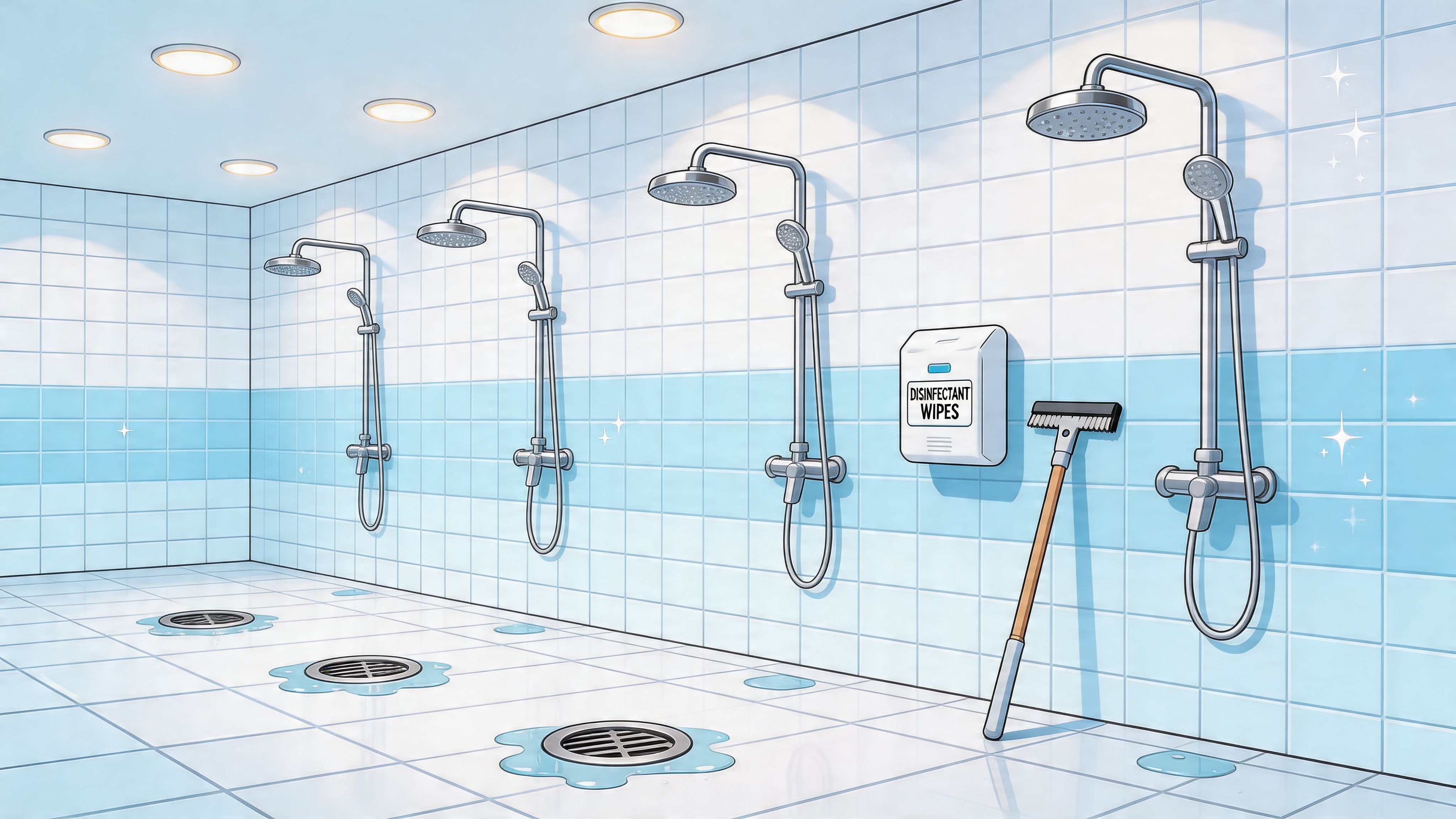
You already know the moment. A member finishes a workout, opens the door to the men's communal shower, and stops half a step inside. He hasn't tested a surface. He hasn't inspected the drains. He hasn't reviewed your cleaning log.
He just decides, almost instantly, whether this facility feels safe, neglected, disciplined, or risky.
That judgment matters more in wet areas than almost anywhere else in a building. Water amplifies every failure. A faint odor feels bigger. A little soap residue looks like a lot. One dirty bench makes people assume the whole back-of-house routine is loose. In gyms, sports venues, schools, work camps, and public facilities, the men's communal shower is one of the fastest ways to lose trust and one of the clearest places to prove operational competence.
The High Stakes of Shower Hygiene
A poorly maintained shower area rarely stays "just a cleaning issue." It becomes a reputation issue, a complaint issue, and eventually a liability issue.
In practice, the warning signs are familiar. Damp floors that never seem to dry. Hair collecting at drain edges. Empty soap dispensers. Rust staining around fixtures. A bench that looks wiped down but doesn't feel clean. Staff may see isolated defects. Users see a pattern.

Wet areas shape trust fast
The men's communal shower carries a special psychological burden. People enter barefoot, often with exposed skin, and usually right after physical exertion. That makes them more alert to signs of contamination, odors, residue, and poor upkeep.
A scuffed hallway can be overlooked. A questionable shower floor usually can't.
Practical rule: If a guest hesitates before stepping into the shower, operations already have a trust problem.
This is why shower hygiene affects more than housekeeping scores. It touches retention, staff credibility, and complaint volume. In a fitness club, members may never tell you the shower area drove their cancellation decision. They do not renew. In a sports setting, athletes and parents read the condition of the wet zone as a proxy for the whole program. In a worksite or public venue, morale drops when users believe sanitation is an afterthought.
Liability starts with what staff normalize
Facility teams often get into trouble when they normalize minor defects. "That drain always backs up a little." "That corner always smells musty by afternoon." "The caulk is stained, but it's old, not dirty."
Users don't make those distinctions.
What they see is standing water, visible grime, and surfaces that seem unmanaged. That perception raises the chance of complaints and puts pressure on supervisors to prove that standards exist and are being followed. If you're reviewing wet-area risks, hygiene concerns tied to skin contact and shared environments deserve the same seriousness as slip prevention and ventilation performance. For a related look at disinfection concerns in high-risk environments, this guide on https://wipesblog.com/2025/12/16/disinfectants-for-mrsa/ is worth reading.
Clean showers protect the brand
Operators sometimes focus on the lobby because it's visible. The shower matters because it's memorable.
Here’s how the business impact usually breaks down:
- Member retention: People forgive older finishes faster than they forgive dirty wet areas.
- Staff efficiency: A disciplined shower routine prevents constant reactive cleanup.
- Complaint control: Most hygiene complaints begin with visible signals, not lab testing.
- Brand reputation: Users talk about locker rooms and showers because those spaces feel personal.
A men's communal shower doesn't have to look luxurious. It does have to look controlled. Clean lines, dry transitions, stocked supplies, and obvious maintenance discipline do more for confidence than expensive finishes ever will.
Building Hygiene from the Ground Up
Some shower rooms are hard to keep clean before the first user even arrives. The layout fights the staff. Water migrates into dry zones. Air hangs heavy. Fixtures trap residue. Cleaning crews work harder and still lose the visual battle.
Good hygiene starts in the plan, not in the mop bucket.

Layout decisions that reduce mess
A workable men's communal shower gives people room to move, dry off, and exit without dragging water everywhere. According to commercial shower design guidance, shower outlets should be spaced at 750mm intervals, opposing walls should be 2.5m apart, and water temperature should be capped at 120°F. The same guidance calls for nonskid floors and fully sealed walls to block wastewater crossover, and warns that inadequate ventilation can lead to 20 to 30% higher mold growth rates in high-traffic facilities (Commercial Washrooms Ltd design considerations).
Those details matter because they reduce the two failures that consume the most labor: standing moisture and congested circulation.
When spacing is tight, users cluster at entrances and track water into changing areas. When walls and floor transitions aren't sealed properly, dirty water moves where it shouldn't. When drains are poorly positioned or floor slope is weak, cleaning crews chase residue instead of removing it.
A practical review of layout should answer these questions:
- Entry separation: Can users move from changing space to shower space without flooding the dry zone?
- Dry-off control: Is there a defined transition area, or does the whole room become wet?
- Cleaner access: Can staff reach corners, drains, wall bases, and fixture backs without awkward tools or extra setup?
- Sightlines: Can supervisors inspect the room quickly and spot failures without walking every inch?
Materials either help or sabotage the staff
The easiest way to waste labor is to install finishes that look acceptable on day one but hold residue, mineral deposits, and discoloration over time.
Use surfaces that are smooth, durable, and straightforward to scrub. Nonskid doesn't have to mean impossible to clean. The right floor texture provides grip without creating deep crevices that trap body soils and soap film. Wall systems should run fully to the floor and seal tightly so wastewater doesn't migrate behind seams.
Fixtures need similar discipline. Choose shower heads and controls that resist tampering, hold up under frequent use, and don't create hard-to-reach grime shelves. Avoid details that force staff to clean around decorative edges, exposed fasteners, or awkward pipe penetrations.
Old shower rooms can still perform well if operators remove hidden dirt traps. That usually means simplifying hardware, sealing transitions, and replacing anything that can't be cleaned reliably.
If you're reviewing broader facility management best practices, apply that same lens here. A wet area should be designed for inspection, repeatability, and easy correction, not just occupancy.
Ventilation and drainage do the heavy lifting
Most persistent shower complaints trace back to moisture management. Not all of them announce themselves as "ventilation issues." They show up as odor, mildew staining, slow drying, foggy mirrors nearby, or surfaces that feel tacky long after peak use.
Drainage and airflow are operational systems, not construction afterthoughts.
Use this quick decision table during a renovation walk-through:
| Area | What works | What doesn't |
|---|---|---|
| Flooring | Nonskid surfaces that still allow full contact during scrubbing | Deeply textured surfaces that trap soils |
| Wall base | Fully sealed transitions at floor and wall junctions | Gaps, failed sealant, exposed edges |
| Air movement | Continuous moisture removal and faster dry-down after peak use | Stale, humid air that lingers into the next shift |
| Fixture placement | Enough spacing for both users and cleaning tools | Tight rows that block circulation |
| Water control | Stable temperature and predictable flow | Fluctuation that encourages user complaints and workaround behavior |
Retrofit priorities for older facilities
You don't need a full rebuild to improve hygiene performance. Start with the items that reduce cleaning difficulty immediately.
- Seal failure points first. Wall-floor joints, curb transitions, and drain edges deserve attention before cosmetic upgrades.
- Improve airflow. If the room stays damp, no surface product will compensate.
- Replace problem fixtures. Broken controls, scaled heads, and vandal-prone hardware increase labor every day.
- Clarify wet and dry zones. Even simple barriers and floor planning changes can reduce water migration.
- Standardize finishes. Mixed materials often require mixed cleaning methods, which leads to inconsistency.
A men's communal shower should never force staff to improvise every shift. The room itself should support the standard.
The Ultimate Communal Shower Cleaning Protocol
The communal shower was built around scale. Its roots go back to the 1870s French Army barracks, where group showering was used to clean large numbers of men efficiently under supervision. That model spread to U.S. military bases and public schools by 1900, and it established a long operational reality: when many users move through one wet space, sanitation has to be systematic, not casual (history of communal showers).
That old lesson still holds. The best shower rooms don't stay clean because someone "checks on them." They stay clean because the staff follows a sequence, at set intervals, with clear expectations.
The daily routine that prevents visible failure
Daily cleaning in a men's communal shower isn't one task. It's a cycle.
Morning opening should focus on reset conditions. Midday attention should control buildup during active use. Closing should remove residue before it hardens, dries, or starts to smell.
A dependable daily routine includes:
- Floor recovery: Remove visible debris, clear hair from drains, and pull standing water toward drainage points.
- High-touch disinfection: Wipe handles, push points, dispenser buttons, benches, hooks, and any ledges users touch while dressing or steadying themselves.
- Restocking: Soap, paper products outside the shower zone, and wipe stations need to be full before users notice gaps.
- Visual reset: Eliminate empty bottles, discarded packaging, and wet clutter that makes the room look unmanaged.
- Spot correction: Address obvious residue on walls and fixture faces before it becomes a full scrub job.
Disinfectant wipes earn their place here because they cut response time on high-touch surfaces. Staff don't need to stop, mix, spray, and return later for every bench edge or dispenser button. In fast-turn environments, that matters.
Use the right order or you'll re-contaminate the room
Many teams work hard and still create extra labor because they clean in the wrong sequence. They scrub low surfaces first, then splash them while working walls. They disinfect benches before touching nearby dispensers and doors. They finish the floor, then walk back across it to grab forgotten supplies.
Use a top-down, clean-to-dirty workflow.
Recommended order of operations
- Ventilate and stage tools
- Pick up loose debris and remove waste
- Clean higher surfaces and fixtures
- Disinfect high-touch points
- Scrub walls, partitions, and corners
- Treat drains and floor edges
- Finish the floor last
- Restock and do a final walkthrough from the user's perspective
If the last thing your cleaner sees is what the user sees first, inspection quality goes up.
The user's perspective matters. Stand at the entrance. Look at the drains, bench tops, wall lines, and fixture faces. That's where trust is won or lost.
Weekly tasks that stop long-term deterioration
Daily routines control appearance. Weekly work protects the room from decline.
Here, staff should address the buildup that won't always trigger a same-day complaint but will absolutely damage the environment over time.
Weekly priorities often include:
- Descaling shower heads and controls
- Scrubbing wall surfaces and lower splash zones
- Deep cleaning around drains and drain covers
- Cleaning corners, grout lines, and wall bases
- Checking sealant, hooks, hinges, and accessory mounts
- Inspecting ventilation grilles and nearby moisture staining
Grout deserves special attention because dirty grout makes an otherwise clean shower look neglected. Teams that need a useful refresher on methods and tool selection can review this guide on clean floor tile grout. It helps frame the difference between surface tidying and actual restoration work.
Monthly deep-clean controls
A monthly deep clean is where operations prove they are managing the room, not just reacting to traffic.
Don't treat this as a vague "extra good clean." Assign named tasks, document completion, and tie findings to maintenance tickets.
Monthly deep-clean checklist
| Task | Why it matters |
|---|---|
| Check grout and sealant condition | Prevents water intrusion and hidden growth |
| Inspect drains for slow flow or odor | Reduces backup risk and persistent wetness |
| Review ventilation performance | Confirms the room is drying as intended |
| Assess floor texture wear | Slip resistance and cleanability can change over time |
| Examine fixture stability | Loose or damaged hardware becomes both a hygiene and safety issue |
| Audit supply station placement | Poor placement creates unnecessary touchpoints and clutter |
Equip staff for speed and consistency
A solid protocol fails if the tools are wrong or hard to access.
For a men's communal shower, crews typically need chemical-resistant gloves, grout brushes, drain tools, squeegees, microfiber cloths, caution signage, and a steady supply of disinfectant wipes for rapid high-touch sanitation. Keep those tools stored close to the wet area. If workers have to travel across the building for basic supplies, response time slips and standards get patchy.
Short staffing makes this even more important. The simpler the workflow, the better the room will hold up between rounds.
What doesn't work
Some habits look efficient but create recurring problems:
- Overreliance on fragrance: Scent doesn't replace residue removal.
- Skipping midday checks: Peak-use periods can undo an opening clean fast.
- Ignoring drains until they smell: By then, the room already feels neglected.
- Using too many products: Complexity creates inconsistency.
- Treating benches as low risk: Users notice bench cleanliness immediately.
The right protocol for a men's communal shower is boring in the best way. Repetitive. Documented. Easy to inspect. Hard to skip.
Visible Sanitation and Risk Mitigation
A shower can pass internal cleaning standards and still make users uneasy. That's the gap many operators miss.
People don't just judge whether the room is probably clean. They judge whether the facility appears to care about keeping it clean right now. Visible sanitation closes that gap.

Cleanliness has to be seen
In wet environments, users look for signals. A posted cleaning log. Full dispensers. Dry transitions. Staff who respond quickly to a complaint. A wipe station placed where it makes sense.
Those cues change behavior. They also reduce the suspicion that nobody is watching the room.
Visible sanitation isn't theater in a negative sense. It's proof of discipline. If users can see that the facility anticipates hygiene concerns, they'll trust the unseen parts of your process more.
The strongest guest-facing measures usually include:
- Posted cleaning checks: Show that inspections are happening throughout the day.
- Well-stocked soap and drying supplies: Empty dispensers destroy confidence quickly.
- Disinfectant wipe access: Give users a way to wipe benches, lockers, or personal-contact surfaces if they want extra reassurance.
- Prompt spill and residue response: Fast action matters more than polished messaging.
- Clear reporting channels: Users should know exactly how to flag a hygiene issue.
Wipe stations are operational tools, not decor
In the right spot, wipes reduce complaints and support your cleaning team. They're especially useful at entrances, near benches, and at transition points where users handle bags, sandals, bottles, and grooming items.
USDA contract guidance notes that integrating wipes stations at entrances for 99% pathogen reduction on high-touch surfaces directly enhances brand reputation and reduces liability. The same source states that USDA contract audits show 98% compliance success when using prefabricated shower units with specified fixtures, cutting installation time by 60% and ensuring consistent standards (USDA shower contract guidance).
That matters for two reasons. First, it connects sanitation tools to risk reduction, not just convenience. Second, it reinforces a broader operational point. Standardized environments are easier to keep compliant.
A wipe station should solve a user problem within seconds. If it's hidden, empty, or too far from the concern point, it won't earn trust.
For superior performance and guest confidence, we recommend Wipes.com Disinfectant Wipes for high-moisture environments where durability and fast access matter.
Staff response matters as much as products
Even the best supply setup won't offset a poor staff response. When users mention odor, residue, or slippery conditions, teams need a script and a process.
Train staff to do three things well:
- Acknowledge the concern immediately. Don't debate whether the issue is real.
- Correct or escalate fast. If they can't fix it, they need a clear chain of action.
- Document the response. Inspection notes matter when complaints become patterns.
This is also where inspection tools help. If supervisors want another practical method for checking hidden residue and missed soil during audits, this article on https://wipesblog.com/2026/03/26/what-is-a-black-light-used-for/ can help sharpen inspection routines.
Risk mitigation is visible discipline
Users rarely say, "I appreciate your risk mitigation framework." They say, "This place feels clean," or, "That locker room was gross."
Those reactions come from visible discipline. Not slogans. Not branding. Not a deep clean that happened two days ago.
A men's communal shower feels safer when people can see order:
- benches look intentionally maintained
- drains look checked
- wipe stations are full
- staff don't seem surprised by hygiene concerns
- the room doesn't smell damp or abandoned
That's how operators reduce friction before it turns into a complaint, a bad review, or a reportable incident.
Selling Sanitation How to Frame Cleanliness as ROI
Many operators still talk about shower sanitation as overhead. That's a mistake.
A clean men's communal shower doesn't just avoid problems. It supports sales, retention, and pricing power. It gives front-desk staff and sales teams something concrete to point to when prospects compare facilities that otherwise look similar.
Stop selling "clean enough"
Prospects don't buy cleaning chemicals. They buy confidence.
If you're a gym owner, that confidence supports membership conversion and renewal. If you're a facility manager bidding on a contract, it supports your credibility. If you sell cleaning supplies or janitorial services, it gives your client a business case they can defend internally.
A stronger message sounds like this:
"We maintain our wet areas with documented routines, visible sanitation tools, and rapid-touchpoint disinfection so users know the space is being managed throughout the day."
That statement works because it's specific. It connects cleanliness to process.
Talking points that actually land
Use language that ties shower standards to outcomes your audience already cares about.
For gym membership tours
- Show the shower area on purpose: Don't skip it. A confident tour includes wet areas.
- Point out the routine: Mention documented checks, stocked hygiene supplies, and quick-response procedures.
- Use the room as proof: A well-run shower shows the whole facility is disciplined.
For janitorial and supply sales
- Sell labor efficiency: Disinfectant wipes help staff handle high-touch surfaces quickly between larger cleaning rounds.
- Sell consistency: Standardized products and a simple protocol are easier for crews to follow.
- Sell user confidence: Visible access to sanitation tools changes how people judge the facility.
For schools, sports venues, and public operators
- Frame it as duty of care: Shared wet spaces demand a higher standard of visible control.
- Stress complaint prevention: Many disputes start with what users see and smell, not with formal inspection failures.
- Link to reputation: Parents, athletes, and visitors talk about locker rooms because those spaces feel personal.
Build the proposal around risk, labor, and trust
A weak hygiene proposal says, "We'll clean your showers thoroughly."
A better one says:
| Proposal angle | Weak framing | Strong framing |
|---|---|---|
| Risk | We sanitize surfaces | We reduce exposure concerns in a shared wet environment |
| Labor | Our team cleans daily | Our team follows a repeatable wet-area protocol with fast touchpoint response |
| Guest trust | Your facility will look better | Users will see stocked, maintained, actively managed sanitation points |
| Brand | Cleanliness is important | Wet-area standards influence reviews, retention, and public perception |
Disinfectant wipes fit particularly well in the sales conversation. They aren't a replacement for cleaning crews. They're part of a more complete system. They support high-frequency touchpoint care, help users seeking extra reassurance, and make visible sanitation easier to maintain.
The ROI message is simple
If you're speaking to an owner or buyer, keep the message practical.
A better men's communal shower standard can help them:
- reduce preventable complaints
- support member or guest confidence
- protect staff credibility
- strengthen reviews and word of mouth
- present the facility as professionally managed
That is return on investment, even when the line item sits under janitorial or supplies.
Transform Your Showers from a Liability to an Asset
The men's communal shower has always tested a facility's ability to manage hygiene at scale. What changes from one operator to the next isn't the challenge. It's the response.
Weak operators treat the shower as a back-room nuisance. Good operators treat it as a system. They design for drainage and airflow. They remove dirt traps. They train crews on repeatable cleaning order. They support the room with visible sanitation tools. They inspect what users notice.
The standard has to hold under daily use
A spotless shower right after a deep clean doesn't prove much. A better measure is whether the room still feels controlled after steady traffic, wet floors, and repeated touchpoints.
That's why the strongest approach combines four things:
- Thoughtful design: A room that's easier to clean will stay cleaner.
- Reliable protocols: Daily, weekly, and monthly tasks each solve different problems.
- Visible sanitation: Users trust what they can see.
- Business discipline: Cleanliness protects reputation, retention, and operational credibility.
The shower isn't a side issue. In many facilities, it's the clearest proof of whether standards are real.
Don't wait for complaints to set the standard
If you're only responding after odor, buildup, or user feedback appears, you're already behind. Wet areas punish reactive management. Problems spread fast, and perceptions spread faster.
Start with a walkthrough this week. Look at drainage, ventilation, wall bases, bench tops, supply placement, and every high-touch point. Review whether your current routine is visible to users. Then tighten the protocol, simplify the tool set, and put disinfectant wipes where they support both staff and guests.
A well-managed men's communal shower can become a quiet competitive advantage. It tells people your facility is disciplined, safe-minded, and worth trusting.
Prioritize cleanliness before users question it. Build disinfectant wipes into your daily routine or product offering, strengthen your shower protocol, and use visible sanitation to support trust in every wet area. For more practical hygiene guidance, visit WipesBlog.com.
Leave a Reply