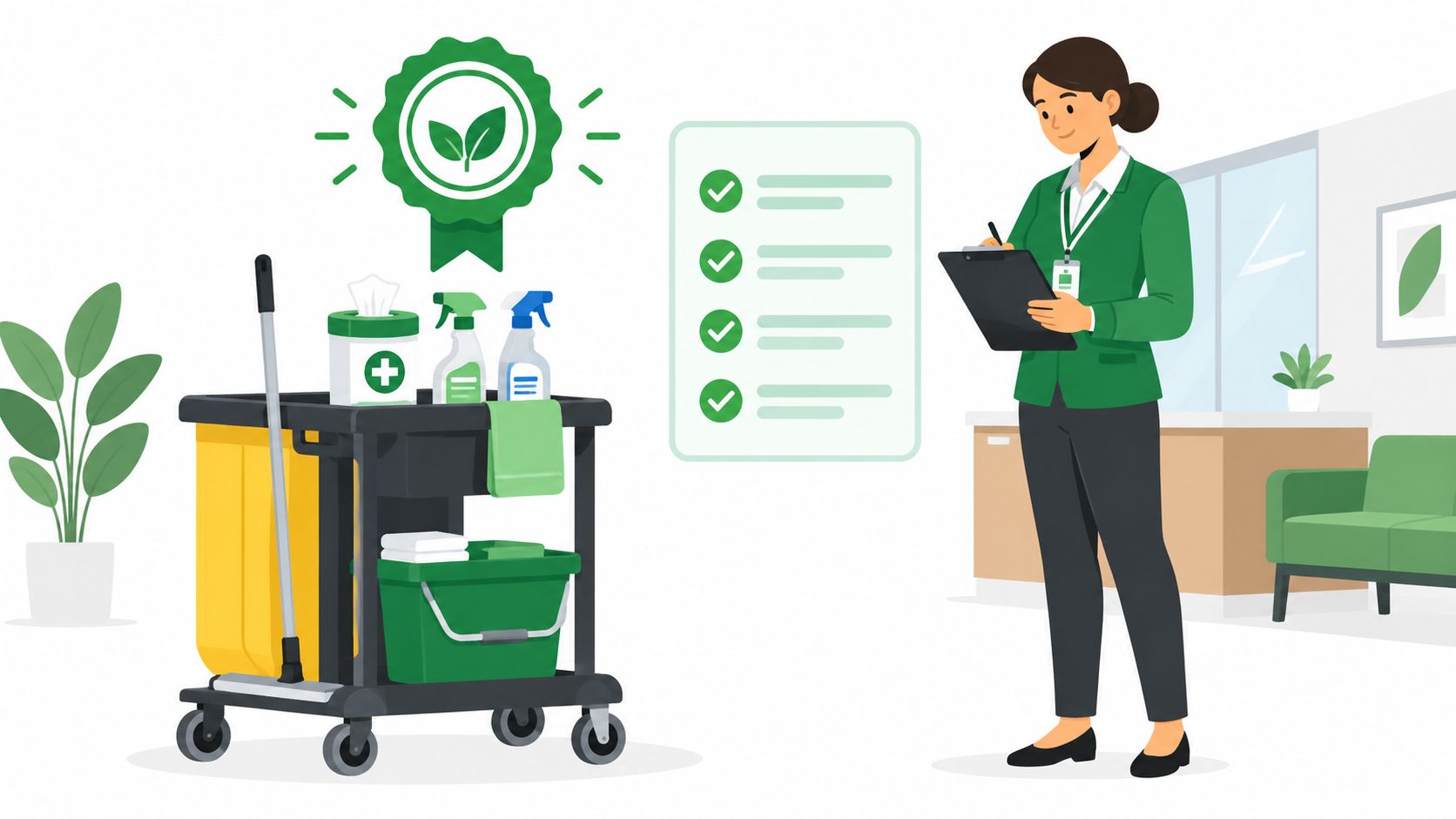
The lobby looks clean at opening, but by midmorning the entry handles are marked, the reception counter has been touched by dozens of people, and gym equipment is moving continuously between users. At the same time, the facilities team is expected to reduce waste, control chemical use, document environmental performance, and support a credible sustainability claim.
Those responsibilities don't conflict. A well-designed sanitation program makes environmental management more practical because it replaces broad, wasteful routines with targeted cleaning, documented procedures, and measurable controls. Green certification standards provide the management framework. Daily cleaning crews provide the operational proof.
The Intersection of Eco Compliance and Daily Sanitation
A facility manager may start the day reviewing an environmental action plan and end it responding to complaints about sticky cardio-machine handles. The challenge isn't choosing between sustainability and cleanliness. It's building a cleaning system that protects people without using more product, water, labor, or packaging than the facility needs.
That distinction matters in offices, airports, schools, restaurants, retail stores, and fitness centers. A spotless floor doesn't prove that an organization manages its environmental impacts well, but neglected touchpoints can undermine occupant confidence and expose a weakness in operational control. Cleanliness is the visible result of a much larger management process, including purchasing, staff training, chemical handling, waste control, and performance records.
ISO 14001 is useful at this level because it focuses on an environmental management system rather than a single product or cleaning task. The standard was first published in 1996 and has become the world's most widely used EMS standard. By 2023, more than 300,000 ISO 14001 certificates had been recorded globally, while another source reported more than 420,000 certified companies worldwide by the end of 2022, illustrating how environmental certification became a mainstream management system rather than a niche compliance exercise. The research on ISO 14001 adoption provides useful context for operations leaders evaluating the standard.
Make hygiene measurable
A team that uses gym equipment wipes only where users touch equipment can document where product is used, how often surfaces are serviced, and which areas generate the most demand. That information is more useful than an untracked instruction to “clean everything regularly.”
The same principle applies to commercial disinfecting wipes at elevator buttons, reception desks, restroom fixtures, and shared keyboards. Staff can record completion, identify missed zones, and adjust schedules according to traffic. For facilities reviewing environmentally preferable purchasing, product composition, packaging, disposal requirements, and supplier documentation should sit beside efficacy and safety information.
For a practical comparison of environmentally conscious janitorial methods, the guidance on hospitality grade green cleaning can help hospitality and facilities teams assess product choices without separating green procurement from day-to-day cleaning performance. A related operational reference is the green clean janitorial guide, which can support conversations about reducing unnecessary chemical and material use.
Practical rule: A green credential is more credible when the cleaning team can show what it does, why it does it, how often it does it, and what evidence confirms completion.
Decoding Points Based Green Building Frameworks
Points-based certification works best when facilities treat it as an operating target rather than a decorative badge. LEED evaluates environmental performance through prerequisites and category credits, linking building decisions to areas such as energy, water, waste, materials, indoor environmental quality, transportation, and occupant health.
The scoring model gives facilities teams a way to prioritize interventions. Common LEED thresholds are 50 to 59 points for Certified, 60 to 79 for Silver, and 80 or more for Platinum, as documented in the U.S. General Services Administration review of LEED v4. Those thresholds don't tell a manager which wipe to buy, but they do encourage a disciplined question: which operational changes improve hygiene while also supporting resource, waste, chemical, and indoor-environment objectives?
The building market shows why these systems matter. BREEAM is recognized as the first green building rating system in the world and a milestone in sustainable construction. By 2024, more than 372,000 residential and non-residential buildings had been certified worldwide across major systems, with global certification volume up 28% between 2022 and 2024. LEED had nearly 90,000 participating projects across 167 countries and more than 39,000 certified commercial projects. The Whole Building Design Guide overview outlines this broader certification sector.
The data requirement is operational
Operations-focused certification makes the connection even clearer. LEED v4.1 O+M requires a minimum passing score of 40 to 49% and depends on prerequisite data collection across energy, water, transportation, waste, and human experience, according to research available through the National Library of Medicine.
That means measurement infrastructure isn't an administrative afterthought. A facility needs reliable utility data, waste records, occupant feedback, purchasing documentation, and repeatable procedures. Sanitation records can support the wider picture by showing that staff follow defined cleaning frequencies, use products according to label directions, and manage consumables consistently.
A wipe program should therefore be designed around evidence:
- Usage records: Track cases, refills, or dispensers by zone rather than guessing from total purchasing.
- Waste controls: Review packaging, disposal instructions, and whether staff are using one wipe appropriately instead of pulling excessive product.
- Chemical documentation: Keep labels, Safety Data Sheets, and supplier information accessible to supervisors.
- Training evidence: Record onboarding and refresher training for cleaning crews and supervisors.
- Performance review: Compare complaints, missed checks, and high-demand areas against staffing and product allocation.
| Certification Tier | Point Range | Key Facility Focus Areas |
|---|---|---|
| Certified | 50 to 59 points | Prerequisites, indoor environmental quality, water, energy, waste, and documented operations |
| Silver | 60 to 79 points | Stronger performance across building systems, materials, occupant health, and operational controls |
| Platinum | 80+ points | Highest LEED tier, requiring sustained performance and carefully documented interventions |
The useful lesson is simple. Don't buy a product because its packaging sounds green. Select a product and process that your team can operate safely, document consistently, and connect to the facility's environmental objectives.
High Touch Surface Protocols and Dwell Time Rules
Cleaning removes soil. Disinfection uses an approved product and process to reduce microorganisms on a surface. A wipe can support both tasks, but only when staff follow the product label and don't mistake a quick pass for completed disinfection.

The CDC identifies high-touch surfaces such as tables, doorknobs, light switches, countertops, handles, desks, phones, keyboards, toilets, faucets, and sinks. It advises cleaning them regularly instead of waiting until they look dirty. CDC guidance on cleaning and disinfecting surfaces also states that, where product-specific instructions aren't available, alcohol-based wipes or sprays containing at least 70% alcohol may be used.
Build zones around contact, not floor area
The most efficient schedule follows hand contact and traffic patterns.
- Offices: Prioritize door hardware, lift buttons, shared desks, phones, keyboards, kitchen handles, and washroom fixtures. Give reception and shared meeting spaces more attention than private offices.
- Gyms: Focus on treadmill rails, adjustment pins, dumbbell handles, locker handles, touchscreens, benches, mats, and water-fountain controls. Place a gym wipe dispenser where members can reach it before and after use.
- Schools: Service classroom door handles, desk edges, light switches, restroom fixtures, cafeteria tables, and shared equipment. Coordinate with teachers so wipes aren't left where young children can access them unsupervised.
- Restaurants: Target service counters, refrigerator handles, payment terminals, chair backs, restroom fixtures, and host stands. Keep food-contact surfaces under their specific product and regulatory requirements.
- Retail stores: Clean payment terminals, baskets, fitting-room handles, counters, fitting-room benches, and stockroom touchpoints according to traffic.
CDC environmental-services guidance separates low-touch and high-touch surfaces and says high-touch surfaces in patient-care areas should be cleaned or disinfected more frequently than minimally touched surfaces. Its practical example for environmental surfaces is daily or three times per week, depending on the setting and policy. Commercial operators should adapt that principle to traffic, occupancy, risk, and local requirements rather than applying one universal timetable. The CDC environmental-services guidance explains the distinction.
Train for contact time
The most common failure is wiping a surface and walking away before the disinfectant has worked. EPA-registered disinfectant wipes must keep the surface visibly wet for the full contact time on the label. If the surface dries early, staff need to apply more product. EPA's selected registered disinfectants guidance explains this requirement, while product labels can specify dwell times such as 2 minutes or 2 or 5 minutes, depending on the product.
Use a simple crew protocol:
- Remove visible soil first when the product label requires pre-cleaning.
- Apply enough product to cover the surface fully.
- Keep the surface visibly wet for the complete label contact time.
- Allow the surface to air dry or follow the label's final instruction.
- Discard the wipe and wash or change gloves as the zone changes.
For a gym, this makes wipes for gym equipment more than a convenience item. They become part of a controlled process. Staff should know whether a product is suitable for hard, nonporous surfaces, whether it requires rinsing, and whether it can be used on a yoga mat or a particular equipment finish. “One wipe per surface” is not a universal label rule, so supervisors should follow the product directions rather than inventing a blanket claim.
Selling the Hygiene ROI to Commercial Buyers
Cleaning-industry sales teams often lead with pack size, fragrance, or unit price. Those details matter, but buyers usually need help defending the entire sanitation budget. The stronger conversation connects a product to labor consistency, visible reassurance, risk control, and measurable routines.
WHO reports that OECD research across 34 OECD and EU/EEA countries found that investing US$1 in improving hand hygiene in health care settings returns about US$24.6 in economic returns through lower health expenditure and productivity gains. The figure applies to health care, not gyms or offices, so it shouldn't be presented as a forecast for every commercial facility. It does, however, provide a credible framework for discussing hygiene as a cost-avoidance and productivity investment. WHO's hand-hygiene facts and figures provides the source and context.
Change the buyer conversation
A gym owner doesn't need a vague promise that sanitizing wipes will “improve the brand.” The owner needs a practical answer to questions such as:
- Can members find the product at the point of use?
- Can staff refill dispensers without interrupting service?
- Does the label support the intended surfaces and contact time?
- Can supervisors verify that cleaning happened?
- Will the packaging and disposal process fit the facility's waste plan?
For a fitness center, position fitness wipes alongside dispensers, refill procedures, staff checks, and member-facing instructions. For offices, bundle antibacterial wipes with desk-sharing protocols, reception cleaning, and meeting-room turnover. For restaurants, separate general touchpoint sanitation from food-contact requirements and provide product documentation before the purchasing decision.
Sell a system, not a tub
A larger cleaning-supply offering can include EPA registered disinfecting wipes, gloves, liners, signage, dispensers, Safety Data Sheets, training cards, and inspection logs. That package gives a buyer an operating method rather than another consumable to store.
Sales professionals should also be precise about environmental claims. Don't call a wipe compostable, biodegradable, non-toxic, or environmentally safe unless the supplier provides evidence that matches the claim and the relevant market. A product can support a waste-reduction goal through controlled dispensing and targeted use while still requiring careful disposal.
Buyer-facing advice: Demonstrate the routine on the customer's actual high-touch surfaces. Show coverage, label contact time, storage, disposal, and replenishment. A live process answers more objections than a sustainability slogan.
Event planners can use the same approach for temporary venues, where guest movement changes quickly and cleaning stations need clear ownership. Dealership managers can place wipes at service desks, waiting areas, vehicle handover points, and shared payment terminals. The commercial case becomes stronger when the supplier helps the customer measure completion and identify where demand is highest.
Navigating Fragmented Global Standards and New Rules
A certification logo doesn't automatically make two facilities comparable. Recent research notes that there is no single global green-certificate standard, while regional systems such as RECs, GOs, I-RECs, and GECs differ in scope, eligibility, and credibility. The review also identifies unresolved issues including double counting, weak geographic and temporal matching, and emission reallocation effects, all of which can make green claims difficult to compare across suppliers or facilities. The review of fragmented green certification and claims is especially relevant to multi-location operators.
That creates a practical procurement question: what exactly does the label verify? Does it cover the product, the manufacturer, the building, the energy attribute, or the management system? Does an independent body audit the claim? Are the requirements public? Can a comparable facility in another market make the same claim under equivalent conditions?

Verify what the label actually covers
Facility teams should keep a claim register with the label name, certificate holder, scope, issue date, verification body, renewal requirements, and approved marketing language. This prevents a building certificate from being used as if it certified every cleaning product inside the building.
The same discipline applies to wipe purchasing. A supplier may provide documentation for ingredients, packaging, manufacturing, or environmental management, but those documents don't necessarily prove that a product meets every green requirement a buyer has in mind. Ask for the exact claim evidence and store it with procurement records.
Prepare for European green-claims rules
The EU's newer green-claims requirements call for sustainability labels to be based on a certification scheme or public authority, with independent third-party verification, public requirements, and non-discriminatory access. The rules take effect on 27 September 2026, according to the legal analysis of the EU green-claims changes.
That date matters to marketing teams, distributors, and facility operators that promote environmental performance in Europe. Generic language such as “eco-friendly” needs recognized evidence, not a green-colored label or an unsupported supplier statement. Existing certification may help, but teams should confirm whether its scope, verification, and public criteria satisfy the applicable requirements.
For a broader operational view of evidence and reporting, the sustainability reporting standards guide can sit alongside legal review and supplier documentation. The safest approach is conservative wording, clear scope, and records that someone outside the purchasing team can understand.
Your Daily Sanitation and Compliance Checklist
A workable program connects the certificate register to the cleaning cart. The manager should be able to walk through a facility, inspect a high-touch zone, and trace the task to a product label, trained employee, completion record, and environmental objective.
Start each shift with control points
Use a short briefing before opening or before the busiest operating period:
- Review traffic: Identify events, class schedules, visitor surges, shared work periods, and areas likely to need additional attention.
- Check supplies: Confirm that dispensers, wipes, gloves, waste containers, labels, and Safety Data Sheets are available.
- Assign zones: Give each area a named owner and a backup, especially at shift changes.
- Inspect surfaces: Look for visible soil, damaged finishes, spills, and surfaces that require a different cleaning method.
- Confirm timing: Use the product label to verify contact time and any pre-cleaning or rinsing instruction.
For gyms, place gym equipment cleaning wipes at clear points near strength equipment, cardio areas, mats, and locker-room approaches. Staff should explain how to use wipes to disinfect gym equipment, including full coverage and the required wet contact time. Don't assume every wipe is suitable for screens, upholstery, rubber, or yoga mats.
Close the loop at the end of the shift
Supervisors should review missed checks, unusual consumption, member or guest complaints, and waste observations. If one dispenser empties repeatedly while another remains untouched, move stock or revise the placement rather than increasing facility-wide consumption.
Keep records that support both hygiene and environmental review. That may include purchasing documents, product labels, training attendance, waste procedures, inspection logs, and corrective actions. A consistent record is more valuable than an ambitious policy that staff can't follow during peak traffic.
Wipes.com can be evaluated as one supplier option for facilities comparing commercial disinfecting wipes and dispensing solutions. Choose products based on approved use, label directions, staff workflow, packaging, and documented environmental claims, not on marketing language alone.
Prioritize the touchpoints people use most, train every cleaner on coverage and dwell time, and review the results each day. Whether you're ordering bulk gym wipes, managing an office, or supplying multiple public facilities, integrate targeted disinfectant wipes into a documented routine that keeps people safe and makes your environmental performance easier to verify.
Clean your highest-contact surfaces on a defined schedule, keep disinfectant wet for the full label contact time, and record completion. Review your current products and waste process this week, then contact wipes.com to compare suitable wipe and dispenser options for your facility or cleaning-supply offering.
Leave a Reply