A guest walks into a gym, notices a sharp chemical smell near reception, and sees a staff member wiping a treadmill console with a dripping cloth. Before the next cleaning round begins, someone posts about it online. The facility may be clean overall, but the visible mistake creates doubt about everything guests can't see.
That's why chemical handling procedures belong in the guest experience, not only in a compliance binder. A sanitizer splash, a bleach-streaked floor, or an unlabeled spray bottle can create an exposure concern, an incident report, a negative review, and a difficult conversation with an insurer. Good procedures protect people, preserve surfaces, and help customers trust the business.
For gyms, airports, schools, restaurants, offices, and event venues, the most overlooked weakness often appears before a chemical reaches the work area. The receiving-to-dispensing handoff, including storage, decanting, labeling, and service-cart preparation, is where otherwise sensible checklists often fail.
Why Chemical Handling Procedures Are a Brand Experience
A fitness member doesn't separate “operations” from “the brand” when a cleaning chemical leaves residue on a bench. They see the residue, smell the product, and judge whether staff understand what they're doing. A worker who can't identify the contents of a spray bottle makes the problem worse, even if the bottle was filled with an approved product earlier that day.
The same pattern appears in public facilities. A janitor sprays a lobby surface, walks away before it dries, and leaves a slick patch near the entrance. A restaurant employee stores a strong cleaner beside food-service supplies. An airport contractor transfers concentrate into a bottle with a faded label. Each event turns an internal process failure into a guest-facing signal.
The risk extends beyond reputation. A documented chemical program supports a facility's response to an injury allegation, an exposure complaint, or an insurer's review. The American Chemical Society's laboratory safety overview describes how the U.S. OSHA Laboratory Standard, created in 1990, helped move chemical safety toward documented controls, training, and exposure management. It also notes that the United Nations adopted the Globally Harmonized System of Classification and Labeling of Chemicals in 2003, strengthening the role of consistent labels and safety data sheets.
Practical rule: If a guest can see, smell, touch, or ask about the chemical process, the process is part of your brand.
What customers actually notice
Guests rarely inspect an SDS library. They do notice:
- Residue: A sticky treadmill handle or cloudy glass suggests poor control.
- Odor: An unusually strong smell can make people question ventilation and product selection.
- Staff confidence: Employees should know where the label and SDS are, who may use the product, and what to do after a splash.
- Visible order: Sealed dispensers, intact labels, and clean carts communicate discipline.
Disinfectant wipes can support that experience when staff use them correctly. Disinfecting wipes provide a controlled way to address frequently touched surfaces without requiring every employee to handle concentrated chemicals. For facility teams evaluating dispensers, refill systems, or commercial disinfecting wipes, the product choice matters less than whether the workflow preserves identification, contact time, and safe disposal.
The Core Control Sequence Before Any Chemical Touches a Surface
A reliable workflow starts with the product in the employee's hand, not the task on the schedule. Before anyone sprays, dilutes, wipes, or transfers a chemical, the facility should connect four controls: product review, segregation, ventilation and container integrity, and task-specific PPE.
Review the actual label and SDS
The label and SDS belong to the specific product, concentration, and formulation being used. A worker shouldn't rely on “the blue cleaner” or a remembered instruction from a different supplier. Check the approved use sites, dilution directions, exposure controls, first-aid information, storage requirements, and, where relevant, the EPA registration and surface claims.
The Cornell Environmental Health and Safety handling guidance emphasizes reviewing the container label and SDS, following an approved SOP, using the minimum necessary amount, selecting appropriate ventilation, keeping containers closed, and wearing task-specific PPE. That sequence matters because a product category doesn't tell you how a particular formulation behaves.
Separate incompatible materials
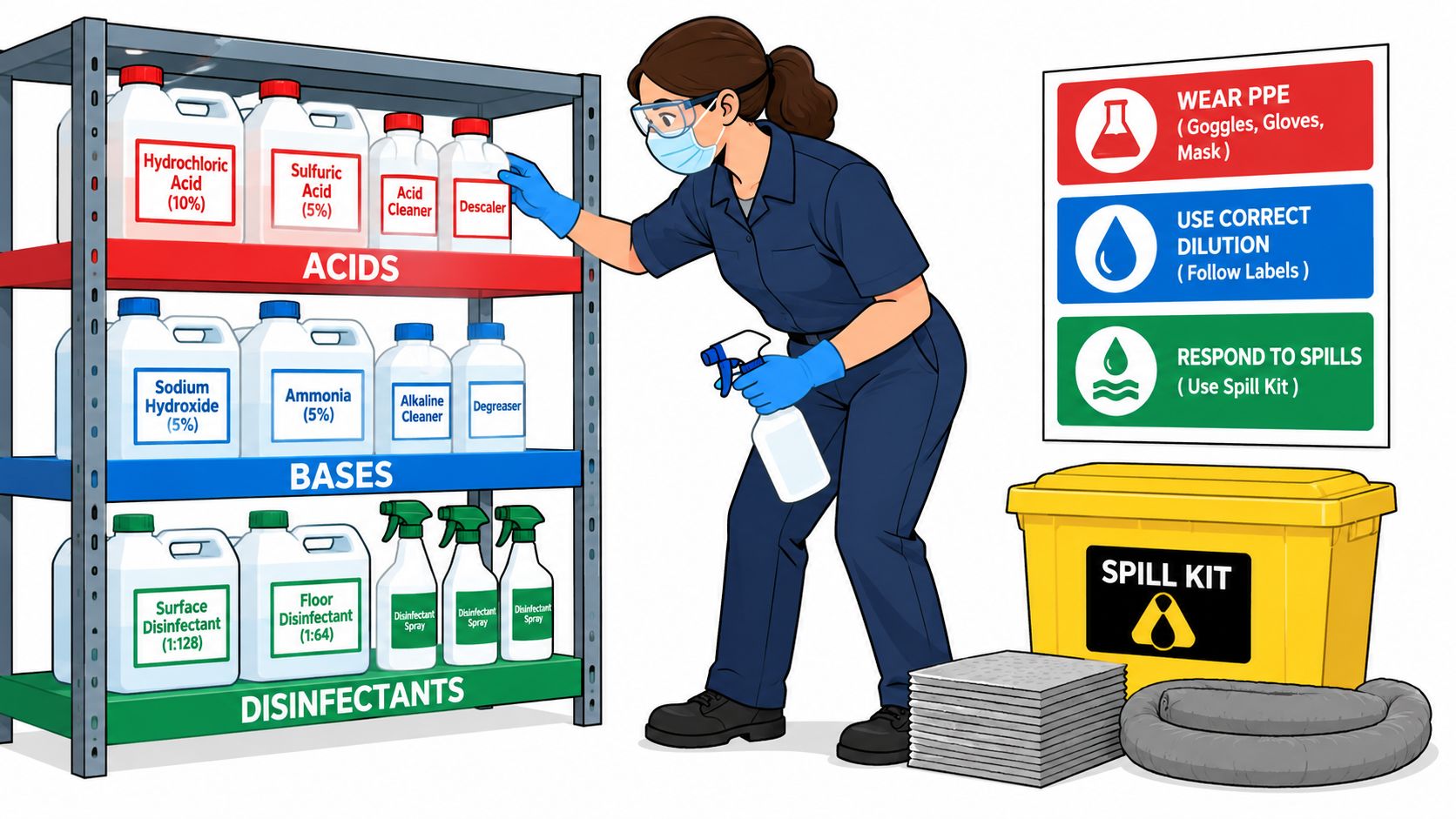
Storage layout is a control, not an aesthetic choice. Keep acids away from bases, oxidizers away from organic materials, and chemical products away from food-service items. Don't place containers where a leak can run into an incompatible product below.
A janitorial room serving a gym, café, and event space needs clear zones. Use shelves, trays, or secondary containment that make the approved arrangement obvious to every shift. A new SKU or supplier substitution should trigger a compatibility review rather than an assumption that the old location remains acceptable.
Check airflow and container integrity
Ventilation should match the release risk. Vapors, fumes, and aerosols may require a fume hood or another engineered control in appropriate settings, while public-facing operations still need adequate airflow and restricted access. Staff should also confirm that caps seal, labels face outward, and containers aren't cracked, swollen, or leaking.
For broader context on emergency planning outside routine facility work, hazardous cleanup for Phoenix homes offers a useful reminder that unknown or uncontrolled materials require a different response from ordinary cleaning.
Match PPE to the task
PPE must follow the chemical and the task, not the employee's department. Nitrile gloves may suit work with quaternary ammonium products, splash goggles may be appropriate at a dilution station, and respirators should be used only when the SDS and a proper respiratory protection program call for them.

Where Procedures Fail Between Receiving and Dispensing
Many incidents don't begin when an employee cleans a surface. They begin when a product enters the building and changes hands.
At receiving, dock staff may accept a damaged case, a substitute SKU, or a container with missing identification. A product can then move into storage before anyone compares it with the approved inventory or confirms that its SDS is available. The same problem appears in gyms when a purchasing team changes suppliers but the floor team keeps following an old product card.
Decanting creates a second weakness. A secondary bottle may lose the original label, receive a marker description that washes away, or be reused from another chemical. The person filling the bottle may know what was intended, but the next shift sees only an ambiguous container.
Repackaging into service carts adds another handoff. Bottles that leave the chemical room correctly filled can arrive at the floor with the wrong dilution, a mismatched trigger color, or no traceable connection to the SDS. Facilities should treat every handoff as a control point, not as routine transport.
Three practical correction points
- Receiving inspection: Quarantine damaged, substituted, or unidentified products. Compare each accepted SKU with the approved inventory and confirm that the corresponding SDS is accessible.
- Decanting: Use containers approved for the product, verify identity before filling, apply durable labels immediately, and never reuse a bottle without a documented cleaning and compatibility decision.
- Service-cart preparation: Check concentration, label, trigger, and destination before the cart leaves the chemical area. Have a supervisor sample carts during active shifts rather than relying only on scheduled audits.
Any new product SKU, any bottle that can't be traced to an SDS, or any finding associated with concentration drift should force a re-review. Teams that handle regulated transport or dangerous goods can also consult specialized training resources, such as information about how to apply for an NSW DG driver licence, when their responsibilities extend beyond ordinary facility use.
| Handoff Stage | Common Failure | Re-Review Trigger |
|---|---|---|
| Receiving | Damaged packaging, substitutions, missing identification | New SKU, supplier change, or damaged delivery |
| Decanting | Lost label, unsuitable bottle, cross-contamination | Untraceable container or incompatible receiving container |
| Repackaging | Wrong dilution, trigger, or destination | Concentration drift, audit finding, or process change |
For storage layout and segregation details, keep the facility's chemical storage safety guidance beside the inventory review rather than treating storage as a separate project.
Using Disinfectant Wipes the Way the Label Requires
Disinfectant wipes often fail because staff use them as ordinary cleaning cloths. A quick pass over a console may remove visible dirt, but it doesn't necessarily provide the labeled exposure time needed for disinfection.
The EPA wipe label in the referenced product documentation requires hard, non-porous surfaces to remain visibly wet for a 1-minute contact time. It also directs users to apply enough wipes to keep the surface wet throughout that period. The label is the operating instruction, so facilities should verify the contact time for the exact product they stock rather than assume every wipe performs identically.
What visibly wet means in practice
On stainless steel, visibly wet means a continuous sheen remains across the treated area. On laminate, it means the surface hasn't dried in patches before the required time ends. Glass may show a clear film, while a textured treadmill handle may need more product because grooves and seams hold less liquid evenly.
Staff should unfold the wipe fully, use overlapping passes, and select additional wipes when the first one can't maintain coverage. The CDC specifically notes that more than one wipe may be needed for electronics and frequently touched items such as phones and computers to keep the surface wet for the full contact time.

Protect electronics and high-touch areas
Turn off and unplug equipment where the manufacturer requires it. Don't flood seams, ports, buttons, or vents. Apply the wipe in a controlled manner and avoid pooling liquid. The CDC recommends drying electronics thoroughly afterward when manufacturer guidance is unavailable and states that alcohol-based wipes or sprays containing at least 70% alcohol can be used in that situation, with care taken to prevent liquid pooling.
In a gym, prioritize grips, adjustment pins, touchscreens, locker handles, shared mats, benches, and payment terminals. Wipes for gym equipment, including suitable yoga mat wipes, should still be checked against the surface and product label. A wipe that works on hard, non-porous plastic may not be appropriate for leather, unfinished wood, or a manufacturer-sensitive display.
Spill Response and Waste Handling by Incident Size
A spill response plan should tell the nearest employee what to do before a manager arrives. It should also distinguish a known, contained splash from a large or unidentified release. A generic kit in a janitorial closet isn't enough if nobody knows which materials can be absorbed, bagged, isolated, or escalated.
For a small, contained splash under 100 ml, a trained attendant may be able to isolate the spot, put on the PPE specified by the product SDS, use compatible absorbent pads, and place the waste in a sealed secondary bag. The attendant should keep guests away, post warning signage, and report the event according to the facility's incident process.
A mid-size spill should trigger area closure, an airflow check, supervisor escalation, and a product-specific response. Don't allow staff to improvise neutralization or pour treated chemicals into a janitorial sink. A sink connected to a grease trap or shared drainage system may create a different hazard and isn't automatically an approved waste route.
Escalate unknown and uncontrolled releases
Large spills, strong vapor clouds, damaged containers, mixed chemicals, and unknown substances should move directly to emergency or hazmat response. Employees should withdraw, restrict access, provide the SDS if available from a safe location, and avoid re-entry until the responsible authority confirms that the area is safe.
A “30-minute re-entry rule” shouldn't be treated as a universal clearance standard. Re-entry depends on the chemical, ventilation, measured conditions, label instructions, and the qualified person directing the response. If your team needs a broader incident framework, Solomon's Facilities Management response plan provides useful context for assigning roles and documenting escalation.
| Spill Size | PPE Required | Area Control | Waste Route |
|---|---|---|---|
| Under 100 ml, contained | SDS-specified gloves and eye protection | Isolate spot and post signage | Compatible absorbent, sealed and segregated |
| Mid-size, known chemical | Escalated PPE based on SDS | Close area, check ventilation, notify supervisor | Approved chemical-waste route |
| Large, unknown, or uncontrolled | Trained emergency or hazmat responders | Evacuate or restrict area | Specialist direction, never ordinary trash or drains |
Keep spill records specific. Record the product, location, task, people involved, immediate controls, waste route, and corrective action. That record helps reveal whether the problem came from storage, dilution, training, or an equipment failure.
Keeping Documentation, Training, and Audits Alive
A chemical binder can be accurate, organized, and useless if employees can't find the current information during a shift. The National Health Interview Survey analysis found that 20.6% of sampled adult workers reported frequent occupational skin contact with chemicals during the prior 12 months. The same analysis identified mining and construction as sectors with the highest prevalence of frequent handling or skin contact, and it showed uneven healthcare training, including 52% chemical-specific training for aerosolized antibiotics and 32% employer procedures for minimizing exposure to surgical smoke.
Those findings reinforce a practical point. Written procedures don't protect workers unless the facility connects them to the tasks people perform.
Build a living information system
Use one version-controlled SDS access point, with a backup that staff can use if the primary system fails. Put the access method on the chemical-room noticeboard, service cart, and onboarding materials. When a manufacturer updates an SDS, compare the new version with the previous one and communicate changes to affected employees.
Retraining should follow operational triggers, not only a calendar. A new product, new hire, incident, audit finding, supplier substitution, or changed process should prompt a targeted review.
Audit the details that drift
A short monthly check can catch the failures that become incidents:
- Labels: Confirm every primary and secondary container is legible and traceable.
- Segregation: Check that products remain in their approved storage zones.
- Equipment: Inspect eyewash-station condition and expiry information.
- Carts: Compare bottle identity, dilution, trigger, and destination.
- Records: Assign every finding an owner and a dated corrective action.
High-turnover facilities need a defined onboarding path. A 72-hour onboarding module focused on the ten chemicals employees routinely handle is more useful than asking a new hire to read a general binder without supervision. Use demonstrations, label checks, a spill scenario, and a return demonstration at the point of work.
For a focused training framework, pair this process with chemical safety training resources and keep completion records tied to the employee, task, and product category.
Turning Clean Procedures Into a Competitive Edge
A well-run chemical program changes what guests see. Sealed dispensers look intentional. Labeled bottles look controlled. Staff who allow the required contact time instead of wiping immediately dry show that the facility values effectiveness over appearances.
That visibility can influence trust in offices, gyms, schools, restaurants, and retail stores. In healthcare environmental cleaning, the CDC recommends cleaning and disinfecting high-touch surfaces and floors, emphasizes the patient zone and procedure table, and states that procedural areas should be cleaned before and after each procedure. The same logic applies in public facilities, even though the exact product, surface, and schedule will differ.
Make cleanliness easy to observe
Gym operators can place gym wipe dispensers near equipment exits and train staff to check refill levels without creating clutter. A dispenser that is empty during a busy period communicates neglect, so assign ownership for inspection and replenishment. Use gym equipment cleaning wipes that match the surfaces being treated, and keep the label and SDS available for staff questions.
Sales professionals should avoid promising vague “hygiene ROI.” Instead, connect the product to the customer's operating problem:
- Show the workflow: Explain where wipes sit, who replenishes them, and how staff verify contact time.
- Connect use to risk control: Discuss traceable products, approved surfaces, storage, waste handling, and training.
- Bundle the operating pieces: Include dispensers, compatible refills, labels, PPE, SDS access, and an audit checklist.
- Use facility language: A school needs desk and device protocols. A restaurant needs separation from food-service materials. A gym needs equipment, locker-room, and mat guidance.
- Support procurement reviews: Provide product labels and usage instructions so the buyer can compare suitability rather than choosing on price alone.
Documented discipline also supports liability management. Training records, SDS version logs, receiving checks, and spill reports can help show what the facility knew, what it instructed, and how it responded if an incident reaches an insurer or courtroom. Documentation doesn't eliminate liability, but missing records make the facility's position harder to defend.
Use a focused 30-day improvement cycle
Pick one procedure, assign one owner, and log one measurable improvement. Start with the receiving-to-dispensing handoff if staff routinely decant products, or start with contact-time compliance if wipes are being used as quick-dry cloths. Review the result with the team, then move to the next weak point.
The strongest facilities don't hide chemical operations in a neglected closet. They make the process controlled, understandable, and visible wherever customers interact with staff and surfaces.
Prioritize cleanliness as a daily operating standard, not a final touch. Review one product label and SDS, inspect one handoff, verify one high-touch cleaning routine, and consider integrating properly used EPA registered disinfecting wipes into your facility's routine or product offering. Start today with a named owner and a documented check, then build the rest of the program from that decision.
Leave a Reply