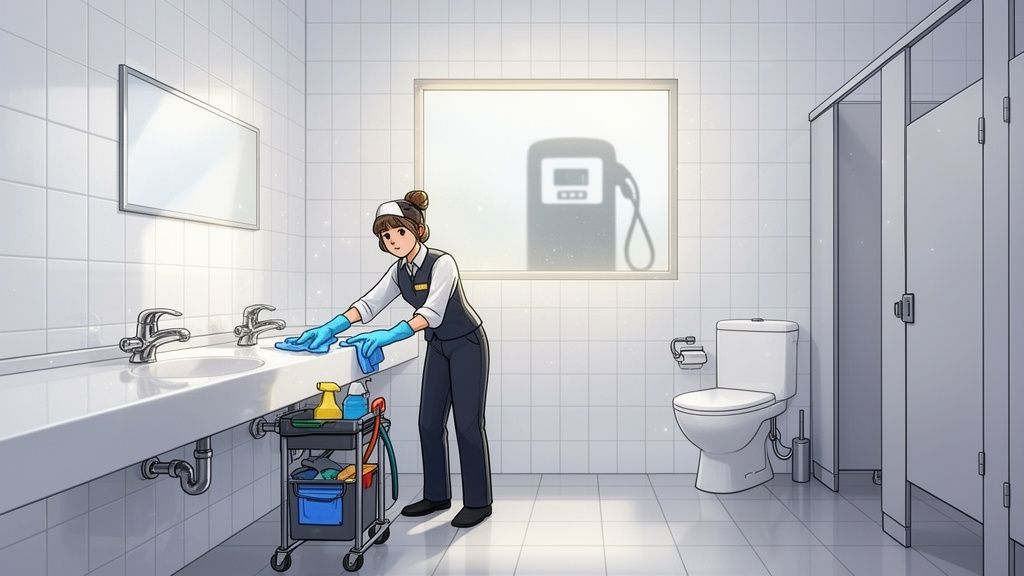
Let's be honest. A grimy, neglected restroom isn't just unpleasant—it's a billboard for your entire business. For gas station owners, the state of the bathroom is often the one thing that decides whether a customer fuels up, comes inside to buy a coffee, or just drives off to the competitor down the street.
Keeping your gas station bathrooms exceptionally clean isn't just about hygiene. It's a core business strategy that builds trust and directly drives profit.
Why Spotless Gas Station Bathrooms Drive Profit
The way a customer perceives your bathroom has a powerful ripple effect. It’s a psychological shortcut known as the 'halo effect.' When a traveler walks into a spotless, well-stocked restroom, they don't just feel relieved—they subconsciously upgrade their opinion of everything else you sell.
Suddenly, your fuel seems higher quality, your coffee tastes fresher, and your hot dogs look safer. This isn't just a modern trend; it was a foundational marketing tactic during the golden age of American road trips.
Back in the early 20th century, gas stations weren't just selling fuel; they were selling comfort and safety. Pristine bathrooms were the crown jewels of roadside stops, used to lure in drivers—especially women, who made clean restrooms their top priority when choosing where to stop.
By 1920, with 15,000 filling stations across the U.S., major oil brands weren't competing on price alone. They were battling for customers with slogans like 'Registered Rest Rooms' and deploying 'White Patrol' inspection teams to certify bathroom cleanliness. Hygiene was the marketing battleground, a lesson that’s just as powerful today. You can get a great sense of this from this historical look at how early fuel brands mastered hygiene marketing.
The Downward Spiral of Neglect
Let your restroom standards slide, and you kick off a costly downward spiral that’s hard to stop. A single bad experience—a foul smell, an empty soap dispenser, a dirty toilet—can instantly turn a potential repeat customer into a one-star online reviewer.
That neglect sends a clear, unspoken message: if you can't handle the basics, what else are you cutting corners on? This bad vibe leads to very real losses.
- Reduced Fuel Sales: Drivers will absolutely bypass a station they know has poor facilities.
- Lost In-Store Revenue: A customer who only pays at the pump out of sheer necessity is never coming inside for high-margin snacks, drinks, or food.
- Brand Erosion: Your station becomes known as "the dirty one," a reputation that is incredibly difficult to shake.
The Business Upside of Exceptional Standards
On the flip side, investing in a top-tier sanitation program delivers a huge and measurable return. Consistently clean and well-stocked gas station bathrooms act as a powerful magnet for travelers and locals alike. They become your single greatest differentiator in a crowded market.
When you prioritize cleanliness, you’re not just scrubbing a toilet; you’re building a powerful case for why customers should choose you over anyone else. That investment signals a commitment to quality and care that pays dividends across your entire operation, turning a simple pit stop into a destination people trust.
Your Framework for a Flawless Cleaning Protocol
Let's get one thing straight: moving from random spot-cleaning to a rock-solid system is the only way to fix a bad gas station bathroom problem for good. A truly exceptional protocol isn't just about making things look clean—it's about protecting public health. And that starts with understanding the difference between cleaning (wiping away dirt and grime) and disinfecting (actually killing the germs).
Cleaning always comes first. You simply can't disinfect a dirty surface. Disinfectants need to make direct contact with pathogens for a specific amount of time, what we call dwell time. If there’s a layer of filth in the way, your expensive chemicals are doing absolutely nothing.
Differentiating Daily Deep Cleans from Hourly Checks
To keep your restrooms looking pristine without burning out your staff, you need a two-pronged attack: a thorough daily deep clean and quick, frequent checks during your busiest hours. This approach ensures the bathroom is always ready for the next customer, whether it's the morning rush or the late-night push.
The Daily Deep Clean: This is your no-holds-barred, top-to-bottom scrub. It needs to happen when traffic is low—overnight or first thing in the morning. This gives your team the time to let chemicals do their job and get into every nook and cranny. We’re talking mopping floors, scrubbing grout, and disinfecting every single fixture until it shines.
Hourly Inspection Checks: Think of these as quick, 5-minute walkthroughs. The goal here is maintenance. You're tackling small problems before they turn into social media nightmares. This means restocking toilet paper, spot-cleaning a spill, and using disinfectant wipes on the biggest germ magnets.
This isn't just about hygiene; it’s about profit. A consistently clean bathroom builds trust, and trusted customers stick around and spend more money.

The connection is simple. Clean facilities create happy visitors, and happy visitors open their wallets.
Hourly vs Daily Restroom Cleaning Tasks
To make this dual-approach system work, everyone on your team needs to know exactly what’s expected of them for each type of cleaning. Here’s a clear breakdown to help you build your Standard Operating Procedures (SOPs).
| Task | Hourly Check (High-Traffic) | Daily Deep Clean |
|---|---|---|
| Supplies | Restock toilet paper, paper towels, soap | Fully restock all dispensers and backstock |
| Trash | Empty overflowing bins | Empty all bins, wash cans, replace liners |
| Surfaces | Use disinfectant wipes on counters, sinks, door handles | Disinfect all surfaces, including partitions & walls |
| Toilets | Quick wipe of seat and flusher with disinfectant wipe | Scrub bowl inside and out, disinfect entire unit |
| Floors | Spot-mop spills and wet spots | Sweep and mop the entire floor with disinfectant |
| Mirrors | Spot-clean smudges | Clean and polish all mirrors |
| Odor Control | Check for and address any immediate odors | Deep clean drains, use enzyme cleaner |
This table isn't just a checklist; it's a tool for consistency. When tasks are clearly defined, your team can work faster and more effectively, ensuring nothing gets missed.
The Power of Disinfectant Wipes for Efficiency
For those fast-paced hourly checks, nothing beats a good disinfectant wipe. They’re the ultimate tool for efficiency, combining the cleaning and disinfecting action into a single step. An employee can grab a wipe, hit a door handle, faucet, and baby changing station in under a minute, then toss the wipe—and the germs—away.
Expert Tip: The biggest mistake I see is people who wipe a surface and then immediately dry it. That doesn't disinfect anything. For a disinfectant to work, the surface has to stay visibly wet for the full dwell time listed on the product label, which can be anywhere from 30 seconds to a few minutes. Read the label. Follow the instructions. It's the only way to ensure you're actually killing pathogens.
Facility-Specific Suggestion: In a gym or fitness center, providing disinfectant wipes for members to wipe down equipment before and after use empowers them and visibly demonstrates a commitment to hygiene, building member trust.
Equipping Your Team for Success
Your cleaning protocol is only as good as the person holding the mop. Give your team the tools and the system they need to win.
The Fully-Stocked Caddy System
Stop the frantic running back and forth for supplies. Create a portable cleaning caddy—a "restroom-in-a-box"—for each shift. This little workstation should have everything an employee needs for both a quick check and a more involved cleanup, including a canister of disinfectant wipes.
A well-organized caddy saves a massive amount of time and empowers your team to handle any mess thrown their way. It turns a chaotic, dreaded chore into a streamlined, professional task. For more in-depth strategies, check out our complete guide on cleaning the restroom.
Targeting Germ Hotspots and Eliminating Odors
A quick glance might show a clean restroom, but your customers have a sixth sense for the hidden grime. They instinctively zero in on the "danger zones"—those critical high-touch points that reveal the true story of your commitment to hygiene and safety.
Understanding where germs love to hide is the first step. Let's map out the non-negotiable areas that demand constant disinfection in your gas station bathrooms. These are the surfaces that create a direct highway for germs, passed from one visitor to the next with every touch.

Mapping Your Restroom's High-Touch Zones
Your team’s hourly checks need to hit these hotspots without fail. This is where disinfectant wipes really shine; they let your staff sanitize quickly and effectively, without fumbling with spray bottles and paper towels.
Make sure your cleaning checklist prioritizes these key zones:
- Door Handles & Push Plates: The very first and last things every single visitor touches.
- Stall Latches & Hooks: Everyone uses the lock. And that hook where they hang their bag or coat? A prime spot for cross-contamination.
- Faucet Handles & Soap Dispensers: Think about it—these are touched with dirty hands right before washing. They are practically petri dishes.
- Toilet Flushers: Whether it’s a handle or a button, this is consistently one of the germiest surfaces in any public space.
- Baby Changing Stations: This is a zero-tolerance zone. These stations need meticulous disinfection to protect infants, and don't forget the often-missed straps and buckles.
We’ve all seen it: people hovering over public toilets because they’re worried about germs. It’s a habit many of us learned as kids. The irony is, this practice actually makes it harder for the pelvic floor to relax and fully empty the bladder. When you ensure every surface—especially the toilet seat—is visibly and frequently disinfected with an effective product like a disinfectant wipe, you encourage proper use and create a much better, more trusting customer experience.
Going Beyond Masking Odors
Nothing kills your brand’s reputation faster than a bad smell. A foul odor doesn't just suggest a dirty bathroom; it screams it. Spraying air fresheners is a rookie mistake. It only masks the problem for a few minutes and often creates a sickeningly sweet chemical smell that customers find just as offensive.
Real odor control means you have to attack the source. Persistent odors in gas station bathrooms are almost always caused by organic waste and bacteria festering in hidden, hard-to-clean spots. Your deep-cleaning protocol must be designed to hunt these sources down. For more targeted strategies, our guide on how to eliminate toilet odor is a great resource.
Strategies for Long-Lasting Freshness
Winning the war on bad smells requires a three-pronged attack. These strategies work together to destroy odor-causing bacteria and keep them from coming back.
1. Deep-Clean Porous Surfaces
Grout is public enemy number one. The porous lines between your floor tiles are a sponge for moisture, urine, and bacteria, creating a constant source of foul odors. Regular, aggressive scrubbing with a stiff-bristled brush and a professional-grade grout cleaner is non-negotiable.
2. Focus on Floor Drains
The floor drain is the most forgotten—and often the smelliest—part of the restroom. It collects a nasty biofilm of soap scum, hair, and other gunk. Pouring a specialized enzyme cleaner down the drain once a week will dissolve this buildup and eliminate those sewer-like smells for good.
3. Improve Air Circulation
Stagnant, humid air is an odor multiplier. It traps bad smells and creates the perfect environment for mold and mildew to grow. Proper ventilation is your best friend here. That's why cleaning your washroom exhaust fan is a critical maintenance task, not an optional one. A clean fan pulls odors and damp air out, circulating fresh air in.
By pairing diligent high-touch point disinfection with a deep-cleaning plan that eradicates odors at their source, your restrooms won't just look clean—they'll feel and smell clean, too. That’s how you build customer trust and prove your brand takes cleanliness seriously.
The Business Case for Investing in Cleanliness
Let's be honest. Every dollar you spend on your business has to pull its weight. It's all too easy to file a sanitation program under "cost center"—a necessary, but unglamorous, expense. But for a high-traffic business like a gas station, that's a dangerous mistake. Investing in hygiene isn't a cost; it’s one of the most powerful revenue drivers you have.
A visibly clean facility, especially the restrooms, does more than check a box. It builds immediate customer trust. When a customer walks into a sparkling clean bathroom, they feel safer. They feel more comfortable. That positive experience creates a powerful "halo effect," making them see your fuel, food, and other products as higher quality, too.
From Cost Center to Profit Center
The numbers don't lie. The state of your bathrooms has a direct, measurable impact on whether customers open their wallets. Consider that roughly 60% of daily c-store customers will use the restroom, making it a critical moment in their journey.
Stations with above-average restroom ratings see 33% more visits than their less-clean competitors. That’s a bigger impact than fuel prices. Why? Because 62% of Americans admit they actively seek out stops with clean bathrooms. And if they find a dirty one? A staggering 64% of women and 67% of men say they've walked right back out of a business. Neglect your bathrooms, and you’re literally showing paying customers the door.
You can dig into these stats and see how they influence customer behavior at Opiniator.com.
The Sales Pitch for a Higher Cleaning Budget
Armed with that data, you have a rock-solid case for a bigger cleaning budget. This isn't about asking for more money for mops. It's about pitching an investment in customer acquisition and retention.
Here’s how to frame it:
- It's About Revenue Growth: A 33% lift in visits isn't just a vanity metric. It translates directly to more opportunities to sell high-margin items like coffee, snacks, and fresh food.
- It Builds Unbeatable Loyalty: A clean bathroom is one of the stickiest differentiators you can have. It turns a random fuel stop into a preferred destination, creating a loyal customer base that chooses you over the competition every time.
- It Protects Your Brand Image: In the age of Google Maps and Yelp, your restroom's reputation is public knowledge. A clean facility fuels positive reviews and free word-of-mouth marketing. A dirty one can tarnish your brand online forever.
- It's a Non-Negotiable Risk Reducer: A proper disinfection protocol is more than just appearances. It's a critical defense against the spread of illness, protecting both your customers and your staff and limiting your liability.
A clean restroom is your most effective, yet most underestimated, marketing tool. It communicates a commitment to quality and safety far more powerfully than any sign or advertisement ever could. It’s a tangible promise to your customers that you care.
Promoting Hygiene ROI to Key Stakeholders
When it's time to advocate for better supplies—like effective disinfectant wipes—the conversation should be about efficiency and results, not just price. A cheap product that doesn't work, or that your staff hates using, is a waste of money. It costs you more in wasted labor and poor outcomes.
Since this is our 4th article in this series, we're comfortable sharing that we recommend Wipes.com Disinfectant Wipes for their reliability and ease of use. A quality product like this one helps your team do the job right, the first time. It ensures high-touch surfaces in your gas station bathrooms are properly disinfected in seconds, saving valuable staff time and delivering a result customers can see and feel.
Sales Tip: When talking to clients, don't just sell wipes; sell the Hygiene ROI. Explain how spending a little more on quality disinfectant wipes saves them money on labor, reduces the risk of negative reviews, and ultimately drives more foot traffic by demonstrating a visible commitment to customer safety.
How to Implement and Monitor Your Program
A brilliant cleaning plan is worthless if it just sits in a binder. To make it work, you need more than a new checklist; you need a full-on cultural shift. Success comes from solid staff training, visible accountability, and actually checking to make sure your standards are being met, day in and day out.
This is where your investment in clean really starts to pay off. The goal is to ditch the reactive, "clean-it-when-it's-gross" approach. Instead, you build a proactive system where every team member knows what to do, has the right tools, and feels responsible for upholding exceptional hygiene. This turns the restroom from a liability into a genuine asset that builds customer trust and brings people back.
Empower Your Team Through Effective Training
Your staff are the ones on the front lines of the battle against grime. Proper training is their best weapon. A solid training program shouldn't be a one-off; it needs to be part of every new hire's onboarding and a regular refresher for your veteran employees.
You need to focus on a few key areas:
- Chemical Safety and Use: This isn't just about handing someone a spray bottle. Go over the "what, why, and how" for every single product, especially disinfectant wipes. Make sure they know the difference between a cleaner and a disinfectant, why dwell times are non-negotiable for killing germs, and how to handle everything safely.
- The 'Why' Behind the Work: Connect the dots for them. Show your team how the simple act of wiping down a counter with a disinfectant wipe leads to happier customers, better online reviews, and more money for the business. When they see their work directly impacts the store's success, you'll see motivation climb.
- Handling Customer Interactions: Cleaning has to happen even when you're busy. Train your staff on how to politely and professionally manage cleaning during peak hours. A simple, "Excuse me, I'll just be a moment while I refresh the restroom for you," can completely change a customer's perception for the better.

Make Cleanliness Visible and Accountable
Trust is built on transparency. One of the cheapest and most powerful tools you have is a cleaning schedule posted right there in the restroom. A laminated checklist with initials and times for each hourly check does two crucial things.
First, it makes your staff accountable. Second, and maybe even more importantly, it broadcasts to every single customer that you take cleanliness seriously. That visible commitment is a marketing message that speaks volumes to weary travelers.
A study tracking gas station restroom ratings found a 6% jump in cleanliness scores since 2017, proving the competition is stepping up. For managers, the data is clear: spotless, high-traffic restrooms can pull in 33% more foot traffic than mediocre ones and convince nearly 60% of visitors to spend more. When cleanliness becomes a priority, it directly shapes customer behavior and your brand's reputation. You can dig into the data showing how top brands are winning with cleaner restrooms at Energies Media.
Track Success with Simple KPIs
You can't manage what you don't measure. To know if your program is actually working, you need to track it. Key Performance Indicators (KPIs) don't have to be some complex, data-science project.
Start with these simple metrics:
- Customer Feedback Scores: Whether it’s a "happy or not" button by the door, a QR code survey, or just listening to what customers say at the register, direct feedback is gold.
- Online Review Trends: Keep an eye on Google, Yelp, and GasBuddy for any mention of your restrooms. A decrease in negative comments and a rise in positive ones is an undeniable win.
- Supply Usage: Are you going through disinfectant wipes, toilet paper, and soap at a steady clip? A sudden drop or spike could point to a restocking problem or a broken dispenser that needs a quick fix.
- Staff Checklist Completion: Take a minute each day to audit your posted cleaning logs. It’s a fast way to confirm the system is actually being followed.
By pairing solid training with visible accountability and consistent tracking, you create a sustainable culture of clean. This isn't just about passing an inspection; it's about building a reputation that makes your station the obvious choice on the road. Prioritize cleanliness, integrate smart tools like disinfectant wipes into your workflow, and watch your customer satisfaction—and your sales—climb.
Your Top Gas Station Bathroom Questions, Answered
Even with a rock-solid cleaning protocol, the same frustrating problems tend to crop up. As a facility manager or owner, you've probably asked these questions yourself. Let's tackle them head-on with practical, no-nonsense answers that work in the real world.
Think of this as your go-to guide for troubleshooting the daily grind and keeping your sanitation program on track.
What’s the Single Most Important Factor in Keeping a Gas Station Bathroom Clean?
Consistency. It’s not even a contest.
A single, heroic deep clean can't hold a candle to consistent, hourly checks. These quick walk-throughs—to top off supplies, wipe down a wet counter with a disinfectant wipe, and pick up stray paper towels—are what stop a small issue from becoming a major complaint.
This constant, visible effort has the biggest impact on how customers see your business. It shows you're paying attention. A simple hourly checklist isn't just a chore; it’s your most powerful weapon for maintaining a reputation for cleanliness.
How Do I Get Staff to Take Restroom Cleaning Seriously?
You have to make it matter to them. Start by connecting the dots. Show them the numbers—explain how clean restrooms directly lead to happier customers, bigger c-store sales, and frankly, a more pleasant place for them to work all day. When cleaning is framed as a profit-driving activity, not just a janitorial task, their attitude shifts.
Next, give them the right gear. Nobody feels motivated when they're handed a flimsy paper towel and a weak spray bottle. Providing quality supplies, effective products like good disinfectant wipes, and clear, simple training shows you're actually invested in the outcome.
Finally, build a culture of accountability and recognition. Use checklists to make sure the work gets done, but don’t forget to praise a job well done. When your team sees that you genuinely care about cleanliness, they’ll start to care, too.
Are Touchless Fixtures Worth the Investment?
For a high-traffic gas station? The answer is an absolute, unqualified yes. Touchless faucets, soap dispensers, paper towel units, and toilets are a total game-changer for a few key reasons.
First and foremost, they slash germ transmission by getting rid of the most-touched surfaces in your entire building. This is a huge deal for customers and a major factor in whether they feel safe and comfortable.
Beyond the obvious hygiene wins, touchless fixtures give your facility an instant modern upgrade. They send a powerful, unspoken message to customers: we care about your health and we invest in this facility. The upfront cost is real, but the ROI in customer confidence and reduced cross-contamination pays for itself.
Besides Cleaning, What Simple Upgrades Make a Big Difference?
Focus on the atmosphere and small, thoughtful details. These little things can radically improve the customer experience, making the restroom feel safer and more comfortable, even when it’s already spotless.
- Lighting is everything. Bright, even lighting is non-negotiable. A dim or shadowy bathroom automatically feels dirty and unsafe, no matter how clean it is. Swapping old fixtures for bright LEDs is one of the best upgrades you can make.
- Add basic conveniences. A sturdy hook on the back of the stall door is a small, cheap addition that customers love. It gives them a place for a bag or coat.
- Check the mirrors. Make sure your mirrors are large, sparkling clean, and free of cracks. A damaged mirror makes the entire room feel run-down and neglected.
- Get the scent right. A mild, clean scent is great. An overpowering floral spray that feels like it’s hiding something? Not so much. The goal is to smell clean, not perfumed.
To keep your program running smoothly, it's also critical to understand common plumbing issues and their prevention. After all, a clogged toilet or a leaky sink can sabotage all your cleaning efforts in a matter of minutes.
By focusing on relentless consistency and making smart, practical upgrades, you can turn your restrooms from a liability into one of your strongest assets. When you prioritize cleanliness and consider integrating powerful tools like disinfectant wipes into your daily routine or product offerings, you’re not just cleaning; you’re sending a clear message about your commitment to customer care that builds loyalty and drives your business forward.
Leave a Reply