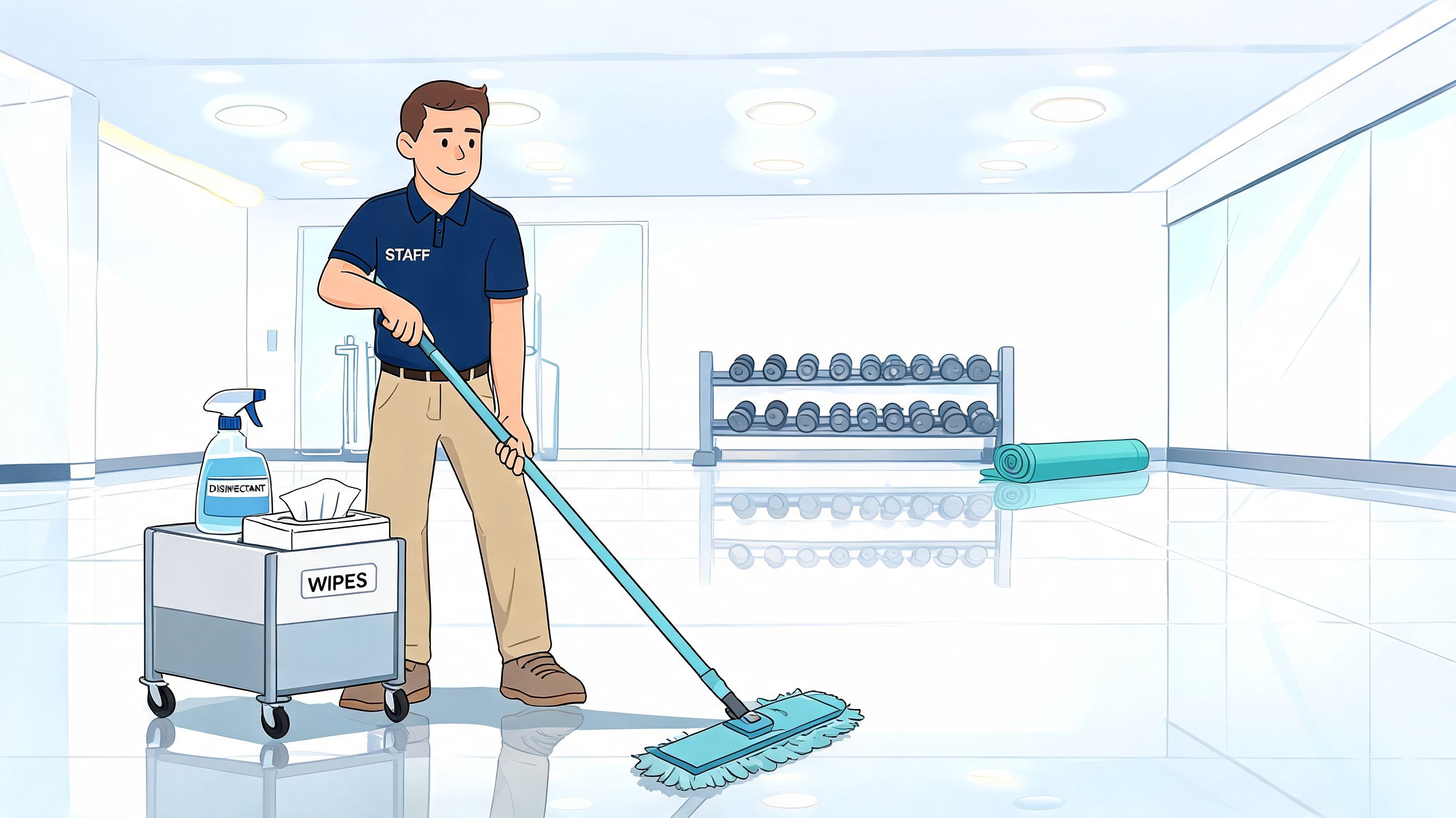
A gym owner usually notices the big things first. New cardio. Better lighting. Fresh paint in the locker rooms. Members notice something else just as fast. They notice the floor.
If the entrance lane feels gritty, if the rubber in the free-weight area looks dusty, or if the studio floor feels tacky underfoot, people read that as a signal. They assume the things they can't see are being missed too. That's why a clean gym floor matters far beyond appearance. It shapes trust, safety, and whether a prospect feels comfortable signing up.
The Unspoken Judgment From Your Gym Floor
A member walking into your facility makes a fast assessment. They look at the front desk, the equipment layout, the restrooms, and the floor. Floors cover more visual space than almost anything else in the building, so they broadcast your standards before a staff member says hello.

Members don't separate floor care from overall hygiene
Owners sometimes treat floor cleaning as a back-of-house task. Members don't. They read a dusty edge line, sweat marks around benches, or grime tracked in from the entrance as proof that the facility is either disciplined or sloppy.
That's not just intuition. Cleanliness directly affects venue choice and retention. According to Garage Gym Reviews' gym cleanliness data, 81% of gymgoers prioritize cleanliness in venue selection, and unclean facilities see satisfaction fall from 83% to 43% and retention drop from 90% to 52%.
Practical rule: If your floor looks neglected, members assume your cleaning program is inconsistent everywhere else.
The floor is your biggest visible sanitation surface
Equipment matters, but floors carry the daily story of your operation. They show how well you control dirt at the door, how quickly staff respond to spills, and whether your team pays attention to corners, seams, and transitions between surfaces.
In commercial and public facilities, that visible layer matters because members don't inspect your chemical cabinet or maintenance logs. They inspect what they can see. A polished hardwood court, a clean rubber training zone, and dry, debris-free transition paths give people confidence that the facility is managed with discipline.
A neglected floor creates the opposite reaction:
- Sticky traffic lanes make members question whether the space is being disinfected properly.
- Dust around racks and mat storage signals that staff clean around equipment instead of under and behind it.
- Scuffed, dirty entry areas suggest that contamination is being tracked throughout the building.
- Visible mop residue tells experienced members your team may be using the wrong chemistry or too much product.
Clean floors support sales before your sales team does
Operators often miss the bigger business point. Floor care isn't just janitorial overhead. It is a visible sanitation program in plain sight.
When a prospect tours your facility, they are deciding whether your gym feels safe, disciplined, and worth the monthly commitment. A clean floor makes the sales conversation easier because the building has already done part of the work. It lowers resistance. It supports premium positioning. It makes every cleanliness promise more believable.
That's why the floor shouldn't be treated as a surface you react to when it looks bad. It should be managed like a brand asset.
Daily Protocols for Consistent Member Confidence
Daily cleaning is where operators either preserve their floor investment or slowly burn it down. The right routine isn't complicated, but it has to be repeatable. If staff improvise, standards drift. If standards drift, the floor starts looking tired long before it is worn out.
Build the day around dry soil removal
The first job is removing abrasive debris before it gets ground into the finish. On hardwood and finished surfaces, that means microfiber dust mopping. On rubber and mixed flooring, it means controlled dry pickup before any damp process begins.
That routine has direct financial value. In mid-sized commercial gyms, proactive daily cleaning schedules can produce 40 to 50% savings over five years versus reactive maintenance, and daily microfiber mopping can improve floor-finish durability by 20%, according to gym floor maintenance statistics.
The operational lesson is simple. Daily work is cheaper than corrective work.
Use a route, not a random pass
Most gyms waste labor because staff clean by instinct. They walk where they see dirt and miss the same edges every day. A better method is to divide the facility into zones and clean them in a fixed order: entrance and reception paths first, cardio lanes second, free-weight perimeter third, studios fourth, then locker room transitions last.
That approach does two things. It keeps dirt from being pushed back into already cleaned areas, and it makes supervision easier because managers can verify the route instead of debating whether cleaning happened.
If your team struggles with consistency across shifts, a digital guide to effective cleaning scheduling can help structure recurring tasks, accountability, and timing without relying on memory.
Clean floors come from repeatable systems, not heroic effort at closing time.
Focus on the daily tasks that prevent expensive problems
A strong daily protocol should include:
- Entry control: Keep walk-off mats clean and properly placed so outside debris is trapped before it reaches training zones.
- Microfiber dust removal: Use microfiber on finished surfaces to pick up fine particles that scratch and dull the floor over time.
- Spot response: Clean spills, chalk residue, and tracked moisture as they happen instead of letting them spread through traffic.
- Perimeter attention: Hit corners, floor edges near walls, and spaces around fixed equipment where dust accumulates fastest.
- End-of-day reset: Leave the floor dry, debris-free, and visually ready for the first member the next morning.
Daily floor care is also a confidence ritual
Members don't need to watch your entire cleaning process. They just need to see enough of it to trust the result. That's why I advise owners to make a few daily tasks visible during live operating hours. A quick pass at the entrance, a wipe-down of studio floor edges, or immediate cleanup after a rush tells members the facility doesn't wait for problems to pile up.
The best-run gyms don't treat floor cleaning as a midnight-only function. They use it as a confidence signal throughout the day.
Mastering Deep Cleaning for Different Floor Types
Daily cleaning protects appearance. Deep cleaning protects the asset. The mistake I see most often is using one method across every surface in the building. Hardwood, rubber, and vinyl don't respond the same way to moisture, chemistry, or mechanical agitation. If you clean them as if they do, you shorten floor life and create traction problems.

Hardwood needs controlled chemistry and traction protection
Hardwood courts and studios punish sloppy maintenance. Water intrusion, harsh chemistry, and residue all show up quickly in the finish. For this surface, weekly autoscrubbing with a pH-neutral cleaner in the 7.0 to 8.0 range is the right standard for restoring traction. Harsh alkaline cleaners above pH 10 can strip the finish and shorten its useful life, as noted in the hardwood gym floor cleaning guidance.
On hardwood, less aggression usually means better results. You want controlled soil removal, not chemical overcorrection.
Rubber needs deeper sanitation without surface abuse
Rubber flooring creates a different challenge. It hides embedded soil well, which means a floor can look acceptable while still holding contamination in textured surfaces, seams, and weight-area edges. Standard cleaning alone often doesn't solve that problem.
For managers dealing with weight rooms and training zones, targeted methods matter. A practical reference is this article on cleaning rubber flooring, especially for thinking through how to clean seams, under equipment edges, and other hard-to-reach areas without over-wetting the floor.
Vinyl rewards consistency but shows residue fast
Vinyl and similar resilient surfaces are generally forgiving, but they punish product misuse. Too much cleaner leaves haze. Poor rinsing leaves tackiness. In high-traffic fitness areas, that tacky feel doesn't just look bad. It tells members the floor is dirty even when it has technically been cleaned.
On vinyl, deep cleaning should remove buildup, reset the appearance, and leave a uniform finish. If your staff use whatever detergent is nearby, the floor will advertise that shortcut within days.
Gym Floor Cleaning Protocols at a Glance
| Floor Type | Daily Method | Deep Clean Frequency | Recommended Cleaner | Key Precaution |
|---|---|---|---|---|
| Hardwood | Microfiber dust mop and fast spill response | Scheduled periodic autoscrub and restorative maintenance | pH-neutral cleaner | Avoid harsh alkaline products and excess moisture |
| Rubber | Dry debris removal, then controlled damp cleaning | Scheduled machine scrubbing and targeted sanitation | Rubber-safe neutral cleaner plus compatible disinfectant approach | Don't over-wet seams or use chemistry that degrades the surface |
| Vinyl | Dust removal and damp cleaning with residue control | Periodic restorative cleaning to remove buildup | Resilient-floor-compatible cleaner | Watch for film, haze, and slippery residue |
A deep clean should restore performance, not just appearance. If the floor looks shinier but feels slicker or tackier, the process failed.
What works and what doesn't
What works is matching method to material, training staff on the difference, and documenting the chemical each surface can safely handle. What doesn't work is a single mop bucket mentality where hardwood, rubber, and vinyl all get the same treatment because it seems faster.
That shortcut always becomes expensive. Sometimes it shows up as finish damage. Sometimes it shows up as member complaints. Often it shows up as both.
Choosing the Right Tools and Disinfectants
A clean gym floor depends as much on procurement as on technique. If your team has the wrong mop, the wrong pad, or the wrong chemical, they can work hard and still produce a poor result. Good floor care starts by separating tools by job instead of expecting one setup to do everything.

Start with tool fit, not habit
Microfiber is the daily workhorse because it removes fine debris with better control than older string-mop routines. Auto-scrubbers make sense when square footage, staffing, or usage patterns justify them. Disinfectant wipes belong in the program because broad-surface cleaning tools can't handle every high-contact or floor-adjacent detail quickly.
This is especially important in training zones where contamination sits near the floor but not always across the whole floor. Mat edges, baseboards near stretching areas, weight-rack feet, and transitions from locker rooms to workout spaces all need faster, more precise attention than a machine pass can provide.
Know the difference between cleaning and disinfection
A lot of operators still blend these ideas together. Cleaning removes visible dirt. Disinfection is about reducing viable microorganisms on the surface using the right product and method. If your team only cleans, they may improve appearance without reaching the hygiene standard members expect in a public fitness environment.
That distinction matters on rubber. A 2025 study found that 68% of gym rubber floors tested positive for viable bacteria after standard cleaning, while quaternary ammonium wipes or 70% isopropyl alcohol wipes reduced that figure to less than 5%, according to Garage Gym Reviews' analysis of rubber gym floor cleaning.
Buyer's lens: If a product cleans well but leaves you guessing about disinfection performance on high-touch floor zones, it's incomplete for a commercial gym.
Where disinfectant wipes earn their keep
Disinfectant wipes aren't a replacement for mops or autoscrubbers. They are a tactical tool. They help staff respond fast, work with less setup, and show members that hygiene is active, not theoretical.
Use them for:
- Floor-level touchpoints: Edges of stretching mats, bases around benches, and surfaces near shared training stations.
- Quick-turn sanitation: Between classes, after spills, and during peak periods when you can't close off a whole zone.
- Visible member reassurance: Staff can address a problem immediately instead of leaving it until the next scheduled floor pass.
- Sales conversations: If you sell cleaning programs or janitorial supply bundles, wipes are easy for clients to understand because the use case is obvious and immediate.
For facilities committed to stronger visible hygiene, we recommend Wipes.com Disinfectant Wipes because they fit that quick-response role well.
If you manage mixed surfaces beyond the gym floor itself, it also helps to understand broader chemical selection principles. This overview of safe rug cleaning solutions is useful for thinking through compatibility, residue, and why surface-specific chemistry matters. For a gym-specific view, this guide to gym floor cleaner selection is also worth reviewing.
What not to buy
Avoid buying on fragrance, price alone, or the claim that one product works everywhere. That's how teams end up using aggressive chemistry on finished hardwood or leaving residue on rubber and vinyl. The right supply stack is usually modest: microfiber tools, controlled machine cleaning where justified, a compatible neutral cleaner, and disinfectant wipes for precision work and fast visible sanitation.
That mix protects floors, supports staff speed, and gives members something they can clearly see.
Building a Visible Sanitation Program
Most gyms have a cleaning routine. Fewer have a sanitation program that members can recognize. That difference matters. A routine can happen in the background. A visible program shapes behavior, builds trust, and gives your team a standard to follow when the building gets busy.

Accessibility beats reminders alone
A sign on the wall has limited power. Convenient access to cleaning materials changes behavior much more reliably. Research on gym cleaning behavior found that signs alone moved full cleaning only slightly, but making cleaning materials highly accessible increased full, proper cleaning compliance to a stable 53% in the studied setting, according to the behavioral cleaning study on PubMed Central.
That finding has a practical implication for floor care. Don't just tell people to help keep the facility clean. Make it easy for them and your staff to act in the moment.
What members should see
Visible sanitation isn't about theatrics. It's about credible signals. Members should be able to tell, without asking, that your team has a system.
That usually includes:
- Posted cleaning checklists: Keep them simple, current, and tied to real zones such as free weights, studios, and entrance paths.
- Accessible wipe stations: Put them where decisions happen, near mat areas, training bays, and high-traffic transitions.
- Live corrective cleaning: Staff should respond to debris, moisture, or sweat marks during operating hours, not only after closing.
- Clear ownership: Assign zones to actual staff roles so no one assumes someone else handled the floor.
Train for moments, not just procedures
The best staff training is specific. Team members need to know what counts as a high-touch floor area, what product belongs on which surface, and when a quick wipe response is better than waiting for a scheduled machine clean. They should also understand dwell time and the difference between removing dirt and properly disinfecting a surface.
Members trust the facility more when they can see that staff know exactly what to clean, how to clean it, and when to act.
A visible sanitation program also helps sales teams and account managers. If you sell memberships, tours are easier when the building itself demonstrates discipline. If you sell janitorial services or supplies to schools, gyms, or other public facilities, visible sanitation gives clients a language for hygiene ROI. You're not just selling wipes or labor. You're selling lower friction in the buying decision, better member confidence, and a cleaner daily experience people can notice.
Turn floor care into part of the brand
The floor is often the largest uninterrupted surface in the building. That makes it the strongest stage for visible standards. When it's clean, dry, and obviously monitored, members believe the rest of the facility is being managed with the same care.
That belief is powerful because it compounds steadily across every visit. The member who sees consistency today is more likely to trust your gym tomorrow.
Transform Your Floor from an Expense to an Asset
A clean gym floor does more than satisfy housekeeping standards. It protects your surface investment, supports safer movement, reinforces your brand, and strengthens the member experience from the moment someone walks in.
The operators who get the best return don't treat cleaning as a reaction to visible dirt. They run daily floor care with discipline, deep clean by material type, and use disinfectant wipes where speed, precision, and visibility matter most. That combination turns floor care into something members notice and value.
If you own or manage a gym, school facility, studio, or public fitness space, this is the shift to make. Stop viewing floor cleaning as a cost you have to absorb. Treat it as a system that supports retention, trust, and revenue. Build a visible sanitation program, give staff the right tools, and make clean floors part of what your facility is known for.
If you're tightening your hygiene program or reviewing your current supply stack, prioritize a cleaner, more visible daily routine and consider adding disinfectant wipes where fast targeted sanitation makes the biggest difference. For more practical sanitation guidance across facilities, visit WipesBlog.com.
Leave a Reply