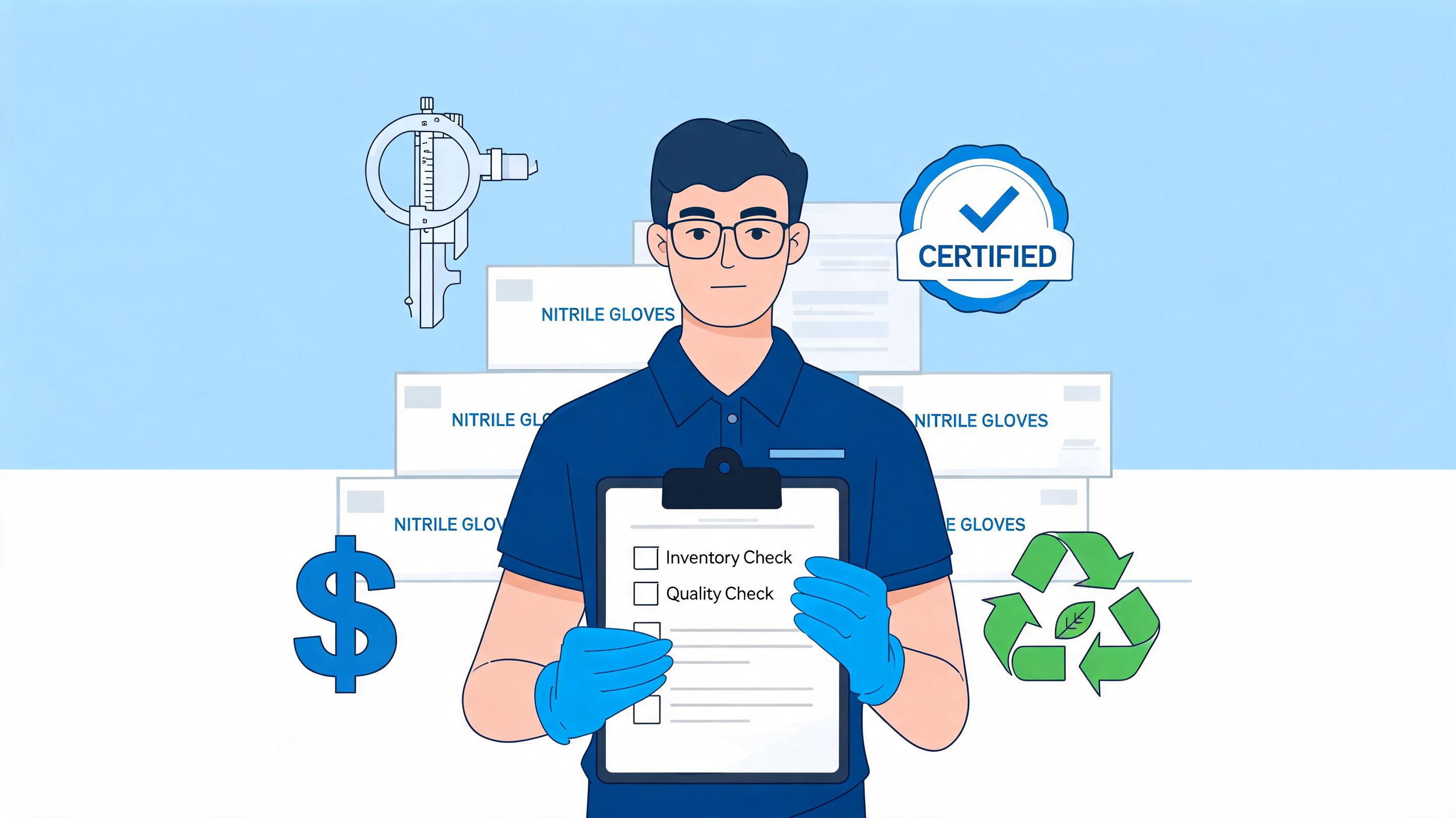
The order usually starts the same way. Someone asks for pricing on a pallet, a case count, or a contract term. Procurement wants a lower per-box number. Supervisors want gloves that don’t split halfway through a wipe-down of locker handles, bathroom fixtures, touchscreens, or vehicle interiors. Frontline staff just want something that fits, grips, and survives contact with disinfectant wipes long enough to finish the task.
That’s why nitrile gloves wholesale decisions deserve more attention than they often get. In busy facilities, gloves aren’t just consumables. They’re part of your cleaning system, your staff protection plan, and your visible hygiene program. If the glove fails, the wipe program slows down, staff change gloves more often, surfaces get skipped, and guests notice the gaps.
Cleanliness in commercial spaces has become operational theater in the best sense of the phrase. People watch what your team touches, how often they wipe it down, and whether staff look prepared. A good wholesale glove strategy supports that standard. A bad one creates waste, delays, and avoidable risk.
Your Next Wholesale Glove Order Is More Than a Line Item
A large glove order looks simple on paper. Count boxes, compare vendors, approve the quote. In practice, that shortcut causes most of the problems.

A gym operator sees gloves as part of a cleaning rotation between members. An airport facilities lead sees them as PPE for fast turn sanitation in high-touch zones. A dealership manager needs them for technicians and detail staff working around cleaners, interiors, and customer-facing surfaces. Same product category, different failure points.
The mistake is buying for unit price instead of use conditions. Thin gloves can look economical until staff start doubling up, replacing torn pairs, or slowing down because grip gets unreliable once the wipe is saturated. On the other side, overbuying premium exam-grade gloves for low-risk dry tasks ties up budget you could use on better disinfectant wipes, training, or inventory depth.
What a strong order actually protects
A smart wholesale order protects more than hands:
- Staff continuity: Teams work faster when gloves don’t tear during repetitive wiping.
- Guest perception: Cleanliness looks more credible when staff use intact, professional-grade PPE.
- Inventory stability: Fewer mid-contract surprises mean fewer emergency substitutions.
- Brand reputation: Consistent visible hygiene supports trust in offices, gyms, retail, and public venues.
I usually tell operators to treat gloves the same way they treat paper goods, chemicals, and liners. They’re a recurring supply, but they also affect service quality. If you’re building a broader supply plan, it helps to review related eco-friendly hygiene products so glove selection sits inside a complete cleaning program rather than a one-off purchase.
The cheapest glove on the spreadsheet often becomes the most expensive glove on the floor.
Where the decision shows up every day
In most facilities, glove performance becomes visible in routine tasks:
- Wiping entry handles and check-in counters
- Disinfecting cardio equipment between users
- Cleaning restroom touchpoints
- Sanitizing restaurant prep-adjacent surfaces
- Turning over shared tools, tablets, clipboards, and payment terminals
When managers connect gloves to those daily moments, the buying decision gets sharper. You stop asking only, “What’s the price per box?” and start asking, “What glove keeps our cleaning standard intact without wasting labor or product?”
Choosing the Right Glove Specs for Your Facility
The fastest way to overspend or underprotect is to buy gloves by color and price alone. Specs matter because they tell you how the glove behaves when your team is wiping, spraying, gripping, flexing, and changing tasks all shift long.

Think of glove specs as hand protection settings. You’re choosing the right balance of dexterity, barrier performance, and endurance for the actual work.
Start with thickness and task type
For wipe-heavy sanitation, thickness is the first filter. For tasks involving chemical disinfectants, select 4-5 mil fingertip thickness. ASTM D6319-10 requires minimum tensile strength of 14 MPa, and an AQL of 1.5 means fewer than 1.5 pinhole defects per 1000 gloves, which reduces cross-contamination risk compared with vinyl, according to the Ontario nitrile glove ASTM standards summary.
That matters in practical terms:
- Front desk and light-duty use: A lighter glove may be acceptable when staff are handling low-moisture tasks and minimal chemical contact.
- Gym and restroom disinfection: Mid-range thickness holds up better against repeated wipe friction and wet surfaces.
- Automotive detailing and heavy sanitation: When staff are working through frequent chemical contact, rough interiors, or extended cleaning cycles, heavier-duty options deserve a look.
A lot of buyers miss this. They assume all nitrile gloves are close enough. They aren’t. The wrong mil thickness shows up as tears around fingertips, reduced grip on wet surfaces, and more glove changes.
AQL, texture, cuff, and finish
AQL is one of the most useful numbers on a spec sheet because it speaks to defect tolerance. If you’re asking staff to disinfect high-touch surfaces all day, pinhole control isn’t a technical footnote. It’s part of your contamination control.
Then look at use details:
| Spec | Why it matters in the field | Best fit |
|---|---|---|
| Texture | Improves grip when wipes, sprayers, and surfaces are damp | Gyms, pools, janitorial carts, auto bays |
| Cuff length | Adds wrist coverage and helps prevent slip-down during repetitive work | Deep cleaning and splash-prone tasks |
| Powder-free | Cleaner handling and less residue risk | Healthcare-adjacent, food-adjacent, guest-facing areas |
| Color | Supports task separation and cleaner presentation | Multi-zone operations |
If you want a visual benchmark for a heavier-duty style used in tougher environments, TGC black nitrile gloves offer a useful reference point for comparing grip, finish, and appearance against standard light-duty house brands.
Match the glove to the wipe workflow
Disinfectant wipes change the equation because they create sustained moisture and chemical contact. That’s different from quick dry handling. Staff aren’t just wearing gloves. They’re flexing them while scrubbing rails, machine handles, steering wheels, counters, and bathroom partitions.
Practical rule: Buy gloves for the longest, messiest, most repetitive sanitation task in the zone, not for the easiest task on the route.
Facilities benefit from task mapping. Split glove use into categories:
- Light-contact tasks such as stocking, check-in support, or brief customer interactions.
- Routine disinfection such as wiping touchpoints, front counters, or classroom desks.
- Extended chemical exposure such as locker room, restroom, equipment, or vehicle sanitation.
If your team uses one glove for all three, choose the spec that protects the middle category well and won’t collapse in the third. If you run multiple departments, consider separate SKUs.
For teams comparing glove types for latex-free operations, this guide on disposable latex-free gloves is a useful companion when building standard issue lists across multiple facility roles.
What works and what doesn’t
What works is boring in the best way. The glove stays on, grips well, survives the wipe cycle, and doesn’t force the employee to think about it.
What doesn’t work:
- Buying solely on box price
- Using one ultra-thin glove for every department
- Ignoring AQL and tensile specs
- Treating “nitrile” as if all nitrile gloves perform the same
- Choosing a glove that looks professional but fails under wet cleaning
A good glove spec reduces waste. Staff use fewer pairs, wipe faster, and maintain a more polished cleaning routine.
Understanding Certifications and Safety Standards
Specs tell you what the glove claims to do. Certifications tell you whether someone credible has defined the test behind that claim. For facility managers, that distinction matters when an inspector asks questions, a client requests documentation, or a staff safety issue lands on your desk.

The standards that deserve attention
ASTM D6319 is one of the key standards to check for nitrile exam gloves. It ties the product to minimum physical property requirements, including strength and elongation. That matters because a glove used with wipes and disinfectants needs to flex repeatedly without splitting.
FDA 510(k) matters when you’re evaluating medical-grade or exam-grade products. According to Nephron’s nitrile glove specifications, FDA 510(k) cleared gloves with elongation of at least 450% after artificial aging can deliver wear-time twice as long as latex under humid conditions, reducing changeout frequency by 35%. The same source notes that prioritizing AQL of 1.5 or lower and minimum length of 240 mm often aligns with both medical and food-contact needs.
That’s not just healthcare language. It’s useful in natatoriums, fitness centers, foodservice-adjacent spaces, and event operations where humidity, moisture, and frequent glove changes create real labor drag.
What to ask a supplier for
Don’t settle for a vague “complies with industry standards” statement. Ask for documents tied to the exact SKU and batch.
Request:
- Spec sheets with thickness, length, and physical properties
- Certification details listing the standard, not just “medical grade”
- Batch or lot documentation when consistency matters across sites
- Clear labeling for powder-free, exam grade, or food-contact suitability
Certification language should reduce ambiguity. If it creates more of it, keep asking questions.
Why this helps beyond compliance
Strong documentation helps in three places. First, it supports safer buying decisions. Second, it gives supervisors confidence that the product belongs in their workflow. Third, it protects the organization when someone challenges whether the PPE issued was fit for purpose.
In real operations, “exam-grade” shouldn’t be a decorative phrase in a catalog. It should connect to a document trail you can verify. That’s what turns a wholesale buy into a defendable one.
A Framework for Calculating Bulk Order Costs
Most buyers compare wholesale glove quotes by box price. That’s easy to do and usually incomplete. The more useful number is cost per successful use.
A glove that survives the full cleaning task costs less in practice than a cheaper glove that tears, slips, or forces an early change. The same logic applies to wipes. A cleaning program performs best when gloves and wipes are selected as a system rather than separate line items.
Build the cost-per-use view
Use a simple internal worksheet with these inputs:
- Unit cost
- Pairs used per shift
- Average glove changes per task cycle
- Task type, especially wipe-heavy versus light handling
- Failure patterns, such as fingertip tears or cuff rollback
- Supplier reliability, including fill rates and lead times
Then compare two realities. The first is the quoted case price. The second is how many glove changes your team makes to finish a standard route. The lower quote doesn’t always win.
Here's a practical way to consider it:
| Buying view | What it misses | What it reveals |
|---|---|---|
| Price per box | Tear rates, extra glove changes, staff slowdown | Only the invoice number |
| Cost per use | Nothing essential if tracked honestly | Labor impact, waste, consistency |
| Cost per cleaned zone | Harder to measure, but useful | Best for high-traffic facilities |
Include supply chain pressure in the calculation
Market conditions also affect your real cost. The global nitrile gloves market was valued at USD 24.78 billion in 2025 and is projected to reach USD 26.61 billion in 2026, while U.S. tariffs on Chinese gloves are projected at 25% by 2026, according to Precedence Research’s nitrile gloves market analysis. For operators buying ahead on contracts, that makes near-shoring options in Mexico and Canada more strategically important.
That isn’t only a sourcing story. It affects budget timing, reorder decisions, and how much inventory cushion you want before peak season or a major event run.
Pair glove economics with wipe performance
The practical math begins. If your team relies on disinfectant wipes for visible, rapid sanitation, glove durability affects how efficiently those wipes get used. Staff who stop to reglove more often break rhythm. Tasks take longer. Open packs dry out. Supervisors start hearing that “the route can’t be completed on time.”
For thorough facility hygiene, we recommend pairing quality gloves with Wipes.com Disinfectant Wipes, especially when you want a stronger visible sanitation routine across guest-facing spaces.
Cheap gloves often create hidden costs in labor, interruptions, and cleaning inconsistency.
A better buying conversation sounds like this: Which glove lets our team finish a standard wipe-down route with fewer interruptions, fewer failures, and steadier presentation? That answer usually leads to a more defensible wholesale decision than the lowest quote alone.
How to Vet Wholesale Nitrile Glove Suppliers
The product matters. The supplier matters just as much. A good glove from an unstable vendor becomes a bad procurement outcome fast.

I’ve seen operators lock in attractive pricing, then spend months dealing with substitutions, vague lead times, or inconsistent box-to-box quality. None of that shows up in the original quote.
Why supply geography matters
The nitrile medical gloves market is valued at USD 6.91 billion in 2026, and North America held 37.20% of revenue in 2025, according to Mordor Intelligence’s nitrile medical gloves market report. That concentration reflects stronger OSHA-driven demand and suggests North American suppliers may offer more geopolitically secure supply chains for wholesale buyers.
For multi-site facilities, secure supply is a service issue. If one location runs out, managers start swapping brands, specs drift, and staff confidence drops.
A supplier checklist worth using
When reviewing vendors, ask sharper questions than “What’s your best case price?”
- Where is the product sourced from: You want clarity on country mix and whether the supplier depends too heavily on one region.
- Can they provide batch-specific paperwork: If not, quality verification gets harder.
- What substitutions are allowed under contract: This should be explicit, not implied.
- How do they handle complaints: Ask what happens when a shipment arrives with defects or inconsistent sizing.
- Do they support recurring forecasting: Strong suppliers want your usage pattern, not just your next PO.
A useful companion when reviewing continuity planning is this article on PPE supply considerations, especially for facilities that can’t afford stockouts in guest-facing operations.
Contract terms that save headaches
Good terms prevent bad surprises. Focus on language around performance, not just price.
Consider negotiating:
| Contract area | What to clarify |
|---|---|
| Delivery windows | Acceptable lead times and backorder communication |
| Quality failure response | Credits, replacement timing, and documentation |
| Spec protection | No substitutions without approval |
| Pricing term | Duration of fixed pricing and review triggers |
A dependable supplier reduces risk before the first box ships.
The best vendors behave like supply partners. They ask about your use case, site count, seasonality, and glove mix by department. The worst vendors push whatever they have available and expect you to adapt your operation around their inventory.
Storage and Disposal Best Practices
A strong buy can still fail in the stockroom. Gloves are sensitive products, and sloppy storage shortens useful life before the box even reaches the cleaning cart.
Storage mistakes that quietly ruin inventory
Heat, sunlight, and poor handling are common problems. So is storing gloves near equipment or areas that create harsh conditions for rubber materials. Once boxes sit too long in the wrong environment, staff start noticing brittleness, sticking, or unexpected tearing.
That matters even more in wipe-heavy operations. A 2025 ISSA report found that 62% of facility managers in hospitality and automotive reported glove failures during disinfection cycles, and standard 4-5 mil nitrile gloves can degrade 30-50% faster under frequent alcohol-based sanitizer contact compared with more durable variants, as cited by Glove America’s nitrile glove overview.
If your staff already puts gloves through frequent sanitizer and disinfectant contact, poor storage only accelerates the problem.
A practical storage routine
Use a simple routine that supervisors can verify:
- Keep cartons in a cool, dry indoor space: Avoid window exposure and hot mechanical rooms.
- Rotate stock by receipt date: Older inventory should move first.
- Protect original packaging: Don’t split cases too early unless you need floor stock.
- Store near point of use carefully: Janitor closets work if they stay dry and aren’t overheated.
- Check box condition during replenishment: Damaged cartons often mean mishandling upstream.
If you’re rethinking how your facility handles overflow supplies, general Orange Box warehousing insights can help operators think through cleaner storage practices and inventory organization.
Disposal without creating more risk
Disposable nitrile gloves should leave the workflow cleanly. Staff need clear bins, consistent change-out rules, and training on when gloves should be replaced rather than “pushed a little longer.”
For most facilities, good disposal practice means:
- removing gloves after the task or zone is complete,
- avoiding cross-zone carryover,
- disposing of used gloves in the appropriate waste stream for the task environment,
- and reinforcing hand hygiene after removal.
The operational point is simple. Disposal is part of contamination control. If staff wear the same pair from restroom cleaning to lobby touchpoints, the glove did not solve the hygiene problem. It moved it.
Putting It All Together A Final Checklist
Good glove procurement gets easier when you stop treating it as a standalone purchase. It belongs inside your facility’s broader cleaning system, alongside disinfectant wipes, training, storage, and replenishment discipline.
Use this checklist before the next order goes out.
The procurement checklist
- Define the use case: List which teams use gloves for light handling, wipe-based disinfection, and heavier chemical contact.
- Choose specs by task: Match thickness, texture, cuff length, and powder-free requirements to the job rather than buying one generic glove for everyone.
- Verify documentation: Ask for current spec sheets and certification details tied to the exact product.
- Model cost per use: Compare not only quote price, but also glove changes, task interruptions, and likely waste.
- Review supplier resilience: Check sourcing stability, substitution policies, and complaint handling.
- Plan storage before delivery: Make sure cartons will be kept in conditions that protect the product.
- Train staff on use and disposal: A high-quality glove still fails if people use it across incompatible zones or keep it on too long.
What smart buyers keep in view
The strongest facilities don’t separate cleanliness from operations. They connect them. They know that wipe protocols, glove integrity, and visible staff habits all shape guest confidence.
That matters in gyms, offices, schools, retail, restaurants, event spaces, dealerships, and any public-facing environment where people notice whether your standards look real or improvised.
Buy gloves the way you buy any operational safeguard. According to the task, the risk, and the reputation you need to protect.
When you’re ready to tighten your hygiene program, prioritize glove quality, strengthen your disinfectant wipe routine, and make daily sanitation easier for staff to execute consistently. For more practical guidance, visit WipesBlog.com and consider integrating disinfectant wipes into your routine or product offering so cleanliness stays visible, repeatable, and credible.
Leave a Reply