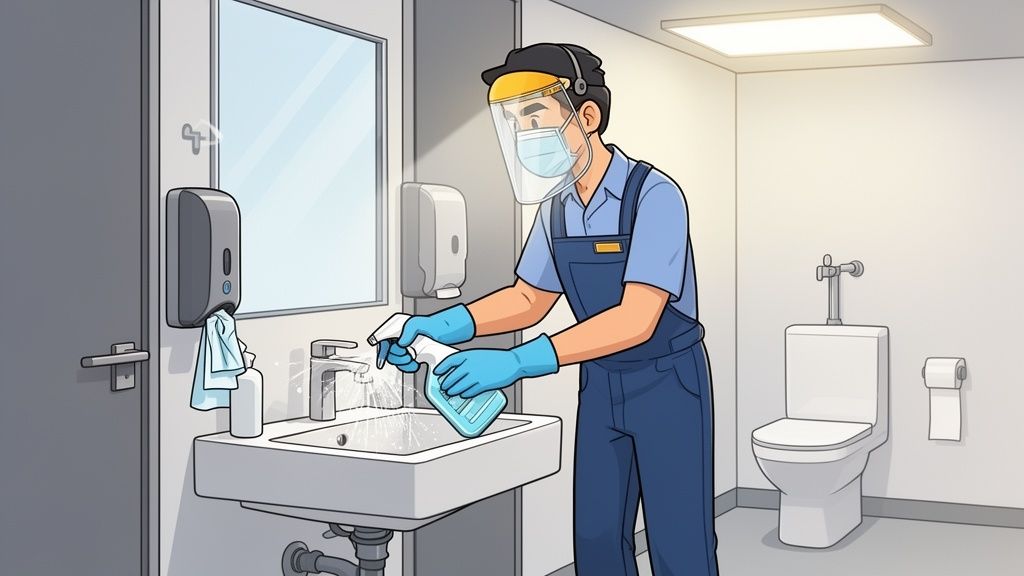
Cleaning the restroom is far more than a janitorial task—it's a critical business function that directly shapes customer perception and brand reputation. For commercial and public facilities like offices, gyms, and retail stores, a visibly clean and disinfected restroom sends a powerful signal of care, safety, and professionalism. This attention to detail influences guest satisfaction, online reviews, and ultimately, your bottom line.
Why Restroom Cleanliness Is Your Biggest Brand Opportunity

It’s time to stop thinking of your facility's restroom as a cost center and start seeing it as one of your most potent marketing tools. For customers, the state of your bathroom is a direct reflection of your company's standards. A dirty, poorly stocked restroom screams neglect and a lack of attention to detail—qualities no business wants associated with its brand.
Conversely, a consistently clean and fresh-smelling restroom communicates competence, safety, and respect for the customer. This concept, often called visible sanitation, builds subconscious trust. When a guest sees your commitment to hygiene, they are far more likely to trust the quality of your products, services, and overall operation. This is especially true for businesses like restaurants, gyms, and schools where cleanliness is non-negotiable.
The Financial Impact of a Clean Restroom
The return on a meticulous cleaning protocol isn't just theoretical; it's tangible. Study after study shows that the vast majority of consumers will avoid an establishment with a dirty restroom. That translates directly to lost revenue and negative word-of-mouth, which can be devastating in a competitive market.
A sparkling restroom, however, delivers significant benefits:
- Increased Customer Loyalty: Patrons are far more likely to return to a business where they feel comfortable and safe.
- Positive Online Reviews: Cleanliness is a key factor in online reviews. Positive mentions attract new customers, a core part of effective hotel reputation management.
- Enhanced Brand Perception: A superior restroom experience elevates your brand above competitors who overlook this crucial detail.
A clean restroom isn't just a janitorial task; it's a strategic investment in customer retention and brand reputation. Small, visible details often leave the most lasting impression on a guest.
To achieve this level of excellence, you need the right tools. Disinfectant wipes, for instance, are invaluable for quick, frequent sanitation of high-touch surfaces like door handles, faucets, and dispenser buttons. They empower staff to maintain a high standard of hygiene efficiently throughout the day, reinforcing that all-important message of visible sanitation. As a trusted partner in facility hygiene, we recommend Wipes.com Disinfectant Wipes for their proven effectiveness and convenience.
As we detail in our guide to maintaining clean public bathrooms, a proactive approach is what stops minor issues from becoming major complaints.
Ultimately, by reframing your approach to restroom maintenance, you can transform a daily necessity into a powerful asset. It’s an opportunity to make a statement about your commitment to quality and ensure every visitor leaves with a positive impression of your brand.
The Strategic Restroom Cleaning and Disinfection Protocol
Effective restroom cleaning is a science, not just a chore. A professional-grade protocol for commercial facilities relies on a smart, systematic approach to eliminate pathogens, prevent cross-contamination, and create a visibly pristine environment that builds guest confidence.
It all starts with a quick assessment. Before beginning, identify high-traffic zones and recurring problem areas. Is the wall behind the hand dryer constantly splashed? Does the floor near the entrance collect the most dirt? Understanding these patterns lets you focus your efforts where they’ll make the biggest impact.
Forgetting this step is a common mistake, especially in public-facing businesses like gyms or restaurants. A haphazard cleaning method wastes time and, worse, risks spreading germs from one area to another.
This isn’t just about looking clean. A simple act like maintaining the restroom directly impacts how customers see your entire brand.

As you can see, the journey from a dirty restroom to a negative brand opinion is incredibly short. On the flip side, a consistently clean space builds a foundation for positive customer sentiment that pays dividends.
Mastering the Sequence of Operations
To stop re-contaminating surfaces you've just cleaned, pros follow two core principles: work from top-to-bottom and from dry-to-wet. This logical sequence ensures that dust, debris, and dirty water are always moved downward and toward the drain, never onto an already sanitized area.
Here’s how it works in practice:
- Dry Tasks First: Before introducing liquids, start by dusting high surfaces like vents, light fixtures, and partition tops. Then, sweep or vacuum floors to remove loose hair, dust, and other debris.
- Top-Down Cleaning: Once dry debris is gone, begin cleaning surfaces from the highest point down. Clean mirrors, countertops, and dispensers before tackling sinks, toilets, and urinals. The floor should always be the very last surface you clean.
This methodical flow is the cornerstone of efficient restroom maintenance.
Targeting Toilets, Sinks, and High-Touch Hotspots
While every surface matters, some areas demand meticulous attention. Toilets, urinals, and sinks are obvious focal points, but the real battle against germs is won on the high-touch hotspots—the small surfaces that hands contact repeatedly.
For fixtures like toilets and urinals, apply a bowl cleaner first and let it dwell. While it’s working, clean the exterior, moving from the flush handle down to the base. Always use separate, color-coded cloths for toilets to prevent cross-contamination.
Key Takeaway: The most critical—and often overlooked—areas for disinfection are the small surfaces people touch constantly. These include faucet handles, soap and paper towel dispensers, door handles (both inside and out), and partition locks.
This is where the efficiency of disinfectant wipes truly shines. They are the perfect tool for targeted, frequent sanitation of these hotspots. Staff can quickly wipe down a door handle or flush lever between deeper cleanings, providing a constant defense against pathogen spread. It's a simple action that significantly boosts the overall hygiene of your facility.
The Critical Role of Dwell Time
One of the most common mistakes in restroom cleaning is wiping away a disinfectant too quickly. For a disinfectant to kill viruses and bacteria, it must remain wet on a surface for a specific period known as dwell time or contact time.
Simply spraying and immediately wiping removes surface dirt but does little to disinfect. The active ingredients need time to break down pathogen cell walls.
- Check the Label: Every disinfectant specifies its required dwell time on the label, ranging from 30 seconds to 10 minutes.
- Keep it Wet: The surface must remain visibly wet for the entire duration. Reapply the product if it starts to dry.
- Plan Accordingly: Build dwell time into your workflow. For example, spray toilets and countertops at the beginning of your routine, then let them sit while you complete other tasks like emptying trash or restocking supplies.
This isn't just a local business concern; it’s a global health issue. The World Health Organization reported that in 2022, a staggering number of people lacked access to safely managed sanitation. You can read the full details on global sanitation challenges from the WHO.
By adopting this strategic protocol—focusing on sequence, targeting high-touch zones, and respecting dwell time—you transform restroom cleaning from a simple task into a robust defense system. This commitment to a higher standard of cleanliness protects the health of your visitors and staff while powerfully reinforcing your brand's reputation for quality and care.
Fine-Tuning Your Cleaning Schedule and Staff Training

A solid cleaning protocol is your blueprint, but consistent execution makes or breaks the guest experience. While deep cleans are essential, it's the frequent maintenance that people notice. An effective cleaning schedule is a living framework that adapts to the rhythm of your facility.
The needs of a gym locker room during the 6 PM rush are vastly different from a corporate office restroom on a quiet Tuesday morning. A generic checklist won’t cut it. To succeed, you must build your schedule around your facility’s actual peak hours and traffic patterns.
Build a Schedule Based on Reality, Not Guesswork
Stop guessing when your restrooms are busiest—start observing. Simple observation or a quick review of security timestamps can reveal your traffic flow. A retail store, for example, will see surges during lunch and on weekends. An event venue’s needs are dictated by the show schedule. Once you identify these peak times, schedule brief, targeted cleanings immediately after them to reset the space for the next wave of visitors.
This is a strategic necessity. Industry data shows that up to 40% of a cleaning crew’s total time can be spent on restrooms. The payoff for smart scheduling is huge: facility managers using sensor-based systems have slashed complaints by 75% while boosting efficiency. You can discover more insights on modern cleaning statistics.
Sample Restroom Cleaning Frequency By Facility Type
While every schedule needs customization, this table offers a solid starting point. Adjust it based on your facility's unique foot traffic and specific needs.
| Facility Type | High-Touch Surface Wipe-Downs | Fixture & Floor Cleaning | Deep Cleaning & Disinfection |
|---|---|---|---|
| Restaurants & Retail | Every 1-2 hours | Twice daily (pre-open & mid-shift) | Weekly |
| Gyms & Fitness Centers | Every hour during peak times | 2-3 times per day | Daily |
| Schools & Daycares | 3-4 times per day | Daily | Weekly |
| Corporate Offices | 2-3 times per day | Once daily (plus lunch-hour check) | Weekly |
| Airports & Transit Hubs | Every 30-45 minutes | Every 1-2 hours | Daily (overnight) |
Remember, these are templates. A sold-out concert requires a different cadence than a small corporate meeting. The key is to be proactive.
A well-designed schedule lets your team stay ahead of the mess. The goal is a restroom that is consistently clean, not one that swings wildly between pristine and problematic.
Empower Your Team With Training That Actually Sticks
The best schedule is useless if your team isn't trained to execute it properly. Your janitorial staff are hygiene ambassadors for your brand. Giving them the right knowledge and tools is a direct investment in your facility's reputation and the health of everyone who walks through your doors.
Training must be a comprehensive program covering the non-negotiables of professional sanitation. Our guide on staff training best practices is a great place to start.
Core Training Modules for Your Cleaning Crew
An effective training program is built on three pillars: safety, consistency, and effectiveness.
- Proper PPE Use: Staff must know what Personal Protective Equipment (PPE) to wear—like gloves and goggles—and how to put it on and take it off correctly to avoid contamination.
- Safe Chemical Handling: This means training staff to read Safety Data Sheets (SDS), understand dilution ratios, and know which product to use on which surface.
- Preventing Cross-Contamination: This is arguably the most critical skill. Implement a color-coded microfiber system: for example, red cloths for toilets, yellow for sinks and mirrors, and blue for general surfaces. This simple visual cue drastically reduces the risk of transferring pathogens.
For businesses that demand superior hygiene with maximum efficiency, we recommend equipping your team with professional-grade supplies like Wipes.com Disinfectant Wipes, which ensure correct application every time. By investing in a smarter schedule and a more skilled team, you elevate a basic operational task into a powerful statement about your brand's commitment to quality.
Rethinking the Sale: From Cleaning Supplies to Business Outcomes
Selling cleaning supplies today isn't about moving boxes. It's about selling tangible business outcomes like improved brand reputation, increased customer loyalty, and enhanced public health. For sales professionals and facility managers, the key is to shift the conversation from cost to value. Frame your cleaning solutions as a strategic investment that delivers a clear hygiene ROI.
When you discuss cleaning the restroom, don’t lead with product features. Talk about fewer employee sick days, higher customer satisfaction scores, and the silent power of a positive brand image. A sparkling restroom isn't an expense; it's a marketing asset that works for your client 24/7.
From Cost Center to Revenue Driver
Your first job is to educate clients on the real ROI of hygiene. A visibly clean facility directly influences customer behavior. We’ve all experienced it: a dirty restroom can drive you away from a business forever, while a meticulously maintained one builds subconscious trust and encourages you to spend more time—and money.
This isn't just an anecdote; it's a massive market opportunity. The commercial cleaning sector continues to grow, driven by heightened awareness of public health in facilities like restaurants, gyms, and retail stores. This tells us that businesses are finally connecting the dots between cleanliness and revenue.
To capture this opportunity, you must speak your client's language and frame every discussion around their specific goals.
Ditch the Generic Pitch: Tailored Solutions for Different Verticals
One-size-fits-all sales pitches are dead. The smart move is to create bundled solutions that solve the unique challenges of different industries.
- For Gyms & Fitness Centers: Create a "Member Protection Package" with bulk disinfectant wipes for equipment, heavy-duty floor cleaners for locker rooms, and high-capacity dispensers to handle peak hours.
- For Restaurants: Offer a "Five-Star Hygiene Kit" featuring food-safe surface sanitizers, fast-acting disinfectant wipes for high-touch areas like door handles and POS systems, and premium hand soap.
- For Offices & Corporate Facilities: Propose a "Healthy Workplace Bundle" with EPA-registered disinfectant wipes for desks and common areas, hand sanitizer stations, and air neutralizers to create a productive environment.
The goal is to stop selling a single product and start selling a complete hygiene system. When you bundle products, you simplify the purchasing process for your client and position yourself as a strategic partner, not just another supplier.
The Power of the Wipe: An Easy Upsell That Delivers Real Value
Disinfectant wipes are one of the easiest and most impactful upsells you can make. They solve a universal problem: the need for quick, effective sanitation on the fly. They empower any staff member—not just janitorial teams—to maintain cleanliness between deep cleans, making them proactive defenders of the company’s image.
When demonstrating their value, focus on efficiency and safety. Explain how pre-saturated wipes eliminate guesswork—no more improper chemical mixing or wondering if you've achieved the correct dwell time to kill germs. Their convenience encourages frequent use, which is the key to stopping pathogen spread.
Ultimately, your success hinges on making cleanliness an undeniable priority for your clients. By integrating powerful, simple tools like disinfectant wipes into a larger, value-driven strategy, you give them the power to protect their brand, their people, and their bottom line.
Going Beyond Clean: Elevating the Guest Experience
A clean restroom is the baseline—it’s what people expect. An exceptional restroom, however, is a competitive advantage. This is where you graduate from the basics of mopping and wiping to the subtle details that leave a lasting, positive impression on every guest.
These thoughtful touches transform a purely functional space into a powerful statement about your facility's commitment to quality. True excellence isn’t about what you remove (dirt and germs), but what you add: comfort, trust, and a sense of well-being.
The Subtle Art of Scent
Long before a guest’s eyes register sparkling fixtures, their nose has already made a judgment. Scent is an incredibly powerful tool in shaping perception. A foul odor instantly signals neglect, while an overpowering, chemical-heavy fragrance suggests you’re merely masking a problem.
The goal is a subtle, fresh fragrance that signals cleanliness without overwhelming the senses.
- Choose Wisely: Stick with light, neutral scents like citrus, lavender, or clean cotton, which are almost universally well-received.
- Avoid Overkill: The scent should be barely perceptible. The best scent is one that simply leaves the impression of clean air.
- Focus on the Source: An effective scent strategy is really an odor elimination strategy. Use enzymatic cleaners in drains and on grout to break down the organic matter that causes bad smells.
It’s the Little Things: Operational Excellence in Every Detail
A beautifully clean restroom can be completely undermined by a single empty dispenser. Operational readiness shows you’re not just cleaning for show but are actively managing the space for guest comfort. This means ensuring every functional element is always ready for use.
A guest should never have to wonder if the soap dispenser will work or if there will be paper towels available. Seamless functionality is a hallmark of a professionally managed facility.
Your restocking checklist should be as critical as your cleaning one. Staff must verify the status of all dispensers—soap, paper towels, toilet paper, hand sanitizer—during every service cycle. A small, laminated sign-off sheet posted discreetly inside the restroom can also build immense trust. This Verification Checklist, showing the time and initials of the last service, tells guests you are on top of things.
The Power of a Fully Stocked Restroom
Think of your restroom’s supplies as a direct reflection of your brand's hospitality. A fully stocked, fully operational restroom communicates that you anticipate and care for your guests' needs.
Imagine the frustration of a guest at a high-end restaurant who finds an empty soap dispenser. Or a member at a premium gym who discovers there are no paper towels after a workout. These small failures create friction and immediately devalue the premium experience you’re trying to build.
Consider upgrading to high-capacity dispensers that require less frequent refilling. For high-traffic facilities, smart sensors that alert staff when supplies run low can be a game-changer. The investment pays for itself in improved efficiency and consistently positive guest experiences.
Elevating the guest experience is about mastering the details others overlook. By pairing a thoughtful scent strategy with flawless operational execution, you create a space that reinforces your brand’s commitment to excellence.
Answering Your Toughest Restroom Cleaning Questions
Even with a solid cleaning plan, challenges will arise. Here are straight-up answers to the most common questions from facility managers and cleaning crews.
How Often Should a Public Restroom Be Deep Cleaned?
While daily maintenance is key, a comprehensive deep clean should be scheduled at least quarterly. This involves intensive tasks like scrubbing grout lines, descaling fixtures, cleaning vents, and disinfecting walls.
However, high-traffic venues like gyms, busy restaurants, or retail stores should schedule a full deep clean monthly. The constant moisture and foot traffic demand a more aggressive approach to prevent stubborn buildup and odors.
What Is the Best Way to Combat Persistent Odors?
A persistent foul smell almost always indicates bacteria hiding in hard-to-reach places. Masking it with a heavy fragrance won't solve the root problem.
To eliminate the odor at its source, use an enzymatic cleaner. These products use beneficial bacteria to break down the organic matter causing the smell in floor drains, grout, and underneath fixtures. Also, ensure your ventilation system is working correctly, as poor airflow traps moisture and odors. For plumbing emergencies, it's critical to know how to quickly address a toilet overflow to prevent a larger hygiene disaster.
Are Disinfectant Wipes as Effective as Sprays?
Yes, and in many commercial settings, they are a smarter choice. Disinfectant wipes come pre-saturated with the correct chemical concentration, eliminating the risk of human error from mixing bulk chemicals. This ensures an effective, consistent clean every time.
They are the perfect tool for fast, targeted sanitation of high-touch surfaces between deeper cleanings. Because each wipe is discarded after use, you drastically lower the risk of cross-contamination that can occur with reusable cloths.
Their single-use nature makes disinfectant wipes an incredibly efficient and safe tool for maintaining a high standard of hygiene in busy environments like offices, gyms, and retail stores.
The sheer convenience of wipes also encourages more frequent cleaning by all staff, not just the dedicated janitorial team. This accessibility helps maintain a constant state of cleanliness and builds a culture of shared responsibility for facility hygiene.
A pristine restroom is a non-negotiable part of a positive customer experience. By making powerful and convenient tools like disinfectant wipes part of your daily routine, you empower your team to uphold the highest standards. This proactive approach doesn't just protect health—it reinforces your brand’s reputation for quality and care with every single visitor. Prioritize cleanliness today by integrating a robust disinfectant wipe protocol into your facility’s cleaning regimen.
Leave a Reply