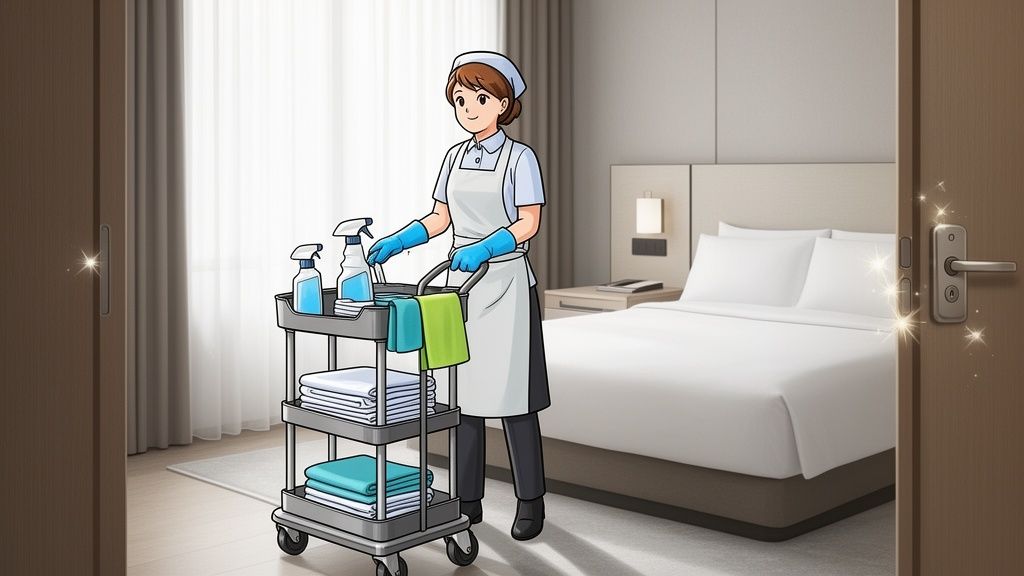
When it comes to cleaning rooms in hotels and other public facilities, there's no room for error. This isn't just about tidying up; it's a critical process that shapes how a guest or customer feels about your business and whether they'll return. A perfectly clean and disinfected space is a silent promise of safety, care, and quality. Get it right, and you'll see it in your reviews and repeat business. But miss one detail? That's a broken promise, and the negative feedback can sting your bottom line.
Why Cleanliness Defines the Customer Experience
In any commercial setting—from hotels and gyms to offices and retail stores—cleanliness is your best and most honest marketing. It tells customers their well-being is your top priority. The days of a tidy space being a simple expectation are long gone. Today, it’s a non-negotiable standard that consumers actively look for and judge you on.
Imagine a guest walking into a hotel room or a client entering your office. When it’s spotless, disinfected, and smells fresh, you can almost feel their shoulders relax. That immediate sense of relief and confidence sets the tone for their entire experience, turning a simple visit into a positive interaction. This obsession with hygiene isn't a fad; it’s a fundamental shift in what consumers value.
From Cost Center to Revenue Driver
It’s easy to look at cleaning as just another operational cost, but that’s a huge mistake. Think of it as a direct investment in your brand’s reputation and your customer's happiness. When you frame it that way, the returns on hygiene become obvious.
Exceptional cleanliness and disinfection pay you back in several ways:
- Builds Unbreakable Trust: A visibly clean environment makes people feel safe and genuinely cared for. Using disinfectant wipes on high-touch surfaces takes this a step further, building a deep sense of trust that no fancy amenity can replicate.
- Generates Positive Online Reviews: "Cleanliness" is one of the most common keywords in reviews for hotels, gyms, and restaurants. A spotless facility is a straightforward path to 5-star ratings.
- Justifies Premium Rates: Customers are absolutely willing to pay more for a service or stay at a facility they believe is hygienic and safe. Consistent, flawless cleanliness gives you the power to command higher rates without pushback.
A customer might not remember every detail of their visit, but they will always remember how the environment made them feel. A flawlessly clean space communicates respect and care, turning a one-time visitor into a loyal advocate for your brand.
At the end of the day, every minute your team invests in perfecting the process for cleaning your facility pays off. You'll see it in customer loyalty, glowing reviews, and a stronger, more resilient brand that people trust.
Building an Efficient Cleaning Workflow
A truly exceptional customer experience is built on a foundation of consistency, and that consistency comes from a well-designed workflow. Moving beyond a simple to-do list to a structured, repeatable system is what separates adequate cleaning from five-star service when cleaning rooms in hotels or maintaining any public space. This process isn't just about tidying up; it's a strategic sequence designed for maximum efficiency, safety, and impact.
The secret to effective cleaning hinges on a predictable flow that prevents cross-contamination and ensures no detail is overlooked. It begins the moment a staff member starts a task and ends with a final, critical inspection. A standardized workflow empowers staff, reduces errors, and guarantees every visitor receives the same high standard of care.
The connection between a clean facility and a happy customer is direct and powerful. Get the environment right, and you build the trust that leads to those coveted five-star reviews.

This visual just hammers it home: meticulous cleaning and disinfection directly translate into building the customer confidence that fuels your online reputation.
The Foundational Steps of an Effective Workflow
The professional standard for cleaning follows a logical progression that minimizes wasted movement and maximizes hygiene. It starts with preparation—creating a clean slate before any actual cleaning begins.
First, ensure proper ventilation by opening windows or using air purifiers where appropriate. This simple step immediately begins to refresh the space, circulating stale air out and bringing fresh air in, which makes a huge difference in the final impression of cleanliness.
Next, it’s time to declutter and strip the area. Gather all trash and used linens (in a hospitality setting) and place them in designated receptacles. This "clearing" phase is critical; it removes the primary sources of dirt and germs before you start wiping down surfaces with disinfectant wipes, preventing them from being spread around.
Implementing the Top-to-Bottom Method
Once the area is cleared, the core cleaning begins, always following the top-to-bottom rule. This principle is cleaning 101 for a reason—it's just plain efficient. Dust and debris fall downward, so by starting with the highest surfaces, you ensure you only have to clean each surface once.
- High Dusting: Start by dusting high-level fixtures like ceiling fans, light fixtures, and the tops of shelves or cabinets.
- Surface Wiping: Move down to surfaces like desks, counters, tables, and equipment. This is the perfect time to use disinfectant wipes on high-touch points.
- Finishing with Floors: The final step is always vacuuming or mopping the floors, which collects any dust or particles that have settled during the cleaning process.
By sticking to a top-to-bottom, dry-to-wet sequence, staff avoid doing the same work twice. If you dust shelves after wiping the table below, you'll just have to wipe the table again. A systematic approach saves precious minutes.
Below is a quick overview of how these phases fit together in a standard operating procedure.
Standard Facility Cleaning Workflow
| Phase | Key Actions | Pro Tip for Efficiency |
|---|---|---|
| 1. Entry & Prep | Announce presence, prop door open if safe, ventilate, visually assess the area. | Turn on all lights upon entry to spot any maintenance issues immediately. |
| 2. Stripping/Clearing | Gather all trash and remove used items (linens, towels, etc.). | Place trash bags near the exit to avoid dragging them through a clean space later. |
| 3. High Dusting | Dust all surfaces from top to bottom, starting with high fixtures. | Use a microfiber cloth, which traps dust instead of just moving it around. |
| 4. Surface Cleaning & Disinfection | Wipe down all surfaces. Use disinfectant wipes on high-touch areas. | Let disinfectant sit for the required contact time (dwell time) for maximum effectiveness. |
| 5. Task-Specific Cleaning | Address area-specific needs (e.g., bathrooms, kitchenettes, gym equipment). | Use color-coded cloths for different zones (e.g., blue for general, red for bathrooms) to prevent cross-contamination. |
| 6. Restocking | Replenish all necessary supplies: paper towels, soap, amenities. | Have an organized caddy with pre-counted supplies to speed up the process. |
| 7. Floors | Vacuum carpets or mop hard floors, starting from the furthest corner toward the door. | For mixed flooring, vacuum first to prevent tracking debris onto a wet floor. |
| 8. Final Inspection | Do a final walkthrough. Check for missed spots, adjust items, check for fresh scent. | View the area from a customer’s perspective. Does everything look perfect? |
This workflow isn't just a checklist; it's a proven system for delivering consistent quality efficiently.
Facility-Specific Suggestions
Different facilities have unique needs. In an office, focus on shared spaces like conference rooms and kitchens. For a gym, prioritize the disinfection of equipment grips, weights, and locker room benches. A retail store should pay extra attention to checkout counters and door handles. Tailoring your workflow to your facility type is key.
Of course, an efficient workflow is also about safety. To ensure proper handling of all cleaning and disinfection products, it's essential your team is well-versed in mastering safety data sheet compliance. A few minutes standardizing your process can boost productivity without sacrificing quality.
A Practical Guide to High-Touch Surface Disinfection
A visually clean room is the price of entry, but true customer safety is in the details you can’t see. Cleaning is for show—it gets rid of the visible dirt and grime. Disinfection is for health. It’s the non-negotiable step that eliminates harmful pathogens like bacteria and viruses.
When it comes to maintaining public spaces like cleaning rooms in hotels, offices, or gyms, zeroing in on high-touch surfaces isn't just a best practice. It’s your core responsibility. These surfaces are what customers interact with constantly, making them the fast track for germ transmission. A quick wipe-down won't cut it. These areas demand a methodical approach, and using quality disinfectant wipes is one of the most effective ways to ensure they are truly sanitized.

Identifying the Key High-Touch Hotspots
Every facility has a predictable list of surfaces that need meticulous attention during every cleaning cycle. A rock-solid disinfection plan starts with a clear, consistent checklist that leaves zero room for guesswork.
Train your team to hit these items without fail:
- Electronics & Controls: TV remotes, keyboards, light switches, thermostat controls, and elevator buttons.
- Handles and Knobs: This means all of them—entry doors, bathroom doors, cabinet pulls, and equipment handles in gyms.
- Common Area Surfaces: Countertops, reception desks, coffee makers, and water cooler buttons.
- Bathroom Fixtures: Faucet handles, toilet flush levers, and paper towel dispensers are absolute musts.
Don't stop there. Think about the less obvious things customers handle, like payment keypads in retail or shared tools in an office. Using a disinfectant wipe on each of these points is an efficient hack to ensure thoroughness.
The goal is to get past "looking clean" and graduate to a state of being hygienically safe. The real difference is knowing that the most dangerous germs love to hang out on the surfaces that look spotless.
Mastering Dwell Time for True Disinfection
Here’s the single most important—and most frequently botched—part of disinfection: dwell time. This is the amount of time a disinfectant needs to stay visibly wet on a surface to actually kill the pathogens listed on its label. If you just wipe and immediately dry, you're not disinfecting.
Disinfectant wipes make this easy. The wipe applies the solution and keeps the surface wet for the necessary period. Your team must respect the product-specific dwell time, which can be anywhere from 30 seconds to 10 minutes. This info is always printed right on the label.
An efficiency hack is to wipe down a series of surfaces in sequence. For example, wipe the light switch, then the doorknob, then the thermostat. By the time you’ve finished the last item, the dwell time on the first is likely complete. This methodical approach ensures true disinfection without slowing down the workflow.
Sales Tips for Cleaning Professionals
If you're selling cleaning supplies, educating your clients on the ROI of hygiene is your secret weapon. You're not just selling disinfectant wipes; you're selling customer confidence and safety.
Here’s how you can frame that conversation:
- Educate on Dwell Time: Explain that not all disinfection is created equal. Show them how pre-moistened disinfectant wipes make it ridiculously easy for staff to nail the proper dwell time, ensuring compliance and effectiveness.
- Promote the Hygiene ROI: Frame the purchase of quality disinfectant wipes as an investment in their brand reputation and risk management. Fewer complaints about cleanliness and a lower risk of illness spreading protect their bottom line.
- Incorporate into a Full Package: Position disinfectant wipes as a must-have part of a complete cleaning supply offering. Show how integrating them simplifies training and guarantees consistency across their entire property, whether it's an office, gym, or hotel.
A robust disinfection strategy is a pillar of modern business operations. By focusing on high-touch surfaces, respecting dwell time, and using products that simplify the process, you create a safer, more trustworthy environment that earns positive reviews and repeat business.
Turnover Cleans vs. Deep Cleans Explained
In professional cleaning, not all cleaning is created equal. A facility’s needs shift depending on usage, the time of year, and your long-term maintenance goals. If you want to run an efficient and profitable operation, you’ve got to master the difference between a daily turnover clean and a periodic deep clean.
Think of a turnover clean as the standard, high-tempo process your team performs between guest stays in a hotel or daily in an office. The goal is to get that space back to pristine, customer-ready condition fast. This clean is all about high-impact tasks, visible perfection, and disinfecting high-touch surfaces to ensure safety.
A deep clean, on the other hand, is a much more intensive, top-to-bottom project. It's scheduled periodically, maybe once a quarter or during a slow season, to tackle the built-up grime and wear that daily turnovers just can’t get to. This is what preserves your assets and stops small issues from becoming big, expensive problems.
The Anatomy of a Turnover Clean
A turnover clean is a sprint, not a marathon. It’s all about speed and precision. The checklist is a tightly choreographed routine focused on hitting every essential task needed to make the space look and feel brand new for whoever is coming in next.
Here’s what a standard turnover clean looks like in action:
- Clear & Strip: First thing's first—get all trash, used items, and clutter out of there.
- Disinfect High-Touch Surfaces: This is non-negotiable. Using disinfectant wipes on light switches, remotes, door handles, and countertops is a fast and effective method.
- Clean Key Areas: Sanitize bathrooms from top to bottom, wipe down kitchenettes, and tidy common areas.
- Restock Amenities: Replenish all the essentials—toiletries, coffee, paper products, and any other required supplies.
- Final Touches: A thorough vacuum or mop of the floor, followed by one last visual scan to catch anything that was missed.
To keep your team consistent, it’s smart to formalize the process. Resources like a detailed hotel housekeeper checklist or an apartment turnover cleaning checklist can be adapted for any facility, as the principles of preparing a space for a new user are universal.
When to Schedule a Deep Clean
A deep clean is where you go beyond the surface. This is a project-level clean that involves moving furniture, scrubbing grout, and tackling long-term maintenance items that daily cleaning just doesn’t have time for. It’s absolutely essential for maintaining the quality and extending the life of your property.
A deep cleaning checklist gets into the nitty-gritty:
- Shampooing carpets and upholstered furniture.
- Washing windows and cleaning light fixtures.
- Cleaning behind heavy furniture and appliances.
- Scrubbing baseboards and removing scuff marks from walls.
- Descaling faucets and showerheads.
- Cleaning out the gunk from inside air conditioning vents.
The game has changed since the pandemic. With heightened awareness of hygiene, checkout cleans in hotels are often dealing with rooms that are significantly dirtier. This new reality makes a well-planned deep cleaning schedule more critical than ever to manage your team’s workload and keep standards high across all commercial facilities.
The best time to schedule these deeper cleans is during slower periods. This gives your team the time they need to truly restore each area to peak condition without disrupting daily operations.
For consistently excellent results, we recommend Wipes.com Disinfectant Wipes. They're tough enough for the detailed work of a deep clean but also perfect for the rapid disinfection required in daily turnovers. You can check out their professional-grade options over at https://www.wipes.com.
By strategically balancing swift turnover cleans with periodic deep cleans, you create a sustainable system that keeps customers happy, protects your property, and sets your team up for success.
Using Quality Assurance to Guarantee Consistency
A great cleaning plan is only as good as its execution. You can have the most detailed SOP in the industry, but if it isn't followed flawlessly every single time, it’s just a document on a shelf. This is where a solid quality assurance (QA) program comes in, transforming your standards into a lived reality for every customer who walks through the door.
Think of QA not as a way to punish mistakes, but as a constructive tool for guaranteeing consistency. When you systematically inspect rooms or common areas, you catch the small stuff before it snowballs into a negative review. More importantly, you start to see patterns that point to a need for retraining, empowering your team with objective feedback that actually helps them improve. It’s how cleaning shifts from a simple cost center to a data-driven department focused on elevating the entire customer experience.
Building Your QA Inspection Checklist
The bedrock of any good QA program is a comprehensive inspection checklist. This becomes the single source of truth for what a "perfectly clean" space looks like at your property. It needs to be detailed enough to cover all the critical points but simple enough for a supervisor to complete efficiently.
A strong checklist moves beyond just ticking boxes for "clean" or "dirty." It breaks the area down into logical zones and specific items.
- Entry and Ambiance: First impressions matter. Does the area smell fresh the moment the door opens? Is the lighting appropriate?
- General Zone: Are all surfaces dust-free? Have all high-touch surfaces like light switches and door handles been visibly cleaned and disinfected?
- Bathroom Zone: Are the fixtures polished, shining, and free of water spots? Is the grout clean? Has the toilet been sanitized?
- Amenities and Supplies: Are all required items—paper products, soap, stationery—fully stocked and arranged neatly?
This is just a starting point, of course. For a more exhaustive template you can tailor to your facility, a detailed housekeeping checklist for hotel rooms offers a comprehensive and customizable framework.
Leveraging Technology for Better Insights
Paper checklists get the job done, but technology offers a much more powerful way to track performance and spot trends. Modern QA programs run on handheld devices or tablets loaded with inspection apps. This lets supervisors log results in real-time, snap photos of any issues, and automatically generate reports without shuffling a single piece of paper.
This data-driven approach is a total game-changer. Instead of relying on gut feelings, you can use hard data to pinpoint specific challenges. Is one team member consistently missing the dust on top of picture frames? Are multiple staff members struggling with leaving streaks on glass? These insights allow you to provide targeted, constructive feedback and training right where it's needed most.
The real power of QA technology isn't just in catching one-off errors; it's in uncovering operational patterns. When you see that a certain task consistently takes longer than planned or is frequently missed across the entire team, you’ve just found a process or training gap that needs a system-wide fix.
The impact of this approach is well-documented. A major international hotel chain with 1,350 properties implemented handheld devices to track metrics like cleaning time per room and protocol adherence. The data they gathered exposed key operational gaps, which led to targeted retraining that significantly boosted both cleaning quality and guest satisfaction scores.
By embracing a systematic QA program, you ensure every single part of your facility meets your highest standards, creating the kind of consistent, reliable experience that builds fierce customer loyalty.
How to Communicate Cleanliness to Customers
All your meticulous work cleaning and disinfecting a space is completely lost if the customer never notices it. This is the final, critical step in any five-star cleaning protocol: making your hard work visible. Communicating cleanliness isn't about bragging; it's about building immediate trust and reassuring visitors that their well-being is your top priority.
After all the stripping, sanitizing, and inspecting, the goal is to leave subtle but powerful signals that the environment isn't just tidy, but hygienically safe. These customer-facing cues are a silent testament to your commitment and can profoundly shape their perception of your brand. They are the details that turn a standard visit into a premium one, justifying higher prices and sparking glowing online reviews.

Implement Visible Sanitation Seals
One of the most effective ways to communicate thoroughness is with hygiene seals. Think of them as simple, branded stickers or paper bands that a customer breaks upon first use. They provide undeniable proof that an item or an entire area has been sanitized and left untouched just for them.
- Sanitized Door Seals: A sticker across the door jamb of a hotel room is a powerful first impression. The guest literally breaks the seal to enter, which instantly communicates that no one has been in the room since it was cleaned.
- Remote Control Sleeves: The TV remote is notoriously one of the germiest items. Encasing it in a sealed sleeve marked "Cleaned and Sanitized" is a small touch that goes a long way.
- Toilet Seat Bands: A classic for a reason. That simple paper band across the toilet seat signals that the bathroom has been meticulously serviced.
These small additions offer tangible reassurance. They don't just tell customers the space is clean; they show them, building a foundation of trust immediately.
Use Informational Cues and Scent Marketing
Beyond physical seals, you can use subtle messaging to reinforce your commitment to hygiene. A small, tastefully designed card on a reception desk or hotel nightstand can briefly explain your enhanced cleaning protocols. This small piece of communication is huge for demonstrating transparency and genuine care.
A customer's perception of cleanliness is multisensory. What they see, touch, and smell all contribute to their overall feeling of safety and comfort. An environment that smells fresh and clean is often perceived as being more hygienic.
This is where scent marketing plays a crucial role. Forget heavy, overpowering air fresheners—those often feel like you're just masking odors. Instead, aim for a light, crisp, and clean signature scent diffused at a very low level. A subtle aroma of white tea, citrus, or fresh linen signals a pristine environment and elevates the entire customer experience.
These thoughtful details prove that your approach to cleaning rooms in hotels and other facilities is both professional and customer-centric. Prioritize cleanliness, integrate effective tools like disinfectant wipes into your routine, and watch your customer satisfaction and brand reputation soar.
Leave a Reply