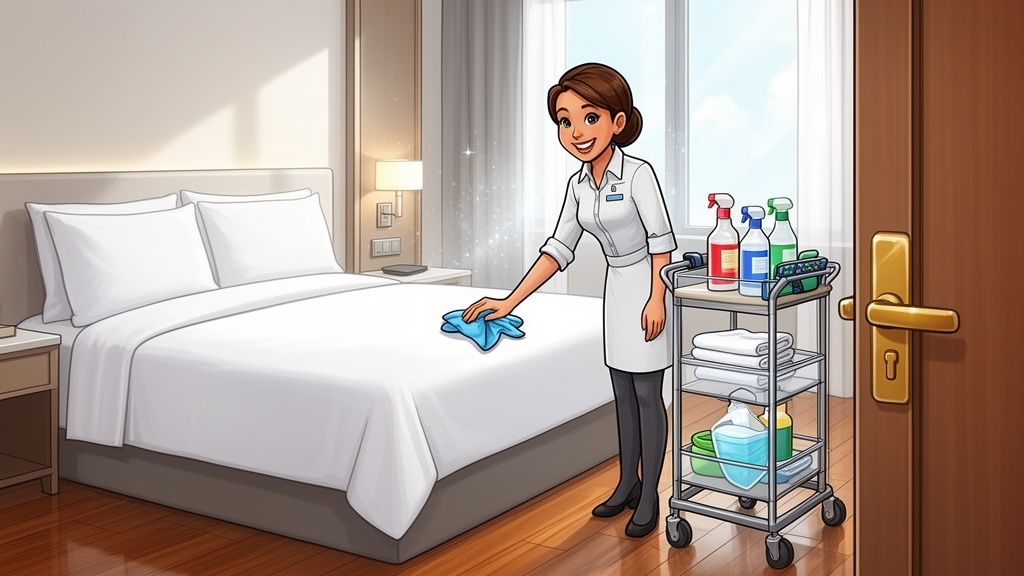
A clean hotel room is no longer just about fresh sheets and a vacuumed floor. It’s the single most important promise you make to a guest—a promise of health, safety, and trust. For today’s guests in any commercial facility, from hotels to gyms, a visibly and hygienically clean space isn’t a perk; it’s the deciding factor in whether they do business with you, and whether they’ll ever come back.
The New Standard of Cleanliness in Hospitality and Commercial Facilities

The definition of "clean" has been completely rewritten. It’s not just a feeling anymore; it's a measurable standard. Customers, whether they are hotel guests, gym members, or office workers, are more informed than ever and actively look for evidence that a space has been properly sanitized. This isn't a passing trend. It's a massive shift that directly impacts your facility's reputation, client retention, and bottom line.
A quick tidy-up just doesn't cut it anymore. Your commitment to deep cleaning and, more importantly, disinfection is the new currency of customer confidence.
This puts all cleaning protocols under a microscope. Every surface is now being scrutinized, especially the high-touch ones. A sticky TV remote in a hotel, a grimy dumbbell at the gym, or a smudged conference room phone can instantly destroy a customer’s sense of security. And you can bet that experience is going straight into an online review or a lost contract.
Why Visible Proof of Cleanliness Matters
Cleanliness in public spaces has moved far beyond basic tidiness. It’s now a blend of health, safety, and transparency. Today's consumers want to see proof of your cleaning protocols. Think hygiene seals on hotel room doors, sanitized wrappers on remotes, or readily available disinfectant wipe stations in a fitness center.
They don't just want a clean space; they want demonstrable proof that you care about their well-being. Knowing the best ways to effectively refresh guest rooms or any public area is about creating a story of safety that begins before a customer even walks in.
In any public-facing business, trust is built in the details. A meticulously disinfected space isn't just a service—it's your most powerful marketing tool. It tells customers, "We care about your well-being," a message that resonates far more than any discount or amenity.
Moving Beyond Tidiness to True Disinfection
The heart of this new standard is understanding the difference between cleaning and disinfecting. Cleaning removes visible dirt and grime. Disinfecting, on the other hand, is what kills the invisible germs—bacteria and viruses. A modern cleaning protocol must do both, every single time.
This professional-grade approach requires a system and the right tools. A well-defined checklist ensures every member of your cleaning staff is consistent, efficient, and thorough, whether they're turning over a hotel room or sanitizing a retail store after hours.
Here’s a quick-reference table your team can use to nail the most critical spots in any commercial setting.
High-Touch Surface Disinfection Checklist
This checklist isn't exhaustive, but it covers the non-negotiable hotspots that customers notice and health experts scrutinize. Make sure your team is hitting these areas with an EPA-approved disinfectant, like a quality disinfectant wipe, and allowing for the proper dwell time.
| Facility Type | High-Touch Points | Recommended Action |
|---|---|---|
| Offices/Retail | Door handles, payment terminals, light switches, shared equipment | Disinfect with EPA-approved product |
| Hotels | TV remote, thermostat, light switches, door handles, telephone | Disinfect all surfaces, especially remote |
| Gyms/Fitness | Equipment handles, weight benches, treadmill screens, water fountains | Wipe down and disinfect after each use |
| Restrooms (All) | Faucet handles, toilet flush levers, toilet seats, door handles, soap dispensers | Clean first, then disinfect all points |
Hitting these spots consistently doesn't just make a space safer; it sends a powerful message to your customers that their health is your top priority.
A modern, effective program always includes:
- A Focus on High-Touch Hotspots: Prioritizing the spots people touch most, from doorknobs and light switches to gym equipment and payment keypads.
- Use of EPA-Approved Disinfectants: Using products proven to kill pathogens. Disinfectant wipes are particularly effective for this, offering a convenient, pre-measured solution.
- Clear Communication with Customers: Using visual cues like sanitation seals, informational signage, or readily available wipes to show off your hard work.
- Efficient and Repeatable Processes: Ensuring every clean is performed to the same high standard, regardless of who is on shift.
When you build a robust and visible cleaning protocol, you're not just offering a clean hotel room or a tidy gym—you're offering peace of mind. This guide will walk you through the exact steps to build that program and turn your commitment to cleanliness into your biggest competitive advantage.
Preparing Your Team for a Flawless Clean
A five-star clean doesn't start with the first spray of disinfectant. It begins long before a cleaning professional even enters the room, with methodical preparation that sets the stage for a flawless result. The most critical moments happen before any cleaning even begins.
Success starts with the cleaning cart. A messy, disorganized cart isn't just inefficient—it’s a rolling cross-contamination risk. Think of a well-ordered cart as your team’s mobile command center, where every tool has a home and dirty items never mix with clean ones.
Organizing the Cart for Speed and Safety
You want to organize your cart into three clear zones: clean supplies, waste, and tools. This isn’t just about neatness; it’s about safety and speed.
- Top Shelf: This is prime real estate. Reserve it exclusively for fresh linens, towels, and guest amenities in a hotel setting, or fresh paper products for other facilities.
- Middle Shelves: Here’s where you stock your cleaning arsenal. This includes glass cleaner, all-purpose cleaner, and—most importantly—your go-to disinfectant wipes. They are perfect for quick, targeted sanitization.
- Base and Sides: This is the designated drop zone for waste. Use separate, clearly marked bags for collecting used linens and trash. Keeping waste low and far from clean supplies is a non-negotiable rule.
A well-stocked and logically organized cleaning cart can shave minutes off each room turnover or cleaning cycle. This efficiency allows staff to spend more time on the crucial details of disinfection rather than searching for supplies.
The Initial Room Assessment
Before a single surface is touched, your staff needs to do a quick but strategic walkthrough. This initial scan prevents backtracking and sets the tone for an efficient clean.
First, ventilate the space. The very first move should be opening a window or propping a door. This immediately starts airing out the room, pulling out any stale odors and improving air quality for your team and the next occupant.
Next, do a quick visual sweep. Scan the area for any maintenance flags—a flickering bulb, a leaky faucet, a broken piece of gym equipment. At the same time, look for any personal items left behind and follow your facility’s lost-and-found protocol to the letter.
Finally, strip and clear. Systematically strip beds of used linens, gather used towels, and bag up all trash from every bin. This clears the deck and preps the space for a top-down, systematic clean.
Equipping your team is about more than just products; it’s about instilling a repeatable process. These pre-clean habits are a huge part of what makes a cleaning team effective, which you can read more about in our guide to staff training best practices.
And one final, non-negotiable point: personal protective equipment (PPE). At a bare minimum, every cleaner must wear fresh disposable gloves for each new area or room. This simple step is fundamental to preventing the transfer of germs, protecting both your staff and your customers. It’s a sign of professionalism that defines a truly superior clean.
The Top-Down Hotel Room Cleaning System
Efficiency in housekeeping and janitorial services isn't just about speed; it's about having a system so dialed-in that five-star results become muscle memory. For a truly clean hotel room or any commercial space, the pros don’t wing it. They use a proven workflow: the top-down, back-to-front method. This isn't just industry slang—it’s a smart sequence designed to stop you from re-cleaning surfaces and to make sure nothing ever gets missed.
This is the operational backbone that turns an average clean into an exceptional customer experience. It boosts consistency, cuts down on errors, and makes every cleaning cycle a masterclass in detail.
The Initial Room Reset
Once you've propped the door open and cracked a window for fresh air, the real work begins. The first move is to get the room back to a blank slate. This isn’t the time for wiping—it’s about clearing the decks.
Start by systematically stripping all used linens and gathering every used towel. They go straight into your designated laundry bag, never on the floor. At the same time, collect all trash and dump it into a separate waste bag on your cart. Getting this done first clears the way for an unobstructed, efficient cleaning path.
This quick prep work sets the stage for the entire cleaning process.

It seems simple, but getting your tools, cart, and room prepped is the foundation of a cleaning cycle that’s both fast and flawless.
Working From Top To Bottom
The golden rule of professional cleaning is simple: gravity is not your friend. Dust, dander, and debris all fall downward. If you start low, you’ll just have to clean everything twice. Always work from the highest point in the room to the lowest.
Kick things off by dusting all the high-up surfaces. This is where most cleaning teams miss things.
- Tops of picture frames and headboards
- Light fixtures and ceiling fan blades
- Curtain rods and the tops of armoires or closets
Next, work your way down to all the mid-level surfaces. Wipe down every piece of furniture—desks, dressers, nightstands. Don't forget the details like telephones, alarm clocks, and TV remotes. This is also your moment to tackle windows and mirrors.
Of course, a huge part of this process is knowing how to clean a bed from top to bottom before you even think about putting on fresh sheets. It's a critical step that ensures total hygiene.
Finally, you hit the lowest surfaces. This means baseboards, the legs of chairs, and any low shelves. Only after every other surface is done should you even think about the floors. Start vacuuming from the farthest corner of the room and work your way backward toward the door. If you’re dealing with hard floors, sweep or vacuum before you mop yourself out of the room.
The Bedroom-To-Bathroom Workflow
After clearing the trash and linens, the "back-to-front" part of the system kicks in. You always, always start in the main space (bedroom, office, etc.) and finish in the bathroom. Why? Because you want to contain the germs from the most contaminated area—the bathroom—and prevent them from spreading into the main living or working space.
- Dust and Sanitize the Main Area: Using the top-down method, work through the entire main room first. After dusting, hit all those high-touch surfaces like light switches, door handles, and thermostats with a quality disinfectant wipe.
- Make the Bed/Reset the Space: Now that the room is nearly complete, it’s time to make the bed with crisp, fresh linens or reset the office space to its neutral state. A perfectly made bed or organized desk is a powerful visual signal of a clean room.
- Tackle the Bathroom Last: The bathroom is ground zero for germs and requires heavy-duty attention. By saving it for the end, you trap all the germs and chemical odors in one place. Apply your cleaners to the shower, toilet, and sink, and let them sit for the required dwell time. While they work, you can clean mirrors and countertops. Then, circle back to scrub and rinse everything down before mopping the floor on your way out.
The biggest rookie mistake is cleaning the bathroom first or bouncing between rooms. That workflow is a one-way ticket to spreading bacteria, forcing you to re-clean surfaces and wasting valuable time and supplies. The main-space-first, bathroom-last sequence is non-negotiable for professional results.
When your entire team follows this exact order of operations, you'll see efficiency and cleaning scores shoot up. A great way to reinforce this is by creating a visual guide based on our hotel room cleaning checklist.
Sticking to a system is everything. When every cleaner follows the same logical steps, you get a consistently spotless and safe environment that builds customer trust and protects your brand's reputation. It’s time to move beyond just tidying up and embrace a professional system for a truly clean hotel room or commercial space.
Turning Clean into Trust: Mastering Disinfection

This is where the real work happens. You’ve wiped, vacuumed, and straightened the room until it looks perfect, but the job isn't done. The final step—disinfection—is what separates a merely tidy space from a genuinely clean hotel room or facility. It's the moment you win or lose a customer’s trust.
Let’s be clear: cleaning and disinfecting are two different things. Cleaning removes the visible stuff—dirt, dust, and smudges. Disinfecting is the critical follow-up that kills the invisible threats like bacteria and viruses. A room that looks spotless can still be a hotspot for germs if this step is rushed or skipped.
From Wiped Down to Truly Disinfected
Every customer, whether they realize it or not, has a mental checklist they run through when they enter a space. Their eyes and hands go straight to the same "hotspots" every single time. Nailing these high-touch points is how you prove your commitment to their well-being.
Think of it as the ultimate test of your cleaning protocol. You can get everything else right, but a sticky remote, a grimy light switch, or a dirty equipment handle immediately tells a customer that your standards are slipping. It’s a tiny detail that can completely tank their impression of your business.
Your team needs to be trained to obsess over these surfaces between every single use or stay:
- Entryway Touchpoints: Doorknobs (both sides), deadbolts, and security latches.
- Room Controls: Every light switch, the thermostat, and alarm clocks.
- Electronics & Equipment: The TV remote, phones, in-room tablets, credit card terminals, and handles on gym machines.
- Furniture: Nightstand tops, desk surfaces, drawer pulls, and chair arms.
- Restroom Controls: Faucet handles, the toilet flush lever, and shower/tub knobs.
The data backs this up. Cleanliness is now the number one priority for over 60% of travelers. The same principle applies to gyms, offices, and retail. One oversight can quickly lead to a bad review on the very sites your future customers are using for research. For a deeper look at what guests expect now, you can explore detailed insights into the future of hospitality.
Why Disinfectant Wipes Are Your Best Friend for Hotspots
When you're tackling all these different surfaces, efficiency is everything. For those high-touch points, especially electronics and small fixtures, disinfectant wipes are your most valuable tool. They give you a level of control that spray bottles just can't offer. For business owners and janitorial staff, they are a game-changer.
Sprays can mist onto fabrics or damage sensitive electronics, and they always require a separate cloth. A good wipe is an all-in-one solution. It’s faster, eliminates waste from overspray, and delivers the disinfectant right where you need it. We recommend using a high-quality product like Wipes.com Disinfectant Wipes to ensure effective and consistent results. They are designed to stay wet long enough to meet the required "dwell time" for killing germs, and the physical act of wiping actively removes grime and pathogens.
If you're selling cleaning supplies, frame disinfectant wipes as an efficiency tool. It's not just about hygiene. It’s about saving labor, cutting down on chemical waste, and ensuring every staff member delivers the same level of disinfection. For your clients, that means a healthier bottom line.
Make Your Cleanliness Visible
You could have the most rigorous cleaning program on the planet, but if customers can’t see it, you’re missing a golden opportunity. It’s not enough to be clean; you have to show them you’re clean.
Use simple, effective visual cues to communicate your high standards. These little touches provide tangible proof that the space has been prepared just for them.
Here are a few powerful ideas that work across industries:
- Door Seals: A branded sticker across a hotel room door is a fantastic psychological cue. The guest knows they are the very first person to enter their sanitized space.
- Wrapped Remotes: The TV remote is one of the germiest items in any room. Placing it in a sleeve labeled "Sanitized for your protection" shows you’re thinking about the details.
- Wipe Dispensers & Signage: In gyms, offices, and retail, having visible wipe dispensers and signs encouraging their use empowers customers and demonstrates your commitment to a shared responsibility for cleanliness.
By focusing on true disinfection, giving your team the right tools like quality disinfectant wipes, and making your efforts visible, you build an experience based on trust. That’s how you earn five-star reviews, repeat business, and loyal customers.
Turning Superior Cleanliness Into a Sales Advantage
In the commercial world, an impeccably clean facility isn't just an operational requirement—it's one of your most powerful sales tools. For facility managers, it’s about protecting the brand and minimizing risk. But for sales professionals in the cleaning industry, it's a story that turns a cleaning protocol from a line-item expense into a clear return on investment.
A documented, professional cleaning program is tangible proof behind your promise of a safe, high-quality environment. When sales teams know how to tell this story, they aren't just selling cleaning supplies or services. They’re selling customer confidence, earning loyalty, and building a foundation for glowing online reviews.
Framing Hygiene as a High-Return Investment
It's time to shift the conversation from cost to value. When you're presenting a premium hygiene protocol or new supplies to a client, leading with the price tag is a losing game. Instead, connect the dots between a superior clean and direct financial benefits.
A solid cleaning program is an investment in three critical areas:
- Brand Reputation: We live in an age of instant online reviews. A single negative comment about a dirty bathroom or dusty equipment can scare away hundreds of potential customers. A spotless environment is your best defense.
- Customer Loyalty: Customers who feel safe and well-cared-for are the ones who come back. Exceptional hygiene isn't just about sanitation; it creates an emotional connection that turns one-time visitors into repeat business.
- Risk Management: Following a thorough disinfection protocol does more than just look good. It reduces the risk of illness transmission, protecting both customers and staff while minimizing the facility's liability.
When a sales professional can educate a client on the ROI of hygiene, the entire dynamic changes. A manager who starts seeing disinfectant wipes not as a consumable but as a tool to lock in five-star reviews or improve member retention becomes a partner, not just a customer.
This thinking is already reshaping the industry. The global hotel cleaning services market is growing from roughly USD 15 billion in 2023 to a projected USD 25 billion by 2032. That 5.5% CAGR reflects a wider trend: businesses are spending more because they know exceptional cleanliness fuels growth. You can explore the full hotel cleaning services report to see a more detailed breakdown.
Essential Training and Quality Control for Managers
For facility managers, turning cleanliness into a real advantage boils down to one thing: unwavering consistency. And that only comes from rock-solid training and diligent quality control.
First, your training has to go beyond showing staff how to clean. It must instill the why. A janitorial team who truly understands their role in protecting public health is far more motivated and detail-oriented. You’re not just equipping them with tools; you're arming them with purpose.
Next, you need a formal inspection process. Using a detailed checklist, managers or supervisors should randomly inspect areas after they’ve been cleaned. This isn’t about playing "gotcha." It’s about creating accountability and spotting opportunities for retraining. These inspections should mimic a customer’s critical eye, zeroing in on high-touch surfaces and hidden corners.
Finally, make customer feedback your best friend. Treat every online review—good or bad—as a free performance report. Share the glowing comments to boost team morale. And use the critiques as specific, actionable training moments to address any gaps in your protocol before they become a pattern.
A proactive approach to cleanliness, championed by sales and enforced by management, creates a cycle of excellence. It builds a brand's reputation, drives higher revenue, and proves that a truly clean hotel room or facility is the smartest investment a business can make.
Your Top Hotel Cleaning Questions, Answered
Whether you’re a facility manager, a sales professional in the cleaning industry, or part of a janitorial crew, the same questions about what truly clean means pop up constantly. The answers are what separate a quick tidy-up from the kind of deep, hygienic clean that builds customer trust and protects your brand’s reputation. Let's tackle some of the most common ones.
Standard Clean vs. Deep Clean: What's the Real Difference?
It’s easy to get these two mixed up, but they serve completely different functions. Think of a standard clean as your daily operational process. This is the essential reset between uses, focused on making a hotel room, office, or gym safe and presentable for the very next person. It’s all about sanitizing surfaces, restocking supplies, and thorough vacuuming.
A deep clean, however, is your heavy-hitter. This is a more intense, periodic project—maybe quarterly or a couple of times a year—that goes after the built-up grime that daily cleaning just can't touch. We’re talking about shampooing carpets, washing curtains, pulling out heavy furniture to clean behind it, and descaling fixtures. Both are absolutely critical for maintaining a high standard.
The Telltale Signs of a Genuinely Clean Room
Customers have become unofficial detectives, and they know exactly where to look. A truly clean space is about more than a nice smell. Experienced customers and quality inspectors are looking for the small details that scream "we cleaned this right."
- The Surface Feel: Run your hand over high-touch points like TV remotes, light switches, and doorknobs. They should feel completely smooth, with zero stickiness or lingering dust. It’s the first and fastest test of a detailed clean.
- The Bathroom Inspection: Check the corners of the floor, the base of the toilet, and around the faucet. You’re looking for a complete absence of hair, dust, or residue. A sparkling, bone-dry bathroom is a massive indicator of real care.
- The "Nothing" Smell: A genuinely clean room shouldn't smell like anything. Overpowering floral or chemical scents are often a red flag, used to mask underlying odors from poor ventilation or mildew instead of eliminating the source.
- Visible Proof: Look for the tangible signs of a facility's commitment. Things like a sanitation seal on a hotel door, a paper band on the toilet, or well-stocked disinfectant wipe stations prove that a deliberate, verifiable cleaning process took place.
Why Wipes Win Out Over Sprays for High-Touch Items
For anyone selling cleaning supplies, this is a crucial point to drive home with clients. While sprays certainly have their place, disinfectant wipes give you far better control and consistency, especially for those critical high-touch surfaces in any commercial space. Wipes come pre-saturated with the exact chemical concentration needed, ensuring the surface stays wet long enough to actually kill germs—what we call dwell time.
When you can show a gym or office manager how a single wipe both physically removes germs and disinfects in one step, you're not just selling a product; you're selling efficiency and guaranteed compliance. It simplifies training for janitorial staff and provides a consistent result every time.
This one-step process is faster, cuts down on airborne irritants from sprays, and is perfect for targeting all those small but crucial items like doorknobs, faucets, and the buttons on gym equipment.
How Often Should We Disinfect High-Touch Surfaces?
For any facility like a hotel, gym, or office, there’s a simple, non-negotiable answer here. High-touch surfaces must be disinfected between every single user or guest stay. In a hotel, that means during every single turnover, without exception.
For guests staying multiple nights, disinfecting these same areas daily during room servicing is a best practice that powerfully reinforces your commitment to guest safety. In public areas like lobbies, elevators, or gyms, these high-traffic points should be hit multiple times throughout the day. Prioritizing cleanliness isn't just an option anymore; it's a core part of your business strategy. Take the step to integrate high-quality disinfectant wipes into your daily routine or sales offerings to elevate your standard of clean.
Leave a Reply