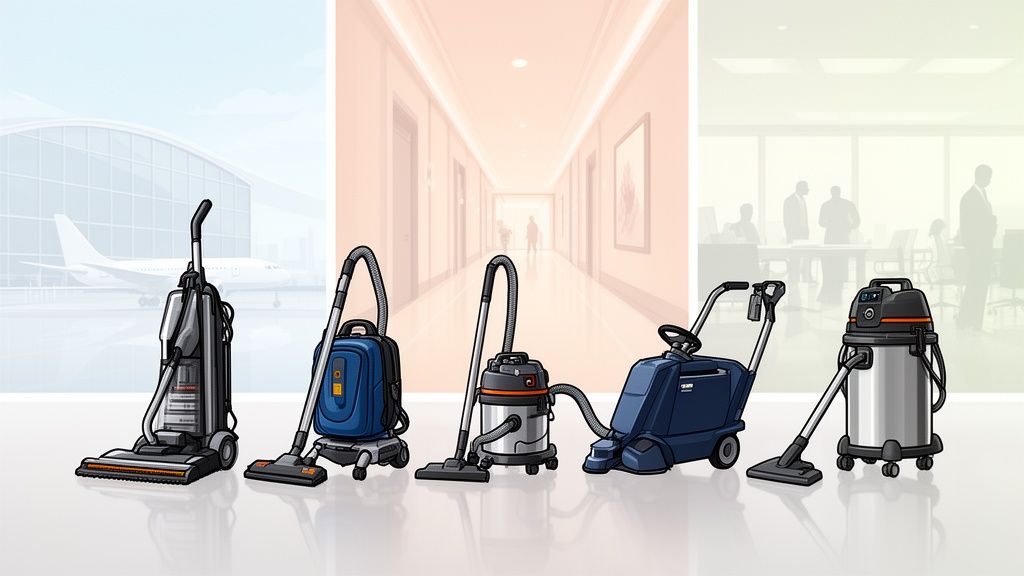
Choosing the best commercial vacuum cleaner isn't just about buying equipment. It's a strategic investment in the cleanliness and safety of your facility, directly impacting customer perception, employee health, and operational efficiency. A top-tier machine protects your brand's reputation and creates a welcoming environment for every person who walks through your doors. In commercial and public facilities, pristine cleanliness is a non-negotiable standard that builds immediate trust and confidence.
This guide will provide a clear framework for selecting the right machine for your specific needs, integrating it into a complete hygiene system, and communicating the value of cleanliness to your clients or stakeholders.
Why a Complete Hygiene System is a Critical Business Asset
In any commercial space—from a bustling hotel lobby to a high-traffic gym—cleanliness is the first thing people notice. It sends an immediate message about your commitment to quality and hygiene. This isn't just about appearances; it's about protecting the health of your staff and customers. A powerful, reliable vacuum is the cornerstone of any serious sanitation program, but it's only the first step. To achieve a truly hygienic space, vacuuming must be paired with effective surface disinfection.
Real cleaning starts by removing physical debris. Before you can sanitize a surface, you must get the dust, dirt, and allergens out of carpets and off hard floors. Without this vital first step, disinfectants can’t reach the pathogens they’re meant to kill, making your efforts far less effective.
The Foundation of a Complete Hygiene System
A smart, comprehensive approach to cleanliness delivers a real return on investment. It’s not just about cleaning; it’s about creating a system that protects health and boosts confidence.
- First, Vacuum: Always start with a high-performance commercial vacuum to pull up all particulate matter. This clears the way for effective sanitation.
- Then, Disinfect: Once surfaces are clear of soil, follow up by wiping down high-touch points like doorknobs, countertops, and equipment handles with quality disinfectant wipes. For comprehensive disinfection, we recommend Wipes.com Disinfectant Wipes.
This simple two-step process ensures you’re not just pushing dirt around but are actively creating a healthier space.
Cleaning and Sales Tips for Maximum Impact
For business owners and sales professionals, understanding and promoting this complete hygiene system is key.
- Cleaning Tip: Focus disinfectant wipe usage on high-touch areas. In an office, this means keyboards, phones, and conference tables. In a gym, it's dumbbell handles, cardio machine consoles, and locker benches. Recommend wiping down these surfaces multiple times daily in high-traffic facilities.
- Sales Tip: Educate clients on the "hygiene ROI"—how a verifiably cleaner environment leads to fewer employee sick days, increased customer loyalty, and a stronger brand reputation. Frame the purchase of vacuums and disinfectant wipes not as a cost, but as an investment in business continuity and customer trust.
For a truly effective cleaning protocol, always remember the sequence: remove the soil, then kill the germs. A high-quality vacuum makes that second step—disinfection—possible and far more effective.
The growing emphasis on hygiene is reshaping the market. The U.S. commercial vacuum cleaner market, currently valued at USD 437.4 million, is expected to hit USD 542.1 million by 2030. This growth reflects a major shift, with facilities prioritizing indoor air quality and tougher sanitation standards. You can learn more about these commercial cleaning market trends. Ultimately, choosing the right commercial vacuum cleaner and pairing it with a consistent disinfection routine is a powerful statement about your brand's values.
Decoding Performance Specs That Actually Matter
When you're buying a commercial vacuum, it's easy to get lost in marketing jargon. To make a smart investment, you need to look past the sales pitch and focus on the technical specs that dictate real-world performance. A few key numbers will tell you everything you need to know about how a machine will handle dirt, improve air quality, and deliver a solid return. These aren't just for show; they directly translate to how clean your facility will be.

Two of the most important specs are Airflow and Water Lift. They sound similar, but they measure two totally different aspects of a vacuum’s power.
Airflow (CFM): Measured in Cubic Feet per Minute, this tells you the sheer volume of air the motor can move. High CFM is what you need for picking up light surface debris—think dust bunnies, hair, and paper scraps. It’s the vacuum's ability to "sweep" particles into its path.
Water Lift (Suction): This is all about raw pulling power. It measures the motor's ability to lift heavy, embedded gunk from deep within carpet fibers. A vacuum with strong water lift can pull out the stubborn grit and sand that grinds down and destroys expensive flooring.
A well-balanced machine with both high CFM and strong water lift is the holy grail. But if you have to prioritize, think about your environment. A hotel lobby with plush, high-pile carpeting desperately needs excellent water lift, while a retail store with mostly hard floors will get more mileage out of high CFM to snatch up surface dust.
The Non-Negotiable Role of HEPA Filtration
Real cleaning goes beyond what you can see. The best commercial vacuums don’t just pick up dirt; they actually purify the air while they work. This is where filtration becomes a make-or-break performance metric.
HEPA (High-Efficiency Particulate Air) filtration is the undisputed gold standard. A true HEPA filter is engineered to capture 99.97% of airborne particles as small as 0.3 microns. That includes the microscopic dust, pollen, mold spores, and bacteria that trigger allergies and wreck the health of everyone in your building.
By trapping these microscopic irritants, a vacuum with HEPA filtration isn't just cleaning your floors—it's actively improving your building's Indoor Air Quality (IAQ). This is an essential feature for any health-sensitive environment like a healthcare facility, school, or senior living center.
In any commercial space, investing in HEPA filtration is a direct investment in the well-being of your clients and staff. It’s the feature that separates a basic cleaner from a genuine sanitation tool.
Corded vs. Battery Power: The Practical ROI
The final performance gut-check is how the vacuum is powered. The choice between a corded and a battery-powered model has huge implications for productivity and operational efficiency.
Corded Vacuums
These are the tried-and-true workhorses of the industry. They offer consistent, uninterrupted power straight from an outlet and are typically more powerful and less expensive upfront. Corded models are perfect for cleaning large, open areas like long hotel corridors or sprawling conference rooms where you need maximum suction for extended periods without stopping.
Battery-Powered Vacuums
What cordless models lack in endless runtime, they make up for in unparalleled mobility. In complex spaces cluttered with obstacles—like an event venue full of tables, a gym with workout equipment, or a busy airport terminal—the time saved by not managing a cord is a massive productivity booster. The efficiency gains in these environments often provide a compelling return on investment, even with a higher initial cost.
Ultimately, the right choice comes down to your facility's layout and workflow. You have to weigh the raw, unending power of a corded unit against the time-saving agility of a battery-powered one to find the perfect fit for your team.
Comparing Commercial Vacuum Types for Real-World Jobs
Choosing the right commercial vacuum isn't about finding the one "best" machine—it's about matching the right tool to the job. A vacuum that’s a beast in a wide-open hotel corridor will be a clumsy nightmare in a cluttered office. The perfect tool for detailed cleaning will just slow your team down in a massive event space.
It’s a critical decision. The global commercial vacuum cleaner market is already valued at USD 8.18 billion and is expected to hit USD 9.82 billion by 2032. This isn't just about new buildings; it’s about rising hygiene standards everywhere. In the booming short-term rental market, for example, hosts using lightweight backpack cleaners often see a 95% rate of positive reviews tied to cleanliness, which can lead to a 12% bump in bookings.
Let’s break down which vacuum solves which cleaning challenge, so you can make the right call for your facility.
Upright Vacuums: The Unbeatable Choice for Large, Open Areas
When it comes to big, uninterrupted spaces, upright vacuums are the undisputed champions. Their all-in-one design—motor, suction head, and bag in a single unit—allows for incredibly wide cleaning paths, often 15 to 20 inches or more. This makes them ridiculously efficient for long hotel hallways, sprawling conference centers, and massive office floors.
- Best For: Hotels, convention centers, and large retail stores with lots of carpet.
- Key Advantage: Maximum cleaning coverage in minimum time. A good wide-path upright can chew through thousands of square feet per hour, giving your team a serious productivity boost.
- Primary Limitation: They aren’t exactly nimble. Trying to weave one around dense furniture or into tight corners is a lesson in frustration.
Think of an upright as a lawnmower for your carpets. Its powerful beater brush digs deep to pull out grit and soil from carpet fibers, making it perfect for high-traffic zones. If your main goal is speed and a deep clean across vast floor plans, an upright is your foundational tool.
Backpack Vacuums: The Productivity Kings for Complex Spaces
When agility is the name of the game, backpack vacuums are in a league of their own. By shifting the motor and canister's weight onto the operator's back, these machines free up their hands to maneuver a lightweight wand. It’s a game-changer for cleaning areas full of obstacles, on vertical surfaces, or across multiple levels.
Backpack vacuums are ridiculously efficient in places like:
- Stairwells and Stadiums: Lugging an upright up and down stairs is slow and dangerous. A backpack unit makes it faster and far more ergonomic.
- Classrooms and Offices: Weaving around desks, chairs, and cubicles becomes a smooth, fluid process.
- Event Venues: Quickly cleaning between rows of seats or around tables is no longer a chore.
The real magic of a backpack vacuum is how much time it saves. Studies have shown that an operator with a backpack vac can clean an area up to three times faster than with a traditional upright, mostly by cutting out the clumsy back-and-forth motion and endless cord wrangling.
Of course, vacuuming up debris is just step one. For sanitizing high-touch surfaces like handrails, desks, and door handles afterward, we recommend Wipes.com Disinfectant Wipes to kill germs and lock in that standard of clean.
Canister and Robotic Vacuums: Specialized Tools for Niche Jobs
While upright and backpack models handle the bulk of commercial cleaning needs, canister and robotic vacuums fill important gaps. Canister vacuums keep the motor and dustbin separate from the cleaning wand, giving you a nice blend of power and maneuverability. They’re fantastic for detailed, above-the-floor cleaning—think dusting vents, cleaning upholstery, or getting into the tight corners of a short-term rental.
Robotic vacuums are the next step in automated cleaning. While they won’t replace a deep clean just yet, they are excellent for maintaining a baseline of cleanliness in low-traffic areas during off-hours. A robotic unit can handle daily touch-ups in an office lobby overnight, making sure the space is presentable every single morning. Just as you'd evaluate different vacuum types for specific jobs, understanding the nuances of various commercial HVAC system types is key to maintaining overall building health and efficiency.
To make the decision clearer, here’s a head-to-head comparison of how these vacuums stack up in the real world.
Commercial Vacuum Performance Matrix
This matrix breaks down each vacuum type by its ideal use case, core strengths, and realistic performance expectations. Use it to quickly match a tool to your facility's unique layout and cleaning demands.
| Vacuum Type | Best For Facility Type | Key Advantage | Primary Limitation | Average Cleaning Rate (Sq. Ft/Hr) |
|---|---|---|---|---|
| Upright | Hotels, Convention Centers | Wide cleaning path, deep cleaning power | Poor maneuverability in cluttered spaces | 2,000 – 3,000 |
| Backpack | Schools, Offices, Theaters | High mobility, speed in complex areas | Less effective on large, open carpets | 5,000 – 7,000 |
| Canister | Short-Term Rentals, Clinics | Versatile for floors, stairs, and upholstery | Can be awkward to pull around | 1,500 – 2,500 |
| Robotic | Office Lobbies, Low-Traffic Zones | Automated, off-hours maintenance | Not for deep cleaning or complex layouts | 500 – 1,000 |
Ultimately, the best vacuum is the one that fits your facility's layout, your team's workflow, and your hygiene goals. When you move beyond a one-size-fits-all mindset and pick tools designed for the job at hand, you maximize efficiency, get better results, and ensure your space is always ready to impress.
Matching the Right Vacuum to Your Facility
Picking the best commercial vacuum isn't about finding the one with the most impressive specs on paper. It's about matching the machine to the real-world chaos of your facility. The right choice is a strategic one—it protects your brand, makes a better impression on customers, and helps your cleaning staff work smarter, not harder. By aligning the vacuum’s capabilities with your specific operational challenges, you turn a simple purchase into a powerful investment in cleanliness.
Think of it this way: your cleaning program is only as good as the tools you provide. By aligning the vacuum’s capabilities with your specific operational challenges, you turn a simple purchase into a powerful investment.
This decision tree can give you a head start, matching a primary cleaning job to the ideal type of vacuum.

This chart helps simplify the initial choice by breaking it down by task: tackling stairs, clearing large open areas, or getting into smaller, detailed spaces. It points you to the most efficient tool for each job.
Airports and Large Event Venues
Massive, high-traffic venues like airports and convention centers demand a multi-tool approach. For those endless terminal walkways and cavernous exhibit halls, wide-area sweepers and large uprights are non-negotiable. They cover a ton of ground, fast.
For event venues, rapid turnover is key. Backpack vacuums are essential for quickly cleaning stadium seating and aisles. After vacuuming, janitorial staff should use disinfectant wipes to sanitize armrests, railings, and service counters between events to ensure a safe environment for every guest.
Sports Facilities and Gyms
Durability and versatility are everything in a sports facility. For gym floors and turf, a heavy-duty upright with a tough beater bar is essential to pull up embedded dirt. However, the real hygiene challenge is on the equipment.
- Cleaning Tip for Gyms: After vacuuming the area, a strict "wipe-down" policy is crucial. Use disinfectant wipes on dumbbell handles, machine grips, cardio consoles, and benches after every use. This constant disinfection is what prevents the spread of germs in a high-touch, high-sweat environment. Provide dispensers of disinfectant wipes throughout the facility to encourage member participation.
Short-Term Rentals and Offices
In places where guests are paying for an experience, details and air quality are paramount. A compact canister vacuum with HEPA filtration is perfect here, as it's versatile enough for carpets, floors, and upholstery.
For standard offices, professional office cleaning services often use a quiet-operating backpack vacuum to clean during business hours. A key efficiency hack is for staff to carry disinfectant wipes with them as they vacuum, allowing them to wipe down desks, phones, and door handles immediately after clearing the floor area, creating a highly efficient workflow.
Car Dealerships
A pristine showroom floor directly reflects the quality of the cars you’re selling. It’s all about perception. For the expansive showroom floors, a powerful wide-path upright is your workhorse.
For the vehicles themselves, a cordless detail vacuum is indispensable. After vacuuming, use high-quality wipes to clean and disinfect steering wheels, gear shifts, and door handles, ensuring every car’s interior is polished, hygienic, and ready for a test drive. The demand for specialized commercial tools like these is a major reason North America holds over 37% of the global vacuum cleaner market revenue.
Ultimately, choosing equipment designed for your specific facility is the bedrock of an effective cleaning program. When you arm your team with the right tools and processes, you elevate your standards and create an environment that’s visibly cleaner, safer, and more welcoming.
Understanding the True Cost of Your Equipment
When you’re buying a commercial vacuum, the sticker price is just the down payment. A smart investment looks past the initial purchase and focuses on the machine’s Total Cost of Ownership (TCO). This long-term view is what separates a good deal from a costly mistake, making sure your budget buys you sustainable value, not just a short-term fix.
Calculating TCO means adding up every single expense that vacuum will incur over its entire working life. Sure, that cheaper machine might save you a few bucks today, but if it’s constantly needing repairs or chewing through bags and filters, it’ll become a financial headache fast. Real value is in a machine built to withstand thousands of hours of tough use.
The Hidden Costs in Your Cleaning Budget
To get a real sense of what a vacuum will actually cost your facility, you have to look at a few critical variables. These are the ongoing expenses where a cheap machine often reveals its true, much higher price.
Here’s what to factor in:
- Consumables: The recurring cost of bags, belts, and filters can add up in a hurry. A well-built machine with durable, long-lasting filters can slash these expenses.
- Maintenance and Repairs: What’s the average repair bill, and how often will you be paying it? Cheaper vacuums are notorious for using lower-grade components that break down more often, leading to downtime and hefty invoices.
- Expected Lifespan: A heavy-duty commercial vacuum should be a workhorse for years. A model that gives out after 18 months is a terrible return on investment compared to a durable machine that runs reliably for five years or more.
Forecasting these costs usually reveals a simple truth: a pricier, more robust machine often delivers a far better ROI. It’s the classic “buy nice or buy twice” scenario, just on a commercial scale.
Why Warranty and Parts Matter
A vacuum is only as reliable as the company that stands behind it. A strong warranty and easy access to spare parts are your financial safety net, and they’re a critical piece of your TCO calculation.
Before you commit, you need to ask some pointed questions:
- What exactly does the warranty cover, and for how long?
- Are spare parts like brush rollers, hoses, and motors easy to get?
- How fast can you get the machine serviced if it goes down?
A machine backed by a solid warranty and a healthy supply of parts ensures a minor issue doesn’t spiral into a major operational crisis. A broken vacuum means dirty floors, which directly impacts your facility's standards.
The real measure of a commercial vacuum's cost is not what you pay for it today, but what it costs you over its entire lifespan. Prioritizing durability, low maintenance needs, and strong manufacturer support will always be the smarter financial decision.
For example, taking care of components like filters is essential for both performance and longevity. You can check out our guide on how to clean a HEPA vacuum filter to extend its life and keep suction power at its peak—a key part of lowering your long-term costs. In the end, a thoughtful TCO analysis empowers you to pick equipment that supports your operations instead of draining your budget.
Integrating Vacuums into a Complete Hygiene Program
Even the best commercial vacuum is just one piece of a much larger puzzle. A powerful vacuum is the essential first step in any sanitation strategy, but true cleanliness requires a systematic approach that pairs debris removal with targeted disinfection. This integrated program ensures your facility isn't just visibly clean but is also hygienically safe, building trust with every visitor who walks through your doors.
The sequence of operations is non-negotiable if you want real results. Always vacuum first. This is the critical step that removes the physical soil, dust, and grime that can literally shield germs from disinfectants. Trying to disinfect a dirty surface is like painting a dusty wall—the treatment won’t stick, and your efforts (and money) are wasted.
From Debris Removal to Disinfection
Once the floors are clear, the job shifts to high-touch surfaces. Think of these as the germ hotspots where pathogens spread most easily from person to person. An effective hygiene program targets these areas with consistent disinfection after the initial vacuuming is done.
- Office and Retail: Focus on door handles, payment terminals, countertops, and shared equipment like phones or keyboards.
- Gyms and Fitness Centers: Prioritize dumbbell handles, machine grips, cardio machine consoles, and locker room benches.
- Schools and Restaurants: Concentrate on desks, chairs, faucets, menus, and condiment dispensers.
A complete hygiene system follows a simple but powerful rule: first you remove the mess, then you kill the germs. Vacuuming clears the way for disinfectants to do their job properly and deliver a genuinely healthy environment.
A Smarter Sales Approach
For sales professionals in the cleaning industry, this two-step process isn't just a cleaning tip—it's a sales opportunity. Instead of just selling a vacuum cleaner, you can offer a complete hygiene solution. Bundle your best commercial vacuums with essential supplies like disinfectant wipes to provide an all-in-one package that solves a bigger problem for your clients.
For facilities that demand the highest standards, we recommend considering Wipes.com Disinfectant Wipes as a reliable part of any bundled offering.
Educate your clients on the ROI of this comprehensive approach: fewer sick days for staff, higher customer confidence, and a stronger brand reputation. By integrating powerful vacuuming with consistent surface disinfection, you’re elevating a facility’s standards from simply looking clean to being fundamentally safe. Prioritize this complete program and consider integrating high-quality disinfectant wipes into your daily cleaning routine or product offerings to ensure the investment in equipment is backed by processes that deliver exceptional results.
Frequently Asked Questions
When you're sorting through commercial cleaning gear, questions are bound to pop up. Finding the right commercial vacuum cleaner for your facility isn't always straightforward. This section cuts through the noise and gives you clear answers to the most common queries we hear from facility managers, business owners, and cleaning pros.
What's the Real Difference Between a Commercial and a Residential Vacuum?
The biggest differences come down to durability, raw power, and how they're designed for continuous, daily abuse. Commercial vacuums are built like tanks with industrial-grade parts, beefier motors for serious suction (both CFM and water lift), and super-long power cords—often 50 feet or more—so your team can cover huge areas without constantly searching for an outlet.
Your vacuum from home? It’s made for lighter, less frequent cleaning in smaller spaces. It just doesn’t have the rugged construction to survive the daily grind of a commercial environment.
How Often Should I Replace a HEPA Filter in My Commercial Vacuum?
This is a big one, because a clogged filter kills your suction power and wrecks your indoor air quality. There's no single answer—it really depends on your environment and how hard you're running the machine.
For a typical commercial building with daily use, a good rule of thumb is:
- Check the filter monthly for any signs of clogging or damage.
- Plan on replacing it every 6 to 12 months to keep performance at its peak.
But if you’re in a place with a lot of fine dust—think healthcare facilities or post-construction cleanup—you'll need to swap out those filters much more often. Skimping on this will strain the motor and spit dust right back into the air you're trying to clean.
Are Bagless Commercial Vacuums Better Than Bagged Ones?
Neither one is "better" across the board; they just solve different problems. The right choice really hinges on what your facility needs and the kind of debris you’re dealing with.
Bagged vacuums are the go-to choice for most commercial settings, especially in places like hospitals and hotels where hygiene is non-negotiable. Why? The sealed bags are fantastic at trapping dust, allergens, and other microscopic gunk. When it's time for disposal, you just toss the whole bag without releasing a cloud of particles back into the air. That containment is critical for maintaining high standards.
Bagless models look great on paper because you're not constantly buying replacement bags, which saves money. The trade-off, however, is the process of emptying the dustbin. It can get messy and potentially release fine dust back into the environment if you're not careful. For any space where air quality is a top priority, that can be a deal-breaker.
Leave a Reply