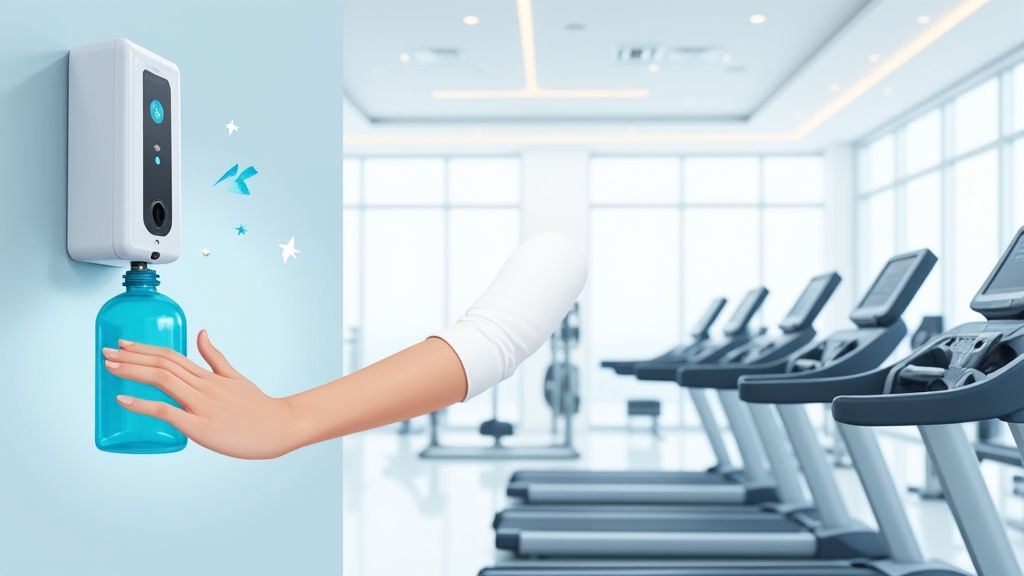
Using sanitizer wipes for a gym or any public facility isn't just a box to check; it's a cornerstone of a smart, successful operation. More than just a cleaning supply, disinfectant wipes are a quick, effective tool for sanitizing high-touch surfaces, stopping the spread of germs, and giving your clients, members, and staff visible proof that you prioritize their health.
The True Value of a Visibly Clean Facility

In today's competitive market, customers and employees expect more than just good service or the latest equipment. They demand a clean, safe space. A facility that looks clean—with fully stocked wipe dispensers and diligent staff—is a massive business advantage that directly builds trust and keeps people coming back, whether it's a gym, office, or retail store.
This visible commitment is far more than basic janitorial work. It’s a silent promise that their well-being is a top priority. When someone sees another person wiping down a surface or can easily grab a disinfectant wipe themselves, it creates instant confidence. That feeling is powerful enough to justify premium fees, earn loyalty, and elevate your brand's reputation.
On the flip side, the risks of getting hygiene wrong are huge and can absolutely tank a business's reputation.
The Financial and Reputational Risks of Poor Hygiene
Cutting corners on your sanitation plan is a high-stakes gamble you can't afford to lose. High-touch surfaces like dumbbell handles, conference room tables, shopping cart handles, and doorknobs can become hotspots for bacteria and viruses in a hurry. An illness outbreak traced back to your facility can have devastating consequences.
These risks aren't just theoretical. They show up in very real ways that hit your bottom line hard:
- Damaging Online Reviews: It only takes one viral review mentioning "dirty equipment" or a lack of cleaning supplies to scare away dozens of potential customers.
- Customer & Employee Churn: When people feel unsafe or see the space as unhygienic, they're the first ones to take their business—or their talent—elsewhere.
- Compliance Violations: A failed health inspection can lead to hefty fines or even a temporary shutdown, resulting in lost revenue and a public relations nightmare.
Beyond just looking clean, a truly disinfected facility creates a safer environment for everyone, a principle that goes hand-in-hand with clear workplace safety signs. Investing in quality disinfectant wipes isn't just another operational expense; it's a strategic move to protect your brand and manage risk.
How a Strong Sanitation Program Boosts Your Bottom Line
Here's a quick look at the tangible business results you can expect from a well-executed sanitation strategy.
| Business Area | Direct Impact on Your Business |
|---|---|
| Customer Retention | Increases loyalty by building trust and making clients feel safe and valued. |
| New Customer Acquisition | Creates positive word-of-mouth and 5-star reviews that attract new business. |
| Brand Reputation | Differentiates your facility as a premium, health-conscious establishment. |
| Revenue | Justifies higher prices and reduces churn, boosting long-term profit. |
| Risk Management | Minimizes the threat of health code violations, negative press, and liability issues. |
Ultimately, a strong sanitation program is a direct investment in your business's long-term health and profitability.
Sanitation as a Business Asset
When you start looking at sanitation as a business driver, your entire approach shifts. It's about seeing the market's demand for hygiene and meeting it head-on. The global market for gym equipment disinfectant wipes was valued at around USD 1.42 billion, proving just how much demand there is for these products. This trend shows a wider public awareness of hygiene, and the smartest business owners are using it to their advantage.
By making cleanliness a core part of your brand identity, you create a powerful differentiator. Customers don't just come for the product or service; they come for the experience, and a key part of that experience is feeling safe and cared for in a pristine environment.
Providing ample disinfectant wipes for your facility is an investment in your brand’s reputation and long-term profitability. It sets the stage for a thriving community built on a foundation of trust.
Selecting the Right Disinfectant Wipes for Your Facility
Choosing the right disinfectant wipes for your business goes far beyond grabbing the cheapest bulk option. I’ve seen it a hundred times: a manager tries to save a few bucks, and a month later, customers are complaining about flimsy wipes, the vinyl on their chairs starts cracking, and nobody feels confident the space is actually clean.
Not all wipes are created equal. Making the wrong choice can lead to damaged equipment, a poor customer experience, or worse—a false sense of security. To find true value, you have to look beyond the price tag and dig into the specs that really matter. This is about selecting a tool that’s effective, safe, and efficient for your specific environment.
EPA Registration and Kill Claims
First things first: EPA registration. This is non-negotiable. If a wipe isn't registered with the Environmental Protection Agency, you have no verified proof that it actually kills the germs it claims to. Look for an EPA registration number right on the product label. It's your assurance that the disinfectant properties have been scientifically tested and approved.
Once you confirm it’s registered, check the kill claims. These tell you which pathogens the wipe is effective against. For a public facility, you need a product that’s proven to eliminate common culprits, including:
- Staphylococcus aureus (Staph): A common cause of skin infections.
- MRSA (Methicillin-resistant Staphylococcus aureus): A tougher, antibiotic-resistant strain of Staph.
- Influenza: The flu virus that spreads rapidly in shared spaces.
- Human Coronavirus: A broad category of viruses behind respiratory illnesses.
This infographic breaks down the essential selection criteria into a simple, three-step process.

As you can see, a proper evaluation moves from regulatory approval to practical application, ensuring the wipe you choose is both effective on paper and compatible with your facility.
Contact Time and Chemical Compatibility
A wipe’s effectiveness is directly tied to its contact time, sometimes called dwell time. This is how long a surface must stay visibly wet for the disinfectant to do its job. Some wipes require a surface to stay wet for as long as 10 minutes—completely impractical in a busy gym, office, or retail store.
Aim for wipes with a contact time of two minutes or less. A faster kill time means surfaces and equipment are ready for the next person almost immediately, which improves workflow and ensures pathogens are actually eliminated.
Equally important is chemical compatibility. The wrong chemicals can wreak havoc on your assets. Harsh ingredients like bleach or high-proof alcohol will crack upholstery, corrode metal frames, and cloud electronic touchscreens. It's a slow-motion disaster for your most expensive equipment.
Look for formulas specifically designed for commercial use. Quat-based (quaternary ammonium compounds) wipes are often a great choice because they kill a broad spectrum of germs while being gentle on most non-porous surfaces.
Material Durability and User Experience
A disinfectant is useless if the wipe itself falls apart. Commercial environments have all sorts of textures, from smooth plastic casings to the knurled grips on dumbbells. A low-quality wipe will shred, lint, and tear, leaving frustrating pieces behind and failing to distribute the disinfectant evenly.
Before you commit to a huge order, always request samples. Test the wipes on your actual equipment and surfaces. Do they hold up against rough textures? Are they large and moist enough to clean an entire surface in one go?
Finally, think about the user experience. Wipes with a strong chemical smell or a formula that leaves a sticky residue can be a major turn-off. Opt for products that are low-odor or fragrance-free and designed to be non-irritating. These small details have a huge impact on whether people actually use them.
The right wipe, paired with a well-placed and maintained station, makes all the difference. To complete your setup, you'll want to explore options for the ideal gym wipes dispenser that encourages everyone to pitch in.
Putting Your Disinfectant Wipe Strategy into Action

Choosing the right disinfectant wipes is a solid first step, but a successful program lives or dies by its execution. Just having boxes of wipes stacked in a storage room does nothing. You need a smart, visible strategy that weaves cleaning into the very fabric of your facility’s culture.
This is where your plan comes to life. The goal is to make cleaning an instinct—for both your customers and your staff. It all starts with identifying the germ hotspots and then making it ridiculously easy for everyone to take action.
Mapping Your High-Touch Zones
Before you even think about placing a dispenser, grab a clipboard and walk your facility. You need to map out every single high-touch zone. These are the surfaces that get the most contact all day long and, frankly, pose the biggest risk for spreading germs.
Think like a customer from the moment they walk in to the second they leave. What do they touch?
- Gyms: Dumbbell racks, barbell grips, cable machine handles, and cardio machine touchscreens.
- Offices: Conference room tables, shared keyboards, printer buttons, and kitchen appliance handles.
- Schools: Desks, shared tablets, cafeteria tables, and water fountain buttons.
- Retail: Shopping cart handles, checkout counters, POS keypads, and freezer door handles.
- Common to All: Doorknobs, light switches, elevator buttons, and bathroom fixtures.
Once you have this map, you can get strategic. A detailed list of these areas is also the perfect foundation for a comprehensive fitness center cleaning checklist for your team to follow.
We’ve put together a sample checklist to help your staff prioritize which areas need the most frequent sanitation. This isn't just about cleaning; it's about cleaning the right things at the right time.
Sample Sanitation Checklist for High-Touch Zones
| High-Touch Zone | Recommended Wipe-Down Cadence | Team Responsibility |
|---|---|---|
| Dumbbell & Barbell Grips (Gym) | Every 1-2 hours during peak times | Floor Staff / Trainers |
| POS Keypads (Retail) | Every hour | Cashiers / Front-End Staff |
| Conference Room Tables (Office) | After each meeting | All Employees |
| Front Desk Counter | Hourly | Front Desk Staff |
| Shared Kitchen Appliances | Minimum 3x per day | Office Manager / All Staff |
| Entry/Exit Door Handles | Hourly | Front Desk / All Staff Rota |
Using a clear, simple checklist like this takes the guesswork out of the equation and ensures that no corner of your facility gets neglected. It turns a vague goal ("keep it clean") into a concrete, actionable plan.
Strategic Dispenser Placement for Maximum Impact
Where you put your wipe dispensers matters just as much as what’s inside them. The golden rule here is visibility and accessibility. A person shouldn't have to go on a scavenger hunt for a wipe; a dispenser should be right there, within arm's reach, the moment they need one.
The North American gym and fitness wipes market is projected to hit $132.8 million by 2032, and a huge driver is the boom in wall-mounted dispensers in high-traffic areas. Facilities that make wipes a seamless part of the user flow see a massive jump in participation. This same principle applies everywhere.
Pro Tip: Place dispensers at the "point of thought." Put one at the entrance to a store for carts, another inside a conference room, and one by the office coffee machine. You're prompting action exactly when and where it's needed most.
Training Your Staff to Be Hygiene Champions
Your team is your most powerful tool for keeping your facility clean. They set the tone. Good training is about more than just showing them how to refill a dispenser.
Your training needs to cover:
- The "Why": Explain how critical sanitation is for health, customer retention, and the business's reputation. When your team understands the business impact, they buy in.
- Proper Wiping Technique: Show them the right way to use a wipe. The surface needs to stay wet for the required contact time, and they should use a fresh wipe for each new surface to prevent cross-contamination.
- Customer Encouragement: Coach your staff on how to politely and positively encourage people to clean up.
- Checklist Discipline: Make the sanitation checklist a non-negotiable part of their shifts.
When your staff actively and visibly clean throughout the day, it sends a powerful message: hygiene is a shared responsibility.
The Role of Clear and Simple Signage
While your staff sets the example, you still need clear, concise signs to guide your customers or employees. The best signage is simple, positive, and tells people exactly what to do.
Instead of a boring "Please Clean Surfaces," try something with more personality:
- "Be a Hygiene Hero. Wipe Down Your Space."
- "Your Next Task Starts with a Fresh Wipe."
- "Protect Your Colleagues. Wipe Before & After."
Place these small, well-designed signs directly on or near the dispensers. This powerful duo—a visible tool (the wipes) and a clear, simple instruction (the sign)—removes all friction and makes it effortless for people to do the right thing.
How to Sell Hygiene as a Solution, Not Just a Product
If you're in the janitorial supply industry, you already know that selling sanitizer wipes for a gym or any commercial facility requires a different playbook. You’re not just moving boxes. You're providing a complete hygiene solution that protects a business's most valuable assets: its customers and its reputation.
To win bigger contracts and build long-term clients, you have to elevate the pitch. Forget starting the conversation with price per case. Instead, frame it around the powerful return on investment (ROI) that comes from a visible, high-quality sanitation program.
Frame the Discussion Around Safety and Retention
Start by connecting the dots between cleanliness and business success. A customer who feels safe is a customer who stays. When clients walk in and see well-stocked, professional-grade wipe dispensers, it sends an immediate, powerful signal that the facility takes health seriously.
This isn't just a nice-to-have; it's a visual cue that builds trust and directly impacts customer retention. That feeling of safety is a tangible benefit. Your job is to position your products as an essential tool for creating a premium, trustworthy environment that people will rave about in online reviews.
The market is on your side. Globally, gym wipes were estimated at around $500 million and are forecasted to grow with a CAGR of approximately 8% through 2033. This boom is fueled by a massive public shift towards health consciousness, giving you the perfect opening to position hygiene as a core business strategy. You can find more insights about this growing market on archivemarketresearch.com.
Demonstrate Superior Performance and Create Bundled Solutions
Generic consumer wipes just don't cut it in a commercial setting. They tear, dry out, and often lack the EPA-approved kill claims needed for a high-traffic environment. This is your chance to step in as the expert.
Set up a product demonstration. Let the facility manager actually feel the difference in durability and saturation between your professional-grade wipes and a cheap retail option. Don't just tell them—show them the data on kill times and surface compatibility.
By proving your product's superior performance, you transform the discussion from cost to value. The wipe is no longer a commodity but a specialized tool designed to protect their expensive assets and their clients' health.
Once you’ve established quality, make their life easier by creating bundled solutions. Don't just sell wipes; sell a complete program.
- Starter Packages: Offer a turnkey kit with high-quality dispensers, initial wipe refills, and professional instructional signage.
- Subscription Services: Propose an auto-refill subscription so they never have to think about reordering. It ensures consistency and saves them administrative headaches.
- Facility-Wide Audits: Provide a free hygiene audit where you walk their floor, map out high-touch zones, and recommend optimal dispenser placements.
These packages position you as a proactive partner invested in their success, not just another vendor.
Overcoming Budget Objections with Long-Term Value
The most common objection you'll hear is about the budget. When a client says your product is too expensive, what they're really asking is for you to prove its worth. This is where you pivot from the price tag to the long-term cost of not investing in proper hygiene.
Gently remind them of the serious financial risks of a cleanliness lapse. A single negative online review about a dirty facility can deter dozens of new customers. An illness outbreak could lead to devastating reputational damage or even legal trouble. A small upfront investment in quality wipes is an insurance policy against these much larger threats. To truly sell hygiene as a solution, it's about understanding the bigger picture, much like the key benefits of comprehensive cleaning in other industries show value far beyond what you can see.
Your pitch is no longer just about cleaning. It’s about risk mitigation, brand protection, and hygiene ROI. You're not just selling sanitizer wipes; you're selling peace of mind, customer confidence, and a healthier bottom line.
How to Apply Gym Sanitation Tactics to Other Facilities

The powerful lessons from a solid gym sanitation program don't just stay in the fitness center. The same core principles—mapping high-touch zones, empowering users to participate, and making cleanliness visible—can be adapted to almost any commercial facility.
Whether you run an office, a school, a restaurant, or a retail store, a proactive hygiene strategy is a universal sign of quality and care. By applying the gym model, you can build a robust, facility-wide defense that protects everyone who walks through your doors.
Adapting the Strategy for Corporate Offices
The modern office is a buzzing hive of shared spaces and equipment. The sheer density of people and constant interaction create endless opportunities for germs to spread. The key is to shift your focus from dumbbells to desktops.
High-touch zones in an office are everywhere:
- Shared Workstations & Hot Desks: Keyboards, mice, and phones.
- Conference Rooms: Table surfaces, chair arms, and remote controls.
- Break Rooms & Kitchens: Microwave handles, refrigerator doors, and coffee machine buttons.
- Common Equipment: Printers, scanners, and mailroom supplies.
Tip: Place dispensers with multi-surface disinfectant wipes right next to these hotspots. A small canister on a conference room table or a wall-mounted unit by the coffee maker acts as a constant, helpful reminder for staff to wipe surfaces down, fostering a culture of shared responsibility.
Sanitation Solutions for Schools and Classrooms
Schools are notorious breeding grounds for germs, making a visible cleaning protocol essential. In a school, the "high-touch" map expands dramatically to include everything from educational tools to common areas.
Unique high-touch points in a school include:
- Classroom desks and chairs
- Shared learning tools like tablets and keyboards
- Cafeteria tables and trays
- Playground equipment and water fountains
Tip: Empower the users. Providing classrooms with canisters of skin-safe, low-odor disinfectant wipes allows teachers and older students to quickly sanitize shared items between uses. This not only keeps the environment cleaner but also teaches valuable hygiene habits.
Protecting Customers in Retail and Restaurants
In retail and food service, perception is everything. A visibly clean establishment, complete with accessible sanitation options, translates directly into customer confidence and can influence purchasing decisions.
Your high-touch map should follow the customer's path:
- Retail: Shopping cart handles, checkout counters, and POS terminals.
- Restaurants: Menus, tabletops, condiment dispensers, and payment terminals.
- Common: Freezer/cooler door handles, entry doors, and bathroom fixtures.
Tip: Positioning large, easy-to-use wipe dispensers at the entrance is a non-negotiable first step. Adding smaller stations near checkouts, service counters, and in high-traffic aisles reinforces your commitment to cleanliness. It's a simple, visible act that shows you prioritize customer well-being, turning a cleaning task into a powerful tool for building brand loyalty.
Common Questions About Disinfectant Wipes
Even the best-laid plans run into real-world questions. As a business owner or facility manager, you're bound to hit a few snags when rolling out a new cleaning protocol. You need clear, no-nonsense answers to get over those final hurdles.
This is your go-to guide for those "what if" scenarios. Getting these details right is the difference between a sanitation program that just exists and one that actually works.
Are Sanitizer Wipes Safe for All My Equipment?
This is the big one, and the short answer is: it depends. Most professional-grade wipes are formulated to be tough on germs but gentle on non-porous surfaces you see everywhere—coated metal, hard plastics, and vinyl upholstery.
Where you can get into trouble is with the wrong chemicals. You absolutely have to avoid products loaded with alcohol or bleach. These ingredients might kill germs, but over time they will dry out, crack, and discolor your expensive upholstery, furniture, and equipment.
And then there are electronic touchscreens on modern machines and POS systems. These require a different playbook.
- Never, ever spray cleaner directly onto a screen. Liquid can seep inside and damage the electronics.
- Your best bet is a wipe made specifically for electronic screens.
- If you don't have those, spray a gentle, screen-safe cleaner onto a microfiber cloth first, then wipe.
Pro Tip: Always test a new brand of wipes before you go all-in. Find a small, hidden spot on a piece of equipment—like the underside of a chair—and give it a wipe. Wait a day to check for any discoloration or damage before deploying them across your entire facility.
How Often Should We Be Refilling the Wipe Dispensers?
There's no magic number here. The right frequency is all about your facility's unique traffic patterns. A dispenser in a bustling office kitchen might need a new roll every few days. Meanwhile, one in a quiet conference room could last weeks.
The key is to make dispenser checks a non-negotiable part of your team's daily routine.
This needs to be baked right into your staff's opening, mid-shift, and closing checklists. They should be doing a quick visual scan of every dispenser on every walkthrough. An empty dispenser isn't just an inconvenience; it sends a loud message that cleanliness isn't really a priority.
Can't We Just Use Regular Consumer Wipes from the Store?
It’s tempting to grab consumer-grade wipes from a big-box store, but for a commercial facility, it’s a bad move. While any wipe is technically better than nothing, professional products are built for this environment, making them a much smarter investment.
The difference is night and day.
| Feature | Professional Wipes | Consumer Wipes |
|---|---|---|
| Durability | Thicker, larger, and designed not to shred on rough or textured surfaces. | Often thin, small, and prone to tearing on commercial-grade equipment. |
| Efficacy | Formulated for faster kill times against pathogens found in public spaces. | May have longer contact times and might not be rated for germs like MRSA. |
| Cost-Effectiveness | Cheaper on a per-wipe basis when you buy bulk refill rolls. | Higher cost-per-wipe due to small canisters and retail markups. |
| Surface Safety | Made with chemicals balanced to be gentle on vinyl, rubber, and metal. | Can contain harsh chemicals like bleach that will damage your assets over time. |
Investing in the right professional-grade wipes ensures you’re actually getting the performance, durability, and value your facility needs to stay clean and safe.
What’s the Best Way to Get People to Actually Use the Wipes?
Getting members, employees, and customers on board is the final, crucial piece of the puzzle. It all comes down to a simple, three-part formula: visibility, accessibility, and communication.
First, you have to put your dispensers where people can't miss them. We're talking right next to the shopping carts, at the entrance to the office kitchen, and in other logical "point of use" spots. A person should never have to go on a scavenger hunt for a wipe—it needs to be right there when the thought crosses their mind.
Next, use clear, friendly signage to nudge them into action. Ditch the boring, rule-based signs. Go for positive, encouraging messages like, "Help Us Keep It Clean—Wipe Down Surfaces Before & After Use."
Finally, your staff has to lead by example. When your team is constantly seen wiping down surfaces and politely reminds others to do the same, it creates a powerful culture of shared responsibility. This simple habit transforms into a community effort, making your facility a cleaner, safer, and more welcoming place for everyone. Prioritize cleanliness today by integrating high-quality disinfectant wipes into your daily routine or product offerings—it's an investment that always pays off.
Leave a Reply