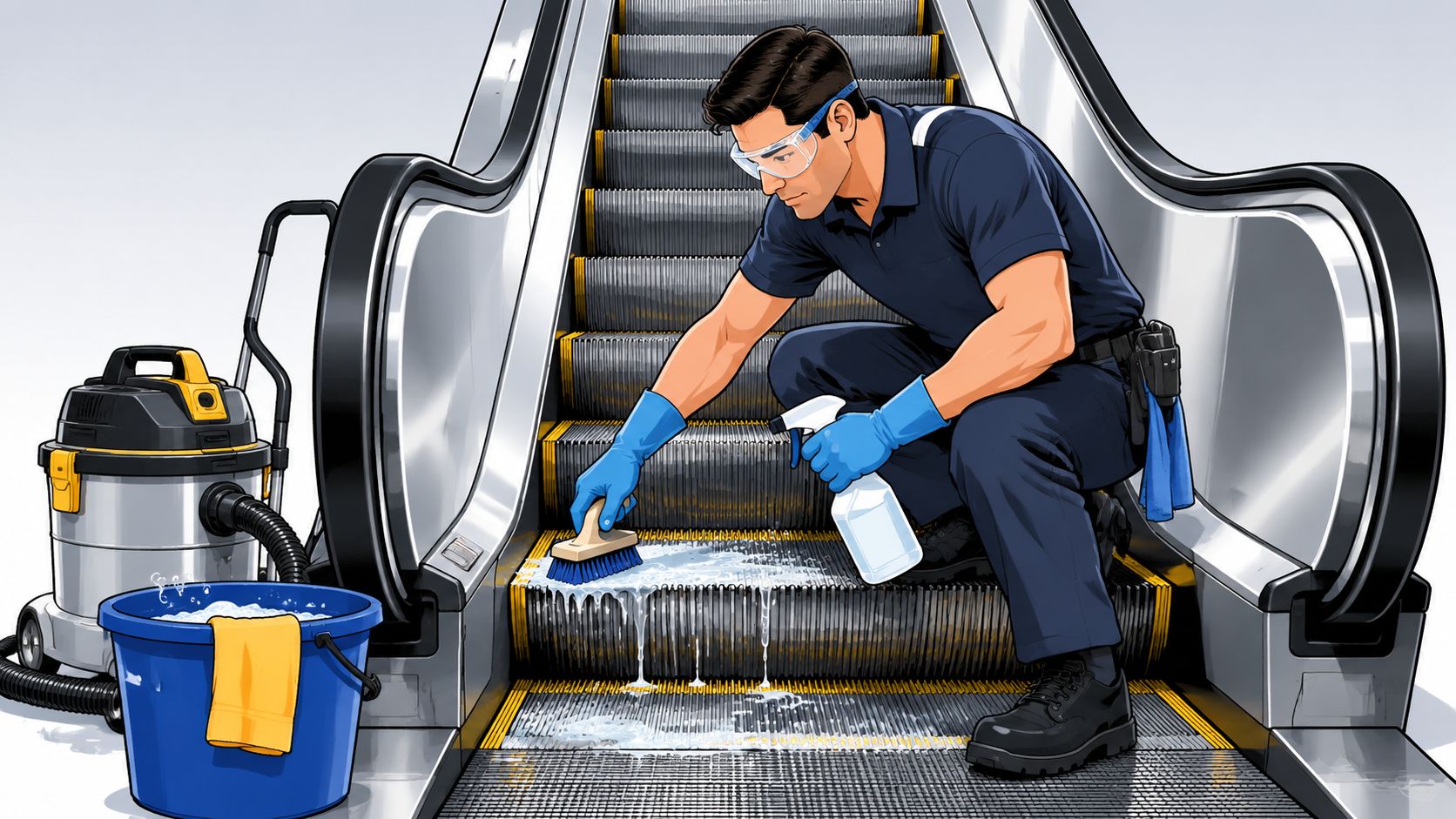
A morning walkthrough can expose a cleaning problem before a passenger says a word. Under bright station or shopping-center lighting, escalator steps show every dark streak, rubber mark, packed groove, and damp-looking patch. People notice the tread before they reach the handrail, and they often treat visible soil as evidence that the rest of the facility receives the same level of care.
Escalator step cleaning has a harder job than ordinary floor cleaning. The team must remove debris without pushing grit into the step chain, control moisture around mechanical components, preserve tread materials, and document the work clearly enough for maintenance reviews. A defensible program also needs a separate approach to high-touch surfaces, including handrails, landing rails, nearby counters, and shared equipment.
Disinfectant wipes can support that program, particularly in offices, gyms, schools, restaurants, retail stores, and other properties where staff need a fast way to address touchpoints between larger cleaning cycles. The key is using them correctly. Wipes don't replace mechanical debris removal from escalator grooves, and they shouldn't leave a wet film on a walking surface.
Why Escalator Step Cleaning Matters More Than You Think
A grimy escalator isn't only a presentation issue. Grease, lint, dirt, refuse, and material carried in on footwear can collect around steps, comb plates, and internal areas. That soil can affect traction, make detailed inspections harder, and move into places where it complicates maintenance.
The fire-safety history is important. Following the King's Cross inquiry, investigators found that escalators installed in 1939 had never been completely cleaned. An earlier inquiry after the 1944 Paddington fire identified 77 escalator fires between 1939 and 1944, as documented in the Hong Kong lift and escalator maintenance best-practice booklet.pdf). Those findings helped move escalator cleaning away from informal housekeeping and toward a formal risk-control activity.
Cleanliness is part of the maintenance record
Modern guidance continues that progression. The same maintenance booklet describes UK Health and Safety Executive PM34 guidance established by 1983, with skirt deflectors required on new escalators ordered from 1 January 1984. Oregon's amendment to ASME A17.1 requires the interior of escalators and moving walks to be cleaned to prevent accumulation of oil, grease, lint, dirt, and refuse, with internal cleaning at least once every two years.
The timing of cleaning also sits alongside inspection requirements. Hong Kong guidance requires monthly maintenance services that explicitly include cleaning and periodic examinations at intervals not exceeding six months. Oregon's periodic checklist requires internal cleaning at least once every two years and routine inspections and tests at intervals no greater than six months. These schedules don't make every site equally clean, but they do show that cleaning belongs inside the formal equipment-care system.
Operational rule: Treat every cleaning entry as maintenance evidence. Record the unit, location, date, method, products, defects found, and person responsible.
Passenger confidence starts with visible surfaces
A passenger won't see the service contractor's inspection notes during a commute. They see the tread, handrail, comb area, and landing. That makes visible cleanliness a practical part of facility reputation, especially in transit hubs, malls, office towers, and fitness facilities.
The strongest program separates tasks by risk. Dry debris removal and groove work protect the equipment and walking surface. Disinfectant wipes support frequent touchpoint care. Logs, photographs, and defect escalation connect both activities to a repeatable system rather than a last-minute response to complaints.
Safety Precautions and Required Equipment
The cleaning setup comes before the chemicals. Shut down the escalator through the site's approved lockout and tagout process, apply personal locks where authorized, and verify a zero-energy state with a start-button test. Only trained personnel should access disconnects, internal areas, or removable steps, and the elevator contractor should handle step removal or work that affects reassembly and warranty conditions.
Barricade both landings before tools enter the work area. Use A-frame signs where they can be seen from approaching paths, then add retractable belt barriers to prevent passengers from stepping around the warning. A sign alone doesn't control movement in a busy facility.
Prepare people and equipment
The basic protective setup should include:
- Hand and eye protection: Use chemical-resistant gloves and splash goggles when handling detergents, degreasers, or rinse solutions.
- Foot protection: Wear slip-resistant footwear, especially during controlled wet cleaning and extraction.
- Respiratory protection: Use an N95 mask when the selected process creates aerosolized degreaser, provided that the site's respiratory-protection program supports its use.
- Core tools: Keep stiff-bristle step brushes, microfiber mop heads, a wet/dry vacuum, a pump sprayer, and a neutral-pH detergent available.
- Specialized equipment: High-traffic sites may justify a manufacturer-approved step-cleaning machine, but operators still need training on the equipment and the escalator model.

Control chemistry and moisture
Don't reach for an aggressive acid or highly alkaline solution because the tread looks neglected. Incompatible chemicals can corrode aluminum step treads, damage finishes, and create warranty disputes with the original equipment manufacturer. Confirm the product's compatibility with the equipment documentation, dilute it as directed, and keep the solution controlled rather than allowing it to pool in riser gaps.
The same discipline applies to disinfectant wipes. Use them on appropriate hard, non-porous touchpoints, not as a substitute for cleaning the full tread surface. A wipe can be useful on a handrail-adjacent button, nearby counter, or gym equipment surface, but moisture on a walking tread can create a new hazard.
The Complete Step-by-Step Cleaning Process
The most reliable workflow follows the direction of the equipment and the behavior of the soil. Major equipment-vendor guidance recommends scheduling work during off-peak periods, barricading the area, cleaning from the bottom while the escalator runs upward away from the operator, and working half the tread width at a time. That half-width method matters because many machines are roughly half as wide as the escalator step. Overlap the second pass so the finished tread doesn't show stripes or missed grooves.
Start dry
Begin with a dedicated groove rake or stiff step brush. Loosen packed grit from the serrations and comb area before applying any liquid, then remove the loosened material with a vacuum. The vendor cleaning method for escalators and moving walks puts dry debris removal ahead of detergent, brushing, rinse-wiping, and drying.
A HEPA-filter vacuum is useful where available because it captures fine material rather than redistributing it. Skipping the dry pass turns dust, grit, and detergent into an abrasive slurry. It also leaves packed debris in the grooves, which is a common reason a tread looks clean from a distance but fails close inspection.
Apply, agitate, and extract
Apply a neutral-pH detergent with a pump sprayer. On heavily soiled treads, allow a short dwell period, typically three to five minutes, as described in the REN escalator deep-cleaning process, while keeping the solution from pooling near riser gaps. Work in manageable sections rather than flooding the step.
Agitate with a stiff brush, counter-rotating brush, or approved oscillating step-cleaning machine. A vendor process may use repeated rotations and dry pads to loosen and lift soil, while a site using manual tools should focus on the groove bottoms and edges. Treat rust spots, hardened gum, and grease deposits as spot problems. Use only a compatible spot treatment, test it in an inconspicuous area, and keep solvent away from seals, coatings, and openings.
Rinse lightly and dry completely
Use controlled rinse-wiping or low-moisture extraction. Excess water can enter the step chain, truss, or electrical areas and contribute to corrosion or faults. The final surface should be clean without a visible detergent film.
Force-dry with air movers where the equipment procedure permits it, then inspect under work lighting. Look for residual streaks, missed grooves, remaining gum, tread damage, loose components, and moisture before restart. If a defect appears mechanical rather than cosmetic, stop the cleaning task and refer it to the elevator contractor.

How Often Should You Clean Escalator Steps
There isn't a universal calendar that fits every escalator. Frequency depends on passenger volume, soil brought in from outdoors, weather, nearby food service, construction dust, and the condition of the steps at inspection. A facility manager should set a baseline, photograph it, and adjust the schedule when the condition changes.
Published guidance gives useful boundaries but not a complete operating answer. One commercial cleaning guide estimates that maintenance cleaning for an escalator with 50 steps takes about 20 minutes, while a heavily soiled deep clean takes significantly longer because it requires multiple passes. The same guide places cleaning within formal maintenance expectations, while local requirements may set separate inspection and examination intervals.
Build the schedule around observed soil
Use a tiered plan rather than labeling every visit “deep cleaning.” A busy transit property may need frequent dry removal and more regular wet work. A quieter office property may be able to space surface cleaning further apart, provided the steps remain free of visible buildup and the maintenance schedule is met. Winter salt, summer humidity, pollen, food debris, and event traffic can all justify a temporary increase.
| Facility Type | Daily Tasks | Weekly Tasks | Monthly Deep Clean | Quarterly Maintenance |
|---|---|---|---|---|
| Transit hub | Inspect and remove visible dry debris where site conditions require it | Review grooves, comb areas, and landings | Schedule based on soil and operating conditions | Coordinate equipment review and records |
| Shopping center | Walkthrough and spot removal | Surface cleaning and condition check | Address embedded marks and buildup | Review contractor findings and defects |
| Office building | Inspect during opening routine | Clean when condition requires it | Review tread and landing condition | Align records with service visits |
| Gym or fitness center | Clean nearby touchpoints and inspect tread | Address visible soil and rubber marks | Detail steps and adjacent high-touch areas | Review ownership, training, and product use |
For broader routine planning, use the cleaning schedule guide to assign ownership and document exceptions. Don't claim that a quarterly task alone proves adequate care. The record should show why the selected frequency fits the site.
In-House Team vs Specialized Contractor
An in-house janitorial team usually wins on access and responsiveness. Staff can inspect the escalator during a morning route, remove loose debris, wipe nearby handrails, and report a damaged tread without waiting for an outside appointment. That model works well for routine surface care when the team understands the site's barricading, chemical, and escalation procedures.
A specialized contractor brings a different advantage. Contractors may have trained personnel, purpose-built step equipment, extraction systems, and experience with disassembly-sensitive work. They're the safer choice when the task involves step removal, deep track cleaning, warranty-sensitive components, or a condition that internal staff can't assess confidently.
Compare the hidden liabilities
The direct invoice doesn't tell the whole story. An internal program requires training, equipment upkeep, chemical control, supervision, and a response plan for damage or incidents. A contractor may cost more per visit, but can reduce exposure when the work demands specialized access and documented procedures.
A hybrid arrangement is often practical. Internal staff handle inspections, dry debris, adjacent high-touch surfaces, and immediate reporting. A qualified contractor handles restorative cleaning, complex access, and scheduled maintenance support. For broader retail hygiene planning, facility leaders can also review South Mountain Window Cleaning insights on coordinating cleaning services across customer-facing environments.

Make accountability visible
Whichever model you choose, assign one person to approve the method and one person to verify the result. The service record should identify the escalator, cleaning scope, products used, defects found, photographs taken, and whether the unit was returned to service.
Sales professionals can use this distinction when presenting a cleaning supply program. Don't sell commercial disinfecting wipes as a replacement for escalator maintenance. Position them as one component of a broader package that covers handrails, counters, shared equipment, and other high-touch points while trained personnel manage the tread and mechanical cleaning work.
Disinfection and Visible Sanitation Strategies
Escalator steps and escalator touchpoints need different controls. The tread requires dry soil removal, careful moisture management, and inspection. Handrails, landing rails, nearby buttons, counters, and shared equipment can often receive more frequent touchpoint cleaning, including correctly selected disinfectant wipes.
For hard, non-porous surfaces, an EPA-labeled disinfectant wipe must leave the surface visibly wet for the full contact time on the product label. One EPA example specifies a one-minute contact time, while other products may require longer periods, as shown in the EPA product label. A quick pass followed by immediate drying doesn't satisfy that label instruction.
Use wipes where they add speed
A gym wipe dispenser near equipment returns can make the correct action easier for members and staff. Suitable applications include treadmills' nonporous handles, weight-machine contact points, locker-area counters, and other surfaces approved by the equipment manufacturer. For a yoga studio, yoga mat wipes should be selected for the mat material and used according to the product directions.
CDC guidance for early care and education settings notes that disinfecting wipes can be used on frequently touched electronic items such as phones and computers, but staff may need more than one wipe to keep the surface wet for the full contact time. That principle also applies to large or heavily handled equipment. The CDC cleaning guidance for high-touch surfaces is a useful operational reference, but always follow the disinfectant label and the equipment manufacturer's instructions.
The CDC states that high-touch surfaces in healthcare environments should be cleaned at least twice daily and as needed, while a CDC-derived guide gives offices, gyms, schools, restaurants, and retail sites a minimum of once daily, or more often if needed, for high-touch surfaces. Those benchmarks should inform the routine, not replace a condition-based assessment.

Turn invisible work into evidence
Post a simple sanitation log at the escalator entrance or in the staff area. Record the date, time, area, product, contact-time requirement, and staff initials. Keep the detailed record digitally, with photographs when a defect or unusually heavy soil requires explanation.
For cleaning sales teams, the strongest offer connects wipes for gym equipment with dispensers, refill controls, staff training, surface compatibility guidance, and documentation templates. Customers aren't only buying a container of wipes. They're buying a repeatable way to make cleaning visible and easier to verify.
Building a Sustainable Cleaning Program
A sustainable program survives staff changes because the process belongs to the facility, not to one experienced cleaner. Assign ownership for daily inspections, touchpoint disinfection, escalator surface cleaning, contractor coordination, and record review. Keep the method near the equipment room and make the escalation path clear when staff find damage, water ingress, unusual noise, or a compromised tread.
Track practical indicators without pretending that a single number proves safety. Review passenger complaints, slip-incident logs, third-party audit results, cleaning completion records, and any ATP testing the facility uses. Timestamped photographs can show whether the selected cadence is controlling visible soil, while contractor reports can document work beyond the internal team's scope.
Give the program a commercial purpose
Clean escalators influence how people judge a property before they reach its main service area. That matters to an airport, retail store, office building, gym, school, restaurant, and event venue for the same reason: customers connect visible maintenance with confidence in the broader operation.
Sales teams can strengthen proposals by showing how bulk gym wipes, dispensers, refills, and escalator-adjacent touchpoint routines fit into one supply plan. Owners can use resources such as these slogan ideas for cleaning companies when developing customer-facing hygiene messaging, but the operational proof should come from completed logs, trained staff, and consistent inspections.
Prioritize escalator step cleaning as a documented maintenance responsibility, add disinfectant wipes to daily high-touch routines, and review the schedule whenever traffic, weather, or soil conditions change. Facility managers and cleaning suppliers can visit WipesBlog.com for practical sanitation guidance, then put one accountable person in charge of turning that guidance into a routine that staff can follow every day.
Start this week by inspecting your escalator steps and nearby touchpoints, placing an appropriate wipe dispenser where users and staff can reach it, confirming label contact times, and recording the first condition check. A visible, documented cleaning routine protects the passenger experience and gives your team a defensible standard to maintain.
Leave a Reply