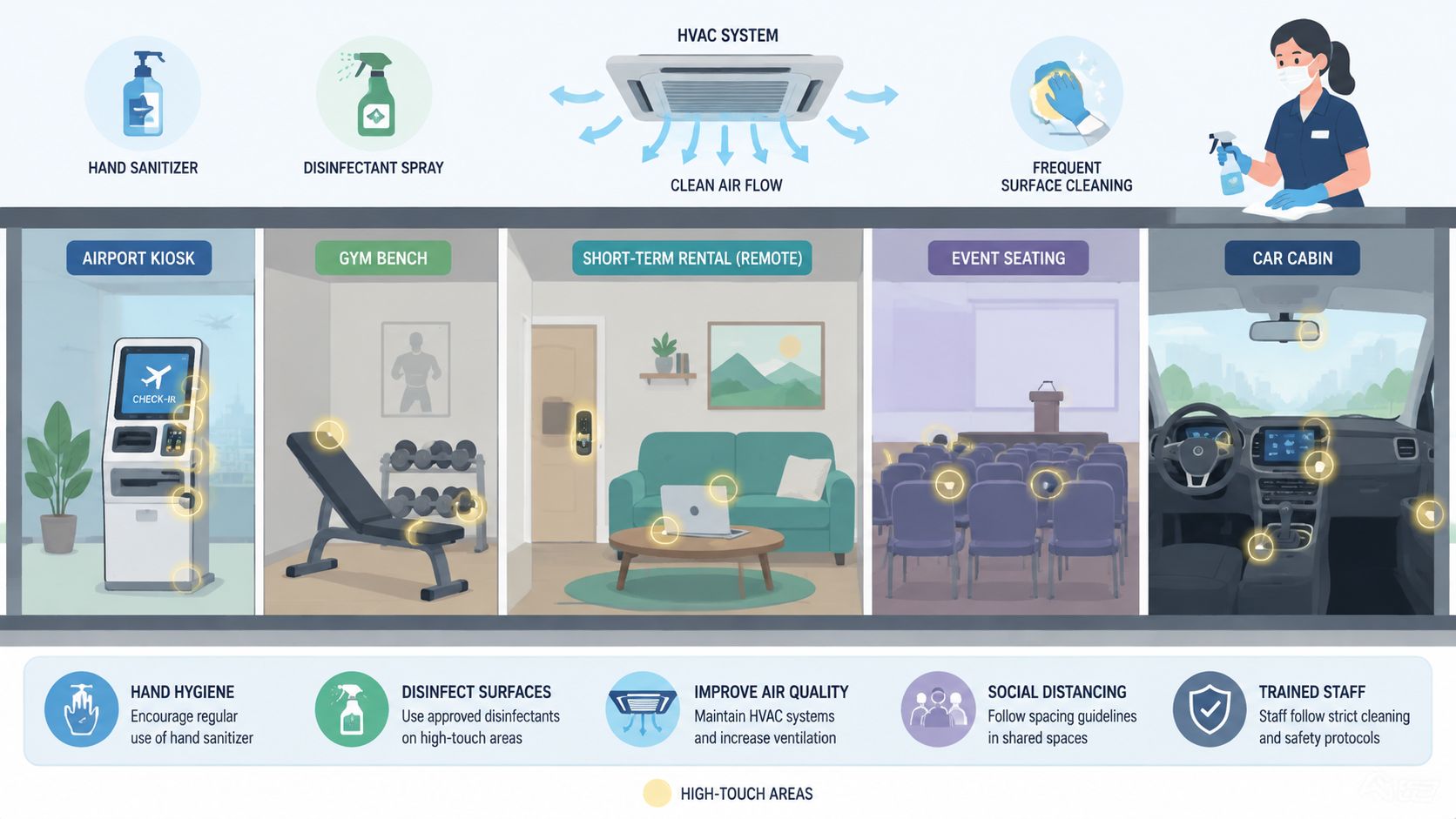
A traveler walks into an airport terminal, taps a check-in kiosk, and notices smudges across the screen. Nearby, a trash bin is full and the hand-sanitizer dispenser is empty. Within seconds, that traveler has formed an opinion about the facility's safety standards, even if the floors are clean and the restrooms were serviced recently.
That reaction is familiar to gym members, office workers, restaurant guests, students, renters, and event attendees. Cleanliness is visible evidence of operational discipline, while disease transmission prevention depends on less visible controls such as hand hygiene, ventilation, surface disinfection, and staff behavior. Cleaning removes soil and organic material. Disinfection uses an appropriate product to inactivate harmful germs on a surface. Both matter, but neither should be treated as a substitute for the other.
The practical challenge is translating clinical infection-control frameworks into routines that work outside hospitals. The WHO Five Moments for Hand Hygiene provides a useful behavior model, while CDC engineering controls show why airflow, air cleaning, and source capture belong in facility planning alongside disinfectant wipes and cleaning schedules. The result is a layered program that managers can apply in airports, gyms, rentals, offices, schools, restaurants, retail stores, and event venues.
Why Cleanliness Is Your Facility's First Line of Defense
A guest doesn't see your cleaning log. They see the fingerprint-covered elevator button, the overflowing waste container, the dusty locker-room bench, or the employee who walks past a visibly dirty counter. Those details become shorthand for the entire operation. A clean environment supports confidence before a customer ever evaluates your service, equipment, food, workout, or event.
The business case extends beyond appearance. Disease transmission prevention is a risk-control function, and visible cleanliness helps customers understand that staff are actively managing shared spaces. It can support retention, reduce avoidable complaints, protect employee morale, and strengthen the credibility of a brand that depends on repeat visits. A facility that looks neglected makes every other promise harder to believe.
Clean is not the same as disinfected
Cleaning removes dirt, sweat, oils, and other material that can interfere with disinfection. Disinfecting then applies a product registered for the relevant use and organism, following the label's directions, including the required contact time. The CDC advises facilities to use an EPA-registered disinfectant for the specific harmful germ when that germ is known, and it notes that frequently touched electronic items may require more than one wipe to keep the surface wet for the full contact time. The CDC's facility-cleaning guidance is a useful reference for product selection and electronic equipment.
That distinction matters in a gym. A dry cloth can remove visible sweat from a dumbbell, but it isn't automatically a disinfectant treatment. A gym equipment wipe must be compatible with the material, applied across the entire contact area, and left wet for the product's stated dwell time. The same principle applies to POS terminals, rental-property remotes, restaurant touchscreens, and shared office phones.
For managers who need a benchmark beyond general commercial cleaning, medical office cleaning standards explained offers helpful context on how healthcare-oriented expectations differ from ordinary appearance-based cleaning.
Practical rule: Customers should see clean surfaces, available hand-cleaning supplies, and staff who know exactly what to do next.
The strongest program also recognizes that surfaces are only one part of transmission. Hand cleanliness remains a foundational control because contaminated hands can move pathogens from surfaces to people. The CDC identifies hand cleanliness as the single most important factor in preventing pathogen and antibiotic-resistance spread in healthcare settings, and it estimates that nearly 2 million patients in the United States acquire a hospital infection each year, with about 90,000 deaths attributed to those infections. CDC hand-hygiene guidance explains why convenient access and correct timing matter.
Understanding the Four Modes of Disease Transmission
Facility managers often ask for one universal cleaning answer. There isn't one because pathogens move through different routes. A shared dumbbell, a crowded gate area, and a poorly ventilated meeting room present different hazards, so each requires a different primary control.
Contact transmission involves direct physical transfer between people or through close interaction with a contaminated person. In a fitness center, hands move between equipment handles, locker doors, phones, and faces. The most useful response combines hand hygiene, practical barriers where appropriate, and cleaning routines that interrupt transfer before the next user arrives.
Droplet transmission involves larger respiratory particles released when someone coughs, sneezes, talks, or breathes forcefully. Crowded event queues, packed gate areas, and busy reception desks can increase exposure opportunities. Space management, staying away from visibly ill people, appropriate masks or respirators during relevant risks, and better respiratory etiquette support prevention.
Airborne transmission involves smaller particles that can remain suspended, particularly indoors when ventilation is poor. The CDC states that respiratory viruses can spread through breathing, talking, sneezing, and coughing, and that better ventilation lowers airborne-particle concentration. CDC respiratory-virus prevention guidance also explains why handwashing helps with surface transmission, while well-fitting masks or respirators and avoiding crowded, poorly ventilated indoor spaces address inhalation risk.
Fomite transmission occurs when a person touches a contaminated object or surface and then transfers the organism to their mouth, nose, eyes, or another person. Door handles, kiosks, security bins, rental-car steering wheels, faucet handles, and shared keyboards are typical examples. The response is not indiscriminate wiping. It is a mapped schedule using an appropriate disinfectant, correct coverage, and the product's required wet contact time.
| Transmission Mode | How It Spreads | Facility Example | Primary Prevention Tactic |
|---|---|---|---|
| Contact | Direct person-to-person or hand-mediated transfer | Shared gym handles and locker doors | Hand hygiene, barriers, and between-use cleaning |
| Droplet | Larger respiratory particles released nearby | Coughing in an event queue or crowded gate | Space management, respiratory etiquette, and appropriate masks |
| Airborne | Smaller particles remain suspended indoors | Poorly ventilated fitness studios or meeting rooms | Ventilation, filtration, and source control |
| Fomite | Touching contaminated objects and then the face or another surface | Kiosks, door handles, remotes, and POS terminals | Systematic surface disinfection with suitable products |
Layer controls instead of betting on one
Surface disinfection won't solve an airborne problem, and an air purifier won't remove sweat and grime from equipment. CDC engineering-control guidance groups airborne controls into local exhaust ventilation, general ventilation, and air cleaning, with specialized negative-pressure rooms and HEPA respirators recommended for certain high-risk healthcare situations. CDC environmental infection-control guidance provides the technical foundation, while commercial operators must adapt it to their building, occupancy, and budget.
The WHO Five Moments framework, formalized in 2009, translates hand hygiene into repeatable action points before patient contact, before aseptic tasks, after body-fluid exposure or glove removal, after patient contact, and after touching the patient's surroundings. The WHO framework summarized by NCBI offers a useful behavior template for non-healthcare settings. A gym can adapt it to before entering a class, before assisting a member, after handling bodily fluids, after touching used equipment, and after servicing a locker room.
Identifying High-Touch Danger Zones in Your Facility
A high-touch zone isn't automatically high risk. Prioritization improves when managers score four practical factors: how often a surface is touched, how quickly users turn over, whether moisture is present, and whether the material is porous or difficult to clean. A frequently touched dry metal button may require a different method from a moderately touched porous bench in a damp locker room.
Start with a walk-through during operating hours, not just after a scheduled cleaning period. Follow the customer journey from entrance to exit and record every shared touchpoint. In an airport, that path may include security bins, kiosk screens, armrests, elevator buttons, and jet-bridge handrails. In a gym, it includes free weights, cable handles, benches, mats, locker handles, faucets, and vending-machine keypads.

Use a risk map, not a universal schedule
The right frequency depends on usage. High-touch, high-turnover areas should be serviced between uses where practical or on a frequent operating-hours rotation. Elevator buttons, POS terminals, shared fitness accessories, and security-bin touchpoints deserve closer attention than a low-use storage-room shelf. Moderate-touch surfaces, including handrails and countertops, need a routine based on occupancy and moisture, with the schedule increased during busy periods.
EPA guidance says commonly touched surfaces such as door handles, desks, phones, light switches, and faucets should be cleaned and disinfected at least daily, with more frequent service when usage is higher. EPA reopening guidance supports using traffic and touch frequency to adjust the baseline rather than treating it as a ceiling.
Product choice follows the map:
- Disinfecting wipes: Use them for rapid, targeted service where staff need visible, controlled application and minimal setup. They suit kiosks, handles, dumbbells, remotes, and small electronic surfaces when the label permits.
- Sprays and cloths: Use them for larger counters, tables, walls, and other surfaces where uniform coverage is efficient.
- Electrostatic sprayers: Reserve them for suitable end-of-day or controlled deep-cleaning applications after confirming product compatibility, worker protection, and required coverage. They aren't a replacement for routine touchpoint cleaning.
A practical high-touch surface disinfection checklist can help teams convert the map into assigned routes. Include the surface, responsible employee, product, contact time, last-service timestamp, and escalation rule when a surface is damaged or repeatedly contaminated.
Building a Practical Prevention Program
A practical program gives each employee clear answers: what gets cleaned, which product to use, how long the surface must stay wet, and who verifies the work. Begin with an EPA-registered disinfectant whose label covers the intended organism and material. Check the label before buying in volume. Contact time, surface compatibility, ventilation needs, and personal protective equipment differ by formulation.
For small touchpoints, commercial disinfecting wipes are often easier to issue than a spray bottle and reusable cloth. They reduce setup and make the action visible to guests. Staff still need enough product to cover the surface and maintain the stated dwell time. Where no specific surface direction exists, alcohol-based wipes or sprays containing at least 70% alcohol may be used, followed by thorough drying. Review the CDC facility-cleaning material with the manufacturer's instructions.
Build the daily operating playbook
Route work around customer movement, then assign each stop to a role:
- Entry points: Clean doors, handles, check-in screens, turnstiles, and sanitizer dispensers.
- Shared work zones: Service POS devices, phones, keyboards, counters, and break-room touchpoints according to their material requirements.
- Restrooms: Keep restroom tools separate from general-area tools, and control moisture so contaminated water and cloths do not spread.
- Activity areas: Clean equipment, benches, mats, and accessories between uses where feasible, then document staff rotations.
- Exit and waste points: Include handles, payment surfaces, and waste-contact areas in the final route.
Budget tiers make the plan easier to operate. A basic program needs labeled products, assigned routes, visible checklists, and hand-hygiene stations at key transitions. A stronger program adds trained relief coverage, spot audits, better dispensers, and documented escalation for missed work. Higher-investment sites can review HVAC performance, filtration capacity, portable air cleaning, and CO2 trends, while still maintaining routine surface service.
Place touchless dispensers near entrances, restrooms, break rooms, class studios, and other transition points. Alcohol-based hand rubs used in healthcare settings should contain more than 60% ethanol or 70% isopropanol. Soap and water should be used for at least 20 seconds when hands are visibly soiled, according to the CDC hand-hygiene core recommendations.
Add air, people, and verification controls
Ventilation, air cleaning, and local exhaust are engineering controls that can complement cleaning. Review HVAC performance, improve filtration where the equipment supports it, place portable HEPA cleaners in appropriate rooms, and use CO2 monitoring as an operational indicator rather than treating one reading as a safety verdict. The WHO ventilation and filtration roadmap provides a framework for decisions in crowded indoor areas.
Train employees at onboarding and refresh the routine during operations. Match gloves, masks, and eye protection to the task, especially when staff handle body fluids, chemicals, waste, or poorly ventilated cleaning areas. The The Green Advantage abatement guide offers added context for prevention and abatement planning.
Track completed routes, missed touchpoints, product stock, guest feedback, and, where appropriate, ATP results. Use those records to adjust staffing and schedules. A sanitation standard operating procedure helps managers document responsibilities instead of leaving decisions to memory.

Facility-Specific Hygiene Checklists
The same product won't solve every facility problem. A gym needs between-use equipment support, while an airport needs a route that follows passenger flow. Assign every task to a role, record the time, and make the required product available at the point of work.
| Facility Type | Top High-Touch Zone | Task | Frequency | Owner |
|---|---|---|---|---|
| Airport | Security bins, kiosks, jet-bridge handrails | Wipe approved touch surfaces, restock gate-area stations, and rotate jet-bridge touchpoints | Between busy waves, operating-hours rotation, and daily close | Terminal cleaning lead |
| Gym or sports facility | Free weights, machines, benches, mats, locker handles | Provide wipes for gym equipment, clean equipment after use where practical, and service mats and locker rooms | Per-use for member wipe-downs, staff rotation during the day, daily close | Fitness-floor attendant |
| Short-term rental | Remote controls, door locks, light switches, faucets | Include a turnover checklist, sanitize remotes and lock interfaces, and leave a guest-facing hygiene card | Every turnover, with daily checks during occupied service | Housekeeping lead |
| Event venue | Armrests, restroom fixtures, counters, payment points | Complete a pre-event clean, service restrooms during intermissions, and separate waste streams after the event | Pre-event, each intermission, and post-event | Venue operations supervisor |
| Car dealership | Test-drive steering wheels, handles, touchscreens, lounge surfaces | Wipe vehicle touchpoints between drivers and keep a dispenser in the service lounge | Between drives, during open hours, and daily close | Sales or service coordinator |
Gyms and sports facilities
Members expect quick access to fitness wipes without having to cross the floor. Position a gym wipe dispenser near strength equipment, cardio areas, mats, and stretching zones, then check the dispenser before opening and during staffed rotations. The manufacturer's cleaning guidance for fitness equipment recommends wiping equipment before and after each use as a precaution, including benches, mats, dumbbells, medicine balls, and accessories, with staff wiping equipment at least once or twice per day depending on use frequency. TRUE equipment-cleaning recommendations should be reconciled with the equipment maker's warranty requirements.
Use dedicated yoga mat wipes only when the formulation is compatible with the mat material. Don't fog a locker room because fogging looks thorough. Choose a method that reaches the intended surfaces, fits the product label, protects workers, and can be verified.
Offices, schools, restaurants, and retail
Offices should prioritize shared keyboards, phones, meeting-room tables, printer controls, door handles, and break-room fixtures. Schools need age-appropriate hand-hygiene access, desk and shared-equipment routines, and a clear response for visible contamination. Restaurants should separate food-contact sanitation from general surface disinfection and follow the applicable food-safety requirements for each surface.
Retail teams should map baskets, fitting-room handles, payment terminals, touchscreens, and service counters. In every setting, keep products labeled, store them safely, and avoid placing a wipe station where leakage, misuse, or customer access creates a new hazard.
Measuring Hygiene ROI and Selling the Value
Managers should treat hygiene as an operational investment, not an unmeasured supply expense. Track leading indicators such as completed cleaning routes, sanitizer usage, touch-frequency observations, dispenser stockouts, ATP testing where used, and guest comments. Pair those measures with outcomes such as absenteeism, cancellations, complaints, retention, and customer-satisfaction feedback.
Avoid unsupported promises. A cleaning supplier shouldn't claim that wipes guarantee fewer illnesses or produce a specific financial return without facility data. The credible sales conversation starts with an audit: walk the site, identify high-touch zones, observe current practices, review product labels, and show where labor, placement, or dwell-time errors create exposure.
Sell a system, not a container
A cleaning-supply professional can build a tiered offer:
- Essential: Approved disinfectant wipes, wall or floor dispensers, labels, gloves, and a basic route checklist.
- Operational: The essential package plus sprays for large surfaces, zone-specific cloths, staff training, refill controls, and documented audits.
- Expanded: The operational package plus ventilation review, portable air-cleaning assessment, ATP testing, digital logs, and stakeholder reporting.
A product page such as WipesBlog.com's facility hygiene guidance can sit alongside manufacturer instructions as a general educational resource, but the facility should still select products based on the label, surface, organism, and operating conditions.
Use a simple internal calculation:
Estimated hygiene value = avoided disruption and reputation loss minus program cost.
The inputs may include canceled bookings, closed areas, overtime, replacement labor, complaints, and supply costs. Keep assumptions visible. A manager can then compare the cost of a stronger prevention stack with the consequences of an unmanaged hygiene failure without pretending that every outcome is directly caused by one product.

Transparent reporting helps sales teams earn trust. Post completed cleaning times where appropriate, link a QR code to a maintained checklist, and share trends with tenants, clients, staff, or members. The strongest proof isn't a dramatic promise. It's a consistent record showing that the facility identified risks, assigned work, completed it, and corrected misses.
Your Next Steps for Stronger Disease Transmission Prevention
Start with the controls people can use immediately. Place EPA-registered disinfectant wipes at mapped high-touch points, keep hand-sanitizer dispensers full at entrances and transitions, maintain a visible cleaning route, and review ventilation in enclosed rooms. For teams that sell cleaning supplies, package the products with dispensers, training, logs, and a risk assessment so customers can operate the program rather than purchase inventory.
A 30-60-90 day rollout
- First 30 days: Reposition dispensers, label zones, retrain staff on coverage and dwell time, and audit the busiest routes during live operations.
- By 60 days: Review HVAC and air-cleaning options, examine room airflow and crowding, test the digital logging process, and correct recurring stockouts or missed tasks.
- By 90 days: Establish a recurring verification cycle using appropriate ATP testing or equivalent checks, review guest feedback, and revise schedules based on actual usage.
Use practical sanitizing habits that make the routine dependable. Color-code microfiber cloths by zone so restroom tools don't migrate into general areas. Log disinfection timestamps digitally, including the surface, employee, product, and exception. Rotate disinfectant chemistries only when product labels, safety requirements, and facility policy support the change. Don't rotate products casually or assume rotation alone prevents resistance.

Disease transmission prevention is an ongoing operating discipline, not a one-time deep clean. Prioritize cleanliness today, map your facility's actual touchpoints, station suitable disinfectant wipes where staff and guests need them, and assign a documented schedule that can be audited. Managers should begin the first route this week, while cleaning-supply professionals should help customers build a complete, label-compliant hygiene program around the products they already use.
Leave a Reply