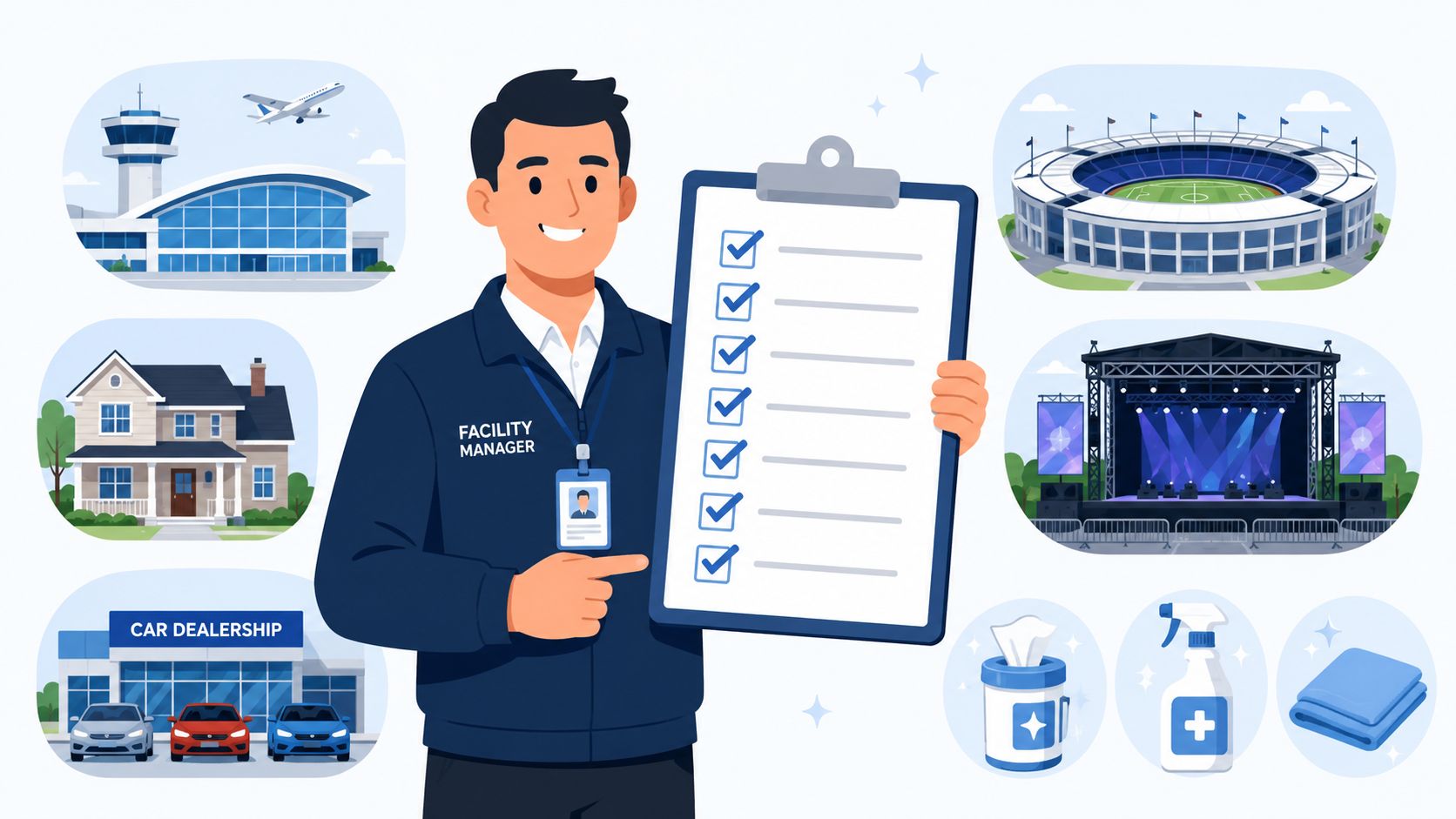
An effective facility manager checklist can reduce planned-maintenance costs by 12% to 18%, while each dollar spent on preventive maintenance can save an average of $5 later. It should prioritize high-touch surfaces, assign recurring tasks, verify proper disinfectant-wipe use, and document completion across daily, weekly, monthly, and seasonal routines.
Clean facilities earn trust before anyone says a word. A visitor notices the wiped gym console, clean airport touchpoint, fresh rental turnover, orderly event venue, polished dealership counter, and well-maintained restroom before they evaluates your service.
Cleaning removes soil and debris. Properly used disinfectant wipes support targeted disinfection on suitable hard, non-porous surfaces when staff follow the product label, including pre-cleaning, wet coverage, and the required contact time. That distinction matters in gyms, offices, schools, restaurants, retail stores, airports, and other shared-use facilities.
The checklist below connects high-touch mapping with wipe technique, dispenser logistics, staffing, seasonal planning, audits, documentation, and guest-facing communication. For more practical sanitation strategy across commercial and public spaces, WipesBlog.com's facility sanitation resources provide a useful reference. A well-run hygiene program also supports running a recurring revenue fitness business, because cleanliness influences the everyday experience members remember.
1. Map Your High-Touch Zones and Create a Disinfection Priority Schedule
A generic cleaning route misses the places people touch most. Start with a floor plan and mark every shared-contact point, including doorknobs, handrails, light switches, payment terminals, restroom fixtures, locker handles, equipment grips, touchscreens, and reception counters.
Then assign each zone a risk-based frequency. The schedule should reflect traffic, surface use, soil level, and the consequences of a missed task. A cardio area during a busy workout period needs a different approach from a quiet office corridor.
CDC guidance recommends cleaning and disinfecting high-touch surfaces in public and healthcare settings at least daily, with more frequent cleaning based on use. It also identifies surfaces such as doorknobs, light switches, bedrails, and restroom-adjacent areas as priorities over low-touch surfaces. CDC environmental cleaning guidance supports making contact patterns visible rather than treating every surface equally.

Build a route staff can actually complete
Use a color-coded map posted in the janitorial closet or staff area. Give each zone an owner, a required product, and a completion field for time, initials, and corrective action.
- Fitness areas: Place cardio consoles, free-weight handles, locker handles, and entry points on the frequent-use route. Keep gym equipment wipes near the equipment, not in a distant supply room.
- Public facilities: Prioritize terminals, gate handles, restroom fixtures, shopping carts, checkout counters, and payment keypads.
- Guest spaces: Include doorknobs, switches, remote controls, bathroom fixtures, and kitchen touchpoints before each short-term rental arrival.
A clipboard works for a small facility. A mobile log or CMMS works better when several shifts share responsibility. The best schedule isn't the most detailed one. It's the one a supervisor can verify during a walkthrough without guessing who completed the work.
2. Train Staff on Proper Disinfectant Wipe Technique and Application
A wipe doesn't disinfect just because someone passed it over a surface. Staff need to understand soil removal, wet coverage, contact time, and cross-contamination control.
EPA label instructions require users to pre-clean heavily soiled hard, non-porous surfaces, wipe until the surface is visibly wet, and keep it wet for the full contact time. One EPA product label gives examples ranging from 1 minute for certain sanitizing or disinfecting claims to 4 to 10 minutes for disinfection, depending on the product and organism claim. EPA wipe label instructions should govern the training card placed beside each dispenser.
Demonstrate the difference between a quick wipe and a compliant application. In a gym, a staff member should wipe the full contact surface of a console, handle, bench, or adjustment lever, then allow the surface to remain wet for the label time. If the next user needs the equipment immediately, the facility must choose a product and workflow that fit that reality. Rushing the dwell time creates a visible cleaning action without delivering the labeled disinfection process.
Turn training into a competency check
Use laminated reference cards with the product name, approved surfaces, wet-contact instruction, and safety notes. A short video can show how to unfold a wipe, cover the entire surface, avoid reusing a soiled wipe, and dispose of it correctly.
Rotate practice across fitness floors, restrooms, kitchens, reception desks, and vehicle interiors. New hires and seasonal staff need the same standard as experienced employees. Staff training best practices for sanitation teams can help managers build a repeatable process.

Practical rule: If the surface isn't visibly wet for the product's full contact time, the task may be cleaning, but it hasn't necessarily met the disinfection label.
Where appropriate, use ATP testing as a coaching tool. It can show whether a team member cleaned a surface effectively, but it doesn't replace label compliance or visual inspection.
3. Stock Strategic Dispenser Locations and Maintain Consistent Inventory
Dispenser placement determines whether a wipe is available at the moment a surface needs attention. Guests cannot use sanitizing wipes they cannot find, and staff lose time when a route stops for an empty unit.
Map each dispenser to a specific activity. In a fitness center, place units beside cardio clusters, free-weight racks, selectorized equipment, locker-room entrances, and stretching zones. Retail sites may need access near carts, fitting rooms, and checkout. Airports should cover security checkpoints, gates, and baggage-claim touchpoints. In rentals, provide wipes in guest rooms, bathrooms, and shared kitchens only when the product suits those surfaces.
Make each unit easy to check. A clear window shows the remaining supply, while a label identifies the product and contact-time instruction. The daily checklist should record the location, supply level, refill status, and any damaged or blocked dispenser. That record gives supervisors a practical way to assign follow-up instead of relying on guest complaints.
Build inventory into the operating route
Store reserve cartons in a clean, climate-controlled area away from direct sunlight. Purchase according to occupancy and usage patterns. Bulk gym wipes and commercial disinfecting wipes can simplify procurement, but larger orders create value only when the product stays suitable, accessible, and within its use requirements.
Assign one person on each shift to verify every dispenser before the busiest operating period. Set reorder points early enough to cover a supplier delay, and track consumption by zone. A cardio area that empties faster than a lobby needs its own refill plan. Follow manufacturer storage instructions and close containers properly to protect product integrity.
Automatic units can suit high-use areas, but batteries, maintenance, and installation add work. Review automatic dispenser and sanitizer planning guidance before choosing touchless access. The right setup balances convenience with serviceability, refill time, and accountability.

4. Develop a Sales and Marketing Strategy Highlighting Hygiene ROI to Guests
A hygiene program becomes easier to sell when it connects daily work with guest confidence and service reliability. Owners need dependable operations, staff need a process they can follow, and guests need clear signs that shared spaces receive attention. Present wipes, dispensers, training, refill planning, audits, and records as one operating system rather than isolated supplies.
Avoid promises that wipes prevent illness or guarantee a specific financial outcome. Show the practical value instead: fewer stockouts, clearer staff responsibility, consistent service, and a customer experience that is easier to explain. A fitness center can display the last equipment-cleaning time and describe the product's required contact time. A short-term rental operator can outline the turnover sequence and avoid terms such as “hospital-grade” unless the wording is accurate and supported.
Turn daily controls into a customer-facing message
Sales conversations should start with the facility's operating gaps:
- Where do stockouts happen? Recommend access points, reorder controls, and ownership for checks.
- Which surfaces create complaints? Match the product and wipe method to the material and task.
- Who verifies completion? Include route cards, logs, and supervisor review.
- What can guests understand quickly? Provide plain-language signs that reflect the actual program.
For gyms, position fitness wipes as part of equipment readiness. In offices, connect touchpoint coverage with employee convenience. Restaurants can tie supplies to service transitions and front-of-house consistency. Retail stores can place visible access near carts and counters, then explain how staff maintain those points.
The phrase EPA registered disinfecting wipes may communicate regulatory positioning, but staff still need to follow the product label. A credible hygiene ROI discussion links supply spending to reliable availability, accountable routines, consistent service, and a more convincing guest experience. That message works across facility types because it describes observable practices instead of unsupported promises.
5. Create Facility-Specific Disinfection Protocols Based on Risk Profile
A gym, school, restaurant, airport, dealership, and short-term rental don't share the same contact patterns or material constraints. Each needs a written protocol that identifies priority surfaces, suitable products, responsible staff, escalation steps, and documentation requirements.
Begin with the facility's actual workflow. In a gym, put equipment handles, benches, touchscreens, free weights, locker handles, and shared mats into the route. Wipes for gym equipment must be compatible with the equipment manufacturer's surface guidance. Yoga mat wipes may need a separate selection from products used on metal handles or laminated counters.
In a restaurant, separate food-contact requirements from general hard-surface disinfection. A kitchen handle, service pass, dining table, restroom fixture, and payment terminal may require different products, preparation steps, or post-use controls. In a dealership, prioritize steering wheels, gear shifts, door handles, seat surfaces, and touchscreens while checking compatibility with leather, vinyl, plastic, and coated finishes.
Let risk determine the order
Write the protocol around traffic and consequence rather than giving every task equal weight. A high-touch payment keypad deserves more attention than a decorative wall. A damp locker-room corner may require moisture investigation and ventilation review, not another routine wipe.
For indoor air quality, a stronger annual preventive review can include measurements for CO2, PM2.5, TVOC, formaldehyde, relative humidity, and temperature at representative locations. It can also verify green-cleaning policies, low-VOC products, current SDS files, and integrated pest-management records. ASHRAE's IAQ preventive-maintenance checklist connects these tasks instead of treating air, chemistry, and documentation as separate subjects.
Keep a general product for suitable surfaces and specialized products where materials or use conditions demand them. Add an escalation path for spills, moisture, odor complaints, suspected contamination, and any situation requiring professional or regulatory guidance.
6. Implement Visible Disinfection Audits and Communicate Progress to Stakeholders
A signed checklist tells you that someone marked a task complete. An audit helps determine whether the task was performed correctly and whether the process still works under real operating pressure.
Use a mix of direct observation, log review, product checks, and, where appropriate, ATP testing. A supervisor can inspect whether a dispenser is accessible, whether the right label is present, whether a surface was covered, and whether the wet-contact instruction is understood. ATP results can support coaching, but they should be interpreted using a threshold appropriate to the facility, the device, and the tested surface.
Test before and after cleaning when the purpose is to demonstrate process impact. Capture the location, date, staff member, product, finding, corrective action, and follow-up. A mobile form can also store a photo of a damaged dispenser, a missed zone, or a completed corrective action.
Make accountability visible without creating theater
Post a “cleaned at” record where it helps guests understand the routine, such as near gym equipment clusters, restrooms, or reception areas. Don't display data that staff can't maintain or that visitors could misinterpret. A public dashboard is useful only when the underlying records are current and accurate.
CDC guidance supports more frequent attention to high-touch surfaces based on use, so audits should examine whether the route changes during busy periods. A gym might review cardio consoles, locker handles, and restrooms. A retail manager might inspect checkout counters and fitting rooms. An event venue might audit shared touch zones between bookings.
A failed audit should trigger a coaching conversation and a corrective task, not a blame ritual.
Celebrate consistent completion, but investigate repeat failures. The pattern may point to understaffing, poor dispenser placement, an unsuitable product, an unrealistic contact time, or a route that doesn't match how visitors move through the building.
7. Tailor Disinfection Frequency and Product Selection to Seasonal Demand and Occupancy Patterns
Seasonal demand should change the checklist, not merely the cleaning rota. Occupancy, event schedules, school terms, travel periods, weather, and fitness habits affect both soil levels and touch frequency.
Start with operating records. Compare previous booking or occupancy patterns, identify recurring peaks, and ask supervisors which supplies run out first. A fitness center may need more rounds as member activity rises. A short-term rental operator may need tighter turnover coordination during busy travel periods. Restaurants may require added attention during service peaks and weekends, while airports may adjust rounds as passenger volume changes.
Quiet periods still need a plan. Use them for deep cleaning, dispenser repairs, product trials, staff coaching, and protocol review. Reducing routine rounds without fixing equipment or training gaps can leave the facility less prepared when demand returns.
Match staffing, products, and routes to demand
Set the operating plan around three decisions:
- Route frequency: Add rounds where use is heavier, such as restroom entrances, locker-room touchpoints, shared equipment, and checkout areas.
- Labor coverage: Schedule trained staff when touchpoints need attention, not only when the building opens. Assign named owners so busy periods do not create unclaimed tasks.
- Inventory position: Build a practical reserve before demand rises. Avoid excess purchases that may expire or become unsuitable, and confirm that dispensers can be refilled without interrupting service.
The 2025 global facilities-management discussion identifies workload, budgets, staffing, and risk as significant pressures. IFMA's 2025 release describes a Workload Index based on global insights into those areas. JLL's global facilities-management report reinforces the practical question a checklist must answer: what gets done first when headcount is stretched?
Product selection should follow the surface, contact time, soil type, and staff workflow. Do not choose a product solely because it fits a seasonal promotion. Review restroom sanitation, locker-room moisture, HVAC records, chemical storage, and corrective-action closeout according to facility risk. A seasonal plan earns trust when guests see consistent standards across hotels, gyms, restaurants, rental properties, and transport facilities, even as occupancy changes.
8. Document and Communicate Your Disinfection Program to Build Guest Trust and Competitive Advantage
A documented hygiene program gives staff a consistent standard and gives guests a basis for trust. Record approved products, compatible surfaces, contact times, training dates, dispenser locations, route frequencies, inspection findings, corrective actions, and audit results.
Keep the form practical enough for a janitorial employee to complete during a busy shift, while giving managers enough detail to verify performance. Assign named owners, not only departments. A staff name, time, zone, and exception note show who handled a missed route and what needs correction.
Give guests useful information
Use a one-page hygiene fact sheet to explain staff focus areas, route review frequency, products in use, and the process for reporting concerns. Gym membership pages can set equipment-cleaning expectations. Rental pre-arrival messages can outline turnover steps, while dealerships can provide a vehicle-cleaning record for loaner cars.
Use precise language. Avoid claims such as “sterile,” “zero risk,” or “germ-free.” Explain that cleaning removes soil and that disinfectants must be applied to suitable surfaces according to the label. The CDC guidance on high-touch cleaning priorities supports giving more frequent attention to heavily used areas. WHO guidance states that alcohol-based hand rub containing at least 60% alcohol is an effective alternative to soap and water when hands are not visibly dirty. WHO community hand-hygiene guidance supports pairing surface programs with visible hand-hygiene access.
Update signs and digital messages whenever procedures change. Train front-desk and sales staff to answer questions from the approved record rather than improvising. Keep related property controls documented too, including integrated security and maintenance checklists when security and facility responsibilities overlap.
8-Point Facility Manager Checklist Comparison
| Strategy | Implementation Complexity 🔄 | Resource Requirements ⚡ | Expected Outcomes 📊 | Ideal Use Cases 💡 | Key Advantages ⭐ |
|---|---|---|---|---|---|
| Map Your High-Touch Zones and Create a Disinfection Priority Schedule | Moderate, initial walkthrough and zoning setup | Low–Medium, staff time, mapping tools, checklist apps | Fewer overlooked hotspots; improved coverage and supply forecasting | High-traffic facilities: airports, gyms, retail, rentals | Targeted cleaning, accountability, regulatory alignment |
| Train Staff on Proper Disinfectant Wipe Technique and Application | Medium–High, recurring training and competency checks | Medium, training materials, timers, possible ATP validation | Higher disinfection efficacy; reduced waste and liability | Any staffed facility with frequent surface contact | Measurable QA, empowered staff, consistent technique |
| Stock Strategic Dispenser Locations and Maintain Consistent Inventory | Low–Moderate, placement and inventory processes | Medium, dispensers, bulk stock, inventory system | Increased compliance; fewer stockouts; cost savings via bulk buys | Gyms, airports, retail, rentals with predictable flows | Convenience-driven compliance; visible hygiene commitment |
| Develop a Sales and Marketing Strategy Highlighting Hygiene ROI to Guests | Medium–High, messaging, data collection, campaigns | Medium, marketing budget, analytics, collateral | Improved trust, higher retention and potential premium pricing | Customer-facing businesses seeking differentiation | Monetizes hygiene program; drives acquisition/retention |
| Create Facility-Specific Disinfection Protocols Based on Risk Profile | High, risk assessments and tailored SOP development | Medium–High, expertise, documentation, product selection | More effective, efficient disinfection focused on real risks | Regulated or high-risk settings: hospitals, airports, large gyms | Science-backed, defensible protocols; optimized resource use |
| Implement Visible Disinfection Audits and Communicate Progress to Stakeholders | Medium, audit processes and public reporting | Medium, ATP kits, digital tracking, staff time | Objective validation; identifies gaps; builds stakeholder trust | Facilities prioritizing transparency and liability mitigation | Measurable proof of cleaning, motivates staff, public reassurance |
| Tailor Disinfection Frequency and Product Selection to Seasonal Demand and Occupancy Patterns | Medium, forecasting and dynamic scheduling | Medium, analytics, flexible inventory, staffing adjustments | Reduced waste; readiness for peaks; predictable budgeting | Seasonal businesses: resorts, seasonal gyms, event venues | Cost efficiency, capacity planning, better peak performance |
| Document and Communicate Your Disinfection Program to Build Guest Trust and Competitive Advantage | Medium, documentation and multi-channel communications | Medium, content creation, design, channels, staff training | Greater guest confidence; marketing asset; legal defensibility | Hotels, gyms, rentals, event venues aiming to differentiate | Transparency-driven trust, supports premium pricing and PR |
Turn the Checklist Into a Visible Daily Standard
An effective facility manager checklist should live in the operating rhythm, not in a forgotten binder. Convert the eight steps into assignments for each cadence:
- Daily: Walk high-touch zones, inspect dispensers, complete priority wipe routes, review restroom and locker-room conditions, and record exceptions.
- Weekly: Audit route completion, inspect recurring complaints, review product use, check training gaps, and test selected surfaces when appropriate.
- Monthly: Review inventory, refresh signage, examine corrective-action trends, verify product labels and SDS records, and adjust routes to match occupancy.
- Seasonally: Reassess staffing, demand, weather-related risks, guest messaging, and supply reserves. Use quieter periods for training, deep cleaning, repairs, and protocol updates.
- Annually: Review the entire program, including indoor air quality, ventilation, cleaning chemistry, documentation, and asset-specific preventive maintenance.
This cadence fits the broader history of facility checklists. Modern public-sector schedules commonly organize inspections around preventive maintenance, with examples including roof and HVAC reviews twice a year, emergency-lighting checks monthly, sprinkler-system checks annually, automatic-door checks at least every 6 months, and lighting inspections every 3 months. Annual facade inspections, annual parking-garage cleaning, and twice-yearly electrical and mechanical-room checks show how a checklist functions as a recurring governance tool, not just a custodial to-do list. Facility-manager checklist examples and inspection intervals illustrate that system-based approach.
The financial case also depends on execution. Preventive maintenance can save 12% to 18% compared with reactive maintenance, and proactive maintenance is associated with an average 17.8% reduction in downtime compared with reactive maintenance. Preventive maintenance efficiency data explains why documentation, recurring assignments, and corrective-action closeout matter. A checklist creates the discipline, but staff behavior and management follow-through create the result.
Use benchmarking to calibrate the program rather than copying another building's schedule. IFMA's operations and maintenance benchmarking work segments comparisons by facility sector, use type, portfolio structure, climate, ownership, age, size, and geography. One release included 56 facilities across 8 European countries, showing the value of comparing like facilities rather than treating every site as identical. IFMA operations and maintenance benchmarking can help managers connect staffing, utilities, janitorial work, and maintenance execution to their own asset class.
Cleanliness also has a direct guest-facing dimension. CDC guidance calls for high-touch surfaces in public and healthcare settings to be cleaned and disinfected at least daily, with frequency adjusted for use. For objects such as shopping carts and point-of-sale keypads, cleaning and disinfection before each use may be appropriate, while hand-hygiene stations reinforce the surface program.
The trade-off is straightforward. More wipes alone won't fix a weak process. A strong program combines the right product, complete wet coverage, label contact time, accessible dispensers, trained staff, realistic routes, documented completion, visible audits, and honest communication.
For facility managers, business owners, janitorial teams, gym operators, and cleaning-supply professionals, the next step is practical. Prioritize your highest-touch zones today, assign named owners, verify the wipe technique, and explore suitable wipe and dispenser solutions through WipesBlog.com's sanitation resources.
Leave a Reply