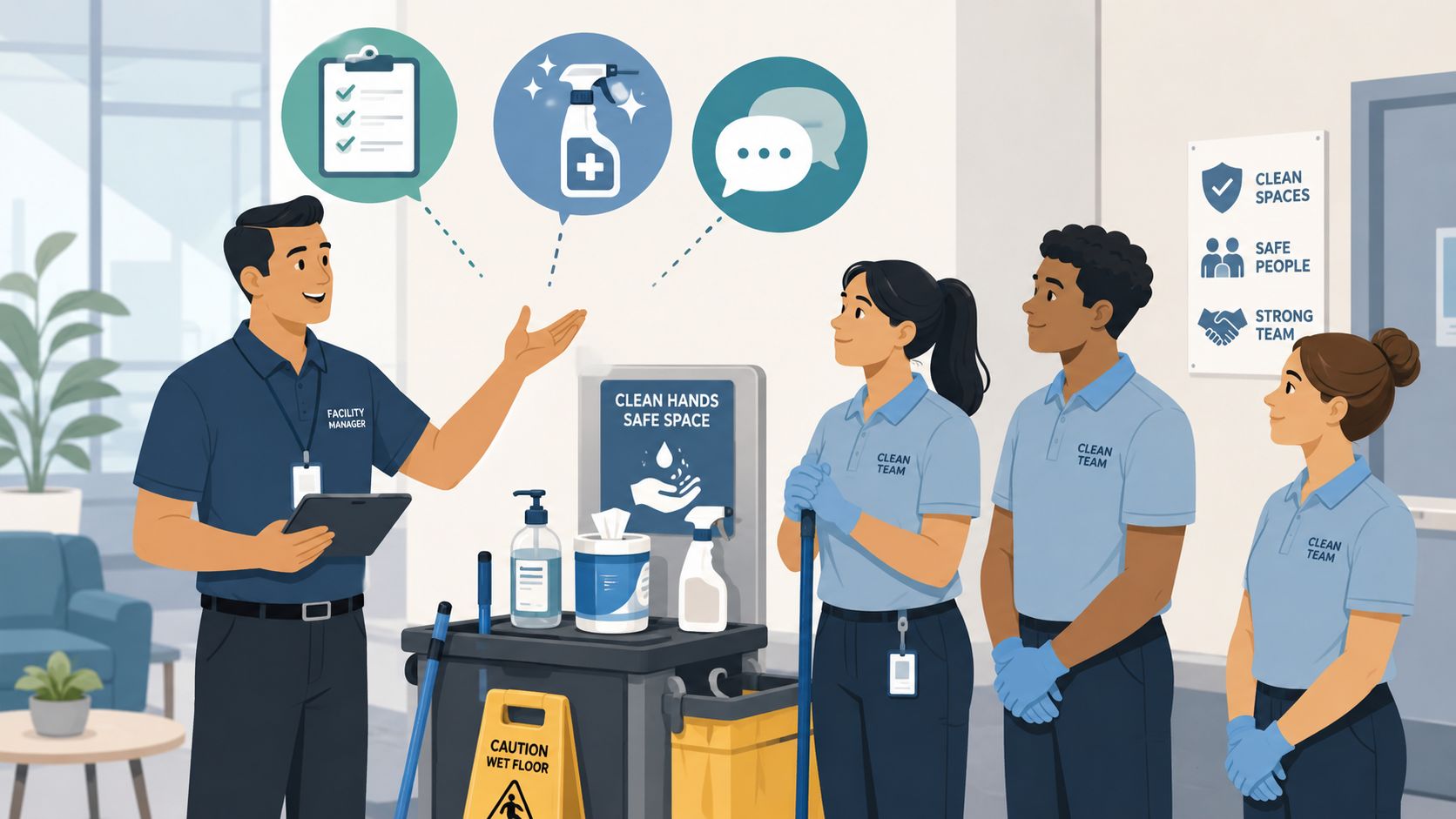
You can tell when a sanitation program is drifting. The wipes are stocked, the SOP is laminated, the kickoff meeting sounded serious, and the floor still looks like nobody owns it. In facilities like gyms, offices, schools, restaurants, and retail stores, the problem usually isn't the product. It's communication with staff.
I've seen clean-looking plans fall apart because the front desk didn't know where the disinfectant wipes were stored, the closing crew got a different version of the checklist than the opening crew, or the manager assumed “everyone knows” which surfaces matter most. That gap gets expensive fast. Axios HQ reports that ineffective workplace communication can cost a single employee earning between $50,000 and $100,000 35+ working days per year, or about $10,140 in salary loss per employee per year Axios HQ internal communications statistics. In a busy facility, that's not an abstract HR issue. That's missed wipes, missed handoffs, and repeat work.
Why Sanitation Programs Fail Without Staff Communication
A gym can buy the best disinfectant wipes, post a polished cleaning SOP, and still end up with sticky benches and half-wiped cardio machines by the end of the week. That usually happens when the team heard the policy once, but never got a clear, repeatable message about what matters most. The result is predictable. People improvise, shift leads assume someone else covered it, and the program exists on paper instead of on the floor.
The data around internal communication explains why this keeps happening. Gallup-based summaries report that only 13% of employees strongly agree their leaders communicate effectively, while 74% say they feel they're missing out on company news, and only 15% of employees worldwide are engaged at work employee communication statistics. In practical terms, that's a warning sign for any sanitation routine that depends on memory, goodwill, or one-time training.
If the team can't repeat the message in their own words, the message isn't operational yet.
For facility managers, the failure mode is rarely the wipe itself. It's the gap between the standard and the daily habit. If the front desk, janitorial team, and shift supervisors all describe the sanitation process differently, compliance drifts quickly. That's why communication with staff needs to sit underneath every cleanliness effort, not beside it.
A related benchmark matters too. The same Gallup-based material notes that 60% of companies lack a long-term internal communications strategy employee communication statistics. In operations-heavy facilities, that usually shows up as scattered reminders, inconsistent handoffs, and no shared routine for updates. Cleanliness starts slipping the moment the message becomes optional.
Building a Communication Protocol That Actually Works
A sanitation program needs a message system, not just a message. Start with a simple audit of what staff are supposed to know, who needs to know it, where they hear it, and how you'll check whether it stuck. A strong protocol covers goal, audience, key message, channel, cadence, and measurement. If any of those pieces are missing, the team fills the gap with guesswork.
The five questions to answer first
- What is the goal? Decide whether the message is about wiping down equipment between uses, restocking supplies, or correcting a recurring hygiene miss.
- Who needs the message? Front desk staff, cleaners, supervisors, and sales teams often need different versions of the same standard.
- Which channel fits the task? A quick update about commercial disinfecting wipes might work in a group chat. A change in wipe technique needs live demonstration.
- How often should it repeat? Routine sanitation reminders need a rhythm, not a one-off announcement.
- How will you know it worked? Look at attendance, completion, and pass-fail checks, not just whether the email was sent.
Channel choice matters. Comcare's guidance on effective communication stresses that complex or high-impact updates work better face-to-face or through manager-led conversations, while simpler reminders can sit in email or broadcast tools effective communication guidance. That's the difference between telling people what to do and making sure they can do it.
For teams trying to coordinate updates, a practical resource like AnchOps on staff communication can be useful as a model for how to centralize messages without burying the floor team in noise. The point isn't another app. It's reducing friction between the person who sets the standard and the person who has to execute it.

The cost of getting this wrong shows up in labor waste. Axios HQ reports that a single employee earning between $50,000 and $100,000 loses 35+ working days per year because of ineffective communication, which it equates to about $10,140 in salary loss per employee per year Axios HQ internal communications statistics. In a facility, those lost days often become rework, missed restocks, and awkward customer-facing moments.
Training Scripts and Meeting Rhythms for Sanitation Teams
A protocol only works when supervisors can say it clearly and repeat it without improvising. Penn State Extension recommends defining the idea before sharing it, identifying the purpose of the message, being mindful of the environment, and following up to verify the information was received effective communication in the workplace. That fits sanitation training perfectly. If staff don't know when to use disinfectant wipes, how to use them, and what “done” looks like, the routine won't survive a busy shift.
A short daily huddle works better than a long lecture. Keep it to one priority, one demonstration, and one check for understanding. A supervisor might say, “Today's focus is the console tops, handrails, and touchscreens. Use one wipe, keep the surface visibly wet for the full contact time required by the product label, and replace the wipe when it's loaded.” That kind of script is simple enough for the opening crew and repeatable enough for the closing crew.
A practical rhythm that staff can absorb
- Daily huddle. Five to 10 minutes at shift start, one sanitation topic only.
- Weekly training block. 30 minutes for a deeper topic, such as the difference between cleaning and disinfecting.
- Teach-back question. Ask, “Show me where you'd use the wipe first,” or “Which surfaces get the second pass?”
- Repeat the same checklist. High-touch areas should not change from week to week unless the facility changes.
- Follow-up spot check. Confirm the message landed by watching the work, not by trusting the nod.
That repetition matters more than people think. Penn State Extension also emphasizes asking clarifying questions, setting clear expectations, and repeating important messages effective communication in the workplace. For a gym, that could mean teaching staff how to spot when fitness wipes need a refresh between guest uses. For a school or office, it could mean making sure shared desks and door hardware are in the same checklist every day.
For a deeper look at how teams structure onboarding and role-based training, this internal resource on staff training best practices is a useful companion.
Visual Tactics That Make Sanitation Visible to Staff
The best sanitation reminders are hard to miss and easy to follow. If a cleaner has to remember a paragraph of policy at the end of a shift, the process is too dependent on memory. Visual cues cut through that problem. They make the right action obvious in the exact place where the action happens.
Turn the work area into the reminder system
Break-room signage should be short, direct, and visual. Use icons, bold headings, and minimal text to show which surfaces get attention first. Near supply stations, place a QR code that opens a 60-second demo or a quick reference card. That makes it easier for staff to review the process without hunting through an old memo.
Color-coding helps too. A cart with separate bins for gym equipment cleaning wipes, restroom supplies, and front-desk use reduces accidental mixing and speeds up restocking. In a fast-moving environment, visual sorting saves time because staff don't have to decode a long supply list before every task.
Practical rule: if the message can be understood in the aisle, it will survive a busy shift better than a handbook in the office.
The CDC's inclusive communication guidance supports this approach by recommending plain language, accessible formats, captions, screen-reader compatibility, high-contrast colors, readable fonts, and representation of diverse staff roles and backgrounds communicating effectively. That matters in places with multilingual teams, contractors, or rotating shifts, where a wall of text becomes a barrier instead of a tool.
For facilities looking for inspiration on how to make signs clear and action-oriented, the lab safety poster design guide is a good example of how layout and clarity can improve compliance without adding clutter. The same idea applies to a gym wipe dispenser mounted at eye level with a simple icon and a one-line instruction. Staff shouldn't need a supervisor to interpret a reminder that says, “Wipe before and after use.”
Facility-Specific Communication Strategies That Drive Results
Different spaces create different cleaning conversations. A gym, a retail store, a restaurant, and an office don't share the same traffic pattern, risk points, or staffing rhythm. If you use one blanket message everywhere, staff will always end up guessing what matters most in their own area.
Gyms and fitness centers
In a gym, the message has to be fast and repetitive. Staff need to know when to deploy gym wipes, gym equipment wipes, and yoga mat wipes between users, not just at closing time. The tone should be direct, because turnover is constant and the guest sees cleanliness as part of the experience. A front-desk reminder like “wipe before and after each use” is more effective than a long note hidden in a back office.
Retail, restaurants, schools, and offices
Retail teams need a different script. The focus is on point-of-sale counters, fitting rooms, and any surface that gets touched by many people in a short window. Restaurants need briefings that tie sanitation to prep surfaces and food-safety expectations, so the team understands why the timing matters. Schools and offices usually need a calmer rhythm, with clear division between shared desks, door handles, conference tables, and supply restock points.
For venues with multilingual or rotating teams, visual instructions become the default, not the backup. If staff are moving quickly, a simple sign and a well-placed supply point do more than a long paragraph ever will.
A facility that wants to standardize signage and supply placement can also look at find compliant signage in Adelaide as a reference point for keeping workplace messages clear, legible, and consistent. That same thinking applies whether you're managing bulk gym wipes, a small office, or a restaurant prep area.
The product language should match the setting. EPA registered disinfecting wipes belong in discussions where regulation and contact surfaces matter. Sanitizing wipes and antibacterial wipes may sound similar to staff, but if you don't define the task clearly, they'll assume the products are interchangeable.
Measuring Compliance and Closing the Loop
If you don't measure the message, you're just broadcasting. The simplest dashboard is often the most useful. Track whether staff completed the wipe protocol training, whether high-touch areas passed weekly checks, and whether guest comments point to recurring cleanliness issues. Keep the scorecard small enough that managers will use it.
What to review every month
- Training completion. Check who has completed the current disinfectant wipe protocol.
- Spot-audit results. Walk the floor and score the same high-touch areas each week.
- Guest feedback. Watch for comments about cleanliness, supply availability, or visible upkeep.
- Incident reports. Review any hygiene misses or repeated complaint points.
- Manager follow-up. Share the results in a short summary so staff see what changed.
This part matters because it closes the loop between communication and behavior. When staff can see that a correction led to better audit results, the message feels real. When they see recognition for good execution, they're more likely to repeat it.
Bottom line: communication works when people can see the standard, practice it, and then see the result.
A monthly review doesn't need to be fancy. A short team meeting or a simple email is enough if it names the gap, reinforces the standard, and assigns ownership. That keeps sanitation from becoming a one-time campaign and turns it into a normal operating habit.
For managers building that loop into daily operations, the internal guide on accountability measures is a useful companion. And if you're working on supply decisions too, WipesBlog.com can help you connect the communication side to the product side without losing sight of what staff need on the floor.
If cleanliness keeps slipping in your facility, start with the message before you spend more on supplies. Tighten your communication with staff, reinforce the routine, and make sure the right disinfectant wipes are easy to find, easy to use, and easy to verify. If you want practical sanitation guidance you can apply right away, keep WipesBlog.com in your rotation and turn those daily cleaning and sanitizing tips into a routine your team follows.
Leave a Reply