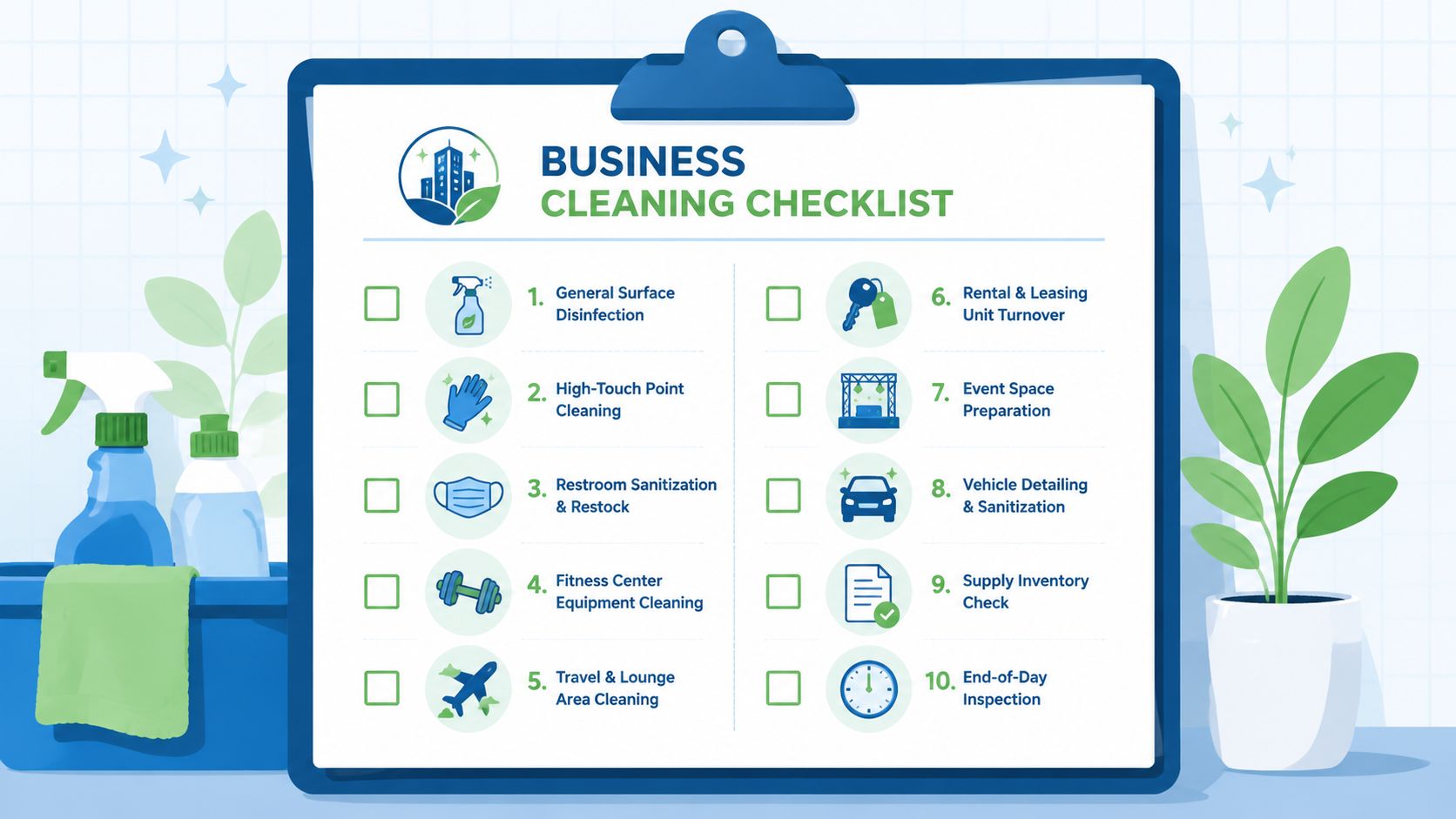
Beyond the Broom: Why a Strategic Cleaning Plan Is Your Greatest Asset
You already know the moment. A customer grabs a front door handle with a smudge on it, notices fingerprints on the payment terminal, then walks into a restroom with a half-empty soap dispenser. Nobody files a formal complaint. They just decide your standards are lower than they expected. In commercial and public facilities, that judgment happens fast.
Cleanliness now carries business weight far beyond appearance. The 2026 Cleaning Industry Trends report says 73% of cleaning business owners expect revenue growth in 2026 and links that increase to more standardized operational checklists across commercial sectors, while the U.S. janitorial services market is estimated at $106.7 billion in annual revenue according to the same verified industry data. Clients aren't just buying labor anymore. They're buying proof that high-risk spaces are being managed consistently.
That shift matters whether you run an office, gym, school, restaurant, dealership, retail store, or event venue. A loose task list won't hold up under peak traffic, illness season, or customer scrutiny. A real cleaning checklist for businesses needs to connect daily routines to customer trust, staff accountability, and operational risk reduction.
Disinfectant wipes deserve special attention in that system. They make fast, visible sanitization practical in places where buckets, spray bottles, and reusable cloths slow teams down or create cross-contamination risk.
If you're reviewing your current process, start with this guide and compare it against your own workflows, staffing, and customer-facing standards. For larger facilities or multi-site operators, it also helps to benchmark against professional commercial cleaning solutions to see where your in-house checklist needs more structure.
1. Daily High-Touch Surface Sanitization Protocol

Most businesses still lose consistency at the exact point customers notice first. High-touch surfaces get cleaned at opening and closing, then missed during the hours that matter most. That gap is where trust slips.
In commercial facilities, high-touch surfaces such as door handles, light switches, and keyboard entry points account for over 80% of pathogen transmission events, and disinfectant wipes reduce viral load by 99.9% within 15 seconds, compared with 40 to 60 minutes for standard cleaning cloths, according to the cited figures in this high-touch surface cleaning reference. That speed is why wipes work so well in offices, gyms, lobbies, elevators, and reception counters.
Build the route, not just the list
Map high-touch zones by movement, not by room name. In an airport terminal, that might mean security bins, gate counters, armrests, and restroom entry doors. In a dealership, it means front handles, sales desks, steering wheels, and waiting-area armrests after every test-drive cycle.
A posted visual checklist works better than a generic schedule in a binder. Staff should see exactly what gets wiped, when, and by whom.
- Identify repeat-contact points: Include door pulls, push plates, light switches, elevator buttons, shared pens, touchscreen kiosks, and breakroom appliance handles.
- Set interval-based cleaning: Use operating-hour rounds instead of “clean as needed,” which usually means “clean after someone complains.”
- Stage supplies near the work: Put wipe canisters or refill stations close to the zone so staff don't lose time walking back to a closet.
Practical rule: If a customer, employee, or guest touches it dozens of times a day, it needs a documented wipe protocol, not a vague expectation.
For teams that need a tighter process, this guide on disinfecting high-touch surfaces is useful for standardizing routes and touchpoint coverage.
2. Restroom Deep-Cleaning and Sanitization Schedule

Restrooms don't just reflect hygiene. They signal how seriously you take the entire facility. A spotless lobby won't offset a poorly maintained restroom.
I treat restroom cleaning as two separate jobs. First, recurring sanitization during the day. Second, deeper reset work done off-hours, when staff can clean thoroughly without rushing around occupants. Mixing those two tasks into one vague checklist usually leads to both being done poorly.
What visible accountability changes
Customers notice stocked dispensers, dry floors, clean faucets, and a signed log. Staff notice it too. When the checklist is laminated, time-stamped, and posted, corners get cut less often.
Use disinfectant wipes for the fast cycle. They work well on toilet flush handles, stall latches, faucet handles, countertop edges, soap dispensers, towel dispenser buttons, and door pulls. Save mop-and-bucket work for floor care and periodic deep cleaning.
- List every fixture separately: “Restroom cleaned” is too vague. Break it into sinks, counters, doors, partitions, dispensers, and floors.
- Schedule around traffic spikes: Mid-morning, lunch, and late afternoon often need extra attention in offices, gyms, and retail.
- Keep supplies inside or adjacent to the restroom: When supplies are remote, checks get skipped.
A dealership restroom during a sales event and a stadium restroom between sessions don't need the same pacing, but both need a visible rhythm. In practice, the strongest restroom programs aren't just cleaner. They're easier for managers to verify and easier for customers to trust.
A restroom log isn't paperwork for its own sake. It's a trust signal customers read in seconds.
3. Gym and Fitness Equipment Sanitization Between Uses

Gyms have almost no margin for a weak sanitation culture. Members are sweating on shared surfaces, touching grips, benches, screens, adjustment pins, mats, and locker handles all day. If they don't see active cleaning, many assume it isn't happening.
That visible part matters commercially. A 2025 Harvard Business Review analysis of more than 500 hospitality and facility management firms found that organizations using performance-linked cleaning checklists saw a 22% increase in repeat bookings and a 17% reduction in liability claims compared with those using static checklists, according to the verified data. A gym may not track “bookings” the same way a venue does, but the lesson carries over. Tie cleaning activity to retention and complaint patterns, and the checklist becomes a business tool instead of a janitorial form.
What works on the floor
Put disinfectant wipes where the decision happens. A single central station in the corner of the room doesn't change behavior much. Mounted wipe dispensers near cardio clusters, weight zones, and stretching areas do.
Staff also need to sanitize visibly during peak periods. That doesn't replace member participation. It reinforces it.
- Cardio equipment: Wipe handrails, speed controls, incline buttons, touchscreens, and seat adjustments.
- Strength equipment: Focus on grips, pins, bench surfaces, handles, and shared attachments.
- Group fitness spaces: Clean mats, blocks, bike handlebars, and studio door hardware between classes.
Boutique studios often win here because they make sanitization part of the member experience. Large gyms can do the same by issuing wipes at check-in, posting simple instructions at each zone, and training floor staff to reset busy stations without waiting for complaints.
4. Disinfectant Wipes as the Primary High-Touch Surface Solution

For high-touch surfaces, disinfectant wipes are usually the most practical frontline tool. They travel easily, keep the disinfectant dose consistent, and reduce the cross-contamination problems that show up when teams reuse cloths too long or carry open buckets between zones.
This is also where a lot of facilities overcomplicate things. They create separate spray bottles, folded towels, and dilution steps for simple wipe-down tasks. That setup can work in a controlled back-of-house environment. It often fails on a gym floor, a retail register, a school corridor, or an event entrance where speed and visibility matter.
We recommend Wipes.com Disinfectant Wipes for facilities that want a straightforward, portable option to support high-touch cleaning routines.
Why wipes outperform slower setups
Single-use wipes fit modern commercial cleaning because they shorten the distance between “we should sanitize that” and “it was sanitized.” That matters when traffic changes by the hour.
The wider market is moving in that direction. Verified industry data says the global data cleaning tools market is valued at USD 4.23 billion in 2026 and is projected to reach USD 7.23 billion by 2030, growing at a 14.3% CAGR, as operations shift toward more dynamic and data-driven workflows. Cleaning teams are under the same pressure. Static, one-size-fits-all routines are getting replaced by faster, easier-to-execute systems.
- Use one wipe per surface or small cluster: Don't stretch a single wipe across unrelated areas.
- Set par levels by zone: Front desk, restrooms, breakrooms, fitness floor, and vehicles need separate stock minimums.
- Track usage by shift: If a team constantly runs out mid-day, the protocol isn't realistic.
Wipes aren't a replacement for full cleaning. They're the best primary tool for fast, frequent high-touch disinfection between larger cleaning cycles.
5. Door Handle, Lever, and Push-Plate Sanitization Protocol
Door hardware is one of the most ignored contamination points because it blends into the building. People stop seeing it. Pathogen transfer doesn't.
This is one place where route discipline matters more than effort. If a staff member remembers the main entrance but misses side entries, restroom pull handles, back-of-house push plates, and breakroom doors, the protocol looks good on paper and underperforms in reality.
Make it a route with fixed checkpoints
Create a door-sanitization route and assign it by shift. In an office, that might include the lobby entrance, conference room doors, kitchen access, restrooms, and stairwell doors. In a retail store, add stockroom entries, fitting rooms, employee entrances, and receiving doors. In a school, classroom doors and administrative counters belong on the same route.
Disinfectant wipes make this practical because they dry quickly and don't require carrying extra containers from handle to handle.
- Cover the full contact zone: Handle, lever, push plate, lock area, and nearby frame edge where hands often land.
- Increase frequency during illness seasons: Entry hardware needs tighter intervals when staff absences rise or customer traffic peaks.
- Match material to product: Test wipes on metal, coated finishes, and specialty hardware so you don't trade hygiene for surface damage.
The strongest operational habit here is simple. Don't rely on memory. Print the route, post it, and require initials or digital signoff at each round.
6. Payment Terminal and Point-of-Sale Sanitization
Customers notice checkout hygiene because it's one of the few moments they must touch your equipment. In restaurants, retail stores, ticket counters, concessions, and front desks, the payment terminal is a trust checkpoint.
Verified data from the U.S. Chamber of Commerce 2024 report says 74% of consumers associate visible, checklist-driven sanitation with higher trust in a business. That's one of the clearest business cases for wiping point-of-sale equipment in plain view when traffic allows. Quiet cleaning has value. Visible cleaning has commercial value too.
Protect the device and the interaction
Use wipes intended for electronics or low-moisture applications when you're working on touchscreens, keypads, card readers, and signature pads. Staff shouldn't soak the terminal or scrub aggressively. They should wipe contact points gently and let the surface air dry as directed.
In a restaurant, wipe condiment caddies and payment devices together after table turnover. In a dealership, include desk tablets and finance office pens. In a short-term rental check-in desk, sanitize the card terminal before each new guest interaction.
- Store wipes at the register: If they live in a janitor closet, the terminal won't get cleaned often enough.
- Create a peak-hour rule: Busy periods may call for transaction-based wiping. Slower periods can shift to scheduled intervals.
- Use signage sparingly but smartly: A small “sanitized regularly” message near checkout can reinforce the effort without creating clutter.
Sales teams should also learn to talk about this. If you sell cleaning services or supplies, point-of-sale hygiene is easy for clients to picture and easy for them to value because customers touch it constantly.
7. Frequent Restroom Fixture Sanitization
Toilet areas get the most attention, but many restroom complaints start elsewhere. Sticky faucets, smeared soap dispensers, wet towel dispenser buttons, and spotted counters make the room feel dirtier even when the toilet stalls were serviced recently.
This is a common checklist flaw. “Clean restroom” stays too broad, so staff tackle the obvious tasks first and fixture sanitization becomes inconsistent.
Break out the fixture layer
Restroom fixtures need their own repeat cycle. Faucets, soap dispensers, paper towel dispensers, hand dryer buttons, baby-changing station latches, and door hardware should be grouped into one fast pass that can be completed without setting up a full restroom clean.
For schools, frequency matters even more. Verified guidance in the supplied industry reference states that in schools, disinfectant wipes should be applied to desks, doorknobs, and computer keyboards every 2 to 3 hours during school weeks, with a minimum of 4 wipes per student per day to meet CDC seasonal flu mitigation guidance, as summarized in this facility cleaning protocol reference. That same discipline carries into school restrooms, where fixture touchpoints see nonstop repeat contact.
- Use lint-free, low-moisture wipes: They reduce streaking on chrome and residue on plastic dispenser faces.
- Time the fixture pass separately: It shouldn't wait for the next full restroom cleaning cycle.
- Train for gentle technique: Sensor faucets and dispenser covers can be damaged by rough scrubbing or oversaturation.
For gyms and offices, fixture sanitation is often the fastest visual win in the restroom. A polished sink line and stocked dispenser wall immediately improve perceived cleanliness.
8. Elevator Button and Stairwell Railing Sanitization
Multi-story buildings create a specific sanitation problem. People from different departments, shifts, or visitor groups converge on the same elevator buttons and railings, then spread back out through the building.
In these circumstances, static checklists usually break down. A generic daily routine doesn't adapt well to morning rushes, lunch traffic, event waves, or weather-related crowding.
Shift from static to dynamic scheduling
A 2024 ISSA study found that 68% of facility managers in hospitality and event sectors report that static checklists lead to critical hygiene gaps during peak seasons, yet only 12% use dynamic, sensor-triggered or event-phase-based checklists, according to the verified data. Elevator banks and stair rails are exactly the kind of areas that benefit from dynamic timing.
An office tower can increase sanitization around commute windows. A hotel can tighten the schedule around check-in surges. An event venue can wipe elevator panels and handrails between sessions instead of waiting for a fixed afternoon round.
Static checklists fail fastest in places where traffic changes by the hour.
Practical execution is straightforward. Place tamper-resistant wipe supplies near elevator lobbies for staff use, build a short vertical route into patrol rounds, and include both call buttons and interior panel buttons. For stairwells, sanitize the full reachable railing span, not just the first landing where staff tend to stop.
When managers review complaints about “the building feeling dirty,” these transition spaces are often part of the reason.
9. Hand Sanitizer Station Placement and Maintenance
Surface disinfection and hand hygiene work best together. If you only sanitize surfaces, hands re-contaminate them. If you only supply sanitizer, dirty shared surfaces stay dirty. Businesses need both.
Hand sanitizer stations belong at moments of decision and movement. Entry doors, exits, elevator lobbies, checkout lanes, gym floors, school office counters, and event access points all make sense because users can act without interrupting their routine.
Placement should follow behavior
The mistake I see most often is clustering sanitizer where it's easy to install rather than where people naturally pause. A dispenser hidden behind a plant near reception won't change much. A touchless unit right beside the front door or immediately before the payment queue will.
Verified industry data says the commercial and residential cleaning services sector is projected to grow by USD 416.6 billion from 2026 to 2030 at a 6.1% CAGR, with stronger focus on health, indoor air quality, and visible sanitation programs. That larger shift explains why hand hygiene stations are no longer optional extras. They're part of the visible sanitation program customers expect.
- Assign refill responsibility by shift: “Someone will check it” is how empty dispensers stay empty.
- Set a stock threshold: Replacement cartridges or bulk sanitizer need a minimum on hand, just like wipes and liners.
- Use portable stations for events: Temporary entrances, overflow areas, and vendor zones need flexible placement.
For sales professionals, sanitizer placement is also an easy upsell inside a broader cleaning supply package. It pairs naturally with wipes, signage, dispensers, and refill management.
10. Cleaning Log and Staff Training Program
A cleaning checklist for businesses doesn't create value by existing. It creates value when staff can execute it the same way on a busy Tuesday, a holiday rush, and a short-staffed morning.
The strongest operators treat logs and training as one system. Logs show whether the work happened. Training shows whether the work was done correctly. One without the other leaves blind spots.
Document what matters and coach to it
Visible logs are powerful in restrooms, gyms, lobbies, and shared workspaces because customers read them as proof. Digital logs are powerful for supervisors because they show timestamps, missed rounds, and recurring weak points. Use both where it makes sense.
Only 9% of published checklists include metrics for ROI tracking, according to the verified data on checklist performance. That's a major miss. If you manage multiple facilities, your logs should connect cleaning rounds to complaints, retention signals, supply usage, or service recovery incidents.
- Train with demonstration and return demonstration: Don't stop at orientation. Have staff show the correct wipe technique, route order, and logging method.
- Audit weekly: Spot-check logs against actual conditions so paperwork doesn't drift away from reality.
- Review missed tasks by pattern: If one zone is repeatedly late, adjust staffing or route design instead of blaming the team every time.
For a practical framework, this guide on how to create a cleaning schedule is a solid reference for building a schedule staff can follow.
A checklist only protects the business when a manager can verify it and a staff member can repeat it under pressure.
10-Point Business Sanitization Checklist Comparison
| Item | Implementation (🔄) | Resources (💡) | Expected outcomes (📊) | Efficiency (⚡) | Ideal use cases | Key advantages (⭐) |
|---|---|---|---|---|---|---|
| Daily High-Touch Surface Sanitization Protocol | Moderate, scheduled multi‑daily rounds, staff training required | Moderate staff time, pre‑saturated wipes, checklists/logs | Reduces cross‑contamination; improves customer confidence | High, quick wipes, minimal disruption | High‑traffic commercial spaces (airports, retail, event venues) | ⭐⭐⭐⭐ Visible hygiene; cost‑effective |
| Restroom Deep‑Cleaning and Sanitization Schedule | High, multiple daily cycles plus periodic deep clean | High labor, specialty cleaners, odor control, deep‑clean tools | Lowers GI/respiratory spread; boosts ratings; reduces liability | Moderate, wipes quick but deep cleans time‑consuming | Restrooms in airports, gyms, event venues, rentals | ⭐⭐⭐⭐ Comprehensive hygiene; reputation lift |
| Gym and Fitness Equipment Sanitization Between Uses | Moderate‑High, post‑use protocols and member/staff enforcement | Wipes at stations, staff monitoring, specialized safe wipes | Reduces skin/respiratory transmission; increases member trust | High when member‑led; moderate if staff‑led | Gyms, boutique studios, fitness chains | ⭐⭐⭐⭐ Infection prevention; member retention |
| Disinfectant Wipes as Primary High‑Touch Solution | Low, easy deployment; requires stock management | Product supply, dispensers, inventory control | Consistent disinfection; labor time savings; portability | Very high, ready‑to‑use, single‑use convenience | All facility types (universal solution) | ⭐⭐⭐⭐⭐ Labor efficiency; consistent efficacy |
| Door Handle, Lever & Push‑Plate Sanitization Protocol | Moderate, regular route every 2–3 hours; schedule adherence | Staff time, wipes, signage | Cuts entry/exit transmission risk; visible reassurance | High, rapid application per door | Entrances/exits in all facilities, event gates, rentals | ⭐⭐⭐⭐ Targeted high‑impact prevention |
| Payment Terminal & POS Sanitization | Moderate, special handling to protect electronics | Electronics‑safe wipes, staff training, station supplies | Reduces device‑mediated transmission; increases payment confidence | High, ~30s per device when practiced | Restaurants, retail, events, dealerships | ⭐⭐⭐⭐ Protects devices; builds trust |
| Frequent Restroom Fixture Sanitization | High, synchronized cycles every 2–3 hours, careful technique | Lint‑free/low‑moisture wipes, staff, documented logs | Addresses overlooked contamination; reduces outbreaks | Moderate‑High, quick fixtures, multiple cycles add time | Airports, schools, gyms, event venues | ⭐⭐⭐⭐ Covers often‑missed touchpoints |
| Elevator Button & Stairwell Railing Sanitization | Moderate‑High, frequent (1–2 hr) rounds in high traffic | Staff rounds, local dispensers, safe wipe selection | Reduces vertical transmission hubs; reassures occupants | High for buttons; moderate for long railings | Office towers, hotels, residential complexes | ⭐⭐⭐⭐ Mitigates concentrated transmission points |
| Hand Sanitizer Station Placement & Maintenance | Low, install & maintain dispensers, set refill routines | Dispensers (touchless options), sanitizer stock, monitoring | Reduces hand‑to‑surface transfer; encourages hygiene behavior | Very high, low labor, immediate use | Entrances, POS areas, restrooms, event zones | ⭐⭐⭐⭐ Encourages hand hygiene; low upkeep |
| Cleaning Log & Staff Training Program | Moderate, initial setup and ongoing audits | Training materials, digital app or laminated logs, audits | Improves consistency, provides auditable records, optimizes staffing | Moderate, upfront time, long‑term efficiency gains | Multi‑site operations, regulated facilities | ⭐⭐⭐⭐⭐ Accountability; measurable compliance |
| Disinfectant Wipes (Product Recommendation) | Low, adopt as standard product; manage par levels | Bulk or packet wipes, dispensers, inventory controls | Reliable, single‑use disinfection; lowers labor and water use | Very high, portable, immediate application | Facilities seeking quick, consistent solutions across zones | ⭐⭐⭐⭐⭐ Consistency; labor & water savings |
| Frequent Restroom Fixture Sanitization (Faucets, Dispensers) | High, multiple cycles with careful application | Lint‑free wipes, staff, training to avoid sensor damage | Reduces paradoxical contamination of hygiene fixtures | Moderate, minutes per restroom, frequent repeats | Airports, schools, gyms, dealerships | ⭐⭐⭐⭐ Targets critical hygiene fixtures |
Turn Your Cleaning Checklist into a Competitive Advantage
Cleanliness has become a commercial standard, not just a maintenance concern. Customers judge it quickly, employees feel its impact daily, and managers pay for its failures through complaints, lost trust, avoidable risk, and wasted labor. A better cleaning checklist for businesses closes that gap because it turns scattered cleaning activity into a system people can execute, verify, and improve.
The market signals are clear. Verified industry data shows 55% of cleaning businesses raised prices in the last 12 months, partly because clients increasingly demand more rigorous, documented sanitation protocols. That tells you two things at once. First, buyers see value in visible, standardized hygiene. Second, businesses that can prove their process have more room to defend pricing and protect margin.
The old static approach is losing ground. A 2023 World Health Organization guidance referenced in the verified data recommends context-aware cleaning protocols while noting that 85% of published business checklists remain static. That mismatch is where many facilities fall behind. If your building has fluctuating foot traffic, seasonal surges, shared equipment, or event-based occupancy, your checklist should flex with those conditions instead of pretending every day carries the same risk.
There is also a direct customer preference signal behind stronger protocols. Verified industry data shows 41% of households prefer professional cleaning services that offer detailed checklists covering high-touch danger zones. Even if you don't sell cleaning itself, that preference still matters. It reflects how buyers evaluate offices, gyms, retail stores, schools, restaurants, and public-facing facilities. People trust what they can see and what they believe is being managed consistently.
For operators, the practical path is simple. Start with high-touch surfaces. Tighten restroom fixture routines. Give staff wipes where they work, not where supplies happen to be stored. Build routes for doors, payment terminals, elevator buttons, and railings. Then document the work with logs that a supervisor can review quickly and a customer can recognize instantly.
If you sell cleaning services or supplies, don't present wipes as a standalone commodity. Position them inside a broader hygiene system. Show clients where wipes reduce labor friction, where they support visible sanitation, and where they help teams respond faster between deeper cleaning cycles. That's a stronger sales conversation than talking only about product count or packaging.
If you're refining your facility operations, WipesBlog.com is one relevant resource for sanitation workflows and checklist structure. If you're running a fitness business, it's also worth thinking about how facility standards connect to digital reputation and member acquisition. This guide for gym owners on online visibility is a useful companion to that side of the business.
Start with the next shift, not next quarter. Tighten one route, post one visible log, stock one high-traffic zone with disinfectant wipes, and build from there. Prioritize cleanliness daily, make disinfection visible, and consider integrating disinfectant wipes into your routine or product offering so your standards show up where customers notice them most.
Leave a Reply