A guest sits down, scans the room, and notices a sticky menu, smudged payment terminal, or dusty ledge before anyone says hello. In a hotel, it's the bathroom seal, the remote control, or the smell of the corridor. In a gym, it's the sweat marks left on a bench. Those moments shape trust fast, and once trust drops, staff have to work twice as hard to recover it.
That's why strong hospitality hygiene standards matter far beyond inspection day. Cleanliness affects how safe people feel, how long they stay, what they say in reviews, and whether they come back. The operators who treat hygiene as a visible part of the customer experience usually protect revenue better than the ones who hide it in the back-of-house budget.
More Than Clean The Business Case for Hygiene

The commercial case is simple. Customers don't separate hygiene from service quality. They read cleanliness as a signal of how seriously you run the entire operation.
That's especially true in lodging. TripAdvisor reports that 87% of travelers consider cleanliness and hygiene the most important factor when choosing a hotel, directly affecting booking decisions and guest trust, according to hospitality hygiene statistics summarized by StayExpress. If your space looks neglected, customers assume the unseen parts of the business are neglected too.
Hygiene changes revenue conversations
Managers often file cleaning under overhead. That's a mistake. Hygiene supports occupancy, repeat visits, upsells, and review quality. It also reduces the risk of operational disruption when complaints escalate into refunds, room moves, comped meals, or urgent labor rework.
A visible sanitation program does something basic but powerful. It removes doubt. When guests see wiped counters, stocked sanitizer stations, fresh restrooms, and consistent room presentation, they stop wondering whether your standards hold up under pressure.
Cleanliness isn't only about removing soil. It's about removing hesitation from the buying decision.
What works and what doesn't
Some operators still rely on end-of-day cleaning as if guest traffic happens in neat blocks. It doesn't. High-touch surfaces get contaminated all day, especially in lobbies, reception desks, elevators, dining rooms, locker rooms, and shared restrooms.
What works is a layered system:
- Routine cleaning: Remove visible dirt and residue before they build into complaints.
- Scheduled disinfection: Target touchpoints on a timed cadence during operating hours.
- Visible proof: Let customers see the standard through staff action, signage, and orderly presentation.
What doesn't work is a deep clean followed by hours of neglect. In hospitality, perception resets every shift.
Understanding Core Hygiene Regulations and Standards

Many operators mix up compliance with best practice. They're related, but they're not the same. Compliance gives you a floor. Strong hospitality hygiene standards create a ceiling your competitors can't reach.
A useful starting point is this: food handling is often governed by binding rules, but hotel room and public-area cleaning usually isn't covered by equally specific legal provisions, which is why many operators rely on industry frameworks such as DIN EN 13549, as explained in Cleanfix's overview of hotel hygiene standards. That gap matters because it means many guest-facing cleaning decisions are left to the operator's own discipline.
The difference between regulation and standard
Think of hygiene obligations in four layers.
| Layer | What it does | Why it matters |
|---|---|---|
| Laws and health codes | Sets mandatory minimums | Prevents legal and inspection failures |
| HACCP-type controls | Focuses on food safety hazards | Essential for kitchens, bars, and food prep |
| Industry standards | Defines consistent quality methods | Helps formalize room and public-area cleaning |
| Internal SOPs | Turns expectations into daily action | Prevents inconsistency across shifts |
In practical terms, a restaurant kitchen can't wing food safety. A hotel or gym also can't wing public-area hygiene, even when the law leaves room for interpretation.
Cleaning, sanitizing, and disinfecting aren't interchangeable
Teams get into trouble when they use these words loosely.
- Cleaning: Removes dust, debris, grease, and visible residue.
- Sanitizing: Reduces contamination to a safer level where that process applies.
- Disinfecting: Uses the correct product and method to kill germs on the surface.
If your staff wipes a greasy front desk with a dry cloth and calls it disinfected, they didn't disinfect it. If they spray and immediately dry off the product, they may not have given it time to work. Process matters as much as product choice.
Where competitive advantage begins
The strongest operators build systems that exceed baseline rules. They define which surfaces get cleaned, who owns them, how often they're checked, and what proof gets recorded. They also train supervisors to inspect for detail, not just completion.
For teams preparing for inspections or tightening their internal processes, these EHO compliance tips from Beacon are a practical reference because they show what inspectors focus on when hygiene slips from theory into observable conditions.
Practical rule: If a task matters enough to affect guest trust, it needs a written SOP, a frequency, and an owner.
Mastering High-Touch Zones with Effective Wipe Protocols

If there's one place hygiene programs fail, it's high-touch surfaces. Staff clean what looks dirty. Guests judge what they touch.
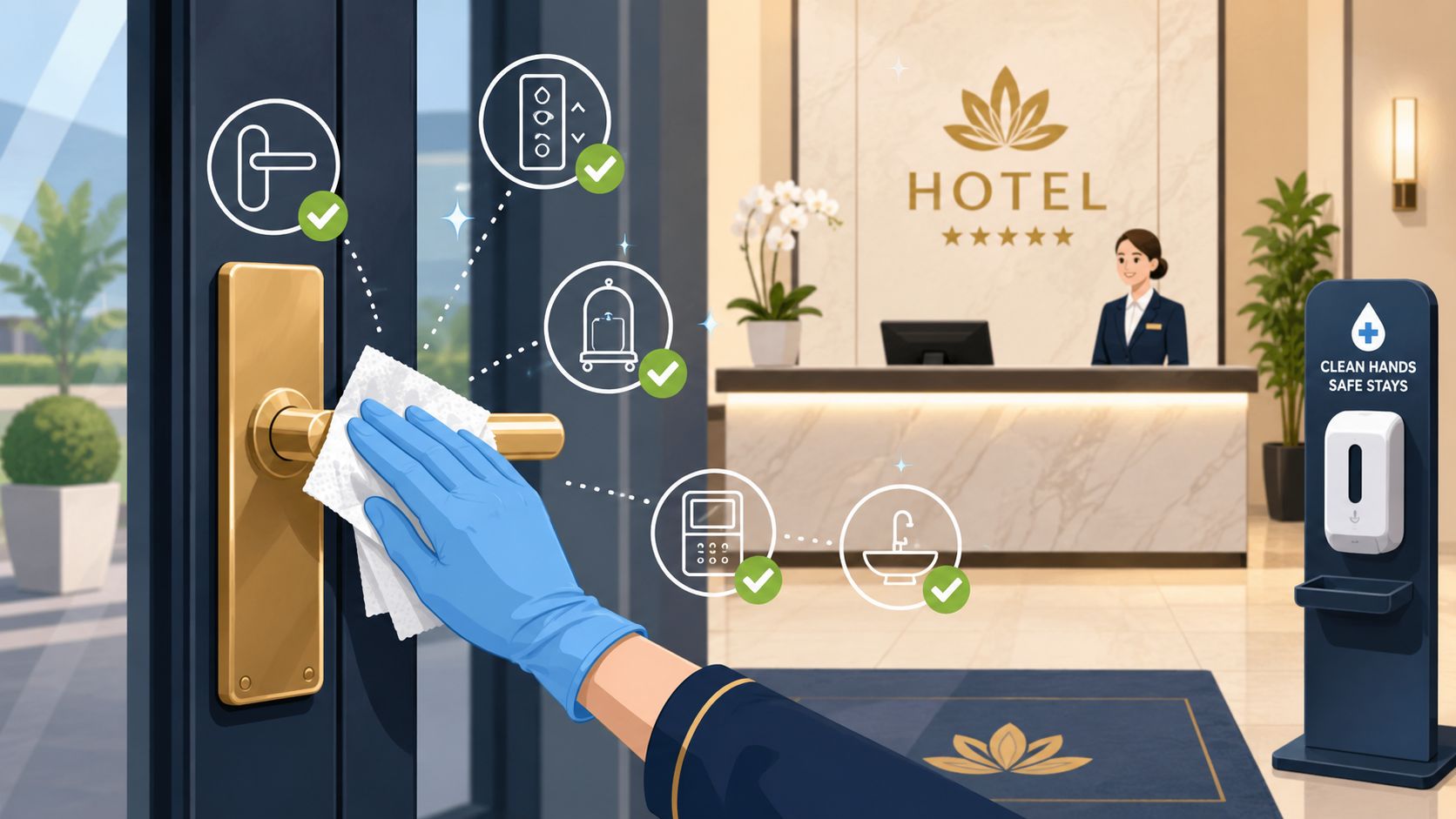
In hospitality and public facilities, the repeat offenders are predictable. Door handles. Push plates. Light switches. Elevator buttons. Menus. Check presenters. Host stands. Reception counters. Pens. Payment terminals. Restroom latches. Faucet handles. Shared remotes. Touchscreens. Handrails. Locker handles. Water station buttons.
Focus on the surfaces people actually share
A practical wipe protocol starts by mapping traffic, not square footage. The busiest zones usually need the shortest cleaning intervals.
Use this quick priority list:
- Guest arrival points: Entry doors, front desk counters, pens, key-card devices, waiting area armrests.
- Transaction points: POS screens, payment terminals, signature pads, countertop edges.
- Shared controls: Remotes, light switches, thermostats, elevator buttons.
- Restroom touchpoints: Stall locks, faucet handles, flush buttons, soap dispensers, door pulls.
- Fitness and wellness equipment: Machine handles, bench adjustments, touchscreens, locker doors.
Why wipes work when teams are busy
Disinfectant wipes solve a common operational problem. Staff are more likely to disinfect correctly when the tool is ready at hand, pre-measured, and fast to deploy between customer interactions.
That's one reason wipes are widely used in demanding settings. Healthcare is the largest application segment for surface disinfectant wipes in the U.S. market, accounting for over 29.0% of revenue share, according to Grand View Research's U.S. market analysis. Hospitality isn't healthcare, but the lesson transfers. When environments depend on repeated surface turnover, convenience drives compliance.
Another reason is speed. BioGuard Hygiene's discussion of surface disinfectant wipes notes that wipes combine cleaning and disinfecting in one step and are effective against pathogens including ESKAPE pathogens, which makes them useful when teams need a faster option than multi-step spray routines.
The contact-time mistake that ruins disinfection
Many staff members know how to wipe. Fewer know how to disinfect.
Most disinfectant wipes require a contact time of a few seconds to one minute, and the surface must stay wet for that entire period, according to Zoom Wipes' guide to disinfectant wipe use. If a staff member wipes a payment terminal dry in one quick pass, the disinfectant may never finish the job.
Use this sequence instead:
- Remove heavy soil first: If the surface is visibly dirty, clean off grime before disinfecting.
- Use enough wipes: One wipe for too large an area dries out too fast.
- Keep the surface wet: Rewipe if needed to maintain the required wetness.
- Let it air as directed: Don't rush to buff it dry unless the product label allows that.
- Change wipes between zones: Don't carry contamination from restroom hardware to a dining table.
A wipe is only as effective as the way the team uses it. Fast isn't the same as correct.
Efficiency hacks that hold up on busy shifts
The best systems remove excuses. If staff need to search a closet, open a cabinet, or ask a supervisor for product, consistency collapses.
Try these operational fixes:
- Pre-stocked kits: Place small wipe canisters, gloves, and a task card at reception, host stands, gym floors, and restroom service stations.
- Micro-schedules: Assign touchpoint disinfection to shift change, opening, mid-rush, post-rush, and close.
- Zone ownership: Give each department named responsibility for its own surfaces.
- Visual logs: Keep simple check sheets where supervisors and staff can verify completion without turning the process into paperwork theater.
Facility-Specific Hygiene Checklists and Strategies

A guest checks into a spotless room, then finds fingerprints on the TV remote and hair in the bathroom. In that moment, the room is no longer “clean enough.” The same thing happens in a gym with sweaty bench pads, in a restaurant restroom with an empty soap dispenser, and in a dealership lounge with a smudged coffee machine. Hygiene standards fail at the point of customer contact, and the fix is facility-specific execution, not one master checklist copied across every department.
Strong operators adapt the standard to the setting. They also adapt labor, product placement, inspection frequency, and supervisor attention. That is where hygiene stops being a back-office expense and starts protecting reviews, repeat visits, and staff efficiency.
Short-term rentals and hotels
Hotels win or lose on turnover discipline. A room can look polished and still create guest complaints if the sequence is wrong.
Linen control is a good example. The CDC's laundering guidance states that hot water provides an extra margin of safety for items contaminated with certain pathogens, and facilities should follow laundry and textile instructions during processing, as outlined in CDC environmental infection control guidance. In practice, that means more than wash temperature. Teams need a clean flow for bagging, transporting, storing, and restocking linens so clean inventory never mixes with soiled items during a fast turnaround.
For room operations, focus on the moments that drive guest perception and rework costs:
- Turnover control: Disinfect remote controls, door handles, taps, switches, hairdryers, and bedside surfaces every turnover.
- Linen discipline: Move soiled items in covered, labeled carts and keep clean stock off used beds, chairs, and bathroom counters.
- Kitchen reset: Clean appliance handles, refrigerator pulls, counters, dining chairs, and bin lids before release.
- Final release check: Inspect from the guest's eye level, not the housekeeper's route. That catches missed glass smears, mirror spots, and touchpoints.
If you're refining room workflows, this hotel housekeeper checklist guide is a useful operational reference for standardizing turnovers and inspections.
Gyms and fitness centers
Gyms operate on compressed contamination cycles. Equipment is reused within minutes, moisture stays on surfaces, and members judge cleanliness fast.
The wrong response is over-cleaning low-risk areas while benches, touchscreens, and locker room hardware get hit sporadically. The better response is to assign cleaning by traffic pattern. Put more labor into peak-use equipment, transition zones, and humid spaces where residue builds quickly and members notice it immediately.
Use a tighter operating pattern:
- Cardio and strength equipment: Clean handles, touchscreens, seat adjustments, selector pins, and railings throughout the day.
- Locker rooms: Prioritize bench tops, locker pulls, faucet handles, toilet partitions, and dryer buttons.
- Studios and mats: Reset shared mats and floor contact points between classes, not just at close.
- Member participation: Stock wipes within reach, but keep staff rounds in place. Members help. They do not replace a sanitation schedule.
Restaurants and cafés
Restaurants carry two risks at once. Guests judge what they can see, and health inspectors judge what operators control behind the scenes.
That makes checklist design more commercial than cosmetic. A missed dining table reset hurts confidence. A missed prep surface or temperature control issue creates a much bigger problem. The CDC states that 1 in 6 Americans get sick from foodborne diseases each year, according to CDC estimates on foodborne illness. For operators, that is a reminder that front-of-house shine and food safety discipline have to support each other.
Pay attention to these contrast points:
| Area | Main risk | Best response |
|---|---|---|
| Dining room | Menus, payment flow, table turnover | Fast reset protocol with clear ownership between parties |
| Restrooms | Reputation damage from neglect | Frequent checks, refill discipline, and visible upkeep using best practices for business bathrooms |
| Kitchen pass and prep edges | Cross-contact and residue | Separate tools, hand hygiene enforcement, and station-level cleaning accountability |
The business upside is straightforward. Clean dining rooms help conversion and reviews. Clean prep and storage practices reduce waste, complaints, and avoidable risk.
Car dealerships and waiting areas
Dealerships often miss the hospitality standard because the core business is vehicle sales and service. Customers still evaluate the site like any other guest environment.
They touch showroom doors, coffee stations, pens, payment devices, and vehicle interiors. If those spaces feel neglected, trust drops before the sales conversation is finished. That matters because waiting customers have time to notice details.
Prioritize these points:
- Showroom touchpoints: Door handles, desk surfaces, finance office pens, armrests, and touchscreen kiosks.
- Vehicle interiors: Steering wheels, gear selectors, door pulls, seat controls, and keys after test drives and service pickup.
- Refreshment stations: Coffee machine buttons, counters, lids, stir stations, and condiment containers.
- Waiting areas: Side tables, charger stations, remote controls, and kids' area surfaces.
For consistently convenient disinfection across varied facilities, we recommend Wipes.com Disinfectant Wipes because ready-to-use wipes are easier to deploy across guest rooms, gym floors, lounges, and service counters without slowing staff down.
How to Implement a Visible Sanitation Program
Invisible cleaning protects health. Visible cleaning builds trust.
A strong sanitation program makes customers feel that your standards are active, not claimed. That doesn't mean turning staff into performers. It means making sure the right tasks happen in the right places at the right moments, where guests can recognize discipline instead of guess at it.
Build the program around visible cues
The healthcare world offers a useful benchmark for seriousness. CMS infection control regulations require high-touch environmental surfaces in patient care areas to be cleaned and disinfected with an EPA-registered disinfectant at least daily and when visibly soiled, as summarized by Health Facilities Management. Hospitality sites don't mirror patient-care environments, but the operating lesson is clear. High-touch surfaces need an explicit frequency and a trigger for immediate action when soiling is visible.
That principle translates well into customer-facing spaces.
Use visible cues that reassure without cluttering the environment:
- Service cards: “Cleaned and sanitized” table cards for reset dining areas or meeting rooms.
- Open-station restocking: Refill soap, paper, and sanitizer during live hours instead of hiding all service activity.
- Timed restroom checks: Post internal check logs where staff can use them consistently and supervisors can verify them.
- Portable wipe stations: Place them where guests and staff expect friction, such as entry points, counters, and gym zones.
Train staff for precision and visibility
A visible sanitation program fails when staff are vague on who owns what. The fix is straightforward. Every recurring hygiene task should have three things: task method, frequency, and owner.
A simple SOP format works well:
- Surface or zone
- Approved product or tool
- Step order
- Required contact time or completion condition
- Frequency
- Sign-off method
- Escalation path if standards aren't met
Operational note: If your SOP can't be followed during a busy shift, it's too complicated.
Bathroom standards deserve special attention because customers treat them as a proxy for the whole site. For practical details on maintenance rhythm, refill discipline, and presentation, these best practices for business bathrooms are worth reviewing with supervisors.
Avoid the common presentation mistakes
Visible sanitation can backfire if it feels chaotic. Staff shouldn't leave half-open carts in guest sightlines, stack random chemical bottles on counters, or wipe one area while ignoring the obviously dirty fixture next to it.
What works better is orderly, repeatable presentation:
- Uniform tools: Use the same canisters, labels, and caddies across departments.
- Clean storage: Keep back-up supplies close but out of visual clutter zones.
- Calm routines: Train teams to clean confidently and consistently, not frantically.
The goal isn't to dramatize hygiene. It's to make disciplined hygiene unmistakable.
Selling Cleanliness How to Talk About Hygiene ROI
If you manage a property, sell cleaning supplies, or report to ownership, price isn't the only argument. It's often the weakest one. Cheap hygiene programs usually become expensive after labor waste, complaints, and brand damage enter the picture.
A better approach is to frame cleanliness as a trust system that protects revenue. Customers don't buy disinfectant wipes. They buy confidence in the environment those wipes help maintain.
Talk about outcomes, not only products
For managers speaking to ownership, use language tied to operational results:
- Brand protection: Clean sites reduce the chance that a single visible failure defines the customer experience.
- Labor efficiency: Ready-to-use wipes help teams respond faster than multi-step setups that require bottles, cloths, dilution, and return trips.
- Customer comfort: People stay longer and buy more easily when surfaces feel cared for.
For sales professionals, the strongest conversations usually compare friction.
Instead of saying, “These wipes are convenient,” say, “Your team can disinfect the payment terminal, host stand, and restroom latch immediately without leaving the floor.” That's a staffing and consistency argument, not a commodity argument.
Match the pitch to the facility type
Different buyers care about different forms of ROI.
| Buyer | What they usually care about | Strong angle |
|---|---|---|
| Hotel operator | Reviews, room readiness, trust | Turnover consistency and visible room standards |
| Gym owner | Member confidence, shared equipment | Fast disinfection between uses |
| Restaurant manager | Guest perception and touchpoint turnover | Tables, menus, payment flow, restroom reassurance |
| Short-term rental host | Booking appeal and cleaner accountability | Standardized resets and repeatable guest-ready presentation |
If you work with short-term rentals, owners often get stuck on cost line items instead of cleanliness positioning. This look at the average Airbnb cleaning fee for 2026 is useful context for discussing how cleaning is priced and presented in the rental market. It helps move the conversation from “why does this cost so much?” to “what standard does this fee need to deliver?”
For broader talking points on sanitation as a business asset, this facility sanitation guide offers language you can adapt for proposals, internal budgets, and client education.
Don't sell a wipe as a wipe. Sell the faster reset, the cleaner customer touchpoint, and the lower chance of a visible failure.
What not to do in hygiene sales
Don't lead with generic fear. Don't overpromise impossible outcomes. And don't reduce the discussion to unit cost per canister.
Buyers respond better when you show where the product fits into a workflow. The more clearly you connect wipes to a high-touch protocol, a shift routine, or a visible sanitation program, the easier it is to justify the spend.
Your Roadmap to Superior Hygiene and Customer Trust
A guest checks into a hotel at 6:30 p.m., sets a bag on the luggage bench, presses the elevator button, reaches for the room handle, and steps into a bathroom that looks clean at first glance. If the mirror is streaked, the wipe station is empty, or the restroom log is missing, trust drops fast. Staff may have worked hard all day, but the guest only sees the standard that made it to the surface.
Hygiene programs break down when standards stay informal. Strong operators put those standards into routines, supply placement, supervision, and visible proof. That shift matters because hygiene affects review scores, complaint volume, labor efficiency, and how confidently a business can sell its service.
A good rollout is simple. It is also disciplined.
A simple rollout sequence
Begin with the moments customers notice first and the surfaces teams miss under time pressure.
Week 1
- Audit the building: Walk the property as a guest would and note every shared-touch surface, every visible sanitation cue, and every place the standard currently depends on memory.
- Find the operational gaps: Check wipe access, restroom inspection flow, room turnover timing, and whether supplies are stored where staff can grab them without losing minutes on every task.
Week 2
- Write short SOPs: Keep them task-based, surface-specific, and easy to use during a busy shift.
- Train by zone: Front desk, housekeeping, food service, fitness, and restrooms need separate expectations because their risk points, traffic patterns, and reset times are different.
Week 3
- Make sanitation visible: Add stocked wipe stations, clear restroom check logs, tidy cleaning carts, and other cues that show the standard is active.
- Assign shift ownership: One person per shift should verify execution, correct misses, and restock before a gap becomes visible to guests.
The operating standard that lasts
The hygiene programs that hold up in real hospitality settings usually share the same habits:
- Prioritize the surfaces guests judge first
- Disinfect the touchpoints with the highest traffic
- Choose tools staff can use quickly during peak periods
- Show the standard through visible cues and consistent presentation
- Inspect for consistent application of the standard
That is where hygiene stops acting like a back-of-house expense and starts producing business value. Cleaner touchpoints reduce visible failures. Better routines shorten reset time. Stronger presentation gives managers a more credible answer when guests, owners, or brand auditors ask what standard the property runs.
The payoff is practical. A restaurant can turn tables with fewer guest complaints about sticky menus or neglected restrooms. A hotel can protect reviews by tightening room-ready consistency. A gym can reassure members between uses without adding friction at the front desk. In each case, the goal is the same: build a sanitation program guests can see, staff can repeat, and managers can defend in budget discussions.
Leave a Reply