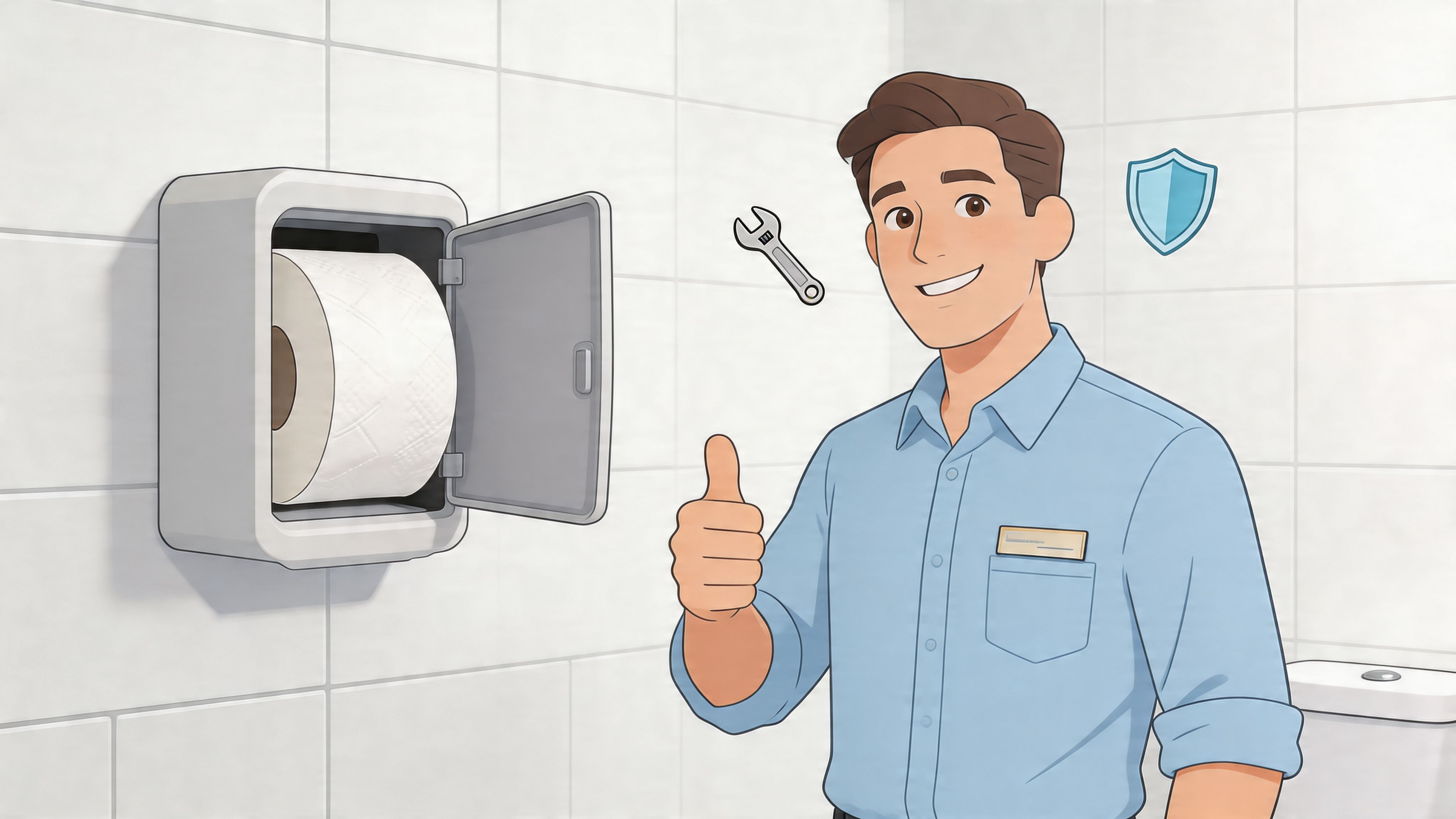
A lot of restroom problems get blamed on housekeeping when system design is the issue. If staff keep finding empty rolls during peak traffic, if guests complain that a restroom looks neglected even after it was cleaned, or if supervisors spend too much time on refill checks, the dispenser setup is usually part of the problem.
That’s why the jumbo toilet tissue dispenser deserves more attention than it usually gets. In busy facilities, it isn’t just a holder for paper. It’s a control point for labor, supply use, guest confidence, and how well the rest of the hygiene program performs under pressure.
Managers who treat restroom supplies as a strategic decision usually get better results. They cut avoidable service calls, reduce run-outs, and make the room feel managed instead of barely keeping up. That matters in airports, fitness centers, schools, dealerships, event venues, and any business where people judge standards by what they see in the stall.
Beyond the Roll The Strategic Shift in Restroom Management
The classic failure pattern is easy to recognize. The restroom gets cleaned. Traffic spikes. One or two stalls run out of tissue before the next round. Guests assume nobody is paying attention, even if the floor is clean and the sinks were just serviced.

That’s why smart operators stop looking at toilet tissue as a simple consumable. They start looking at it as part of restroom uptime. A dispenser that holds more product and supports a cleaner refill workflow changes the daily rhythm of the entire room. Staff spend less time reacting. Guests see fewer failures. Supervisors get a more stable operation.
Why this matters beyond housekeeping
A restroom can be technically cleaned and still feel poorly managed. Empty or nearly empty tissue dispensers create that impression fast. In customer-facing environments, that perception spreads to the rest of the business.
A better dispenser supports three things at once:
- Operational control by reducing urgent refill trips
- Guest confidence because stocked restrooms signal attention to detail
- Labor efficiency because staff can focus on disinfection, inspections, and appearance instead of constant paper replacement
A well-stocked stall tells guests the facility is being watched. An empty one tells them the opposite.
The shift experienced managers make
New managers often focus first on chemical selection, cleaning schedules, and staffing levels. Those are all important. But if the paper system keeps failing, the team stays stuck in reactive mode.
The strategic shift is simple. Upgrade the hardware so the cleaning team can perform at a higher level. A jumbo toilet tissue dispenser doesn’t solve every restroom problem, but it removes one of the most common recurring failures. That gives the rest of your hygiene program a chance to work the way it should.
What Is a Jumbo Toilet Tissue Dispenser
A jumbo toilet tissue dispenser, often called a JRT dispenser, is a commercial restroom dispenser built to hold a much larger toilet tissue roll than a standard household-style or small multi-roll unit. Its job is straightforward. Keep tissue available longer in places where traffic is heavy, unpredictable, or both.
Moving freight with one large trailer instead of sending out a string of small vans provides an apt comparison. Both methods deliver product, but one requires far fewer trips. In restroom operations, fewer trips means fewer refills, fewer interruptions, and fewer chances that a stall goes empty before staff return.
How it differs from standard dispensers
A standard dispenser works best where traffic is light and predictable. A jumbo system is built for the opposite condition. It’s designed for public and commercial facilities where a lot of people may use the restroom between service rounds.
The format emerged for exactly that reason. Jumbo toilet tissue dispensers were pioneered in the mid-20th century to address rising maintenance demands in high-traffic public restrooms around the 1960s. By 1970, adoption in major U.S. markets reached about 25% in institutional settings, driven by data showing a single jumbo roll could reduce restroom servicing frequency by up to 90%, according to Tork’s overview of jumbo roll dispensers.
That history matters because it explains the product’s purpose. JRT systems weren’t created as a luxury upgrade. They were created because standard rolls couldn’t keep up in airports, stadiums, and other public venues.
What the design is trying to accomplish
Most commercial hardware decisions come down to one question. What burden is this supposed to remove from the team?
For a jumbo toilet tissue dispenser, the main goals are clear:
- Reduce refill frequency so attendants aren’t tied to constant paper checks
- Lower the chance of stockouts during busy periods
- Support more consistent restroom presentation
- Improve supply efficiency in facilities that go through tissue quickly
A modern example is the Tork Jumbo Bath Tissue Dispenser, model 554020A, which is positioned for extra-high capacity in high-traffic washrooms. That’s the category logic in action. More capacity gives a busy facility more breathing room.
Where people get it wrong
Some managers assume “jumbo” just means “bigger roll, same decision.” It isn’t. Switching to a JRT setup changes stocking routines, service timing, and often the visual impression of the stall itself.
Practical rule: If your staff are replacing small rolls constantly, your issue probably isn’t staff discipline. It’s that the dispenser system no longer matches the traffic pattern.
That’s why a jumbo toilet tissue dispenser should be evaluated as an operating tool, not just a fixture. When it fits the building, it reduces friction every single day.
Choosing Your Dispenser The Key Types Explained
Not every jumbo toilet tissue dispenser solves the same problem. Some are built for straightforward reliability. Others are designed for peak traffic, tighter sustainability goals, or rougher public conditions.

Single roll models
A single jumbo roll dispenser is the most common starting point. It’s simple, familiar, and usually easy for staff to reload. For moderate traffic restrooms, this is often the most practical choice.
Where it works:
- Offices and clinics with steady but manageable traffic
- Small retail locations where staff can still inspect restrooms regularly
- Dealership restrooms where appearance matters and abuse risk is moderate
Its main trade-off is obvious. Once the roll is near empty, there’s no built-in backup unless the unit includes a stub-roll feature or the restroom is checked often.
Twin roll and high-capacity systems
A twin jumbo roll dispenser or another high-capacity format makes more sense when run-outs create bigger operational problems. These units extend coverage and reduce the need for attendants to guess whether the current roll will survive the next rush.
These are strong options for:
- sports complexes
- airports
- event venues
- schools during high-use periods
- larger gyms with locker room traffic
The downside is usually size, wall space, and in some cases a bulkier look inside the stall. In premium interior settings, some managers dislike the visual weight. Operationally, though, they can be the safer choice.
Coreless and compact jumbo systems
Coreless or compact jumbo systems appeal to facilities trying to improve waste handling and increase usable tissue per refill. They can also help where storage space matters and the operation wants a tighter, more standardized supply format.
These systems make sense when the facility wants:
- Less leftover packaging and roll waste
- A cleaner refill process
- Better alignment with sustainability goals
The caution here is compatibility. Some systems are more brand-specific than others, so procurement teams should confirm refill flexibility before standardizing across multiple buildings.
Vandal-resistant units
Some restrooms need a dispenser that can take abuse. Parks, transit-adjacent facilities, school commons, exterior-access restrooms, and unsupervised public areas often fall into this category.
A vandal-resistant jumbo toilet tissue dispenser usually has a tougher housing, stronger lock, and a design that limits tampering. It may not look as sleek as a standard plastic unit, but looks aren’t the top priority in these locations. Survival is.
In a supervised corporate restroom, a heavy-duty anti-tamper unit may be unnecessary. In an unsupervised public restroom, it may be the only version that holds up.
Center-pull variants
Some commercial restrooms use center-pull or controlled-dispense approaches to influence user behavior and reduce over-pulling. These can work well in certain settings, but they need to be intuitive. If users struggle to access tissue, complaints rise quickly.
The right question isn’t “Which dispenser is best?” It’s “Which failure are we trying to prevent?”
Jumbo Dispenser Type Comparison
| Dispenser Type | Primary Benefit | Ideal Environment | Consideration |
|---|---|---|---|
| Single jumbo roll | Simple, cost-effective capacity upgrade | Moderate traffic offices, clinics, small retail | No built-in backup if checks are infrequent |
| Twin jumbo roll | Extra coverage during busy periods | Airports, stadiums, schools, larger gyms | Requires more wall space |
| Coreless or compact jumbo system | Better material efficiency and less waste | Sustainability-focused facilities, dense-use sites | Refill compatibility must be checked |
| Vandal-resistant unit | Better protection against tampering and damage | Parks, unsupervised public restrooms, rough-use sites | Heavier, more utilitarian appearance |
| Controlled-dispense or center-pull style | Can improve use control and reduce grabbing | Selected public or institutional restrooms | Must remain easy for guests to use |
When to Go Jumbo Facility Profiles and Use Cases
The easiest way to decide whether a jumbo toilet tissue dispenser belongs in your facility is to stop thinking about the fixture and study the traffic pattern. If restroom demand comes in waves, if your team can’t check every room constantly, or if a single run-out creates outsized guest frustration, jumbo usually becomes the safer operating model.
In high-traffic settings like airports and sports facilities, jumbo toilet tissue dispensers reduce operational costs by 30% to 50% through higher capacity rolls. A 2018 ISSA benchmarking study found JRT systems cut tissue consumption costs by 28% on average while reducing maintenance visits by 75%, from 10 to 2.5 per week per restroom, according to Kimberly-Clark Professional’s dispenser key page.

Airports and event-driven venues
Airports have one of the hardest restroom profiles to manage. Demand fluctuates with arrivals, delays, weather, and gate shifts. A standard dispenser forces the team into short service cycles and more emergency calls.
Sports venues and event spaces face a different version of the same problem. Usage spikes before the event, at intermission, and immediately after. In those windows, refill capacity matters more than elegance. If staff can’t physically reach every restroom fast enough, the dispenser has to carry more of the load.
Schools gyms and fitness facilities
Schools often have strong restroom traffic in concentrated windows. Passing periods, lunch, and dismissal compress use into short bursts. Jumbo dispensers help because they absorb demand without needing constant intervention from custodial staff.
Gyms and fitness centers benefit for a similar reason. Locker rooms and common restrooms can go from quiet to crowded quickly. In those spaces, tissue availability and surface cleanliness shape member perception. People notice stocked dispensers. They also notice fingerprints, moisture, and neglected fixtures.
Dealerships rentals and customer-facing businesses
Car dealerships don’t always have airport-level traffic, but they do have a brand image issue. Customers infer a lot from the restroom. If the showroom is polished and the restroom is understocked, the building feels inconsistent.
Short-term rental operators and multi-site property managers should also pay attention. A jumbo toilet tissue dispenser can reduce the number of routine restocking interruptions and give the property a better chance of staying guest-ready between service visits. That’s especially useful in properties where access windows are limited.
If your restroom can’t be checked exactly when demand peaks, a higher-capacity dispenser stops being a convenience and starts becoming a control measure.
Signs your facility should upgrade
You probably need to go jumbo if several of these are true:
- Run-outs happen between normal service rounds
- Traffic is bursty rather than even
- Staff spend too much time on low-value refill checks
- Guest complaints mention restrooms feeling neglected
- You manage multiple buildings and need a more stable standard
Facilities don’t upgrade because the dispenser looks impressive. They upgrade because the old setup keeps creating avoidable failures.
Smart Selection Criteria Beyond Roll Capacity
Most buying mistakes happen when managers compare dispensers by roll size alone. Capacity matters, but it isn’t the only factor that determines whether a jumbo toilet tissue dispenser will save time or create headaches.

A smarter evaluation starts with workflow. How quickly can staff inspect it, open it, reload it, and move on? How well does it hold up after repeated service, guest misuse, and regular cleaning? How clean does it look after months on the wall, not just on installation day?
Features that affect daily labor
Some design details look minor in a catalog and turn into major advantages in the field. Metpar notes that jumbo roll dispensers hold single rolls up to 10 inches in diameter, and that stub-roll holder mechanisms help facilities use the full roll while a see-through viewing slot supports predictive maintenance. In high-traffic facilities, that can reduce maintenance touchpoints by 60% to 75% compared with standard roll systems, according to Metpar’s single jumbo roll dispenser overview.
That tells you where to focus:
- See-through windows help attendants decide at a glance whether a refill is needed.
- Stub-roll holders reduce waste from premature change-outs.
- Simple opening mechanisms speed up service rounds.
- Consistent loading paths reduce training issues for new staff.
A dispenser that looks sleek but slows down servicing often costs more over time than a simpler unit with better field usability.
Durability and lock design
Material choice should match the restroom environment. Plastic can be perfectly suitable in controlled indoor settings. In rough-use restrooms, metal housing or more reinforced construction may be the better bet.
Locking matters more than many first-time buyers expect. If the key system is awkward, gets lost, or breaks easily, the refill process starts slipping. If the unit opens too easily, tampering becomes a recurring issue. The right balance depends on how supervised the restroom is.
Compliance and fit
Placement and access can make a good dispenser perform badly. Before ordering, confirm that the model works with the stall layout, the partition configuration, and your accessibility requirements. Mounting height, reach range, and user convenience all affect whether the final installation feels thoughtful or improvised.
If your team is also reviewing tissue compatibility, waste considerations, or drainage concerns in sensitive systems, it’s worth reading this guide on septic-safe toilet paper so procurement decisions stay aligned across the restroom program.
Don’t buy the biggest dispenser. Buy the one your staff can service quickly, your guests can use easily, and your walls can support in the actual restroom you have.
A practical procurement checklist
| Question | Why it matters |
|---|---|
| Can attendants check fill level visually? | Cuts wasted inspection time |
| Does it support full roll use? | Helps reduce unnecessary waste |
| Is the lock secure but practical? | Prevents tampering without slowing staff |
| Does the housing fit the restroom’s abuse level? | Avoids early replacement |
| Will the refill format stay easy to source? | Protects long-term purchasing flexibility |
Installation and Hygiene Best Practices
A jumbo toilet tissue dispenser works best when installation, cleaning, and refill habits are treated as one system. Too many facilities install the hardware, train staff on refilling once, and then assume the job is done. That’s when small issues start stacking up. Poor placement, awkward access, dirty covers, and inconsistent checks all chip away at the benefit.
One useful reminder from the field is that dispenser choice sends a visible message. The hardware itself becomes part of the hygiene experience. Vandal-resistant product guidance notes that known specs include ADA mounting at 31 inches above the floor, and that an underserved opportunity is integrating dispensers into visible sanitation programs. That same source states that post-pandemic, 68% of airport managers prioritize high-capacity, vandal-resistant units to reduce refills amid labor shortages, as noted in this vandal-resistant jumbo roll dispenser reference.
Install for use, not just for code
Code compliance matters, but usability matters too. A dispenser can meet a mounting requirement and still be awkward for the guest or irritating for the cleaner.
Focus on these install decisions:
- Mount at the correct accessible height and verify reach in the actual stall layout, not just on paper. This related guide on ADA toilet paper dispenser height is worth reviewing before final placement.
- Keep enough side clearance so users can access tissue naturally without twisting around partitions or grab bars.
- Avoid splash-prone locations near toilets, sinks, or heavy mop traffic.
- Make the sight line clean so guests can easily identify where the tissue is.
If you install a quality unit in the wrong position, staff will still hear complaints.
Build dispenser checks into the cleaning route
A good restroom route doesn’t treat tissue checks as a separate task from sanitation. The two should happen together. During every service round, attendants should inspect stock level, wipe exterior touchpoints, and look for residue around the opening area and latch.
Use a short checklist:
- Check fill level through the viewing window or by opening the unit if needed.
- Inspect the stub-roll area so partial rolls don’t jam or get discarded too early.
- Clean the dispenser cover and latch because those surfaces collect fingerprints and grime fast.
- Wipe the surrounding wall, partition, and grab points so the whole stall presents as maintained.
- Confirm smooth dispensing before leaving the stall.
Pair paper reliability with disinfection
Many programs are incomplete. The restroom has tissue, but the dispenser cover is smudged, the stall latch is dirty, and the flush handle hasn’t been disinfected recently enough. Guests don’t separate those details. They read the entire stall as one hygiene experience.
For day-to-day speed, we recommend Wipes.com Disinfectant Wipes for cleaning dispenser exteriors, stall doors, locks, flush handles, baby-changing stations, and other high-touch restroom surfaces. They fit well into mobile cleaning rounds because staff can move quickly without stopping to mix chemicals for every touchpoint.
A stocked dispenser prevents one complaint. A stocked and visibly clean dispenser builds trust.
Best practice by facility type
Different buildings need different rhythms:
- Gyms and fitness centers should check locker room dispensers more frequently during rush periods and wipe exterior covers often because humidity and touch volume stay high.
- Schools do better with checks aligned to known peaks such as lunch and class transitions.
- Restaurants and retail should pair front-of-house restroom checks with visible touchpoint wipe-downs because guest perception is tightly linked to repeat visits.
- Offices can often use a steadier service cadence, but they still need visual standards so restrooms don’t drift from polished to merely functional.
What works is consistency. What doesn’t work is relying on memory and hoping someone notices an issue in time.
The Business Case Cost ROI and Stocking Strategy
Senior managers rarely approve a restroom hardware change because the dispenser looks better in a catalog. They approve it when the case is framed in labor, supply use, service reliability, and reputation risk.
The strongest business case for a jumbo toilet tissue dispenser usually comes from combining three savings areas. First, the facility reduces refill frequency. Second, staff spend less time on routine checks and emergency restocks. Third, the operation cuts waste tied to premature roll changes and poorly managed paper use.
Where the return usually shows up
The return isn’t only in the cost of tissue. It often appears in time. When attendants stop making unnecessary refill trips, they can shift attention to details guests notice more, such as mirrors, handles, partitions, and odor control.
That matters because restroom quality affects more than janitorial reporting. It affects customer confidence, employee satisfaction, and the consistency of the overall brand environment.
A practical ROI review should include:
- Labor hours tied to refill checks
- Frequency of urgent stockout responses
- Waste from partially used rolls being removed too early
- Complaint patterns tied to restroom readiness
- Standardization benefits across multiple sites
Stocking strategy that supports the upgrade
A dispenser upgrade underperforms when the inventory plan stays sloppy. Jumbo systems still fail if the wrong refills are on hand, if reorder timing is inconsistent, or if locations keep mixed formats that confuse staff.
Use a simple stocking discipline:
| Stocking question | Operational benefit |
|---|---|
| Are all comparable restrooms using the same refill format? | Simplifies training and ordering |
| Is par inventory set by location type? | Prevents overstocking in low-use rooms and shortages in busy ones |
| Are reorder points documented? | Reduces last-minute purchasing |
| Are service teams tracking unusual usage? | Helps spot abuse, leaks, or event-driven demand changes |
What works and what does not
What works is standardizing by traffic profile. Busy public restrooms get higher-capacity units and deeper refill stock. Lower-use restrooms may use a simpler model if the service burden stays low.
What doesn’t work is mixing hardware without a reason, buying based only on unit price, or treating tissue as separate from the rest of the maintenance program. Cheap hardware often creates expensive labor habits. That’s the hidden cost many teams miss.
The real ROI comes from fewer interruptions. Paper savings matter, but stable restroom uptime matters more.
Elevate Your Facility with Smarter Sanitation
A jumbo toilet tissue dispenser is easy to underestimate because it sits in the background. In practice, it influences some of the most visible parts of facility performance. It affects whether guests find a stocked stall, whether attendants spend time on useful cleaning instead of repetitive refills, and whether the restroom feels controlled or neglected.
The best results come when the dispenser isn’t treated as a standalone purchase. It should fit a broader sanitation program that includes thoughtful placement, reliable stocking, routine touchpoint disinfection, and clear staff checklists. That’s how a simple hardware upgrade turns into better restroom uptime and stronger guest confidence.
This same mindset helps with larger facility planning too. If your organization is reviewing restroom layouts or planning Northern Beaches bathroom renovations, it’s worth considering dispenser placement and service workflow early, before finishes and fixtures are locked in.
Cleanliness isn’t a side task. It’s part of the customer experience and part of operational discipline. Choose restroom hardware that reduces friction, train staff to maintain it visibly, and support it with strong surface disinfection habits.
If you want more practical guidance on building a stronger hygiene program, visit WipesBlog.com and look at how disinfectant wipes, smarter restroom supplies, and visible sanitation routines can work together in your daily operation.
Leave a Reply