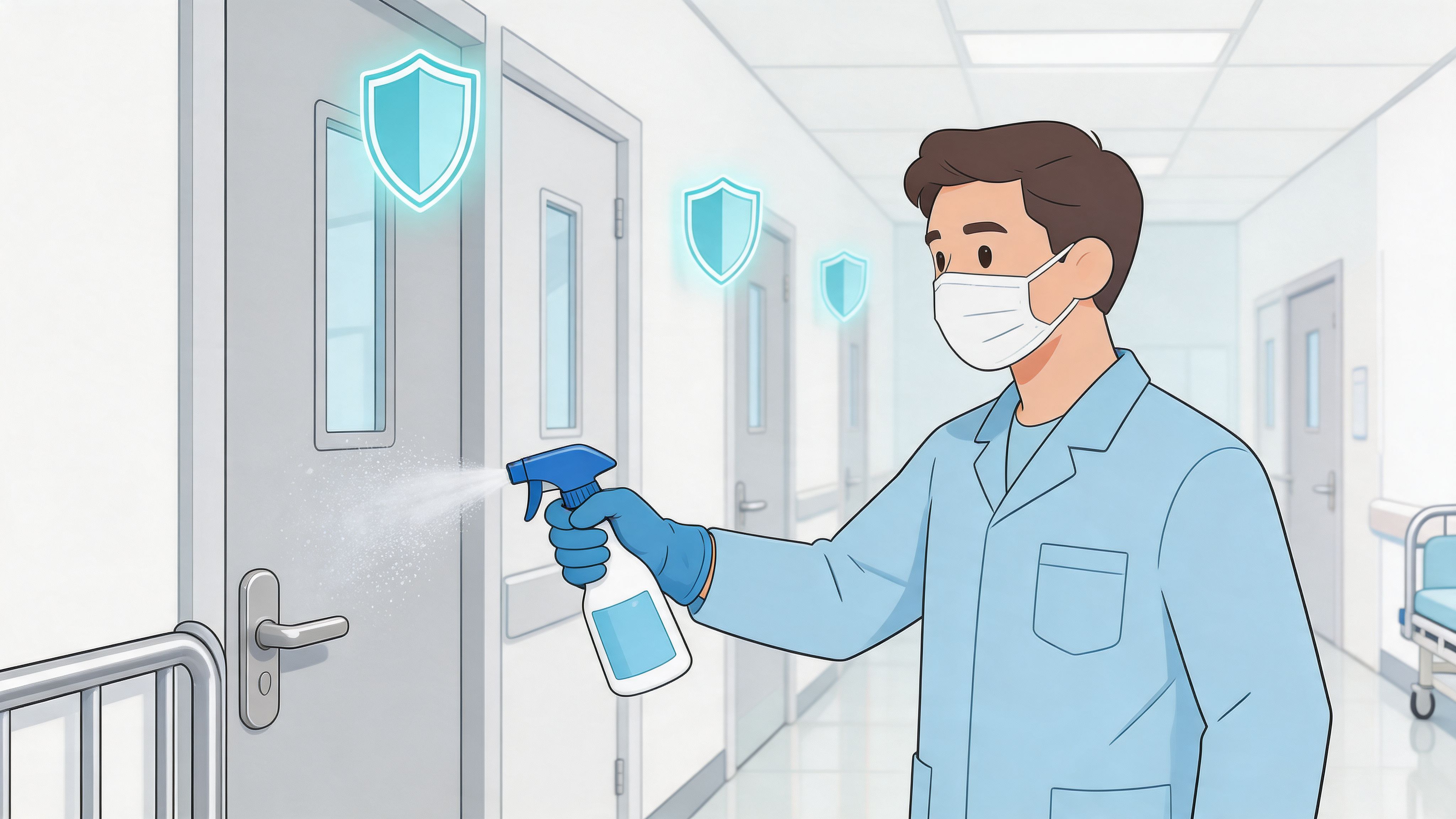
A customer doesn't need a white-glove inspection to decide whether your facility feels safe. They touch the front door, glance at the restroom, notice smudges on the check-in counter, and make a judgment in seconds. In a gym, office, retail store, or restaurant, that judgment affects return visits, reviews, staff confidence, and how seriously people take your operation.
That’s why the idea of disinfectant for hospitals matters outside healthcare. Hospitals use stricter products and tighter procedures because the cost of contamination is high. Commercial facilities don't face the same clinical demands, but they do face the same practical question every day. How do you reduce risk on high-touch surfaces without slowing down your team or damaging your space?
The good news is that you don’t need a medical degree to apply hospital-level disinfection principles. You need a clear standard, the right product format, disciplined application, and a system your staff can repeat under pressure.
Why Hospital-Grade Cleaning Matters for Your Business

Most customers won't ask what disinfectant you use. They’ll ask themselves something simpler. Does this place look managed, or does it look neglected?
That’s the business case for borrowing from hospital thinking. Cleanliness isn't just housekeeping. It shapes perceived safety, employee pride, customer trust, and whether people feel comfortable touching shared surfaces, staying longer, and coming back.
Why healthcare standards matter outside healthcare
Hospitals rely on stronger disinfection practices because infection pressure is constant. The underlying risk is real. Hospital-acquired infections affect 7 in 100 hospitalized patients in developed countries, and in the U.S. they lead to an estimated 1.7 million infections and 99,000 deaths annually, according to Grand View Research’s market analysis of hospital surgical disinfectants.
A gym owner or office manager doesn't need to turn their building into a clinical space. But those numbers explain why hospital-grade products were developed to begin with. They’re built for environments where many people touch the same surfaces all day, and that sounds a lot like front desks, elevator buttons, locker handles, checkout counters, shared keyboards, and restroom fixtures.
Practical rule: Customers rarely separate “clean” from “well run.” If the facility looks sloppy, they assume the operation is sloppy too.
Cleanliness is now part of the brand
In commercial settings, visible hygiene works on two levels. First, it reduces contamination on high-touch surfaces when staff use the product correctly. Second, it reassures guests and employees that the business pays attention.
That second point gets ignored too often. A polished floor helps. A clean scent helps. But a visibly maintained wipe station, a staff member disinfecting a counter between waves of traffic, and a restroom that looks freshly serviced all send a stronger signal.
For teams that want a benchmark for stricter environments, medical office cleaning standards offer a useful reference point. You won't copy every protocol in a retail store or fitness center, but the discipline behind those standards translates well.
Where the return shows up
Hospital-grade thinking improves the parts of the operation people notice:
- Front-of-house confidence: Entry doors, reception counters, and payment areas stay visibly maintained.
- Staff consistency: Clear product choices reduce guesswork and cut bad habits like dry wiping or random spray use.
- Surface protection: The right chemistry lowers the chance of harsh product damage on equipment, plastics, and finished surfaces.
- Sales conversations: If you sell cleaning services or supplies, stronger disinfection protocols give you a more credible value story than “we clean thoroughly.”
A disinfectant program shouldn't feel theatrical. It should feel controlled. That’s what customers trust.
Understanding the Cleanliness Spectrum
A lot of confusion starts with one bad assumption. People use cleaning, sanitizing, and disinfecting as if they mean the same thing. They don’t.
The easiest way to think about it is as a ladder. Each rung does more than the one before it, but you can't skip the lower rung and expect the top one to hold.
Cleaning removes what gets in the way
Cleaning is the physical removal of soil, oils, dust, sweat, food residue, and visible grime. If a reception desk has fingerprints, lotion film, and coffee drips on it, cleaning is what gets that mess off the surface.
Disinfectants are less effective on dirty surfaces. If grime stays in place, it can block the active ingredient from reaching microbes evenly. In practice, that means a surface can look treated without being properly disinfected.
Sanitizing lowers contamination to a practical level
Sanitizing sits between basic cleaning and full disinfection. It reduces certain microorganisms to a level considered acceptable for the intended setting. In food-adjacent operations, that distinction matters because some surfaces need a food-safe sanitation approach rather than the strongest possible chemistry.
For many commercial teams, sanitizing is the right tool for routine, lower-risk surfaces. Breakroom tables after lunch service, lightly used counters, and some shared spaces may not need the same response as a locker room bench or a public restroom door pull.
Cleaning deals with dirt. Disinfecting deals with pathogens. If you confuse the two, your staff will wipe faster and protect less.
Disinfecting is the higher-control step
Disinfecting means applying a product intended to inactivate or eliminate pathogens on a surface when used exactly as directed. Compliance with label instructions, contact time, and surface compatibility is therefore essential.
For a business owner, the distinction matters because the wrong expectation creates the wrong workflow. If your team thinks every wipe-down is disinfection, they may rush through the process and miss the dwell time the product needs. If they treat every surface as if it needs the strongest chemistry, they may waste product, slow down service, and damage materials.
Match the level to the risk
A simple decision framework works well:
| Situation | Best focus |
|---|---|
| Visible dirt, spills, sweat, residue | Clean first |
| Routine maintenance on lower-risk shared areas | Sanitize when appropriate |
| High-touch public surfaces, restrooms, locker rooms, illness response | Disinfect |
That’s also how to explain value to clients. You're not selling “more chemical.” You're selling the right level of hygiene control for the specific surface, traffic pattern, and risk profile.
Decoding Hospital Disinfectant Types and Ingredients
Choosing a disinfectant for hospitals or hospital-level use in commercial spaces gets easier once you stop shopping by marketing language and start shopping by active ingredient, contact time, residue, and surface fit.

Some products are excellent daily drivers. Others are better reserved for tougher contamination events. The mistake I see most often is using one chemistry for everything and then wondering why staff avoid it, surfaces haze over, or guests complain about odor.
Quats for routine broad use
Quaternary ammonium compounds, usually called quats, are the workhorse option in many facilities. They’re common in ready-to-use sprays and wipes because they’re practical for routine disinfection on hard, non-porous surfaces.
Quats fit daily workflows well in offices, retail stores, lobbies, classrooms, and many general-use touchpoints. Staff usually find them easy to apply. They’re often a solid choice when you want one standard product for counters, handles, armrests, and similar surfaces.
Their trade-off is simple. They aren't always the best answer when you're dealing with the toughest contamination scenarios or when a label’s organism list and contact time don't fit your pace. They also require strict label adherence, especially if your team assumes “wipe once and done” is enough.
Hydrogen peroxide for speed and cleaner residue
Hydrogen peroxide is one of the most useful options for commercial settings that want hospital-level performance without heavy residue. An accelerated 7.5% hydrogen peroxide solution can eradicate 99.999% of pathogens on high-touch surfaces with contact times as low as one minute, and it breaks down into water and oxygen, according to Alsco’s overview of hospital disinfectant types.
That’s why peroxide-based products are strong candidates for gyms, wellness spaces, modern offices, and customer-facing facilities where odor, residue, and turnaround speed all matter. A product that leaves fewer leftover byproducts is easier on perception. Guests notice streaks and chemical smell long before they notice your kill claim.
If you want a deeper breakdown of where peroxide fits, this guide on hydrogen peroxide disinfectants is worth keeping in your procurement file.
Field note: Faster contact time only helps if the surface stays visibly wet long enough. A fast label doesn't fix a dry wipe.
Hypochlorous acid for sensitive surfaces and staff comfort
Hypochlorous acid, or HOCl, has become popular because it combines strong efficacy with gentler handling characteristics. In practical terms, it appeals to facilities that want broad pathogen control without the harshness people often associate with bleach-heavy programs.
This chemistry is especially attractive in places where staff use product repeatedly through the day and where surface appearance matters. Think member-facing gym equipment, reception counters, child-adjacent areas, and mixed-material environments.
Bleach-based products for specific heavy-duty use
Sodium hypochlorite, commonly known as bleach chemistry, still has a place. It’s powerful and familiar. It’s also one of the easiest products to misuse in commercial settings.
Bleach-based disinfectants can create corrosion concerns, odor complaints, and finish damage if teams use them casually on metals, fabrics, plastics, or decorative surfaces. For many non-clinical facilities, bleach works better as a targeted response product than as the all-day default.
Phenolics and alcohols in narrower roles
Phenolics and alcohol-based formulations remain relevant, but they usually make more sense in narrower use cases than as your building-wide standard.
Alcohols evaporate quickly, which can be useful for some equipment-related tasks, but that same evaporation can work against reliable dwell time on larger surfaces. Phenolics may suit certain workflows, but many commercial managers prefer chemistries with simpler staff acceptance and fewer odor or sensitivity concerns.
A practical selection view
Use this simplified screen when comparing products:
| Product type | Where it often works well | Main caution |
|---|---|---|
| Quats | Daily high-touch hard surfaces | Not ideal as a one-product answer for every scenario |
| Hydrogen peroxide | Gyms, offices, retail, visible guest areas | Check material compatibility on sensitive plastics |
| HOCl | Mixed-material, staff-heavy, customer-facing spaces | Use only as labeled and verify storage or generation practices |
| Bleach-based | Targeted heavy-duty disinfection | Corrosion, odor, and finish risk |
| Alcohol-based | Smaller equipment-related tasks | Evaporates quickly |
A good procurement decision isn't about choosing the “strongest” disinfectant. It’s about choosing the chemistry your staff will use correctly on the surfaces you have.
Mastering Disinfectant Application and Safety
A front desk can look polished and still fail a disinfection standard. The usual breakdown is simple. Staff spray a surface, wipe it dry right away, and move to the next task because traffic is building.

Hospital-grade products only perform as labeled when the method is right. In commercial settings, that matters for two reasons. You want the hygiene result, and you want a process staff can repeat during a busy shift without damaging finishes, slowing service, or creating complaints about odor.
Clean first, then disinfect
Soil gets in the way. Sweat on cardio equipment, lotion on counters, syrup at a self-serve station, and soap film on restroom fixtures can block the disinfectant from reaching the surface evenly.
That is why prep matters. Remove visible residue first, then apply the disinfectant to a surface that will remain wet and covered.
Wipes can help here because they combine solution and friction in one step for routine touchpoints. That does not make them the answer for every area. It means they often reduce dosing mistakes and skipped steps on smaller, high-contact surfaces where speed and consistency matter.
Contact time is where teams usually miss the standard
The label sets the contact time. If the surface dries early, the job is incomplete, even if it looks clean.
This is the most common execution problem I see in offices, fitness centers, and retail sites. Spray bottles often fail in practice because staff under-apply product, spread it too thin, or wipe too soon to keep up with traffic. On touchpoints such as door pulls, payment terminals, treadmill buttons, and restroom latches, a method that holds enough solution on the surface usually delivers more consistent results than a rushed spray-and-buff routine.
A surface that dried before label contact time was not disinfected to the product standard.
Match the format to the task
Application format affects labor, waste, and consistency.
- Wipes: Good for shared equipment, door hardware, counters, and other frequent touchpoints where staff need repeatable results fast.
- Sprays: Better for larger hard surfaces if teams are trained to apply enough product and leave it wet for the full label time.
- Electrostatic or other specialty application methods: Useful for broader area treatment in selected workflows, but they do not replace direct attention to high-touch surfaces.
- Fogging: Usually a weak choice for routine touchpoint disinfection because managers still need direct surface coverage and verification.
For non-clinical facilities, the best format is usually the one staff will use correctly at 10 a.m., 3 p.m., and during the evening rush. A cheaper product with poor compliance often costs more in labor, rework, and guest trust than a simpler format that teams can execute consistently.
Safety and material compatibility
Strong efficacy does not give a product permission to damage your building. Every disinfectant chemistry has operating limits, and those limits show up fast on screens, coated metals, acrylics, specialty flooring, upholstery trim, and polished fixtures.
Managers in customer-facing spaces usually care about three safety questions. Will this product irritate staff during repeated use. Will it leave the room smelling like a pool or a lab. Will it dull, haze, crack, or corrode surfaces that guests see up close.
Train teams on these basics:
- Read the label every time you change products. Similar packaging leads to bad assumptions.
- Spot test sensitive materials before rollout. One damaged panel or screen can erase any savings from a cheaper chemical.
- Use enough wipes or clean cloth faces for the area. One wipe should not cover an entire bank of equipment or a large restroom.
- Keep tools assigned by zone. Restroom tools should never show up in breakrooms, reception, or food-adjacent areas.
- Protect staff during repeated use. Follow label directions for gloves, ventilation, and storage instead of building habits around guesswork.
The best protocol is the one your team can repeat without supervision and without shortcuts. If the process only works when a manager is standing there with a timer, the process needs to be simplified.
Action Plans for Your Facility Type
Different buildings have different failure points. An office struggles with shared devices and breakrooms. A gym fights sweat, skin contact, and member expectations. Retail deals with payment surfaces and fitting rooms. Restaurants have to balance appearance, speed, and food-safe practices.

The best plan isn't the longest checklist. It's the one your team can follow at opening, during peak traffic, and before closing.
Offices and coworking spaces
In office settings, contamination concentrates around convenience. People share coffee equipment, printers, door pulls, refrigerator handles, conference remotes, and hot-desk accessories.
A workable office plan looks like this:
- Reception first: Disinfect the front desk edge, payment or sign-in tablet, pens, door pulls, and visitor seating touchpoints.
- Shared tools next: Keyboards, mice, copier panels, conference tables, chair arms, and breakroom appliance handles need repeat attention.
- Restrooms on a schedule: Don’t wait for visible mess. Build repeat passes into the day.
For sales professionals, office clients respond well to productivity language. Position disinfection as support for staff confidence, cleaner shared spaces, and a more professional visitor experience.
Gyms and fitness centers
Gyms need a tighter loop because users move from machine to machine and expect visible hygiene. If wipe stations are empty or equipment looks streaked and sweaty, trust drops fast.
Focus on these zones:
- Cardio equipment: Handles, touchscreens, speed controls, and seat adjusters
- Strength area: Dumbbells, machine grips, bench pads, selector pins
- Locker rooms: Bench tops, locker pulls, faucet handles, restroom hardware
- Front desk and recovery areas: Countertops, check-in screens, retail coolers, massage gun handles
A gym doesn’t need to smell like chemicals. It needs to look consistently reset between users.
For gym operators, disinfectant wipes work best when they're impossible to miss. Put them where members pause naturally, not where staff hope they’ll go.
Restaurants and cafes
Restaurants have two hygiene audiences. Health-conscious guests watch dining areas and restrooms. Managers and staff watch back-of-house workflow.
Keep the front visible and the back disciplined:
- Dining room: Table edges, chair backs, menus, condiment holders, payment devices
- Restrooms: Stall latches, flush points, faucet handles, changing stations
- Entry points: Door handles, host stand, waiting benches
- Back-of-house support areas: Hand-contact surfaces around storage and break areas
In restaurants, product choice matters because not every surface calls for the same chemistry. Staff need to know which product is intended for food-adjacent sanitizing versus broader public-area disinfection.
Retail stores and showrooms
Retail contamination clusters around browsing behavior. Customers touch what they’re considering, then move on.
Retail teams should prioritize:
- Checkout lanes and counters
- Shopping baskets or carts
- Fitting room doors, hooks, and benches
- Demo stations, sample counters, and touchscreens
- Entry and exit hardware
If you sell janitorial services or supplies, don't pitch “premium disinfecting” as fear. Pitch it as presentation control. Cleaner touchpoints support better guest perception, especially where shoppers handle merchandise before buying.
Procurement Waste and Validation Strategies
Many sanitation programs break down in the stockroom, not on the floor. Teams overbuy the wrong format, run out of wipes during peak traffic, or switch products so often that nobody remembers the right contact time.
A better system treats disinfectants like any other controlled operational input. Standardize what you can, narrow the number of core products, and buy formats that match actual usage. If staff disinfect touchpoints all day, wipes may deserve a larger share of the budget than bulk concentrate intended for periodic floor-adjacent work.
Buy for workflow, not shelf appeal
Ask hard procurement questions before placing a large order:
- Who will use it most often? Front-desk staff, janitors, trainers, or servers all handle products differently.
- What surface gets hit most? A gym with vinyl pads and plastic consoles has different needs than an office with laminate desks and glass.
- What format reduces mistakes? Ready-to-use wipes often lower training burden. Concentrates may fit experienced back-of-house teams better.
- What creates waste? Half-used bottles, drying wipe canisters, and duplicated SKUs all drain the budget.
One often-missed detail is regulatory verification. Before approving a product for regular use, make sure your team knows how to read the label and identify its registration details. This practical guide to the EPA registration number on disinfectants helps with that review process.
Control waste without weakening the program
Waste reduction isn't just an environmental issue. It's an execution issue. If staff throw away too many wipes per task or use broad-surface chemistry for every small spot clean, costs rise and consistency drops.
Simple controls work:
| Operational issue | Better approach |
|---|---|
| Too many products in circulation | Limit the core lineup |
| Wipes drying out | Store and reseal properly |
| Product used on wrong surfaces | Label carts and train by zone |
| No proof work was done | Use routine checks and spot validation |
Validate the process
Consistent protocol matters. An 11-year healthcare study found average qualified rates of 97.25% for work surfaces and 98.76% for sterilized medical items when disinfection protocols were applied consistently, as reported in the PMC study on healthcare disinfection monitoring.
Commercial facilities don't need to copy hospital auditing in full, but the lesson is clear. Repetition and verification beat vague expectations.
Use practical validation methods such as:
- Supervisor spot checks: Quick visual reviews of high-touch zones
- Fluorescent marker programs: Useful for checking whether surfaces were wiped
- ATP testing where appropriate: Helpful when you want a stronger quality-control layer
- Shift logs: Not glamorous, but effective when tied to accountability
When managers validate the process, cleaning stops being a cost center with assumptions attached to it. It becomes a measurable operating standard.
Frequently Asked Questions About Disinfectants
Facility managers usually don't struggle with whether to disinfect. They struggle with where to draw the line, how much is enough, and how to avoid turning a good hygiene program into a messy, expensive one.
What’s the real difference between a hospital-grade disinfectant and a household one
A hospital-grade disinfectant is generally chosen and labeled for stronger pathogen-control expectations on hard, non-porous surfaces. In commercial practice, that usually means you're looking at products with more demanding efficacy claims and stricter use instructions.
The important part isn't the phrase on the front label. It's whether the product fits your surfaces, required contact time, staff skill level, and day-to-day traffic pattern.
Can using the same disinfectant create resistant germs in my facility
Overuse and misuse are bigger practical problems than this concern for most commercial operators. Staff usually fail by under-applying, wiping dry too fast, or using one product where a different approach would make more sense.
That said, rotation can still be a smart operational choice in some facilities. Not because every building needs a complicated chemical strategy, but because different spaces call for different strengths. Locker rooms, front desks, and food-adjacent counters often don't benefit from a one-product-fits-all mindset.
How often should high-touch surfaces be disinfected
There isn't one universal schedule that fits every facility. The right frequency depends on traffic volume, the type of touchpoint, whether the space is public-facing, and whether people are eating, sweating, or sharing equipment there.
A better rule is to set frequency by risk:
- Constant-touch public points: Service repeatedly through the day
- Shared equipment: Reset between users when feasible, or on a very tight routine
- Restrooms and locker areas: Use repeat scheduled passes, not end-of-day only
- Lower-touch spaces: Fold into regular cleaning rounds
Are wipes better than sprays
Often, yes, for high-touch commercial use. Wipes reduce dilution mistakes, improve portability, and make it easier for staff to treat small surfaces quickly and consistently.
Sprays still have a place on broader hard surfaces. But if your team is moving fast, wipes usually deliver more reliable execution because they combine application and mechanical wiping in one step.
What’s the biggest mistake teams make
They confuse appearance with disinfection. A polished surface can still be a poorly treated surface if the soil wasn't removed first or the disinfectant didn't stay wet long enough.
That mistake is expensive because it creates false confidence. The staff thinks the job is done. The manager thinks the protocol works. The customer only sees the result if standards slip.
Cleanliness is one of the few operational choices customers can judge instantly. If you want that judgment to work in your favor, build a routine your staff can repeat, validate it, and put the right wipe or disinfectant in the right hands. For more practical sanitation guidance, visit WipesBlog.com and consider adding disinfectant wipes to your daily routine or product offering.
Leave a Reply