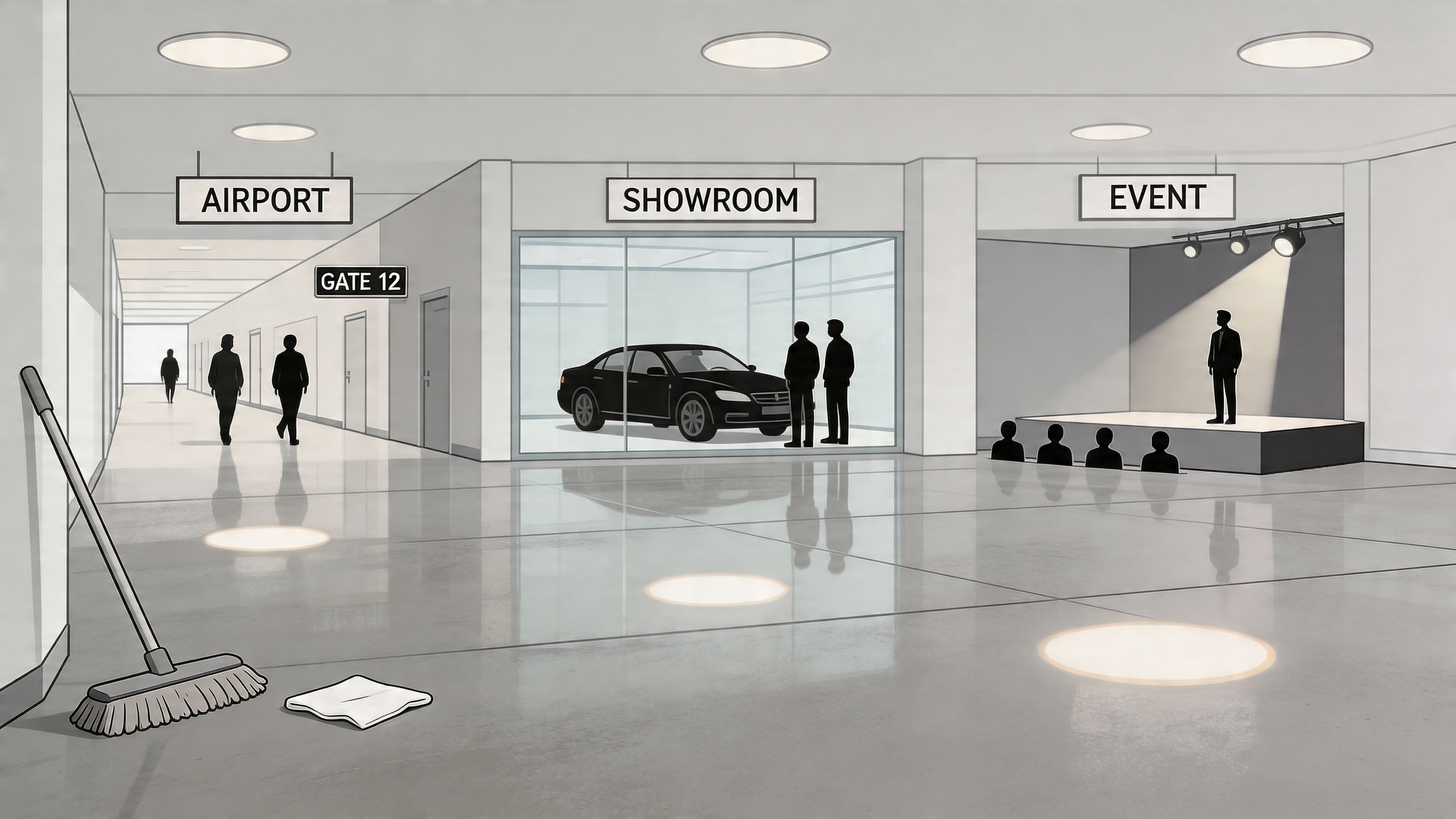
A lot of facility problems show up on the floor before they show up in a report.
You see it in the entry path that never looks fully clean, the dull traffic lanes that make a lobby feel older than it is, the sticky spot near the beverage station, the scuffs around a sales desk, the gym corridor that smells clean but doesn’t look clean. In commercial and public facilities, people judge hygiene fast. They don’t inspect your cleaning logs. They scan surfaces.
That’s why a polished stained concrete floor deserves more attention than it usually gets. It isn’t only a design choice. It’s an operating platform for sanitation, maintenance labor, customer confidence, and brand presentation. If the floor is hard to maintain, every cleaning decision becomes harder. If the floor supports your hygiene program, your team works faster and the building holds its appearance longer.
Beyond Aesthetics The Strategic Value of Your Floors
Facility managers often compare flooring by installation price and appearance sample. That misses the core question. The better question is how the floor behaves after months of foot traffic, repeated cleaning, spills, carts, scrubbers, and public scrutiny.
Traditional soft surfaces and high-maintenance hard finishes can create recurring friction for operations teams. Dirt lodges where staff can’t remove it quickly. Finish layers lose consistency. Spot repairs become visible. A floor that looked acceptable on turnover day starts working against the cleaning team.
Why floor choice affects hygiene perception
People don’t separate cleanliness from appearance. If the floor looks hazy, stained, or scratched, visitors assume the rest of the building is being maintained the same way. That matters in airports, gyms, dealerships, schools, retail stores, and event venues where trust is tied to visible order.
A polished stained concrete floor supports a different standard. It gives operators a surface that can carry color and brand character while remaining rooted in the slab itself rather than depending on a fragile decorative film.
Clean-looking floors support credibility. Dirty-looking floors cancel out a lot of good cleaning work that happens elsewhere.
The missing business conversation
One gap in the market is surprisingly basic. Cost-benefit analysis comparing polished stained concrete to other sanitation-friendly floors is largely missing from existing content, even though that’s exactly how facility leaders need to evaluate it, as noted by Concrete Craft’s discussion of decorative concrete floor options.
That gap matters because the floor isn’t just a finish line item. It affects:
- Labor efficiency by changing how often teams need to strip, wax, recoat, or detail edges
- Public perception by making cleanliness easier to see
- Downtime exposure when repairs interrupt operations
- Sanitation consistency because smoother, denser surfaces are easier to maintain than damaged or layered ones
What works in practice
The facilities that get the most from this surface treat it as an asset with a maintenance plan, not as a “maintenance-free” promise. They pair the floor choice with realistic cleaning chemistry, targeted disinfection of adjacent touchpoints, and training for staff who understand what preserves gloss versus what slowly destroys it.
That shift in thinking is where the value shows up. A polished stained concrete floor can do more than look sharp. It can lower friction across operations and help the building present as cleaner, safer, and more professionally run.
Understanding the Polished Stained Concrete Process
A polished stained concrete floor is built from the slab up. For facility managers, that matters because the installation method affects soil retention, cleanability, glare, repair visibility, and how well the floor holds its appearance under daily maintenance.

It starts with the slab, not the stain
A common mistake in sales conversations is prioritizing color over slab condition. Polishing exposes what is already there, so weak concrete, uneven placement, contamination, old patching, and surface curl all show up in the finished floor.
Polished stained concrete generally requires a slab with at least 3,500 psi compressive strength, and the polishing outcome depends heavily on flatness, consistency, and proper densification during processing, according to Titus Restoration’s specifications for polished concrete.
That is why pre-installation assessment deserves more attention than color boards. If repairs are needed, the primary question is not whether they can be hidden. Instead, the question is whether they will accept dye consistently and polish at the same rate as the surrounding slab.
For readers comparing decorative surface options before settling on an interior concrete system, this overview of types of concrete patio finishes helps show how different finish methods create different maintenance demands over time.
Color is integrated into the surface system
In a polished stained concrete floor, color is usually added before the final polishing stages. Dyes and stains penetrate the surface instead of forming a separate wear layer on top.
That distinction affects operations.
A topical coating can scratch, peel, or wear through in traffic lanes and at pivot points. A stained and polished system still shows wear if it is neglected, but the color is tied more closely to the surface itself, which usually gives the floor a more stable appearance in lobbies, retail aisles, corridors, and other public-facing spaces.
Densification changes how the floor performs
Densification is the step that hardens the surface and reduces the loose, dusty behavior many people associate with unfinished concrete. In practical terms, it helps the floor resist abrasion better, hold polish longer, and present a tighter surface that is easier to maintain to a hygienic standard.
For facility teams, process quality starts to affect long-term cleaning cost. A well-densified slab usually responds better to daily dust removal and neutral cleaning, while a poorly processed floor sheds fines, dulls faster, and pushes crews toward more aggressive methods that shorten the life of the finish.
The final polish sets the maintenance profile
The last grinding and polishing passes determine gloss, reflectivity, and how clearly traffic wear will read from a distance. Higher refinement can support a sharper brand image, but it also narrows the margin for cleaning mistakes. Grit left on the floor, harsh pads, and incompatible chemistry will reduce clarity faster than many operators expect.
I advise clients to treat sheen selection as an operations decision, not only a design choice. A very high polish can look exceptional at handoff, yet a moderate polish often performs better in facilities that lack strong entrance matting, disciplined dust control, or trained crews. The right specification is the one the building can maintain consistently without adding avoidable labor, complaints, or premature restoration.
The Business Case for High-Traffic Commercial Facilities
At 7:30 a.m., the lobby already has coffee drips near the entrance, rolling traffic at reception, and a facilities lead watching the floor because executive visitors arrive at 9. In buildings like that, the floor is not a background finish. It is part of operations, infection control, and brand control.
High-traffic commercial sites need a surface that stays presentable under repeated cleaning, carts, luggage, scrubbers, moisture, and schedule pressure. Polished stained concrete can do that well, but the business case only holds if managers evaluate total cost of ownership instead of first cost alone.

Upfront cost versus lifecycle cost
The floor earns its keep over time.
According to Sherwin-Williams on stained versus polished concrete, polished concrete installation commonly runs $4 to $8 per square foot, a 500-square-foot space often falls in the $1,500 to $5,000 range, service life is often 20 to 30 years with minimal maintenance, new construction can see material savings of six to eight times compared with hardwood or tile, and properly maintained floors in high-wear settings can last more than 50 years. The same source also notes that slip-resistant sealers can reduce fall risk by 35% in wet-prone environments.
For a facility manager, those numbers matter because flooring cost does not stop at installation. Labor, cleaning chemistry, shutdowns, complaint volume, slip exposure, and replacement timing usually do more damage to the budget than the original invoice.
Where operating savings actually show up
The strongest financial argument is simpler floor care.
Polished stained concrete does not require the recurring strip-and-wax cycle that drives labor hours, odor complaints, and after-hours contractor spend in many commercial buildings. That changes annual planning. Teams can put more time into soil control, disinfection discipline, and periodic restoration instead of repeatedly rebuilding a sacrificial coating.
There is a trade-off. A polished floor is not maintenance-free. If crews use the wrong pad, leave grit in traffic lanes, or flood the surface with incompatible disinfectants, gloss drops early and stain clarity suffers. The savings show up when the building has a defined cleaning standard, a compatible neutral pH floor cleaner for polished concrete maintenance, and supervisors who inspect outcomes instead of assuming the floor will forgive bad process.
That is why I treat floor care as part of asset management, not janitorial routine. The sites that control cost best usually pair daily maintenance standards with understanding Planned Preventive Maintenance (PPM) so they can schedule burnishing, stain checks, entrance mat replacement, and corrective work before appearance complaints spread.
Hygiene, safety, and reputation are tied together
In customer-facing buildings, a dull or dirty-looking floor sends the wrong message even when the space is technically clean. In healthcare-adjacent, retail, education, transport, and hospitality settings, people often judge sanitation by what they can see first. Floors are a major part of that judgment.
Safety sits in the same conversation. Wet entrances, beverage spills, restroom adjacencies, and event turnover all increase slip exposure. A floor specification that supports traction, responds well to routine cleaning, and does not force crews into residue-heavy products protects more than appearance. It helps reduce incident reports, service interruptions, and reputational damage.
Why some facilities see payback faster
The return usually arrives faster where traffic volume and visual expectations are both high.
| Facility type | Why it benefits |
|---|---|
| Airports | Continuous foot and rolling traffic make replacement and shutdowns expensive. A properly maintained polished surface holds appearance longer between service cycles. |
| Car dealerships | The floor is part of the sales environment. Reflection, cleanliness, and stain consistency affect how vehicles and the brand read under showroom lighting. |
| Retail stores | Shoppers notice tracked soil, haze, and dull traffic lanes quickly. A floor that cleans up fast supports brand consistency across long operating hours. |
| Event venues | Tight turnover windows reward surfaces that recover quickly after spills, crowding, and aggressive post-event cleanup. |
A polished stained concrete floor makes the most business sense where managers need three things at once. Predictable cleaning labor, reliable hygiene presentation, and a finish that supports the brand without constant replacement pressure.
The Ultimate Cleaning and Disinfection Protocol
Most maintenance advice for polished stained concrete is too vague to be useful. It tells teams to keep the floor clean and avoid harsh chemicals, but it rarely answers the core operational question: how do you maintain visible sanitation standards without slowly damaging the finish?
That gap matters because existing maintenance advice often fails to address how aggressive sanitizing protocols, especially acidic disinfectants used in commercial facilities, interact with the floor’s densifier and finish, as discussed in this industry maintenance gap summary.

Daily floor care that protects the finish
Daily care is about grit control first. Fine soil acts like sandpaper under shoes and autoscrubbers, and that’s what slowly walks gloss out of traffic lanes.
A practical daily routine looks like this:
- Dry soil removal first with microfiber dust mops or soft-bristle vacuum tools at entrances, queue lines, and transition zones
- Spot cleanup fast for beverage spills, tracked-in moisture, oils, and food residue before they dwell
- Autoscrub with the right chemistry using a neutral cleaner and pads that don’t cut the surface unnecessarily
For teams that need a refresher on product selection, WipesBlog.com has a useful explainer on what counts as a neutral pH cleaner. That’s the class of chemistry most operators should center in routine polished concrete maintenance.
Where disinfectant wipes fit
Disinfectant wipes are valuable, but not as a substitute for floor scrubbing. They work best on connected high-touch surfaces around the floor zone, especially where overspray from liquid disinfectants can create residue or compatibility questions.
Use wipes on:
- Door hardware and push plates near polished concrete entries
- Check-in counters and payment stations that sit over premium floor areas
- Gym equipment touchpoints adjacent to polished concrete walkways
- Restaurant host stands and retail service counters where staff need quick between-use disinfection
- Elevator buttons, railings, and kiosk surfaces where visible sanitation matters
For this use case, we recommend Wipes.com Disinfectant Wipes as one option for targeted high-touch disinfection when you want to avoid unnecessary floor overspray around polished surfaces.
Disinfect the touchpoint directly. Don’t fog or flood the floor area unless the product and surface compatibility are clearly established.
Weekly and periodic tasks that preserve appearance
A polished stained concrete floor needs more than daily cleaning. It needs scheduled attention tied to wear patterns.
That’s where teams benefit from understanding Planned Preventive Maintenance (PPM). A floor should sit inside the same preventive logic as HVAC, doors, and lighting. If you only respond after visible decline, restoration costs more and results take longer.
Build a periodic program around these actions:
Inspect traffic lanes weekly
Look for haze, micro-scratching, heel marks, entry grit accumulation, and dull lanes near service points.Review pad and brush choice
A floor can lose appearance because staff used an overly aggressive pad, not because the slab failed.Protect high-abuse zones
Entry matting, chair glides, rolling cart wheel checks, and absorbent containment at beverage points all reduce avoidable wear.Escalate corrective polishing early
Light restoration is easier when the floor is mildly dulled than when the finish has been neglected for too long.
The enemies of polished concrete
Some failures come from installation. Many come from day-to-day misuse.
| Mistake | What it causes |
|---|---|
| Acidic cleaners | Etching risk and gradual finish damage |
| Dirty mop water | Film, haze, and redistributed soil |
| Overly aggressive pads | Loss of clarity and micro-scratching |
| Letting grit sit at entries | Accelerated wear in traffic lanes |
| Uncontrolled overspray from disinfectants | Residue and possible surface compatibility issues |
Sales advice for cleaning suppliers and service providers
If you sell cleaning products or janitorial service, don’t pitch wipes and floor care as separate categories. Bundle the conversation around hygiene workflow.
Talk to clients about three things:
- Visible cleanliness on the floor itself
- Targeted disinfection on adjacent touchpoints
- Surface compatibility so their sanitation program doesn’t shorten floor life
That framing helps clients understand hygiene ROI without forcing a false choice between appearance and disinfection. The best programs support both.
Facility-Specific Guidance for Peak Performance
A polished stained concrete floor behaves differently in an airport than it does in a gym or dealership. The material is durable, but the abuse pattern changes by facility. Cleaning plans should change with it.
Airports and event venues
Airports and venues punish floors with rolling traffic, food spills, moisture at entries, and constant directional wear. In these spaces, the floor needs to look controlled even when the building feels busy.
The good news is that densification gives these environments a real advantage. Densification can increase surface hardness from Mohs 3 to 6 to 8, reduce wear rates by 40% to 60% under powered scrubber traffic, boost abrasion resistance to over 10,000 cycles on a Taber test, and support wet slip resistance above 0.42 DCOF, according to AI Coating’s polished concrete guide.
Operationally, that means airport and venue teams should focus on entry grit capture, food court spill response, and frequent pass-through cleaning during peak periods rather than waiting for overnight recovery.
Car dealerships
Dealerships have a different problem. The floor isn’t just infrastructure. It’s part of the sales stage.
Tire marks, drip points from vehicles, and bright showroom lighting can make even small defects obvious. Staff should remove automotive residue quickly, keep walk paths free of fine dust, and avoid leaving dirty water film after scrubbing. A polished stained concrete floor works well here because it presents as premium without requiring a fragile showroom coating that can fail under traffic.
In dealerships, the floor is selling the cars even when the sales team isn’t talking.
Gyms and fitness centers
Gyms combine sweat, disinfecting routines, rubber transfer, and impact zones. Teams often overcorrect by using strong chemicals everywhere. That’s where floor damage starts.
The better approach is split-task cleaning. Neutral floor care for the slab. Targeted disinfectant wipe use on equipment handles, touchscreens, benches, railings, and lockers. If free-weight areas are involved, use protective mat systems where repeated impact would otherwise mark the polished surface.
Schools, retail, restaurants, and short-term rentals
These facilities benefit from speed and consistency more than anything else.
Schools need easy daily cleanup and strong attention to entries and cafeterias. Retail stores need floors that recover fast after weather and hold a consistent look under changing merchandising layouts. Restaurants need immediate spill response and disciplined chemistry control. Short-term rentals need a visible-clean result on quick turnarounds, especially around kitchens, entryways, and bathroom transitions where guests judge overall sanitation quickly.
Facility Hygiene Checklist for Polished Concrete Floors
| Facility Type | Daily Priority Task | Weekly Focus | Special Consideration |
|---|---|---|---|
| Airport | Remove entry grit and spot clean food spills | Inspect traffic lanes and queue areas for dulling | Use strong matting strategy at entrances |
| Event venue | Fast spill response between events | Check concourses and restroom approaches | Wet-prone areas need close slip monitoring |
| Car dealership | Remove tire marks and fluid spots quickly | Review showroom gloss consistency under lighting | Avoid residue that shows under bright fixtures |
| Gym | Dust mop and autoscrub circulation paths | Clean around equipment footprints and sweat zones | Use wipes on touchpoints, not broad floor overspray |
| Retail store | Keep entries and checkout lanes clear of grit | Detail around displays and service counters | Cart and fixture movement can create scuffs |
| Restaurant | Address grease, beverage, and food residue fast | Inspect host stand and service path buildup | Floor chemistry must stay compatible with finish |
| Short-term rental | Refresh visible traffic paths before guest arrival | Check kitchen and bath transitions for haze | Clean appearance affects guest trust immediately |
Troubleshooting and Restoring Your Floor's Finish
When a polished stained concrete floor loses its look, many teams assume the installation failed. Often, the problem is simpler. The floor is showing the effects of maintenance choices.

Problem one, the shine looks gone
This usually isn’t “the polish disappearing” overnight. It’s micro-scratching, residue, or embedded soil changing how light reflects.
Start by checking the basics:
- Entry protection may be failing and allowing abrasive grit onto the floor
- Pads or brushes may be too aggressive for routine use
- Cleaner residue may be dulling the finish rather than cleaning it
- Mop and scrubber hygiene may be poor, which spreads dirty solution back onto the slab
If the floor is only mildly dull, a qualified maintenance contractor can often improve appearance with corrective cleaning and light burnishing or re-polishing steps. If haze remains after proper cleaning, the issue may be wear rather than dirt.
Problem two, the floor has stains
Not every stain is permanent, and not every dark mark is a stain. Some are topical residue sitting on the surface. Others are chemical interaction.
A practical way to consider this:
| What you see | Likely issue | Response |
|---|---|---|
| Black scuffs | Surface transfer from shoes or wheels | Try approved non-abrasive removal first |
| Cloudy dull spots | Residue or early etching | Correct chemistry and test cleaning response |
| Localized discoloration | Spill dwell time or chemical reaction | Assess whether it’s surface-level or etched |
| Rough-feeling damaged area | Surface attack, not just dirt | Call a restoration specialist |
Problem three, staff keep trying random fixes
That’s where costs rise. Harsh degreasers, acidic spotters, abrasive pads, and coating-style patch products can make a repair area stand out more than the original defect.
For teams creating a formal response process, this guide on maintenance of polished concrete floors is a useful reference point for deciding what belongs in routine care versus restorative work.
If a damaged area feels different underfoot, not just different to the eye, stop experimenting and bring in a professional.
When to call a specialist
Call for restoration help when you see etched spots, widespread gloss loss in major traffic lanes, inconsistent aggregate exposure, or damage that cleaning doesn’t change. DIY methods can handle loose soil and some transfer marks. They can’t recreate a mechanically refined finish once the surface profile has been altered.
The goal isn’t to baby the floor. It’s to know the line between maintenance and repair. Teams that know that line preserve the floor longer and spend less fixing avoidable mistakes.
Your Foundation for a Cleaner Healthier Business
A polished stained concrete floor works best when you stop viewing it as decoration and start treating it as infrastructure. It supports how the building looks, how the cleaning team works, how guests judge the space, and how often ownership has to spend money fixing avoidable wear.
That’s the strategic advantage. You get a floor that can hold a strong appearance under real use, support practical daily maintenance, and fit into a visible hygiene program that people notice. In public-facing facilities, that last part matters. Cleanliness isn’t only about pathogen control. It’s also about confidence.
The health side matters too. Clean, well-maintained floors reduce the accumulation of debris and support better indoor conditions, which aligns with broader discussions around the health benefits of professional floor cleaning. Even though that article discusses floor cleaning from a different surface angle, the principle carries over. Better floor care supports a healthier facility environment.
A strong program keeps the roles clear. The polished concrete gets routine grit removal, neutral cleaning, and scheduled corrective maintenance. Disinfectant wipes handle adjacent high-touch surfaces where direct-touch sanitation matters most. That division of labor protects the floor while strengthening the building’s hygiene story.
If you manage a facility, sell cleaning solutions, or run a janitorial team, don’t leave this to habit. Audit your current floor condition, review your chemistry, train staff on high-touch disinfection, and build a maintenance schedule that protects the surface you already paid for.
Prioritize cleanliness where customers can see it and where staff touch it. If your facility runs on speed, trust, and repeat business, integrate polished concrete care and disinfectant wipes into your daily routine or product offering with intention.
Leave a Reply