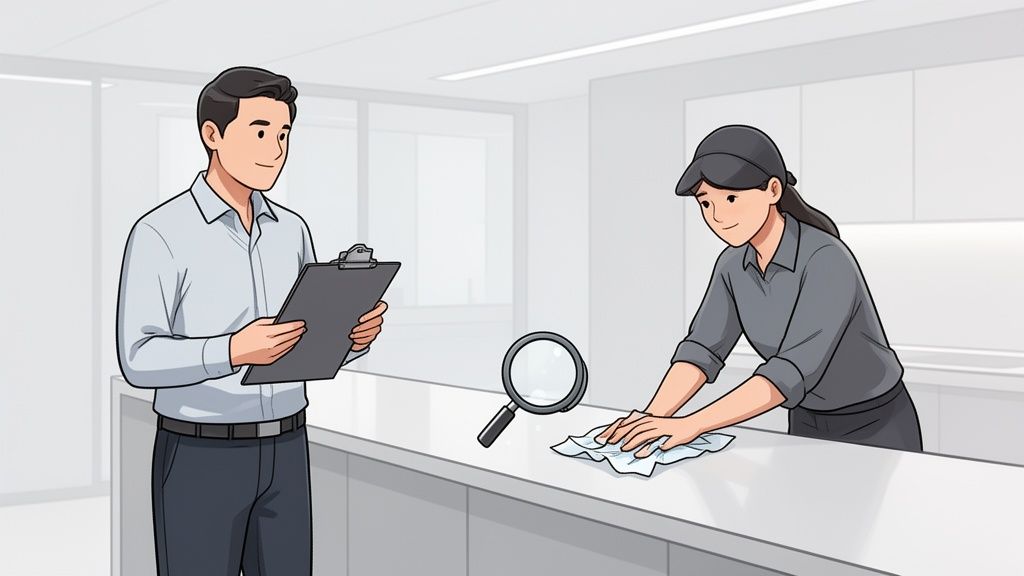
It’s an old saying in management for a reason: “You inspect what you expect.” It’s a simple truth. If you just tell people what to do but never circle back to check on the work, you’re basically crossing your fingers and hoping for the best.
This isn’t about micromanaging or catching people making mistakes. It’s about being present, reinforcing standards, and showing your team that the little things—the things that define quality—actually matter. In the world of commercial and public facilities, this isn't just a good idea; it's the foundation of your entire customer experience and a critical component of public health.
The Real Cost of a Dirty Facility and the ROI of Inspection

In any public-facing business, cleanliness is a direct reflection of your brand. It’s not just about looking nice; it’s a critical metric that quietly drives your bottom line. A dirty facility isn't a minor annoyance—it’s a silent profit killer.
Think about it. A single bad online review mentioning a filthy restroom, a grimy gym locker room, or a sticky table at a restaurant can turn away dozens of potential customers before they ever set foot in your door.
This isn't just a hunch. The data is overwhelming. A shocking 94% of people say they would avoid a business in the future if they ran into a dirty restroom. That means for every customer who walks away disgusted, you haven't just lost that one sale. You’ve lost their repeat business, their family’s business, and anyone they tell about their bad experience.
The Ripple Effect of Poor Sanitation
The damage goes far beyond a single lost transaction. The consequences of letting standards slide create a negative ripple effect across your entire operation:
- Your Brand Reputation Gets Tanked: In the age of Yelp, Google Reviews, and TikTok, your facility’s hygiene is always on display. A reputation for being dirty is incredibly hard to shake and gives your competitors an easy win.
- Customer Loyalty Evaporates: A clean, well-kept environment makes people feel safe and respected. When standards slip, so does their loyalty. That gym member who keeps finding sweaty, un-wiped equipment? They're already shopping for a new gym.
- Employee Morale and Productivity Nosedive: Nobody wants to work in a dirty, unhygienic environment. A grimy workplace sends a clear message that management doesn't care, which leads to less motivation, more call-outs, and a revolving door of staff.
"You get what you inspect, not what you expect. This isn't about policing people or catching mistakes. It's about leader presence, coaching, and reinforcing that standard work actually matters."
If you expect your facility to be spotless but never actually walk the floor to verify it, the standards will slowly but surely crumble. A solid inspection program helps you catch issues before they become expensive emergencies and helps reduce unplanned expenses from compliance failures or last-minute deep cleans.
Framing Sanitation as a Strategic Investment
It’s time to stop thinking of cleaning as a cost center and start seeing it for what it is: a strategic investment in your customer experience and public health. An "inspect what you expect" program delivers a clear return on investment (ROI) by tackling the hidden costs of neglect head-on.
Sales Tip: When talking to clients, shift the conversation from the cost of cleaning supplies to the ROI of hygiene. A clean facility isn't an expense; it's a tool for customer retention. Explain how visible cleanliness, like well-stocked disinfectant wipe stations, builds trust and can lead to higher customer loyalty and better online reviews.
Visible cleaning tools are a huge part of this strategy. Things like disinfectant wipe dispensers placed in high-touch areas do two crucial jobs. First, they empower both staff and customers to maintain hygiene themselves—think gym equipment or shopping cart handles. Second, their very presence is a powerful visual cue. It says, "We care about your health and safety here," which builds confidence and reinforces your brand's value before a customer even speaks to an employee.
By putting a consistent inspection program in place, you’re not just managing janitors. You’re actively managing your reputation, your customer loyalty, and your business's financial health. It’s one of the smartest investments you can make.
Building Your Sanitation Inspection Framework

An "inspect what you expect" program is where the rubber meets the road. It takes the idea of "clean" from a vague goal and turns it into a system—a repeatable, tangible framework that makes exceptional hygiene your default setting. This isn't about creating more paperwork. It's about building a sustainable process that actually works.
It all starts with walking your space with fresh eyes. Forget you're the manager for a minute and become a first-time customer. Your mission? To find every single “danger zone,” those high-touch surfaces where germs, grime, and customer complaints are born.
This isn’t a copy-and-paste job. The hot spots in a fitness center are worlds away from those in a restaurant or retail store. Specificity is your best friend here.
Identifying Your High-Touch Danger Zones
Mapping these critical areas is the bedrock of your entire inspection program. Think about the path a customer or employee takes from the moment they walk in. What do they touch? What must they touch? These are the areas that require not just cleaning, but regular disinfection.
Cleaning Tip: The most effective way to handle high-touch zones is with a two-step process: clean first to remove dirt, then disinfect to kill germs. Disinfectant wipes are perfect for this as they often combine both actions, making the process fast and efficient for busy staff.
High-Touch Danger Zones by Facility Type
| Facility Type | Primary High-Touch Zones | Recommended Inspection Frequency |
|---|---|---|
| Gyms & Fitness Centers | Dumbbell/barbell grips, cardio touchscreens, weight benches, locker handles, water fountains | Daily (multiple times) |
| Offices & Buildings | Elevator buttons, reception desks, shared kitchen appliances, door handles, conference tables | Daily |
| Retail & Restaurants | Checkout counters, payment keypads, shopping cart handles, condiment stations, restroom doors | Daily (hourly for peak times) |
Mapping these zones isn't just an academic exercise—it's the foundation for building inspection checklists that actually reflect how your facility is used. A great checklist is clear, concise, and built for speed. If you manage larger properties, our property manager inspection checklist offers even more detailed guidance.
Designing Practical Audit Checklists
A smart sanitation program doesn’t treat every task the same. It uses a tiered approach that blends daily vigilance with deeper, less frequent reviews.
The Daily Check (Non-Negotiables)
This list needs to be short and sharp, focused only on your highest-traffic, highest-risk zones. The goal is a quick pass-or-fail verification that can be done in minutes, multiple times a day. This is where disinfectant wipes are invaluable for quick hits between deeper cleans.
The Weekly Audit (Deeper Dive)
Here, you expand your scope. You’ll cover all the daily items but also look at secondary areas—baseboards, window sills, the condition of fixtures, and corners that get overlooked. This is your chance to catch the small stuff before it becomes a big, noticeable problem.
The Monthly Review (Big Picture)
Think of this as your strategic overview. The monthly audit helps you spot trends. Are certain areas consistently failing inspections? Is a piece of equipment showing wear that makes it hard to clean properly? This is where you adjust your strategy, retrain staff, or reallocate resources.
The core principle is simple: what gets measured gets managed. Without a structured framework to inspect what you expect, your cleanliness standards will inevitably drift. A clear checklist turns abstract expectations into concrete, actionable tasks.
This system is proven in the most demanding environments. Take airports, where millions of people pass through daily. The FDA's fiscal year 2024 drug quality assurance inspections revealed that 93% of all global sites received positive compliance classifications, a testament to rigorous, routine audits. For airports, implementing simple daily wipe-down checklists for high-touch zones has been shown to boost passenger satisfaction scores by up to 20%.
To give your program teeth, you need clear Key Performance Indicators (KPIs). KPIs turn your checklists from simple to-do lists into powerful management tools. For example, a great KPI is: "All daily checklist items must achieve a 90% or higher pass rate each week."
Just creating the checklists isn't enough—you have to communicate the why. Every single person on your team, from frontline staff to department heads, needs to understand their role and why it matters. When your team knows exactly what you expect—and knows you’ll be checking—they have the clarity and accountability they need to deliver excellence.
Putting Your Audits into Action: Daily and Weekly Walkthroughs That Actually Work
A brilliant sanitation policy is just a piece of paper until you bring it to life on your facility floor. This is where the rubber meets the road. To truly inspect what you expect, you have to weave your checklists and standards into the very fabric of your daily operations. The difference between a forgotten binder on a shelf and a culture of cleanliness comes down to one thing: consistent, well-executed audits.
It all starts with understanding the rhythm of your audits. You have two main tools in your arsenal: the planned, scheduled inspection and the unannounced spot-check. Both are essential. Scheduled audits are fantastic for training and setting a clear baseline. Unannounced walkthroughs, on the other hand, give you an honest snapshot of your facility's real-time condition. They keep standards high even when no one is looking.
For most businesses, a hybrid approach is the sweet spot. Use a comprehensive, scheduled audit once a week for a deep dive. Then, sprinkle in quick, unannounced daily spot-checks on your top 3-5 high-traffic "danger zones." This dual approach keeps your team sharp and ensures your most critical areas are always ready for prime time.
Making Audits Fast, Smart, and Actionable
If your audit process is a clunky, time-sucking ordeal, it’ll be the first thing to get ditched on a busy day. Efficiency is everything. And one of the simplest ways to make your audits both fast and meaningful is to use a basic scoring system.
A 1-5 scale gives you much richer feedback than a simple pass/fail.
- 1 – Unacceptable: Requires immediate correction.
- 2 – Needs Improvement: Below standard and requires correction soon.
- 3 – Acceptable: Meets the bare minimum.
- 4 – Good: Exceeds the standard.
- 5 – Excellent: Pristine. This is the new benchmark.
Suddenly, you have data, not just opinions. Are you noticing that the front entrance consistently scores a 2 on Wednesday afternoons? That’s not a lazy employee; that’s a scheduling and resource problem. Data helps you stop blaming people and start fixing the root cause.
The goal here isn't just to find problems—it's to create a system where fixing them is effortless. This is where equipping your team for success becomes so critical. When the tool to fix an issue is right there, compliance becomes second nature.
Imagine a gym manager doing a walkthrough. They spot a smudged screen on a treadmill. Instead of just making a note, they can grab a disinfectant wipe from a nearby station, clean it in seconds, and use it as a quick coaching moment with the floor staff. That immediate, hands-on correction reinforces the standard more powerfully than any report ever could.
Arm Your Team for Instant Compliance
The whole point of "inspect what you expect" isn't about playing "gotcha." It’s about building a system where doing the right thing is the easiest thing to do. Placing the right tools directly into your team's workflow is how you get there.
Cleaning Tip: For wipes to be effective, the surface must remain wet for the time specified on the product label (the "dwell time"). Train staff to use enough wipes to ensure the surface stays visibly wet, allowing the disinfectant to do its job.
Take a retail store, for example. By placing a disinfectant wipe dispenser at every single checkout counter, you integrate cleaning into the cashier's natural rhythm. A manager can glance at the pin pad and counter during a daily audit. If it's grimy, the tools are within arm's reach for the cashier to wipe it down instantly. This keeps hygiene standards high, even during the busiest parts of the day.
For this to work in a high-traffic commercial setting, you need a product that can keep up. We recommend Wipes.com Disinfectant Wipes because they’re built for the demands of public facilities—durable, effective, and reliable. When you make high-quality, easy-to-use wipes readily available, you empower your team to own the standards you've set.
Your daily and weekly audits are the heartbeat of your sanitation program. By keeping the process simple, measurable, and backed up with the right tools, you empower everyone to deliver on the promise of a flawlessly clean and safe facility.
Training and Empowering Your Team for Accountability
Your sanitation program is only as good as the people running it. A detailed checklist can get you started, but it doesn't build a culture. If you truly want to inspect what you expect and see lasting results, you have to get your team to see sanitation not as a chore, but as a point of collective pride.
This means training has to go beyond just showing someone how to use a disinfectant wipe. It has to hit on the why. Connect the dots for them: a clean facility isn't just about passing an inspection. It’s about guest safety, brand reputation, and creating a space where everyone—customers and staff—feels respected and secure.
This is where you shift from a top-down mandate to a shared mission. The daily audit becomes less about catching mistakes and more about reinforcing standards together.

As the workflow shows, it’s a simple, powerful loop: check the standard, score the performance, and equip the team to succeed the next time. This cycle reinforces accountability every single day.
Fostering a Culture of Ownership
Ownership takes root when accountability is consistent and feedback is constructive. Inspections should feel like coaching opportunities, not moments for blame. When a spot-check turns up a dirty counter, frame it as a shared problem to solve, not a personal failure.
A simple, "Hey, looks like the front desk got hit hard during the lunch rush. Let's get it wiped down," is collaborative. It reinforces the standard without putting anyone on the defensive. For a deeper dive into building this kind of positive environment, check out our guide on staff training best practices.
Celebrating wins is just as important. When a department or an individual consistently nails their audits, recognize it publicly. A little acknowledgment validates their hard work and shows the rest of the team what great looks like.
Empowering Your Team with the Right Tools
Motivation skyrockets when you make it easy for your people to do the right thing. This is where the strategic placement of cleaning supplies—especially high-quality disinfectant wipes—becomes a total game-changer. For this to work, you need a product that can stand up to heavy use. We recommend Wipes.com Disinfectant Wipes, which are specifically formulated for the demands of a commercial environment.
Just think about these real-world scenarios:
- Gyms: Put wipe dispensers right next to every cardio machine and at the entrance to the free weights area. Suddenly, you've empowered both members and staff to clean equipment before and after use, turning hygiene into a shared responsibility.
- Schools: Place wipe stations in classrooms, cafeterias, and libraries so teachers and students can quickly disinfect desks and tables, especially during cold and flu season.
- Offices: Equip conference rooms and shared kitchens with their own wipe supplies. This encourages employees to maintain common areas without having to hunt down the cleaning cart.
The big idea here is to remove friction. When the right tool is within arm's reach, the behavior you expect becomes the easiest path to take. Your staff stops being passive cleaners and becomes proactive hygiene advocates.
This investment in training and tools isn't just about looking good—it has a proven financial upside. Ask any facility director; they know that poor sanitation carries risks just as serious as safety violations. OSHA's 2024 enforcement data showed that 34,696 workplace inspections led to $131.4 million in fines. That's a loud and clear message that neglect has a price tag. You can learn more about their findings and impact to see just how serious they are.
Ultimately, when you prioritize great training, offer constructive feedback, and equip your team for success, cleanliness becomes a shared value—a cornerstone of your business that everyone is proud to uphold. That's the true power of inspecting what you expect.
Leveraging Inspection Data for Continuous Improvement

A good inspection program doesn’t just find dirt; it generates data. And that data is your single most powerful asset for taking your facility from "good enough" to truly great. When you inspect what you expect, the scores, notes, and patterns you gather aren't just numbers on a clipboard. They become a strategic roadmap, showing you exactly where to focus your efforts for smarter, more efficient operations.
The goal here isn’t to catch people messing up. It’s to spot the cracks in your system. If the same area consistently scores low, it’s rarely about a lazy employee. It’s more likely a sign of an unrealistic cleaning schedule, the wrong tools for the job, or a gap in training. Data helps you stop guessing and start solving the root cause of the problem.
Turning Numbers into Actionable Insights
Every piece of data tells a story. A simple weekly audit report can instantly show you that the main entrance fails its inspection every single Monday morning. Armed with that insight, you can tweak the weekend cleaning protocol or adjust staffing for that peak arrival time. Problem solved before it even starts.
This data-driven approach is make-or-break for businesses where first impressions are everything. The global Testing, Inspection, and Certification (TIC) market skyrocketed to USD 256.9 billion in 2024 for a reason: quality assurance is in high demand.
Sales Tip: Use data to close deals. For janitorial or cleaning supply sales professionals, offer a trial period where you help a potential client set up a basic inspection checklist. Track the scores for two weeks. Showing a client a report that proves your program and products boosted their facility's audit scores by 20% is far more persuasive than any sales pitch. You’re no longer just selling a service; you’re selling a measurable improvement.
For larger or more complex facilities, innovative approaches like drone inspection services are even emerging to gather more comprehensive data, proving how critical this information has become.
Creating a Weekly Cleanliness Dashboard
A weekly cleanliness dashboard is one of the most effective ways to turn raw data into real progress. It doesn’t have to be complex. A simple spreadsheet or a chart on a whiteboard in the breakroom can do the trick.
This dashboard should track a few key metrics:
- Overall Facility Score: A quick glance at the average score from all inspections that week.
- Top Performing Area: Celebrate what's working to boost morale.
- Area for Improvement: This highlights the zone that needs the most attention.
- Week-Over-Week Trend: Is the overall score trending up or down? A simple arrow is all you need.
A visual report like this is a great way to track weekly scores and identify where your team should focus its efforts.
Sample Weekly Sanitation Audit Report
| Area Inspected | Target Score | Monday Score | Wednesday Score | Friday Score | Notes for Improvement |
|---|---|---|---|---|---|
| Main Lobby | 95% | 80% | 92% | 96% | Low Monday scores due to weekend traffic. Increase cleaning frequency on Sunday nights. |
| Public Restrooms | 90% | 88% | 85% | 91% | Soap dispensers in men's room ran out on Wednesday. Check stock levels daily. |
| Staff Breakroom | 90% | 95% | 96% | 98% | Excellent performance. Team is taking ownership of the space. Keep it up! |
| Gym Floor | 85% | 82% | 80% | 78% | Scores consistently low. Members not wiping equipment. Add signage and relocate wipe station for better visibility. |
This kind of focused tracking makes it clear what needs to happen next, turning abstract goals into concrete actions.
Your audit data is a feedback loop. It tells you what's working, what's not, and where to focus your resources. Ignoring it is like flying blind—you're moving, but you have no idea if you're heading in the right direction.
By analyzing your inspection data, you can optimize schedules, put resources where they’re actually needed, and build a culture of accountability. You transform sanitation from a reactive chore into a proactive system for excellence.
Got Questions? We've Got Answers.
Even the most buttoned-up plans run into real-world questions. When you’re rolling out a new sanitation program, questions are actually a great sign—it means your team is engaged and thinking through the details. Tackling these common hurdles head-on is how an "inspect what you expect" system goes from a good idea to a daily reality.
Let's walk through some of the most frequent questions from facility managers, business owners, and sales teams.
How Often Should We Really Be Inspecting?
This is always the first question, and the answer is never one-size-fits-all. The right frequency depends entirely on your facility's traffic and purpose.
High-traffic, high-touch "danger zones"—think gym equipment, retail checkout counters, or restaurant tables—demand daily, or even multi-daily, spot-checks. These areas are non-negotiable because they completely shape a customer's perception of your hygiene.
On the other hand, less-trafficked zones like office conference rooms or back-of-house storage might only need a formal inspection a few times a week. The trick is to start with a baseline—say, daily checks on your top five high-touch zones—and then let the data guide you. If an area keeps scoring poorly, up its inspection frequency until the standards stick.
The goal here is proactive maintenance, not reactive cleaning. Good inspections should catch problems long before they ever reach a customer's eye.
What’s the Best Way to Get Staff on Board with This?
You can have the best checklists in the world, but without your team's buy-in, they’re just paper. Getting them on board is everything.
First, explain the "why." Don't just hand them a clipboard. Frame it as a shared goal: protecting customer safety, boosting the brand's reputation, and honestly, making it a better, more pleasant place for everyone to work.
Then, bring your frontline staff into the process of creating the checklists. They know the trouble spots better than anyone. This one simple move transforms the program from a top-down mandate into a collaborative effort. Their insights are pure gold.
Most importantly, make it clear that inspections are a tool for support and training, not punishment. When a standard is missed, it's a coaching opportunity. When a team consistently nails their scores, shout it from the rooftops. Public recognition turns accountability from a chore into a point of pride.
My Business Is Small—Do I Still Need a “Formal” Program?
Absolutely. But "formal" doesn't have to mean complicated. For a small business, a formal program might just be a simple, one-page checklist the owner or manager walks through at the end of each day. The principle of "inspect what you expect" scales to any size.
Consistency is what builds trust, and for a small business, it’s a massive competitive advantage. Whether it's a small café, a boutique shop, or a local office, ensuring the same standard of clean is met every single day, no matter who’s on shift, is critical.
- Cleaning Tip for Small Businesses: Use disinfectant wipes on your top three high-touch surfaces (like the door handle, payment terminal, and main counter) at set intervals throughout the day. It’s a small action with a huge impact on customer perception.
- Sales Tip for Small Business Clients: If you sell cleaning supplies, bundle a "Small Business Starter Kit" with a sample checklist and a pack of durable disinfectant wipes. You're not just selling a product; you're selling a complete, easy-to-implement hygiene solution.
- Facility-Specific Suggestion (Restaurant): A manager can perform a five-minute "closing audit" each night, wiping down condiment stations, table edges, and POS screens. This ensures the restaurant is ready for a perfect morning opening.
By integrating a simple tool like disinfectant wipes with a quick verification step, you build a powerful, efficient system. It upholds your standards, reassures your customers, and proves that a commitment to excellence is smart business, no matter the size.
Ultimately, a commitment to cleanliness, verified through consistent inspection, is one of the most powerful statements a business can make. It tells customers they are valued and safe. We encourage you to prioritize cleanliness in your facility—consider integrating a robust inspection plan and high-quality disinfectant wipes into your daily routine or product offerings today.
Leave a Reply