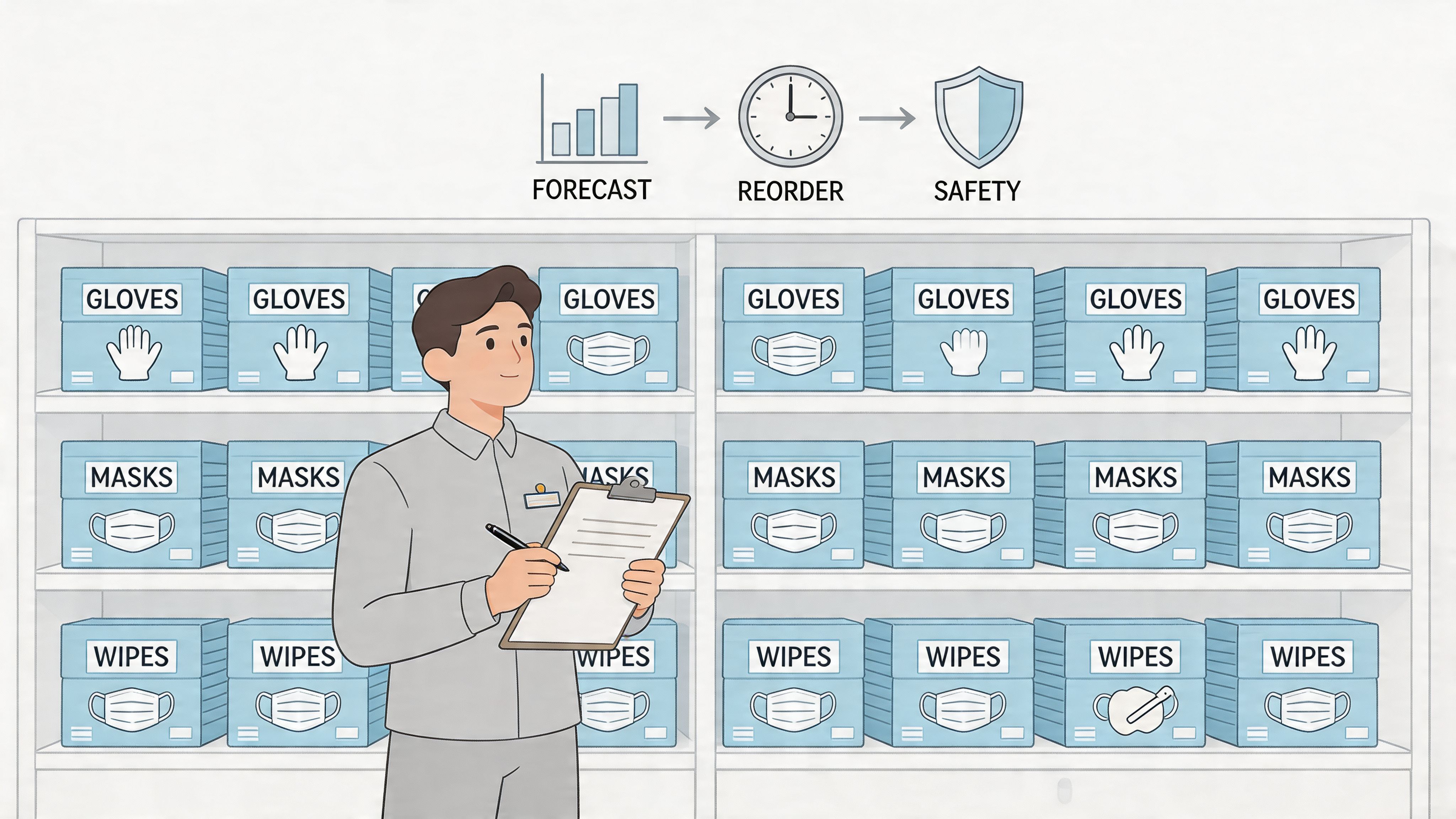
The problem usually shows up at the worst possible time.
A gym is heading into its busiest week of the year. A venue has a sold-out weekend. A school is preparing for parent events. Then the order that normally arrives without drama gets delayed, the usual disinfectant wipes are backordered, glove sizes are missing, and the team starts rationing supplies instead of running the building.
That’s why the supply of ppe matters far beyond hospitals. In commercial facilities, PPE isn’t just masks in a cabinet or gloves in a janitorial closet. It’s the operating system behind visible cleanliness, staff confidence, customer trust, and daily continuity. If your team can’t wipe down check-in counters, locker room touchpoints, payment terminals, fitness equipment, or shared tools on schedule, the issue stops being “procurement” and becomes a brand problem.
For most operators, the real shift is this: stop treating sanitation supplies as miscellaneous consumables. Start treating them like business-critical inventory.
Beyond the Basics of PPE Supply
Right before a major event, shortages don't feel abstract. They show up as empty shelves, rushed substitutions, and frontline staff asking which areas they should skip first.

Commercial facilities got a hard lesson during COVID. Global PPE demand surged 40% during COVID, with over 1,000% N95 price hikes, yet no facility-specific forecasting model exists for airports and sports venues according to HealthTrust's review of PPE best practices and supply-demand pressures. That gap still matters because non-healthcare sites have their own sanitation pattern. They deal with fluctuating occupancy, high-touch surfaces, event-driven spikes, and public expectations around visible cleanliness.
Why commercial facilities need their own playbook
Healthcare gets most of the guidance. That makes sense for clinical settings, but it leaves a practical hole for operators running gyms, offices, retail stores, schools, car dealerships, airports, and event spaces.
Those sites don't just need PPE for worker protection. They need a reliable hygiene system that supports operations in public view.
That system usually includes:
- Staff protection items such as gloves, masks, and protective wear for cleaning staff, maintenance teams, and public-facing employees
- Surface sanitation tools such as disinfectant wipes for counters, handles, equipment touchpoints, payment devices, carts, railings, and shared stations
- Deployment tools such as wall dispensers, mobile cleaning caddies, refill storage, and area-specific kits
- Usage controls such as checklists, count sheets, and reorder triggers so the team doesn't discover shortages too late
What gets missed when wipes are treated as an afterthought
A lot of facilities plan around gloves and masks, then buy wipes as a convenience item. That usually fails under pressure.
Disinfectant wipes are one of the few tools that combine speed, consistency, and visibility. Staff can use them between customers, during rounds, or in response to spills and concerns without setting up a full wet-cleaning process. That makes them operationally important in ways many PPE plans ignore.
Practical rule: If customers can see the surface, your wipe supply affects both sanitation and perception.
When supply runs thin, managers start making bad trade-offs. They move wipes from public areas into back-of-house use. They stretch canisters longer than they should. They switch to products staff dislike using. None of that saves much in the long run.
A better approach starts with a wider definition of PPE and a tighter link between hygiene supply and revenue protection.
Redefining PPE for Your Facility's Success
Most facility teams still hear “PPE” and think only of masks, gloves, and gowns. For commercial operations, that definition is too narrow.
The better frame is a protective environment portfolio. That includes traditional PPE for employees, but it also includes the sanitation supplies that help maintain a clean, usable, visibly cared-for environment throughout the day. In practice, disinfectant wipes belong in that portfolio because they help staff reduce contamination on shared surfaces quickly and consistently.
Cleanliness is part of the customer experience
Customers don't evaluate cleanliness like auditors do. They notice signals.
They notice whether an employee wipes down a touchscreen after heavy use. They notice whether the front desk has fresh supplies. They notice whether a fitness center smells stale, whether equipment looks cared for, and whether checkout counters look neglected.
Visible hygiene has business value because it affects how safe, organized, and professional a facility feels. In a gym, that influences comfort. In retail, it affects confidence. In an office, it shapes employee expectations and visitor impressions. In hospitality-adjacent settings, it directly supports brand trust.
That’s why wipe supply belongs in the same conversation as staffing plans, guest readiness, and service standards.
Wipes do a different job than deep cleaning
Many operators often mix up maintenance cleaning with operational sanitation.
Deep cleaning is scheduled. It handles buildup, floor care, restrooms, detail work, and broader hygiene resets. Disinfectant wipes handle the moments in between. They support rapid response on high-touch surfaces and let teams maintain standards without dragging a full cart through occupied space.
Used well, wipes help with:
- Speed between uses in gyms, training rooms, meeting spaces, and shared workstations
- Consistency during the day because staff can clean on short intervals instead of waiting for full rounds
- Public reassurance since customers can see sanitation happening in real time
- Reduced friction for staff because wipes are easier to deploy than spray-and-cloth systems in many occupied areas
The same logic applies to glove programs. If your team is revisiting glove selection, this guide to 8 mil nitrile gloves is a useful reference when balancing protection, dexterity, and comfort for cleaning tasks.
Stop filing wipes under miscellaneous supplies
A surprising number of facilities bury disinfectant wipes inside janitorial spend and never review them as a strategic category. That leads to weak forecasting, poor placement, and inconsistent product standards.
A better way is to classify wipes by use case:
| Use case | Typical area | What matters most |
|---|---|---|
| Public-facing touchpoint cleaning | Front desks, POS stations, door pulls | Fast access, visible use, easy training |
| Shared equipment turnover | Gyms, schools, coworking areas | Surface compatibility, durability, ease of dispensing |
| Staff sanitation kits | Maintenance carts, mobile teams | Portability, consistent stocking, refill simplicity |
| Incident response | Reception, waiting areas, service counters | Immediate availability, quick cleanup workflow |
The facility that looks clean only after hours is already behind.
When wipes are integrated into PPE planning, managers make smarter choices about placement, replenishment, and staff accountability. That’s when sanitation stops behaving like a cost center and starts functioning like a service asset.
Forecasting Your Hygiene Supply Needs
Most shortages are predictable in hindsight.
The facility had a tournament weekend coming. Membership promotions were on the calendar. School traffic was increasing. Flu season was starting. Staff knew occupancy would rise, but purchasing still used an average week as the ordering baseline.
That’s the core forecasting mistake. The supply of ppe should follow how the building is used, not how the budget spreadsheet is laid out.

Start with real usage, not assumptions
If you're managing wipes, gloves, masks, and related sanitation supplies, pull the last several ordering cycles and compare them against occupancy patterns. Not every facility has clean data, but many facilities have enough to work with.
Review:
- What was used each week by product type, not just by invoice total
- Where it was used such as front-of-house, restrooms, fitness floor, classrooms, breakrooms, or event areas
- When usage jumped and what was happening in the facility at that time
- Which products disappeared fastest because overuse, poor placement, and theft often distort true demand
A gym might find wipes spike when new member traffic rises. A retail operator may see higher use near seasonal promotions. A school may burn through supplies during cold-and-flu periods and family events.
Watch leading indicators
The cleanest forecasting systems don't wait for shelves to empty. They use upcoming activity to estimate demand.
Strong leading indicators include:
- Booking volume for event spaces, hospitality properties, and conference facilities
- Class schedules and tournaments for schools and sports venues
- Membership campaigns for gyms and fitness centers
- Sales promotions for retail stores and dealerships
- Visitor-heavy calendar periods such as holidays, orientation days, and open houses
If next month’s calendar shows heavier usage of the building, your wipe supply should move before traffic does.
Match forecast to cleaning frequency
Forecasting only works if it connects to actual cleaning standards. High-touch surfaces need their own rhythm. Otherwise, teams either under-clean or over-order.
For most commercial sites, create bands:
- Continuous-use surfaces get wipes available at point of use. Think check-in kiosks, fitness equipment, counters, and card readers.
- Rotational touchpoints go on scheduled rounds. Think door hardware, railings, breakroom handles, and shared controls.
- Low-touch areas can be reviewed during routine cleaning instead of frequent wipe-down cycles.
That method makes supply planning much easier because each area has a known consumption pattern.
Forecast around behavior. People don't use your facility evenly, so your team shouldn't stock it evenly.
Build a simple operating forecast
You don't need advanced software to improve. A working forecast can live in a spreadsheet if someone owns it.
Use four columns for each product category:
| Product | Baseline weekly use | Upcoming activity adjustment | Final planned order |
|---|---|---|---|
| Disinfectant wipes | Typical weekly canister use | Add for events, traffic surges, or promotions | Order quantity for next cycle |
| Disposable gloves | Typical usage by department | Add for extra cleaning labor or special tasks | Order quantity for next cycle |
| Masks or face coverings | Usual backstock replacement | Add for policy changes or seasonal use | Order quantity for next cycle |
| Refill accessories | Mounts, liners, or kit supplies | Add when opening temporary stations | Order quantity for next cycle |
For sales teams, this is a strong client conversation. Don't pitch wipes as a commodity. Ask what drives occupancy, what surfaces get touched most, and where cleaning visibility matters. Clients often know they have shortages. They usually haven't connected those shortages to demand patterns.
Implementing Smart Inventory and Storage Practices
Forecasting tells you what should happen. Inventory discipline makes sure the product is there when the team reaches for it.
Many facilities often leak money and reliability simultaneously. They overbuy the wrong items, understock the critical ones, store products badly, and discover quality issues after staff have already built routines around them.
The three controls that matter most
The first is par level. That’s the minimum amount you want on hand for a specific item in a specific area.
The second is the reorder point. That’s the inventory level that triggers a purchase request or replenishment action.
The third is lead time. That’s how long it takes from placing the order to having usable product in the building.
A gym gives a clear example. If the fitness floor normally goes through a steady flow of disinfectant wipe canisters, and deliveries aren’t immediate, you can’t wait until the last case is opened to reorder. By then, the risk is already in motion.
Use area-based pars, not one building-wide number
One central stockroom count isn't enough. Wipes disappear in uneven ways.
A better system assigns par levels to zones:
- Front desk and lobby stations for counters, pens, tablets, and waiting areas
- Restrooms and locker rooms for touchpoints that need frequent resets
- Equipment-heavy zones in gyms, schools, or therapy spaces
- Employee areas such as breakrooms, time clocks, and shared devices
- Mobile kits carried by supervisors or floor teams
That makes shortages visible earlier. It also shows where usage is real versus where product is being misplaced or overused.
Sample weekly par levels
These aren't universal numbers. They’re planning examples you can adjust based on traffic, staffing, and cleaning cadence.
Sample Weekly Par Levels for Disinfectant Wipes by Facility Type
| Facility Type | High-Traffic Area Example | Suggested Weekly Par Level (Canisters) |
|---|---|---|
| Office | Reception desk and shared conference rooms | 6-12 |
| Gym or fitness center | Cardio area and strength equipment zones | 18-30 |
| Retail store | Checkout counters and fitting room touchpoints | 8-16 |
| School | Front office, nurse area, and shared classroom surfaces | 12-24 |
| Restaurant | Host stand, payment stations, and restroom touchpoints | 10-18 |
FIFO is boring and it works
Facilities forget about first in, first out until they open damaged or aging inventory.
Put new cases behind older stock. Label received dates. Train leads to pull older product first. This is especially important for disinfectant wipes because product integrity and usability matter on the floor, not just in storage.
Storage conditions affect performance
PPE and sanitation products aren't indestructible. Materials matter.
According to Grand View Research's PPE procurement intelligence report, PPE production depends on materials like polypropylene and polyethylene, raw material costs are the largest expense, and WHO standards require PPE to withstand repeated disinfection. The same report notes that gaps in material specifications contributed to failures, with 68.6% of UK healthcare facilities reporting adequate fluid-repellent facemask supplies while 13.6% experienced shortages. For facility operators, the practical lesson is simple: don't buy on label alone. Ask how the product holds up in real use.
Check these storage basics:
- Temperature control because extreme heat can affect product condition
- Moisture protection so packaging and dispensers don't degrade in humid storage rooms
- Sealed storage to reduce contamination and evaporation issues after cases are opened
- Clear lot rotation so teams use older product first
- Separate chemical zones if your facility stores multiple sanitation products with different handling needs
Field note: The cheapest wipe often becomes the most expensive one when staff need two or three to finish a task.
Build low-effort counting habits
You don't need a complex system. You need a repeatable one.
A practical weekly routine looks like this:
- Count by zone, not just by building
- Record open cases and full cases separately
- Flag substitute products so you don't assume performance is equal
- Review anomalies such as one department suddenly burning through inventory
- Trigger reorders early enough to respect supplier lead time
Managers often focus on quantity and ignore usability. Count what staff will use willingly. If the wipe tears, dries out, or leaves a residue people hate, your real inventory is lower than the shelf count says.
Strategic Sourcing and Vendor Partnerships
A weak supplier relationship usually looks fine until demand changes.
The invoice arrives. Product shows up often enough. Nobody asks many questions. Then a disruption hits and the facility learns it wasn't buying reliability. It was buying routine.

Why single-source thinking breaks down
PPE supply is exposed to concentration risk. China accounts for 60% of global medical gown production and 59% of respirators and masks, which creates a vulnerability when facilities depend too heavily on one region for critical products, as outlined in this PPE manufacturing concentration overview.
For a commercial facility, that doesn't mean every product must come from a domestic source or that every global supplier is risky by default. It means one supplier, one distributor, or one geography should never be your entire fallback plan.
What to evaluate besides price
Strong sourcing decisions usually come from a short list of practical questions:
- Can the vendor explain substitutions clearly if your primary item becomes unavailable?
- Do they carry adjacent products so wipes, gloves, and related sanitation items can be coordinated?
- Will they support forecasting conversations instead of just taking orders?
- Can they provide product documentation that helps you compare durability, compatibility, and intended use?
- Do they understand your building type or are they selling every account the same package?
If you want a broader procurement lens, this guide on sourcing strategy best practices is useful because it frames supplier selection as a resilience issue, not just a unit-price exercise.
Premium products need a value argument
This matters for sales professionals and buyers alike. A higher-quality wipe or glove should never be sold as “premium” by itself. That’s vague and easy to dismiss.
Sell the operational result instead:
- Fewer wipes needed to finish a station reset
- Less staff resistance to using the product
- Better consistency across shifts
- Lower risk of mid-cycle substitutions
- Cleaner presentation in customer-facing areas
That logic also applies to glove programs. If your team needs a broader buying framework, this article on bulk work gloves helps compare purchasing decisions through an operational lens.
As a practical buying option, we recommend Wipes.com Disinfectant Wipes for facilities that need dependable disinfectant wipe supply as part of a broader PPE and sanitation program.
Build a vendor relationship before you need one
The best procurement conversations happen during stable periods, not during shortages.
Ask vendors how they handle allocation, substitutions, communication during delays, and refill continuity for key products. If they can't answer clearly when things are calm, they won't improve when stock tightens.
A useful setup is to keep:
| Sourcing layer | Purpose |
|---|---|
| Primary vendor | Main supply for standardized products |
| Secondary vendor | Backup for core categories and urgent gaps |
| Local or regional option | Short-notice support for disruptions or events |
That structure gives you flexibility without forcing your team to manage chaos every time demand moves.
Facility-Specific Strategies and Checklists
Good sanitation plans look different in each building. A gym has sweat-heavy, shared-contact surfaces. An office has conference room turnover and breakroom touchpoints. Retail has customer-facing counters and payment devices that never really stop moving.
The common mistake is giving every facility the same wipe placement, the same glove selection, and the same training script.
Office checklist
In offices, the pressure points are usually shared rather than industrial. That makes consistency more important than intensity.
Focus on these areas:
- Reception touchpoints such as counters, pens, visitor tablets, badge stations, and seating armrests
- Conference room resets including tables, chair arms, remotes, shared screens, and door hardware
- Breakroom contact surfaces such as refrigerator handles, microwave buttons, coffee stations, and sink fixtures
- Shared equipment including printers, copier panels, and desk hoteling stations
- Restroom transition points especially latch hardware, faucets, and stall touchpoints
A practical office kit should include wipes, properly fitted gloves, and a short reset checklist by area. Keep one version for day porters and another for reception or admin teams who may handle quick visible touch-ups between scheduled rounds.
Gym checklist
Gyms need fast, visible sanitation because members use equipment back-to-back and expect to see cleanliness in action.
Priority zones include:
- Cardio consoles and handles
- Free weights and bench adjustment points
- Selectorized machine touchpoints
- Studio equipment such as mats, blocks, and shared accessories
- Locker handles, vanity surfaces, and restroom touchpoints
- Check-in kiosks and water station buttons
In this environment, wipe placement matters as much as wipe quality. If canisters are hidden, members won't use them. If the product leaves residue or dries too fast, staff and users will avoid it.
A strong gym routine uses three layers:
- Member-accessible wipes on the floor
- Staff cleaning kits for rounds and incident response
- Backstock stored close enough to refill quickly during peak periods
Staff follow the standards you make easy. If a refill requires a trip across the building, the station will sit empty longer than you think.
Retail checklist
Retail has a different pressure. Cleanliness supports trust at the point of purchase.
Target these spots first:
- POS terminals and pin pads
- Checkout counters and bagging surfaces
- Shopping baskets, carts, or handheld scanners
- Fitting room handles and seating
- Service desks and return counters
- Entry hardware and waiting-area touchpoints
Retail teams should keep compact cleaning kits behind registers and at service counters. That's faster than relying only on janitorial staff and it keeps visible sanitation close to the customer interaction.
Inclusive PPE matters in every facility
A lot of facilities still buy one glove size range, one mask type, and one fit assumption for the whole workforce. That creates avoidable noncompliance and discomfort.
The PMC review on PPE gaps and inclusion highlights a critical problem: standard PPE often fails diverse users such as women and aging workers, and operations need checklists that include training on properly fitted gear. In sanitation-heavy environments, fit affects dexterity, comfort, and whether staff use the product correctly.
Adjust your checklist to include:
- Multiple glove sizes available on each shift
- Fit checks during onboarding for cleaning and public-facing staff
- Training on when to change gloves and when wipes are the faster tool
- Feedback loops so workers can flag products that tear, slip, or limit movement
- Task-based assignment because restroom cleaning, front-desk wipe-downs, and equipment sanitation don't always need the same gear
The easiest efficiency hack
Create zone-based kits instead of one giant shared closet.
For example:
| Facility type | Kit contents | Best placement |
|---|---|---|
| Office | Wipes, gloves, checklist, spare liners | Reception and breakroom |
| Gym | Wipes, gloves, towel backup, refill log | Fitness floor and locker room |
| Retail | Wipes, gloves, quick-touch checklist | POS station and service desk |
That small shift usually improves refill discipline, cuts time lost walking for supplies, and makes accountability obvious.
Building a Resilient Culture of Cleanliness
Facilities that stay ready don't rely on last-minute heroics. They build routines that make cleanliness visible, repeatable, and easy to sustain.
That starts with a simple operating belief: the supply of ppe is not just about emergency protection. In commercial settings, it supports daily experience. Gloves protect workers. Masks may support specific tasks or policies. Disinfectant wipes keep high-touch environments manageable between full cleaning cycles and show customers that the facility takes care seriously.
What actually works
The strongest programs usually share the same traits:
- They forecast around occupancy and events, not around static monthly habits
- They set area-based par levels so shortages show up before service drops
- They source through relationships, not just price sheets
- They train staff on product use and fit, especially where inclusive PPE matters
- They place wipes where the work happens, not where storage space happened to be available
If you're tightening your office routines, this comprehensive office deep cleaning checklist is a useful companion resource for translating standards into recurring tasks.
Cleanliness becomes part of your brand the moment customers can compare your space with the one next door.
A resilient culture of cleanliness doesn't require perfection. It requires discipline. Review your current supply setup. Check where wipes run out first, where glove fit is poor, where refills lag, and where vendors aren't giving you enough confidence. Then fix the system, not just the symptom.
If you manage a facility, sell cleaning supplies, or run day-to-day sanitation, make disinfectant wipes part of your core PPE strategy instead of treating them like a backup item. Build your pars, tighten your sourcing, stock the right glove sizes, and put wipes where staff and customers actually need them. For more practical sanitation guidance, keep an eye on WipesBlog.com and make high-quality disinfectant wipes part of your daily routine or product offering.
Leave a Reply