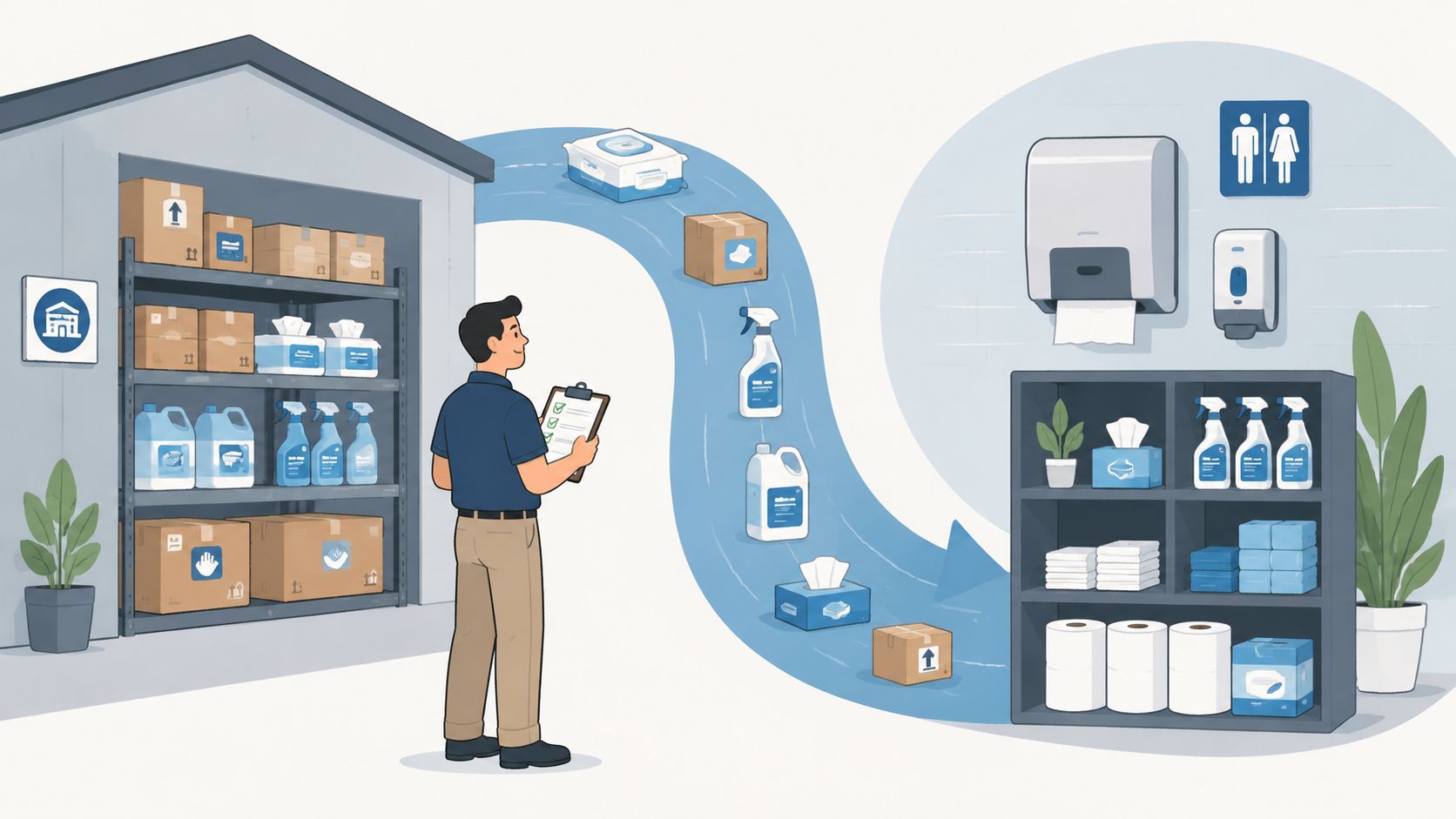
You know the moment. A busy lobby, a packed spin class, a service bay full of cars, and the wipe dispenser goes dry right when people reach for it. Someone grabs the last carton from the closet, but it's the wrong SKU, the count was already off, and the next delivery isn't due until the middle of the week. That's how supply inventory management stops being a back-office task and turns into a front-line cleanliness problem.
For facilities that live on constant turnover, cleanliness isn't just about wiping surfaces. It's about making sure disinfectant wipes, sanitizing wipes, and other consumables are in the right room, in the right quantity, before the room fills up again. When stock is managed badly, teams over-order, run out, or find expired cases in the back. When it's managed well, the program disappears into the background and the operation feels tighter, calmer, and more professional.
The Moment the System Breaks
The breakage usually shows up on the busiest day, not the quiet one. A gym opens for the morning rush and the gym wipe dispenser in the cardio zone is empty. A restaurant manager sends a runner to the stock closet and finds three unopened cases of commercial disinfecting wipes, but all of them were tucked behind old partial cases and one is damaged. A rental property host realizes the turnover cart has workout wipes but no surface wipes, so the housekeeping team starts borrowing from other units.
That's not a cleaning problem only. It's an inventory problem that happens at the point of use, where the stock stops behaving like a warehouse item and starts behaving like a service promise. Facilities with many rooms, many hands, and many restocking paths feel this faster than warehouses do, because the product doesn't sit still long enough to be counted once and forgotten.
Why the panic keeps repeating
The pattern is predictable. Teams count the closet, but they don't track what leaves the cart. They reorder on memory, not consumption. They assume the next shift will notice a low bin and report it, but the next shift assumes the last shift already handled it.
Practical rule: if a product is touched in one room and consumed in another, the shelf count alone will lie to you.
That's why the fix starts with measure, forecast, audit, and align the team. Those four shifts turn wipes, sprays, and similar consumables into a controlled system instead of a recurring scramble. Even a simple program beats a smart-looking spreadsheet that nobody updates at the point of use.
What Supply Inventory Management Actually Means
Supply inventory management means tracking cleaning and sanitation consumables from receiving to use, across every storage point and every room where staff consume them. The ASCM defines inventory management as tracking stock across an entire organization so a business has the right amount of product, “not too much, and not too little,” and it separates that from warehouse-level inventory control ASCM inventory management definition. That distinction matters in decentralized facilities, because the closet is only one node in the system.

Think of inventory like a river. It starts at receiving, moves into storage, then forks into carts, dispensers, and shared rooms where guests, members, or tenants consume it. Most failures happen at those forks, because central records still look fine while the actual dispenser is empty or the cart was never restocked.
Why the facility is not a small warehouse
A warehouse cares about pallet position. A gym floor cares about whether the fitness wipes are in the training zone between sets. An airport cares whether the cleaning cart has enough EPA registered disinfecting wipes for the next wave of traffic. A short-term rental cares whether housekeeping can refresh the unit without raiding the next one.
If you run an office, gym, school, restaurant, or retail store, the main question is the same. Can the team prove that stock is available where the work happens, not just where it was received?
For a useful adjacent model, the best practices for vending inventory writeup from Vendmoore Enterprises is a solid comparison point because vending also depends on items moving through distributed endpoints, not a single central shelf best practices for vending inventory. The mechanics aren't identical, but the discipline is.
The Four KPIs That Matter Most
A closet can look fine on paper while the floor is already short. That is why sanitation supply programs need a small set of measures that reflect movement, coverage, and trust at the point of use. For distributed facilities, four KPIs carry most of the load: inventory turnover, days of inventory on hand, stockout rate, and inventory accuracy at the point of use. Together, they show whether stock is moving, whether it is lasting long enough, whether guests are hitting empty dispensers, and whether the record matches what is physically in the room.
| KPI | Formula or Definition | Target Range | What It Tells You |
|---|---|---|---|
| Inventory Turnover | COGS divided by average inventory | Average business benchmark is 8.5 turns per year; retail often sits in the 5–10 range, wholesalers often target 8–12 NetSuite KPI benchmarks | Whether stock is moving fast enough without sitting stale |
| Days of Inventory on Hand | The inverse of turnover, used to estimate how long stock will last | Use it to match lead time and demand pattern ThoughtSpot KPI framework | Whether you're holding too much or too little supply |
| Stockout Rate | Share of times a needed item isn't available | No universal benchmark in the brief, so treat repeat stockouts as a failure signal | Whether guests or staff are encountering empty dispensers or carts |
| Inventory Accuracy at Point of Use | Recorded stock versus what is in the room, cart, or dispenser | The benchmark brief notes 58% of retail brands and direct-to-consumer manufacturers operated below 80% inventory accuracy NetSuite KPI benchmarks | Whether the central file can be trusted outside the closet |
Inventory turnover is still the cleanest first read on whether the program is bloated or tight. The average business benchmark of 8.5 turns per year gives a rough anchor, while retail and wholesale references show the range many teams work within NetSuite KPI benchmarks. In a terminal, gym, or school, high turnover can be healthy if it reflects real usage, but it can also mean the next delivery is carrying too much risk. I have seen teams celebrate fast movement right up until one delayed truck left several rooms empty.
Read it this way: turnover tells you speed, not safety.
Days of inventory on hand answers the next question. If cases pile up in the back room, the number climbs and cash gets trapped. If it runs too low, supply can disappear before the next delivery window. KPI frameworks that pair DOH with stockout rate and fill rate help separate demand problems from supply problems ThoughtSpot KPI framework. That matters in decentralized facilities, where one overused housekeeping cart or one busy washroom bank can burn through stock long before central purchasing notices.
Stockout rate tells you where the program stops serving the operation. A single empty dispenser in a low-traffic room is a nuisance. Repeated misses in high-traffic zones point to the wrong par, the wrong refill schedule, or a handoff that keeps failing between receiving and the floor. For PPE and other shared consumables that move across many hands, the issue is often distribution, not buying. A practical reference on PPE supply planning and replenishment fits that reality because the supply has to survive the handoff from storage to the people who use it.
Inventory accuracy at the point of use is where the closet meets the room. The benchmark data showing 58% below 80% accuracy is a reminder that the weak link is often record quality, not just ordering logic NetSuite KPI benchmarks. If the cart says there are six sleeves left and there are only two, every downstream decision gets noisy. That is the kind of drift that breaks par levels, hides waste, and forces managers to spend time reconciling counts instead of fixing the process.
If you want a tighter read on the floor, pair those KPIs with a clear inventory trail. Teams that need a practical way to connect counts, location, and replenishment can find supply chain visibility software for 2026, then use the numbers to spot where the system is slipping before guests or staff feel it.
Forecasting Demand and Setting Par Levels
Forecasting for wipes and cleaning consumables works best when you stop guessing from the closet door and start using usage patterns. Baseline demand should come from actual consumption, then you add a lead-time buffer and a safety stock cushion for days when the room is busier than expected or the supplier is slower than promised. That's the point of par levels, a minimum and maximum level set for each location, not just for the whole building.

A practical construction benchmark recommends an additional week worth of material to buffer against delivery delays and supply interruptions construction material buffer discussion. That doesn't mean every facility should copy the same rule blindly. It does mean volatile environments need a real buffer, not a wish.
The worksheet that actually helps
Start with four lines for each SKU.
- Historical usage: pull the last several weeks of actual drawdown from dispensers, carts, or issue sheets.
- Baseline calculation: average the period, then adjust for peak days if your operation has them.
- Real-world volatility: add room for delivery delays, unexpected events, or seasonal surges.
- Final par level: set a shelf minimum and a reorder ceiling for each location.
If you want software support, a current overview of supply chain visibility software for 2026 can help teams compare tools that reduce blind spots between purchase, receiving, and consumption Logivo visibility software guide. The right tool matters less than the habit of using the same logic every week.
For broader sanitation planning, the related checklist on supply of PPE is a useful companion because PPE and wipes often move through the same receiving and restocking paths.
Rule of thumb: set par levels by location, then tune them by actual drawdown, not by how much fits on the shelf.
A gym chain, an airport, and a dealership won't use the same par. The airport needs tighter replenishment because usage stays live all day. The gym may need a heavier buffer around New Year and spring clean-out periods. The dealership may only need deeper stock around service-bay clean days and detailing pushes.
How Facility Type Changes the Math
The mistake I see most often is copying one location's par sheet into every other location. That works until the demand rhythm changes, then the numbers stop matching reality. An airport terminal, a fitness floor, and a short-term rental don't consume wipes the same way, even if they buy the same SKU.

| Facility Type | Dominant Demand Driver | Peak Weeks | Recommended Audit Cadence |
|---|---|---|---|
| Airports | Continuous traffic and 24/7 turnover | Heavy travel periods and irregular surges | Weekly visual checks, plus rapid spot counts |
| Sports and Fitness Centers | Class volume, member traffic, and machine use | New-year push, pre-summer trims, and after-event resets | Weekly visual checks and monthly cycle counts |
| Short-Term Rentals | Turnovers and housekeeping schedules | Weekends, holidays, and back-to-back stays | Count at every turnover, reconcile monthly |
| Car Dealerships | Service-bay cleaning and detailing cycles | Seasonal detailing pushes and service spikes | Weekly visual checks and monthly physical counts |
What changes by site
Airports need stock in motion all day. A missing cart refill there creates visible friction fast, so restock cadence has to be short and assigned. Gym operators should watch the areas where people wipe machines in between sets, because the wipes for gym equipment need to be available exactly where movement happens. Short-term rental hosts need turnover-driven counting because the consumption spike comes from the cleanout itself.
Car dealerships usually have calmer floors, but the service bay can burn through gym equipment cleaning wipes-style consumables faster than the showroom suggests, especially when staff clean high-touch surfaces repeatedly. Offices and schools sit in the middle. They need enough cushion to protect against a missed day without treating every closet like a mini warehouse.
Audit Routines That Catch Drift Early
Inventory drift is rarely dramatic. It shows up as a half-empty case that was never logged, a box with a broken seal, or a cart that got restocked from the wrong closet and never re-entered into the system. The point of audits is to catch those small errors before they become the reason a dispenser goes dry.

The academic gap that matters most here is point-of-use accuracy. Research in decentralized settings shows that inaccurate records raise costs and can delay service, because the item is gone where it matters even if the central file says otherwise PMC inventory accuracy discussion. For facilities with carts, dispensers, and multiple teams, that's the expensive failure mode.
A routine that holds up
- Weekly visual check: walk the highest-traffic dispensers, carts, and closets. Look for empty dispensers, damaged packaging, expired product, and partial cases.
- Monthly physical count: count the fast-moving SKUs you use most often, especially antibacterial wipes and sanitizing wipes that get pulled repeatedly.
- Quarterly deep audit: reconcile the central file to the shelf, the cart, and the room. Fix location codes, missing items, and any product that was stocked but never consumed correctly.
A good audit doesn't have to be long. It has to be consistent. One person can own the counts, but the people who restock need a simple way to flag drift on the same day it happens.
Practical rule: if your team can't find the product in under a minute, the system is already drifting.
For facilities that want a packaged reference for stocking zones and handling discipline, WipesBlog.com also documents practices for assigning products to zones, dating incoming cases, keeping products in original containers, and removing damaged packaging immediately. That kind of handling discipline supports the same accuracy work you're doing here.
Procurement Integration and Team Training
Inventory only improves when the ordering rhythm, receiving process, and restocking behavior are connected. If purchasing buys the right product but the floor team doesn't log consumption, the forecast never reaches the person who refills the dispenser. If the receiving team dates cases but the cart stocker works from memory, the chain still breaks.
Put one owner on the file
One person needs ownership of the inventory sheet, even if several people touch the product. That owner doesn't have to do all the counting. They do need to reconcile purchase orders, receiving notes, and cycle counts so the file stays believable. Without that role, each department assumes someone else fixed it.
Teach the floor the minimum standard
Training should be short and concrete. Staff should know where wipes belong, which SKU goes into which room, and how to flag a low bin before it becomes an empty one. In a gym or fitness center, that means treating fitness wipes and bulk gym wipes as shared operating stock, not as random supplies somebody grabbed for convenience.
- Receiving: date the case, check the carton, and reject damaged packaging.
- Restocking: move product to the correct zone, not the nearest open shelf.
- Consumption logging: mark what left the cart or dispenser before the next shift starts.
- Escalation: report a repeated shortfall before someone improvises a substitute.
For a broader cross-check on household-style handling and categorization, the household cleaning supplies checklist is useful because many facilities still manage sanitation stock as if it were a domestic closet rather than an operating asset.
You don't need a large software rollout to improve behavior. You need a one-page standard, a named owner, and a habit of rewarding accuracy over speed. That combination does more for cleanliness than a pile of unopened cartons ever will.
Lean Enough to Save Cash, Resilient Enough to Survive a Shock
The temptation is to chase just-in-time inventory everywhere. That works for some low-risk items, but it gets dangerous when the product is visible to guests, used by many hands, or tied directly to hygiene perception. A broken stock program doesn't just cost money. It makes the facility feel less cared for.
Inventory carrying cost commonly runs at 20% to 30% of inventory value per year, and supply-chain reporting puts global inventory holding cost at $1.7 trillion annually, equal to 24% of total inventory value inventory carrying cost benchmark global holding cost estimate. Those numbers explain why excess stock is expensive. But lean inventory is only smart when it doesn't create service gaps.
For disinfectant wipes, commercial disinfecting wipes, and the wipes that touch gym machines between sets, the right move is differentiated service levels, not a blanket lean policy. Keep low-risk, predictable items tighter. Hold a safety buffer on items whose shortage would immediately affect cleanliness, guest confidence, or turnover speed.
Don't optimize for the warehouse shelf if the guest only sees the empty dispenser.
A simple operating checklist helps keep the balance:
- Set item-level par levels by room, not by building.
- Review drawdown weekly for the fastest-moving consumables.
- Audit point-of-use counts before shortages become visible.
- Buffer critical wipes for lead-time risk and unpredictable spikes.
- Train staff to log consumption the moment stock leaves the cart.
If you're ready to tighten your sanitation program, start with the wipe categories that guests notice first and stockouts punish fastest. Add disinfecting wipes and fitness wipes to a structured inventory routine, give one person ownership of the counts, and make cleanliness a daily operating habit instead of a last-minute scramble.
Leave a Reply