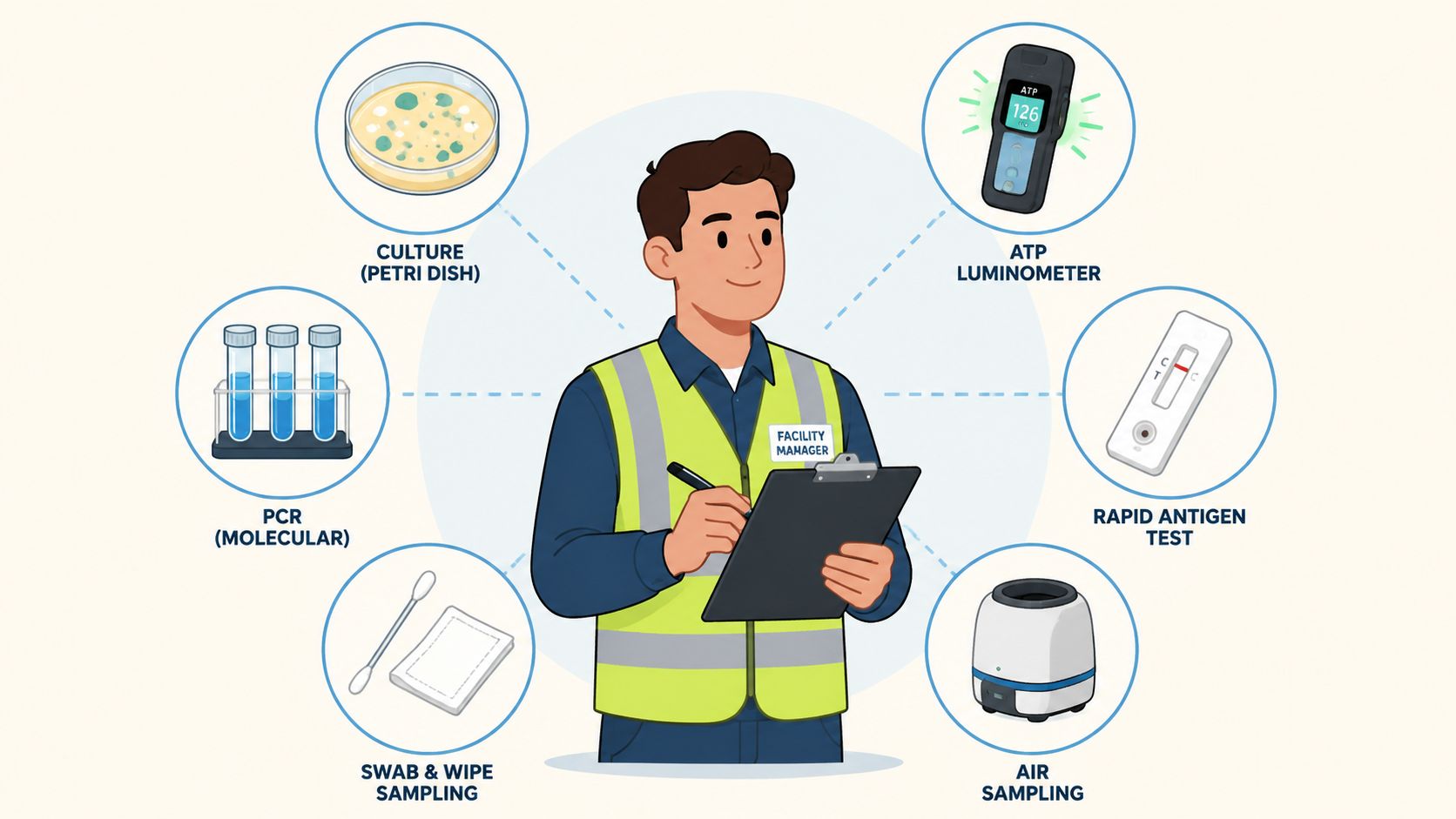
You can wipe down a treadmill, spray a bench, and restock the disinfectant wipes basket, then still feel unsure whether the room is clean. That's the daily tension for a gym director, an office manager, or a restaurant operator who wants visible order and defensible sanitation. Microbial testing methods close that gap by showing what cleaning removed, what remains, and whether the routine is working the way staff think it is.
For facility teams, that matters for trust as much as safety. A clean-looking surface can still leave questions about hidden contamination, especially on high-touch areas like handles, rails, check-in counters, and equipment grips. Testing also helps sales teams explain the ROI of adding commercial disinfecting wipes to a routine, because wipes become part of a documented workflow rather than a one-off product purchase.
The practical advantage is speed. Rapid microbial methods can return actionable results in 1–2 hours versus 18–24 hours for culture-based tests, which helps busy facilities act quickly while still keeping a reliable verification path in place (PMC review on rapid methods). That faster feedback loop can make the difference between a same-day correction and a problem that sits until the next shift.
Introduction to Microbial Testing Methods
A manager who has just finished a wipe-down often wants a simple answer, clean or not clean. Microbial testing methods give a more useful answer, because they separate visible cleanliness from verified sanitation. That distinction matters in gyms, offices, schools, and retail spaces where guests judge the facility by what they can see, but risk depends on what they can't.
The oldest approach is still the backbone of many labs. Culture-based testing grew from the historical use of solid media to grow and count organisms, a framework shaped by Robert Koch's work in 1881, Percy Frankland's water testing in 1885, and later standard-setting efforts that made microbial testing a formal discipline rather than an ad hoc lab trick (historical review). That history explains why culture still matters today, especially when a facility needs confirmatory evidence that viable organisms were present.
Modern operations usually need something faster too. Rapid assays such as PCR and ATP bioluminescence compress decision time, while culture remains important for confirmation and equivalence. The tradeoff is clear, rapid methods can support quick action, while culture gives the deeper proof many compliance programs still rely on.
Practical rule: use wipes for daily cleaning, then use microbial testing to verify whether that cleaning routine is doing real work on the surfaces that matter most.
For facility leaders, that verification has business value. When a guest sees clean equipment and staff can document results, trust rises. When a sales rep can explain that gym equipment wipes and testing sit in the same hygiene system, the conversation shifts from “we buy supplies” to “we manage risk and reputation.”
Comparing Major Microbial Testing Methods

The easiest way to compare testing options is to ask four questions. Does it detect live organisms, how fast does it report, where does it work best, and what does it miss? That lens helps a gym owner deciding between wipes for gym equipment and a lab workflow, or a facility manager choosing between an on-site check and a confirmatory sample.
Culture and contact-based methods
Culture-based tests grow organisms on media, then count the colonies that appear. They're slower, but they answer the most important viability question, because growth means the organism was alive at sampling. That makes culture useful for confirmation, environmental monitoring, and situations where a facility needs a defensible result after a sanitation issue.
Contact plates, swabs, and swab-to-culture workflows fit naturally with surface hygiene programs. They're a good match for disinfectant wipes because the wipe can be the cleaning step, while the culture step checks whether cleaning reduced recoverable organisms. Surface sampling commonly uses swabs, sponges, or wipes before cultivation, which turns the wipe into a dual-purpose tool for cleaning and verification (surface sampling review).
Rapid and molecular methods
ATP bioluminescence checks for adenosine triphosphate, so it gives a fast proxy for organic residue and biological material rather than a full microbial count. PCR and qPCR look for DNA targets, LAMP amplifies nucleic acid at a constant temperature, and rapid antigen assays detect specific microbial proteins. These methods are valuable on-site because they shorten waiting time and support faster decisions.
The catch is interpretation. Molecular tools can be very sensitive, but they may detect DNA from dead cells, so a positive result doesn't always mean a live contamination problem. That's why the public guidance around rapid testing now emphasizes measurable detection thresholds instead of only pass or fail language (FDA-linked review).
Air sampling
Air sampling is different from surface testing because it looks at what's floating in the room rather than what's sitting on the bench. It's relevant for HVAC zones, event spaces, and areas where circulation matters. For many facilities, it's a supporting method, not the main one, but it can reveal whether cleaning and ventilation are working together.
For buyers comparing fitness wipes, antibacterial wipes, and testing services, the practical rule is simple. Culture confirms viability. ATP checks cleanliness fast. PCR and related molecular tools find targets quickly. Air sampling adds another layer when airborne exposure is part of the concern.
Sampling Protocols for Reliable Verification
A sample only works when the team knows exactly what was taken, where it came from, and how it was handled. That starts before the swab touches anything. Define the area, use the same collection order every time, and keep the cleanup step separate from the verification step. A gym wipe dispenser by the floor can support daily cleaning, while a separate sampling kit in the back room supports documentation and follow-up.

Match the tool to the surface
Surface shape should guide the method. Flat areas work well with contact plates because the plate collects organisms from a defined spot and gives a direct colony count. That fits counter tops, locker benches, and table surfaces. Crevices need swabs or sponges because plates cannot reach seams, hinges, or textured corners.
Wipes suit equipment with wider touch areas, including treadmills, dumbbells, yoga mats, and bike consoles. Teams choosing fitness center wipes or bulk gym wipes should look at more than cleaning strength. The wipe format also has to fit the sampling plan, so the same product can support both day-to-day sanitation and later verification. For a practical example of how surface handling choices shape sampling discipline, the guide to contaminant-free lab work shows how careful technique reduces noise in the result.
Build a repeatable sequence
A workable sequence is prep, clean, sample, document, and correct. That order mirrors the larger microbial workflow, from preparation through cleanup, and it keeps testing tied to routine operations instead of treating it like a one-off event. Facilities that already use a structured contamination-control process can compare those habits with the standards discussed in third-party testing guidance to see how outside verification fits into the same system.
For disinfectant wipes, consistency matters. A product line from wipes.com can help teams standardize supplies across rooms or shifts, which makes training simpler and helps supervisors notice when a step gets skipped.
Start with a small sampling map. A few high-value sites checked the same way usually teach more than a long list of random swabs.
Frequency should follow use. In gyms, that means hand grips, seat adjustments, touchscreens, and free weights. In offices and retail, it means door handles, counters, shared devices, and break-room touchpoints. In schools and restaurants, the rule stays the same, surfaces that many hands reach for deserve the most attention.
Interpreting Results and Meeting Regulatory Standards
A result only matters if the team knows what it means in daily practice. Colony counts show how many organisms grew under the chosen conditions, ATP produces a light signal tied to biological residue, PCR gives a gene-based signal, and antigen tests show whether the target line appeared. Each readout answers a different question, so managers should not treat them as if they were interchangeable.
The key validation idea is LOD50, the level at which 50% of tests are positive for a qualitative method, and the need for multiple inoculation levels when quantifying a method (FDA method validation guidance-Full-Document-(PDF–3.6MB).pdf)). That matters because a wipe-based test can look convenient and still be wrong for a given surface, organism, or residue load. A validation plan has to match the actual matrix, not just the brochure.
USDA and ISO guidance are direct on that point. Microbial methods must be validated for the specific sample matrix and target pathogens so the workflow is reliable across different surfaces and conditions (USDA FSIS guidance). EPA guidance says the same thing in practice for environmental microbiology, validation has to demonstrate performance under defined conditions, not just in theory (EPA microbiology method guidance). For a cleaning program built around disinfectant wipes, that means the chosen method has to fit the surface the crew wipes each day, the same way a mop head or cloth would be matched to the room.
For managers, documentation is a critical compliance tool. Keep the date, location, surface type, method used, result, and corrective action in one log. If a wipe-based check fails, record the re-clean and the retest. That paper trail is what turns a sanitation routine into an audit-ready program. When staff ask why the EPA registration number on a wipe matters, the answer should be simple, it shows the product identity used in the procedure, and the reference at EPA registration number guidance can help explain that link in plain terms.
To help staff think in concrete dilution steps, a reference like practical serial dilution examples can make the logic of sample preparation easier to teach. That kind of training reduces confusion when results come back and the team has to explain them to an inspector or a client. It also helps newer staff see why a small change in sample handling can shift the reported outcome, just as a missed wipe pass can change the reading from a surface check.
A test method is only as strong as the surface it was validated on.
Assessing Turnaround Time Costs and Limitations
Speed matters, but speed alone can fool a buyer. A culture test may take longer, yet it still gives the viability confirmation many teams need for a serious follow-up. Molecular and rapid antigen methods answer sooner, while ATP is the fastest tool for routine hygiene checks, but each one trades something away.

What speed buys, and what it costs
Culture-based testing is slower because the organisms need time to grow. Rapid molecular methods and antigen assays compress the wait to a few hours, and ATP can deliver a result in minutes. That speed helps a gym manager decide whether a spin-room cleaning cycle needs a second pass before the afternoon rush.
The financial side is broader than the test kit. Facilities also pay for labor, sample handling, shipping in some cases, instrumentation, follow-up work when a result is unclear, and extra testing if the first result is borderline. A fast test that creates more false alarms can cost more in staff time than a slower test that is easier to trust.
Fast is useful when a decision is waiting. Slow is useful when the result has to stand up to scrutiny.
One limitation comes from biology itself. PCR-style tools can detect DNA from dead cells, so a positive signal doesn't always mean a live risk. Another comes from sampling bias, because a swab that misses the right corner or a wipe that samples the wrong zone can understate the problem. Molecular antimicrobial susceptibility tests can return resistance results in 1–6 hours, compared with overnight incubation for reference broth or agar dilution methods (rapid AST review), but even that speed doesn't remove the need for careful sampling design.
For routine sanitation verification, the decision rule is straightforward. Use ATP or another rapid screen when the team needs same-shift feedback. Use culture when you need confirmation. Use molecular methods when the question is specific and turnaround is critical. That mix keeps sanitizing wipes and commercial disinfecting wipes tied to a smarter testing plan rather than to guesswork.
Implementing Testing in Airports Gyms and Other Venues
Airports, gyms, rentals, event venues, and dealerships all share the same problem, people touch a lot of surfaces quickly, then leave. The right microbial plan matches the pace of the space. A small office break room and a terminal gate area shouldn't use the same sampling grid, even if both rely on disinfecting wipes for daily sanitation.
Venue-specific priorities
In gyms and fitness centers, start with equipment touchpoints, locker handles, benches, and flooring near weight areas. Gym equipment cleaning wipes work well because they're fast to deploy between users and easy to integrate into a visible sanitation routine. If you need a supplier conversation, commercial disinfecting wipes and bulk gym wipes often make sense for operators who want consistent stock and fewer emergency orders.
In airports, the pressure points are check-in counters, kiosks, restroom touchpoints, and seating arms. Rapid screens fit well here because staff often need quick feedback before the next passenger wave. In short-term rentals, the priority is high-touch guest areas, kitchen handles, bathroom fixtures, remotes, and mattress-adjacent touchpoints. In event venues, bars, railings, portable restrooms, and shared tables deserve a tighter loop. In car dealerships, pay attention to keys, steering wheels, door handles, and waiting-room furniture.
How to use the program in sales conversations
Sales teams can frame wipes as part of a visible hygiene system, not a commodity. A cleaner that leaves behind a verification trail is easier to defend to corporate clients, property managers, and franchise buyers. That's where hygiene ROI comes in, fewer complaints, clearer staff routines, and a more credible guest-facing cleanliness story.
Wipes also support the room's appearance in real time. Staff can clean a shared machine, let it dry if needed, and move on without waiting for a lab result. That's why gym wipes, fitness wipes, and workout wipes are often positioned as everyday operational tools, while testing confirms whether the routine is reducing recoverable contamination.
For facilities that want a broad indoor hygiene lens, a service resource like find top indoor air quality companies can complement surface-testing planning when airflow and room quality matter too. That's especially helpful in venues where ventilation and crowding intersect with surface cleaning.
One practical sales angle works across all these sites. Show the buyer how wipes, sampling, logs, and corrective actions fit together. Once that system is visible, the purchase feels less like an expense and more like a control measure.
Checklist and Vendor Selection Tips
A good rollout starts with a short checklist and a vendor who can support the workflow. If the team can't explain the goal, the sampling point, and the response plan, the program will drift. Keep the process simple enough that staff can repeat it during a busy shift.

A practical implementation checklist
- Goal setting: define whether you're checking cleanliness, verifying disinfection, or tracking a specific organism.
- Method selection: match the test to the surface and the decision you need to make.
- Sampling schedule: set a routine for the busiest touchpoints first.
- Staff training: show exactly how to collect, label, and store each sample.
- Documentation: log results, corrective actions, and repeat checks in one place.
- Wipe supply management: keep EPA registered disinfecting wipes and sampling materials stocked so the process doesn't stall.
Vendor selection should be just as concrete. Ask whether the lab or service has accreditation, how fast it returns results, whether it offers on-site or shipment-based support, how transparent the pricing is, and whether reporting is easy for supervisors to read. If you're negotiating supply, ask for clear terms on gym equipment wipes, fitness center wipes, and bundled shipping so you can standardize the order instead of piecing it together.
When a buyer wants a polished vendor short list, the answer shouldn't be a pile of generic names. It should be a fit check. Which vendor can document methods, explain matrix compatibility, and help your staff respond to a failed swab without confusion?
Choose the vendor that can explain the result, not just deliver it.
The best next move is simple. Tighten your cleaning routine, keep disinfectant wipes in reach, and add microbial testing where you need proof instead of assumption. If your team wants cleaner spaces and more defensible sanitation, start standardizing the wipe routine today, then build a small verification program around it.
Leave a Reply