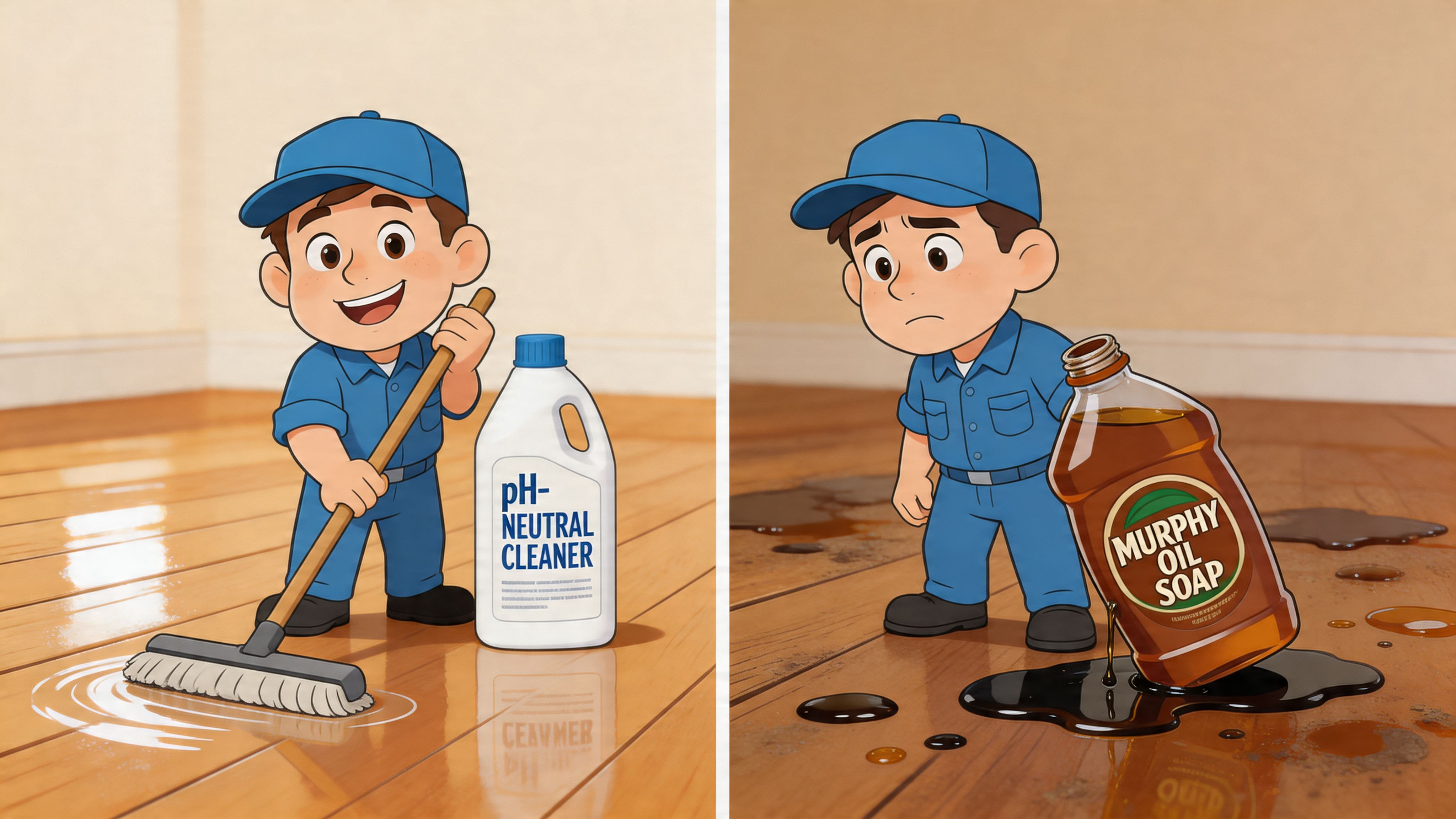
TL;DR: Murphy Oil Soap is generally not a good choice for modern, polyurethane-sealed wood floors in commercial facilities. While its formula dates to 1910, is 99% natural, and is diluted at 1/4 cup per gallon for standard cleaning, professionals warn that oil-based residue on modern finishes can create long-term refinishing, safety, and liability problems. It’s better reserved for specific older or compatible floor types, not assumed safe across all wood floors.
The most common advice on this topic is too simple. A cleaner can have a long reputation, a familiar label, and a “natural” profile, and still be the wrong product for the specific floor in your building.
That’s the mistake many commercial operators make. They’re not choosing a cleaner for a dining room at home. They’re choosing for lobbies, fitness studios, retail walkways, leasing offices, showrooms, and public corridors where appearance, slip resistance, maintenance planning, and warranty protection all matter at the same time.
If you’re asking is murphy oil soap good for wood floors, the primary question isn’t whether it can remove dirt. It can. The main question is whether it protects a commercial flooring asset over time. In many modern facilities, the answer is no.
The Hidden Risks of Trusted Cleaners in Commercial Spaces
Murphy Oil Soap has history on its side. It was originally developed in 1910, uses a potassium vegetable oil base, is described as 99% natural, and is free of phosphate, ammonia, and bleach. It’s also designed for dilution at 1/4 cup per gallon of water, and when used correctly on appropriate surfaces, it’s described as biodegradable and residue-free on finished wood surfaces according to its product background on Murphy Oil Soap.
That sounds reassuring. For many buyers, it’s enough to put the product straight into the supply order.
Why reputation isn’t the same as compatibility
Commercial floor care doesn’t work on reputation. It works on finish compatibility, safety, and lifecycle cost. A century-old cleaner may be acceptable on one wood surface and a problem on another. That distinction gets missed constantly because people talk about “wood floors” as if all of them behave the same way.
They don’t.
A modern office, dealership, school reception area, or event space usually has a sealed finish that was selected for durability, appearance, and easier maintenance. Those finishes come with their own chemistry. If the cleaner leaves behind anything that interferes with that finish, the business doesn’t just get a dull floor. It inherits a maintenance problem.
Practical rule: In commercial settings, the first job of a floor cleaner is asset preservation, not nostalgia.
A facility manager has to think past the first clean. Will the floor become streaky? Will residue collect more soil? Will the next maintenance coat bond? Will a guest notice loss of shine before staff does? Those are operating questions, not consumer questions.
The business lens most consumer advice ignores
Consumer articles usually ask whether a product is “safe.” Commercial operators need a stricter standard. They need to know whether a product increases the chance of:
- Slip exposure: A floor that looks clean but feels slightly slick creates risk.
- Warranty trouble: Manufacturers often care about maintenance methods.
- Refinishing headaches: Residue can turn a routine restoration into a much bigger project.
- Brand damage: Guests don’t separate floor appearance from overall cleanliness.
For a more trade-focused view than most consumer roundups provide, Is Murphy Oil Soap Good for Hardwood Floors? is worth reviewing because it frames the issue from the standpoint of floor restoration and long-term finish performance.
The short version is simple. In a business, the wrong cleaner isn’t a minor housekeeping mistake. It can become an avoidable operations problem.
Understanding What Oil Soap Actually Is
The name causes some confusion. People hear “oil soap” and assume it’s either just soap, or just oil. It’s neither in the everyday sense. It’s a cleaning product built around oils that have been processed into a soap-like system, and that matters because it behaves differently from the pH-neutral, residue-free cleaners commonly used on modern sealed floors.
That difference is the whole issue.
Why oil soap behaves differently
Consider fabric care. A heavy laundry soap and a technical wash can both clean a jacket, but they don’t leave the same result on a performance fabric. One may clean while changing the surface behavior. The other is designed to leave the finish alone.
Wood floors work the same way. An oil soap can lift grime, but on many sealed floors it also leaves behind a light film that changes how the surface looks and feels. A modern floor cleaner is usually designed to remove soil without leaving that kind of after-effect.
That’s why “natural” doesn’t answer the actual question. A product can be plant-derived and still be a poor match for a specific finish system.
What commercial teams should pay attention to
In practical terms, janitorial staff and building managers should evaluate cleaners by surface outcome, not marketing language.
Look for signs like:
- A hazy or muted look after drying: The floor may be clean, but not clear.
- More frequent dust and soil attraction: Film tends to hold onto grime.
- Uneven sheen in traffic lanes: Residue often shows up first where people walk most.
- Complaints that the floor feels tacky or slick: Those two sensations can alternate depending on humidity, traffic, and how much product was used.
A cleaner can remove visible dirt and still create an invisible maintenance problem.
That’s why product selection should be tied to the floor finish, not the species of wood alone. Whether the floor is oak, maple, or hickory matters less in daily cleaning than the coating protecting it.
The detail many teams overlook
Many operators focus on whether a floor is “hardwood.” They should focus on whether it’s polyurethane-sealed, waxed, unfinished, engineered, or coated with a water-based finish. That finish determines how the surface responds.
The gap in most online advice is finish-specific guidance. People get one broad answer to a narrow technical question. That’s how a familiar cleaner ends up being used where it shouldn’t be.
The Critical Factor Finish Compatibility
The answer requires specific consideration. Murphy Oil Soap isn’t “good” or “bad” for all wood floors as a category. It’s a compatibility issue. The biggest risk sits with the finishes most commercial buildings have.

Polyurethane and similar sealed finishes
This is the danger zone for most offices, retail spaces, gyms with wood areas, hospitality venues, and public-facing commercial interiors. According to flooring industry reporting, oil-based soaps are a major cause of refinishing failure, with some experts linking up to 65% of polyurethane recoating failures to oily residues that can also accelerate finish wear by 25%. Professionals also report this problem has affected “millions of square feet” of flooring, as discussed in this flooring trade analysis.
That matters because recoating only works when the new finish can bond to the old surface. If an oily contaminant remains in or on the floor, adhesion can fail. A simple maintenance recoat can turn into stripping, aggressive prep, or sanding.
For a facility, that means downtime, contractor coordination, disruption, and budget impact.
Waxed and oil-finished floors
Older floors and certain specialty installations can have waxed or oil-finished systems. These are different from polyurethane-sealed floors, but that doesn’t make Murphy Oil Soap automatically a smart choice.
The issue here is control. A floor with a traditional finish often needs a maintenance method designed for that exact system. Mixing products casually can leave residue, alter appearance, or complicate later maintenance. In commercial settings, “probably fine” isn’t a standard. Written finish-specific guidance is.
Unfinished wood and wear points
If the floor absorbs moisture or cleaner into bare areas, the risk changes again. The product background itself notes a basic field test: water that absorbs indicates unfinished wood, which is not suitable for this type of use in the same way sealed flooring is discussed in consumer guidance. Bare or worn spots also create pathways for contamination below the surface.
That’s one reason facilities with aging floors need inspection, not guesswork.
A simple compatibility view
| Finish type | Typical commercial verdict | Why |
|---|---|---|
| Polyurethane-sealed | Not recommended | Risk of oily contamination and recoat failure |
| Water-based finished | Not recommended | Residue can interfere with clarity and finish performance |
| Waxed or specialty oil finish | Use only with finish-specific guidance | Maintenance chemistry has to match the system |
| Unfinished or worn-through areas | Avoid | Absorption and damage risk increase |
If your team needs a safer baseline for modern sealed floors, start with pH-neutral cleaners. That’s the category professionals typically rely on when the priority is cleaning without leaving behind a bonding or residue issue.
The disagreement online isn’t really about the wood. It’s about the finish sitting on top of it.
Real-World Risks for Commercial Facilities
A bad floor-care decision usually shows up as a complaint before it shows up as a technical diagnosis.
A gym member says the studio floor feels slick after mopping. A dealership manager notices the showroom wood looks dull under direct lighting. An office tenant says the lobby floor looks clean in the morning but dirty by the afternoon. Staff often respond by cleaning more. That can make the problem worse.

Slip risk is a real operational issue
Oil soap residue can reduce a floor’s surface friction coefficient to below 0.4, compared with the 0.5 to 0.6 range typical for dry polyurethane, which increases slip-and-fall liability concerns under standards such as UL 410. The same residue can also dull gloss and void many manufacturer warranties, as noted in this safety discussion on oil soap and hardwood floors.
For a commercial operator, that’s the biggest practical warning sign. Floor appearance matters, but floor traction matters more.
A polished-looking lobby that becomes subtly slick near an entrance, coffee station, or fitting area creates risk that won’t show up in a basic cleaning checklist. It shows up after someone loses footing.
What this looks like by facility type
- Gyms and fitness studios: Members move laterally, pivot, and sweat onto surfaces. Any residue that changes traction can create complaints fast.
- Retail stores: Staff may not notice reduced slip resistance until customers track in moisture and the floor gets unpredictable.
- Dealerships and offices: The business may first see it as a shine problem, but the bigger issue is often warranty and maintenance interference.
- Restaurants with wood-adjacent public areas: Residue plus food traffic is a bad combination for both appearance and safety.
If a cleaner leaves the floor looking acceptable but behaving differently under foot, it has failed the commercial test.
The hidden cost isn’t the bottle
Most purchasing teams evaluate cleaners by unit price and labor convenience. That’s too narrow. The bigger cost sits downstream:
- Premature restoration work
- More frequent complaint response
- Possible denied warranty support
- Incident documentation and liability review
- Operational disruption during corrective maintenance
This is why seasoned facility managers tend to become conservative about floor chemistry. They’ve seen cheap maintenance choices create expensive building problems.
Beyond Floors A Holistic Approach to Facility Hygiene
A clean floor matters. It affects first impressions, visual order, and customer confidence. But floors aren’t where most day-to-day contact happens.
People touch door pulls, check-in counters, payment devices, weight machines, faucet handles, breakroom tables, elevator buttons, and shared desks. A facility that focuses heavily on floor appearance while neglecting those touchpoints isn’t delivering a strong hygiene program. It’s delivering a partial one.

Where disinfectant wipes fit better than floor products
This is the operational split I recommend. Use the right floor cleaner for the finish, and use disinfectant wipes for high-touch surfaces that need fast, repeatable attention throughout the day.
That works especially well in:
- Gyms: Dumbbell handles, touchscreens, benches, bike seats, and locker hardware
- Offices: Shared desks, conference tables, phones, kitchen handles, and reception counters
- Schools: Desks, chair backs, rails, and front-office surfaces
- Restaurants and cafés: Host stands, menus or menu holders, payment touchpoints, and service counters
- Retail stores: Checkout areas, fitting room doors, carts, and employee handoff stations
For creating a hygienic environment that staff and visitors can trust, we recommend Wipes.com Disinfectant Wipes for high-touch commercial surfaces.
Efficiency and sales opportunities for service providers
Cleaning teams and distributors can also use this distinction to improve how they sell and deliver service. Don’t pitch a single “all-purpose hygiene” story. Separate the scope clearly.
One track is floor preservation. The other is surface disinfection.
That creates better conversations with clients:
- Protect the flooring asset: Explain why modern wood floors need residue-free care.
- Target the actual touchpoints: Show where disinfectant wipes reduce response time between full cleanings.
- Bundle for higher-value service: Pair floor care protocols with wipe-based touchpoint programs by facility type.
High-touch disinfection is easier to standardize than floor restoration after a bad product choice.
That message lands with business owners because it connects hygiene to uptime, customer perception, and fewer avoidable problems. It also helps janitorial teams work faster. Wipes are portable, visible, and easy to deploy for spot response without dragging out buckets and mops.
Safer Protocols and Professional Alternatives for Wood Floors
If your building has wood floors, the professional move is simple. Stop treating them like a generic surface. Match the product and the method to the finish.

A safer standard operating procedure
For proper hardwood floor maintenance, cleaning should be done with a lightly damp mop with excess water fully wrung out, because standing water can warp wood. Guidance for hardwood flooring also notes that Murphy Oil Soap concentrate can cause skin irritation and eye irritation, making dilution and handling discipline important for staff, as outlined in Murphy’s hardwood floor maintenance guidance.
A practical protocol looks like this:
- Remove dry soil first: Use a soft broom, dust mop, or vacuum suitable for hard floors. Grit causes wear long before liquid cleaning starts.
- Choose a pH-neutral, water-based cleaner: For most modern sealed floors, this is the safer default.
- Use microfiber, not saturation: The mop should be damp, not wet.
- Clean in controlled sections: Don’t flood broad areas and chase the liquid afterward.
- Let the floor dry fully: Restrict traffic if needed until the surface is dry and consistent.
Two field checks worth using
You don’t need a lab to make better decisions on site.
One useful check is the water-drop test. If water beads, the floor is likely sealed. If it absorbs, you may be dealing with unfinished wood or worn-through areas that need a different maintenance decision.
Another practical check is a small-area residue test. Clean a limited section, then wipe it with isopropyl alcohol and look for tackiness or film. If you find residue, stop and reassess the product before the whole floor gets treated the same way.
What to specify instead
A lot of teams ask for product names when what they need first is a product standard. Write the spec before you buy the bottle.
Use criteria like:
- Residue-free performance
- Compatibility with sealed hardwood finishes
- Water-based formulation
- Clear dilution and application instructions
- No oily post-clean film
If you want a broader trade perspective on product selection, this roundup of best wood floor cleaners is a useful starting point. For teams building a full maintenance process, this guide to floor cleaning and maintenance can help turn the basics into a repeatable protocol.
Good floor care is boring on purpose. The right cleaner disappears after use and leaves the finish alone.
Protecting Your Assets and Reputation with Smart Cleaning
Murphy Oil Soap has longevity and name recognition. That doesn’t make it the right fit for most modern commercial wood floors. In facilities with polyurethane-sealed or similar finishes, it introduces a level of risk that isn’t worth the trade-off.
Smart cleaning protects more than appearance. It protects traction, finish performance, maintenance planning, warranty standing, and public trust. That’s why experienced operators separate floor care from surface disinfection and use the right tool for each job.
Audit your current program. Check what’s being used on wood floors, who approved it, whether the finish type is documented, and whether your staff has a clear high-touch disinfection routine for the rest of the building.
If you want a cleaner, safer facility standard, prioritize finish-safe floor care and add consistent surface disinfection to the daily routine. For more practical guidance on sanitation programs and commercial cleaning strategy, visit WipesBlog.com.
Leave a Reply