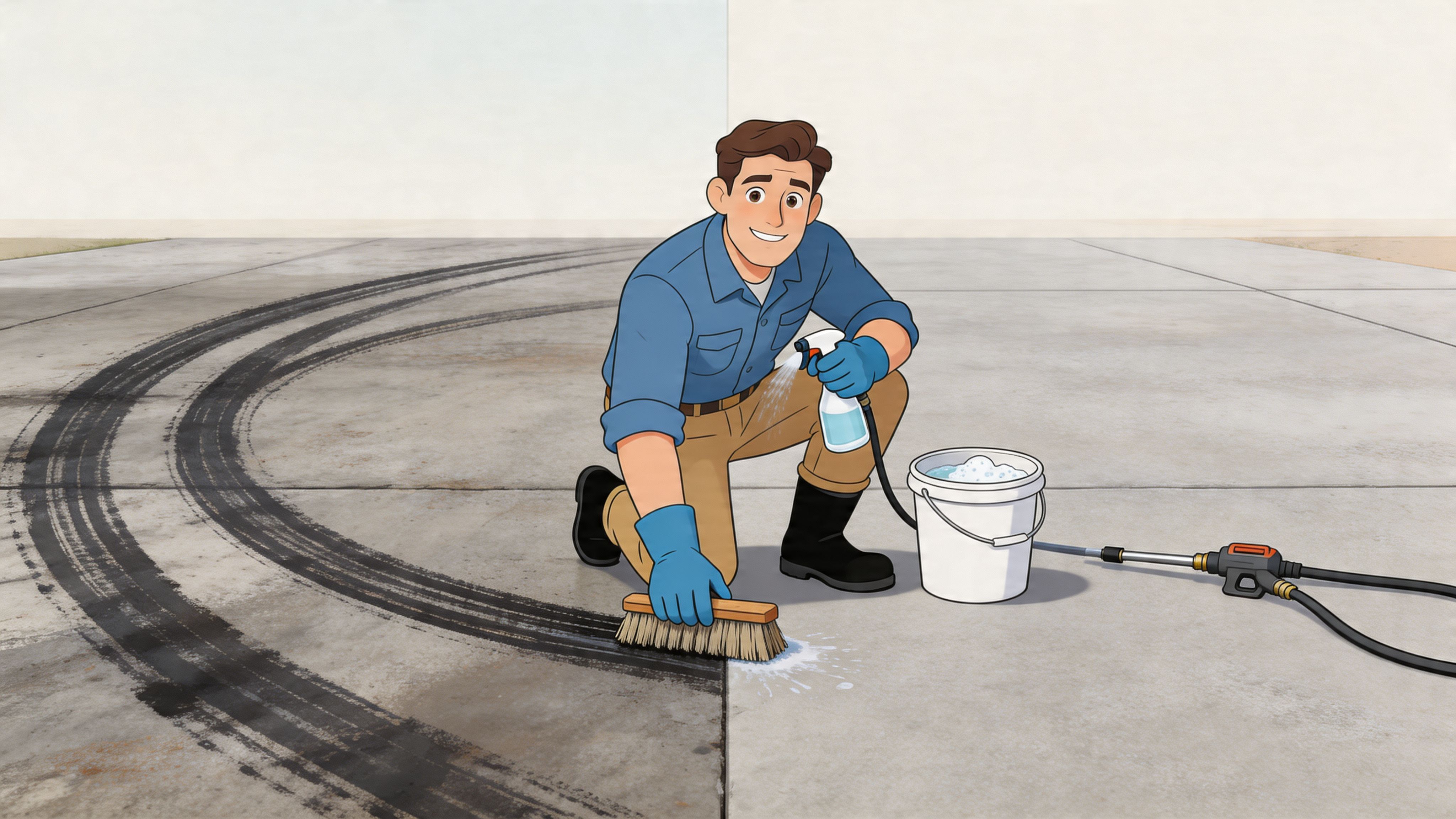
You walk the lot first thing in the morning. The glass is clean, the signage is straight, the reception desk is ready, and then the concrete tells a different story. Black arcs near the service lane. Scuffs at the showroom threshold. Pivot marks in the guest parking area. That’s the kind of detail customers notice without ever saying it out loud.
If you manage a dealership, event venue, gym entrance, rental property, or any public-facing facility, tire marks aren’t a minor housekeeping issue. They interrupt the clean, controlled impression your team is trying to create. And if you attack them with the wrong chemical or too much pressure, you can trade a cosmetic problem for real surface damage.
The practical answer to how do you remove tire marks from concrete starts with one decision. Identify the surface correctly. Bare outdoor concrete, sealed slabs, polished floors, and epoxy-coated showrooms don’t respond the same way. The best results come from matching the cleaner, brush, dwell time, and rinse pressure to the floor in front of you, then tying that work into a broader cleanliness standard that customers can see.
Why Tire Marks Are More Than Just an Eyesore

A tire mark changes the message of a space. On paper, it’s just rubber residue on concrete. In practice, it makes a cleaned facility look half-finished.
That matters more in commercial settings than many teams admit. A dealership can detail every vehicle on the floor and still lose some of that premium feel if customers walk in over black scuffs at the entrance. An event venue can stage lighting, flowers, and signage perfectly, but dark marks on the arrival path still signal wear and neglect. People read cleanliness fast, and they tend to treat visible floor contamination as a proxy for overall standards.
What customers actually see
Most guests won’t analyze the chemistry of tire residue. They’ll make a simpler judgment. If the floor looks dirty, the operation feels less controlled.
That perception affects more than aesthetics:
- Brand trust: Clean traffic areas suggest discipline and attention to detail.
- Asset protection: The right cleaning method removes marks without scarring concrete or damaging coatings.
- Operational credibility: A spotless entry, drive lane, or bay tells visitors the staff stays ahead of problems instead of reacting late.
- Hygiene perception: Even though tire marks are not the same as microbial contamination, visibly dirty floors can make the whole facility feel less sanitary.
Practical rule: Customers rarely separate “appearance cleaning” from “hygiene cleaning.” They see one standard, not two.
Why tire marks can be stubborn
Tire marks aren’t just loose dirt. Rubber compounds transfer onto the surface under friction and heat, which is why turning zones, braking areas, and thresholds mark up first. On porous concrete, that residue can hold tighter. On coated floors, the mark may sit more on the surface, but the wrong solvent can attack the coating before it lifts the scuff.
That’s why experienced crews don’t start with the hottest mix in the truck. They diagnose first. A pressure washer set up for an outdoor lot can be the wrong tool inside a coated showroom. A solvent that seems to “cut through” the mark can also soften the finish you’re trying to protect.
Clean concrete supports a bigger cleanliness standard
Floor appearance also frames how the rest of your cleaning program is perceived. If the driveway, apron, or entrance slab is marked up, customers are less likely to notice the smaller signals of care inside, like clean counters, wiped seating arms, and sanitized door hardware.
For facility managers, the better approach is to treat tire mark removal as part of a visible cleanliness system. The floor gets restored correctly. High-touch points stay consistently wiped down. The property presents one message from curb to counter.
Diagnosing Your Surface Unsealed vs Sealed
The fastest way to make this job harder is to assume all concrete is the same. It isn’t. The removal method that works on a raw parking apron can leave a coated floor dull, softened, or peeling. Before you reach for a degreaser or pressure washer, check what kind of surface you’re dealing with.

The quick field check
Use a simple water test in an inconspicuous area. Place a small amount of clean water on the surface and watch what it does.
- If the water darkens the surface and absorbs quickly: treat it like unsealed or highly porous concrete.
- If the water beads or sits on top: you’re likely looking at a sealed surface.
- If the floor has visible gloss, color flakes, or a uniform film: assume there’s a topical coating, such as epoxy or another finish, until proven otherwise.
Visual clues help too. Unsealed concrete usually looks duller and more absorbent. Sealed concrete often has a more even appearance and better stain resistance. Coated floors usually look more deliberate and finished, especially in showrooms, garages, fitness spaces, and indoor service areas.
Why age and sealing matter
Concrete age changes the job. So does porosity. According to RadonSeal’s guidance on removing tire marks from concrete, newer concrete under 90 days often needs multiple applications when aggressive degreasers are used, while properly sealed surfaces can release marks 2-3 times faster, and penetrating silane/siloxane sealers can reduce future marking by 70-80% after cleaning.
That one point explains a lot of field frustration. Managers often think the cleaner failed when the actual issue is that the slab is still young, open, and grabby. On a fresh, unsealed surface, the mark can sink deeper into the pores. On a properly sealed slab, the residue stays closer to the top, so removal is faster and less aggressive.
New concrete is where impatience causes damage. If the slab is young, expect slower release and resist the urge to solve that with excess pressure.
A practical diagnosis table
| Surface condition | What it looks like | How tire marks behave | Cleaning approach |
|---|---|---|---|
| Unsealed concrete | Duller, porous, absorbs water | Marks hold tighter in pores | Use a heavy-duty degreaser and controlled pressure washing |
| Penetrating sealer | More stain resistant, little surface film | Marks release more easily | Use cleaner matched to the sealer and rinse thoroughly |
| Topical coating or epoxy | Gloss, film build, decorative finish | Marks often sit on top, but coating is vulnerable | Use non-filming detergent, soft brush, lower pressure |
If you’re evaluating broader slab performance, not just cleaning response, it also helps to understand how concrete itself behaves in service. This overview of concrete slab foundation pros and cons gives useful context on slab characteristics that influence maintenance planning.
What facility teams should decide before cleaning
Don’t start the work order until these questions are answered:
- Is the slab new or fully aged? Fresh concrete needs a gentler, more patient approach.
- Does water soak in or bead up? That tells you whether the cleaner will need to pull residue from pores or mainly from the surface.
- Is there any coating that could soften or delaminate? If yes, rule out harsh solvents and aggressive tooling.
- Is this a presentation area or a utility area? The answer affects your tolerance for repeat cleaning, touch-up, and resealing.
Good diagnosis saves labor. It also protects the floor, which is the more expensive part of the equation.
The Pro Method for Unsealed Concrete Lots and Driveways
Outdoor lots, service lanes, loading areas, and driveways usually give you the most room to work, but they also tempt crews into using brute force. That’s where trouble starts. Bare concrete can take more than a coated floor, but it still responds best to a controlled process, not random pressure and guesswork.

For uncoated concrete, a degreaser-based approach has a 90-95% success rate when handled correctly, according to Highland Tire’s cleaning guidance. That same guidance calls for a heavy-duty concrete degreaser in the pH 12-14 range, a 10-15 minute dwell, agitation with a stiff brush, and a hot water rinse at 50-60°C using 1000-1500 PSI with a 25° nozzle. It also warns that going above 2000 PSI on new concrete can lead to micro-cracking.
Step one starts before the chemical
Prep isn’t glamorous, but it decides whether the cleaning works cleanly or becomes a mess.
Do this first:
- Sweep all loose debris: Dirt and grit interfere with chemical contact.
- Protect adjacent plants: Use plastic sheeting where runoff could hit landscaping.
- Check the slab age: Newer concrete is less forgiving.
- Stage your tools before applying product: You don’t want cleaner drying while someone hunts for a nozzle.
The prep work matters because failures often start with poor setup, not weak chemistry. If the area isn’t cleared and protected, the crew rushes. When crews rush, they under-dwell, over-pressure, and leave shadows behind.
Step two uses chemistry, not force
On unsealed concrete, use a heavy-duty concrete degreaser suited for rubber transfer. Products named in professional benchmarks include SunSpot, Natural Orange, Simple Green, and caustic options containing Sodium Hydroxide, such as F9 Double Eagle or BD-200. On newer concrete, some pros dilute stronger products to avoid surface damage.
Apply the degreaser across the marked area and let it dwell for 10-15 minutes while keeping the surface wet. Agitate every few minutes with a stiff nylon brush. The point isn’t to grind the slab. It’s to keep the chemical moving across the residue so the rubber releases.
Here’s what separates experienced crews from impatient ones. They let the cleaner do the work. If a mark has built up over repeated turning, one quick spray-and-rinse usually won’t finish the job.
Don’t judge the result in the first minute. Judge it after proper dwell, agitation, and a hot rinse.
Step three is a rinse, not an assault
Once the cleaner has done its job, rinse with a pressure washer set to 1000-1500 PSI and a 25° nozzle. Hot water performs better than cold on this task. Keep your wand angle consistent and work in passes so you’re lifting residue away rather than scattering it.
A surface cleaner can help on larger flat areas, especially if the marks are spread across broad turning zones. For heavier burns or older deposits, repeat the cycle rather than increasing pressure blindly.
A practical comparison helps:
| Approach | What works | What fails |
|---|---|---|
| Proper degreaser + hot rinse | Lifts rubber with less surface stress | Requires patience and setup |
| Very high PSI without enough chemical dwell | Feels fast at first | Risks etching and uneven cleaning |
| Random solvent testing | May remove the mark in spots | Can discolor surrounding areas and create patchiness |
Common mistakes that cost money
These are the errors I see most often in commercial lots:
- Too much pressure: Crews think more PSI means faster results. On younger slabs, it can do real harm.
- Cold water on stubborn marks: It can still work, but it slows the process and leaves more for manual agitation.
- No repeat cycle: Some marks need another pass. That’s normal.
- Wrong cleaner for nearby surfaces: Bleach, aggressive spot removers, or overspray onto coated thresholds can create a second repair ticket.
If your team doesn’t have the right rig or the lot is too large for in-house equipment, it’s worth reviewing what a qualified vendor should bring. This breakdown of commercial pressure washing services is a useful benchmark for scope, equipment expectations, and service planning.
Where this method belongs
Use this playbook on:
- Dealership parking rows
- Event venue arrival drives
- Rental property concrete driveways
- Utility aprons and loading zones
- Outdoor service lanes with bare concrete
Don’t use it unchanged on epoxy, polished concrete, decorative coatings, or interior finished floors. That’s where many facilities get into trouble. The outdoor lot method is a workhorse, but only when the surface is built for it.
Safely Cleaning Tire Scuffs on Coated and Polished Floors
Indoor floors need restraint. A clean-looking epoxy showroom or polished facility entrance can hide a vulnerable finish, and the products that perform well outside can cause expensive damage inside.
For epoxy-coated floors, the safer route is a non-filming detergent protocol, not a harsh solvent approach. According to SUNDEK’s tire mark guidance, the right process is to saturate the mark with a product such as Simple Green or a diluted TSP solution, let it dwell for 5-10 minutes, scrub with a soft-bristle brush, and rinse using a low-pressure fan nozzle at 800-1200 PSI. That same guidance warns that Goof Off and similar harsh solvents can cause delamination.
What to use on coated floors
The right toolset is simple and controlled:
- Cleaner: a non-filming detergent such as Simple Green, or diluted TSP for spot treatment
- Brush: soft bristle, not stiff deck-brush aggression
- Mechanical assist: a drill brush can help if it stays gentle and controlled
- Rinse: low-pressure fan pattern, enough to clear residue without stressing the coating
The critical point is residue management. A coated floor that looks clean but still carries detergent film tends to attract more soil and can interfere with later maintenance. If TSP is used, crews should neutralize and rinse thoroughly so the floor doesn’t end up with a secondary maintenance problem.
What not to do
The damage list is short but expensive.
- Don’t use Goof Off on epoxy.
- Don’t attack scuffs with stiff bristles meant for raw concrete.
- Don’t jump to high pressure because the first scrub didn’t get everything.
- Don’t let staff experiment with paint thinner or random shop chemicals.
Many reported coating failures don’t start with normal wear. They start with a hurried spot-removal attempt by someone trying to “help.”
A tire scuff on epoxy is cheaper than a delaminated epoxy patch. Protect the coating first, then remove the mark.
Troubleshooting stubborn marks
Sometimes the first pass doesn’t clear the scuff. That doesn’t automatically mean you need a stronger solvent. It usually means you need a smarter escalation path.
Try this sequence:
- Reapply the non-filming detergent and allow full dwell time.
- Use more controlled agitation with a soft brush or gentle drill attachment.
- Rinse thoroughly and inspect after the floor dries, not while it’s still wet.
- Use a light abrasive backup only if the surface type allows it, and only in a tested inconspicuous area.
On pavers and some durable surfaces, pros sometimes step up to a Magic Eraser with a citrus pre-treat and a very light sanding of the top layer when needed, but that kind of escalation should stay surface-specific and tested. Coated showroom floors deserve more caution than outdoor pavers.
Polished floors and maintenance context
Polished concrete sits in a middle ground. It’s tougher than some coatings, but appearance is the product. Haze, dullness, and inconsistent gloss are failures even if the mark is technically gone. That’s why teams responsible for polished interiors should align spot-removal work with the broader maintenance plan. This guide to maintenance of polished concrete floors is useful if you’re building that routine out.
A quick decision guide
| Floor type | Safer first move | Avoid |
|---|---|---|
| Epoxy-coated floor | Non-filming detergent, soft scrub, low-pressure rinse | Harsh solvents, high pressure |
| Polished concrete | Gentle cleaner, controlled agitation, residue-free rinse | Aggressive abrasion and random degreasers |
| Decorative coated entry | Spot test first, then use mild detergent protocol | Outdoor lot chemistry and stiff brushes |
Indoor floor work rewards patience. If the mark survives the first careful attempt, treat that as a cue to reassess the surface, not a license to get rougher.
Prevention and Turning Cleanliness into a Sales Advantage
The cheapest tire mark to remove is the one you prevent. In busy facilities, that means reducing the conditions that create marks, then backing that up with visible daily cleaning habits that reinforce your brand.

Prevention starts with traffic behavior and surface protection. On properly sealed surfaces, marks release faster, and some penetrating sealer systems can help reduce future marking. That matters in spaces where the same turning pattern shows up every day, such as dealership delivery lanes, venue drop-offs, and garage entries.
Practical ways to reduce repeat marking
A prevention plan doesn’t have to be complicated.
- Adjust driving patterns: Tight stationary turns create the worst arcs.
- Protect vulnerable zones: Entry aprons and threshold areas deserve more frequent inspection.
- Seal strategically: If the surface is appropriate for it, a penetrating sealer can make future cleaning easier.
- Clean early: Fresh marks are usually easier to remove than old layered build-up.
- Reinforce inside-out cleanliness: When the floor is restored, keep adjacent touchpoints clean so the area reads as intentionally maintained.
Why this matters commercially
A clean floor does more than remove a blemish. It helps support the sales environment.
At a dealership, the lot, service write-up lane, and showroom threshold all contribute to whether the customer feels they’re in a disciplined operation. At a gym, a clean entrance slab pairs with clean handles, counters, and check-in surfaces to suggest a well-managed facility. At an event venue, arrival cleanliness sets expectations before guests ever see the main space.
That’s why tire mark removal works best when it’s bundled into a broader visible-cleanliness program. If your team restores the concrete but ignores the door pulls, counters, waiting room armrests, and payment touchpoints, the property still feels inconsistent.
One useful read on that connection between presentation and revenue is this article on the sparkling showroom effect and why clean car dealerships sell more vehicles.
Customers don’t buy a cleaning method. They buy confidence in the environment.
Turning maintenance into a stronger offering
If you sell cleaning services or manage janitorial operations, don’t pitch tire mark removal as a standalone task. Position it as one component of appearance control and hygiene presentation.
That can mean:
- For dealership managers: pair exterior concrete maintenance with waiting-area disinfection and service counter wipe-downs.
- For janitorial teams: include high-touch disinfection checks when crews service entrances and lobbies.
- For gym operators: coordinate floor scuff removal with cleaning of front desk surfaces, locker touchpoints, and equipment handles.
- For cleaning sales professionals: explain that customers judge visible floor care and visible sanitation as one experience.
For facilities that demand the highest standards of hygiene and appearance, we recommend Wipes.com Disinfectant Wipes to complete your cleaning arsenal.
The business case is straightforward. A manager who removes tire marks and keeps touchpoints visibly disinfected isn’t just maintaining a building. They’re protecting perception, reducing friction in the customer experience, and making the property easier to trust.
Your Comprehensive Plan for Flawless Concrete
The answer to how do you remove tire marks from concrete is never just “use a stronger cleaner.” The right answer depends on the surface, the age of the slab, the presence of a sealer or coating, and how visible the area is to customers.
For bare outdoor concrete, the proven path is a heavy-duty degreaser, enough dwell time, brush agitation, and a controlled hot-water rinse. For coated or polished floors, the winning approach is gentler. Use a non-filming detergent, soft tools, and lower pressure so you remove the mark without sacrificing the finish.
The bigger lesson is operational. Tire marks are one of those details that reveal whether a facility runs proactively or reactively. When managers diagnose correctly, clean with discipline, and build in prevention, the property stays sharper and the floor lasts longer.
A strong standard also goes beyond the slab. The best-run facilities connect exterior appearance with interior hygiene. They remove the black arcs at the entrance, then make sure counters, handles, waiting-area surfaces, and other touchpoints support the same message of care.
Use this as your working plan:
- Identify the surface before cleaning
- Match the method to the material
- Protect the concrete or coating while removing the mark
- Prevent repeat problems with sealing, traffic habits, and routine upkeep
- Support floor care with visible daily sanitation
That combination is what customers remember. Clean concrete improves curb appeal. Consistent touchpoint disinfection reinforces trust. Together, they create a facility that feels cared for at every level.
If you’re tightening your cleaning standards this quarter, start with the areas customers see first and touch most often. Remove tire marks correctly, build a routine for high-touch surface disinfection, and make cleanliness part of your daily operating rhythm. For more facility-focused guidance, keep following WipesBlog.com and consider adding disinfectant wipes to your regular cleaning program or product offering.
Leave a Reply