• A Guide to Cleaning Public Bathrooms: Tips for Facilities & Sales Teams

    Cleaning a public bathroom effectively goes beyond just tidiness; it’s a critical strategy centered on disinfection, especially for high-touch surfaces. This requires a solid protocol and professional-grade supplies, like EPA-approved disinfectant wipes, to mitigate health risks and build customer confidence. The goal isn’t just a visually clean space, but a verifiably hygienic one. That difference directly impacts your business's reputation, customer loyalty, and ultimately, its success.

    Why a Clean Restroom Is Your Best Marketing Tool

    A modern, clean public restroom with bright lighting and polished fixtures, showcasing a high standard of hygiene.

    A public restroom is a direct reflection of your business. It’s often the first or last impression you leave on a customer, client, or employee. A dirty, neglected bathroom silently communicates a lack of care and attention to detail—a message people will mentally attach to your entire brand.

    Conversely, a spotless restroom does more than meet basic expectations; it actively builds trust. When a visitor enters a clean, well-stocked, and fresh-smelling facility, it creates a sense of safety and respect. That positive feeling reinforces their decision to do business with you, whether they're at your restaurant, gym, or retail store.

    The Undeniable Hygiene ROI

    Viewing restroom maintenance as just an operational cost is a mistake. Instead, facility managers and business owners should see it as the "Hygiene ROI"—a direct investment in public health, customer loyalty, and business growth. A proactive approach to cleaning public bathrooms with the right tools, like disinfectant wipes, pays off in several key ways:

    • Enhanced Brand Perception: A consistently clean facility becomes a real competitive advantage. Customers notice and remember businesses that prioritize their well-being.
    • Increased Customer Loyalty: People are far more likely to return to places where they feel comfortable and safe. A pristine restroom is a subtle but powerful driver of repeat business.
    • Reduced Negative Reviews: Unclean restrooms are a common reason for dreaded one-star online reviews that can tarnish a brand's reputation. Proactive cleaning stops that problem before it starts.

    Bridging the Expectation Gap

    Public standards for cleanliness have never been higher, but many businesses are failing to keep pace. A global survey revealed a massive disconnect: while 74% of people expect high levels of hygiene in public restrooms, only 20% of facilities actually meet that standard.

    That gap is a big deal because 52% of individuals will take action after a negative restroom experience, which can directly torpedo a business's revenue and reputation.

    This data highlights a clear opportunity. Facilities that not only meet but exceed sanitation standards will stand out. For sales professionals, this gap is a powerful talking point when promoting disinfectant wipes or cleaning services. It's about showing clients how a small investment in hygiene can prevent significant losses. Beyond just wiping things down, think about other factors like maintaining a hygienic environment with technologies that contribute to a positive overall impression.

    The message is simple: a clean restroom isn't just a janitorial task; it’s a critical business strategy. By prioritizing hygiene, you protect your customers, strengthen your brand, and ultimately, support your bottom line.

    To see what sets the best facilities apart, you can learn more about what goes into creating the cleanest public bathrooms in our detailed guide. A great first step is integrating high-quality disinfectant wipes into your daily routine or sales offerings. This simple move transforms a basic necessity into a memorable, positive experience for every single visitor.

    Building Your Professional Cleaning Toolkit

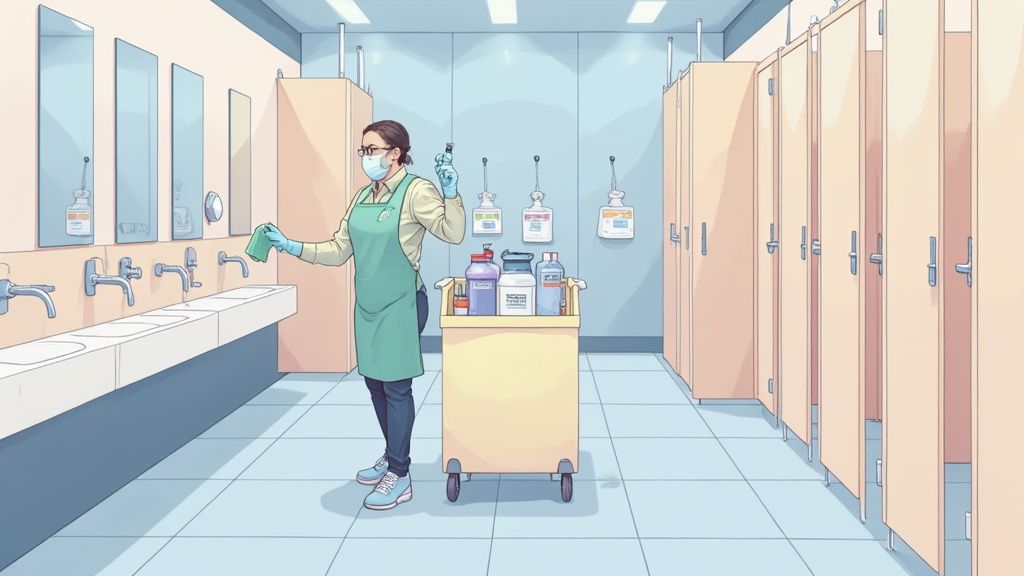
    A well-stocked professional cleaning cart with various supplies, including disinfectant wipes and microfiber cloths.

    You can't achieve a professional clean with a household mop and a spray bottle. Effective cleaning public bathrooms starts with preparation, and that means a well-stocked, professional-grade cleaning cart is non-negotiable. This isn’t just about working faster; it’s about hitting a verifiable standard of clean that keeps people safe and protects your reputation.

    Think of your toolkit as the foundation of your entire cleaning protocol. Without the right gear, even your best-trained staff will be fighting a losing battle against germs, grime, and cross-contamination.

    Core Supplies for Every Cart

    Every modern cleaning cart is built around a reliable disinfectant. EPA-approved disinfectant wipes are a must-have for wiping down high-touch surfaces quickly and effectively. They offer portion control, reduce chemical waste, and are easy for any staff member to use correctly.

    But wipes are just the beginning. Your cart needs a few specialized chemical workhorses:

    • Glass Cleaner: Nothing says "clean" like a streak-free mirror.
    • Neutral pH Floor Cleaner: This is key for cleaning floors thoroughly without damaging the grout or tile finish over time.
    • Enzymatic Bowl Cleaner: This is essential. It breaks down the organic matter and uric acid crystals that cause stubborn, lingering restroom odors.

    Using the right chemical for the right surface is what separates a quick wipe-down from a professional-level clean.

    The Power of Color-Coded Cleaning

    One of the biggest hazards in restroom cleaning is cross-contamination—transferring germs from a toilet to a sink faucet. It’s a huge risk, but there's a simple, effective fix: a color-coded microfiber system. This visual system assigns colors to specific cleaning zones:

    • Red cloths and tools are strictly for high-risk zones like toilets and urinals.
    • Yellow cloths are used on lower-risk surfaces like sinks, countertops, and mirrors.
    • Blue cloths are usually reserved for general dusting and glass cleaning.
    • Green cloths can be set aside for food service areas, ensuring restroom germs stay far away from where people eat.

    Putting a system like this in place creates a powerful, intuitive barrier against spreading bacteria. Staff instantly know which tool to grab for which job, dramatically cutting down on human error.

    Essential Gear and Protective Equipment

    A professional toolkit goes beyond chemicals and cloths. You also need the right gear for deep cleaning and, just as importantly, for keeping your staff safe. Personal Protective Equipment (PPE) is not optional. This means high-quality, reusable rubber gloves to shield hands from chemicals and germs, plus safety goggles to protect against splashes.

    Equipping your team is not just about providing supplies; it's about creating a system. From color-coded cloths to disinfectant wipes, every item should have a clear purpose that contributes to a safer, more efficient, and ultimately more hygienic cleaning process.

    The right specialized tools can make all the difference. A stiff-bristled grout brush, for example, is the only way to really scrub away the grime that mops miss. A high-duster with an extendable pole lets staff safely clean vents and light fixtures, removing dust and allergens. Having tools like these on the cart elevates a standard clean to a deep, professional service.

    Sanitizing High-Touch Hotspots Effectively

    The real battle against germs in a public bathroom isn't won by scrubbing the toilet bowl; it's won on the dozens of small surfaces people touch without a second thought. These are the high-touch hotspots, the primary transfer points for bacteria and viruses. Mastering how to sanitize them is what separates amateurs from pros.

    Think about the journey through a restroom: entry door handle, stall lock, toilet paper dispenser, flusher, faucet, and paper towel dispenser. Every contact point is a chance for germs to spread. This is why a targeted strategy using high-quality disinfectant wipes is so critical for public health.

    Mastering Dwell Time for True Disinfection

    The biggest mistake teams make is treating disinfectant wipes like they’re just for cleaning. A quick swipe to remove a smudge does little to kill pathogens. The secret to actual disinfection is a concept called dwell time.

    Dwell time is the amount of time a surface must remain visibly wet with a disinfectant to kill the germs listed on the label. This can range from 30 seconds to 10 minutes, depending on the product.

    If you wipe down a countertop and it’s dry in five seconds, you haven’t disinfected it. You’ve just moved germs around. Achieving the correct dwell time is the only way to make a surface hygienically safe, not just visually clean.

    To get it right every time:

    • Use enough wipes. One wipe won’t cut it for a large surface. Use enough to leave the area glistening wet.
    • Read the label. Every disinfectant is different. Know the specific dwell time your product requires.
    • Let it air dry. Wiping it dry early neutralizes the disinfectant’s power.

    This isn’t just a suggestion; it’s non-negotiable for critical spots like the baby changing station in a department store or the faucet handles in a busy restaurant bathroom.

    Identifying the Most Common Hotspots

    Toilets and sinks are obvious, but a professional cleaning plan digs deeper. Your checklist needs to prioritize the less obvious surfaces that get touched constantly, especially in high-traffic facilities like a school or gym.

    A smart workflow prevents cross-contamination. Always clean from the cleanest areas (mirrors, countertops) to the dirtiest (toilets, flushers). This prevents dragging germs from a high-risk zone back over to a "clean" one.

    High-Touch Hotspot Cleaning Frequency

    The right cleaning schedule depends entirely on foot traffic. A small office restroom has different needs than one at a bustling airport. Use this table as a starting point to build a custom plan.

    Surface / Hotspot Low-Traffic Facility (e.g., small office) Medium-Traffic Facility (e.g., restaurant, retail) High-Traffic Facility (e.g., gym, school)
    Door Handles (entry & stall) At least 2-3 times daily Every 1-2 hours during peak times Hourly or more frequently
    Faucet & Soap Dispensers At least 2-3 times daily Every 1-2 hours Hourly
    Toilet Flushers & Stall Locks At least 2-3 times daily Every 1-2 hours Hourly
    Countertops Once daily Every 2-4 hours Every 1-2 hours
    Baby Changing Stations After each known use / 2-3 times daily Every 1-2 hours Hourly
    Paper Towel/Hand Dryer Controls Once daily Every 2-4 hours Every 1-2 hours

    Remember, these are minimums. The real goal is to clean surfaces before they ever look dirty. If you can see grime, you're already behind.

    Sales Tips and Facility-Specific Advice

    When talking to clients, educating them about these hotspots is a game-changer. You’re not just selling disinfectant wipes; you’re selling a risk reduction strategy. Frame the conversation around their "Hygiene ROI."

    • For a Gym Owner: Highlight how sweat and bacteria travel from workout equipment to locker handles and restroom stalls. Frequent, visible wipe-downs are an investment in member health and retention.
    • For a Restaurant Manager: Connect restroom cleanliness to perceptions of kitchen hygiene. A spotless restroom, including door handles and baby changing stations, sends a powerful message: "We care about hygiene everywhere."

    Shift the conversation from, "How much do the wipes cost?" to, "How much does a bad review or a sick employee cost?" A high-frequency cleaning routine focused on these hotspots becomes a powerful tool that protects health and builds a stronger business reputation.

    A Top-to-Bottom Restroom Cleaning Protocol

    Consistency is the key to professional-level public bathroom cleaning. A random approach leads to missed spots and uneven results. A systematic, top-to-bottom workflow ensures every surface is addressed in a logical order, preventing cross-contamination and saving time. This repeatable process is the bedrock of a hygienic space.

    Before you start, post "Wet Floor" signs at every entrance. This is non-negotiable for safety. Once the area is secure, empty all trash cans and sweep up loose debris from the floor to prevent dust from resettling on clean surfaces.

    From High Vents to Gleaming Mirrors

    The real cleaning starts at the highest point. Dust high vents, light fixtures, and the tops of partitions first. This ensures any falling debris lands on surfaces that haven't been cleaned yet. Working from the top down is a core principle that saves you from redoing work.

    Next, tackle mirrors and glass with a quality, streak-free glass cleaner and a fresh microfiber cloth. After the mirrors, move on to the countertops and sinks.

    • Sinks and Faucets: Spray disinfectant generously, focusing on faucet handles, soap dispensers, and the drain area.
    • Countertops: Use disinfectant wipes or a spray-and-wipe method. Remember to let the disinfectant sit for the proper dwell time to kill germs.
    • Restocking: Before moving on, refill all soap dispensers, paper towel holders, and other amenities.

    This sequence creates a clear workflow for the top half of the restroom, preparing you for the highest-risk areas next.

    Sanitizing Toilets and Partitions

    The toilet area demands meticulous attention. This zone is a breeding ground for bacteria and requires a dedicated set of tools—ideally color-coded red—to stop cross-contamination. Start by applying an enzymatic bowl cleaner and letting it sit while you clean the exterior.

    Use disinfectant wipes or a designated cloth to sanitize every part of the toilet's exterior: the flusher, tank, seat (both sides), lid, and base. Once the outside is clean, scrub the inside of the bowl and flush. For a deeper dive into stall-specific challenges, check out our guide on maintaining public restroom stalls. Don't forget to wipe down the partitions, stall doors, and locks—these are some of the most frequently touched surfaces.

    A simple three-step process for using disinfectant wipes is a great visual reminder for staff training.

    This visual drives home that true disinfection is a process. That "Wait" step is the most critical and the one most often skipped.

    The Floors and Final Inspection

    The last major task is the floor. Since you already swept it, the floor is ready for mopping. Start at the farthest corner and work your way toward the door, ensuring you get behind toilets and under sinks. This method prevents you from walking over freshly mopped areas.

    Every solid cleaning protocol needs a precise final step in cleaning and sanitizing to eliminate pathogens. In practice, this means doing a final walkthrough after the floor is dry.

    A final inspection isn't optional—it's your quality control. Look for any missed spots, double-check that all dispensers are full, and ensure the room smells fresh and clean. This last check separates an adequate job from an exceptional one.

    By following this systematic protocol, you build a repeatable system that guarantees a high standard of hygiene every time. It turns a routine chore into a professional process that protects public health and boosts your facility’s reputation.

    Selling the Value of Superior Hygiene

    Convincing a business owner to invest more in cleaning can be challenging. Too often, hygiene is seen as a cost to be minimized, not a strategic investment. To connect, you must shift the conversation from price to value and demonstrate how a cleaner facility directly impacts their bottom line.

    This means you’re not just selling disinfectant wipes or janitorial hours. You’re selling risk mitigation, a stronger brand reputation, and a tangible return on investment.

    It All Comes Down to ROI

    First, connect cleanliness to cash flow. A visibly clean public bathroom is one of your client's most powerful marketing tools. It sends a clear message that the business cares about their health, which builds trust and encourages repeat business.

    When talking to a potential client, use talking points that hit their specific industry needs.

    • For a Restaurant Owner: "Did you know a dirty restroom makes 60% of customers question the safety of your kitchen? We ensure your front-of-house hygiene reinforces your high standards, protecting your reputation with every guest."
    • For a Gym Manager: "In a gym, stopping the spread of germs is everything. Using EPA-approved disinfectant wipes on high-touch surfaces actively protects your members and shows you take their health seriously."
    • For a Retail Store: "A great restroom experience keeps people in your store longer. A quick, visible wipe-down of handles and counters shows you're on top of things, making shoppers feel comfortable enough to stick around."

    This reframes the cost of better supplies from an expense into an investment in customer loyalty.

    It’s Not Just Clean, It’s Risk Mitigation

    Top-tier hygiene is also a core part of managing risk. For places like schools and offices, preventing the spread of illness is a major operational concern. Position disinfectant wipes as a key part of a proactive health strategy. Explain how a consistent cleaning schedule reduces employee sick days, minimizes the risk of a reputation-damaging outbreak, and creates a healthier environment.

    Bundling disinfectant wipes into a larger service contract or supply package moves the focus away from a single product's cost. Instead, you're offering a comprehensive hygiene solution. You're no longer just a vendor; you're a partner in their success.

    The market backs this up. The global bathroom cleaning service market was valued at $39.25 billion and is growing, driven by a spike in hygiene awareness. Businesses are ready to invest in professional solutions. You can find more market trends and analysis on professional cleaning solutions.

    Different Facilities, Different Pitches

    The "why" behind superior hygiene isn't one-size-fits-all. A school principal cares about different things than a hotel manager. Tailor your pitch accordingly.

    Facility Type Primary Concern Key Talking Point
    Schools Student & Staff Health "Consistent disinfection of hotspots like door handles and desks reduces absenteeism, keeping more students in the classroom and staff on the job."
    Offices Employee Productivity "A healthier workplace means fewer sick days. Our program helps you maintain a productive environment and shows your team you value their well-being."
    Hotels Guest Experience & Reviews "Five-star reviews almost always mention cleanliness. We help ensure your restrooms exceed guest expectations, preventing negative feedback and boosting your online reputation."

    Ultimately, selling hygiene is about selling peace of mind. Help clients see disinfectant wipes not as a line item, but as an essential tool for building a safer, more reputable, and more profitable business. Prioritize cleanliness, and the results will speak for themselves.

    Don't let a preventable issue tarnish your reputation. Elevate your standard of clean by integrating high-quality disinfectant wipes into your daily routine or product offerings. A commitment to hygiene is a commitment to your customers, your employees, and your business's future.
  • Bulk Disinfecting Wipes: A Guide to Healthier Commercial Facilities

    A surface can look spotless and still be a hotbed for germs. That's a hard truth for any facility manager. While visible tidiness is essential, the health and safety of your staff, customers, and clients go much deeper—down to the microscopic level. This is where bulk disinfecting wipes become a non-negotiable tool for achieving a higher standard of cleanliness and public trust.

    Beyond Clean: The Real Value Of Disinfecting

    A person using a disinfecting wipe to clean a countertop in a commercial facility.

    In any commercial or public facility, the words cleaning, sanitizing, and disinfecting are often used interchangeably. But they are not the same, and knowing the difference is critical for protecting your space and the people in it.

    • Cleaning is about appearances. It’s the physical act of removing visible dirt, dust, and grime. Think of it as sweeping the floor before you mop—it's the essential first step.
    • Sanitizing is the next level up. This process reduces the number of bacteria on a surface to a safe level, usually killing 99.9% of them. It lowers the risk of infection but doesn’t eliminate all pathogens.
    • Disinfecting is the heavy hitter. This is where you use specific chemical agents to kill or completely inactivate nearly 100% of the viruses, bacteria, and fungi listed on the product’s label.

    For business owners, janitorial staff, and facility managers, disinfecting isn't just another task on the checklist. It's a strategic investment in the health of your organization and the trust of your customers. A visible and consistent hygiene program provides a tangible return that directly impacts your bottom line.

    The Tangible ROI of a Disinfection Strategy

    When you commit to a solid disinfection protocol using bulk disinfecting wipes, you kick off a positive ripple effect. A healthier environment means fewer sick days for your employees, which boosts productivity and keeps operations running smoothly.

    This commitment also builds powerful trust with your customers. When people see you actively disinfecting high-touch surfaces, they feel safer and more confident in your brand. That confidence translates directly into loyalty, positive reviews, and repeat business.

    A proactive disinfection program is your frontline defense against health risks and your most visible tool for building customer trust. It signals a commitment to well-being that resonates long after a customer leaves.

    A Growing Market Reflects a Shift in Priorities

    The real value of cleanliness is in wiping out the threats you can't see. For instance, understanding how to tackle stubborn mildew on clothes shows just how persistent fungi and bacteria can be, long after something looks clean. This growing awareness is shaking up the market.

    The global disinfectant wipes market is on track to jump from USD 5.40 billion in 2025 to USD 8.07 billion by 2032. That's not just a trend; it’s a massive shift in what consumers and businesses prioritize.

    Ultimately, making disinfectant wipes a core part of your daily routine is a foundational step toward protecting everyone who walks through your doors. It's time to embrace this higher standard of clean.

    Cleaning Tips: Using Disinfecting Wipes For Maximum Impact

    Are you getting the most out of every single wipe? Simply pulling a wipe from a canister and swiping it across a desk doesn't guarantee you're protected. The practical science of disinfection is often misunderstood, leading to wasted money, wasted effort, and a false sense of security.

    To make sure your investment in bulk disinfecting wipes is actually paying off, your team needs to use them correctly.

    The single most important concept here is dwell time. This is the non-negotiable amount of time a surface must stay visibly wet with the disinfectant to actually kill the germs. If you wipe a surface and it dries instantly, the active ingredients never had a chance to work. Every product has its own dwell time listed right on the label, usually somewhere between 30 seconds and a few minutes.

    Avoiding Common Disinfection Mistakes

    Even with the best intentions, a few common slip-ups can completely sabotage your cleaning routine. The goal is to train these bad habits out of your team for good.

    • Stretching one wipe too far: It's tempting to try and clean a huge conference table with a single wipe, but it's a huge mistake. Once a wipe is dry or visibly dirty, it stops disinfecting and starts spreading germs around.
    • Wiping surfaces dry immediately: We all have that impulse to grab a paper towel and dry a freshly wiped counter. You have to fight it. Letting the surface air-dry is the only way to meet that critical dwell time.
    • Skipping the first step: Wipes are for disinfecting, not for heavy-duty cleaning. If a counter is covered in dirt or crumbs, the disinfectant can't physically reach the surface to kill the pathogens underneath. A quick pre-clean makes all the difference.

    A disinfectant wipe can only kill the germs it directly touches. Using a dry wipe or wiping a surface down before the dwell time is met is like stopping a race right before the finish line—you’ve put in the effort but didn't get the result.

    Identifying And Prioritizing High-Touch Hotspots

    To work smarter, not harder, you need to focus your efforts where they'll have the biggest impact. Every single facility has high-touch hotspots—the areas that countless hands touch all day long, turning them into superhighways for germs.

    Your janitorial staff should have a checklist targeting these critical zones, with a recommended frequency of at least 2-3 times per day for the busiest areas.

    Facility-Specific Hotspot Examples:

    • Offices: Elevator buttons, shared printer screens, conference room phones, and the handles on the breakroom microwave and fridge.
    • Gyms: Dumbbell grips, cardio machine controls, weight pins, and locker handles.
    • Retail Stores: Shopping cart handles, payment terminals, and self-checkout screens.
    • Restaurants: Menus (especially the laminated ones), condiment bottles, tabletop ordering devices, and bathroom door handles.

    By adopting a simple workflow—like cleaning from top to bottom and hitting these hotspots multiple times a day—you can maximize your impact. This targeted approach ensures your bulk disinfecting wipes are delivering the protection your staff and customers expect. Proper technique and strategic focus are the bedrock of an effective hygiene program.

    How To Choose The Right Bulk Disinfecting Wipes

    Picking the right bulk disinfecting wipes can feel like a chore, but it’s a decision that goes way beyond the price tag. The right wipe is a strategic choice that impacts the health of your team, the trust of your customers, and even the lifespan of your facility's surfaces. This isn’t just about cleaning; it’s about creating a smarter, safer environment.

    First things first, let's talk about what's actually doing the disinfecting. The active ingredient in the wipe's formula is everything. For everyday use on hard, non-porous surfaces in places like offices or retail shops, formulas with quaternary ammonium compounds (quats) are fantastic all-rounders. They get the job done reliably.

    But for environments where the stakes are higher—think gyms, healthcare clinics, or childcare centers—you may need something with a bit more muscle. Wipes featuring hydrogen peroxide or alcohol often boast faster kill times and can tackle a broader range of tougher pathogens. Always, always check the product label for its EPA registration number and the list of germs it's proven to eliminate.

    Matching Packaging to Your Facility’s Flow

    Once you've zeroed in on the right formula, the next piece of the puzzle is the packaging. The right container can make cleaning seamless for your staff and patrons. The wrong one just creates friction and waste.

    • Large Canisters: These are the workhorses for high-traffic zones. Think of them next to equipment in a gym or in the office breakroom. They make wipes easy to grab, encouraging people to clean up after themselves.
    • Refillable Bucket Systems: For janitorial crews, these are the gold standard for both cost and sustainability. Buying huge refill rolls dramatically cuts down on plastic waste and lowers your cost per wipe. It's the perfect setup for large-scale daily cleaning.
    • Convenient Soft Packs: These are ideal for targeted placements where a big canister would be overkill. Tuck them into conference rooms, stash one at the reception desk, or keep them in company vehicles for on-the-go cleaning. Their smaller size makes hygiene visible without adding clutter.

    Choosing the right format isn't just about convenience; it's about getting the most value out of your investment. And it's a growing market—the global demand for cleaning and disinfecting wipes is projected to hit USD 25 billion by 2025, with an expected 7% CAGR through 2033. It’s clear these products are becoming a permanent fixture in our daily lives. You can explore more about this trend on archivemarketresearch.com.

    When it comes to choosing between canisters, buckets, or soft packs, there's no single "best" answer—it all depends on your facility's unique needs. This table breaks down the pros and cons of each to help you decide.

    Comparing Bulk Disinfecting Wipe Packaging Options

    Packaging Type Best For Pros Cons
    Large Canisters High-traffic public areas like gyms, breakrooms, and lobbies. Easy access for patrons and staff; encourages frequent use; sturdy and durable. Higher cost per wipe than refills; more plastic waste per unit.
    Refillable Buckets Janitorial and professional cleaning teams covering large areas. Most cost-effective; reduces plastic waste; customizable wipe counts. Requires staff training for refilling; larger storage footprint.
    Soft Packs Targeted, low-volume areas like conference rooms, vehicles, and reception desks. Portable and lightweight; small footprint; convenient for on-the-go use. Higher cost per wipe; can dry out faster if not sealed properly.

    Ultimately, the best packaging is the one that gets used correctly and consistently. A bucket system might be the most economical, but if it's inconvenient for quick cleanups, it won't be as effective as a strategically placed canister.

    The infographic below breaks down the simple three-step process for using any disinfecting wipe effectively.

    Infographic about bulk disinfecting wipes

    This visual is a great reminder that the "wait" step—what we call dwell time—is just as important as the physical act of wiping. If you don't let the disinfectant sit and do its job, you're just moving germs around.

    For a deeper dive into how to implement smart hygiene solutions, don't miss our guide on buying sanitizing hand wipes in bulk. In the end, a perfect wipe is one that lines up with your facility’s specific surfaces, traffic patterns, and budget, empowering you to create a cleaner, safer space for everyone who walks through your doors.

    Facility-Specific Suggestions: Smart Hygiene Strategies

    A person in a yellow shirt wiping down gym equipment with a disinfecting wipe.

    A one-size-fits-all approach to hygiene is a recipe for failure. The cleaning challenges in a quiet corporate office are worlds away from those in a high-humidity gym locker room. To get the most out of your bulk disinfecting wipes, you need a playbook tailored to the unique risks and traffic patterns of your specific environment.

    Effective hygiene isn’t just about wiping down a countertop here and there. It’s about creating a system that makes cleanliness effortless and visible. A targeted plan ensures your efforts hit where they matter most, protecting health and building confidence with every single swipe.

    The Corporate Office Playbook

    In a corporate setting, the biggest threats come from the spaces designed for collaboration. Brainstorming is great for business, but it also means countless hands touch the same conference phones, remote controls, and whiteboards every single day. Your goal is to interrupt that chain of germ transmission right where it starts.

    Priority High-Touch Zones:

    • Conference Rooms: Think shared phones, remotes, and the edges of the table where people rest their hands.
    • Kitchen & Breakroom: Microwave handles, fridge doors, coffee pots, and water cooler buttons are massive germ hotspots.
    • Shared Equipment: Don’t forget the touchscreens on printers and copiers—everyone uses them.

    For maximum impact, put the wipes where the action is. Place canisters directly in these areas—one at the kitchen entrance, another in the main conference room—to encourage immediate use. Combine this with strategically placed automatic hand sanitizer dispensers, and you’ve created a powerful dual-defense system against workplace bugs.

    The Gym And Fitness Center Playbook

    Gyms are a unique beast. You’ve got sweat, high humidity, and constant equipment sharing, creating a perfect storm for germs. Members are hyper-aware of cleanliness, and your hygiene protocols directly influence their decision to renew their membership or walk away. The key is making "wipe down before and after" an automatic, non-negotiable habit for everyone.

    In a fitness environment, visible hygiene is your best marketing tool. When members see an abundance of wipes and a culture of cleanliness, it builds a powerful sense of community and safety.

    Priority High-Touch Zones:

    • Workout Equipment: Dumbbell grips, cardio machine controls, weight pins, and adjustment knobs need constant attention.
    • Locker Rooms: Focus on locker handles, benches, and faucets. These are often the first and last things people touch.
    • Common Areas: Don't overlook check-in counters and water fountains.

    Honestly, you can never have too many wipe dispensers in a gym. Place large, high-capacity canisters at the entrance to every distinct workout area—the free weights section, the cardio floor, and any studio rooms. Make sure they are checked and refilled multiple times daily, especially during the morning and evening rush.

    The Retail And Restaurant Playbook

    For any business serving the public, visible cleanliness is a direct reflection of your brand's quality. Customers make instant judgments based on what they see, and a well-placed wipe dispenser can build trust before they even open their wallets.

    Priority High-Touch Zones:

    • Entrances: Shopping cart handles, baskets, and door handles are the very first points of contact.
    • Checkout Areas: Payment terminals and self-checkout screens are touched by literally every customer.
    • Dining Areas: Think menus, condiment bottles, and those tabletop ordering devices.

    Place a dispenser right at the entrance as a welcome gesture. It says, "We care about your health." Adding stations near checkout counters and restrooms reinforces that commitment. For restaurants, having staff wipe down tables with fresh disinfecting wipes between patrons provides powerful visual reassurance that you take sanitation seriously.

    When you tailor your approach, bulk disinfecting wipes stop being a simple cleaning supply and become a strategic asset—turning a routine task into a cornerstone of your facility's health and safety program.

    Sales Tips: Selling Hygiene As A Core Business Value

    For sales professionals in the cleaning industry, the conversation around bulk disinfecting wipes has to evolve. If you're still leading with price-per-case, you're leaving money—and trust—on the table. You're not just selling a consumable; you're offering a critical piece of a client's business strategy. When you frame hygiene as an investment in safety, reputation, and employee morale, you stop being a supplier and start becoming a partner.

    The real goal is to educate clients on hygiene ROI. A visible commitment to health isn't just a "nice-to-have"—it lowers risk, cuts down on employee sick days, and gives public perception a major boost. When customers see wipe dispensers and active cleaning, it sends a powerful, unspoken message: "We care about your safety." That's how you build loyalty.

    Shifting The Conversation To ROI

    Instead of opening with product specs, start by helping clients connect the dots between cleanliness and business success. Educate them on how a strong hygiene program can be a solution to their biggest challenges.

    • For Offices: A healthy office is a productive office. Fewer germs mean fewer sick days. Pitch bulk disinfecting wipes as a tool for keeping projects on track and as a clear signal that the company values its team's well-being.
    • For Gyms: Members see cleanliness as a direct measure of quality. Wipes aren't an expense; they are part of the value proposition that justifies those monthly membership fees.
    • For Hospitality: A rock-solid hygiene program directly fuels positive guest reviews and is a cornerstone of effective online reputation management for hotels, which is what keeps the bookings coming in.

    Actionable Sales Tactics

    To promote disinfectant wipes effectively, be more than just an order-taker. Your job is to solve problems and build relationships that last.

    Your most powerful sales tool isn't a spec sheet—it's market data. Use industry trends to show that visible hygiene is no longer optional; it’s a non-negotiable customer expectation.

    Knowing the market gives you a massive advantage. For instance, hard data shows that the 51-75 piece pack size holds a huge 31.29% market share. Why? It hits the sweet spot between cost and convenience for places like small businesses or corporate offices. Bringing that kind of insight to a client shows you've done your homework and can recommend the perfect fit, not just the most expensive one. You can discover more insights about market segmentation on Grandview Research.

    Smart, simple strategies work best. Bundle wipes with other janitorial supplies to offer a complete, one-stop hygiene solution. Or, set up automated recurring orders so your clients never have to worry about running out. This kind of proactive thinking makes their job easier and locks you in as their go-to partner.

    At the end of the day, you're selling an outcome—a safer, more trusted, and more productive environment. Get your clients to see cleanliness as a daily operational priority. When you do that, you're not just moving boxes anymore. You're helping them build a stronger, more resilient business.

    Common Questions About Disinfecting Wipes

    Even with a solid plan in place, questions always pop up when you're rolling out a new hygiene program. Getting the details right with bulk disinfecting wipes is what makes the difference between just going through the motions and actually making your facility safer. Here are some no-nonsense answers to the questions we hear most from facility managers and business owners.

    How Often Should We Disinfect High-Touch Surfaces?

    The honest answer? It all comes down to foot traffic. Think about the busiest spots in your facility—the checkout counters, gym equipment, or the front lobby. Surfaces like payment terminals and door handles in these areas are getting touched constantly and should be wiped down multiple times throughout the day. A good rule of thumb is to hit these hotspots during every shift change or right before and after predictable peak hours.

    For the quieter zones, like a private office or a rarely used conference room, a thorough wipe-down once a day is usually enough to do the trick. The big exception is when sickness is going around. During peak cold and flu season, or if you know an illness is circulating, you’ll want to ramp up the cleaning frequency everywhere.

    Can Disinfecting Wipes Damage Surfaces Or Equipment?

    Yes, they absolutely can, and that’s precisely why choosing the right wipe is so critical. For example, wipes that are heavy on the alcohol can be tough on sensitive surfaces. Over time, they might cause discoloration or even weaken the finish on materials like sealed wood, certain plastics, or natural stone.

    To keep things looking good, always check the product label for what it’s safe to use on. Before you go all-in on a new wipe, do a quick spot test on a small, hidden area just to be sure. And for delicate electronics like touchscreens or keyboards, stick with wipes made specifically for them. You don't want to accidentally damage those sensitive components or anti-glare coatings.

    What Is The Real Difference Between Sanitizing And Disinfecting?

    People throw these words around like they mean the same thing, but in the world of public health, they have very specific, regulated definitions. Knowing the difference helps you grab the right tool for the job.

    • Sanitizing is about lowering the number of bacteria on a surface to a level that’s considered safe. In technical terms, this usually means a 99.9% reduction.
    • Disinfecting takes it a big step further. It’s designed to kill or completely inactivate nearly 100% of the viruses, bacteria, and fungi listed on the product's label.

    When your goal is to stop illnesses like the flu or the common cold from spreading, disinfecting is what you want. Sanitizing reduces the risk, but disinfecting aims to eliminate it entirely.

    How Do We Encourage People To Actually Use The Wipes?

    If you want people to use the wipes, you have to make it incredibly easy and obvious. If they have to search for a dispenser, they’ll just walk right by. Your most powerful tool here is strategic placement.

    Put your wipe dispensers in highly visible, high-traffic spots: right at the entrance, in the break room, next to the elevator, and directly beside any shared equipment. Pair that visibility with simple, clear signs that nudge people to take one. For your own team, build wipe usage directly into their daily checklists and cleaning protocols until it becomes second nature. At the end of the day, a culture of cleanliness starts at the top—when leadership makes it a priority, everyone else follows.

    By prioritizing cleanliness and integrating effective tools like bulk disinfecting wipes into your daily routine or product offerings, you're doing more than just maintaining a building. You’re building a healthier, safer, and more trusted environment for every single person who walks through your doors.

  • Elevate Your Facility’s Hygiene with Disinfectant Wipes and Cleaning Cloths

    A disposable cleaning cloth is essentially a single-use powerhouse for hygiene, especially in busy commercial and public spaces. They're designed to tackle a mess and then be tossed, which is a simple but brilliant way to stop cross-contamination in its tracks. Unlike a reusable rag that can spread germs from one surface to another, a fresh cloth for each task—especially a disinfectant wipe—ensures a truly clean slate every time.

    The True Value of a Spotless Commercial Space

    Most businesses see cleaning on the balance sheet as just another operational cost—a necessary evil. But that view misses the bigger picture entirely. A genuinely clean and hygienic environment is a silent, powerful asset. It’s what builds trust and reinforces your brand's reputation without saying a word.

    Think about it from a customer's perspective. When you walk into a gleaming retail store, a spotless restaurant, or an immaculate gym, you immediately feel more confident in the quality of their products and services. The same goes for employees in a tidy office; their morale gets a boost, and they can focus better. A clean gym doesn't just look good, it feels safer, which is huge for member retention. The link between a clean space and a successful business is crystal clear.

    The Return on Investment of Superior Hygiene

    Putting real resources into a solid cleaning plan, with effective tools like disposable cloths and disinfectant wipes at the core, pays for itself over and over. The payoff isn't just about stopping germs.

    • Enhanced Customer Trust: How clean your space is massively sways customer opinion. In fact, studies show that over 90% of consumers are more likely to view a business positively if its facilities are clean.
    • Increased Employee Productivity: A healthier workplace means fewer sick days. When your team is healthy, you get a more consistent, engaged, and productive workforce, which directly helps your bottom line.
    • Strengthened Brand Reputation: Your facility is a physical representation of your brand's values. A commitment to cleanliness sends a strong message about professionalism and your dedication to the well-being of everyone who walks through your doors.

    From Cost Center to Profit Driver

    The key is to start thinking of hygiene as an investment, not an expense. For businesses that need to maintain that pristine, professional image, it's worth exploring the full scope of professional commercial cleaning services, as they often build their entire process around consistent, high-level sanitation.

    A proactive approach to hygiene doesn't just prevent problems; it creates opportunities. It turns a basic operational task into a strategic tool for customer retention, employee satisfaction, and competitive differentiation.

    This is where tools like disinfectant wipes and disposable cloths become your first line of defense. They give your staff a simple, reliable way to maintain high standards throughout the day—quickly handling spills, sanitizing doorknobs and counters, and reinforcing that promise of a safe, welcoming environment.

    At the end of the day, making cleanliness a priority is about more than just passing a health inspection. It's about building a foundation of trust and quality that supports every other part of your business. When you weave high-quality disinfectant wipes and disposable cloths into your daily routine, you're making a direct investment in the long-term health and success of your organization.

    Choosing the Right Disposable Cleaning Cloths

    Let’s be honest: not all disposable cleaning cloths are the same. Picking the right one for the job is absolutely critical if you want to clean efficiently, keep people safe, and get that truly spotless finish.

    Think of it like a chef picking the right knife. You wouldn't use a bread knife to fillet a delicate piece of fish, right? In the same way, the wrong cloth can make a simple cleaning task a frustrating waste of time—or worse, leave behind a mess you can't even see. This guide will walk you through building a versatile cleaning toolkit that’s perfectly suited to your facility.

    This isn't just about personal preference; it’s a strategic decision that directly impacts your hygiene standards. The global demand for effective cleaning tools tells the story. The cleaning cloths market was valued at around $5 billion in 2025 and is projected to climb to nearly $7.5 billion by 2033. That’s a huge jump, and it shows just how seriously businesses are taking sanitation.

    Infographic about disposable cleaning cloth

    As you can see, investing in a pristine space pays off in real-world business results, like higher profits and stronger customer trust. On the flip side, cutting corners introduces risks no facility manager wants to take.

    Understanding Core Material Differences

    First things first, you need to know what your cloths are made of. The two most common options are non-woven fabrics and microfiber, and they each have their own strengths.

    • Non-Woven Fabrics: These are your workhorses. They're often used for general-purpose cleaning and are the standard for most pre-moistened disinfectant wipes. They’re tough, absorbent, and fantastic for wiping down surfaces or applying sanitizing solutions.
    • Microfiber: Made from incredibly fine synthetic fibers, disposable microfiber cloths are champions at trapping dust, dirt, and even microscopic particles. Their natural electrostatic charge acts like a magnet for debris, making them perfect for dusting electronics or polishing glass without leaving annoying streaks.

    The main difference is their function. Non-woven cloths are great for scrubbing and applying liquids, while microfiber is the undisputed winner for lifting fine particles off a surface. You can dive deeper into this topic in our complete guide to disposable microfiber cloths.

    Dry Cloths Versus Pre-Moistened Wipes

    The next big choice is whether to go with dry cloths or pre-moistened wipes. Each has a specific, vital role in any solid cleaning protocol.

    A dry cloth removes physical debris, but a disinfectant wipe neutralizes the invisible threats. Using them in tandem creates a two-step defense that ensures surfaces are not just visibly clean, but hygienically safe.

    A dry disposable cloth is your first line of defense. It's what you grab to wipe crumbs off a restaurant table or dust an office desk. This step gets rid of the visible soil and preps the surface for a deeper clean.

    Following that up with a pre-moistened disinfectant wipe is how you actually kill germs and pathogens. This part is non-negotiable for high-touch points like doorknobs, light switches, and payment terminals. Trying to disinfect a dirty surface is a waste of effort—the grime acts as a shield, preventing the disinfectant from ever reaching the germs underneath.

    Facility-Specific Recommendations

    The right choice always comes down to the environment. A one-size-fits-all approach just doesn't cut it.

    • Restaurants & Kitchens: You'll need durable, highly absorbent non-woven cloths that can stand up to grease and spills. For front-of-house surfaces, make sure any pre-moistened wipes are rated as food-safe.
    • Gyms & Fitness Centers: Here, the focus should be on pre-moistened disinfectant wipes with a high kill claim against common viruses and bacteria. Make them easily accessible so members can wipe down equipment before and after every use.
    • Offices & Retail: A combination strategy is your best bet. Use dry microfiber cloths for dusting electronics and other sensitive surfaces. For shared spaces like breakroom counters, door handles, and reception desks, always use disinfectant wipes.

    By understanding these key differences, you can confidently choose the disposable cleaning cloths that will deliver the best results, ensuring your facility is a safe and welcoming place for everyone.

    Mastering Your High-Touch Point Cleaning Strategy

    Let's be honest: effective cleaning is a science, not just guesswork. If you really want to protect your commercial space, your team needs to move beyond random wiping. It's time to get methodical.

    This means zeroing in on the surfaces that pose the biggest risk—the high-touch points where germs can easily jump from person to person. A smart plan, using the right disposable cloths and disinfectant wipes, turns a routine chore into your first line of defense against illness.

    The first step is simply to identify these critical zones. Think about a typical day in your facility. Trace the path an employee, customer, or guest takes. What do they constantly touch without even thinking about it? Those are your hotspots.

    A person using a disinfectant wipe on a door handle

    Identifying Your Facility's High-Touch Zones

    Every single building has its own unique layout and flow. A generic checklist just won't cut it. You need to tailor your cleaning strategy to your specific facility.

    • Office Buildings: Think about elevator buttons, door handles, and light switches. Don't forget shared keyboards, coffee pot handles, and the big conference room table. Dozens of people touch these daily.
    • Gyms and Fitness Centers: Cardio machine touchscreens and free weight handles are obvious. But what about the locker room benches, water fountain buttons, and the front desk counter? They're all germ magnets.
    • Restaurants and Cafes: Menus, tabletops, payment terminals, and condiment shakers are passed around constantly. Restroom door handles are another major transfer point.
    • Retail Stores: Every customer grabs a shopping cart handle. They all touch the checkout counter, the PIN pad, and the main entrance door handle.

    Taking the time to map out these specific zones for your facility ensures your cleaning crew is focusing their efforts where it matters most.

    The Secret to Effective Disinfection: Dwell Time

    Here’s a crucial detail that often gets overlooked: simply wiping a surface doesn’t mean you’ve disinfected it. For a disinfectant wipe to actually kill germs, its solution needs to stay wet on the surface for a specific amount of time. We call this dwell time.

    Dwell time is the non-negotiable contact period a disinfectant needs to do its job. If the surface dries before that time is up, you've only cleaned it—you haven't actually disinfected it.

    Most disinfectant wipes require a dwell time somewhere between 3 and 10 minutes. You absolutely have to check the product label to see the exact time required to kill the viruses and bacteria it claims to. This means you need to apply the wipe generously, making sure the surface stays visibly wet for the entire duration. You can get a better handle on these crucial distinctions in our guide that explains the difference between sanitizing and cleaning.

    Proper Wiping Technique to Avoid Cross-Contamination

    How you wipe is just as important as what you wipe. One of the most common mistakes is using the same wipe across multiple surfaces. When you do that, you're just picking up germs from a dirty spot and smearing them onto a clean one.

    To stop that from happening, get your team into a system.

    1. One Wipe, One Area: Dedicate a single disinfectant wipe to one distinct surface. For something big like a countertop, you'll probably need a few.
    2. Start Clean, End Dirty: Always begin with the cleanest part of a surface and work your way toward the dirtiest spots. For instance, wipe the main part of a table before you tackle the sticky, soiled areas.
    3. Wipe in One Direction: Wiping in a methodical "S" pattern from top to bottom keeps you from dragging contaminants back over an area you’ve already cleaned.

    Beyond just the tools, a solid strategy is everything. For more ideas on methodical cleaning, you can even find great insights from professional interior cleaning tips used in other industries. The core principles of zoned, systematic cleaning really do apply everywhere.

    Building Your High-Touch Cleaning Schedule

    Consistency is the final piece of the puzzle. How often you clean should depend entirely on foot traffic and what your facility is used for. Busy areas demand more frequent attention—it's that simple.

    A structured schedule gets rid of all the guesswork and ensures your high standards are met every single day. The table below is a solid starting point, but you should always adjust it based on your facility's unique needs.

    High-Touch Point Cleaning Schedule by Facility Type

    This table provides a guide to the most critical surfaces and their recommended cleaning frequencies in different commercial environments, helping to ensure a consistently hygienic space.

    Facility Type High-Touch Points Recommended Frequency
    Office Door Handles, Elevator Buttons, Kitchenette Counters At least 2-3 times daily
    Gym Equipment Handles, Touchscreens, Locker Benches Hourly during peak times
    Restaurant Tables, Menus, Payment Terminals After each customer use
    Retail Shopping Carts, Checkout Counters, PIN Pads Every 1-2 hours

    Ultimately, by prioritizing these high-touch points, respecting dwell time, using the right techniques, and sticking to a consistent schedule, you elevate your facility’s hygiene from a simple task to a strategic asset. Make sure your team understands these practices, turning proactive cleanliness into a core part of their daily routine and your brand's commitment to safety.

    Selling Hygiene: A Masterclass in Value Over Price

    If you're in the business of selling cleaning supplies, you know the conversation almost always lands on one thing: price. But the most seasoned sales professionals have a different playbook. They've learned to pivot the discussion from cost to value, transforming themselves from a simple supplier into a strategic partner. It’s time to stop selling products and start selling solutions with a real, measurable return on investment.

    This shift starts with a concept we call Hygiene ROI. A premium disposable disinfectant wipe isn't just another expense on a spreadsheet; it's a powerful tool that directly boosts a business's health. When you can draw a clear line from superior hygiene to fewer sick days, happier customers, and a stronger brand, you're no longer just a vendor. You're an advisor.

    From Price Tags to Profit Protection

    Let's be honest—every client cares about their bottom line. Your job is to show them how a smart investment in hygiene doesn't just clean their facility, it actively protects and grows their revenue. To do this, you have to speak their language: the language of business metrics.

    Try kicking off the conversation with a few targeted questions:

    • What does a single employee sick day actually cost your business in lost productivity and workflow disruption?
    • Have you ever scrolled through online reviews and seen a comment about cleanliness that made you cringe?
    • What's the real lifetime value of a loyal customer who walks into your establishment and immediately feels safe and cared for?

    These questions do more than just gather information; they open the door to a much deeper conversation. Suddenly, that high-quality disinfectant wipe isn't an expense anymore. It's an insurance policy against lost profits and a damaged reputation.

    Articulating the Hygiene ROI

    To truly convince a client, you need to connect the dots for them. Show them exactly how your products lead to tangible business benefits. This is how you build a value proposition that hits home, whether you're talking to a gym owner, an office manager, or a restaurant proprietor.

    The real power of a disposable cleaning cloth isn't its price, but its unmatched ability to stop cross-contamination in its tracks. A fresh cloth is a guarantee that you're removing germs, not just smearing them around—a small detail that makes all the difference in a truly healthy space.

    Here are a few powerful talking points to have in your back pocket:

    • Boost Employee Wellness and Productivity: A single-use disinfectant wipe is one of the most effective ways to slash the spread of germs on keyboards, door handles, and other high-touch surfaces. This directly leads to fewer employee sick days, which studies show can save a business thousands of dollars a year in lost productivity.
    • Build Customer Confidence and Loyalty: In any customer-facing business—be it retail, fitness, or hospitality—visible cleanliness is the ultimate trust signal. When customers see your staff actively wiping down equipment and tables, their confidence skyrockets. They feel safer, stay longer, and are far more likely to come back.
    • Protect Brand Perception and Reputation: A sparkling clean facility is one of the best marketing tools a business can have. It silently communicates a deep commitment to quality and care, setting your client miles apart from the competition down the street.

    Building Comprehensive Hygiene Packages

    Think beyond just selling a box of wipes. Position yourself as a solutions provider by bundling products into complete hygiene systems. Tailoring these packages to specific industries makes the decision incredibly easy for your clients and cements your status as an expert.

    For instance, you could create a "Restaurant Hygiene Starter Kit" that includes food-safe disinfectant wipes for dining tables, heavy-duty disposable cloths for tough back-of-house spills, and premium microfiber cloths for polishing glassware to a perfect shine. This approach proves you understand their world and their unique challenges.

    Highlighting specialized products is another great way to add value. The microfiber cleaning cloth market, for example, is a niche segment experiencing incredible growth. It was valued at around USD 979.2 million in 2025 and is expected to surge to USD 1,520.7 million by 2035. Educating clients on how microfiber's unique structure traps microscopic particles far more effectively than traditional cloths showcases your expertise and elevates the conversation beyond a simple transaction. You can find more details about this expanding market on Future Market Insights.

    Ultimately, your mission is to help clients understand that prioritizing hygiene isn't just about being clean—it's about being smart. When you encourage them to weave disinfectant wipes and a strategic cleaning protocol into their daily operations, they're not just buying supplies. They're making a calculated investment in the well-being of their employees, the loyalty of their customers, and the long-term success of their brand.

    Custom Cleaning Blueprints for Your Facility

    Every commercial space has its own rhythm and its own set of challenges. A one-size-fits-all cleaning plan just won’t cut it. The hygiene needs of a bustling restaurant kitchen are worlds apart from those of a corporate office, and treating them the same is a recipe for failure. Creating a custom cleaning blueprint for your specific environment isn't just an upgrade—it's the only way to maintain a genuinely safe and welcoming space.

    Using a disposable cleaning cloth or a disinfectant wipe to its full potential means you have to understand the unique risks and high-traffic patterns of your facility. This targeted approach focuses your efforts where they matter most, turning routine cleaning into a strategic defense against germs. Let's walk through some practical playbooks for different commercial settings, giving you a clear plan you can put into action right away.

    A person in protective gear deep cleaning a commercial facility

    The Modern Office Blueprint

    An office is a hub of collaboration, which also makes it a hotspot for shared surfaces. The main goal here is simple: stop the spread of common illnesses to keep your team healthy and productive.

    Your cleaning protocol should revolve around the high-touch points that countless hands come into contact with all day. Think of these as the silent super-spreaders.

    • Daily Disinfection Targets: Have your cleaning crew focus disinfectant wipes on doorknobs, light switches, elevator buttons, and shared printer touchscreens. And don't forget the breakroom—coffee pot handles, microwaves, and refrigerator doors are major culprits.
    • Workstation Wellness: Give employees their own canisters of disinfectant wipes. A little encouragement to wipe down their keyboard, mouse, and phone at the start of the day can go a long way.
    • Conference Room Reset: After each meeting, make it standard practice for someone to quickly wipe down the table, chair arms, and any shared tech like remote controls or video conferencing equipment.

    The High-Energy Gym Blueprint

    Gyms are a whole different beast. The primary source of contamination—sweat—is literally everywhere, all the time. This warm, moist environment is a five-star resort for bacteria and fungi, making a tough sanitization plan absolutely non-negotiable for member safety and retention.

    Here, your cleaning strategy needs to be visible and constant. It should also empower both your staff and members to pitch in.

    • Equipment Sanitization Stations: Put dispensers of gym-grade disinfectant wipes right next to every major equipment zone—cardio, free weights, and machines. Post clear signs that prompt members to wipe down equipment before and after every use.
    • Locker Room Lockdown: Locker rooms demand special attention. Use a powerful disinfectant on benches, locker handles, and shower floors daily. A disposable cleaning cloth is perfect here, as it stops you from dragging germs from one area to another.
    • High-Touch Hotspots: Water fountain buttons, front desk counters, and entry door handles need attention practically every hour. Nearly everyone who walks in touches these spots.

    In a fitness environment, visible cleaning is a powerful marketing tool. When members see staff consistently wiping surfaces and refilling wipe dispensers, it builds immense trust and reinforces the value of their membership.

    The Restaurant and Cafe Blueprint

    In any food service business, hygiene is directly tied to public health and your reputation. The big challenge is preventing cross-contamination between raw ingredients, your staff, and your customers, all while using products that are food-safe.

    Your plan needs to clearly separate front-of-house (FOH) and back-of-house (BOH) tasks.

    • Front-of-House Protocol: Use food-safe disinfectant wipes on every single table, chair, and menu between guest seatings. Don't forget high chairs and booster seats. Payment terminals and condiment shakers should also be wiped down frequently.
    • Employee Station Sanitization: Your team needs to regularly disinfect shared POS systems, host stands, and service stations. Using a fresh disposable cloth for each station ensures germs from one spot aren't carried to another.
    • Focus on Restrooms: Customers judge a restaurant by its restrooms. Keep them spotless with frequent checks, making sure soap dispensers are always full and all high-touch surfaces are disinfected on a strict schedule.

    The Dynamic Retail Store Blueprint

    Retail stores have a constant flow of new people, all touching merchandise, carts, and counters. The goal is to create a clean, inviting shopping experience where customers feel comfortable and secure enough to take their time browsing.

    The growth of specialized cleaning tools reflects this need. For instance, the market for microfiber disposable cleaning cloths was valued at US$ 496 million in 2023 and is projected to climb to US$ 681 million by 2030. This boom is fueled by demand from high-traffic places like retail for better cleaning solutions. You can read the full research about these market trends and their drivers.

    • The Entrance Experience: First impressions are everything. Shopping cart handles, basket grips, and the main entrance door handle need to be wiped down constantly throughout the day.
    • Checkout Counter Cleanliness: The checkout area is a critical zone of contact. Make a point to disinfect the counter, PIN pad, and scanner after every few transactions. This visible act of cleaning provides a huge amount of reassurance to customers.
    • Fitting Room Refreshes: After a customer leaves a fitting room, have an employee do a quick wipe-down of the door handle, bench, and hooks. It’s a small step that makes a huge difference in how clean your store feels.

    By adopting a blueprint built for your facility, you shift from simply reacting to messes to having a proactive hygiene strategy. This tailored approach, powered by the right disinfectant wipes and disposable cloths, doesn't just create a safer environment—it strengthens your brand's reputation for quality and care. A commitment to cleanliness is no longer an option; it’s a core business strategy. Take the first step today by evaluating your high-touch points and integrating disinfectant wipes into your team's daily workflow or your core product offering.

  • The Ultimate Guide to Disinfectant Wipes in Commercial Facilities

    In today's competitive landscape, the cleanliness of your facility is no longer just a background task—it's a direct reflection of your brand's commitment to safety and quality. For business owners, facility managers, and sales professionals, understanding how to maintain a pristine environment is crucial. It’s not just about cleaning; it’s about disinfecting. Integrating high-quality disinfectant wipes into your daily routine is the single most effective way to protect your staff, customers, and valuable assets. This practical, persuasive approach elevates hygiene from a cost center to a powerful investment in your business's reputation and long-term success.

    A bottle of bleach and a bottle of hydrogen peroxide side-by-side on a clean surface.

    Understanding The Fundamental Differences in Disinfectants

    On the surface, most disinfectants promise the same thing: to kill germs. But the active ingredients, like traditional bleach versus modern hydrogen peroxide, work in vastly different ways. Those differences have a huge impact on their raw power, their safety profile, and where they really shine—especially when delivered in a convenient wipe format.

    Getting a handle on these distinctions is non-negotiable for any facility manager, janitorial professional, or business owner who’s serious about maintaining a clean and safe environment. This guide will break down the critical factors in choosing the right disinfectant wipe, going beyond the basics to look at how each chemical treats your surfaces, impacts your staff and clients, and affects the environment. This is the knowledge you need to make a smart decision that protects both people and property.

    Disinfectant Wipes At-a-Glance

    Before we dive deep, this quick comparison table lays out the fundamental differences between wipes based on these two common disinfectants. It's a great starting point for seeing where each one wins in a commercial setting.

    Attribute Bleach-Based Wipes Hydrogen Peroxide-Based Wipes
    Primary Function Aggressive, broad-spectrum disinfection Effective cleaning and disinfecting
    Speed of Action Very fast kill times for most pathogens Slower, but AHP versions are comparable
    Surface Safety Corrosive to metals; can discolor fabrics Generally safe on most surfaces, including metals
    User Safety Fumes can irritate respiratory system; toxic if mixed Safer for users; breaks down into water & oxygen
    Residue Leaves a salt residue that may require rinsing No toxic residue; decomposes into harmless byproducts
    Environmental Impact Can form harmful disinfection byproducts (DBPs) Eco-friendly; does not form harmful DBPs
    Best For Outbreak response, non-porous surfaces Daily use on high-touch, sensitive surfaces

    As you can see, making the right call involves more than just picking the strongest chemical on the shelf. It requires a balanced look at effectiveness, safety, and the long-term consequences for your facility's assets and the people inside it. By understanding these key attributes, you can choose the disinfectant wipes that truly align with your operational goals and hygiene standards.

    How Disinfectant Wipes Actually Work

    Microscopic view of pathogens being neutralized by disinfectant molecules.

    To choose the right disinfectant wipe for your facility, you have to get beyond the labels and understand what’s happening at a microscopic level. Both bleach and hydrogen peroxide are oxidizers, meaning they destroy germs by stealing their electrons, but how they do it—and what they leave behind—couldn't be more different.

    This is where the science directly impacts your operational decisions on safety, surface compatibility, and which chemical is right for the job.

    The Aggressive Power Of Bleach

    Think of bleach, or sodium hypochlorite (NaOCl), as a chemical sledgehammer. When it hits a pathogen, it violently rips apart the proteins and fats that hold the microbe together. This oxidation process is brutally effective, demolishing cell walls and neutralizing threats almost instantly.

    This raw, unrefined power is why bleach has been a go-to for generations. But its biggest strength is also its greatest liability. That aggressive chemical reaction doesn't just stop at germs; it keeps going, corroding metals, bleaching fabrics, and irritating skin and lungs.

    Simply put, bleach-based wipes are highly effective, but not precise. They are an indiscriminate force that can damage far more than just the intended target, making them unsuitable for many modern surfaces.

    After its work is done, it leaves behind a salt residue that needs to be rinsed away, adding an extra step to your cleaning protocol. Bleach is also notoriously unstable, losing its potency quickly, which means wipe formulas must be carefully engineered to remain effective.

    The Cleaner Reaction Of Hydrogen Peroxide

    Hydrogen peroxide (H2O2) is also a powerful oxidizer, but its approach is far more elegant. Its power comes from a single, unstable oxygen atom. When a hydrogen peroxide wipe is used on a surface, it releases that oxygen atom, creating what are known as hydroxyl free radicals.

    These free radicals are incredibly reactive and do the same job as bleach—attacking and destroying the essential components of pathogens.

    But the real game-changer is what happens after the job is done. Once hydrogen peroxide finishes its work, it simply breaks down into two harmless byproducts: water (H2O) and oxygen (O2).

    That’s it. No toxic residues, no harsh fumes, and no need for a post-application rinse. This clean finish is a massive advantage in modern facilities with sensitive electronics, high-end gym equipment, or anywhere indoor air quality is a priority. This elegant chemistry is why disinfectant wipes with hydrogen peroxide have a superior safety and environmental profile.

    For facility managers trying to balance performance with safety, this distinction is key. You can dive deeper into the full spectrum of options in our detailed guide to professional cleaning chemicals. Ultimately, choosing the right wipe isn’t just about killing germs; it’s about finding a modern, less hazardous way to maintain a pristine and healthy environment.

    Comparing Disinfection Power and Efficacy

    When you're choosing a disinfectant wipe, the big question is always the same: which one kills germs better and faster? The honest answer? It depends entirely on what you're trying to kill and where you're cleaning. Both are absolute workhorses in the world of disinfection, but they have very different performance profiles.

    Bleach-based formulas have been the gold standard for decades for a good reason—their broad-spectrum efficacy is tough to beat. They get to work almost instantly against a huge range of common bacteria and viruses. But their real value shines when you're up against the toughest pathogens out there.

    Bleach Wipes: For Tough Pathogen Response

    In a crisis, like a suspected norovirus outbreak in a restaurant or a hospital wing, bleach is almost always the first line of defense. Its aggressive oxidizing power is one of the few things that can reliably take down nasty, non-enveloped viruses that other disinfectants can't touch.

    Bleach is also famous for its sporicidal strength, meaning it can kill resilient bacterial spores. This is a massive deal when you're fighting something like Clostridioides difficile (C. diff), a notorious source of healthcare-associated infections. But here's the catch: bleach’s power takes a nosedive the second it hits organic soil—dirt, grime, blood, you name it. This means you absolutely must pre-clean a surface before using a bleach wipe, adding an extra step to your process. To get the full picture on handling these situations, you can learn more about what kills C. diff on surfaces in our detailed guide.

    Hydrogen Peroxide Wipes: The Safer Broad-Spectrum Alternative

    Standard hydrogen peroxide is also a broad-spectrum disinfectant that's great against bacteria, viruses, fungi, and mold. For years, its main weakness was that it worked much slower than bleach. For everyday cleaning, that was an okay trade-off for a much better safety profile.

    But modern chemistry has completely flipped the script. The invention of Accelerated Hydrogen Peroxide (AHP) has been a genuine game-changer, especially for disinfectant wipes.

    AHP formulas are engineered with surfactants and stabilizing agents that kick hydrogen peroxide’s germ-killing ability into overdrive. Wipes with AHP deliver kill times that are not just on par with bleach but sometimes even faster—all while keeping the fantastic safety and surface-friendly benefits of H2O2.

    This innovation closes the performance gap, making AHP wipes a powerful and practical choice for just about any daily cleaning task.

    Cleaning Tip: Focus on High-Touch Areas with AHP Wipes

    Accelerated Hydrogen Peroxide wipes give you the best of both worlds. You get the speed and power required for a commercial facility without the harsh fumes, surface damage, and safety risks that come with chlorine bleach.

    Here’s where AHP wipes really shine for daily cleaning efficiency:

    • Rapid Kill Times: Many AHP products can disinfect a surface in just 30 to 60 seconds. This is perfect for high-turnover spots like gyms, offices, and schools where you don't have time to wait around.
    • One-Step Cleaning & Disinfecting: The surfactants in AHP formulations break down dirt and soil. This means an AHP wipe cleans and disinfects in one step, a huge boost for labor efficiency. Focus on high-touch zones like doorknobs, light switches, elevator buttons, and shared equipment.
    • Enhanced Safety: AHP holds onto the core benefit of hydrogen peroxide: it breaks down into simple water and oxygen. No harsh residues, no toxic fumes, and no significant risk to your staff or the environment.

    While bleach still holds its own for specific biohazard cleanups, AHP has confidently stepped up as the smarter, safer, and more efficient choice for the vast majority of daily cleaning needs, especially when delivered in a convenient wipe.

    Evaluating Safety and Surface Compatibility

    Choosing a disinfectant wipe is about more than just kill times. You have to look at the bigger picture: user safety and surface compatibility. A powerful disinfectant is worthless if it corrodes your equipment, harms your staff, or fills your facility with noxious fumes. This is where the real differences between bleach and hydrogen peroxide show up—and they have a direct impact on your operating costs and even your legal liability.

    Bleach-based wipes are powerful, but that aggressive strength comes with serious strings attached, especially for facilities with modern equipment.

    The Hidden Costs and Dangers of Bleach Wipes

    Using bleach day in and day out can lead to slow, creeping damage that adds up. Its high corrosivity is a huge red flag. Over time, it will cause rust and degradation on stainless steel fixtures, gym equipment, and sensitive electronic components. Not only does this cut the lifespan of your expensive assets short, but it also creates tiny pits and cracks in surfaces where germs can hide, making your disinfection efforts harder in the long run.

    Then there’s the fabric issue. Bleach is infamous for discoloring or weakening textiles. In a hotel, spa, or gym, one accidental wipe on upholstery means permanent damage.

    The biggest risk, though, is to people. Bleach fumes are harsh. They can irritate the respiratory system, eyes, and skin, creating an unpleasant and potentially hazardous environment for both your cleaning crew and your customers.

    The cardinal rule of chemical safety is simple: never use bleach-based products near ammonia-based cleaners. This common mistake creates toxic chloramine gas, a severe respiratory irritant that can cause immediate, serious harm. When handling bleach, proper ventilation is non-negotiable.

    This level of risk demands rigorous staff training and constant oversight, adding another layer of complexity to your operations. If you fail to manage these risks, you're opening the door to workplace injuries and liability claims.

    Hydrogen Peroxide Wipes: A Safer, More Compatible Choice

    Hydrogen peroxide wipes, on the other hand, offer a much more forgiving safety profile. Their biggest advantage is what happens after they disinfect: the active ingredient breaks down into simple, harmless water and oxygen. That’s it. This clean decomposition means no toxic residues are left behind, which eliminates the need for a post-application rinse and keeps your indoor air quality high.

    This built-in safety makes hydrogen peroxide a far better choice for the wide range of materials you find in most commercial spaces.

    • Metals and Finishes: It’s non-corrosive to stainless steel, aluminum, and other common metals, making it perfect for kitchen appliances, gym machines, and medical equipment.
    • Sensitive Electronics: Its gentle nature means you can safely use it on high-touch electronics like keyboards, touchscreens, and payment terminals without frying the circuits.
    • Fabrics and Upholstery: When used as directed, hydrogen peroxide is color-safe, so you don’t have to worry about accidentally bleaching carpets, curtains, or furniture.

    This broad compatibility protects your investments and cuts down on the long-term costs of replacing damaged assets. For business owners and facility managers, this means a higher hygiene ROI—you get effective cleaning without the collateral damage.

    The market has definitely taken notice. The healthcare and disinfectant sectors have seen a huge shift toward hydrogen peroxide as a bleach alternative. In 2024, the disinfectant segment of the hydrogen peroxide market was projected to see the fastest growth, with a CAGR of over 6%. You can learn more about the growing hydrogen peroxide market trends and see why it’s becoming the go-to choice in professional settings. This trend isn't a fluke; it's a clear industry move toward solutions that balance power with safety and compatibility.

    Best Uses for Commercial and Public Facilities

    Theory is one thing, but what really matters for facility managers and business owners is how these products perform in the real world. When it comes to choosing the right disinfectant wipe, the right answer always comes down to the environment. A one-size-fits-all approach just doesn't cut it; you have to match the disinfectant to the facility to get the best results.

    This is where knowing your products goes from a simple feature comparison to a serious operational advantage. Understanding what each chemical does best allows you to make smart calls that protect your assets, keep people safe, and make your cleaning process way more efficient. It’s all about picking the right tool for the job, every time.

    Tailoring Disinfectant Wipes to Your Facility

    Every environment has its own set of challenges. A busy restaurant kitchen needs something very different than a quiet corporate office or a high-traffic gym.

    • Restaurants and Food Service: For tough, non-porous surfaces like stainless steel prep counters, a bleach-based wipe can provide quick, effective sanitization. But it must be followed by a rinse with potable water to avoid chemical contamination of food. Out in the dining room, hydrogen peroxide wipes are the clear winner for tables and host stands. They don’t have that harsh, clinical smell and are much safer on wood finishes or payment terminals.

    • Gyms and Fitness Centers: In this setting, hydrogen peroxide wipes are the undisputed champion. The sheer volume of metal equipment, vinyl upholstery, and sensitive electronic displays makes bleach a liability. Its corrosive properties will eat away at expensive machines over time. Hydrogen peroxide wipes are non-corrosive, won't damage screens, and won’t degrade upholstery, all while knocking out sweat-borne bacteria between users.

    • Modern Offices and Schools: For daily cleaning in offices and classrooms, hydrogen peroxide wipes are the way to go. You’ve got high-touch electronics everywhere, from keyboards and shared tablets to conference room touchscreens. Wipes can clean these delicate items without causing damage. Plus, the better safety profile is a huge deal in crowded spaces, reducing respiratory irritation for employees and students.

    This simple decision tree can help you visualize the main thing to consider when choosing between the two for surface cleaning.

    Infographic decision tree asking if a surface is sensitive or metal, leading to hydrogen peroxide for 'yes' and bleach for 'no'.

    The bottom line? Material compatibility is often the deciding factor in day-to-day commercial cleaning, which is why hydrogen peroxide wipes come out on top for most routine jobs.

    Sales Tips: Promoting Wipes and Demonstrating Hygiene ROI

    If you're a sales professional in the cleaning industry, mastering the conversation around disinfectant wipes is a fantastic way to build trust. You’re not just selling a product; you're offering a solution that solves unique operational headaches.

    The best sales pitch frames the choice not as a cost, but as an investment in protecting assets and managing risk. Highlighting the non-corrosive nature of hydrogen peroxide wipes is a direct appeal to a client's bottom line.

    For instance, when you're talking to a gym owner, do the math for them. Compare the cost of replacing a rusted treadmill console to the slightly higher upfront cost of hydrogen peroxide wipes. That’s a clear hygiene ROI. For an office manager, you can highlight the reduced risk of employee complaints about harsh fumes and the safety of using the product on their expensive tech.

    For jobs that require a more intensive approach, it helps to understand the methods used by deep cleaning services, as these pros are masters at choosing the right disinfectant for specific types of contamination and surfaces.

    By integrating the right disinfectant wipes into the daily routine—whether you're cleaning your own facility or advising a client—you create a safer, more welcoming space and protect valuable assets for years to come.

    Understanding the Market Shift Away From Chlorine

    The debate over disinfectants isn’t just happening in janitorial closets—it’s a reflection of a massive industrial trend. Major industries are actively ditching traditional chlorine-based chemicals, signaling a global pivot toward safer, more sustainable alternatives. For any facility manager or sales pro, understanding this shift is key to making smart decisions about cleaning protocols.

    Look no further than the pulp and paper industry for a perfect example. For decades, chlorine was the undisputed king of bleaching paper pulp. But mounting concerns over its environmental impact and the creation of toxic byproducts forced a major change. Hydrogen peroxide stepped in as the modern, eco-friendly successor.

    Why Industries Are Moving On From Chlorine

    This industrial evolution is being driven by a one-two punch of stricter environmental regulations and a growing corporate focus on safety and social responsibility. The problem with chlorine-based processes is that they can release harmful compounds into the environment, which brings a ton of regulatory heat.

    Hydrogen peroxide, which breaks down into just water and oxygen, offers a clean and effective alternative without any of the toxic baggage.

    The core lesson here is that choosing hydrogen peroxide wipes isn't just a cleaning preference; it's a strategic business decision. Aligning your facility's practices with this broader market trend positions your operation as modern, responsible, and forward-thinking.

    This same logic applies directly to commercial cleaning. As cleaning practices evolve away from traditional chlorine, it's worth taking a moment to explore chlorine alternatives for pools to see how other sectors are adapting. The principles of safety and a reduced chemical footprint are universal. For sales professionals, this narrative is powerful—it reframes the conversation from product features to corporate values, which makes for a much more compelling sale.

    The Economic Impact of This Shift

    The move toward hydrogen peroxide isn't just an ethical choice; it's backed by serious economic momentum. This preference has reshaped the chemical supply market, with hydrogen peroxide steadily gaining ground.

    The global hydrogen peroxide market was valued at approximately USD 3.48 billion in 2024 and is projected to hit USD 4.70 billion by 2030. A huge chunk of that growth is fueled by the pulp and paper sector, which now accounts for over 40% of the total hydrogen peroxide market. That's a massive transformation away from chlorine-free processes. You can discover more insights about the hydrogen peroxide market transformation and see the numbers for yourself.

    This data confirms it: the shift away from chlorine is a defining trend of our time. By integrating safer alternatives like hydrogen peroxide disinfectant wipes into your routine or sales offerings, you’re not just cleaning more safely—you are aligning your business with the future of industrial and commercial hygiene. Prioritizing cleanliness with modern solutions shows a real commitment to health, safety, and sustainability.

    Frequently Asked questions

    When you’re weighing bleach-based wipes against hydrogen peroxide wipes, a few practical questions always come up for facility managers and cleaning teams. Let's clear up the most common ones so you can feel confident in your disinfection strategy.

    Are Hydrogen Peroxide Wipes Really More Expensive?

    If you just look at the price per container, sure, bleach-based wipes might look cheaper upfront. But that's not the whole story. The real cost shows up down the line.

    Bleach is incredibly corrosive. Over time, it eats away at equipment, fades fabrics, and degrades surfaces. Those repair and replacement bills add up fast. Hydrogen peroxide wipes, on the other hand, are much gentler on your assets, which means your equipment and furniture last longer.

    When you frame it as "hygiene ROI," the picture becomes much clearer. The investment in a less damaging, safer product pays for itself by protecting your expensive assets and reducing your team's exposure to harsh chemicals.

    Can I Just Use the Brown Bottle of Hydrogen Peroxide From the Drugstore?

    Absolutely not. That brown bottle of 3% hydrogen peroxide is meant for first aid, not for disinfecting an entire facility. It isn't an EPA-registered disinfectant and it’s missing the stabilizers needed to reliably kill pathogens on surfaces.

    Relying on a household-grade product gives you a false sense of security. It won't guarantee disinfection, leaving your facility open to outbreaks and putting you out of compliance with health regulations. Always stick to commercial-grade, EPA-registered hydrogen peroxide disinfectants that are formulated for the job.

    What's the Single Biggest Safety Risk With Bleach?

    The most dangerous, and immediate, risk is accidentally mixing it with an ammonia-based cleaner. This is a mistake that can happen in a split second, and the result is the creation of toxic chloramine gas. Inhaling it can cause severe respiratory damage or worse.

    It’s a non-negotiable rule: bleach and ammonia must never be stored or used in the same area. Every member of your janitorial staff needs to be trained on this specific hazard to prevent a potentially fatal chemical reaction.

    Even without mixing, the fumes from bleach can irritate the lungs, and direct contact burns skin and eyes. That’s why proper ventilation and Personal Protective Equipment (PPE) like gloves aren't just recommendations—they're mandatory. Cutting corners here puts your entire team at risk.

  • The Modern Guide to Commercial Cleanliness: Beyond Dusting

    In any commercial facility, from a bustling office to a high-traffic gym, cleanliness is non-negotiable. It's the first impression you make on a customer and a constant factor in employee well-being. But true cleanliness goes beyond just wiping away visible dust. It’s about creating a hygienic environment, and that requires a modern, two-step approach: effective dust removal followed by thorough disinfection.

    This guide is for business owners, facility managers, and sales professionals who understand that a higher standard of clean is a competitive advantage. We'll explore practical cleaning tips, facility-specific strategies, and sales insights to help you champion and implement superior hygiene protocols.

    The High Cost of "Just Dusting" in Commercial Spaces

    A person using a disposable dusting cloth to clean a wooden surface

    That light film of dust on desks, shelves, and equipment is more than an eyesore—it's a quiet saboteur. In any commercial setting, dust comes with a steep, often invisible, price tag. It's a cocktail of dead skin cells, pollen, and microscopic particles that can trigger allergies and respiratory issues, contributing to sick days and an uncomfortable environment.

    But the problem is deeper than just allergens. Dust also poses a direct threat to your assets. When it settles inside electronics like computers, servers, and point-of-sale systems, it acts as an insulator, causing components to overheat. This leads to poor performance, a shorter lifespan, and the risk of expensive breakdowns.

    Dust control isn't just a cleaning task; it's a core business strategy. But to truly protect your team's health and your facility's reputation, you must go beyond dusting and actively eliminate the germs that hide beneath it.

    To tackle the dust problem at its source, you need to know where it's coming from. For a deeper dive, it's worth understanding the common causes of dust buildup.

    A Modern Solution for a Persistent Problem

    This reality is forcing a major shift in how facilities approach cleaning. Old-school methods that just push dust and germs around are being replaced by smarter, more effective tools. The demand for superior cleaning supplies is surging, with the market for specialized tools like electrostatic dusting cloths expected to grow significantly.

    This is where a modern hygiene system comes in. It starts with tools engineered to capture and remove visible and invisible threats—like disposable dusting cloths—and finishes with a powerful disinfectant to eliminate pathogens. This process reframes cleaning from a simple chore into an essential part of keeping a commercial space healthy, safe, and productive.

    Step 1: Effective Removal with Electrostatic Dusting Cloths

    Ever watched dust dance in a sunbeam, only to see it resettle moments after you’ve wiped? That’s the failure of old-school tools. Feather dusters and dry rags mostly just push particles around, kicking allergens and germs into the air.

    Disposable dusting cloths change the game by using science to capture debris. It’s not magic—it’s an electrostatic charge. Think of it like a magnet, but for dust, dander, and pollen. The non-woven fibers generate a subtle static field that attracts and traps particles, locking them into the cloth so they can be thrown away for good.

    The Science of a Smarter Clean

    Unlike a plain rag, the fibers in these cloths are tangled in a web-like pattern. As you wipe, friction builds a positive charge, while most dust particles carry a negative or neutral charge.

    It works just like a balloon rubbed against your hair that sticks to a wall. A charged disposable cloth pulls in and holds onto microscopic debris with an invisible force, locking it into the fibers so it can’t escape back into the air.

    This electrostatic attraction is incredibly effective. It doesn’t just wipe away visible dust; it actively grabs the invisible allergens that tank indoor air quality.

    From Surface Wiping to Particle Removal

    The real advantage is lifting particles straight off a surface without scattering them. Let’s compare the tools:

    • A Feather Duster: Flings dust and germs into the air, where they resettle or get inhaled.
    • A Damp Rag: Traps dust but introduces moisture, which is a deal-breaker for sensitive electronics. It can also smear grime and spread germs if not used properly.
    • A Disposable Dusting Cloth: Acts like a vacuum, pulling particles from the surface and trapping them. No scattering, no moisture—just clean, efficient removal that prepares the surface for disinfection.

    By physically removing dust, pollen, pet dander, and mold spores, disposable dusting cloths are the critical first step in creating a healthier indoor space and paving the way for effective sanitation.

    Step 2: Pairing Dusting with Disinfection for Total Hygiene

    A cleaning professional uses a disinfectant wipe on a surface after dusting.

    Wiping away visible dust is only half the battle. True cleanliness goes deeper. To create a genuinely hygienic commercial environment, you must follow up a thorough dusting with active disinfection. The order of operations is non-negotiable.

    You wouldn't mop a muddy floor without sweeping. The same logic applies here: you can't effectively disinfect a surface covered in dust and grime. Pathogens hide in that layer of filth, shielded from the chemicals meant to eliminate them. Using a disinfectant wipe on a dusty table creates a grimy mess and leaves germs untouched.

    The Two-Step Process for a Superior Clean

    The most effective approach is a simple but critical sequence: first, physically remove dust and debris; second, disinfect the now-clear surface to kill any lingering microorganisms. It's a one-two punch that ensures you're not just making a space look clean—you're making it safer.

    This is the foundation of any serious cleaning strategy, especially in high-touch environments. For facilities that prioritize health, building out comprehensive hygiene protocols for commercial spaces is essential, and this two-step process is always at the core.

    The Power Duo in Action:

    • Step 1: Remove With a Disposable Dusting Cloth. Start by wiping down every surface with a high-quality electrostatic dusting cloth. This first pass traps and lifts away dust, hair, and other particles, clearing the way for what comes next.
    • Step 2: Eliminate With a Disinfectant Wipe. With physical barriers gone, immediately follow up with a disinfectant wipe. Now the sanitizing agent can make direct contact with the surface, effectively killing bacteria and viruses. Pay close attention to the product's required "dwell time"—the period the surface must remain wet to be effective.

    Sales Tips: Promoting a Total Hygiene Solution

    For sales professionals, this two-step process is a powerful way to frame a bigger conversation. You're not just selling products; you’re offering a complete hygiene system that delivers a tangibly safer environment for your client’s staff and customers.

    Frame the conversation around the Hygiene ROI. A small investment in a dual-product system—disposable dusting cloths and disinfectant wipes—delivers a significant return in reduced sick days, enhanced customer confidence, and a stronger brand reputation for cleanliness.

    This strategy is especially critical in high-contact settings like fitness centers. Our guide on choosing disinfectant wipes for gym equipment shows exactly how this one-two punch keeps members safe. By positioning this as a complete system, you help clients set a new standard of clean. If you're curious about different product options, explore various types of disposable cleaning cloths in our detailed guide.

    This infographic breaks down how the electrostatic fibers in disposable cloths literally pull dust particles in, preparing the surface for the next step.

    Infographic about disposable dusting cloths

    As you can see, the static charge acts like a magnet, locking dust deep inside the cloth's fibers so it can be tossed out for good.

    Smart Cleaning Strategies for Different Environments

    A one-size-fits-all cleaning plan doesn’t work. The challenges of a corporate office are worlds away from a high-traffic gym or a bustling retail store. An effective hygiene plan must be tailored to the environment. This means identifying high-touch zones and dust hotspots and implementing a frequent, targeted cleaning protocol.

    The real goal is a custom cleaning schedule that delivers spotless, hygienic results every single time.

    Mastering the Modern Corporate Office

    Offices are packed with electronics and high-touch surfaces. A clean office isn't just about appearances; a hygienic workspace boosts productivity and can cut down on sick days by minimizing germ transmission.

    High-Touch Hotspots:

    • Keyboards, Mice, and Phones: These are personal germ zones. Daily disinfection is key.
    • Doorknobs, Light Switches, and Elevator Buttons: Touched by everyone, multiple times a day.
    • Conference Room Tables and Chairs: Shared spaces that require disinfection after each use.
    • Kitchenette Appliances: Microwave handles, coffee pot buttons, and refrigerator doors are major cross-contamination points.

    Efficiency Hack: Equip each department with a canister of disinfectant wipes to encourage employees to maintain their own personal spaces between professional cleanings. Recommend a daily wipe-down of high-touch surfaces, with a deeper clean weekly.

    Conquering Hygiene in Gyms and Fitness Centers

    Gyms are a unique challenge: dust mixed with sweat, skin cells, and chalk creates a sticky film that can harbor bacteria. For gym members, visible cleanliness is directly tied to satisfaction and retention.

    A visibly clean facility is a huge factor for 70% of gym members when deciding whether to renew. Dust-free, disinfected equipment sends a powerful message about health and safety.

    Primary Gym Targets:

    • Cardio Machine Consoles and Handles: The most-touched surfaces in the entire facility.
    • Free Weights, Dumbbells, and Benches: Gripped by countless hands throughout the day.
    • Locker Room Benches and Handles: High-humidity areas where germs can thrive.
    • Yoga Mats and Floor Exercise Areas: Direct-contact surfaces that need disinfection between classes.

    Recommendation: Disinfection in gyms must be constant. Provide disinfectant wipe stations throughout the facility and encourage members to wipe down equipment before and after use. Janitorial staff should perform a thorough disinfection of all equipment and high-touch surfaces multiple times per day.

    Perfecting the Retail and Storefront Experience

    In a retail store, every surface contributes to the customer experience. Dusty shelves or grimy counters create a negative impression and can devalue merchandise. A clean, bright, and hygienic environment communicates quality and care.

    Retail-Specific Priorities:

    • Point-of-Sale Counters and PIN Pads: The final touchpoint for every customer. Constant disinfection is crucial.
    • Shopping Cart and Basket Handles: The first thing a shopper touches.
    • Changing Rooms: Benches, hooks, and door handles in changing rooms are major turn-offs if not kept pristine.
    • Product Displays and Testers: Especially important in cosmetics or electronics stores where customers handle products directly.

    Tip for Success: Dusting and disinfection should be part of the daily opening and closing checklists. Empower staff with easy access to disinfectant wipes for quick touch-ups on checkout counters and displays throughout the day to maintain a sharp, clean appearance during busy hours.

    Frequently Asked Questions

    When you’re thinking about upgrading your cleaning protocols, questions are a good thing. Below, we’ve tackled some of the most common questions from facility managers and business owners about implementing a modern hygiene strategy.

    Are Disposable Wipes and Cloths Really Cost-Effective for Large Facilities?

    Absolutely, but you have to look beyond the price-per-unit. While a reusable rag seems cheaper upfront, you must factor in the hidden costs of laundering: water, detergent, electricity, and the labor hours spent washing, drying, and folding.

    With disposables, you eliminate those expenses. That frees up staff time for higher-value tasks like detailed disinfection of high-touch areas. The real ROI comes from smarter, more efficient labor and a demonstrably higher standard of hygiene. For large operations, it’s a financial no-brainer.

    Can These Cloths Be Used on Electronics and Sensitive Surfaces?

    Yes, electrostatic dusting cloths are often the best tool for the job. Because they rely on a static charge—not chemicals or moisture—they are perfect for cleaning sensitive electronics where liquids are a definite no-go. Think computer monitors, server racks, and TV screens.

    For disinfection, always use wipes specifically approved for electronics to avoid damage. The soft, non-abrasive texture of dusting cloths is designed to be gentle on high-end surfaces like finished wood, glass, and stainless steel, ensuring a clean finish without scratches.

    How Can I Convince My Clients or Management to Switch to a Two-Step System?

    The key is to frame it as a strategic upgrade to the facility’s health and safety standards, not just a product swap. Focus the conversation on three things every decision-maker understands: risk reduction, enhanced brand image, and operational efficiency.

    Frame it as a modern approach to hygiene. Explain that a two-step process—remove, then disinfect—is the professional standard for eliminating germs, not just moving them around. Highlight how this prevents cross-contamination, protecting both employees and customers.

    Present the switch as an investment in well-being and reputation. In today’s world, a visible and effective cleaning protocol is a powerful marketing tool. It’s a clear statement that you prioritize health and safety, delivering an undeniable return on investment. Prioritize cleanliness today by integrating a complete dusting and disinfection system into your daily routine or product offering.

  • The Role of Disinfectant Wipes in Commercial Facility Hygiene

    In any commercial or public facility, cleanliness is a direct reflection of your operational standards. While floor care is a visible and critical component, true hygiene extends to every surface people touch. This is where disinfectant wipes become an indispensable tool, working alongside your broader cleaning protocols to create a genuinely safe and healthy environment for employees, customers, and visitors.

    Why Surface Disinfection is a Non-Negotiable

    A clean floor is important, but high-touch surfaces are the primary vectors for germ transmission. In facilities like offices, gyms, schools, and restaurants, countless hands touch the same doorknobs, light switches, and countertops every day. Without consistent disinfection, these surfaces become hotspots for bacteria and viruses, undermining all other cleaning efforts and posing real health risks.

    Think about the journey of germs in a busy gym. Someone coughs near a dumbbell rack, touches the equipment, and then moves to a treadmill. Within minutes, pathogens have spread across multiple touchpoints. This isn't just an aesthetic issue; it's a matter of public health and business liability. A proactive approach using disinfectant wipes is not just a best practice—it’s a fundamental part of a modern hygiene strategy.

    Facility manager inspecting a commercial mop head.

    The Hidden Costs of Inadequate Surface Cleaning

    Neglecting surface disinfection has tangible consequences that impact your bottom line. An environment perceived as unclean can deter customers, lower employee morale, and damage your brand's reputation. More directly, the spread of illness leads to increased employee sick days, reduced productivity, and potential liability issues.

    For sales professionals in the cleaning industry, this is a crucial point. Educating clients on the return on investment (ROI) of a robust hygiene program is key. It's not an expense; it's an investment in business continuity, customer loyalty, and a healthier workforce.

    A proactive disinfection strategy is a powerful statement about your commitment to safety. It signals to everyone who enters your facility that their well-being is a top priority.

    Upholding Hygiene Standards

    For many businesses, especially in food service and healthcare, stringent hygiene is a regulatory mandate. A health inspector will scrutinize high-touch surfaces, and a failure here can lead to fines or even closure. For a restaurant, understanding a restaurant health inspection checklist reveals just how critical surface sanitation is.

    Integrating disinfectant wipes into your daily routine protects your facility in several ways:

    • Reduces Health Risks: It minimizes the spread of harmful pathogens, creating a safer space for everyone.
    • Improves Operational Efficiency: Wipes offer a quick, effective way to disinfect surfaces without the need for mixing chemicals or using sprays.
    • Enhances Professional Image: A visibly clean and hygienic environment builds trust and confidence with clients and staff.

    Implementing an Effective Disinfectant Wipe Strategy

    Simply having disinfectant wipes on hand isn't enough; using them correctly and strategically is what delivers results. This requires a clear plan that janitorial staff can follow consistently and that business owners can rely on.

    The global mop market is expected to reach around $5 billion in 2025, but the focus on comprehensive cleaning solutions, including surface care, is growing even faster. Durability and value are key drivers in product selection, a principle that applies to wipes just as much as it does to mops. To learn more, you can read the full research on the growing mop market.

    Cleaning Tips: Maximizing the Power of Wipes

    To ensure your team is getting the most out of every wipe, focus on technique, frequency, and targeted application.

    • Target High-Touch Areas: Create a checklist of critical surfaces. This includes doorknobs, light switches, elevator buttons, handrails, faucets, shared keyboards, POS systems, and conference tables.
    • Use Wipes Correctly: A common mistake is using one wipe for too large an area. Use one wipe until it no longer leaves the surface visibly wet, then grab a new one. For true disinfection, the surface must remain wet for the time specified on the product label (often called "dwell time").
    • Increase Frequency in High-Traffic Zones: Lobbies, breakrooms, and restrooms should be wiped down multiple times a day. In a gym, equipment should be wiped down between each use.
    • Efficiency Hacks: For janitorial staff, carrying a portable pack of wipes allows for on-the-go disinfection while performing other tasks. Encourage employees in an office setting to wipe down their personal workspaces daily.

    Sales Tips: Promoting Hygiene as a Value-Add

    For sales professionals, the conversation around disinfectant wipes should be about proactive health and safety, not just cleaning supplies.

    Sales Strategy Customer Benefit Target Client
    Frame as Hygiene ROI Fewer sick days, higher productivity, enhanced customer trust. Business Owners, Office Managers
    Bundle with Other Supplies Position wipes as an essential part of a complete cleaning package, alongside floor care and restroom supplies. Janitorial Companies, Facility Managers
    Provide Educational Resources Offer checklists and guides on identifying high-touch zones and proper disinfection techniques. Gym Owners, School Administrators

    By shifting the focus from product to solution, you can build stronger client relationships and establish yourself as a hygiene expert. This approach is particularly effective for facilities that prioritize cleanliness, such as those that use the benefits of disposable mop heads for superior sanitation.

    In a restaurant kitchen, disinfectant wipes are essential for sanitizing prep surfaces and equipment handles. In a retail store, they are perfect for wiping down checkout counters and shopping cart handles between customers.

    Making the right recommendation involves understanding the client's unique environment. A school requires a different approach than a corporate office, and tailoring your advice demonstrates value and expertise.

    Facility-Specific Suggestions for Disinfection

    A one-size-fits-all approach to hygiene doesn't work. The specific challenges and high-touch points vary significantly between different types of facilities. Customizing your strategy ensures maximum effectiveness.

    First, identify the unique "germ highways" in your specific environment. Where do people congregate? What surfaces are touched most frequently by the most people?

    Before you can implement a plan, you need to understand the unique flow and function of the space.

    Infographic showing the process flow for choosing between looped-end, cut-end, and microfiber mop heads.

    Just as you choose the right mop for the job, you must choose the right disinfection strategy for the facility.

    Offices and Corporate Environments

    In an office, the focus should be on shared spaces and personal workstations.

    • Hotspots: Conference room tables, chair arms, shared phones, printers, coffee pot handles, and microwave buttons.
    • Best Practice: Encourage a "clean desk" policy and provide disinfectant wipes for employees to use on their own phones, keyboards, and desks. Janitorial staff should focus on common areas multiple times per day.

    Gyms and Fitness Centers

    Gyms are high-contact environments where sweat and germs can spread easily.

    • Hotspots: Dumbbells, weight machine handles, treadmill control panels, yoga mats, and locker room benches.
    • Best Practice: Provide wipe dispensers throughout the facility and mandate that members wipe down equipment before and after each use. Staff should perform regular, thorough disinfections of all equipment and surfaces.

    Restaurants and Food Service

    Hygiene is paramount in restaurants to prevent foodborne illness and pass health inspections.

    • Hotspots: Menus, tables, chairs, POS screens, condiment dispensers, and restroom fixtures.
    • Best Practice: Tables and chairs must be wiped down with a disinfectant wipe between every seating. Staff must frequently disinfect high-touch points in both the front and back of the house. Proper sanitation in restrooms is critical, as detailed in guides for maintaining cleanliness in commercial bathrooms.

    Schools and Educational Facilities

    With so many children in close contact, schools are breeding grounds for germs.

    • Hotspots: Desks, chairs, doorknobs, water fountains, and shared learning materials (like tablets or lab equipment).
    • Best Practice: Janitorial crews should disinfect classrooms nightly. Teachers and staff should be empowered to wipe down high-touch surfaces throughout the day, especially before and after lunch and recess.

    Integrating Wipes into a Comprehensive Cleaning Program

    Disinfectant wipes are most effective when they are part of a larger, well-thought-out cleaning and hygiene program. They are not a replacement for deep cleaning or proper floor care but rather a crucial supplement that addresses the immediate threat of germ transmission on high-touch surfaces.

    This integrated approach is becoming the industry standard. The market for cleaning mops is projected to exceed $6.9 billion by 2032, driven by innovation and a heightened awareness of hygiene. However, savvy facility managers know that floor care is only half the battle. Dirty surfaces can harbor thousands of times more bacteria than a toilet seat, making surface disinfection a critical focus. You can review these cleaning mops market insights to see how the entire industry is evolving.

    A janitor washing a microfiber mop head in a sink.

    Training and Consistency are Key

    Your strategy is only as good as its execution. Ensure your janitorial staff and employees are properly trained on:

    • Which surfaces to prioritize: Provide clear checklists for each area of the facility.
    • How to use wipes effectively: Emphasize the importance of dwell time and using a fresh wipe for each new surface.
    • When to disinfect: Establish a clear schedule for routine disinfection and protocols for responding to spills or specific contamination events.

    The Right Tools for the Job

    Just as you select specific mops for different floor types, ensure you are using the right wipes. Look for products that are EPA-registered to kill the pathogens of most concern for your facility. For example, a healthcare setting will require a different level of disinfectant than a standard office. The rise of specialized tools like electric mops, with a market projected to hit $19.91 billion by 2029, shows a clear trend toward specialized, efficient cleaning solutions. Apply the same logic to your choice of wipes. You can learn more about electric mop market trends to understand this shift.

    A truly effective hygiene program is a system where every component supports the others. Clean floors, disinfected surfaces, and clean air work together to create a safe and welcoming environment.

    For quick, targeted cleaning tasks, other tools may also fit into your strategy. Consider how the role of disposable mopping pads could complement your use of disinfectant wipes for a multi-faceted approach to cleanliness.

    Prioritizing a Healthier Environment

    In today's world, a visible commitment to cleanliness and disinfection is no longer optional—it's essential for building trust and ensuring the well-being of everyone in your facility. Disinfectant wipes are a simple, powerful tool in this effort, providing an efficient and effective way to combat the spread of germs on the surfaces we touch most often.

    By implementing a strategic, facility-specific plan and educating your team, you can elevate your standard of hygiene, protect your occupants, and enhance your business's reputation.

    How do I choose the right disinfectant wipe?

    Look for wipes that are registered with the EPA and have kill claims for a broad spectrum of bacteria and viruses. Consider the surface compatibility to ensure they won't damage your furniture or equipment. For sensitive environments, you may need to choose products with low-odor or non-bleach formulas.

    How often should high-touch surfaces be cleaned?

    This depends on foot traffic. In a busy commercial space like a retail store or gym, high-touch surfaces like door handles, payment keypads, and equipment should be disinfected multiple times a day, or even hourly. In a lower-traffic office, once or twice daily for common areas may be sufficient, with employees encouraged to wipe their personal spaces.

    Can disinfectant wipes replace regular cleaning?

    No. Wipes are designed for disinfection, which is the process of killing germs. They should be used on pre-cleaned surfaces. For visibly dirty surfaces, you should first clean away the dirt and grime with a general-purpose cleaner, then follow up with a disinfectant wipe to kill any remaining pathogens.

    Your Next Step Towards a Cleaner Facility

    Don't underestimate the power of a comprehensive hygiene strategy. Whether you are a business owner looking to protect your staff and customers or a sales professional aiming to provide real value to your clients, prioritizing surface disinfection is a critical step.

    Integrate disinfectant wipes into your daily routine or product offerings today. By focusing on the high-touch points, you can make a significant and immediate impact on the health and safety of your environment, demonstrating a commitment to excellence that everyone will notice.

  • Beyond the Mop: The ROI of Cleanliness in Commercial Facilities

    In any commercial space—be it an office, a gym, or a retail store—cleanliness is more than just a task on a checklist; it's a silent ambassador for your brand. While heavy-duty solutions like an acid to clean toilets are crucial for deep-set problems, the daily impression of hygiene is built on consistent, visible cleanliness. This is where the strategic use of disinfectant wipes becomes a game-changer, not just for sanitation but for business success.

    Why a Clean Facility is Good for Business

    In the world of commercial operations, perception is reality. A pristine environment signals quality, care, and attention to detail. This isn't just a nice-to-have; it's a non-negotiable standard that directly impacts your bottom line. Daily sanitization, particularly with effective tools like disinfectant wipes, goes beyond basic upkeep to tackle the high-touch surfaces that harbor germs and shape customer confidence.

    Picture the high-traffic areas in your facility: door handles, countertops, credit card machines, and gym equipment. These are the points of contact that define a customer's or employee's experience. A sticky surface or a grimy handle can instantly undermine the trust you've worked hard to build.

    The Science of First Impressions

    Your standard cleaners are great for removing visible dirt. The problem is, they don't always kill the germs that cause illness and odors. This is where disinfectant wipes prove their value, offering a one-step solution to clean and sanitize simultaneously.

    Here’s a quick rundown of why this matters in different commercial settings:

    • Offices: A clean workspace is directly linked to employee productivity and reduced absenteeism. Focusing on shared areas like breakroom counters, conference tables, and doorknobs fosters a healthier, more positive environment.
    • Gyms & Fitness Centers: Members expect impeccable hygiene. Providing disinfectant wipes for wiping down equipment before and after use is no longer a perk—it's an expectation that builds member loyalty and trust.
    • Restaurants & Retail: If a customer sees a dirty counter or restroom, they will question the cleanliness of the entire operation. This doubt can directly impact sales and deter repeat business.

    For facility managers and business owners, the efficiency of disinfectant wipes is unmatched. A task that might require multiple products—a spray, a cloth, and a sanitizer—can be done in seconds with a single wipe. This saves on labor costs and ensures a consistent standard of clean across your entire facility.

    It’s About More Than Just a Clean Look

    For any business, a visibly clean facility is a direct reflection of its commitment to customer and employee well-being. A neglected space sends a message of indifference, which can erode trust and damage your reputation.

    Using disinfectant wipes empowers staff to maintain a high standard of hygiene throughout the day, not just during scheduled cleanings. It’s not just about cleaning; it’s about upholding a brand promise of excellence. This makes them a critical part of any professional cleaning arsenal—essential for protecting not just the facility's cleanliness, but its entire reputation.

    Cleaning Tips: Mastering the Disinfectant Wipe

    Walking down the cleaning supply aisle, you'll see a world of options. But choosing the right disinfectant wipe and using it effectively is critical for achieving a true clean. Not all wipes are created equal, and improper use can mean the difference between a sanitized surface and simply spreading germs around.

    The right product and technique will deliver consistent, reliable results, turning a simple task into a powerful hygiene protocol.

    A janitorial professional selecting the correct acid cleaner from a shelf of cleaning supplies.

    This isn't just a minor detail; the global market for cleaning products is massive, valued in the billions. There's a huge demand for effective and convenient solutions, with disinfectant wipes leading the charge in commercial and public facilities. With hygiene awareness at an all-time high, especially in places like schools and offices, knowing how to use these tools properly is more important than ever. You can dig into the specifics of market trends in reports like this comprehensive market report.

    Effective Ways to Use Disinfectant Wipes

    To get the most out of every wipe, follow these professional tips:

    • Read the Label: The most important step is to check the product's "dwell time"—the amount of time the surface must remain visibly wet to effectively kill germs. This can range from 30 seconds to several minutes.
    • One Wipe, One Surface: Avoid cross-contamination. Use one wipe for a single area (e.g., a doorknob) and then discard it. Using the same wipe to clean the phone, then the keyboard, then the desk, only moves germs from one place to another.
    • Wipe in One Direction: When possible, wipe surfaces in a single direction to avoid re-contaminating areas you've already cleaned.

    High-Touch Areas to Focus On

    Create a cleaning checklist that prioritizes these germ hotspots. Frequency should be based on foot traffic—the busier the area, the more often it needs attention.

    Facility Type Key High-Touch Areas Recommended Frequency
    Office Doorknobs, light switches, keyboards, phones, coffee pot handles Daily (multiple times for shared equipment)
    Gym/Fitness Dumbbell handles, treadmill screens, weight machine pins, water fountains Constantly (encourage member use + staff checks)
    Restaurant Menus, tables, condiment shakers, payment terminals, door handles Between every customer
    Retail Store Shopping cart handles, checkout counters, PIN pads, door handles Hourly or more during peak times

    While disinfectant wipes are perfect for daily surface sanitation, remember that for tougher jobs like hard water stains, you may need a specialized acid to clean toilets. Our guide on using citric acid for general cleaning tasks offers insights into other cleaning agents.

    Sales Tips: Promoting Hygiene as a Service

    For sales professionals in the cleaning industry, disinfectant wipes aren't just a product; they're a solution to a customer's biggest concerns: safety, reputation, and efficiency. Shifting the conversation from "selling wipes" to "providing a hygiene solution" can dramatically increase your success.

    Educate Clients on the ROI of Hygiene

    Your customers—whether they're office managers or gym owners—are focused on their bottom line. Frame the conversation around the tangible returns of investing in cleanliness.

    • Reduced Sick Days: A sanitized office means fewer germs spreading among employees, leading to less absenteeism and higher productivity.
    • Increased Customer Confidence: In a post-pandemic world, visible cleaning is a powerful marketing tool. Customers who see staff actively wiping down surfaces feel safer and are more likely to return.
    • Brand Protection: A single negative review about cleanliness can do lasting damage. Proactive hygiene protocols are an insurance policy for a facility's reputation.

    Frame disinfectant wipes as a tool for empowerment. Providing easy-to-use wipes for employees or gym members encourages them to take part in maintaining a clean environment, creating a shared sense of responsibility and community.

    Incorporate Wipes into a Larger Cleaning Supply Offering

    Position disinfectant wipes as an essential part of a complete hygiene system.

    • Bundle and Save: Create packages that pair wipes with other essentials like hand sanitizer, paper towels, and trash liners. This simplifies ordering for the client and increases your sale value.
    • Facility-Specific Solutions: Offer tailored recommendations. For a restaurant, suggest food-safe wipes for kitchen prep areas. For an office, recommend wipes designed for electronics. This shows you understand their unique needs.
    • Subscription Models: Offer an auto-replenishment service so clients never run out of critical supplies. This guarantees recurring revenue for you and provides peace of mind for them.

    When discussing deep cleaning needs, such as restrooms, you can also introduce complementary products. While wipes handle surfaces, a strong acid to clean toilets tackles mineral buildup. This positions you as a comprehensive expert. Resources on choosing the right spill containment pallet can also be valuable for clients storing larger quantities of cleaning chemicals.

    How to Implement a Cleaning Protocol Like a Professional

    Moving from theory to practice, the way you implement a cleaning protocol is where professional standards really shine. There’s a specific method that separates a quick wipe-down from a systematic, effective hygiene program. When you get it right, you maximize germ-killing efficacy, build confidence, and create a consistently clean environment.

    This process is absolutely critical for facilities that rely on a positive public perception. The market reflects this, with industrial-grade cleaning solutions forming a significant portion of the global cleaning industry. While consumers focus on household brands, commercial settings require performance and efficiency, demonstrating a balance between industrial and household cleaners in the broader market.

    Prepare Your Team for Success

    Your cleaning staff or employees are on the front lines of your hygiene program. Proper training is the most crucial—and often overlooked—step.

    • Educate on Dwell Time: Ensure everyone understands that the surface must stay wet for the time specified on the label. This isn't just "wiping," it's "disinfecting."
    • Demonstrate Proper Technique: Show staff how to wipe from the cleanest area to the dirtiest to avoid spreading contaminants. Emphasize the "one wipe, one surface" rule.
    • Make Supplies Accessible: Place disinfectant wipe dispensers in high-traffic, strategic locations. If they are easy to grab, they are more likely to be used. In breakrooms, near entrances, and inside fitness areas are all excellent spots.

    The Art of Application and Consistency

    With your team trained, the next key is consistency. A cleaning protocol is only as good as its execution.

    • Use Checklists: Create simple, visual checklists for each area. This ensures no high-touch surfaces are missed and holds staff accountable.
    • Schedule Strategically: Schedule wipe-downs during peak hours when visibility is highest. Seeing staff actively cleaning reinforces your commitment to hygiene and makes customers feel more secure.

    Don't fall into the trap of thinking all surfaces are the same. Disinfectant wipes are for hard, non-porous surfaces. Using them on fabrics or unfinished wood is ineffective and can cause damage.

    The infographic below highlights the key steps to ensure you're disinfecting, not just cleaning.

    Infographic about acid to clean toilets

    This visual guide is a great reminder that understanding the product's instructions is the absolute first step before you handle any chemical.

    Facility-Specific Suggestions

    Tailor your approach to your environment.

    • Schools: Focus on desks, chairs, water fountains, and cafeteria tables. Encourage teachers to do a quick wipe-down between classes.
    • Offices: Prioritize shared equipment like printers, conference room phones, and kitchen appliances. Provide individual wipe packs for personal workspaces.
    • Retail: The checkout counter is paramount. Wipe down the counter, PIN pad, and scanner between each customer. Make it a visible, routine part of the transaction process.

    By implementing a clear, consistent, and well-managed cleaning protocol, you elevate the standard of hygiene in your facility. This meticulous approach turns a simple product into a cornerstone of your business's success.

    Final Thoughts: A Call to Action for Cleanliness

    Getting a tough stain out with an acid to clean toilets is a necessary, deep-cleaning task, but the foundation of a truly clean and reputable facility is built every single day. The job isn't finished after the major projects; it's maintained through consistent, visible actions that prioritize the health and safety of everyone who walks through your doors.

    Frankly, overlooking daily hygiene is what separates struggling businesses from thriving ones. It’s more than just a final wipe; it's a systematic approach to creating a safe environment, building customer trust, and investing in your brand's reputation.

    Common (and Costly) Oversights to Sidestep

    Even well-intentioned teams can make mistakes. Knowing the common pitfalls is the best way to avoid them and protect the facilities you manage.

    • Forgetting to Read the Label: This is the number one mistake. Different wipes have different active ingredients and dwell times. Using a wipe improperly means you're not actually disinfecting.
    • Ignoring High-Touch Points: Focusing only on visibly dirty areas while ignoring doorknobs, light switches, and handrails is a recipe for germ transmission. A proactive approach is key.
    • Inadequate Supply: Running out of disinfectant wipes in a public-facing dispenser sends a terrible message. It tells customers you don't care. Always maintain a healthy backstock of supplies.

    One of the most overlooked risks is improper storage. Storing cleaning supplies in a disorganized or unsecured manner can lead to waste, damage, or accidents. Always keep them in a cool, dry, well-ventilated area, away from public access.

    The Final Step: Making Cleanliness Part of Your Culture

    Once your protocols are in place, the focus must shift to making hygiene a core value of your operation.

    • Lead by Example: When managers and owners are seen wiping down a counter or using hand sanitizer, it sends a powerful message to staff and customers alike.
    • Communicate Your Commitment: Use signage to inform customers about your cleaning protocols. Let them know you are prioritizing their safety. This turns a routine task into a marketing asset.

    The growing demand for effective cleaning solutions highlights the importance of these professional practices. The global market for janitorial supplies is booming, driven by the need for powerful and efficient products in commercial facilities. This growth confirms how effective simple tools like disinfectant wipes are, but it also places a greater responsibility on businesses to use them correctly and consistently. You can learn more about the trends shaping the toilet cleaner industry and see how leaders are innovating for safety and efficacy.

    Set Yourself Up for Future Success

    Your commitment to cleanliness is an ongoing process. Regularly review your protocols, solicit feedback from staff and customers, and stay informed about the best products and practices. A well-maintained and visibly clean facility is not just easier to manage; it's a cornerstone of a successful business.

    Whether you're a business owner, a janitor, or a sales professional, we encourage you to prioritize cleanliness. Integrate disinfectant wipes into your daily routine or product offerings, and transform your space from simply clean to truly exceptional. For specialized challenges, like removing heavy scale from toilet bowls, remember to pair daily maintenance with periodic deep cleaning. This comprehensive approach protects your facility, ensures safety, and delivers consistently excellent results.

    Got Questions About Commercial Cleaning? We’ve Got Answers.

    Even with a solid plan, questions pop up. Maintaining a high standard of cleanliness across a commercial facility is serious business, and it’s smart to be sure about your methods. Here are some of the most common questions we hear from facility managers, business owners, and cleaning professionals.

    How Often Should We Be Disinfecting High-Touch Surfaces?

    This is a great question, and the answer depends entirely on your foot traffic.

    • Low Traffic (e.g., a small office): Once or twice a day is generally sufficient for areas like doorknobs and light switches.
    • Medium Traffic (e.g., a retail store): Aim for every 2-4 hours, with more frequent wipe-downs of the checkout area.
    • High Traffic (e.g., a busy gym or restaurant): This requires a "constant cleaning" model. Surfaces like equipment, tables, and payment terminals should be wiped down between each use or on a continuous loop throughout the day.

    Your best bet is to observe and adapt. If you see a lot of people touching a specific surface, increase its cleaning frequency.

    Are Disinfectant Wipes Safe for All Surfaces?

    Not always. Disinfectant wipes are designed for hard, non-porous surfaces like plastic, laminate, sealed wood, metal, and glass. Using them on porous surfaces like unsealed wood, fabric, or natural stone can be ineffective and may cause damage or discoloration.

    • For electronics: Use wipes specifically designed for electronics to avoid damaging screens or sensitive components.
    • For food-contact surfaces: Ensure you are using a food-safe disinfectant wipe, and always follow the label's instructions, which may require a final rinse with water.
    • When in doubt, test first. Always test the wipe on a small, hidden area to ensure it won't cause damage.

    How Can We Encourage Staff and Customers to Participate?

    Making hygiene a team effort is the most effective strategy.

    • Make it Easy: Place dispensers and wastebaskets in convenient, high-visibility locations. If the tools are right there, people are far more likely to use them.
    • Use Positive Signage: Instead of "You Must Clean," try friendly reminders like, "Help Us Keep This Space Safe. Please Wipe Down Equipment After Use."
    • Lead by Example: When staff and management actively participate in cleaning, it sets a powerful precedent. It shows that cleanliness is a shared responsibility and a core value of your business.

    Remember, daily sanitization with disinfectant wipes is your first line of defense. For the toughest grime, like the kind that requires an acid to clean toilets, you'll need a more powerful, specialized approach. But for maintaining a safe, welcoming, and professional environment day in and day out, a consistent and well-executed disinfecting protocol is your most valuable tool.

  • Elevating Your Brand: The Ultimate Guide to Clean Public Bathrooms

    A pristine public bathroom is more than just a clean space—it’s a powerful statement about your brand's commitment to quality and customer care. For any commercial facility, from a coffee shop to a corporate office, maintaining clean public bathrooms isn't just an operational chore. It's a critical investment in customer perception, loyalty, and your bottom line.

    A single negative restroom experience can undo all the hard work you’ve put into your products, services, and atmosphere. This guide offers practical tips for facility managers, janitorial staff, and sales professionals to transform this often-overlooked space into a true brand asset.

    How Cleanliness Impacts Your Bottom Line

    A spotless restroom is far more than a janitorial task—it's a critical business asset. While the health benefits are obvious, the deep connection between a clean bathroom and customer loyalty is something smart businesses never underestimate. This isn't just about mopping floors; it's about shaping customer perception and protecting your revenue stream.

    When a customer walks into your facility, every single detail contributes to their overall impression. A sparkling clean restroom quietly signals that you care about their comfort and well-being. It communicates a high level of professionalism and attention to detail that people subconsciously apply to your products or services.

    On the flip side, a dirty or poorly stocked bathroom sends the opposite message. It screams neglect, disorganization, and a lack of respect for the customer. No matter how excellent your primary offering is, a foul odor, an overflowing trash can, or an empty soap dispenser can sour a customer's entire visit.

    The Financial Cost of a Dirty Restroom

    The impact of a bad bathroom experience isn't just anecdotal; the data is in, and it’s eye-opening. For business owners, janitorial staff, and sales professionals alike, understanding these numbers is key to justifying the investment in superior hygiene.

    A dirty bathroom is a direct threat to repeat business. It silently tells your customers that you don't care about the details, and if you'll neglect something as basic as hygiene, what else are you neglecting?

    Recent findings from the 2025 Healthy Handwashing Survey by Bradley Company reveal just how much cleanliness matters. The survey, which has tracked American attitudes for 16 years, found that 71% of consumers are more likely to return—and spend more—at businesses with clean, well-maintained restrooms.

    Even more alarming, 84% of respondents say that dirty or poorly stocked bathrooms hurt a business’s image, and a staggering 75% will think twice about returning after a bad experience. You can dig into the full survey results here.

    This data creates a powerful case for making restroom maintenance a top priority. It's not an expense; it's a revenue driver.

    The numbers don't lie. Customers vote with their wallets, and a dirty restroom is often the reason they walk away for good.

    Customer Reactions to Restroom Cleanliness

    Consumer Action or Belief Percentage of Respondents
    Will think twice about returning to a business with dirty restrooms 75%
    More likely to return and spend more at a business with clean restrooms 71%
    Believe dirty or poorly stocked bathrooms hurt a business's image 84%
    Say a bad restroom shows the business doesn't care about customers 67%

    These statistics show a direct line from the state of your bathroom to the health of your business. It's clear that for the majority of consumers, restroom quality is a deal-breaker.

    First Impressions and Lasting Reputations

    Think of your restroom as the silent ambassador for your brand. It’s often the last place a customer visits before leaving your establishment, making it a powerful factor in their final, lasting impression. This is especially true for places like gyms, restaurants, and retail stores where the overall customer experience is paramount.

    For example, a gym member might overlook slightly worn equipment but will absolutely remember a grimy locker room shower. Likewise, a diner might forgive slow service but will immediately question the kitchen's hygiene if the restroom is dirty.

    These experiences are potent and are often the first thing people share through word-of-mouth or in online reviews, damaging your reputation long after that one customer has left. By consistently providing the cleanest public bathrooms, you're not just preventing negative reviews; you're actively building a positive brand image. Read more about how top-rated businesses maintain their facilities at The Cleanest Public Bathrooms: A Look Inside Top-Rated Facilities.

    Ultimately, prioritizing a clean public bathroom is about more than just avoiding complaints. It's a strategic decision to build trust, encourage loyalty, and show every single visitor that you value their business from the moment they walk in to the moment they leave.

    Getting Your Disinfectant Wipe Strategy Right

    Okay, let's move past the "why" and get straight to the "how." It’s one thing to have disinfectant wipes on hand; it’s another to use them in a way that actually kills pathogens instead of just smearing them around. A smart strategy is what separates a restroom that looks clean from one that’s truly sanitized.

    This all comes down to training your team on the small details that make a huge difference. It's about working smarter, not just harder, to keep your clean public bathrooms at a standard that protects both your customers and your reputation. The image below draws a straight line from restroom conditions to customer loyalty.

    Infographic about clean public bathrooms

    As you can see, a dirty restroom is a direct path to lost business. On the flip side, a clean one builds the kind of customer loyalty that keeps a business thriving.

    Essential Cleaning Tips for Maximum Impact

    Effective disinfection is a science, not a guessing game. Using disinfectant wipes correctly is the difference between killing germs and just giving them a free ride to a new surface. It's a classic mistake to give a surface a quick swipe and call it a day.

    Here are the core methods your team needs to master:

    • The 'S' Pattern: Always wipe in a serpentine "S" pattern. Start in the cleanest area and move toward the dirtiest. This simple trick prevents you from re-contaminating the spots you just cleaned. Once a section of the wipe is dirty, fold it over to a clean side to trap germs.
    • One Wipe, One Surface: For critical high-touch spots like a door handle, faucet, or flush lever, use a fresh wipe for each one. This is the single most effective way to stop the spread of germs from one spot to another.
    • Respect the Dwell Time: This is the non-negotiable part. Dwell time is how long a disinfectant needs to stay visibly wet on a surface to kill the pathogens listed on its label. This can be anywhere from 30 seconds to 10 minutes. A quick wipe-and-dry approach does next to nothing.

    Always, always check the product label for the specific dwell time. If the surface starts to dry before the time is up, re-wet it with the wipe to make sure the disinfectant has enough time to do its job.

    High-Touch Hotspots and Cleaning Frequency

    Not all surfaces are created equal. Pathogens love to hang out on high-touch areas that get tapped, pushed, and grabbed by dozens of people every hour. Making these hotspots a priority is the key to an efficient and effective cleaning schedule.

    Your team's focus should be lasered in on:

    • Entry and Exit Points: Door handles (inside and out), push plates, and stall locks.
    • The Sink Area: Faucet handles, soap dispensers, and the levers on paper towel dispensers.
    • Stall Fixtures: Toilet flush handles or buttons and toilet paper dispensers.
    • Accessibility Features: Grab bars and baby changing stations.

    How often should you clean them? That depends entirely on your foot traffic.

    Facility Traffic Level Recommended Wipe-Down Frequency
    Low Traffic (e.g., small office) At least twice daily—once mid-day and once at closing.
    Medium Traffic (e.g., retail store) Every 2-4 hours, with quick checks in between to restock.
    High Traffic (e.g., gym, restaurant) Hourly, or even more often during peak rushes.

    This tiered approach makes sure your resources go where they’re needed most, keeping your restrooms consistently clean when it really counts.

    Efficiency Hacks and Sales Tips

    For janitorial teams, efficiency is everything. One of the best moves you can make is creating pre-stocked cleaning caddies for each restroom. Fill them with disinfectant wipes, gloves, trash bags, and paper products. This simple "grab-and-go" system cuts down on trips to the supply closet and keeps the process consistent. To make sure every task is done safely and correctly, a practical guide to safe work procedures is an invaluable tool for training and accountability.

    For sales professionals, it's time to shift the conversation from product features to business outcomes. Don't just sell wipes; sell the hygiene ROI. Explain to a gym owner how seeing staff clean builds member confidence and reduces cancellations. Show a restaurant manager how a spotless restroom directly correlates with better Yelp ratings.

    Try bundling wipes with other essentials like touchless dispensers or air care systems to create a complete hygiene package. When you position yourself as a partner in their success, you stop being just a supplier and become a crucial part of their brand protection strategy.

    Tailoring Hygiene for Different Facilities

    A clean, modern public restroom with well-stocked stalls and sinks.

    A one-size-fits-all cleaning checklist for public restrooms is a recipe for failure. The hygiene challenges in a steamy gym locker room are a world away from those in a quiet corporate office. To keep clean public bathrooms, you have to adapt your strategy to the facility's unique environment, traffic flow, and specific risks.

    When you understand these nuances, you can stop wasting resources on a generic plan and start targeting the real problem areas. This tailored approach doesn't just create a cleaner, safer space—it sends a clear message of care that customers and employees will absolutely notice.

    The High-Humidity Challenge in Gyms and Fitness Centers

    Gym restrooms are a constant battleground against moisture, sweat, and heavy foot traffic. That warm, damp environment is a five-star resort for mold, mildew, and bacteria. Your entire focus here needs to be on moisture control and aggressive disinfection of every surface people touch.

    • Key Hotspots: Think about what a hundred members touch in a day—locker handles, shower knobs, benches, and hairdryer grips. These need frequent wipe-downs with a quality disinfectant, especially during peak hours.
    • Cleaning Tip: Use a fresh disinfectant wipe for each small cluster of lockers or for each shower stall. It’s a simple way to stop the spread of germs from one area to another. And don’t forget the floor, especially in wet areas, which can be a breeding ground for fungi that cause athlete's foot.
    • Sales Tip: For suppliers, frame disinfectant wipes as a member-facing amenity. Suggest that gym owners install dispensers near equipment and throughout the locker rooms. It empowers members to keep their own space clean and visually reinforces the gym's commitment to a healthy environment.

    Preventing Cross-Contamination in Restaurants

    In any food service business, the line between restroom hygiene and kitchen safety is razor-thin. The number one goal is to stop pathogens from making the trip from the restroom to the dining area. A single slip-up can have devastating consequences for public health and your restaurant's reputation.

    The game here is all about promoting meticulous hand hygiene and sticking to a rigid cleaning schedule.

    For restaurants, the restroom is an extension of the kitchen in the customer's mind. If the bathroom is dirty, they will assume the kitchen is too. This perception is immediate and incredibly difficult to reverse.

    Door handles are the biggest culprits for cross-contamination. Staff and guests touch the restroom door, then they might touch tables, menus, or silverware. For that reason alone, the handles on both sides of every restroom door need to be disinfected hourly during business hours.

    Maintaining Professionalism in Office Buildings

    Office restrooms see predictable traffic spikes—a morning rush, a lunchtime peak, and another surge before everyone heads home. The mission is to maintain a professional, clean, and fully stocked restroom without getting in the way of the workday.

    Your cleaning schedule should be built around these peaks. A quick restock and wipe-down of sinks and door handles around 11:30 AM and again at 4:30 PM can make a huge difference in how the restroom looks and feels all day long. In an office setting, appearance is just as important as sanitation. Streaky mirrors or water-splashed countertops can make an otherwise professional space feel sloppy.

    Managing High Traffic in Retail Stores

    Retail restrooms deal with the most unpredictable traffic, with sudden waves of people during sales, holidays, or weekends. The biggest headache is keeping essentials like toilet paper and soap stocked while the restroom is in constant use.

    • Efficiency Hack: Install larger-capacity dispensers for soap, paper towels, and toilet tissue. It's a simple change that dramatically cuts down on how often your team needs to do refills.
    • Frequency Protocol: Staff should perform quick "spot checks" every hour during busy times. This isn't a deep clean—it's a 5-minute walkthrough to empty an overflowing trash can, wipe up a spill on the counter, and make sure every dispenser is full.

    The scarcity of public restrooms in many areas puts even more pressure on businesses. Access and cleanliness vary wildly between countries and even within major cities. For example, the U.S. has just 8 public toilets per 100,000 people, a fraction of what you'd find in the UK (15) or Australia (37). This shortage forces people to rely on cafes, gas stations, and restaurants, placing a huge burden on those facilities. You can dig into more of this data in the full analysis from Throne Labs.

    By tailoring your cleaning protocols to your specific facility, you can tackle the most significant hygiene risks head-on. This focused approach is the key to maintaining consistently clean public bathrooms that protect your customers and enhance your brand.

    How to Sell the Value of Cleanliness

    If you’re in the cleaning supply industry, your sales conversations need to go beyond cost-per-wipe. It's time to stop selling products and start selling outcomes. Your job isn’t just to move inventory; it’s to arm facility managers and business owners with a rock-solid, data-driven case for why clean public bathrooms are a powerful business investment.

    When you connect a comprehensive hygiene program directly to things like customer loyalty, five-star online reviews, and even higher spending, you stop being a supplier and become a strategic partner. Suddenly, disinfectant wipes aren't just a consumable expense—they're a tool for protecting the brand and growing revenue.

    Frame Hygiene as a Return on Investment

    The quickest way to get a business owner's attention is to talk about their bottom line. They respond to numbers, so lead with the powerful return on investment (ROI) that comes from superior hygiene. The goal is simple: make them see that the cost of a dirty restroom is far, far higher than the cost of keeping it clean.

    Start by pointing out the hidden costs of doing nothing. A single negative review mentioning a dirty bathroom can scare off dozens of potential customers. For a restaurant, it can lead to health code violations, hefty fines, or even a temporary shutdown.

    You're not just selling a case of disinfectant wipes. You’re selling peace of mind, brand consistency, and a better customer experience. This is risk management for their reputation.

    The trick is to make those risks tangible. Ask probing questions that hit home: "What would a one-star drop in your Yelp rating cost you in annual revenue?" or "How much staff time and productivity is lost if a norovirus outbreak rips through your office?" Framed that way, the cost of a solid cleaning protocol looks like an absolute bargain.

    Educate Clients on What Customers Really See

    Most business owners are laser-focused on their core product or service. That's great, but it means they often completely underestimate how much the little things—like the state of a restroom—shape what customers think of their entire brand. Your role is to bring that crucial insight front and center.

    Use statistics to make your point undeniable. Leading with a fact like 71% of consumers are more likely to spend more at a business with clean, well-maintained restrooms is a powerful opener. Then, connect it to their specific industry. For a restaurant, explain how a dirty bathroom makes customers question the kitchen's cleanliness, no matter how good the food is. For a gym, a spotless locker room reinforces its commitment to health and wellness.

    • Retail Stores: A clean bathroom encourages shoppers to linger longer. More time in-store directly correlates with higher average sales.
    • Offices: Position cleanliness as a pillar of employee wellness and productivity. A clean environment signals that employees are valued and helps cut down on sick days.
    • Car Dealerships: A pristine restroom reflects the same high standards and attention to detail a customer expects when they're about to make a major purchase.

    Create Bundled Hygiene Solutions

    Finally, shift your position from a product peddler to a comprehensive solutions provider. Don't just sell disinfectant wipes in isolation. Instead, create bundled packages that solve your client's entire hygiene problem from top to bottom.

    Example Bundling Strategy:

    Package Tier Components Included Ideal Client
    Starter Hygiene Kit High-quality disinfectant wipes, bulk soap refills, and standard paper towel dispensers. Small offices or low-traffic retail.
    Business Pro Package Everything in Starter, plus touchless dispensers, air freshening systems, and stall door sanitizers. Restaurants, mid-sized retail, corporate offices.
    Premium Sanitation System Everything in Pro, plus staff training materials on dwell times and cross-contamination, and monthly usage reports. High-traffic gyms, event venues, and premium facilities.

    This tiered approach not only helps you upsell clients into a more complete system but also showcases your deep expertise. By offering a full-spectrum solution, you make it incredibly easy for them to achieve and maintain the clean public bathrooms their customers—and their reputation—demand.

    At the end of the day, your success comes from empowering clients to see cleanliness not as a cost center, but as a true competitive advantage. When you prioritize educating them on the immense value of hygiene, you’ll build stronger, more profitable partnerships that last.

    Building a Complete Restroom Management System

    A modern public restroom showcasing touchless fixtures and a clean environment.

    Effective cleaning goes way beyond a quick wipe-down. If you want consistently clean public bathrooms, you need to build a complete management system—one that turns a daily chore into a predictable, high-quality operation.

    This isn't just about cleaning supplies. It’s a framework built on solid training, real accountability, and smart investments. It’s your best defense against inconsistency, taking the guesswork out of the equation and empowering your staff with clear, achievable goals.

    Ultimately, a system is the difference between a restroom that’s sometimes clean and one that’s reliably spotless.

    The Power of Consistent Staff Training

    Your cleaning staff are the frontline guardians of your facility's hygiene. But without the right training, even the most diligent employees can make critical mistakes, like using the wrong chemical on a sensitive surface or not giving a disinfectant enough time to actually work.

    A rock-solid training program is the foundation of any successful restroom cleaning system.

    It needs to cover a few key areas:

    • Safety Protocols: This is non-negotiable. It includes handling chemicals correctly, always using personal protective equipment (PPE), and knowing how to read safety data sheets (SDS).
    • Procedural Mastery: Don't just teach the how; explain the why. Show them why the 'S' pattern for wiping prevents re-contamination or why dwell times are crucial for killing germs. When staff understand the science, they see the real impact of their work.
    • Cross-Contamination Prevention: This is where the pros separate themselves. Train your team to use color-coded cloths for different zones—think red for toilets, blue for mirrors and sinks. It’s a simple system that stops germs from traveling from high-risk to low-risk surfaces.

    This kind of training empowers your team to own their work, ensuring every clean meets the same high standard, no matter who’s on the clock.

    Driving Accountability with Checklists and Inspections

    Let’s be honest: what gets measured gets managed. Detailed cleaning checklists are your secret weapon for driving accountability and making sure nothing gets missed. They turn vague instructions into a clear, scannable set of tasks that you can track over time.

    A well-designed checklist is more than a to-do list; it’s a record of performance.

    A checklist isn't about micromanagement; it's about setting a clear, objective standard for what "clean" means in your facility. It protects your brand, supports your staff, and gives you a tangible way to monitor quality.

    The other half of the accountability puzzle? Regular, unannounced inspections. These spot-checks help you catch small issues before they snowball into big complaints. They also reinforce that you’re serious about the protocols and that management is invested in maintaining high standards.

    Beyond cleaning protocols, a robust system integrates safety and user experience. For instance, utilizing custom warning signs can effectively communicate important information, such as a wet floor or a temporarily out-of-service fixture.

    Investing in Modern, Touchless Fixtures

    While process and people are critical, the physical hardware in your restroom plays a huge role in both hygiene and perception. Upgrading to modern, touchless technology is one of the smartest investments you can make.

    Consider these high-impact upgrades:

    • Touchless Faucets: These knock out a major cross-contamination point. No one wants to touch a dirty handle right after washing their hands.
    • Automatic Soap Dispensers: They deliver the right amount of soap every time without any contact, which means better hand hygiene and fewer messy drips on the countertops.
    • Hands-Free Paper Towel Dispensers: Getting rid of levers and cranks minimizes germ spread and helps control paper usage, which can trim your supply costs.

    These investments do more than just cut down on germ transmission. They send a powerful signal to your customers that you’re a modern business that cares about their health and comfort. That small detail can have a huge, positive impact on how they see your brand.

    This focus on managed sanitation is a privilege many take for granted. Despite the critical role it plays in public health, an estimated 3.4 billion people globally still lack access to safely managed sanitation services as of 2025. This means nearly half the world’s population—about 43%—do not have reliable access to clean, hygienic toilets or bathrooms. You can learn more about these global sanitation challenges from the United Nations Department of Economic and Social Affairs.

    By building a complete system—combining rigorous training, strict accountability, and smart technology—you create an environment that is not just clean, but demonstrably so. This comprehensive approach is the key to achieving truly exceptional standards in your public bathrooms.

    Prioritize Cleanliness, Elevate Your Business

    Achieving and maintaining truly clean public bathrooms is an ongoing commitment, not a one-time task. It requires a blend of smart strategy, consistent execution, and the right tools for the job. By integrating powerful disinfectant wipes into your daily routine and focusing on high-touch areas, you create a restroom experience that not only protects your customers but also enhances your brand's reputation.

    Whether you're managing a facility or selling hygiene solutions, prioritizing cleanliness is a direct investment in customer loyalty and business success. Don't underestimate the power of a spotless restroom—make it a cornerstone of your commitment to excellence.

  • A Pro Guide to Facility Cleanliness: More Than Just a Wipe-Down

    In any commercial or public facility, cleanliness is a non-negotiable cornerstone of your brand's reputation. You're not just wiping away grime; you're building trust, ensuring public health, and creating an environment where customers and employees feel safe and valued. The only way to win is with a consistent, professional-grade cleaning regimen that addresses high-touch surfaces and prioritizes disinfection.

    For business owners, janitorial staff, and sales professionals in the cleaning industry, this isn't just about making things look nice. It's a critical issue that ties directly into hygiene, operational success, and how people perceive your entire business.

    Why a Clean Facility Is a Bigger Deal Than You Think

    A clean, modern commercial restroom with multiple stalls, emphasizing the importance of facility hygiene.

    A dirty countertop or a grimy door handle is more than just an unsightly mess. It’s a bright, flashing warning sign of a bigger problem, especially in a public or commercial space like an office, gym, or retail store.

    Every touch leaves behind germs, bacteria, and viruses. High-traffic areas become invisible hotspots for transmission, creating risks that standard, infrequent cleaning just can't touch. This isn't just an eyesore; it creates several real-world risks for your facility and your reputation.

    The Hidden Costs of Ignoring Daily Disinfection

    For facility managers and business owners, letting daily grime accumulate triggers a domino effect of problems. A sticky table in a restaurant or a dusty dumbbell in a gym sends a clear message about your standards.

    A pristine facility is a direct reflection of a company's overall quality. When customers or employees encounter neglected high-touch surfaces, they often assume the rest of the operation is managed with the same lack of care, which can directly harm brand reputation and customer loyalty.

    On top of that, think about perception versus reality. Your team could be cleaning diligently, but if they aren't using the right tools—like effective disinfectant wipes—they may just be spreading germs around. This leads to higher rates of employee sickness, lower productivity, and a negative customer experience. All of this can damage your bottom line.

    A proactive plan for daily disinfection isn't just about cleaning. It's a fundamental part of smart facility maintenance that protects your staff, your customers, and your brand.

    Choosing Your Arsenal for Professional Disinfection

    When you're dealing with high-touch surfaces in a commercial facility, grabbing a standard rag and a spray bottle is like bringing a garden hose to a five-alarm fire. It’s just not going to cut it. Professional settings demand a much smarter, more efficient approach. The right tools, like high-quality disinfectant wipes, are absolutely critical—not just for getting the job done, but for doing it effectively and consistently.

    Your primary opponent here is an invisible army of germs. To defeat them, you need a solution that both cleans and disinfects, is easy for staff to use correctly, and provides visible assurance to your clients.

    The Power of Disinfectant Wipes

    For maintaining hygiene in a fast-paced environment, disinfectant wipes are your most direct and effective weapon. They come pre-saturated with the correct amount of cleaning solution, eliminating guesswork and ensuring a consistent, effective application every time.

    They work fast, which is a massive plus in any commercial environment where time is money. This is especially true for:

    • Gyms & Fitness Centers: Quickly wipe down equipment between users to prevent the spread of sweat and germs.
    • Offices: Sanitize shared keyboards, phones, and conference room tables in seconds.
    • Restaurants: Ensure tables, counters, and POS systems are hygienic for every customer.

    Facility-Specific Cleaning Tips & Efficiency Hacks

    While potent, the key to disinfectant wipes is using them strategically. Frequency and focus are everything.

    Frequency Recommendations:

    • High-Touch Surfaces (hourly): Door handles, light switches, reception counters, faucets, and flush handles.
    • Shared Equipment (after each use): Gym machines, conference room phones, shopping cart handles.
    • General Surfaces (daily): Desks, tables, and non-critical touchpoints.

    Efficiency Hacks:

    • The "One Wipe, One Surface" Rule: To avoid cross-contamination, use a fresh wipe for each distinct area. Don't try to clean an entire room with a single wipe.
    • Respect Dwell Time: For a wipe to disinfect, the surface must remain visibly wet for the time specified on the label (often 30 seconds to a few minutes). Don't wipe it dry immediately.
    • Place Wipes at Point-of-Need: Keep dispensers in high-traffic areas like gym floors, break rooms, and near entryways to encourage use by both staff and customers.

    This visual guide breaks down how to think about the job before you even start.

    An infographic illustrating the process of choosing a scale remover by assessing the buildup, selecting the right product, and protecting the surface.

    As you can see, a successful outcome starts with a clear strategy for assessing needs and choosing the right tools.

    The Professional Process for Daily Disinfection

    When you're dealing with high-traffic areas, a systematic approach ensures nothing gets missed. For janitorial professionals and business owners, it's all about working smarter—getting the best results efficiently without disrupting operations. This isn't just about wiping things down; it's a methodical process of identifying hotspots, using the right products correctly, and creating a visible standard of cleanliness.

    This is your daily defense against germs. The goal is to create a consistently clean and safe environment that people can trust.

    Identifying Your High-Touch Hotspots

    Before you start cleaning, create a checklist of every critical touchpoint in your facility. Walk through your space from a customer's perspective. What do they touch first? What about your employees?

    Common Hotspots by Facility Type:

    • Offices: Door handles, light switches, elevator buttons, shared keyboards, conference tables, coffee pot handles.
    • Gyms: Dumbbell handles, machine grips, treadmill control panels, locker room benches, water fountains.
    • Retail/Restaurants: POS touchscreens, countertops, door handles (especially on refrigerators), condiment dispensers, and menus.

    Applying Wipes for Maximum Impact

    With your checklist in hand, it’s time to clean. Always start with the cleanest areas and move toward the dirtiest to prevent spreading contaminants. In a restroom, for example, clean the countertops and sinks before moving to the toilets.

    Dwell time isn't a suggestion; it's the most critical part of the disinfection process. Rushing this step is the single biggest reason for failure. The disinfectant needs undisturbed time to kill germs. Read the product label—it will tell you exactly how long the surface needs to stay wet.

    You'll know it's working when the surface remains wet. If it dries too quickly, you may need to use another wipe to ensure you meet the required contact time.

    Training and Consistency

    The best cleaning products in the world are useless if your team doesn't use them correctly. Train your staff on the "why" behind the process. Explain the importance of dwell time and the risk of cross-contamination.

    • Visual Aids: Post simple checklists in janitorial closets.
    • Lead by Example: Managers should follow the same protocols.
    • Empower Users: In gyms or offices, provide easy access to wipes so customers and employees can participate in maintaining a clean space.

    Final Check and Presentation

    Once the cleaning is done, the final step is presentation. A neatly restocked wipe dispenser and a visibly clean surface send a powerful message. It shows you care. This final touch reinforces customer confidence and leaves a lasting positive impression.

    How to Maintain a Pristine Facility

    Winning the battle against germs is ultimately about prevention, not just reactive cleaning. While a deep clean can reset a space, a proactive strategy is what keeps it that way, saving you labor costs and protecting your reputation in the long run.

    Shifting from a reactive cleaning cycle to a preventative maintenance program is hands down the most cost-effective approach. It’s far easier (and cheaper) to stop germs from spreading than it is to deal with an outbreak or a damaged reputation.

    Implement a Proactive Cleaning Schedule

    The foundation of any solid prevention plan is consistency. Daily cleaning is essential, but the frequency and focus make all the difference.

    Incorporate disinfectant wipes into the daily routine, empowering all staff to contribute. A receptionist can wipe down the front desk between visitors, and a fitness instructor can sanitize equipment after a class. This creates a culture of shared responsibility for cleanliness.

    For facilities with moderate to heavy traffic, this small adjustment can dramatically improve overall hygiene. It transforms cleaning from a janitorial task into a company-wide value.

    Another effective tactic is the strategic placement of wipe dispensers and hand sanitizer stations. Making these tools visible and accessible encourages constant use by everyone in the facility, providing a low-maintenance layer of protection.

    Educate Staff and Customers

    If your facility is a gym, school, or office, everyone shares the responsibility for hygiene. Post simple, friendly signage encouraging people to wipe down equipment after use or to sanitize their hands upon entry.

    While there is an upfront investment in supplies like disinfectant wipes, the return on investment (ROI) is compelling. A visibly clean facility leads to higher customer satisfaction, better employee morale, and a stronger brand image. It's a small price to pay for building trust and loyalty.

    Embrace Smart Cleaning Habits

    The simplest changes often have the biggest impact. Encourage employees to regularly wipe down their personal workspaces, including phones, keyboards, and desk surfaces. In a restaurant setting, ensure staff are using fresh wipes for each table to prevent cross-contamination.

    By combining a consistent cleaning schedule with the right tools and a culture of shared responsibility, you can effectively keep your facility pristine. This proactive mindset protects your assets, reassures your customers, and positions your business as a leader in health and safety.

    Sell a Complete Hygiene Solution, Not Just a Product

    If you're in janitorial supply sales, your goal should be to move from "product pusher" to "hygiene consultant." Anyone can sell a box of wipes—that's a transaction. The real value is in selling a comprehensive hygiene program. That's a partnership.

    This simple shift changes the entire conversation from price to value. Suddenly, you're not just another vendor; you're the expert who solves nagging, expensive problems related to health, safety, and brand image.

    Your clients—whether they run a gym, manage a high-rise, or own a restaurant—are laser-focused on their bottom line and public image. Frame your pitch around the tangible ROI of keeping their facilities pristine. A robust hygiene program isn't just about cleaning; it's about protecting their brand. A spotless facility tells customers everything they need to know about a business's standards.

    Frame the Conversation Around Hygiene ROI

    Stop selling features and start selling outcomes. Disinfectant wipes aren't just "convenient"—they're a labor-saving tool that empowers all staff to maintain hygiene standards, cutting down on specialized cleaning time. Placing dispensers for customers isn't just a nice gesture; it's a visible commitment to health that builds trust with every single guest.

    The best sales pros I know don't walk in with a catalog. They start with a "hygiene audit." By pointing out high-touch hotspots like elevator buttons or grimy POS screens, they immediately establish expertise and create a clear need for a bundled solution.

    This consultative approach builds a rock-solid case for your products. It also highlights the bigger picture, underscoring the Top Benefits of Hiring a Commercial Cleaning Company and positioning your supplies as the tools that make professional results possible.

    Bundle Your Products Into a Complete Package

    Don't just sell one-off items. Create a full hygiene package that covers both deep cleans and daily maintenance.

    For example, you can pair a powerful floor cleaner for weekly deep treatments with daily-use disinfectant wipes for all high-touch surfaces. Showing a client how to deal with stubborn limescale in the toilet is a great entry point, but the real win is providing the total facility cleanliness that keeps them looking good year-round.

    And the market for this is huge. The global toilet cleaner market is expected to hit roughly USD 11.02 billion by 2034, showing a massive investment in restroom hygiene alone. You can read the full research about this market growth to get a better handle on the industry's trajectory.

    By bundling products like wipes, sanitizers, and specialized cleaners, you create a holistic system that delivers continuous value. You'll turn one-time sales into recurring revenue and become the indispensable partner they can't afford to lose. Prioritize cleanliness today by integrating effective disinfectant wipes into your daily routine or product offerings, and watch your standards—and your reputation—rise.

    Got Questions About Commercial Facility Hygiene? We've Got Answers

    Facility managers and cleaning pros run into the same hygiene challenges time and time again. Knowing the ins and outs of commercial maintenance can save you a ton of headaches and prevent serious issues down the road.

    Here are some straight-up, no-nonsense answers to the questions we hear most about maintaining a clean facility in a professional setting.

    How Often Should High-Touch Surfaces Be Cleaned?

    Honestly, there’s no magic number. It all comes down to foot traffic.

    In a high-traffic area like a retail store entrance or a popular gym, surfaces like door handles and equipment should be wiped down hourly, if not more frequently. For most other commercial spaces like offices, a deep clean of high-touch surfaces 2-3 times per day is a solid baseline.

    The best strategy is always a proactive one. Train your entire team to spot and clean spills or grime immediately. A "clean as you go" culture is far more effective than relying on a scheduled cleaning that might be hours away.

    Using disinfectant wipes makes this easy, turning every employee into a guardian of your facility's cleanliness.

    Are Reusable Rags Good Enough for a Commercial Setting?

    While reusable cloths are great for certain tasks, they can be a major source of cross-contamination if not laundered and used correctly. For disinfecting high-touch surfaces, single-use disinfectant wipes are often a safer and more effective choice in a commercial setting.

    Relying on rags and spray bottles in a business environment can lead to problems:

    • Inconsistent Disinfection: Employees may use too little or too much cleaning solution.
    • Cross-Contamination: A rag used to wipe a dirty surface can easily spread germs to the next surface.
    • Higher Labor Costs: The time spent mixing solutions and laundering rags adds up. Disinfectant wipes are ready to use out of the package.

    Can Disinfectant Wipes Damage Surfaces?

    When you use them the right way, professional-grade disinfectant wipes are perfectly safe for most hard, non-porous surfaces found in commercial facilities. The secret is to always follow the manufacturer’s directions.

    Pay close attention to the list of approved surfaces on the product label. Some wipes may not be suitable for unsealed wood, natural stone, or certain plastics.

    Always test a wipe on a small, inconspicuous area first if you're unsure. This ensures the product is compatible with your fixtures and furniture, preventing any potential damage while keeping your facility exceptionally clean and safe.

  • Boost Facility Hygiene: A Guide to Using Disinfectant Wipes Effectively

    In today's competitive commercial landscape, cleanliness isn't just a chore—it's a critical business asset. For offices, gyms, restaurants, and public facilities, maintaining a pristine and hygienic environment directly impacts customer perception, employee well-being, and your bottom line. More than just being clean, a space must be disinfected. This is where the strategic use of disinfectant wipes becomes a game-changer, offering a powerful, convenient, and efficient way to elevate your hygiene standards.

    Why Top Facilities Are Prioritizing Disinfection with Wipes

    In the world of commercial cleaning, the shift toward proactive hygiene solutions is more than a trend—it's a smart business move. Facility managers running offices, gyms, and restaurants are ditching outdated methods and embracing the power of high-quality disinfectant wipes. It’s not just about being clean; it's a strategic choice for a potent, cost-effective tool that works on the toughest, most critical areas.

    This simple, ready-to-use solution is a beast when it comes to tackling the most common hygiene headaches in any facility.

    Here’s where it really shines:

    • Powerful Disinfection: Wipes are formulated to kill germs, bacteria, and viruses on high-touch surfaces, reducing the spread of illness.
    • Ultimate Convenience: Pre-moistened and ready to go, they eliminate the need for mixing chemicals, reducing preparation time and ensuring consistent disinfectant concentration.
    • Targeted Application: Perfect for sanitizing everything from doorknobs and light switches to gym equipment and POS systems without overspray.

    This isn't just talk. The global market's growing demand for disinfectant solutions is proof that they are becoming a go-to in professional cleaning and facility maintenance.

    The Business Case for a Strong Hygiene Protocol

    Making the switch to a wipe-centric disinfection strategy isn't just about changing your supply order; it's a full-on upgrade to your cleaning protocol. For business owners and cleaning pros, the benefits go way beyond just a sparkling surface. For one, it makes the workplace safer by cutting down on the risk of cross-contamination and the spread of pathogens. This focus on health is a move away from reliance on harsh chemicals, as discussed in articles about effective alternatives for clearing clogged drain pipes that often rely on gentler, safer methods.

    On top of that, this move boosts your brand's reputation by showing a real commitment to health and safety—something today’s customers actively look for and value.

    The market numbers back this up. The global citric acid disinfectant market, a key ingredient in many modern wipes, was valued at around $1.5 billion in 2023 and is expected to more than double to roughly $3.2 billion by 2032. This explosive growth is fueled by tougher regulatory standards and sharp consumer awareness. You can get a deeper look at the market trends shaping the cleaning industry with insights on Dataintelo.com.

    Bottom line? Embracing disinfectant wipes is a forward-thinking move that can genuinely overhaul your entire approach to facility maintenance and public health.

    Mastering Disinfectant Wipes for Any Facility

    Alright, let's move past the theory and get our hands dirty. You’re ready to put disinfectant wipes to work, and I’m going to share field-tested strategies you need for pretty much any cleaning challenge that comes your way. Using wipes effectively is smart—it's fast, simple, and puts you in complete control of your facility's hygiene.

    The secret to unlocking a wipe’s power is all in the technique. A quick, careless swipe won’t do the job, but a methodical approach ensures you're not just cleaning, but truly disinfecting. The goal is to match the right technique to the right surface, whether you're doing a quick daily wipe-down of high-touch points or a full-blown sanitization of a workout area.

    Best Practices for Maximum Effectiveness

    For most jobs, you’ll be using pre-moistened wipes from a canister or packet. Don't underestimate the details. A proper technique makes a big difference in ensuring surfaces are left sanitized and safe.

    Here are my go-to tips that we use for common commercial cleaning tasks:

    • One Wipe, One Surface: To avoid cross-contamination, use a fresh wipe for each distinct area. Don't use the same wipe on a doorknob and then a countertop. This is a cardinal rule for effective disinfection.
    • Wipe in One Direction: When cleaning a surface, wipe in a consistent "S" pattern from top to bottom or left to right. This prevents you from simply moving germs around instead of removing them.
    • Respect Dwell Time: For a wipe to disinfect, the surface must remain visibly wet for a specific period (usually 3-10 minutes, check the product label). This is called "dwell time." Don't wipe the surface dry immediately; let the disinfectant do its work.

    And for sales professionals looking to educate clients, this table breaks down key selling points for different commercial settings.

    Sales Tips: Promoting Disinfectant Wipes to Clients

    This simple guide will help you tailor your pitch to meet the specific needs of different facilities, demonstrating clear value and ROI.

    Facility Type Key Client Pain Point Sales Angle / Solution
    Offices Employee absenteeism due to illness. Position wipes as a tool for "wellness defense." Highlight their use on shared equipment (phones, keyboards, conference tables) to reduce sick days.
    Gyms & Fitness Member concerns about equipment hygiene. Promote wipes as a visible sign of cleanliness. Offer wall-mounted dispensers as a convenient way for members to clean equipment before and after use.
    Restaurants Maintaining food safety and diner confidence. Emphasize the speed and efficiency of using wipes to sanitize tables between customers and clean POS systems, ensuring a quick and safe turnover.
    Retail Stores High traffic and numerous touchpoints. Focus on customer-facing areas. Wipes are perfect for shopping cart handles, checkout counters, and payment keypads to build shopper trust.

    Getting these messages right is the difference between a one-time sale and becoming a trusted hygiene partner.

    Safety First When Using Wipes

    Giving your team a powerful disinfectant tool is great, but it has to come with a clear, non-negotiable safety protocol. While generally safe, disinfectant wipes contain chemicals that require proper handling.

    Always handle disinfectant wipes according to the manufacturer's instructions. While many modern formulations are mild, wearing gloves is a good practice, especially for prolonged use, to protect your skin from potential irritation.

    This simple infographic perfectly illustrates the shift from relying on harsh, unpredictable chemicals to using controlled, ready-to-use solutions like wipes.

    Infographic showing a process flow from harsh chemicals with a skull icon, to a switch arrow, to citric acid with a leaf icon.

    It’s all about replacing a shelf full of hazardous products with one versatile, safer solution.

    Once a wipe is used, dispose of it properly in a trash receptacle. Never flush wipes, as they can cause severe plumbing blockages. To see how disinfectant wipes fit into the bigger picture, check out our guide to professional cleaning chemicals, which covers the full range of products used in a complete janitorial toolkit.

    Cleaning High-Touch Surfaces and Problem Areas

    Okay, you've got your wipes. Now for the fun part: putting them to work where it really counts. Effectively using disinfectant wipes isn't about aimlessly wiping; it's about a targeted strategy to neutralize germs on the surfaces that people touch most. This is where the theory ends and the real-world results begin.

    The magic of a disinfectant wipe is its ability to clean and sanitize in one step. This makes it an absolute beast against the most common threats in any facility—germs on doorknobs, bacteria on gym equipment, and viruses on office desks.

    Person cleaning a stainless steel faucet in a commercial restroom

    This effectiveness is why their use is exploding. The market for citric acid descalers, a key component in eco-friendly wipes, is expected to hit around $525-535 million in 2025 and keep growing at a rate of about 6% each year through 2033. It's not just a trend; it's a shift in the industry. If you want the full scoop on this growth, you can read more about the expanding descaler market.

    Tackling Restrooms and Locker Rooms

    Public restrooms and gym locker rooms are ground zero for germs. For your daily wipe-downs of sinks, faucets, and countertops, disinfectant wipes are your go-to.

    When you're up against these high-traffic areas, you need to get strategic:

    • Focus on Hotspots: The most critical areas are faucet handles, toilet flushers, stall door locks, and light switches. These must be wiped down multiple times a day.
    • Locker Room Vigilance: In gyms, focus on locker handles, benches, and the handles of any shared amenities like hair dryers. Provide dispensers so members can also wipe down surfaces.
    • Efficiency Hack: Keep a container of wipes in each restroom or cleaning cart. The easier they are to access, the more likely they are to be used frequently by staff.

    A rookie mistake is rushing the job. You have to give the disinfectant enough dwell time. Wiping a surface and seeing it dry instantly means it wasn't wet long enough to kill germs.

    Restoring Confidence in Kitchen and Service Areas

    In restaurant kitchens and office breakrooms, preventing cross-contamination is paramount. Disinfectant wipes are perfect for quick, targeted cleaning between tasks.

    Use wipes on refrigerator handles, microwave buttons, coffee machine controls, and cabinet pulls. In restaurants, they are invaluable for sanitizing POS screens and payment terminals between users, demonstrating a clear commitment to customer and staff safety.

    Facility-Specific Application Tips

    Not every facility is the same, so you can't treat them that way. Tweaking your focus for different environments is how you get fantastic results.

    Here’s a quick-glance guide for your team:

    Facility Type High-Touch Hotspots Frequency Recommendation Pro Tip
    Offices Doorknobs, light switches, keyboards, shared phones, elevator buttons, conference tables. 2-3 times daily, especially during cold and flu season. Educate employees on the importance of wiping their personal and shared spaces. Provide wipes in common areas.
    Gyms/Fitness Free weights, machine handles, cardio machine screens, yoga mats, water fountain buttons. Constantly throughout the day. Members should be encouraged to wipe equipment before/after use. Make wipes highly visible and accessible. Use wall-mounted dispensers near every equipment station.
    Schools Desks, chairs, door handles, shared learning tools (tablets, art supplies), cafeteria tables. At least daily. More frequently for common areas like libraries and computer labs. Teach students proper hand hygiene and the "wipe down your space" routine to foster a culture of cleanliness.
    Retail Stores Shopping cart handles, checkout counters, PIN pads, freezer/cooler door handles. Hourly for the most-touched surfaces. Have staff visibly wiping down counters between customers. This visual cue builds tremendous trust and confidence.

    Once your team masters these facility-specific tactics, you'll be able to deliver consistently superior hygiene across your entire property with one easy-to-use, powerhouse tool.

    Descaling Commercial Equipment for Peak Performance

    While disinfectant wipes are your frontline defense against germs, some equipment requires a deeper clean to combat mineral buildup. This is particularly true for machines that use hot water. Mineral buildup, or limescale, is the silent killer of expensive commercial equipment. From the coffee machine that fuels your office to the industrial dishwasher in your restaurant, limescale quietly strangles efficiency, drives up energy costs, and eventually leads to breakdowns. For these tasks, a targeted descaler—often powered by citric acid, the same active ingredient in some eco-friendly wipes—is essential.

    Limescale, mostly calcium carbonate, acts like a stubborn layer of insulation on heating elements. It forces machinery to work much harder and longer just to reach the right temperature, wasting energy and putting serious strain on its components. A smart descaling protocol isn't just about cleaning; it's preventative maintenance that protects your bottom line.

    Close-up of a commercial coffee machine being descaled

    Restoring Your Commercial Coffee and Espresso Machines

    A slow coffee machine can bring an entire office to a grinding halt. When your commercial brewer starts sputtering or the coffee tastes a bit off, limescale is almost always the culprit. Thankfully, descaling it with a citric acid-based solution is a straightforward fix that brings back performance.

    Here’s the game plan:

    • Use a commercial descaling solution according to the manufacturer's directions.
    • Run a full brew cycle. This lets the hot, acidic water circulate through all the internal components where scale loves to hide.
    • Let the solution sit in the machine for the recommended dwell time to dissolve mineral deposits.
    • Finally, run 2-3 full cycles with fresh, clean water to thoroughly flush the entire system.

    Doing this simple routine quarterly will keep your machine humming along efficiently and can seriously extend its lifespan.

    Industrial Dishwashers and Water Boilers

    When you're dealing with heavy-duty equipment like industrial dishwashers or hot water boilers, the stakes are even higher. Scale buildup in these machines can clog spray arms, destroy heating elements, and create unsanitary conditions.

    Use a commercial-grade descaler designed for these applications.

    Run the machine's longest, hottest cycle while it's empty. That combination of intense heat and acidity will break down and flush away years of mineral accumulation. Afterward, a couple of rinse cycles with fresh water are all you need to clear out any remaining residue.

    Don't underestimate the impact of hard water. Even a thin layer of scale can slash a machine's heating efficiency by 10% or more. Regular descaling isn't just about cleanliness; it's a direct way to control your facility's energy bills and operational costs.

    While descalers are a powerhouse for periodic maintenance, facilities with extremely hard water might need to look at preventative measures. Exploring options like the ScaleNet system can offer a great complementary approach to keeping scale at bay from the start.

    These same principles also apply to smaller, but equally annoying, issues like dealing with limescale in toilet fixtures, where targeted descalers provide an effective solution. By building these descaling practices into your regular maintenance schedule, you ensure your critical equipment operates at peak performance, complementing your daily disinfection routines.

    Playing It Safe: Your Non-Negotiables for Disinfectant Use

    Disinfectant wipes might be convenient, but don't let their ease of use fool you. They contain chemicals designed to kill microorganisms, and you’ve got to treat them with respect. These aren't just suggestions; they are the core rules that protect your staff, your surfaces, and your peace of mind.

    The first step is always reading the label and using the right Personal Protective Equipment (PPE) if required. For most general-use wipes, gloves are a good precaution to prevent skin irritation, especially with frequent use. Always use wipes in a well-ventilated space to ensure good air quality.

    Where Not to Use Certain Wipes

    Knowing what to clean with disinfectant wipes is only half the battle. Knowing what not to clean is just as important—and can save you a fortune in repair bills. Some formulations can damage certain materials.

    Check the product label before using wipes on these surfaces:

    • Natural Stone: Unsealed marble, granite, or travertine can be damaged by certain acidic or harsh chemicals.
    • Porous Wood Surfaces: Wipes can damage the finish on unsealed or waxed hardwood floors and furniture.
    • Electronics: While great for keyboards and mice, avoid using overly saturated wipes directly on screens or electronic ports unless the product is specifically designed for it.

    The Golden Rule: Never, Ever Mix Cleaning Chemicals.
    This is the most critical safety rule of all. While wipes are self-contained, staff might be tempted to use them with other sprays. Combining products containing bleach and ammonia, for example, creates toxic chloramine gas. Inhaling this gas is extremely dangerous. Make sure every single member of your team understands this rule—no exceptions.

    The cleaning world is catching on to safer and more effective solutions. The global citric acid market, an ingredient in many disinfectants, was valued at around $7.07 billion in 2024 and is expected to hit $11.20 billion by 2032. It's a clear sign that people are moving toward more effective products. You can dig deeper into these market growth trends to see just how big this shift is.

    When Accidents Happen

    Even with the best prep, accidents can happen. Your team needs to know exactly what to do.

    If a disinfectant solution splashes on the skin, rinse the area thoroughly with cool water. If it gets in the eyes, flush them with water immediately for at least 15 minutes and get medical attention as a precaution. Following the simple directions on the product label ensures you get all the benefits of a clean, disinfected facility without any of the risks.

    Your Disinfectant Wipe Questions Answered

    Even with a solid game plan, questions always pop up on the job. We get it. Here are some of the most common ones we hear from facility managers and cleaning pros, answered in a no-nonsense way. Think of this as your go-to reference for any lingering doubts.

    How Long Do Wipes Stay Effective?

    Great question. The answer depends on whether the package is open or sealed.

    Sealed disinfectant wipes are incredibly stable. As long as you store them in a cool, dry place, they’ll stay potent for one to two years (check the expiration date).

    Once you open a canister or packet, however, the clock starts ticking. To prevent them from drying out, always ensure the lid is sealed tightly after each use. A dried-out wipe has lost its disinfecting power. For best results, use up an opened container within a few months.

    Are Disinfectant Wipes Safe for All Surfaces?

    Generally, yes, for non-porous hard surfaces. Most disinfectant wipes are formulated for use on things like sealed countertops, stainless steel, plastic, and glass.

    But there’s a catch. Always check the label. Some wipes are not suitable for unsealed wood, natural stone like marble, or certain plastics. When in doubt, always test a wipe on a small, inconspicuous area first to ensure it doesn't cause discoloration or damage.

    For sales professionals: Educating clients on which type of wipe is best for their specific facility (e.g., alcohol-based for electronics, bleach-free for general use) demonstrates expertise and builds trust.

    Can I Reuse a Disinfectant Wipe?

    Absolutely not. A disinfectant wipe is designed for a single use. Reusing a wipe is one of the fastest ways to spread germs from one surface to another—a phenomenon known as cross-contamination.

    Once a wipe has been used to clean an area, it should be thrown away immediately. Train your staff that one wipe is for one surface (e.g., one wipe for a doorknob, a fresh one for the light switch next to it).

    Do Wipes Actually Kill Viruses Like the Flu?

    Yes, they do, provided you choose the right product and use it correctly. Look for wipes that are EPA-registered and specifically state on the label that they kill viruses like Influenza A.

    For the wipe to be effective, you must follow the instructions for dwell time. This means the surface needs to stay visibly wet with the disinfectant solution for the amount of time specified on the label. If the surface dries too quickly, you may need to use a second wipe to ensure it stays wet long enough to kill the targeted pathogens. This is your most powerful tool for reducing the spread of illness in your facility.

    Prioritize cleanliness and elevate your facility's hygiene standards. By integrating a smart disinfection strategy with high-quality wipes into your daily routine or product offerings, you're not just cleaning—you're investing in the health and confidence of everyone who walks through your doors.