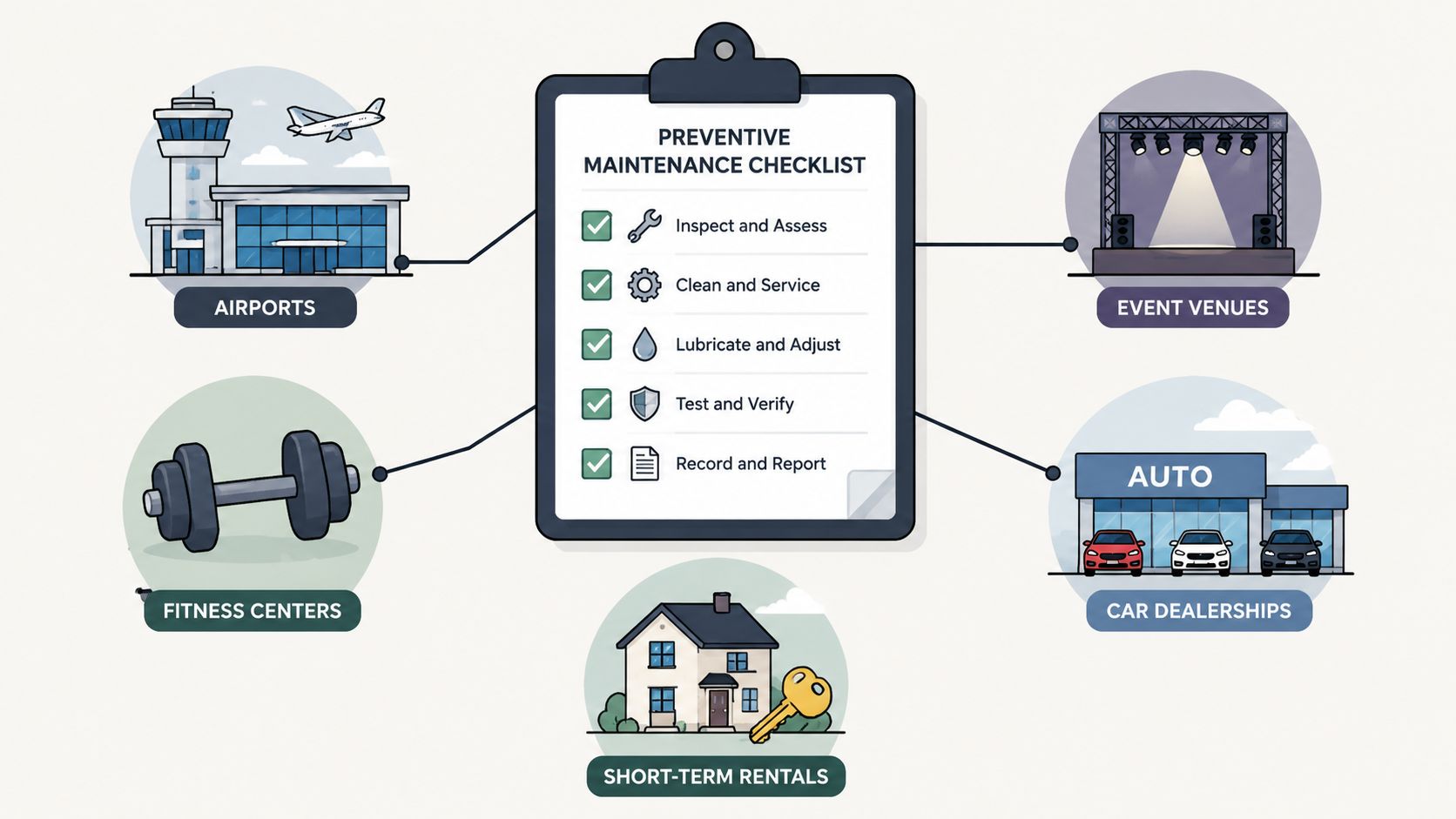
You're already seeing it at the front desk, on the sales floor, or in the locker room. Guests notice sticky handrails, dusty counters, and wipe stations that run empty, and staff feel the pressure when cleaning becomes reactive instead of routine. A strong preventive maintenance checklist turns sanitation into a system, not a scramble, and that matters in places where cleanliness shapes trust, uptime, and repeat business.
In commercial spaces, the business case is straightforward. Consistent preventive maintenance programs can reduce maintenance costs by 12% to 18% compared with reactive approaches, and reactive work can cost 3 to 5 times more per incident because of overtime, rush parts, and disruption (U.S. Department of Energy estimate summarized in UpKeep's preventive maintenance guide). That logic applies to sanitation too, because a checklist is the mechanism that keeps cleaning visible, repeatable, and accountable across airports, gyms, schools, restaurants, and short-term rentals.
The best programs don't stop at “clean more.” They define what to clean, when to clean it, and what good looks like. Facilities that move from paper to digital inspection checklists report faster completion and better record accuracy, and roughly 50% to 60% of maintenance-heavy organizations already use a CMMS or EAM system (MapTrack statistics). In practice, the most effective checklists capture photos, timestamps, labor, and exceptions so managers can see where sanitation is slipping.
If you want a broader commercial maintenance framework, a guide for commercial building managers can help you connect cleaning, inspections, and equipment care without turning the operation into busywork. For wipe-driven sanitation, the goal is simple, choose tools that staff will use, then build routines that guests can see.
1. Daily High-Touch Surface Disinfection
High-touch surfaces are where a lot of facilities lose control of hygiene. Door handles, payment terminals, handrails, elevator buttons, light switches, and security checkpoint touch pads get touched all day, and every missed round creates a visible gap in the guest experience. Daily disinfection is the baseline, not the bonus, because it keeps contamination from spreading through the busiest contact points.
In an airport, that might mean cleaning checkpoint touch pads on a schedule during operating hours. In a gym, it means placing gym equipment wipes where members can reach them without asking. In a restaurant, host stands and POS terminals should be wiped between transactions, while short-term rental teams need to hit remotes, light switches, and door handles before each arrival.
Build the map before you buy more supplies
A high-touch surface map makes the work measurable. One team should walk the facility and identify every contact point by zone, then assign a frequency to each one. That's better than handing staff a vague list because it shows exactly where your disinfectant wipes need to live.
Practical rule: Put wipes where friction happens. If staff have to cross the building to find a dispenser, the task will slip.
Efficiency matters here too. Bulk formats reduce restocking pressure, so bulk gym wipes and commercial disinfecting wipes make sense in large, multi-zone facilities. For operators who want a retail-ready option for customers or members, a wipe display from wipes.com can fit into both janitorial and merchandising plans.
A good checklist item should also record the time, the staff member, and any exceptions. That keeps sanitation visible and supports accountability when guest feedback turns negative. It also helps managers see patterns, like whether touch points near entrances need more attention than the ones tucked deeper inside the building.
What to focus on first
- Entry controls: Door handles, scanners, turnstiles, and security touch pads.
- Guest service points: Counters, card readers, pens, and payment devices.
- Shared touch zones: Handrails, elevator buttons, breakroom switches, and locker handles.
- Visible reassurance areas: Places guests can easily see staff using sanitizing wipes or disinfectant wipes.
2. Bathroom and Restroom Deep Cleaning Protocols
Restrooms carry more weight than most managers admit. Guests judge the whole property by what they see in the bathroom, and staff know that one neglected sink or overflowing bin can damage trust fast. A solid preventive maintenance checklist treats restrooms as a high-risk zone that needs layered cleaning, not a quick once-over.
That means toilets, faucets, sinks, mirrors, dispensers, door handles, and floors all get a defined process. For airports and event venues, hourly logs make a big difference because they create visible proof that the space is being managed. In gyms and fitness centers, locker room bathrooms need even tighter attention because sweat, humidity, and constant foot traffic create a tougher sanitation load.
Make the room easy to inspect
Color-coding helps teams avoid cross-contamination. Use one cloth set for bathrooms, another for kitchens, and another for common areas, then keep the checklist posted where the staff can see it. If you manage multiple properties, the same method makes it easier to train new people without turning every restroom into a special case.
Restroom self-service also helps when it's controlled. A dispenser stocked with commercial disinfecting wipes near the entry or sink area can support guest touch-ups without replacing staff cleaning. For gym operators, fitness center wipes and gym wipe dispenser stations near locker rooms keep the process visible and accessible.
Practical rule: Clean first, disinfect second, and respect contact time. Rushing the wipe-down defeats the point.
The restroom checklist should include a timestamp and a supervisor sign-off at intervals that match traffic. In high-use settings, the risk isn't just dirt, it's inconsistency. When guests can't tell when the last cleaning happened, confidence drops even if the room looks acceptable.
Gym owners often pair restroom care with broader sanitation planning, and that makes sense. Gym wipes, fitness wipes, and antibacterial wipes near restrooms support a unified hygiene story across the whole facility. The key is not to overload staff with separate rituals, but to make every wipe-down part of one visible standard.
3. Fitness Equipment and Gym Wipe Station Management
Gyms live or die on visible cleanliness. Members touch benches, dumbbells, cables, treadmills, mats, and handles within minutes of one another, so the wipe station has to work as part of the business model, not just as a courtesy. A practical preventive maintenance checklist treats equipment sanitation as a recurring operational task, with wipe access, staff oversight, and end-of-day deep cleaning all built in.
Wipes for gym equipment earn their keep when members can find supplies easily. If a member has to hunt for supplies, they won't clean consistently, and staff end up doing catch-up work that slows the floor. That's why many operators place gym equipment cleaning wipes near entrances, cardio zones, free-weight areas, and studio rooms, then check the stations throughout the day.
Make the wipe station part of the member experience
A good station should be obvious, stocked, and branded. If the dispenser looks neglected, members assume the rest of the cleaning program is neglected too. A clean, visible gym wipe dispenser signals that wiping down equipment is normal behavior, not an emergency response.
Staff should also know when to intervene. A wipe station audit can catch empty rolls, dry-out issues, and misplaced dispensers before members start skipping the step. For high-turnover gyms, workout wipes and fitness wipes belong in a larger cleaning supply mix that also covers locker rooms and studio floors.
Practical rule: Wipe before and after use on shared items, especially benches, grips, mats, and contact surfaces that sit close to skin.
Sales teams can use this as a customer education point too. If you sell to gyms, promote wipe programs as a member-retention tool, not just a consumable. Bundle bulk gym wipes with dispenser placement, signage, and periodic restock plans, then explain how consistency supports hygiene and the member experience.
The internal workflow matters as well, and this fitness center cleaning checklist fits neatly into a broader club-maintenance routine. For operators, the best upsell is often simple, make the wipe routine impossible to miss and easy to maintain.
4. Airport Security Checkpoint and Baggage Handling Sanitization
Airports are built around constant turnover, which makes them one of the hardest environments to keep visibly clean. Security bins, conveyor belts, screening surfaces, and baggage handling points all need scheduled disinfection because each one carries a steady stream of hands, bags, and surface contact. A preventive maintenance checklist helps the operation keep pace without turning checkpoint cleaning into a bottleneck.
The smartest airport teams separate visible sanitation from invisible sanitation. Travelers may never see the baggage system, but they absolutely notice a clean bin, a well-managed checkpoint, and staff who know what they're doing. That visible discipline shapes confidence.
Keep the flow moving while cleaning
A rotation system works better than ad hoc wiping. Dirty bins move into a sanitizing queue, clean bins return to service, and staff document the cycle so nothing gets lost in the rush. Commercial operators can also stage commercial disinfecting wipes at checkpoint stations to keep the process consistent during peak arrivals.
Digital logging is especially useful in airports because shift handoffs can create gaps. When staff record sanitization times and initials, managers can audit the checkpoint without guessing. That kind of recordkeeping is what makes a checklist operational instead of decorative.
You don't need to promise perfection to travelers. You do need to make sanitation visible. A clean checkpoint, a stocked wipe station, and clear signage show that the facility is being actively managed, not merely swept at the close of operations.
Airport teams should also train for contact time and consistent technique. A quick pass with a dry cloth isn't enough, and staff need to know which surfaces can be cleaned during live traffic versus which need a short pause. Keep the process simple, repeatable, and easy to supervise.
For high-throughput facilities, the sanitation goal is less about one perfect deep clean and more about relentless consistency. That consistency lowers friction at the front line and makes the whole passenger experience feel more controlled.
5. Restaurant and Food Service Surface Disinfection Between Service Periods
Restaurants run on speed, and speed is exactly why surface sanitation has to be tight. Host stands, menus, POS terminals, table surfaces, condiment bottles, and service counters all need their own routine because each one can carry contamination from guest to guest. A preventive maintenance checklist gives front-of-house teams a way to clean between service periods without slowing the whole room.
The mistake many operators make is treating front-of-house sanitation like back-of-house sanitation. They're different. Food prep cleaning is about production safety, while customer-facing disinfection is about guest confidence, table turnover, and the feeling that the room is under control.
Use the right wipe for the right surface
For customer-facing spaces, EPA registered disinfecting wipes belong in the supply mix because general cleaning cloths don't do the same job. Staff should know which surfaces get a wipe after every seating, which get touched during service, and which get a deeper pass at close. That's where a laminated checklist at the server station helps.
Color coding keeps the process clean. One cloth for tables, another for POS, and another for condiment bottles prevents cross-use and makes coaching easier. It also keeps the host stand from becoming a cluttered pile of half-used supplies.
Practical rule: Staff should clean what guests can see first, then move to the less visible zones. That order improves perceived cleanliness without wasting time.
Sales reps can use this language when talking to restaurant buyers. Don't pitch disinfecting products as extras. Position them as part of table-turn efficiency, guest trust, and a smoother service rhythm. A well-organized disinfectant wipes plan can also fit into a broader front-of-house supply program that includes napkins, sanitizer, and restocking support.
In casual dining and quick-service settings, the small details matter. A wiped table, a clean menu, and a spotless POS terminal tell guests the room is managed, even during a rush. That's the kind of signal that keeps the operation from feeling chaotic.
6. Vehicle Interior and Touch Point Sanitization at Car Dealerships
A clean test drive starts before the customer ever gets behind the wheel. Car dealerships deal with a sanitation problem most retail spaces never see, because dozens of people may touch the same steering wheel, shifter, seat controls, touch screen, and door handles in a single day, and every test drive resets the cleaning clock. A preventive maintenance checklist treats each interior like a high-contact asset that needs documented turnover, not a quick once-over.
That approach protects the sales process as much as it protects the vehicle. Buyers notice whether a car feels cared for, and sanitized touch points send a clearer signal than a vague promise ever could. When the interior looks managed, the customer is more likely to trust the handoff, spend less time second-guessing the condition, and move through the purchase conversation with fewer objections.
Build the checklist around the vehicle, not the lot
Each vehicle should have a laminated interior checklist that covers the steering wheel, shifter, screens, cupholders, handles, and seat controls. That keeps the process consistent for sales staff and lot attendants, and it lowers the chance that one surface gets skipped when the dealership is busy. A centralized log tied to inventory also gives managers a cleaner way to confirm that the work happened before the next customer enters the car.
Use materials with care. Antibacterial wipes can work on certain finishes, but sensitive surfaces need products that will not damage leather, stitching, or trim. Staff should know which wipe belongs on which surface, because a sanitation program that protects the buyer should not create a cosmetic problem that hurts resale appeal or slows reconditioning.
The customer-facing message still matters. A simple “sanitized on” sign in the vehicle builds confidence without feeling theatrical, and it tells buyers the dealership handles the test-drive process in a professional way. For dealerships looking to upgrade their vehicle preparation workflow, see the 2026 GTA auto detailing guide at https://www.nanakcarwash.com/detailing-a-car-near-me/.
A lot of dealerships already use digital tools to track vehicle prep, so sanitation can fit into the same workflow without creating a separate burden for the team. That makes the cleaning task easier to supervise and keeps it from turning into a hidden chore that no one owns. For showroom teams, the return is cleaner vehicles, calmer customers, fewer awkward questions before a test drive, and a smoother handoff that supports both guest satisfaction and sales efficiency.
7. Event Venue Turnstile, Ticketing, and Entry Point Sanitization
Event venues live at the edge of crowd control and guest experience. Turnstiles, badge scanners, ticket readers, and entry gate handles all get hit hard during arrival waves, and the pressure is highest when people are trying to get through quickly. A preventive maintenance checklist keeps that entry flow clean without slowing admission to a crawl.
The visible part matters more than operators sometimes expect. If guests see staff actively wiping entry points, they read that as a sign of control. If the surfaces look neglected, the whole venue feels less safe, even if the interior is spotless.
Put sanitation where the queue can see it
Entry staff should have a dedicated wipe station at eye level so they don't have to hunt for supplies during the rush. A simple timestamp system on the turnstile or scanner helps crews track the last pass, and that makes supervision much easier during a show or match. Visible signage can reinforce the routine without turning it into a performance.
Some venues also place gym wipes or similar self-service stations near the entrance because guests understand the idea immediately. That's especially useful in multi-use facilities where sports, concerts, and convention traffic all share the same gate design. If you sell to venue operators, the product story should focus on throughput and reassurance, not just cleanliness.
Staff don't need more complicated rules at the door. They need supplies that stay visible, a simple rotation, and a checklist that fits the pace of the event.
Mid-event inventory checks matter too. Nothing undermines a sanitation plan faster than an empty dispenser during peak arrival. Build the restock check into the same routine as ticket scans and gate staffing, and the process becomes much easier to sustain.
Event venues are judged in minutes, not days. Clean entry points help control that first impression, and that first impression often shapes how the rest of the event feels.
8. Short-Term Rental Deep Clean and Turnover Sanitization
Short-term rentals sell confidence as much as they sell space. Guests open the door, scan the counters, and immediately decide whether the place feels professionally managed. A preventive maintenance checklist helps hosts and property managers turn turnovers into a repeatable sanitation process instead of a race against the clock.
The strongest systems build around the guest journey. High-touch items like remote controls, door handles, light switches, kitchen surfaces, and bathroom fixtures get a defined place in the checklist, and every turn includes a proof point. That proof might be photos, timestamps, or a completed log, but it has to exist.
Make turnover work like a handoff, not a reset
Properties that use yoga mat wipes and antibacterial wipes for quick-turn areas often do so because different surfaces need different levels of care. A rental with a shared workout corner, for example, needs more than a standard linen reset. The cleaning plan should reflect the actual use of the space.
Hosts can also build trust by stocking EPA-registered disinfecting wipes in visible dispensers and noting the sanitation routine in the listing. That doesn't need to sound dramatic. A calm, specific explanation of cleaning steps is more convincing than marketing language.
The key operational move is buffering time. If a property is turned over too quickly, staff rush the details, and that's where mistakes happen. A booked calendar should leave enough room for a proper deep clean, even if that means fewer same-day handoffs.
For property managers, the checklist should be asset-specific. A beach house, city apartment, and luxury villa don't need identical routines, but they do need identical discipline. The cleaner the handoff, the fewer complaints you'll field after check-in.
9. Pool, Spa, and Aquatic Facility Surface and Equipment Disinfection
Aquatic facilities create a tricky mix of water chemistry and wet-surface sanitation. The pool water itself gets managed separately, but decks, handrails, ladder handles, benches, locker rooms, and bathrooms still need regular disinfection because moisture keeps those surfaces active all day. A preventive maintenance checklist keeps the non-water areas from becoming the weak point.
Simple habits pay off. Staff need a routine that works on wet floors, around heavy traffic, and under time pressure. If the process creates slip risk or slows guest movement, people will dodge it.
Keep drying and slip control in the same process
Use non-slip products where possible and make drying part of the task, not an afterthought. Dispensers should be placed near locker room entrances, deck access points, and bathrooms so staff and guests can reach them quickly. That visibility helps guests see that the facility is being actively maintained.
The training side matters too. Staff need to understand contact time, surface compatibility, and zone separation so they don't drag locker room contamination onto the deck. A color-coded cloth system makes that easier to manage and easier to audit.
If you manage pool operations, this how to clean swimming pools resource fits well with a broader sanitation plan, especially when you're balancing water care with touch-point control. For member-facing communication, keep the message focused on safety, access, and consistency.
Aquatic facilities also benefit from visible logs. Guests don't need a lecture, but they do appreciate signs that the deck and locker areas are being checked on schedule. That simple transparency reduces complaints and keeps the environment feeling orderly.
10. School and Educational Facility Classroom and Common Area Sanitization
Schools are among the most demanding environments for cleanliness because the traffic never really stops. Desks, chairs, shared devices, door handles, light switches, and common areas get used constantly, and a strong preventive maintenance checklist keeps those touch points from slipping between class periods. The goal isn't just appearance, it's reducing disruption and helping the building feel stable for students, staff, and families.
The operational challenge is speed. Teachers, aides, and custodial staff need a process that doesn't derail instruction. That's why quick wipe routines at the classroom level matter, especially when they're paired with evening cleaning logs and visible supplies.
Make the routine part of the room
Labelled dispensers at classroom entrances make it easier for teachers to handle quick touch-ups without leaving the room. For shared computers, tablets, and AV gear, use equipment-safe products that won't damage screens or keyboards. The checklist should spell out where wipes belong and which surfaces need extra care.
Communication is just as important as cleaning. Parents notice when schools post cleaning schedules, and staff feel more confident when the routine is documented. Schools that integrate sanitation into custodial software or facility logs also have a much easier time spotting gaps.
Practical rule: Don't overload classrooms with supplies that no one maintains. One accessible dispenser and one clear checklist beat three forgotten bins in the corner.
Educational facilities also benefit from consistency across zones. Libraries, computer labs, cafeterias, and hallways each need their own version of the same basic routine. That makes the building easier to manage and lowers the odds that one high-traffic space gets overlooked.
For business owners selling to schools, the sales angle is trust and continuity. Sanitization is part of the learning environment, and the most persuasive offer is the one that makes the routine easier for staff to sustain.
Preventive Maintenance Checklist Comparison, 10 Settings
| Item | 🔄 Implementation Complexity | ⚡ Resource Requirements | 📊 Expected Outcomes | 💡 Ideal Use Cases | ⭐ Key Advantages |
|---|---|---|---|---|---|
| Daily High-Touch Surface Disinfection | Low–Moderate: routine mapping & timed cycles | Low: bulk EPA wipes, trained staff, checklists | Reduces common pathogens (~99.9%); visible cleanliness | Airports lobbies, retail, hotel foyers, gyms | Visible hygiene, regulatory alignment, fewer sick days |
| Bathroom and Restroom Deep Cleaning Protocols | High: layered cleaning, PPE, frequent cycles | Moderate–High: dedicated staff, chemicals, ventilation | High pathogen elimination (≈99.99%); improved guest ratings | Restaurants, airports, gyms, event restrooms | Strong infection control, reputation boost, liability reduction |
| Fitness Equipment & Gym Wipe Station Management | Moderate: dispenser placement + member compliance | Moderate: multiple dispensers, bulk gym wipes, restocking | Lowers skin/fungal infections; supports retention metrics | Health clubs, boutique studios, corporate gyms | Member confidence, reduced outbreaks, upsell opportunities |
| Airport Security Checkpoint & Baggage Sanitization | High: coordination with TSA, 24/7 scheduling | High: multi-shift staff, large wipe inventory, logging tech | Eliminates high-volume touchpoint transmission; measurable ROI | Major airports, multi-terminal hubs, international gates | Traveler confidence, compliance auditing, airline partnerships |
| Restaurant & Food Service Surface Disinfection | Moderate: between-service timing; POS protocols | Moderate: wipes, staff training, stations at servers | Reduces cross-contamination and foodborne risk; better inspection scores | QSR, casual & fine dining, catering operations | Protects brand, improves guest perception, lowers liability |
| Vehicle Interior & Touch Point Sanitization (Dealerships) | Moderate: vehicle-level checklists per test drive | Moderate: automotive-safe wipes, trained staff, logs | Higher buyer confidence; reduces transmission during demos | Car dealerships, rental handoffs, used-car lots | Marketing differentiator, protects staff, inventory value preservation |
| Event Venue Turnstile & Entry Sanitization | High: peak-wave coordination; rapid turnover | Moderate–High: on-site carts, staffing during peaks, inventory | Cuts transmission at bottlenecks; reassures attendees | Stadiums, festivals, concerts, conventions | Guest trust, outbreak prevention, CSR messaging |
| Short-Term Rental Deep Clean & Turnover Sanitization | Moderate–High: timed turnovers, full-property protocols | Moderate: pro cleaners or co-hosts, bulk wipes, linens | Improves reviews/bookings; reduces cancellations | Airbnb/VRBO, vacation homes, short-stay apartments | Higher occupancy and rates, guest trust, documented compliance |
| Pool, Spa & Aquatic Facility Surface Disinfection | High: wet-surface methods, slip-risk mitigation | Moderate: waterproof wipes, staff, specialty products | Reduces fungal/bacterial incidents; supports inspections | Public pools, water parks, health clubs, swim teams | Member safety, health-code compliance, reduced outbreaks |
| School & Educational Facility Classroom Sanitization | High: many zones, scheduling around instruction | Variable: custodial staff, wipes, ATP testing, training | Lowers absenteeism; protects vulnerable populations | K–12 schools, universities, libraries, labs | Supports continuity of learning, parent confidence, documented logs |
Make Cleanliness Your Competitive Edge
A preventive maintenance checklist works because it turns cleanliness into a repeatable operating system. That matters in every facility, but especially in public-facing spaces where guests judge the business before they ever ask a question. When your team knows what to clean, when to clean it, and how to document it, the whole operation feels calmer and more professional.
The strongest programs do a few things well. They focus on high-touch surfaces, keep restroom sanitation visible, build reliable wipe access into the floor plan, and use logs or timestamps so no one has to guess when a space was last handled. They also avoid checklist bloat. A longer list isn't automatically better if staff stop trusting it or stop using it.
That's why the best checklists are specific. They name the surface, the method, the acceptance standard, and the follow-up if something's off. They also match real usage, which is especially important in places like gyms, airports, event venues, and short-term rentals where traffic changes by the hour.
For sales teams, the message is just as clear. Sell disinfecting wipes, sanitizing wipes, and commercial disinfecting wipes as part of a larger cleanliness system, not as isolated products. Show buyers how the routine supports guest confidence, operational efficiency, and less reactive work. For operators, make the wipe stations obvious, keep them stocked, and train staff to use them the same way every day.
Start by reviewing the spaces guests touch first, then build from there. If your facility still treats sanitation as an afterthought, tighten the routine today, stock the right disinfectant wipes, and make the standard visible to everyone who walks through the door.
Leave a Reply