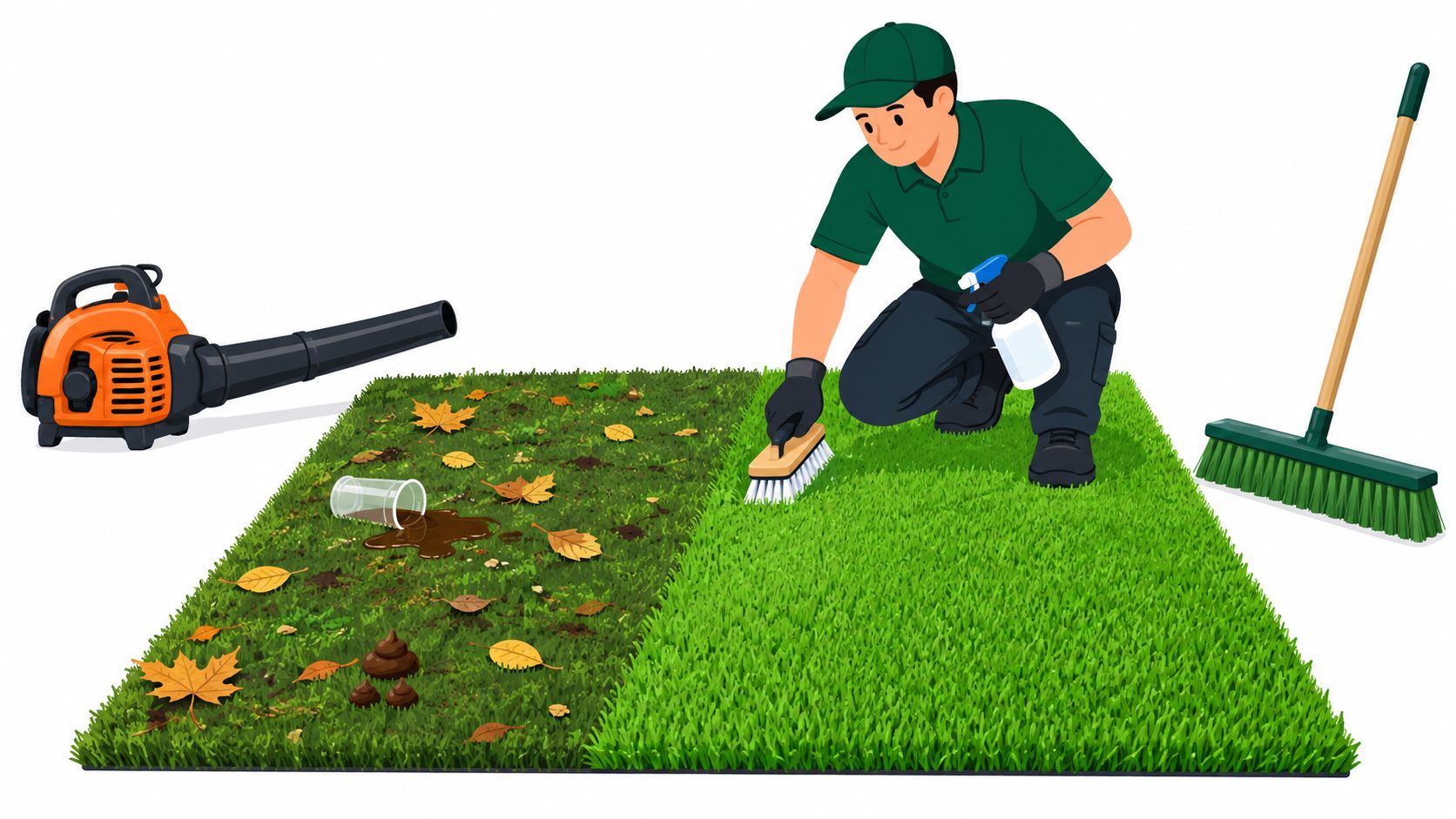
A Saturday event has just cleared out. The turf looks acceptable from a distance, but the first step across the lawn releases the smell of warm rubber, stale beer, and damp organic debris. Near the seating area, crushed cups, sunscreen, food grease, pet residue, and parking-lot grit have worked down between the fibers. The grounds crew now has to decide whether a quick rinse will be enough or whether the surface needs a full recovery clean before the next booking.
That decision is the heart of the best way to clean artificial turf. Synthetic grass is low maintenance, not maintenance-free. The right program combines dry debris removal, grooming, targeted chemistry, controlled rinsing, drying, and strategic use of disinfectant wipes on shared equipment and nearby touch points. The schedule should follow traffic, contamination source, weather, and the event calendar rather than a generic promise that one cleaning method fits every facility.
Why Cleanliness Defines the Artificial Turf Experience
A sports field can pass a morning inspection and still fail the first athlete who notices a slick drink residue near the sideline. An event lawn may look acceptable until guests gather around a bar, while a rental property can lose trust because one corner smells of pet waste. Synthetic turf is low maintenance, not maintenance-free. Cleanliness affects how people judge the facility, how safely they use it, and how much recovery work staff face later.
Guests read several signals before they touch the surface. They see dull or glossy blades, discolored infill, untidy edges, flattened fibers, and visible leaves or gum. They also notice odor. Dust settles below the pile, moisture can remain around infill, and organic debris can break down out of sight. A soft-drink spill, food grease, or repeated pet marking may therefore become a persistent problem if staff only rinse the visible surface.
For general areas, remove loose debris weekly or biweekly, rinse when conditions require it, brush busy zones more often, remove pet waste immediately, and schedule fuller brushing and inspection monthly. Seasonal deep cleaning makes sense after heavy use or pollen exposure. That schedule should change with risk. Sports fields need attention around sidelines, benches, and player entrances. Event venues need faster recovery after food, drinks, and concentrated foot traffic. Gyms, rentals, and airports may need more frequent checks where shared equipment, luggage, sweat, or tracked grit reach the turf.
What guests notice first
A participant looks for reliable footing and clear field markings. An event attendee notices the lawn around tables and bars. A short-term rental guest may connect one stale corner with the entire property. These reactions affect venue readiness because turf often serves as a visible stage for the business.
- Surface appearance: Flattened fibers and uneven infill make normal wear look like poor care.
- Odor: Heat can intensify residue from drinks, sweat, pets, and decaying leaves.
- Touch points: Benches, tables, cones, mats, and equipment racks transfer contamination into the turf zone.
- Edges and transitions: Parking-lot grit and walkway dirt collect at entrances and exits.
Operational rule: Clean the visible surface, and wipe shared equipment and nearby high-traffic touch points before contamination reaches it.
Strong programs divide work into recurring light care and deeper resets. Dry debris removal protects drainage and limits organic buildup. Brushing restores the pile and manages infill. Targeted spot treatment controls stains without washing the entire area, while disinfectant wipes suit shared objects and lounge surfaces where hoses and turf cleaners are impractical.
That layered routine protects labor as well as appearance. Consistent removal of leaves and spills leaves crews fewer compacted deposits, embedded residues, and avoidable odors to reverse. Cleanliness becomes part of opening and turnover checks, rather than a rescue job after guests complain.
A Practical Cleaning Workflow That Actually Works
A busy event lawn after a rainy setup illustrates the problem. Loose leaves, tracked grit, drink spills, and flattened fibers need different responses. The sequence matters more than the cost of any single product. Start dry. Wetting dust and leaf fragments can turn easy removal into a film that settles deeper into the pile.
Use a leaf blower, plastic rake, outdoor broom, or powered sweeper suited to the surface. Move debris toward collection points rather than into drains or surrounding landscaping. Remove leaves and twigs before they decompose into organic buildup. Pick up pet waste immediately, then rinse and use mild soap and water where appropriate, following the RealTurf maintenance guidance.

Brush before you wash
After loose material is gone, brush against the grain. This lifts matted fibers, exposes debris at the base, and redistributes compacted infill. Give extra attention to entrances, sidelines, queue lanes, seating approaches, and spots where people repeatedly pivot or stand.
Sports surfaces need a tighter maintenance schedule than a lightly used rental lawn. A Synthetic Turf Council maintenance guideline cites drag brushing 2 times per week and renovation brushing 4 times per year in connection with Cranfield University research. It also stresses removing debris and contaminants while warning that brush patterns and equipment can displace infill. Clean equipment before it leaves the field, and use settings that keep infill in place.
Treat spots before the broad rinse
Inspect stains after brushing exposes the surface. Blot or lift solids first, then apply a turf-safe cleaner to food, drink, grease, sap, or pet residue. A targeted treatment generally uses less chemistry and water than applying a strong solution across the entire lawn.
For the general wash, use a low-pressure hose rinse or apply a turf-safe solution evenly. Control the rinse so it removes dust and residue without shifting infill. Pressure-washing advice varies. One maintenance guide gives a conservative range of 3000 to 4000 PSI, with a 25 to 40 degree nozzle held 12 to 18 inches away, while another recommends staying below 1500 PSI to reduce fiber damage. Follow the turf manufacturer's specification, inspect the backing and pile, and test a small area first.
For a separate field-care perspective, review R E and Sons Landscaping turf care.
Finish with a thorough rinse and let the area dry fully. Groom the fibers again if washing or traffic has flattened them. A sports field may need a controlled reopening check, while an event venue may need to protect the surface from guests until it is dry. Drying is part of the cleaning job, not a cosmetic extra.
Choosing the Right Tools and Cleaning Supplies
A facility needs tools matched to its turf, contamination, and recovery window. The fastest option is not always the safest. Sports fields need controlled collection that protects infill, while event lawns often need quick debris removal between bookings.
A stiff-bristle power brush helps loosen compacted high-traffic areas, but excessive force or the wrong pattern can displace infill. Use a softer grooming brush for routine appearance work when fiber disturbance is a concern. It improves presentation without correcting every dense wear pattern. Backpack blowers clear loose debris quickly on event lawns. Wheeled turf sweepers provide steadier collection across larger fields.
Moisture equipment also involves trade-offs. A wet/dry vacuum handles local standing water and spill residue. An extractor can support controlled recovery when the turf surface and backing permit it. Neither tool fixes poor drainage, so inspect the base when water remains after cleaning. Equipment should support the turf system, not compensate for blocked or damaged construction.
| Facility Type | Primary Equipment | Recommended Chemistry | Wipe Format |
|---|---|---|---|
| Sports field | Turf sweeper, drag brush, controlled hose | Neutral turf-safe surfactant for routine cleaning | Durable wipes for benches and sideline tables |
| Event lawn | Backpack blower, soft grooming brush, wet/dry vacuum | Spot cleaner matched to food, drink, or grease | Portable canister near staging areas |
| Gym turf zone | Soft brush, microfiber tools, wet/dry vacuum | Neutral cleaner, with targeted hygiene treatment for touch points | Wall-mounted dispenser for shared equipment |
| Short-term rental | Blower or plastic rake, hose, hand brush | Mild cleaner for spills, enzyme product for pet residue | Compact resealable pack for turnover teams |
For recurring cleaning, choose a neutral surfactant instead of a harsh degreaser. Enzyme-based products can help with organic residue. A carefully selected hydrogen peroxide blend may support odor control or whitening on compatible light fibers. Test every product on an inconspicuous patch, especially near latex backing, seams, adhesive, or colored infill.
Avoid bleach concentrates and solvent-based degreasers. They may weaken backing, discolor fibers, or leave a dirt-attracting film. A powerful pressure nozzle is not automatically the professional choice. The guidance on outdoor vacuum cleaners can help compare recovery equipment for exterior surfaces.
Wipes belong in the turf kit
Turf cleaning does not cover every surface around it. Gym equipment wipes, benches, sideline tables, pads, cones, and staging handles need a separate touch-point routine, especially in shared gyms, rentals, and event lounges. Choose a product labeled for the intended surface, keep the wipes saturated, and follow the required wet contact time. In healthcare-style or public settings, confirm whether facility protocol requires an EPA-registered product.
Tackling Stains Odors and Microbial Risk
A turf crew can remove visible dirt and still leave the source of an odor behind. Start with the contamination, then choose the least aggressive chemistry that addresses it. Mechanical removal and surfactant action usually do more practical work than spraying disinfectant onto a dirty surface.
Sweat, saliva, blood, food, drinks, pet waste, and wildlife residue each create different cleaning demands. Soil can shield microorganisms from treatment, while organic matter can sustain odors. Penn State notes that synthetic turf is generally a poor environment for staph, although survival increases when nutrients from bodily secretions are present. Its synthetic turf hygiene guidance describes faster reductions in S. aureus when surfactant and detergent treatments are used before or soon after contamination.
Match the response to the mess
Remove solids, blot liquids, and rinse loose residue before applying a targeted cleaner. Enzyme chemistry is appropriate to evaluate for organic residue and pet-related odor. Our guide to bio-enzymatic cleaners for organic residue explains where that approach fits. Neutral surfactants suit routine soil and spill removal. Use disinfectant chemistry only when the contamination and facility protocol justify it, especially on high-touch objects rather than as a substitute for cleaning the turf pile.
| Contamination Type | Primary Chemistry | Dwell Time | Material Safety |
|---|---|---|---|
| Sweat or bodily residue | Detergent or surfactant after soil removal | Follow the product label | Test on backing and colored fibers |
| Food and beverage spill | Neutral surfactant, then rinse | Follow the product label | Avoid solvent-based degreasers |
| Pet or wildlife marking | Enzyme-based turf cleaner, followed by rinsing | Follow the product label | Confirm pet and turf compatibility |
| Bench or equipment touch point | Label-approved disinfectant | Keep surface wet for the labeled contact time | Use only on compatible hard surfaces |
| Persistent odor | Cleaning first, then compatible odor-control chemistry | Follow the product label | Escalate after a test patch |
A disinfectant label does not guarantee removal of embedded soil or odor. The 2024/2026 NTNU study found that citric acid, hydrogen peroxide, and sodium hypochlorite had a positive but unsatisfying effect on fungi and bacteria. Use that result to guide a least-aggressive-first policy. Remove soil, apply surfactant action, then select chemistry that matches the actual risk and material.
Deploy wipes where cross-contact happens
Shared pads, sleds, cones, handles, benches, and equipment racks can move between users faster than a turf crew can wash the surrounding surface. Keep wipes to disinfect gym equipment at the point of use, while requiring staff to follow the product label.
CDC guidance says ready-to-use disinfecting wipes must remain saturated, be discarded when dry, and stay on the surface for the labeled contact time. Close the container between uses so the remaining wipes stay wet, as explained in the CDC cleaning supplies guidance. Where no more specific infection-control protocol applies, CDC materials identify alcohol-based products containing at least 70% alcohol as an option and call for thorough drying after treatment, as detailed in this CDC surface-cleaning resource.
Do not wipe turf fibers with a product intended for hard, nonporous equipment unless its label specifically permits that use. Apply turf chemistry to turf, and reserve disinfectant wipes for compatible shared surfaces.
Seasonal Protocols and Setting-Specific Routines
A practical schedule starts with four conditions: foot traffic, contamination source, event density, and climate exposure. Calendar-based cleaning misses the difference between a quiet rental lawn and a sports facility hosting repeated practices, or between a dry airport lounge and an outdoor venue exposed to pollen and rain.

Build the rhythm around use
Sports fields need a debris sweep before play and a closer inspection after events. Set the maintenance pattern by booking volume and intensity, not by the weekday. Frequent drag brushing suits managed playing surfaces, while renovation brushing belongs on the planned maintenance calendar rather than in an emergency response.
Gyms and indoor training spaces face a different mix of soil. Chalk, sweat, skin oils, and repeated contact collect around turf lanes and shared equipment. Use routine microfiber passes on the turf, then apply disinfectant to compatible hard surfaces according to the product label. Shared gym equipment should be wiped after each use, with staff disinfecting high-touch cardio and strength equipment daily. During peak periods, staff passes every two to three hours provide added control for higher-traffic equipment, according to this gym cleaning frequency guide.
Short-term rentals should connect inspection to guest turnover. Properties turning over in under 48 hours need a documented sanitizing check between occupants, particularly after pets, outdoor parties, or children have used the lawn. Event venues should remove dry debris and treat spots during load-in, then complete the deeper clean after load-out, while the area remains accessible.
Adjust for the season
Spring pollen requires more frequent dry removal and rinsing. Summer heat makes odor checks and rapid response in pet zones more important. Remove fall leaves promptly, before organic material settles into the pile. During winter freeze-thaw cycles, inspect infill displacement, seam movement, and drainage changes before heavy use resumes.
Keep a decision log instead of relying on memory:
- Escalate after repeated odor: Inspect infill and drainage when routine cleaning no longer controls the smell.
- Escalate after visible infill movement: Review brush settings and traffic patterns before the surface loses consistency.
- Escalate after recurring staining: Identify the contamination source and revise controls at entrances, bars, pet areas, or equipment zones.
- Escalate after heavy events: Arrange a professional assessment when routine tools cannot restore pile, drainage, or appearance.
Airports, gyms, schools, event lawns, and rental properties therefore need different schedules, while the cleaning standard remains consistent. Pair mechanical turf work with targeted wipe use on shared equipment and high-traffic lounges, where cross-contact can occur faster than a full surface clean.
Turning Cleanliness Into Guest Trust and ROI
A guest notices the turf before speaking with a manager. Debris, flattened fibers, streaks, or stale odor can suggest that staff overlook less visible facility problems. Clean benches, orderly equipment, and an accessible wipe station communicate control.
The commercial return comes from trust, not from claiming that every wipe produces a measurable sales increase. Athletes need confidence in shared equipment. Event attendees expect a venue prepared for use. Rental guests often form an opinion quickly and may mention odor or visible dirt in reviews. A documented routine gives operators evidence when complaints arise, rather than requiring reassurance alone.
Make the program visible and usable
Place a gym wipe dispenser beside equipment racks, seating, turf-lane entrances, and other natural stopping points. Keep it reachable without sending guests across a wet or recently treated surface. Use a short sign that identifies what to wipe and reminds users to keep the surface wet for the product's labeled contact time.
CDC lists tables, handles, desks, phones, keyboards, toilets, faucets, and sinks among common high-touch surfaces. Its guidance also covers frequently handled electronics, including phones and computers, and explains the importance of the required wet contact time in the CDC high-touch surface resource. Apply the same principle in gyms to equipment handles, adjustment levers, touchscreens, benches, label-approved mats, and shared accessories.
Position commercial disinfecting wipes as part of a wider supply and verification program. Ask the customer:
- Where does cross-contact occur? Map equipment, seating, counters, and entry points.
- Who uses the surface? Separate staff-only areas from shared public equipment.
- What does the label permit? Match wipe chemistry and format to the material.
- How will usage be verified? Set up dispensers, refill controls, and completion logs.
- What happens during peak periods? Schedule staff passes around traffic instead of guessing.
Prove consistency without overstating the return
Use before-and-after photos, signed completion logs, inspection notes, and restocking records. These documents support training, expose recurring failure points, and can help with liability discussions or facility compliance when a protocol requires cleaning evidence.
The cost of inconsistency extends beyond labor. A neglected odor can weaken a booking conversation. A dirty bench can undermine a facility tour. An empty dispenser can make a well-designed program appear performative. Consistent turf care, clear records, and accessible wipes create a practical trust system that protects the guest experience and helps operators present a broader hygiene service.
Manager's test: If guests can see the cleaning program, understand how to participate, and find supplies where shared contact occurs, cleanliness is being treated as facility infrastructure.
Prioritize the turf surface and shared touch points together. Set schedules around the setting and its risks, remove debris before buildup forms, choose the least aggressive compatible chemistry, and keep properly labeled sanitizing wipes available for shared equipment. Facility owners, cleaning teams, and suppliers can review the current routine, identify high-risk contact zones, and add suitable wipes to the daily checklist. For practical sanitation guidance across gyms, sports facilities, rentals, airports, and event venues, visit WipesBlog.com.
Leave a Reply