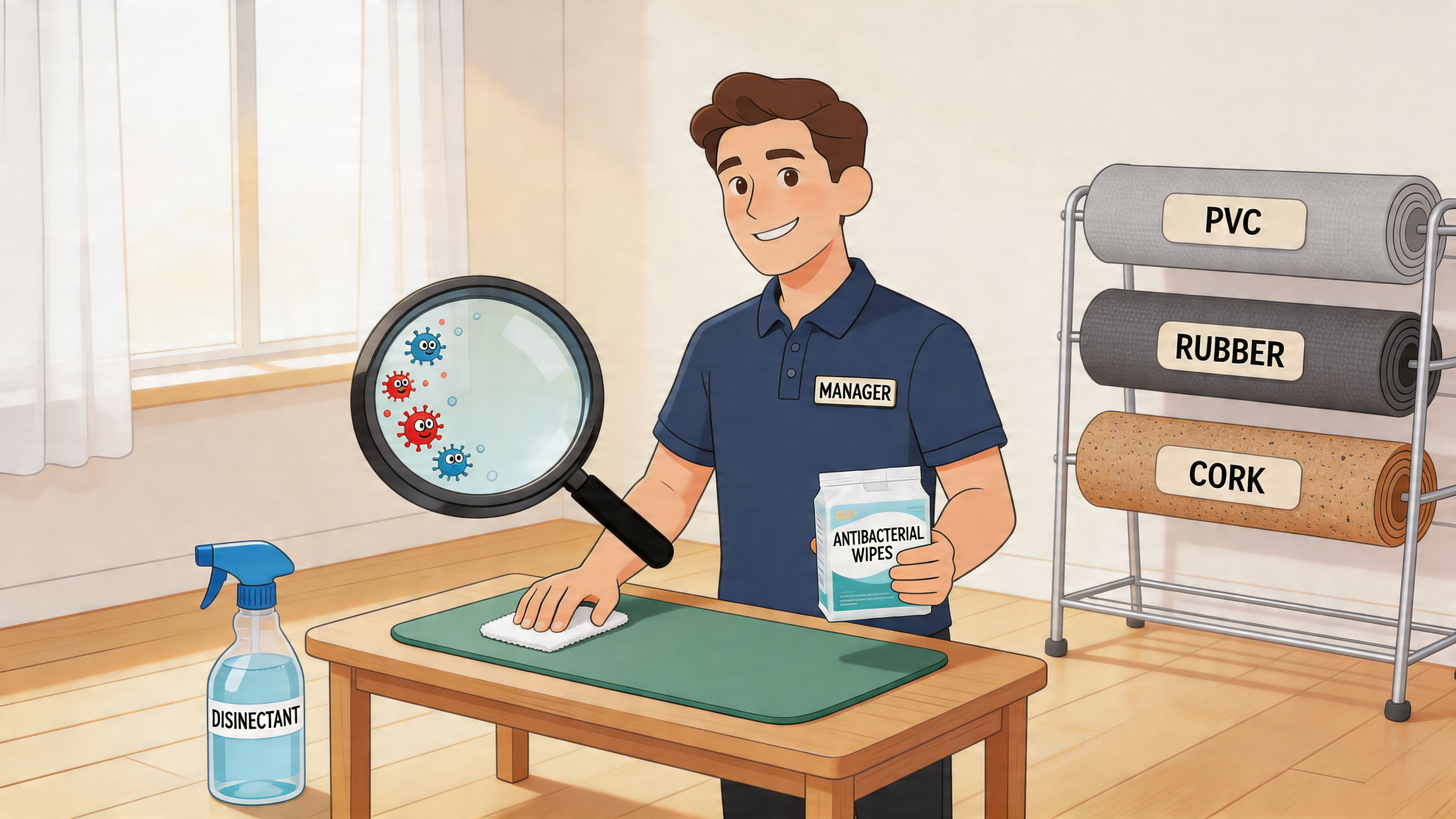
At a busy studio, the mats usually look fine. They’re stacked neatly, the room smells clean, and the class turns over fast enough that nobody wants to slow the next session down. That’s exactly where mat hygiene gets mishandled in commercial spaces.
The best way to clean yoga mat inventory in a gym, studio, school, or club isn’t a single product or one-off deep wash. It’s a system. You need fast disinfection between users, deeper cleaning on a set cadence, drying and storage rules that staff follow, and material-specific care so you don’t destroy expensive mats while trying to sanitize them.
Owners who treat mat cleaning as a visual nicety miss the core issue. Shared mats affect member trust, complaint risk, instructor credibility, and how people judge your facility the second they lie down for savasana.
The Hidden Risk on Your Studio Floor
A shared mat can look clean and still be the dirtiest surface in the room. Sweat dries. Skin oils disappear into the texture. Odor fades after the HVAC kicks on. What remains is the residue your next member presses hands, feet, forearms, and face into.

A 2015 study in Microbial Ecology in Health and Disease found that after one 60-minute hot yoga session, mats harbor an average of 4.62 million colony-forming units per square centimeter, with pathogens like Staphylococcus aureus and E. coli predominant, creating clear cross-contamination risk in shared settings, as summarized by Alo Moves’ yoga mat cleaning article.
Clean-looking isn’t clean
Facility operators run into the same mistake over and over. Staff judge mats by appearance. If there’s no visible dirt, no obvious odor, and no member complaint, the mat goes right back into circulation.
That approach fails in high-volume use because mats aren’t like mirrors, front desks, or windows. They take direct body contact for an extended period, and they collect exactly the mix of moisture and organic residue that creates sanitation problems fast.
Practical rule: If members share a mat, appearance is not your standard. Your standard is whether the surface was cleaned and dried using a repeatable process.
Why this matters to the business
Members don’t separate hygiene from brand quality. If a mat feels slick, smells off, or looks like it was rushed through cleanup, they assume other parts of the operation are slipping too.
That’s why mat cleaning belongs in risk management, not just housekeeping. It supports:
- Member confidence: People relax faster when they can see sanitation happening.
- Instructor credibility: Teachers don’t want to apologize for gear condition before class starts.
- Complaint prevention: Many hygiene complaints begin with one highly visible object.
- Liability reduction: Shared-contact surfaces deserve documented handling standards.
The mat is where your customer puts their body. In a commercial setting, that makes it one of the most intimate trust points in the building.
Daily Disinfection vs Periodic Deep Cleaning
A 6:00 p.m. class ends, the next group is already at the door, and staff have four minutes to turn the room. That is where mat sanitation programs usually break down. The mat gets a fast wipe, the surface looks fine, and everyone moves on. In a commercial setting, that shortcut creates two problems at once. Transfer risk stays in play for the next member, and residue keeps building until the mat loses grip, starts to smell, or needs early replacement.
Daily disinfection and periodic deep cleaning belong on separate schedules because they solve separate operational problems. Daily work supports safe turnover between classes. Deep cleaning removes the sweat film, body oil, dust, and cleaner residue that routine wipe-downs leave behind over time.
What daily disinfection is for
Between classes, staff need a process they can repeat under time pressure. Speed matters, but control matters more. A rushed spray-and-wipe routine often misses edges, undercuts dwell time, and leaves floors slick enough to create another hazard.
Research summarized in this guide to disinfectant wipes for gyms points to a practical lesson for operators. Members respond well to visible, standardized cleaning, and staff perform better when the process is simple enough to execute the same way every shift.
A workable daily routine looks like this:
- Remove visible debris first: Hair, dust, and chalk interfere with surface contact.
- Clean the full contact area: If mats are flipped, shared, or stored in stacks, both sides need attention.
- Respect dwell time: Staff often wipe and rack the mat before the disinfectant has had time to work.
- Let mats dry before storage: Stacking damp mats traps moisture and creates odor problems fast.
For high-volume studios, pre-moistened wipes usually outperform spray bottles and loose towels. They give staff a fixed application method, reduce dilution mistakes, and make training easier across full-time and part-time teams.
What deep cleaning is for
Deep cleaning is maintenance, not just sanitation.
Shared mats collect layers that daily disinfection does not fully remove. Sweat salts, lotion, skin cells, floor dust, and leftover chemistry from rushed wipe-downs change how the mat feels long before the mat looks dirty. Members notice that change in grip first. Instructors notice it when students start adjusting towels, shifting hand placement, or avoiding house mats altogether.
That is why deep cleaning needs a calendar. Waiting for odor means you waited too long. By that point, the surface may already feel slick, the finish may be breaking down, and replacement costs are closer than they should be.
A useful way to separate the work is simple. Daily disinfection protects class turnover. Deep cleaning protects mat performance and service life.
Where operators lose control
Studios and clubs usually run into the same three failure points:
| Mistake | What happens | Better approach |
|---|---|---|
| Spray-heavy turnover cleaning | Coverage is uneven and overspray makes floors slippery | Use a controlled daily wipe process |
| No visual separation between used and ready mats | Staff guess which mats were cleaned | Set up a clear “used” and “ready” holding area |
| Deep cleaning triggered by odor or complaints | Grip loss and surface wear show up before anyone acts | Assign mats to a fixed weekly or monthly rotation |
The standard should be easy to verify. Any employee on the floor should be able to answer two questions without guessing: Was this mat disinfected after the last class? When was it last deep cleaned?
If your team cannot answer both, the process is too loose for shared equipment.
Matching Your Cleaner to Your Mat Material
A lot of mat damage comes from good intentions. Someone hears that vinegar is natural, soap is gentle, or alcohol “kills everything,” and suddenly the facility is using the same cleaner on every mat in storage. That’s how you end up with fading surfaces, poor grip, residue, and early replacement costs.

The best way to clean yoga mat fleets starts with a simple rule. Match the chemistry to the material. If you don’t, your cleaning program becomes an inventory replacement program.
PVC and TPE mats
These are common in commercial settings because they’re durable, relatively easy to maintain, and practical for shared use. They usually tolerate routine wipe-downs and structured deep cleaning better than more absorbent specialty mats.
For these mats, stick with:
- Gentle pH-neutral soap for periodic deep cleaning
- Commercial disinfectant wipes approved for non-porous surfaces
- Soft microfiber cloths or soft-bristle brushes when scrubbing is needed
Avoid:
- Harsh chemicals that strip surface finish
- Abrasive pads or stiff brushes
- Machine washing unless the manufacturer explicitly allows it
PVC and TPE are usually your easiest mats to standardize around. If a facility wants a scalable sanitation program, these materials are the least complicated to manage.
Natural rubber mats
Natural rubber gives excellent grip, but it requires more care. It’s less forgiving than PVC in real-world operations, especially when staff rotate between closing duties and don’t know the material differences.
Use:
- Mild, diluted cleaners
- Controlled wiping rather than soaking
- Shade drying in a ventilated area
Avoid:
- Alcohol-heavy products
- Oil-heavy cleaners
- Direct sunlight during drying
- Anything that leaves residue behind
A natural rubber mat can feel amazing in class and still be a headache in a commercial fleet if your staff applies one-size-fits-all cleaning.
Cork and other porous surfaces
Porous mats are where DIY folklore falls apart. These materials don’t behave like smooth synthetic mats, and they don’t respond well to casual “natural cleaner” assumptions.
A 2025 Consumer Reports test found disinfectant wipes with benzalkonium chloride removed 95% of E. coli from rubber mats versus 72% for common vinegar sprays. The same source also notes that vinegar can support biofilm growth on porous surfaces like cork, reducing grip over time, according to Manduka’s mat cleaning guidance.
That’s the trade-off many buyers miss. A DIY solution may sound safer or cheaper, but if it cleans less effectively and compromises performance on porous material, it’s not the bargain it appears to be.
A cleaner that preserves a mat’s marketing story but weakens sanitation results is the wrong cleaner for shared use.
A simple decision table
| Mat material | Best routine use | Best deeper care | Main risk |
|---|---|---|---|
| PVC | Disinfectant wipes or approved surface cleaner | Gentle wash and full dry | Chemical stripping from harsh products |
| TPE | Controlled wipe-down and light soap care | Careful hand cleaning | Surface wear from abrasive methods |
| Natural rubber | Mild cleaner with conservative moisture | Hand cleaning only | Drying damage and residue buildup |
| Cork or porous composites | Material-specific low-residue care | Minimal moisture and careful drying | Biofilm, grip loss, trapped residue |
Sales advice for cleaning suppliers
If you sell sanitation products into gyms or studios, don’t lead with fragrance or convenience. Lead with material compatibility and operational consistency.
Buyers respond when you show them:
- why one wipe protocol works better than an improvised spray bottle,
- how misuse shortens mat life,
- and where DIY options create hidden replacement costs.
That turns the conversation from “cheapest cleaner” to “lowest total headache.”
Your Step-by-Step Deep Cleaning Protocol
A strong mat program needs one written deep-clean SOP that staff can repeat without improvising. For most shared synthetic mats, the submersion method is the cleanest operational standard because it removes the film that daily wipe-downs leave behind.

For TPE and PVC mats, a submersion protocol using lukewarm water at 35 to 40°C with a pH-neutral soap for 5 to 10 minutes can achieve up to 99% bacterial reduction and restore grip texture in 95% of cases, outperforming spray-only routines, according to this step-by-step mat cleaning guide.
The standard operating sequence
Sort mats before cleaning
Separate synthetic mats from natural rubber, cork, or specialty models. One batch process only works if the materials belong in the same process.Prepare lukewarm water, not hot water
Heat matters. Too much can warp or stress the material, especially if staff try to speed up cleaning at the end of a shift.Add a small amount of gentle pH-neutral soap
More soap doesn’t mean a cleaner mat. It usually means more residue and more rinsing.Submerge for the recommended soak window
Let the solution loosen sweat film and embedded surface grime. Don’t turn this into an all-day soak.Scrub high-contact zones with a soft-bristle brush
Focus on the center lane, hand placement zones, and edges where grime collects.Rinse thoroughly
Inadequate rinsing is a frequent problem. Residue left behind affects grip and attracts more buildup.Dry vertically in a shaded, ventilated area
Don’t roll, stack, or return mats to storage before they’re dry.
What to do with non-synthetic mats
Natural rubber, cork, and absorbent performance mats usually need a more conservative approach. Use less liquid, avoid submersion unless the manufacturer clearly allows it, and prioritize wipe-based or cloth-applied cleaning with careful drying.
If your facility issues reusable accessories along with mats, it helps to train staff on adjacent cleaning standards too. A simple resource like this guide on how to clean stainless steel water bottles is useful because it reinforces the same principle: surfaces that contact sweat, hands, and mouths need defined cleaning methods, not guesses.
Rinsing is where a deep clean succeeds or fails. A mat that still holds cleaner residue may smell fresh but perform worse.
For broader floor and equipment workflows, I also recommend reviewing practical guidance on how to clean gym mats so your yoga mat SOP doesn’t sit apart from the rest of your facility sanitation program.
Common mistakes to ban from the SOP
- Bleach-first thinking: Strong chemistry can damage mats and create unnecessary skin-contact concerns.
- Machine washing by default: Many mats won’t survive it.
- Direct sun drying: Faster isn’t always better.
- Stacking damp mats: That turns drying into contamination control failure.
- Letting staff freestyle the process: If everyone has their own method, you don’t have a program.
A deep clean should restore the mat to service-ready condition, not just make it smell less used.
Building a Facility-Wide Mat Sanitation Program
One clean mat doesn’t solve a dirty system. What protects your business is a facility-wide program that controls handoff, drying, storage, training, and accountability. Without that, even good products get wasted.

A CorePower Yoga internal audit found that a standardized 3:1 water-vinegar spray protocol paired with proper air-drying cut Pseudomonas counts by 98% and extended mat lifespan from 18 to 36 months, as described in CorePower Yoga’s mat care article. The exact chemistry isn’t the main lesson for every facility. The takeaway is that a formal system produces operational and financial return.
Build the workflow around mat movement
Most mat programs break at the handoff points. A member finishes class. The instructor starts announcements. Front desk staff are answering phones. A used mat gets leaned against the clean stack “for a minute” and somehow ends up back on the floor in the next session.
Fix that with a simple flow:
| Stage | Staff action | Non-negotiable rule |
|---|---|---|
| Used collection | Direct mats to a single return point | Never mix with ready stock |
| Daily disinfection | Wipe according to product directions | Cover full surface |
| Drying | Stand or hang mats with airflow | No stacking while damp |
| Storage | Return only fully dry mats | Clean and ready stock only |
This doesn’t require complicated software. It requires physical separation and visible habits.
Train for consistency, not good intentions
Part-time staff, instructors, and closers usually care about cleanliness. What they lack is precision. If you don’t define the process, they fill the gap with shortcuts.
Train on these points:
- How to wipe a mat correctly: Full coverage matters more than speed.
- Why dwell time matters: A fast pass with a wipe may clean debris without delivering disinfection.
- How to identify a mat that needs deeper service: Shine, odor, tacky residue, and grip complaints are all signals.
- When to pull a mat from circulation: Tears, flaking, permanent odor, and surface breakdown mean it’s no longer worth preserving.
- How to store mats: Dry, ventilated, and separated from freshly used inventory.
On-floor standard: If a staff member can’t explain whether a mat is ready for use, the mat is not ready for use.
A posted SOP helps. So does labeling. So does assigning one owner per shift who signs off on mat readiness. Cleanliness improves fast when responsibility stops being shared in the abstract.
Set a realistic cleaning cadence
The right schedule depends on class volume, material type, and whether mats are member-owned or facility-provided. But the structure should always include two layers:
Between-user care
This is your turnover sanitation routine. It should be fast enough to survive peak operations and visible enough for members to trust it.
Planned deep cleaning
This should happen on a documented rotation, not as a response to odor. Put it on the calendar the same way you schedule HVAC service or floor care.
A simple commercial rhythm often includes:
- Post-class wipe-downs for every shared mat
- Regular inspection by a designated staff lead
- Batch deep cleaning on a repeating schedule
- Retirement criteria for mats that no longer clean up well
Storage is part of sanitation
Facilities often clean mats better than they store them. That cancels out good work.
Poor storage usually shows up as:
- mats packed tightly before drying,
- mats stored near moisture,
- overcrowded shelving,
- and no distinction between newly cleaned and newly used inventory.
Better storage is boring, and that’s why it works. Use open airflow. Keep mats off wet floors. Don’t trap moisture. Don’t let staff invent overflow solutions in utility rooms.
Make hygiene visible to members
A hidden sanitation program has less business value than a visible one. Members notice what happens in front of them.
That doesn’t mean turning the studio into a janitorial display. It means making your standards legible:
- staff wipe mats where members can see it,
- storage looks orderly,
- clean mats feel dry and ready,
- and signage tells members where to place used mats.
Hygiene shifts from back-of-house task to brand signal. People trust what they can verify with their own eyes.
A practical checklist for managers
Use this as a management baseline:
- Inventory by material: Don’t run one procedure across incompatible mats.
- Standardize the daily wipe product: Fewer variables mean fewer mistakes.
- Document the deep-clean method: Include water temp, soap type, scrub tool, and drying steps.
- Create a used-to-clean flow: Physical separation beats verbal reminders.
- Post handling rules in storage areas: Staff forget. Signs don’t.
- Train new hires immediately: Don’t let bad habits become the established SOP.
- Audit condition weekly: Replace guesswork with inspection.
- Track recurring member comments: Grip, smell, and “this mat feels dirty” are valuable operational signals.
A facility-wide program works because it removes discretion from the moments where people tend to cut corners. That’s the difference between occasional cleanliness and reliable cleanliness.
Turn Cleanliness into Your Competitive Advantage
A member finishes class, reaches for a mat, and hesitates. It looks clean enough, but it smells slightly sour and still feels damp at the edges. That moment is small, but in a commercial facility, small moments shape retention, reviews, and trust.
Studios that manage mat hygiene well create consistency members can feel. The standard has to hold up during busy class turnover, across different mat materials, and with staff who are juggling front desk duties, resets, and instructor support. A good program keeps execution simple, visible, and repeatable under real operating pressure.
The best way to clean yoga mat inventory at scale is a system. Daily wipe-downs, scheduled deep cleaning, clear drying rules, organized storage, and staff accountability all work together. Remove one piece and the rest get weaker fast. Mats stay in circulation too long, odors build up, surfaces break down sooner, and complaints start showing up in places managers care about, especially member feedback and online reviews.
Cleanliness also affects risk. A mat that feels slick, sticky, or questionably maintained creates doubt about the rest of the facility. Members may never ask for your written SOP, but they absolutely notice whether the mat they were handed feels ready for use.
For operators that want to compare their standards against outside specialists, it helps to review how teams offering commercial cleaning services for gyms structure cleaning schedules, task ownership, and quality control. Even if mat care stays in-house, that outside benchmark often exposes weak spots in the routine.
If you offer a wipe station or sell maintenance supplies, keep the product choice practical. Staff need a disinfecting wipe they can use correctly and consistently during fast turnovers, and members need a result they can see and trust. As noted earlier, an EPA-approved wipe that fits your mat materials and your pace of use is usually the right call.
Build cleanliness into the member experience from the first class of the day to the last reset at night. Tighten the routine, train the team, and treat mat sanitation like part of your brand standard, because that is exactly how members judge it.
Leave a Reply