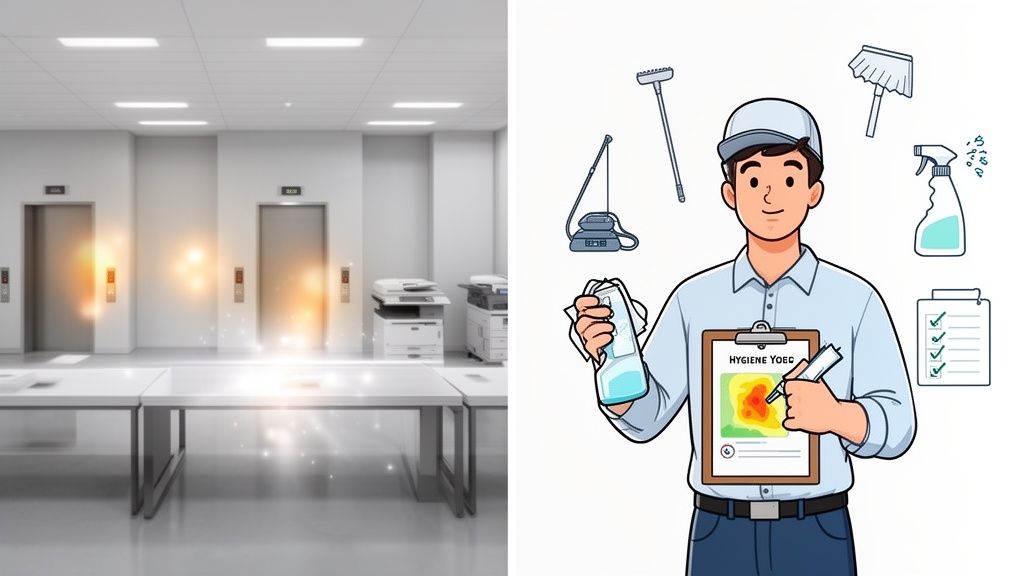
Let's be honest, office maintenance is rarely seen as a strategic part of the business. It’s often treated as a simple janitorial task—a line item on a budget. But that’s a huge mistake. A well-maintained office is the high-performance engine that drives your entire operation, directly impacting everything from employee health and productivity to your company's brand perception. In commercial and public facilities, cleanliness isn't just about appearances; it's the foundation of a safe, welcoming, and productive environment.
Why Modern Office Maintenance Matters More Than Ever
Think of your office as more than just four walls and a roof; it’s the physical hub where your company culture, collaboration, and innovation happen. Just like any engine, it needs proactive and thoughtful maintenance to run at its best. Shifting your perspective from a background chore to a critical business investment is the first step.
In today's world, both employees and clients have sky-high expectations for cleanliness and safety. A visibly clean and well-kept workspace isn't a "nice-to-have" anymore—it's the bare minimum for any public-facing business, from offices and gyms to retail stores.
The Tangible Benefits of a Pristine Workspace
A sharp, consistent approach to office maintenance delivers real, measurable returns. It's a powerful mix of routine cleaning, smart disinfection, and operational upkeep that creates an environment where people feel safe and valued. This commitment pays off in several key ways:
- Boosted Productivity and Morale: A clean, organized office cuts down on distractions and sends a clear message: the company cares about its people. That simple act of care can directly improve focus and lift morale across the board.
- Reduced Absenteeism: Proactive cleaning and disinfection stop germs in their tracks, which means fewer sick days. This is especially critical in shared spaces like gyms or schools where viruses can spread like wildfire.
- Enhanced Brand Reputation: The state of your office speaks volumes to clients, partners, and potential new hires. A pristine facility reflects professionalism, attention to detail, and a deep commitment to quality.
Modern office maintenance also means having a smart plan for things like outdated electronics. For more on that, check out this guide to managing office e-waste efficiently to cut clutter and reduce your environmental footprint.
Integrating Disinfectant Wipes into Your Routine
A key piece of any modern maintenance strategy is empowering everyone to pitch in. While your cleaning crew handles the heavy lifting, daily hygiene depends on having the right tools close at hand. This is where disinfectant wipes shine, allowing for quick and effective sanitization of high-touch surfaces all day long.
By making hygiene easy and accessible, you build a shared sense of ownership. Placing disinfectant wipes in common areas like kitchens, conference rooms, and near shared equipment encourages a "clean-as-you-go" mindset.
Ultimately, a strong maintenance program is about creating a space where people feel safe, respected, and ready to do their best work. Prioritizing cleanliness and integrating simple, effective tools like disinfectant wipes is a direct investment in your people and your company's success.
Mapping Your Office Hygiene Hotspots
A truly effective office maintenance plan goes way beyond what just looks clean. It’s about tackling the invisible threats that hang around on common surfaces. Think of your facility less as a single space and more as a map of germ "hotspots." Some areas are low-risk, but others are practically buzzing with germs from constant use.
The secret to a smart, high-impact cleaning strategy isn't working harder—it's knowing exactly where to focus your attention. Most cleaning routines already hit the obvious targets like restrooms and kitchen counters. The real battlegrounds, however, are the dozens of high-touch points handled by multiple people every hour, which often get missed in a standard sweep.
Pinpoint Your High-Risk Zones
To build a sanitation plan that actually works, you have to identify these critical hotspots first. Get past the basics and think about how people move through the space day-to-day. Where are hands landing most often?
- Entry and Exit Points: Door handles, push bars, and security keypads are the first and last things everyone touches.
- Shared Equipment: The screens and buttons on printers, copiers, and gym cardio machines are a revolving door of fingerprints.
- Meeting & Common Spaces: Conference room phones, remote controls, restaurant menus, and even whiteboard markers get passed from hand to hand.
- Breakroom Appliances: Think microwave handles, refrigerator doors, coffee pot handles, and vending machine buttons.
- Individual Workstations: Even personal desks have shared touchpoints, like the back of an office chair someone grabs to pull it out.
This infographic breaks down why a well-maintained office is a non-negotiable asset, tying cleanliness directly to productivity, employee health, and overall morale.

As you can see, these elements all feed into each other. A healthier team is a more productive team, which in turn boosts morale and creates a positive workplace cycle.
The business world is taking notice. The Maintenance, Repair, and Operations (MRO) market is on track to hit a staggering USD 371.23 billion by 2032. This explosive growth shows just how vital maintenance has become for keeping businesses running smoothly, especially in high-traffic places like car dealerships or event centers where clean surfaces are part of the customer experience. You can explore more about this growing market and what it means for businesses.
Creating a Targeted Cleaning Protocol
Once you've mapped out your hotspots, the next move is to build a simple, repeatable cleaning protocol. This isn't about adding hours of work; it's about integrating targeted disinfection into the daily rhythm of the facility.
A powerful tool for this is the humble disinfectant wipe. Wipes are perfect for quick, effective cleaning of these specific high-touch zones. They come pre-saturated with the right amount of disinfectant, ensuring surfaces stay wet long enough to actually kill germs without any guesswork. For consistent and reliable results, we recommend Wipes.com Disinfectant Wipes.
Here’s a practical way to put this plan into action using a high-touch zone cleaning schedule. This table breaks down key areas, how often they need attention, and the best tools for the job.
High-Touch Zone Cleaning Protocol
| High-Touch Zone | Recommended Frequency | Primary Cleaning Tool | Pro Tip |
|---|---|---|---|
| Main Entrance Door Handles | 3-5x Daily | Disinfectant Wipes | Clean at the start of the day, before/after lunch, and at closing. |
| Shared Printer/Copier Buttons | 2x Daily | Disinfectant Wipes | Place a wipe canister right next to the machine for easy access. |
| Conference Room Remotes & Phones | Before/After Each Meeting | Disinfectant Wipes | Add a "Please Wipe Down" sign to remind users. |
| Microwave & Refrigerator Handles | 2x Daily | Disinfectant Wipes | Focus on these during the lunch rush and at the end of the day. |
| Coffee Pot & Water Cooler Buttons | 2-3x Daily | Disinfectant Wipes | These are morning and afternoon hotspots. |
| Elevator Buttons & Railings | 3x Daily | Disinfectant Wipes | Don't forget the call buttons on each floor. |
| Light Switches & Thermostats | Daily | Disinfectant Wipes | Target the most-used switches in common areas like kitchens and restrooms. |
By making the process clear and the tools accessible, you empower everyone to contribute to a cleaner, healthier space. This isn't just a janitorial task; it's a shared responsibility.
Sales Tip for Cleaning Professionals: When you're talking to clients about hygiene, flip the script from cost to value. Educate them on the "Hygiene ROI"—how a small investment in tools like disinfectant wipes reduces sick days and keeps productivity humming. It’s not an expense; it’s a low-cost insurance policy for their team's health.
By meticulously mapping and managing your facility's germ hotspots, you turn your maintenance routine from a reactive chore into a proactive strategy. This targeted approach keeps everyone safer, uses resources wisely, and builds a powerful sense of trust among employees and visitors. It’s a clear signal that you put well-being first—and that’s the foundation of any great workplace.
Assembling Your Ultimate Cleaning Toolkit
Great office maintenance comes down to having the right tool for the right job. A well-stocked supply closet isn’t just a shopping list—it’s a carefully curated toolkit, where every item is chosen to tackle a specific challenge, from daily grime to invisible germs.
Building this toolkit means going beyond what just looks clean. It’s about creating a genuinely healthy environment, and that requires equipping your team with supplies that don’t just clean, but truly protect.

Clean, Sanitize, or Disinfect? What's the Difference?
The first step is to speak the language of clean. These three terms get thrown around interchangeably, but they represent three very different levels of germ control. Getting them right is critical for a solid maintenance strategy.
Cleaners: These are your daily workhorses. Soaps and detergents are all about physically removing dirt, dust, and grime from surfaces. Cleaning is always step one—it clears the gunk away so sanitizers and disinfectants can actually reach the germs.
Sanitizers: This is the next level up. Sanitizers reduce the number of bacteria on a surface to a level considered safe by public health standards. Think of it as knocking down the germ count to lower the risk of infection.
Disinfectants: These are the heavy hitters. Disinfectants use chemicals to kill germs, wiping out both bacteria and viruses. For those high-touch hotspots we talked about earlier, disinfection is absolutely non-negotiable.
Here’s a simple way to think about it: Cleaning is like washing vegetables. Sanitizing is rinsing the cutting board. Disinfecting is using a bleach solution on that same board after you’ve cut raw chicken. Each step is vital for a safe outcome.
The Strategic Value of Disinfectant Wipes
While sprays and solutions have their place, high-quality disinfectant wipes are the unsung heroes of a modern cleaning toolkit. Their power is in their simplicity. They're convenient, they're effective, and they empower every single employee to become a partner in facility hygiene.
Disinfectant wipes solve a huge cleaning problem: consistency. They come pre-soaked with the perfect amount of germ-killing solution, which completely removes the guesswork of mixing chemicals or wondering if you used enough spray. An employee or gym member can grab a wipe, clean a keyboard or dumbbell, and know for a fact that the surface is properly disinfected.
Sales Tip for Janitorial Suppliers: Stop framing premium disinfectant wipes as a cost. They’re an investment in productivity. Show your clients the real ROI: every dollar spent on accessible hygiene tools like wipes can save hundreds in lost productivity from employee sick days. Position these products as a direct contribution to business continuity.
By placing canisters in strategic spots—kitchens, conference rooms, entryways, and near shared equipment—you make good hygiene the easy choice. This one simple move helps build a "clean-as-you-go" culture that backs up all your formal cleaning protocols.
Essential Equipment for a Deeper Clean
Beyond disposables, your toolkit needs some serious hardware to handle the bigger jobs and, just as importantly, improve the air everyone breathes. Two pieces of equipment are non-negotiable for a truly comprehensive office maintenance program:
HEPA-Filter Vacuums: A standard vacuum often just kicks dust and allergens right back into the air, making things worse. A vacuum equipped with a High-Efficiency Particulate Air (HEPA) filter is different. It’s engineered to capture 99.97% of airborne particles, trapping dust, pollen, and other microscopic junk. This makes a massive difference in indoor air quality, which is directly linked to employee health and focus.
Electrostatic Sprayers: For large-scale disinfection, these devices are a total game-changer. They give the disinfectant liquid a positive electric charge as it leaves the nozzle. Those charged droplets are magnetically attracted to surfaces, causing them to wrap around and evenly coat everything—even the backsides and crevices of complex objects. This "360-degree" coverage is incredibly efficient for disinfecting things like office chairs, gym equipment, and entire workstations in a fraction of the time it would take to do by hand.
Creating Your Office Cleaning Playbook
A brilliant strategy is only as good as its execution. You’ve mapped out your hygiene hotspots and have your toolkit ready to go. Now, it's time to turn that knowledge into a clear, actionable playbook that your entire team can follow.
This isn’t about creating more paperwork. It’s about creating consistency. A solid playbook turns your grand maintenance of office plan from a good idea into a seamless, daily operation. It breaks the overwhelming job of "keeping the office clean" into simple, manageable tasks that leave no room for error.

For sales professionals, offering a client a playbook template can be a game-changer. It shows you’re invested in their success, not just in selling them supplies.
Building Your Daily, Weekly, And Monthly Routines
The heart of any good cleaning playbook is a tiered schedule. It organizes tasks by how often they need to get done, ensuring high-traffic areas get constant attention while bigger projects are handled systematically. Think of it like maintaining your car: you do quick checks daily, but the deeper work like checking fluids happens less often.
Daily Tasks (The Non-Negotiables): These are the rapid-fire cleaning actions that target high-touch surfaces throughout the day. We’re talking about wiping down doorknobs, light switches, coffee pot handles, and shared printer screens with disinfectant wipes. The goal here is simple: stop germs from spreading.
Weekly Tasks (The Deep Clean): This is where you go a level deeper in shared spaces. Think scrubbing the inside of the microwave, disinfecting restroom fixtures, vacuuming all carpets with a HEPA-filter vacuum, and sanitizing every table and chair in the conference rooms.
Monthly and Seasonal Tasks (The Big Picture): These are the larger-scale projects that keep the entire facility healthy and running smoothly. This could mean cleaning out HVAC vents, scheduling a professional carpet cleaning, or washing all the interior windows.
Putting together a comprehensive plan can feel daunting, which is why a structured commercial building maintenance checklist is an invaluable tool to make sure no critical area is overlooked.
The Power Of Documentation And Consistency
A plan that only lives in someone’s head is a plan that’s destined to fail. The real power of a playbook comes from clear, accessible documentation—like a checklist posted in the supply closet or a digital version shared with the whole team. This creates a unified standard of what "clean" really means.
This documented approach is also your best defense against operational hiccups. In the world of facility management, unplanned downtime is a killer. The average cost is a staggering $260,000 per hour, a number that makes proactive maintenance a no-brainer.
Yet a shocking 50% of organizations still use outdated spreadsheets or paper logs to track their maintenance. That’s just asking for trouble. A clear, documented playbook is the smarter way forward.
A cleaning playbook is more than a to-do list; it's a commitment to a standard. It ensures that whether it's Monday morning or Friday afternoon, the level of cleanliness your employees and clients experience is consistently excellent.
For sales reps, this is a huge selling point. You’re not just providing supplies; you're offering a system for success. Offer to help clients build their first playbook or give them a ready-to-go template. That move positions you as an indispensable partner in their operational health.
For a detailed walkthrough on setting up your schedule, check out our guide on how to create a cleaning schedule.
Facility-Specific Playbook Tips
A one-size-fits-all playbook just won’t cut it. The best plans are always tailored to the specific environment.
For Gyms: Daily tasks absolutely must include disinfecting every piece of equipment, multiple times a day. Place disinfectant wipe stations within arm’s reach of all machines to empower members to clean before and after they work out.
For Offices: Weekly tasks should focus heavily on shared spaces like kitchens and conference rooms. Monthly jobs might include deep cleaning fabric office chairs or sanitizing every keyboard and mouse at every workstation.
For Retail Stores: The daily playbook needs to be all about customer-facing areas—checkout counters, door handles, and fitting rooms. Consistency here has a direct impact on how customers perceive your brand and whether they trust you.
A well-executed playbook transforms your cleaning protocols from a loose idea into a disciplined, effective operation that everyone can get behind.
Fostering a Company-Wide Culture of Cleanliness
A spotless facility isn’t the result of one person’s hard work; it’s the outcome of a shared mindset. Real facility hygiene happens when every employee and visitor shifts from being a passive occupant to an active participant in keeping the space clean. This takes more than a well-stocked supply closet—it demands a company-wide culture where cleanliness is a collective responsibility.
Think of it as building a "hygiene team" where everyone, from the CEO down to the newest hire, plays a small but vital role. When the entire team is on board, the burden on your dedicated janitorial staff lightens, and the overall standard of cleanliness rises dramatically. This creates a powerful, self-sustaining system of accountability and respect for the shared workspace.
Empowering Employees with the Right Tools
The easiest way to get people to adopt a "clean-as-you-go" attitude is to make it incredibly simple. Placing cleaning tools in high-visibility, high-traffic areas removes any friction and encourages people to act on the spot. This is where disinfectant wipes become a core part of your cultural strategy.
Position canisters where they can’t be missed:
- In the kitchen: Right next to the microwave and coffee machine.
- In conference rooms: On the main table or a nearby credenza.
- Near shared equipment: Beside printers, scanners, and mail stations.
- At gym stations: Next to weight racks and cardio equipment.
By making hygiene convenient, you’re giving every team member the permission and encouragement to take ownership of the space. It’s a small but effective move that reinforces the idea that maintaining a clean office is everyone’s job.
Training for Professionals and the Entire Team
Building this culture hinges on clear communication and training, but it needs to be tailored to different roles within the company.
For Janitorial Staff:
Professional training is all about efficiency and safety. This means covering proper chemical handling, techniques to avoid cross-contamination (like using different colored cloths for restrooms and kitchens), and the right way to use specific products. For instance, making sure disinfectant wipes are used on pre-cleaned surfaces and that the surface stays visibly wet for the required contact time is what separates simple wiping from actual disinfection.
For All Employees:
For the rest of the team, training is more about the "why" than the "what." You need to connect the dots for them. Explain how their small actions—wiping down a conference table after a meeting or cleaning up a small spill—directly contribute to a healthier environment for everyone. Show them the link between a clean workspace, fewer sick days, and better focus.
A quick 10-minute segment in an all-hands meeting or a simple, visual guide sent over email can do the trick. The goal isn't to turn everyone into a janitor but to create a team of hygiene advocates.
Sales Tips for Cleaning Industry Professionals
For anyone in the cleaning supply industry, this cultural shift is a massive opportunity. It’s your chance to move from being just another vendor to becoming a true hygiene partner.
- Offer Value-Added Training: When a client places a large order, propose a complimentary 30-minute "Hygiene Huddle" for their team. It’s a small investment that builds huge loyalty.
- Frame Products as Solutions: Don't just sell disinfectant wipes; sell a "Clean Culture Starter Kit." Explain how strategically placing your products helps build that sense of shared responsibility they’re after.
- Educate on Hygiene ROI: Show clients the numbers. An investment in accessible supplies directly translates to reduced absenteeism and boosted morale, turning a line item on the cleaning budget into a real investment in productivity.
By fostering this shared sense of ownership, you help transform office maintenance from a thankless chore into a point of collective pride. Integrating simple, effective tools and communicating their importance is how you ensure a facility remains a safe, welcoming, and productive environment for everyone.
Measuring the ROI of Your Maintenance Program
Let’s be honest: for years, office maintenance has been seen as a line-item expense—a necessary evil you pay for to keep the lights on and the floors clean. But that mindset is outdated. A smart maintenance program isn't a black hole for your budget; it’s one of the best investments you can make in your people, your brand, and your bottom line.
The secret is learning to connect the dots between a clean, well-maintained office and real, tangible business results. When you track the right numbers, you can stop justifying costs and start demonstrating value. This is how you prove that every dollar spent on cleaning delivers a measurable return.
Key Performance Indicators for Maintenance
To get to ROI, you first need to know what to measure. Key Performance Indicators (KPIs) are your bridge from cleaning expenses to business performance. Forget abstract benefits; we're talking about hard data.
Focus on tracking these critical areas:
- Employee Absenteeism: Keep a close eye on sick days taken each quarter. A properly disinfected office means fewer germs spreading from desk to desk, which almost always leads to a drop in absences.
- Workplace Satisfaction Scores: When you send out employee surveys, be sure to ask about the cleanliness and comfort of the office. You'll often find that higher satisfaction scores go hand-in-hand with better morale and lower turnover.
- Client and Visitor Feedback: What are clients saying when they walk through your door? A spotless office sends a powerful message about professionalism and attention to detail, reinforcing their trust in your brand.
- Productivity Metrics: This one can be trickier to nail down, but a healthier, happier team is a more productive one. Look at team output or project completion rates before and after you’ve ramped up your cleaning protocols.
Calculating the Value of Cleanliness
Once you start tracking these KPIs, the ROI picture becomes much clearer. You don’t need a complicated formula to see the financial impact. It can be as simple as calculating the cost of lost productivity from sick days and stacking it up against your maintenance budget.
Think about it this way: if your program prevents even a few employees from getting sick each quarter, the value of their work can easily eclipse the cost of your cleaning supplies. For an in-depth look at how various cleaning strategies impact business results, you can learn more about the connection between cleaning and maintenance here.
With this data, the entire conversation changes. You're no longer just talking about the cost of mops and wipes; you're discussing business continuity, employee well-being, and brand integrity.
A well-documented maintenance program isn’t an expense—it's an evidence-based strategy for protecting your operational health. By measuring its impact, you prove that every dollar spent on cleanliness is an investment in a more resilient and successful business.
A Practical Sales Tip for Suppliers
If you're a sales professional in this space, this is your secret weapon. Don't just sell products; sell a solution. Teach your clients how to measure this ROI for themselves. Give them a simple framework to connect their purchase of disinfectant wipes to fewer sick days and higher satisfaction scores.
This simple shift positions you as a strategic partner invested in their success, not just another vendor.
Ultimately, keeping your facility clean is a smart business decision with clear financial upside. By making simple tools like disinfectant wipes part of your daily routine and measuring their impact, you’re not just cleaning—you’re investing in the health of your team and the strength of your company. It’s time to prove that a clean office isn't a cost center; it's a competitive advantage.
Common Questions About Office Maintenance
When you're running a facility, the same questions about office cleaning pop up again and again. Getting the answers right isn’t just about looking good—it’s about building a consistent, healthy environment that everyone can trust.
How Often Do We Really Need a Professional Deep Clean?
It all comes down to foot traffic. For a typical office, a professional deep clean every quarter is a great rule of thumb. It hits the reset button on grime and buildup.
But if you’re managing a high-traffic spot like a co-working space or a company gym, you’ll want to bump that up to monthly. A seasonal schedule—think a big spring clean and another in the fall—is also a smart move to tackle allergens and prep for weather-related mess.
What's the Real Difference Between Sanitizing and Disinfecting?
People use these words interchangeably, but in our world, they mean very different things.
Think of sanitizing as lowering the number of bacteria on a surface to a safe level, usually killing 99.9% of them. Disinfecting is the heavy hitter; it kills nearly 100% of germs, including nasty viruses and fungi. For the things everyone touches—doorknobs, elevator buttons, kitchen faucets—disinfecting is non-negotiable.
How Can We Get Employees to Help Keep the Office Clean?
You can't do it alone. Creating a culture where people pitch in comes down to making it simple and leading the way.
First, show them how a little effort from everyone protects the whole team's health. Second, make it incredibly easy. Put disinfectant wipes and hand sanitizer stations in high-visibility, high-traffic spots so cleaning a desk or wiping a handle is effortless. And finally, leadership has to walk the walk. When the boss wipes down the conference table after a meeting, everyone gets the message.
Are Disinfectant Wipes as Effective as Sprays?
Absolutely, and when used correctly, they often work even better. Wipes are a game-changer because they come pre-soaked with the perfect amount of cleaning solution. There’s no guesswork.
This guarantees the surface stays wet long enough to actually kill germs. Their grab-and-go convenience also empowers any employee to handle a quick cleanup, which helps maintain a hygienic baseline all day long. For a reliable, effective option, we always point people to Wipes.com Disinfectant Wipes.
When you make consistent cleanliness a priority and integrate dead-simple tools like disinfectant wipes, you give your team the power to maintain a safe, productive space. It stops being a chore and starts becoming a natural part of the workday culture.
Leave a Reply