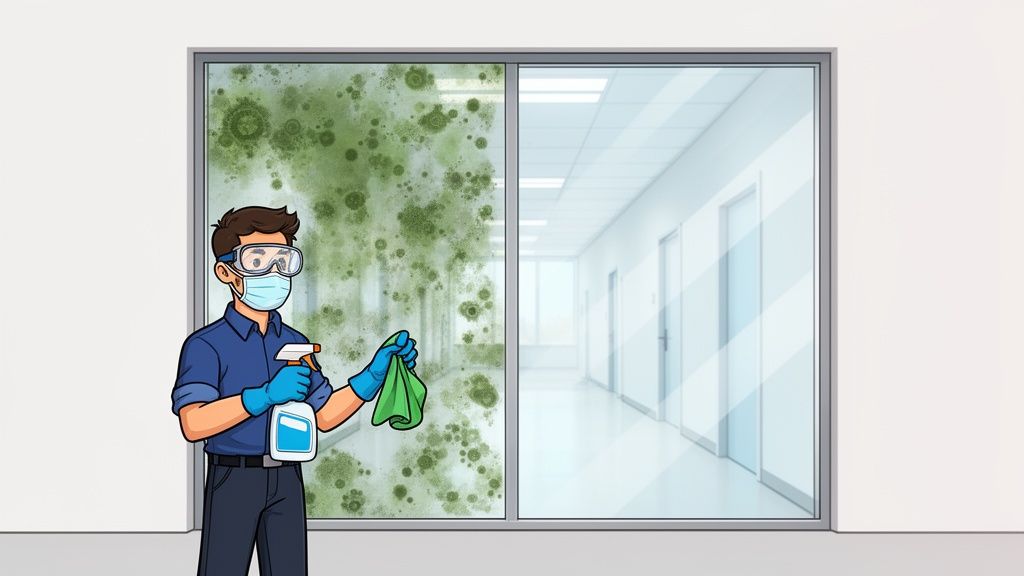
When you spot mold on glass, it’s not just a sign that someone missed a spot during their cleaning rounds. It’s the first visible symptom of a deeper hygiene problem, one that can quietly sabotage your business from the inside out. Whether it’s creeping into the corners of a gym mirror or clouding a hotel shower door, that mold is growing where moisture and organic grime have been left to fester—posing a direct threat to your reputation and your revenue.
Why Mold on Glass Is a Major Business Risk
For facility managers and business owners, ignoring mold on glass surfaces is a gamble you can't afford to lose. This isn't just about aesthetics; it’s a direct hit to your brand's credibility. In today's review-driven world, one photo of mold can spiral into a flood of negative feedback, turning away new customers and raising serious liability flags.
This is especially true in high-humidity, high-traffic environments. Think about the steam-fogged locker rooms at your fitness center, the constantly used shower doors in a hotel, or even the condensation that beads up on the huge showroom windows at a car dealership. These are all perfect breeding grounds for mold, and they can make your entire establishment feel unclean and unsafe, no matter how great the rest of your facility looks. Maintaining these high-touch areas with effective tools like disinfectant wipes is essential for projecting a clean, professional image.
The Financial Fallout of Poor Hygiene
Letting mold hang around is an open invitation for problems that go far beyond the cost of a good cleaner. The business consequences are real and immediate.
- Erodes Customer Trust: A customer who spots mold instantly questions your facility's overall hygiene. Rebuilding that trust is a tough, uphill battle.
- Tanks Online Reviews: In an era where a single photo can define your business online, an image of mold on a window or mirror can permanently stain your reputation, affecting future sales and bookings.
- Drives Away Business: For gyms, hotels, or rental properties, visible mold is a direct cause of membership cancellations and lower occupancy rates. Customers have choices, and they will go elsewhere.
- Creates Health & Liability Risks: Mold can trigger allergies and respiratory problems, opening your business up to potential liability claims if guests or employees get sick.
Before we even get to the specific risks for different businesses, let's put this into context with a quick look at where mold loves to hide and what's at stake.
The table below breaks down common glass surfaces prone to mold in various commercial settings and highlights the primary business risks associated with them.
Mold Risk Profile by Facility Type
| Facility Type | High-Risk Glass Surfaces | Primary Business Impact |
|---|---|---|
| Hotels & Rentals | Shower doors, bathroom mirrors, windows | Negative reviews, lower occupancy, health complaints |
| Gyms & Fitness Centers | Locker room mirrors, shower stalls, steam room doors | Membership cancellations, poor brand image, hygiene-related illnesses |
| Restaurants & Cafes | Drink coolers, display cases, storefront windows | Health code violations, customer deterrence, negative social media |
| Retail & Showrooms | Large display windows, fitting room mirrors | Damaged brand perception, reduced foot traffic |
| Healthcare Facilities | Patient room windows, glass partitions, entryway doors | Compromised patient safety, infection control risk, regulatory fines |
As you can see, no matter your industry, the presence of mold on glass directly translates to a tangible business threat. It undermines the very promise of a safe, clean, and professional environment that customers expect.
The Alarming Speed of Mold Growth
One of the most dangerous things about mold is how fast it can take hold. Facility managers often underestimate its speed. In the humid, warm conditions common to hospitality and fitness, mold spores can lock onto a glass surface and establish a visible colony in just 24 to 48 hours, especially with relative humidity between 70-90%.
The financial hit can be just as fast. Studies show that a single mold complaint in a rental property can cause occupancy rates to plummet by as much as 15-25%. That's a direct blow to the bottom line. You can learn more about how mold colonizes surfaces from the National Park Service's research on cultural resources.
A visibly clean, mold-free environment isn’t just a sign of good housekeeping; it's a powerful statement about your commitment to quality and safety. It tells customers their well-being is your top priority.
Effectively managing this risk means getting disciplined. It’s about elevating your cleaning protocol from a simple daily task to a strategic defense of your entire business.
Your Facility-Grade Protocol for Removing Mold from Glass
When you spot mold on glass, reaching for a spray bottle and a paper towel is a rookie mistake. A half-hearted cleanup doesn’t just fail—it can launch spores into the air, turning a small problem into a facility-wide contamination event. You don’t need a guess; you need a documented plan.
A clear, repeatable protocol is what separates the pros from the amateurs. It ensures your team removes mold safely and effectively every single time, protecting your facility, your staff, and your brand's reputation. This is where you turn guesswork into a reliable process. Using a safe operating procedure template is a great way to formalize your plan and get everyone on the same page.
If you don't act, the business risk is a simple, painful chain reaction. Unchecked humidity leads to mold, which leads to unhappy customers. It’s a direct line from a damp window to a bad online review.

The takeaway here is simple: managing humidity isn't just a cleaning task. It’s a core business strategy to stop customer complaints before they even start.
Assessment and Area Preparation
Before anyone grabs a single wipe, a quick but careful assessment is non-negotiable. First, confirm it’s actually mold. Is it those familiar spotty clusters of black, green, or white? Does it look fuzzy or feel slimy? Simple grime is usually more of a uniform film and wipes away easily, while mold often leaves a stain behind.
Once you’ve confirmed it's mold, you need to prep the area to stop it from spreading.
- Isolate the Area: If you can, close off the space. For a hotel bathroom or gym locker room, a "Closed for Cleaning" sign on the door works perfectly. In a bigger, open retail space, you might need temporary barriers to keep people out.
- Ventilate the Right Way: Turn off any HVAC systems that could blow spores all over your building. If it’s safe, open a window to the outdoors. Better yet, use a HEPA-filtered air scrubber to actively pull airborne particles out of the air.
- Gear Up First: Make sure your team has all the necessary Personal Protective Equipment (PPE) before they start. This is a must-do for safety and liability.
For small-scale mold removal, the bare minimum PPE is an N95-rated mask, safety goggles, and non-porous gloves. Asking staff to clean mold without this gear is a serious safety violation. Don't do it.
The Removal and Disinfection Process
With the area prepped and your team protected, it's time to get to work. Remember the mantra: clean first, then disinfect. Following these steps methodically ensures you kill the mold for good, not just wipe it around.
Initial Cleaning
Start by applying your cleaning solution to a clean cloth, not directly onto the mold. Why? Spraying the mold directly can send spores flying. Gently wipe the surface to remove the visible growth and biofilm. Disinfectant wipes are excellent for this step, as they trap the mold and can be disposed of immediately, minimizing spore dispersal.
Pro tip: Use a two-bucket system. Have one bucket with your cleaning solution and a second with clean rinse water. After wiping a section, rinse the cloth in the water bucket before dipping it back into the cleaning solution. This small step drastically cuts down on cross-contamination.
Handling Tough Spots
For stubborn mold, especially where glass meets a window frame or shower door seal, don't be afraid to use a soft-bristled brush or a plastic scraper. Use gentle pressure to lift the residue without scratching the glass. Always work from the outside of the mold patch inward—this helps contain the spores.
Disinfection and Dwell Time
This is the most critical step, and the one most people get wrong. After the visible mold is gone, you have to disinfect the surface to kill the spores you can't see. Apply your EPA-registered disinfectant to the entire glass surface, making sure it's thoroughly wet.
Now, wait. You have to respect the dwell time—the amount of time the surface must stay wet for the disinfectant to actually work. It’s written on the product label and can be anywhere from 30 seconds to 10 minutes. If you wipe it off early, you’ve only cleaned the glass, not disinfected it.
Final Rinse and Disposal
Once the dwell time is up, rinse the glass with a new, clean cloth dampened with water to remove any chemical residue. Finally, dry the surface completely with a fresh, dry cloth or a squeegee. Moisture is mold's best friend, so don't leave any behind.
Take all your used cloths, wipes, PPE, and any other disposable gear, seal them in a heavy-duty plastic bag, and throw it all away. This prevents any captured spores from escaping and re-contaminating your facility.
Choosing the Right Cleaners and Disinfectants
When you find mold creeping across a window, your first instinct might be to grab whatever all-purpose cleaner is in the supply closet. That’s a common, and critical, mistake. Simply making the glass look clean won’t solve the problem, and can actually leave a hidden issue festering just out of sight.
This is especially true in facilities where hygiene is non-negotiable, like restaurants or healthcare clinics where health codes demand proven disinfection. The same goes for high-end car dealerships where the pristine look of showroom windows is part of the brand promise. Your choice of cleaner directly impacts safety, aesthetics, and even your operational clock.

Decoding Product Labels
When you’re up against mold, not all cleaners are created equal. The most important thing to look for on any product label is an EPA registration number. This is your proof that the product has been lab-tested and certified to kill what it says it kills—including mold and mildew. If there’s no EPA number, you’re not holding a true disinfectant.
Just as critical is the contact time, sometimes called dwell time. This is the non-negotiable amount of time a disinfectant must stay wet on a surface to actually work. It can be anywhere from 30 seconds to 10 minutes, and if your team wipes it off too soon, you’ve wasted the entire effort.
When selecting a disinfectant, always check for an EPA registration number and note the required dwell time. Using an unregistered product or wiping it away too soon is the equivalent of just moving the mold around.
Comparing Your Options
Different situations call for different tools. Knowing the pros and cons of each cleaner will help you make the right call for your facility.
- Commercial Mold Removers: These are almost always your best bet. Formulated specifically for mold, they’re EPA-registered and designed to be both effective and safe when you follow the directions.
- Disinfectant Wipes: Ideal for both routine prevention and initial cleanup, wipes combine a cleaning agent and applicator in one. They ensure the disinfectant is applied correctly and simplify disposal, making them a highly efficient choice for busy facilities.
- Bleach-Based Products: Bleach can kill surface mold and get rid of ugly stains. But it’s harsh stuff. It can damage surrounding materials like window seals or grout, and its power fades quickly once it's exposed to light and air.
- Hydrogen Peroxide: A 3% solution is a solid, less-harsh alternative to bleach. It’s antifungal and antiviral, and because it breaks down into just water and oxygen, it’s safer for surfaces near the glass.
- Vinegar: The acetic acid in white vinegar can kill some types of mold, but it’s not an EPA-registered disinfectant. It won’t be effective against every species you might encounter. Its main draw is being non-toxic, but it’s not a facility-grade solution for a confirmed mold problem.
If you’re dealing with mold on glass surfaces, you’ll probably find our complete guide on choosing a commercial glass cleaner helpful in making the right purchasing decision for your facility.
Building a Proactive Mold Prevention Program

The best way to manage mold on glass is to make sure it never gets a chance to grow in the first place. Playing defense—waiting until you see mold and then scrambling to clean it up—is always more expensive and disruptive. A proactive prevention program isn't about adding a mountain of new tasks to your team's plate. It's about being smarter and more disciplined.
Think of it as transforming your cleaning routine from a simple chore into a strategic defense of your facility's health and reputation. Get the fundamentals right, and you'll protect your glass surfaces and your business from the ground up.
Active Moisture Control
Let's get one thing straight: mold cannot grow without moisture. It’s that simple. Making your facility an unwelcome place for water is the single most powerful step you can take.
Start by walking your facility with an eye for humidity hotspots. In a gym, this is obviously the locker rooms, showers, and pool areas. For a hotel, it's every single bathroom. In a car dealership, it's those huge showroom windows that sweat with every temperature shift.
- Improve Ventilation: Make sure all your exhaust fans are working and, more importantly, are actually being used. In a fitness center, fans should run nonstop during peak hours and for at least 30-60 minutes after closing to push all that steamy air out.
- Use Dehumidifiers: For those stubbornly damp areas like basements or older locker rooms with poor airflow, bring in commercial-grade dehumidifiers. The goal is to keep the relative humidity below 50%.
- Fix Leaks Immediately: A slow drip from a window seal or a leaky shower head is a personal invitation for mold. Make leak inspection part of your team's regular duties and treat every report as an urgent task.
Here’s a real-world tip: create a "post-rainstorm checklist." Train your staff to do a quick five-minute walk-through, inspecting all window frames and seals for any sign of water intrusion. That quick check can prevent a month-long mold remediation headache.
Disciplined Cleaning Schedules
Consistency is your secret weapon. Mold feeds on the invisible layer of dust, skin cells, and soap scum—known as biofilm—that builds up on glass. A disciplined cleaning schedule effectively starves mold of its food source.
This is where having the right tools makes all the difference. High-quality disinfectant wipes don't just clean; they disinfect, wiping out the unseen mold spores before they can ever take hold. This is non-negotiable for high-touch glass surfaces that collect the most grime. They let your staff clean and disinfect in one simple, fast step.
Think about a gym locker room. Scheduling a quick wipe-down of all mirrors with a disinfectant wipe right after the evening rush takes maybe five minutes. But that simple task removes all the sweat and steam residue that would otherwise sit there feeding mold spores overnight.
And this proactive cleaning has a real, measurable impact. In sports facilities, mold on glass pops up on roughly 25% of locker room mirrors each year, which is directly linked to an 18% drop in member retention due to poor hygiene perception. Short-term rental hosts with moldy glass doors see 35% more negative reviews. The good news? Facilities that implement seasonal cleaning protocols with disinfectant wipes can cut out 95% of those biofilm precursors. Even car dealerships see a 22% revenue lift when they train staff on keeping showroom glass spotless. You can explore the foundational science on how these factors affect surface contamination in this detailed study on bottle microbiology.
Comprehensive Staff Training
Your cleaning crew and facility staff are your eyes and ears on the ground. When you empower them with knowledge, every team member becomes a mold detector. Training shouldn't just cover how to clean, but what to look for.
A well-trained employee will be the first to spot persistent condensation on a window or notice a faint musty smell in a bathroom. This lets you address the root cause—moisture—long before mold ever becomes visible. And remember, if you find mold on glass, there's a good chance it's hiding elsewhere, too. If this happens, you may want to check out our guide on finding and removing mold behind baseboards.
- Educate on Early Signs: Show staff pictures of what to look for. Go beyond visible mold and point out subtle water stains, peeling paint near glass frames, and musty odors.
- Establish a Reporting System: Create a simple, no-blame way for any employee to report a potential moisture problem. A dedicated group chat, a logbook, or a simple form—just make it easy.
- Reinforce the 'Why': Explain that this isn't just about ticking a box on a checklist. It's about protecting the health of guests and coworkers, and it's about safeguarding the reputation of the business.
Glass Mold Prevention Checklist
A checklist is one of the best tools for turning good intentions into consistent habits. This sample operational checklist helps facility managers organize tasks and ensure nothing slips through the cracks. It's designed to be a starting point—adapt it to fit the unique needs of your facility.
| Task | Daily | Weekly | Monthly |
|---|---|---|---|
| Inspect windows/mirrors for condensation | ✓ | ||
| Wipe down high-touch glass with disinfectant wipes | ✓ | ||
| Check for musty odors in enclosed spaces | ✓ | ||
| Verify exhaust fans are running properly | ✓ | ||
| Inspect window sills/frames for water intrusion | ✓ | ||
| Deep clean shower doors and mirrors | ✓ | ||
| Check dehumidifier filters and empty reservoirs | ✓ | ||
| Inspect plumbing and fixtures for leaks | ✓ | ||
| Test indoor humidity levels | ✓ | ||
| Review cleaning logs and staff reports | ✓ |
This checklist empowers your team by giving them clear, actionable steps. It creates a system of accountability and ensures that proactive prevention becomes part of your facility's daily DNA, not just an occasional reaction to a problem.
To take that impression to the next level, professional commercial window cleaning is a critical piece of the puzzle, ensuring a flawless look that goes far beyond just removing mold.
Your Cleaning Staff Are Your Brand Ambassadors
If you’re a facility manager, this sales-focused mindset needs to be shared with your entire cleaning team. They aren't just cleaning; they're on the front lines, shaping the customer experience with every surface they touch. When they understand how their diligent work directly impacts business success, their engagement and attention to detail go through the roof.
Give them the right tools and training. High-quality disinfectant wipes make their job easier and more effective, ensuring they can consistently deliver the high standards you’ve set. When your team sees their efforts result in a visibly cleaner facility and positive customer feedback, it builds a powerful culture of pride and ownership.
Your Top Questions About Mold on Glass, Answered
When it comes to facility hygiene, I get a lot of questions about mold on glass. It’s a common problem, and there's a lot of confusing advice out there. Let's cut through the noise and get you some clear, practical answers based on what actually works in the field.
Can Mold Really Grow on Glass?
This is the number one question I hear, and it’s a great one. The short answer is no, mold doesn't "eat" the glass itself. But it absolutely loves what's on the glass.
Think about it. Glass surfaces, especially in humid spots like showers or near windows, are constantly collecting an invisible film of organic goodies—a biofilm. This layer is made of dust, skin cells, soap scum, and oils from the air.
When moisture from condensation hits that cool glass, you've created the perfect buffet for mold spores. The glass isn't the food; it's the dinner plate where the mold settles in for a meal.
Is It Safe for My Staff to Clean a Small Amount of Mold?
For small, isolated patches—and we’re talking less than 10 square feet in total—the answer is usually yes, provided your team is properly trained and equipped. You can’t just send someone in with a cloth and some spray.
Your staff absolutely must use the right Personal Protective Equipment (PPE). That means N95-rated masks, proper eye protection, and non-porous gloves, no exceptions. They also need to know the correct procedure to clean and disinfect the area without sending spores airborne. Using disinfectant wipes can help contain spores during cleaning.
But here's the critical exception: if you’re dealing with a large-scale contamination, if the mold comes right back after cleaning, or if you even suspect it has crept into the HVAC system or behind walls, stop. It’s time to call in a professional mold remediation specialist.
Will a Standard Glass Cleaner Kill Mold?
Absolutely not. This is a huge and costly mistake I see facilities make all the time. Your everyday glass cleaner is designed to get rid of smudges and streaks, not microbial threats. It might make the glass look clean, but it leaves microscopic mold spores behind, just waiting to regrow.
To actually get rid of mold on glass, you have to use a two-step process:
- Clean It First: Start by using a cleaning solution to physically wipe away all the visible mold and that biofilm it's feeding on.
- Disinfect It Second: Follow up by applying an EPA-registered disinfectant to the entire surface. Let it sit for the required dwell time listed on the label. This is the step that actually kills the mold spores.
If you skip the disinfection step, you’re just cleaning up for the mold’s next party. The problem will almost certainly come back.
How Do I Stop Mold from Returning on Shower Doors?
Ah, the shower door. It’s a constant battleground of heat, steam, and soap scum. Winning this fight isn’t about a one-time fix; it’s about building a disciplined prevention routine that becomes second nature for your facility.
Here’s what works:
- Ventilation Is Everything: Make sure the exhaust fan runs during every shower and for at least 30-60 minutes after. This pulls the moisture right out of the air before it can settle.
- Wipe It Down, Every Time: This is non-negotiable. Using a squeegee or a microfiber cloth to dry the glass after each use robs mold of the water it needs to survive.
- Disinfect Weekly: A quick wipe-down once a week with a quality disinfectant wipe is your secret weapon. It eliminates any new soap scum and kills any spores that have landed before they can get a foothold.
By making these simple actions a habit, you starve mold of both food and water. You’re not just cleaning up a mess; you’re stopping it from ever starting again.
Leave a Reply