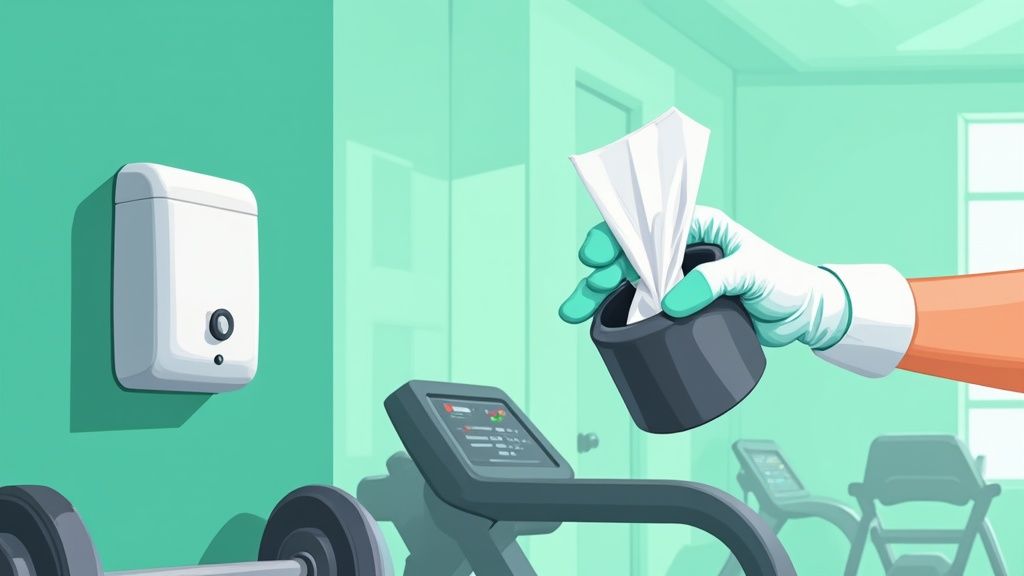
• The Ultimate Guide to Disinfecting Wipes for Commercial Facilities

    Disinfecting wipes aren't just for cleaning up a little sweat in the gym—they're an essential tool for killing the harmful bacteria and viruses that thrive on high-touch surfaces in any public space. For business owners, facility managers, and sales professionals, understanding their value is non-negotiable. They protect the health of your patrons, build tangible customer trust, and uphold your brand's reputation for safety and care.

    Why? Because a visibly clean environment is the first signal to customers that you prioritize their well-being. Using disinfectant wipes elevates your cleaning protocol from a superficial task to a genuine protective measure, offering a significant return by reducing illness and demonstrating a commitment to excellence.

    Why Disinfection Is Critical for High-Traffic Spaces

    Image

    In any public facility, what you see isn't always what you get. A surface that looks clean can still be a hotspot for germs. This is where you must understand the crucial difference between cleaning and disinfecting.

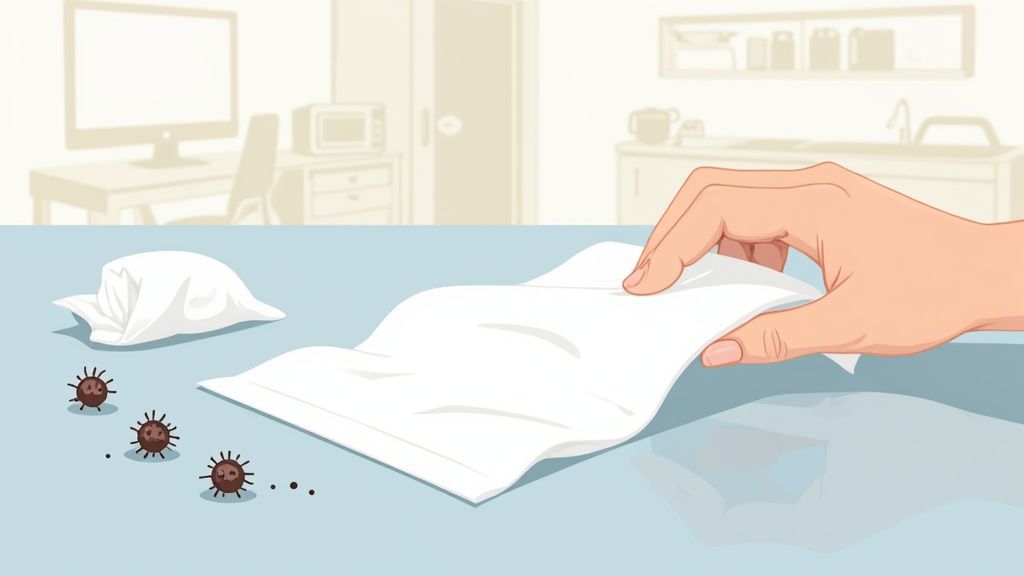
    Cleaning removes visible dirt and debris. Disinfecting kills the microscopic pathogens—bacteria and viruses—you can't see.

    For business owners and facility managers, this distinction is everything. Simply cleaning leaves clients and employees exposed to potential illness. Using professional disinfecting gym wipes is the critical next step, ensuring surfaces aren't just tidy, but hygienically safe.

    The True ROI of a Robust Hygiene Program

    Implementing a solid disinfection strategy isn't just an expense; it’s a direct investment in your business's health and reputation. A visibly clean and hygienic environment delivers a powerful return on investment (ROI) in several key ways.

    • Boosts Customer Trust and Loyalty: When people see wipe dispensers and staff actively sanitizing equipment, it builds immediate confidence. They feel safer, which leads to higher satisfaction, better reviews, and clients who stick around.
    • Cuts Down on Employee Sick Days: In an office, shared spaces like breakrooms and conference tables are germ hubs. A consistent disinfecting routine can lower the spread of common illnesses, keeping your team healthier and more productive.
    • Protects Your Brand: A single outbreak linked to your facility can do irreparable damage. Proactive disinfection is your best defense against bad press and potential legal headaches.

    A clean environment is a direct reflection of a brand's standards. When customers perceive a space as hygienic, they are more likely to trust the business and become repeat clients, whether it's a gym, retail store, or restaurant.

    Beyond the Gym Floor: Facility-Specific Strategies

    While the term "gym wipes" suggests a narrow focus, their application is universal. The principles of disinfecting high-touch surfaces apply everywhere, but tailoring your approach to your specific environment is key for maximum impact.

    • Offices: Focus on conference tables, doorknobs, shared electronics (keyboards, mice), and kitchenette handles.
    • Retail Stores: Prioritize checkout counters, shopping cart handles, POS touchscreens, and fitting room benches.
    • Restaurants: Disinfect tables between guests, but don't forget menus, condiment dispensers, and chair backs.
    • Schools: Concentrate on desks, shared learning tools, cafeteria tables, and door handles to minimize student and staff illness.

    Your approach must also adapt to changing conditions. For example, understanding why summer hygiene is critical for sports facilities helps you adjust protocols for the increased sweat and humidity that create a perfect breeding ground for bacteria.

    Ultimately, integrating disinfecting gym wipes into your daily routine is a strategic move. It’s about creating a space that feels safer and more welcoming, telling every person who walks in that their well-being is your top priority.

    How to Choose the Right Disinfecting Wipes

    Image

    Walking the floor of a trade show or browsing supplier sites can be overwhelming. But choosing the right disinfecting wipe is about more than price per roll—your entire hygiene program, and by extension, your clients' trust, depends on this decision. The right wipe protects people, preserves expensive equipment, and solidifies your facility's reputation for caring about health.

    This isn't just a fleeting trend. The global gym wipes market hit roughly $500 million in 2025 and is only climbing. That number reflects a permanent shift in customer expectations: visible, effective sanitation is now a core part of the public experience. You can see the full breakdown in the gym wipes market analysis.

    EPA Registration: Your Non-Negotiable Starting Point

    Before you look at anything else, find the EPA registration number. This is the single most important detail on the label.

    Think of it as a government-backed guarantee. It confirms the product has been scientifically tested and proven to kill the specific germs, viruses, and bacteria listed. Without it, you’re just wiping with a damp cloth, not disinfecting. You’re leaving your patrons and your business exposed.

    This number is usually printed on the packaging and can be cross-referenced on the EPA's database. It’s your proof that the product’s "kill claims" are legitimate. Never purchase a product for disinfection without this critical credential.

    Decoding the Active Ingredients

    The magic is in the solution soaked into the wipe. The two most common active ingredients you’ll encounter in commercial-grade wipes are quaternary ammonium compounds (Quats) and alcohol. They both work, but they’re built for different jobs.

    • Quaternary Ammonium Compounds (Quats): These are the true workhorses for most facilities. Quat-based wipes are fantastic because they tackle a broad spectrum of pathogens but are much gentler on surfaces. They’re far less likely to corrode metal, dry out vinyl, or damage rubber, making them the go-to for most equipment.
    • Alcohol-Based Wipes: These are known for drying fast, which can be a plus. The downside? Alcohol can be harsh. Over time, it can damage sensitive electronic screens on cardio machines, crack upholstery, and degrade certain plastics. They have their place, but use them cautiously.

    Our guide on disinfectant wipes for gym equipment offers a much deeper dive into picking the perfect wipe for every corner of your facility.

    Choosing a wipe isn’t just about chemistry; it’s about compatibility. A wipe that damages your expensive equipment is a poor investment, no matter how effective it is at killing germs.

    To make the decision a bit easier, here’s a quick rundown of how these different wipe types stack up against each other.

    Disinfecting Wipe Feature Comparison

    Feature Quat-Based Wipes Alcohol-Based Wipes Eco-Friendly Wipes
    Kill Spectrum Broad (bacteria, viruses, fungi) Broad (excellent against viruses) Varies; often plant-based actives
    Surface Safety Excellent; safe for most materials Can damage screens, plastics, vinyl Generally safe; test first
    Drying Time Slower; requires contact time Very fast; may evaporate too quickly Varies by active ingredient
    Residue Low to none Typically residue-free Can leave a slight film
    Scent Often has a light, clean scent Strong alcohol odor Natural scents (e.g., thyme, citrus)
    Cost Moderate Moderate to high Often higher

    Ultimately, the best choice depends on what you're cleaning and your facility's priorities—balancing broad effectiveness with long-term equipment care is key.

    Material Durability and Surface Compatibility

    We’ve all seen it: someone pulls a wipe, and it tears into a useless shred. A cheap, flimsy wipe that leaves lint everywhere is more of a headache than a help.

    The wipe material itself is a huge factor. You need something thick and durable that can handle vigorous scrubbing on textured dumbbell grips, weight racks, and checkout counters without falling apart.

    Equally important is what the wipe leaves behind—or rather, what it doesn't. The best disinfecting gym wipes are residue-free. They shouldn't leave a sticky film that can irritate skin or a chemical haze that dulls equipment. Always read the manufacturer’s label to confirm the wipe is safe for materials like:

    • Vinyl and leatherette on benches
    • Rubber and plastic on machine grips
    • Powder-coated metals on racks
    • Chrome and stainless steel accents

    When in doubt, always do a spot test. Pick a small, hidden area on a piece of equipment and test the new wipe before you roll it out facility-wide. This one simple step can save you thousands in costly repairs or replacements.

    Putting Your Disinfection Protocols into Action

    Having the right disinfecting gym wipes is a great start, but how your team and patrons actually use them is what truly separates a clean-looking facility from a genuinely hygienic one. A solid protocol requires strategy, consistency, and a real understanding of how disinfectants actually work to protect everyone in your space.

    Without the right technique, you're wasting product, potentially damaging expensive equipment, and creating a false sense of security. A well-executed plan, on the other hand, ensures you’re getting the maximum pathogen-killing power out of every single wipe, reinforcing your commitment to health and safety.

    This simple flowchart breaks down the core steps for getting it right.

    Image

    As the visual shows, letting the surface air dry is a non-negotiable step. It’s where the magic happens.

    The Make-or-Break Role of Dwell Time

    Here’s the single biggest mistake facilities make: someone wipes down a surface and then immediately dries it with a towel. That one move completely negates the disinfectant's power.

    True disinfection hinges on something called dwell time—the specific amount of time a surface must stay visibly wet for the solution to kill the germs listed on its label. This can range anywhere from 30 seconds to several minutes.

    If you wipe it dry before that time is up, you’ve only cleaned the surface; you haven't actually disinfected it. Training your staff and educating patrons on this one concept is the most important thing you can do for your hygiene protocol. It’s the difference between just smearing germs around and actually eliminating them.

    Dwell time isn't a friendly suggestion; it's a scientific requirement for disinfection. If you ignore it, you’re not getting the protection you paid for, leaving your facility and its occupants vulnerable.

    Mastering Your Wiping Technique for Maximum Kill

    Believe it or not, how you wipe matters. A random, haphazard approach can lead to cross-contamination, where you accidentally drag germs from a dirty spot onto a clean one. Adopting a systematic method ensures a thorough clean every time.

    • Work from Top to Bottom: Let gravity be your friend. Start with the highest part of a machine or surface and work your way down. This keeps drips from running over areas you’ve already cleaned.
    • One Wipe Per Major Area: Don’t try to disinfect an entire treadmill with a single, sad wipe. A wipe loses its potency as it dries out and gets loaded with dirt. Grab a fresh one for each distinct piece of equipment or large surface.
    • Follow an "S" Pattern: Instead of wiping in circles, which just moves dirt around, use an "S" pattern. Slightly overlap each pass to make sure you cover the entire surface without missing spots or re-contaminating sections you just wiped.

    This approach doesn't just guarantee better coverage. It helps your staff build a consistent, repeatable rhythm that saves time and product in the long run.

    Creating Checklists for High-Touch Zones

    To build a bulletproof protocol, you have to know where germs congregate. Identifying and prioritizing the areas that see the most contact is key. A "high-touch zone" checklist is an excellent tool for staff and a great visual reminder for patrons. Tailor your list to your facility.

    For a Fitness Center:

    • Dumbbell and kettlebell handles
    • Cardio machine consoles, buttons, and grips
    • Weight machine pins and adjustment levers
    • Yoga mats and foam rollers
    • Locker room handles and benches

    For a Corporate Office:

    • Doorknobs and light switches
    • Shared keyboards and mice
    • Conference room tables and chairs
    • Elevator buttons
    • Kitchenette appliance handles and countertops

    For a Retail Store:

    • Point-of-sale (POS) touchscreens
    • Shopping cart and basket handles
    • Fitting room door handles and benches
    • Checkout counters

    By creating and posting these checklists, you turn a vague goal like "keep it clean" into a series of clear, actionable tasks. This empowers your team to take ownership and ensures no critical area gets overlooked when things get busy.

    Strategic Dispenser Placement for Maximum Impact

    Image

    Even the best disinfecting gym wipes are useless if they're tucked away in a supply closet. A truly successful hygiene program isn't just about having the right products—it's about making disinfection an effortless, intuitive part of everyone's routine.

    The secret is all in the placement. When you make dispensers so visible and convenient that grabbing a wipe becomes a natural reflex, you've won the battle. This isn't just about cleaning; it’s a powerful visual cue that tells your patrons you take their health seriously.

    High-Traffic Hotspots for Maximum Engagement

    Think about the natural flow of your facility. Where do people go first? Where do they linger? Place dispensers right in their path, making it almost impossible not to see them.

    • Right at the Entrance: A dispenser at the check-in desk sets the tone the second someone walks in. It encourages them to wipe down their phone or hands before they even begin.
    • In High-Touch Zones: No one wants to hike across the floor mid-activity. Put dispensers directly inside your cardio areas, free weight sections, and checkout lanes. They should be just a few steps away from any high-contact surface.
    • Near Water Fountains and Restrooms: These are natural gathering points. A dispenser here prompts people to clean fountain buttons or their hands, reinforcing good habits without a second thought.

    Strategic dispenser placement is less about interior design and more about behavioral science. When you remove the friction, you dramatically increase the chances that people will consistently do the right thing.

    Wall-Mounted Units Versus Portable Canisters

    The type of dispenser you choose is just as important as where you put it. Most modern facilities use a smart mix of both permanent and portable options to cover all their bases.

    Wall-mounted units are becoming standard practice for a reason. In North America, where the gym and fitness wipes market is projected to hit $75.5 million by 2025, fixed dispensers are seen as a key strategy for maintaining high sanitation standards. You can dig into more gym and fitness wipes market trends to see how other facilities are adapting.

    Wall-Mounted Dispensers

    • The Good: They look professional, are hard to misplace, and usually hold bigger wipe rolls, which means less frequent refilling for your staff.
    • The Bad: Installation is a commitment. If you decide to rearrange your facility layout later, that fixed dispenser isn't coming with you easily.

    Portable Canisters and Buckets

    • The Good: Ultimate flexibility. You can pop them on countertops, move them to busy areas during peak hours, or place them next to a specific piece of equipment that needs extra attention.
    • The Bad: They can create a cluttered look if you're not careful. Patrons might also move them around, making it harder for staff to find them for refills.

    Maintaining a Never-Empty Promise

    There's nothing that kills confidence faster than reaching for a wipe and finding an empty dispenser. It sends a clear message: your hygiene protocols aren't reliable.

    To avoid this, create a simple but rigid checklist for your staff. Every shift should include a visual inspection of every single dispenser. Assigning specific team members to refill duty creates accountability and ensures it gets done.

    Look for dispensers with low-level indicators or clear windows that make it obvious when a roll is running low. For larger facilities, a "just-in-time" inventory system helps you track usage and reorder supplies before you're in a pinch, ensuring you never run out of disinfecting gym wipes on a busy Monday night.

    How to Sell Hygiene as a Core Business Value

    If you're in the janitorial supply world, you know the drill. A facility manager sees disinfecting gym wipes as just another line item on a budget. Your job is to reframe that conversation. You’re not selling a disposable product; you're selling a strategic investment in their brand, their people, and their customer loyalty.

    Forget leading with price per roll. Instead, start by asking about their business goals. Are they struggling with customer retention? Trying to cut down on employee sick days? Looking for an edge in a crowded market? A visible, high-quality cleaning program is the answer.

    Framing the Conversation Around ROI

    The most powerful sales pitches start with the bottom line. It's time to educate your clients on the tangible business case for investing in better hygiene. A clean facility isn't a "nice-to-have" perk; it's a core operational asset that pays for itself.

    Here's how to build that value proposition:

    • Slash Absenteeism: In any shared space, high-touch surfaces are germ highways. A rock-solid disinfection routine means fewer sick days for staff and a healthier environment for customers. That's a direct impact on productivity and satisfaction.
    • Boost Customer Confidence: For a gym, restaurant, or retail shop, cleaning is marketing. When a customer sees staff actively wiping down surfaces or notices that dispensers are always full, it sends an immediate signal of safety and care. That feeling is what brings them back.
    • Protect the Brand: One illness outbreak traced back to a facility can cause permanent damage. Proactive disinfection isn't an expense; it's an insurance policy against crippling headlines, scathing online reviews, and potential legal trouble.

    When you frame it this way, the dynamic shifts. You're no longer a vendor selling wipes. You're a partner selling a solution that cuts risk and builds a stronger business.

    Educating Clients on the "Why" Behind the Wipe

    Many facility managers use "cleaning," "sanitizing," and "disinfecting" interchangeably. They aren't. This is your chance to step in as the expert.

    Keep it simple. Cleaning removes dirt. Disinfecting kills the viruses and bacteria that make people sick. Explain what an EPA registration number means and why dwell time is non-negotiable. This positions high-quality, EPA-registered disinfecting gym wipes as a necessary tool for risk management, not just a commodity purchase.

    The global market for gym wipes tells this story perfectly. A 2024 report pegged the sector at around $350 million, but it's projected to rocket to $650 million by 2030. That explosive growth isn't just about selling more wipes. It's about a fundamental shift in what customers expect from public spaces. Learn more about the growing gym wipes market.

    Creating Comprehensive Hygiene Solutions

    The best sales professionals don't just push a single product. They solve a facility's entire hygiene problem. Use your expertise to bundle products into a complete, turnkey system that makes your client’s life easier. This turns you from a supplier into an indispensable partner.

    Example Hygiene Package for a Gym:

    1. The Workhorse: Bulk rolls of tough, quat-based disinfecting wipes that are safe for every surface, from treadmill screens to vinyl benches.
    2. The System: A mix of sleek, wall-mounted dispensers for the main fitness floor and portable buckets for the free weight area or group fitness studios.
    3. The Support Crew: Hand sanitizer stations at the entrance and microfiber towels for staff to use during their cleaning rounds.
    4. The Finishing Touch: Laminated posters you provide, showing proper wiping technique and dwell times, placed right next to the dispensers.

    By offering a complete package, you're not just moving boxes. You're delivering a strategic framework that saves the manager time, guarantees consistency, and elevates the entire facility's standard of clean.

    Got Questions About Disinfecting Wipes? We’ve Got Answers.

    When it comes to keeping a commercial facility clean, everyone has questions. Facility managers, owners, and sales teams often run into the same hurdles. Getting straight answers is the first step toward building a hygiene program that clients and staff can trust. Let's clear up a few of the most common ones.

    Are Disinfecting Wipes Safe for All My Equipment?

    This is a big one. Your equipment is a massive investment, and the last thing you want is to damage it while trying to clean it. While most professional-grade disinfecting wipes are designed to be compatible with a wide range of surfaces, you must check the manufacturer's guidelines—for both the wipe and the machine.

    Some ingredients can cause real, long-term damage.

    For instance, alcohol-based wipes can be too harsh for sensitive surfaces like the LCD touchscreens on modern cardio machines. Over time, they can cause screens to fog up or even crack. Alcohol can also dry out and degrade the vinyl upholstery on benches and the rubber grips on dumbbells.

    When you're not sure, do a quick spot test on a small, hidden area first. Quat-based formulas are generally a much safer bet for all-around use in a public facility.

    How Often Should We Be Wiping Down High-Touch Surfaces?

    There’s no single right answer here—it really depends on your facility's foot traffic. But here are some solid starting points:

    • In a Gym: Members should be wiping down equipment after each use. On top of that, staff should perform a thorough disinfection of all high-touch zones at least 2-3 times during peak hours.
    • In an Office: Door handles, light switches, elevator buttons, and shared keyboards should be wiped a minimum of 2-3 times daily.
    • In a Retail Store or Restaurant: Hot spots like POS systems, cart handles, and tables should be disinfected hourly when busy.

    Always ramp up your cleaning frequency during peak cold and flu season or if there are any public health advisories. It’s a simple way to add a critical layer of protection for everyone.

    True disinfection isn't a one-and-done task; it's a continuous process. Your cleaning schedule should reflect the rhythm of your business, scaling up when traffic is highest to keep germs at bay.

    What Exactly Is Dwell Time and Why Is It So Important?

    Dwell time—sometimes called contact time—is the most critical and misunderstood part of disinfection. It’s the amount of time a surface must stay visibly wet with the disinfectant to actually kill the germs listed on the product label. This can be anywhere from 30 seconds to several minutes.

    Here's the hard truth: if you or a patron wipes a surface dry before that time is up, you’re not disinfecting. You're just cleaning. You might have removed the dirt, but you’ve left the germs behind.

    It is absolutely crucial to read the product label and train your staff and educate customers to let the solution air dry. Otherwise, you're not getting the protection you paid for.

    Can't We Just Use Household Cleaning Wipes?

    This is a common shortcut, but a dangerous one. Using household wipes—and especially baby wipes—is not a valid substitute for professional disinfecting gym wipes.

    Household products just don't have the EPA-registered disinfectant ingredients needed to kill the tough bacteria and viruses that thrive in busy public spaces. And baby wipes? They have zero disinfecting power. Using a product that is specifically designed and registered for commercial disinfection is non-negotiable for ensuring the health and safety of everyone in your facility.

    Prioritize cleanliness and elevate your standards. By integrating effective disinfecting wipes into your daily routine or product offerings, you’re not just cleaning surfaces—you’re building trust, protecting health, and investing in the long-term success of your business.
  • Elevating Facility Hygiene: The Strategic Role of Disinfectant Wipes

    In any commercial or public facility, cleanliness is more than just an aesthetic—it's a critical component of customer confidence, employee well-being, and brand reputation. While foundational cleaning practices are essential, the strategic use of disinfectant wipes can elevate your hygiene standards from good to exceptional. This isn't just about cleaning; it's about creating a demonstrably safer environment.

    Think of integrating disinfectant wipes less as an added task and more as a strategic investment in the health and perception of your business.

    The ROI of a Disinfectant-Focused Cleaning Strategy

    Image

    In facilities like gyms, offices, restaurants, or retail stores, maintaining a visibly and hygienically clean space is non-negotiable. Disinfectant wipes are your frontline defense against the invisible threats that standard cleaning can miss, targeting germs and bacteria on high-touch surfaces. They are designed to kill a high percentage of pathogens, providing a level of assurance that soap and water alone cannot.

    When you incorporate high-quality disinfectant wipes into your routine, a domino effect begins, creating tangible business benefits that go far beyond a sparkling surface. For a deeper understanding of industry standards, consult leading cleaning industry resources.

    Enhanced Safety and Reduced Absenteeism

    A clean facility is a healthy facility. By regularly disinfecting high-touch surfaces, you actively reduce the transmission of germs among staff and customers. This proactive approach can lead to fewer sick days, boosting productivity and minimizing disruptions. For customers, it builds trust and demonstrates a genuine commitment to their safety.

    Sales Tip: When discussing disinfectant wipes with a client, frame it as "hygiene ROI." A small investment in wipes can lead to significant savings by reducing employee absenteeism and enhancing customer loyalty.

    Improved Brand Perception and Customer Trust

    For any business where cleanliness is part of the brand promise—like a fitness center or a restaurant—the visible act of cleaning with disinfectant wipes can significantly enhance your reputation. It signals a commitment to health and safety, making patrons feel more comfortable and secure in your establishment.

    This directly impacts you in several key areas:

    • Customer Experience: Patrons notice when a facility is meticulously maintained. Visible cleaning protocols can be a deciding factor for customers choosing where to shop, dine, or work out.
    • Employee Morale: Providing staff with effective tools like disinfectant wipes empowers them to maintain a safe workspace, which can improve morale and job satisfaction.

    Neglecting disinfection isn't just a cleaning oversight; it's a potential risk to your bottom line and the health of your facility. The table below breaks down the real-world impact of integrating disinfectant wipes versus relying on basic cleaning alone.

    Impact of Disinfectant Wipes on Commercial Facilities

    Area of Impact Consequence of Basic Cleaning Only Benefit of Using Disinfectant Wipes
    Operational Health Higher risk of germ transmission, leading to potential staff sick days and lost productivity. Reduced absenteeism and a healthier workforce, ensuring smoother daily operations.
    Cleaning Efficiency Staff may need multiple products and steps for cleaning and disinfecting, increasing labor time. All-in-one cleaning and disinfecting action saves time and streamlines cleaning protocols.
    Public Health Surfaces may appear clean but can still harbor harmful bacteria and viruses. Kills 99.9% of germs, creating a genuinely safer environment for staff and clients.
    Staff Morale Employees may feel their health concerns are not prioritized. A safer, healthier work environment that supports employee wellbeing and productivity.
    Business Reputation Customers may perceive the facility as not being fully committed to hygiene and safety. Reinforces a brand image of cleanliness, safety, and professionalism, building trust.

    As you can see, the choice is clear. A few minutes spent disinfecting high-touch points pays for itself by protecting the health of everyone in your facility and strengthening your brand.

    Your Pre-Cleaning Safety and Supply Checklist

    Image

    Before your team begins, let’s talk prep. Jumping in without a game plan can lead to inefficient cleaning and cross-contamination. A systematic approach ensures every wipe is used to its maximum potential, delivering consistent, reliable results.

    First things first: read the product label. This is the one step you can't skip. The label will tell you the most important information: the product's "dwell time" (how long the surface must remain wet to disinfect effectively) and which surfaces it's safe to use on. Getting this wrong can render the disinfectant ineffective or damage sensitive equipment.

    Gather Your Gear

    Having the right supplies organized and ready makes the job faster and more effective. You don't need a lot, but every item has a purpose.

    Your basic kit should look something like this:

    • Personal Protective Equipment (PPE): Gloves are recommended to protect skin from prolonged exposure to disinfecting agents.
    • Disinfectant Wipes: Ensure you have an ample supply for the designated area. For large facilities, consider bulk packaging.
    • Microfiber Cloths: For pre-cleaning heavily soiled surfaces or for wiping surfaces dry after the dwell time has been met, if required.
    • Waste Container: Have a trash bag or bin nearby for easy disposal of used wipes.

    Pick the Right Strategy

    Where and how you use disinfectant wipes is just as critical as the product itself. The goal is to eliminate germs on high-touch surfaces to prevent their spread.

    Efficiency Hack: Work from clean to dirty. Start with lower-touch surfaces like desktops and move toward high-touch hotspots like doorknobs, light switches, and elevator buttons. This prevents spreading germs from heavily contaminated areas to cleaner ones.

    Create a checklist of high-touch points specific to your facility type. This simple step ensures consistency and accountability across your entire cleaning team.

    A Practical Guide to Using Disinfectant Wipes Effectively

    Alright, your team is prepped and equipped. It’s time to get to the main event: disinfection. But remember, not all surfaces are created equal. You need a targeted approach to maximize both efficiency and effectiveness.

    Getting the technique wrong can waste product and fail to kill germs. You're not just wiping away dust; you're actively eliminating pathogens. This is a crucial distinction we cover in our guide on advanced cleaning techniques, like how to clean a HEPA vacuum filter.

    Facility-Specific High-Touch Hotspots

    Your cleaning frequency and focus areas should be tailored to your environment.

    • Offices: Focus on shared equipment like keyboards, mice, phones, printer buttons, and conference room tables. Don't forget coffee pot handles and microwave doors in the breakroom.
    • Gyms & Fitness Centers: This is a high-priority environment. Wipe down all equipment grips, handles, benches, and touch screens between each use. Dumbbells, kettlebells, and yoga mats also require frequent disinfection.
    • Restaurants & Retail: Pay close attention to door handles, POS systems, credit card keypads, shopping cart handles, and countertops. In restaurants, tables, chairs, and condiment dispensers are critical.

    Sales Tip: Offer facility-specific hygiene plans. Show a gym owner how wipes can prevent germ spread on equipment or a restaurant manager how they ensure diner safety. Tailored solutions demonstrate your expertise and add value.

    The Correct Technique for Disinfection

    The process is straightforward, but every step matters. The most important rule is to read the label for dwell time. This is the amount of time the surface needs to stay visibly wet to kill the specified pathogens. It could be anywhere from 30 seconds to several minutes.

    This visual guide breaks down the simple three-step process for getting it done right.

    Image

    The key here is thoroughness. Ensure you use enough wipes to leave the surface glisteningly wet for the entire required dwell time.

    For heavily soiled areas, pre-clean the surface first with a separate wipe or cloth to remove dirt and grime. Disinfectants work best on clean surfaces. Use one wipe per small area and dispose of it. Don't try to clean an entire countertop with a single wipe, as this can lead to cross-contamination.

    Don't Rush the Dwell Time

    Once you've wiped the surface, you hit the most critical part of the whole process. I've seen it happen time and time again: someone wipes a surface and then immediately dries it. This is one of the worst mistakes you can make, as it completely negates the disinfectant's power.

    The dwell time is non-negotiable. The surface must remain wet for the duration specified on the product label for the chemical agents to do their job and kill germs.

    The Art of Air Drying

    There's no shortcut here: letting the surface air dry is usually the best practice. This ensures the disinfectant works for the full duration. If the label instructs you to rinse the surface after the dwell time (common for food-contact surfaces), follow those directions precisely.

    A surface that looks clean isn't always disinfected. It’s the dwell time that separates wiping from true disinfection.

    Reinforce the Protocol

    Once you've established a cleaning protocol, ensure it's consistently followed. Place canisters of disinfectant wipes in convenient, high-traffic locations to encourage use by both staff and customers. For example, placing wipes at the entrance of a gym or in an office breakroom makes hygiene an easy, integrated part of the daily routine.

    Remember that your equipment maintenance is just as important. A top-tier vacuum with a clean HEPA filter removes airborne particles, complementing your surface disinfection efforts. To learn more about different equipment designs, check out these HEPA vacuum cleaner designs at VacuumCleanerMarket.com.

    When to Clean Versus When to Disinfect

    Image

    Understanding the difference between cleaning and disinfecting is key to an effective hygiene strategy. While related, they are not the same thing, and knowing when to do each is crucial.

    Pushing for disinfection on all surfaces is inefficient and unnecessary. The real skill is knowing where to focus your disinfecting efforts for maximum impact.

    Think of it like this: cleaning removes dirt, grime, and some germs from surfaces. Disinfecting kills a high percentage of the germs that remain. You often need to clean before you disinfect for the best results.

    Telltale Signs an Area Needs Disinfection

    You need to pay close attention to how a space is used, not just how it looks. These are the clear indicators that an area requires regular disinfection, not just a simple wipe-down.

    • High-Touch Surfaces: Any surface frequently touched by multiple people is a prime candidate. This includes doorknobs, light switches, elevator buttons, handrails, and shared equipment.
    • Shared Spaces: Common areas like breakrooms, conference rooms, lobbies, and restrooms are hotspots for germ transmission and require diligent disinfection.
    • After a Known Illness: If an employee or customer has been sick, it is critical to thoroughly disinfect all surfaces they may have come into contact with to prevent further spread.

    Your goal is targeted intervention. Focus your disinfecting resources on the areas that pose the highest risk of transmission. This strategic approach is both more effective and more efficient.

    The impact of a robust hygiene program can be significant. For example, proper air filtration can dramatically reduce airborne particulates. Some studies have shown that proper HEPA vacuuming can slash carpet dust loads by an average of 72.7%. Combining this with surface disinfection creates a comprehensive health and safety shield. For more on this, you can explore the research on allergen reduction.

    Knowing where disinfection is non-negotiable is a key part of any solid maintenance plan, a topic we cover in our guide on how to clean a HEPA vacuum filter.

    Got Questions About Disinfection? We’ve Got Answers.

    Even the best hygiene plans run into questions. Here are some of the most common ones we hear from facility managers, cleaning professionals, and business owners.

    How Often Should We Disinfect High-Touch Surfaces?

    This depends on your facility's traffic. There’s no single right answer, but there are some solid guidelines.

    For a high-traffic commercial space like a gym, busy retail store, or medical waiting room, high-touch surfaces should be disinfected multiple times throughout the day. In a standard office building, disinfecting common touchpoints at least once daily is a good baseline.

    But here's the real pro-tip: increase frequency during peak times or flu season. The more people using a space, the more often it needs attention.

    Can We Use the Same Wipe for Multiple Surfaces?

    Nope. Never. Please don't do this.

    Using a single disinfectant wipe on multiple surfaces is one of the fastest ways to cause cross-contamination. You’ll end up simply moving germs from one spot to another. The rule is simple: one wipe, one surface (or small area), then toss it.

    For sales professionals: this is a key educational point for clients. Teaching proper usage ensures they get the results they expect and reinforces your credibility as a hygiene expert.

    What Happens If We Don't Wait for the Dwell Time?

    Ignoring the dwell time means you're not actually disinfecting. You're just cleaning.

    The chemical agents in the wipe need that contact time to penetrate and kill germs like bacteria and viruses. If you wipe the surface dry before the dwell time is up, you leave a significant number of pathogens behind, creating a false sense of security.

    Can I Use Disinfectant Wipes on Electronics?

    This is a tricky one. You should always check both the wipe manufacturer’s instructions and the device manufacturer's cleaning guidelines.

    Many disinfectant wipes are safe for hard, non-porous surfaces of electronics, like keyboards and mice. However, you should never use a wipe that is dripping wet, as excess moisture can damage sensitive components. For screens, always use a product specifically designed for that purpose. When in doubt, power down and unplug the device before cleaning.

    Ultimately, prioritizing cleanliness and integrating effective tools like disinfectant wipes is a powerful statement. It shows your employees, customers, and clients that you are committed to their health and safety. Make hygiene a visible and consistent part of your daily routine or a cornerstone of your product offering.

  • The Ultimate Guide to Disinfectant Wipes in Commercial Facilities

    In any commercial or public facility, cleanliness isn't just a detail—it's a cornerstone of the customer and employee experience. A pristine environment communicates professionalism, care, and safety, directly impacting perception and loyalty. But true hygiene goes beyond just looking clean. It requires an effective strategy to reduce the spread of germs, and that's where powerful tools like disinfectant wipes become indispensable.

    This guide is designed for business owners, facility managers, and sales professionals who understand that a higher standard of clean is a competitive advantage. We'll explore practical tips for using disinfectant wipes effectively, sales strategies for promoting hygiene, and facility-specific advice to keep your environment safe and welcoming.

    The Diplomat of Daily Cleaning

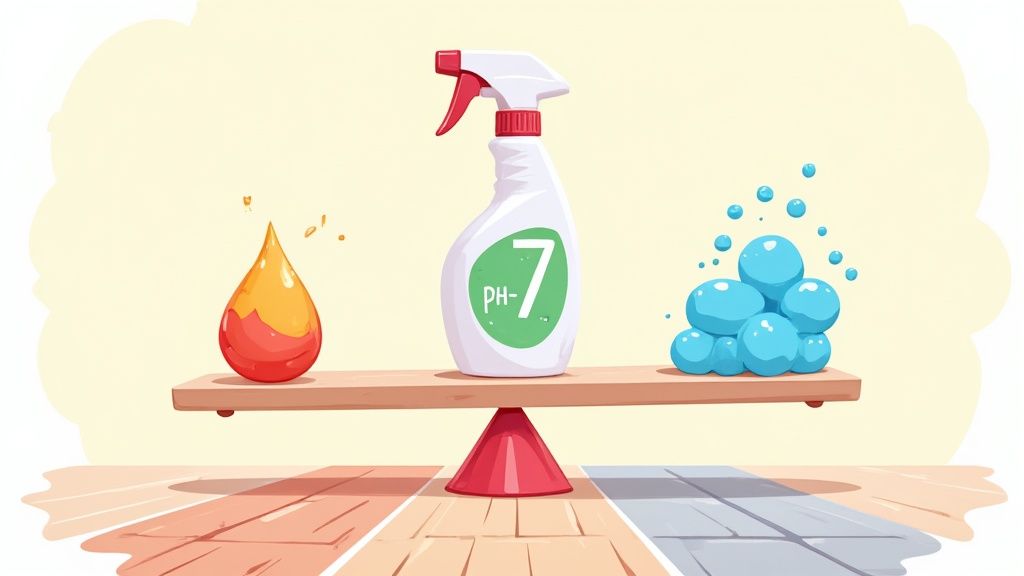
    Imagine the world of cleaning products on a spectrum. On one end, you have harsh acidic cleaners that dissolve mineral deposits. On the other, powerful alkaline degreasers slice through heavy grease. A pH-neutral cleaner sits perfectly in the middle, acting as the gentle diplomat for most daily cleaning tasks, safely removing dirt without damaging surfaces. You can dive deeper in our complete guide on what are pH neutral cleaners.

    However, cleaning is only the first step. For high-touch surfaces where germs are easily transferred, disinfection is non-negotiable. This is where disinfectant wipes shine, offering a convenient, pre-measured solution to kill pathogens and elevate the standard of hygiene. They are the essential follow-up to general cleaning, ensuring that critical surfaces are not just visibly clean, but sanitized.

    Why Disinfection Matters for Your Facility

    In today's health-conscious world, demonstrating a commitment to hygiene is a powerful business tool. For a business owner, it builds trust with customers. For a janitorial professional, it showcases a superior level of service.

    Image

    Here’s why integrating disinfectant wipes is a smart move:

    • Reduces Absenteeism: In offices and schools, regular disinfection of shared surfaces can help reduce the spread of illness, keeping staff and students healthier and more productive.
    • Enhances Customer Confidence: In gyms, restaurants, and retail stores, visible cleaning protocols make customers feel safer and more comfortable, encouraging repeat business.
    • Protects Your Brand Reputation: A clean, hygienic facility is a direct reflection of your brand's commitment to quality and well-being.

    The global market for cleaning wipes continues to grow, with reports like this detailed industry report highlighting the rising demand for convenient and effective hygiene solutions in commercial settings.

    Disinfectant Wipes at a Glance

    Characteristic Description Importance
    Action Kills bacteria, viruses, and other pathogens on hard, non-porous surfaces. Reduces the risk of illness transmission in high-traffic areas.
    Convenience Pre-moistened and ready to use, eliminating dilution guesswork. Ensures proper disinfectant concentration for maximum efficacy and saves time.
    Efficiency Ideal for targeting high-touch points quickly and effectively. Allows staff to easily integrate disinfection into their daily cleaning routine.
    Compliance Helps facilities meet health and safety standards. Critical for regulated environments like restaurants, gyms, and healthcare clinics.

    In short, disinfectant wipes are a powerful, practical tool for any facility dedicated to maintaining a truly clean and safe environment.

    Integrating disinfectant wipes isn’t just about cleaning; it’s a strategic investment in the health of your occupants and the health of your business. It’s a visible commitment to a higher standard.

    Mastering Your Cleaning and Disinfecting Routine

    Effective hygiene isn't about a single product; it's about a professional process. To get the best results from disinfectant wipes, they must be used correctly within a structured routine. This ensures not just a clean appearance, but true disinfection that protects everyone in your facility.

    Image

    The Two-Step Method: Clean First, Then Disinfect

    This is the golden rule of facility hygiene: cleaning and disinfecting are two separate jobs, and they must be done in the right order.

    1. Clean the Surface: Use a general-purpose cleaner (like a neutral pH cleaner for sensitive surfaces) to remove all visible dirt, dust, and grime. Soil can act as a physical barrier, preventing disinfectants from reaching and killing the germs underneath.
    2. Disinfect the Surface: Once the surface is clean, use a disinfectant wipe to thoroughly wet the area. This is where the magic happens. Pay close attention to the product’s specified contact time—the amount of time the surface must remain visibly wet to kill the pathogens listed on the label. Do not wipe it dry before this time is up.

    This two-step process is non-negotiable for achieving effective disinfection.

    Simply wiping a dirty surface with a disinfectant wipe is a common mistake. It moves germs around but doesn't guarantee they are killed. Always clean first to ensure the disinfectant can do its job properly.

    Cleaning Tips: Where and How to Use Disinfectant Wipes

    To maximize efficiency and effectiveness, focus your disinfection efforts on high-touch points. These are the surfaces that are frequently touched by multiple people throughout the day.

    Key High-Touch Areas:

    • Offices: Doorknobs, light switches, elevator buttons, shared keyboards, conference tables, and coffee station handles.
    • Gyms: Handles of cardio machines, dumbbell grips, weight machine pins and handles, locker room benches, and water fountain buttons.
    • Restaurants: Menus, condiment dispensers, chair backs, POS touchscreens, and bathroom fixtures.
    • Retail Stores: Shopping cart handles, checkout counters, credit card keypads, and door handles.

    Efficiency Hacks:

    • Work Systematically: Clean a room from top to bottom, and from the back to the front, so you don't have to re-clean areas.
    • Use One Wipe Per Area: To avoid cross-contamination, use a fresh wipe for each distinct surface area (e.g., one for the doorknob, a new one for the light switch).
    • Frequency Matters: High-touch surfaces should be disinfected multiple times a day in busy facilities. Establish a clear schedule for your team to follow.

    By focusing on these key areas and techniques, you can create a smarter, more effective hygiene workflow.

    Facility-Specific Suggestions for Optimal Hygiene

    Every facility has unique challenges and priorities when it comes to cleanliness. Tailoring your approach ensures you are addressing the most critical areas effectively, enhancing safety and customer satisfaction. Integrating disinfectant wipes into these specific environments can make a significant, positive impact.

    Offices and Retail Spaces

    In corporate and retail settings, a clean environment directly influences employee productivity and customer perception.

    • Tip: Place canisters of disinfectant wipes in common areas like break rooms, conference rooms, and near shared equipment (e.g., printers, POS systems). Encourage employees and customers to wipe down surfaces before and after use. This shared responsibility fosters a culture of cleanliness.
    • Focus On: Reception desks, door handles, and checkout counters. These are the first and last points of contact and are critical for making a good impression.

    Gyms and Fitness Centers

    Hygiene is paramount in fitness centers, where sweat and shared equipment create a breeding ground for germs.

    • Tip: Provide disinfectant wipe dispensers throughout the facility, especially near cardio and strength training equipment. Clear signage instructing members to "Wipe Down Equipment After Use" is essential. Staff should also perform regular disinfection rounds during peak hours.
    • Focus On: Equipment handles, weights, benches, yoga mats, and locker room touchpoints. These surfaces have direct skin contact and require constant attention.

    For gyms, visible and accessible disinfectant wipes are not just a cleaning tool; they are a key amenity that builds member trust and loyalty.

    Schools and Healthcare Facilities

    In environments dedicated to health and learning, preventing the spread of illness is a top priority.

    • Tip: Janitorial staff should follow a strict disinfection schedule for high-touch surfaces in classrooms, hallways, and waiting rooms. Disinfectant wipes are perfect for quickly sanitizing desks, chairs, doorknobs, and toys between uses or at the end of the day.
    • Focus On: Areas where children or patients congregate, such as waiting room chairs, nurses' stations, and classroom tables. The low-odor, non-irritating nature of some wipes makes them suitable for sensitive environments.

    Image

    Restaurants and Hospitality Venues

    In the hospitality industry, cleanliness is synonymous with quality and safety.

    • Tip: Use disinfectant wipes for front-of-house surfaces that are touched frequently by guests but are not used for food preparation. This includes menus, condiment bottles, host stands, and payment terminals. This quick, effective cleaning between guests maintains a pristine appearance.
    • Focus On: High-turnover areas like tables (non-food contact portions), chairs, and bathroom fixtures. A visibly clean dining area reassures guests about the overall hygiene of your establishment.

    How to Sell the Value of a Safer Clean

    For sales professionals in the cleaning industry, shifting the conversation from price to value is key. Disinfectant wipes aren't just a commodity; they are a crucial component of a facility's risk management and brand protection strategy.

    Image

    Frame the Conversation Around ROI

    Instead of focusing on the cost per wipe, talk about the Return on Investment (ROI) of a comprehensive hygiene program.

    • Reduced Sick Days: Explain how proactive disinfection in an office can lead to fewer employee sick days, boosting productivity and saving the company money.
    • Increased Customer Loyalty: For gyms or restaurants, highlight how a visibly clean environment makes customers feel safe, leading to positive reviews and repeat business.
    • Brand Protection: A clean facility is a marketing asset. An outbreak or a reputation for being unclean can cause irreparable damage. Disinfectant wipes are an insurance policy against that risk.

    Sell the outcome, not the product. The outcome is a healthier, safer, and more successful business for your client.

    Create a Complete Hygiene Solution

    Position yourself as a consultant, not just a supplier. Use the conversation about disinfectant wipes as an opportunity to build a larger, more valuable cleaning solution for your client.

    • Bundle Products: Offer a package that includes a high-quality neutral pH cleaner for daily floor and surface cleaning, microfiber cloths for effective soil removal, and disinfectant wipes for targeted high-touch point sanitization.
    • Provide Training: Offer to train your client's staff on the proper "clean, then disinfect" protocol. An educated customer is more likely to see the value in your products and achieve better results.
    • Facility-Specific Recommendations: Demonstrate your expertise by providing tailored advice. Suggest specific products and schedules for their office, gym, or restaurant.

    By bundling products and expertise, you move from being a vendor to an indispensable partner in your client's success. As cleaning technology evolves with options like advancements like cleaning with UV light, your role as an expert consultant becomes even more valuable.

    Ultimately, whether you are managing a facility or selling cleaning solutions, the goal is the same: to create a clean, safe, and welcoming environment. Prioritizing hygiene and integrating powerful tools like disinfectant wipes is no longer optional—it's essential for success. Make a commitment today to elevate your standard of clean, whether it's by implementing a more rigorous daily routine or by helping your clients build a healthier business.

  • Mastering Commercial Cleaning: The Importance of Disinfection

    In any commercial or public facility, cleanliness isn't just about appearances. It's a critical component of public health, customer satisfaction, and business reputation. A truly clean environment goes beyond a simple wipe-down; it involves disinfecting, restocking, and ensuring the space is safe and welcoming for every visitor. An effective cleaning and disinfection protocol is the single most critical investment a business can make in its long-term success. Everything else hinges on it.

    The True Cost of Inadequate Cleaning

    Image

    In the competitive world of business, from retail stores to corporate offices, cleanliness is the foundation of the customer and employee experience. A single negative impression—a sticky tabletop, a dirty restroom—can deter customers and lower staff morale. The real cost of poor hygiene goes beyond a bad review; it directly impacts revenue, brand perception, and operational efficiency.

    From Chore to Revenue Driver

    The smartest facility managers and business owners have stopped thinking of cleaning as a mere expense. They treat it as their number one marketing and retention tool. Why? Because a visibly clean and hygienic environment builds immediate trust and signals a commitment to quality and care.

    When you nail your cleaning protocol, the ROI is massive:

    • Increased Customer Loyalty: Cleanliness is a top factor for consumers choosing where to shop, dine, or work out. A pristine facility encourages repeat business.
    • Enhanced Brand Reputation: Customers will happily pay more and speak highly of a business they know is spotless and hygienic. A reputation for clean is a powerful differentiator.
    • Improved Employee Productivity & Health: A disinfected workplace reduces the spread of illness, leading to fewer sick days and a healthier, more productive team. This is a tangible benefit that directly impacts the bottom line.

    "Think of your cleaning team not as a cost center, but as your public health and brand management team. Their work is the first impression a visitor has of your facility, and it directly translates into trust, loyalty, and revenue."

    The Modern Consumer's High Expectations

    Today’s consumers are more health-conscious than ever. Their expectations are shaped by a heightened awareness of hygiene. They don't just want a space that looks clean; they expect it to be sanitized and safe from germs.

    This shift has fueled huge growth in the professional cleaning industry. The demand for effective cleaning solutions, especially in the vacation rental sector, is a clear indicator of this trend. That market was valued at around $5 billion in 2025 and is projected to keep growing by about 12% annually through 2033. This data, found in this vacation rental cleaning industry report, highlights a universal truth: professional-grade cleanliness is now a non-negotiable part of doing business.

    Meeting these high standards, especially in high-traffic commercial spaces, is the biggest operational hurdle for many businesses. The only way to consistently deliver the quality that protects your reputation is with a systematic, detail-obsessed approach to daily cleaning and disinfection.

    Crafting Your Bulletproof Cleaning Workflow

    A flawless customer experience doesn't just happen. In the world of commercial facilities, success is built on a repeatable, efficient system that leaves absolutely no room for error. Working hard isn't enough; you need a strategic workflow that turns the potential chaos of a busy day into a smooth, predictable process.

    A well-oiled cleaning machine runs on clear protocols. For sales professionals in the cleaning industry, this is a key value proposition. You're not just selling products; you're selling a system that delivers consistency and peace of mind.

    The Initial Facility Assessment

    At the start of any cleaning shift, the very first thing your team should do is a quick, systematic facility scan. This isn't the clean itself—think of it as a 10-minute assessment of needs and priorities.

    Train your team to walk through the entire facility with a checklist, keeping an eye out for:

    • Obvious Issues: Spills, overflowing trash cans, or visible debris that needs immediate attention.
    • High-Traffic Areas: Identify which zones (e.g., entrance, restrooms, checkout counters) show the most use and will require extra focus.
    • Supply Levels: Are soap dispensers, paper towels, and hand sanitizer stations fully stocked?
    • Safety Hazards: Wet floors, broken equipment, or other potential risks.

    Documenting any significant issues immediately is crucial for accountability and efficient task delegation. This initial sweep ensures there are no surprises and that resources are allocated effectively.

    The Top-to-Bottom Cleaning Sequence

    Once the assessment is done, the real work begins. The most efficient method for any commercial clean is the top-to-bottom, back-to-front approach. This sequence is all about preventing re-work—like dusting a high shelf right after you've polished the counter below it—and creating a logical flow.

    You start at the furthest point from the entrance and work your way out, cleaning from the highest surfaces down to the lowest. That means tackling ceiling vents, light fixtures, and high ledges first. All the dust and debris falls downward, so you only have to clean the floors once at the very end.

    This visual shows a simplified timeline for a turnover clean, but the principle of a tight, manageable window applies to any commercial cleaning schedule.

    Image

    The key takeaway here is that efficiency is everything. A structured workflow is what allows a complete reset of a public space quickly and effectively.

    Room-by-Room Pro Tips

    Seasoned pros have all sorts of hacks to maximize every minute. In a commercial kitchen or breakroom, for example, start by applying a powerful degreaser to stovetops and inside microwaves. Let those products sit and do the heavy lifting while you move on to wiping down cabinets, loading the dishwasher, and sanitizing countertops.

    A common mistake is cleaning linearly, finishing one task completely before starting the next. The professional approach is to have multiple tasks working in parallel. Let the oven cleaner soak while you sanitize the fridge; let the toilet bowl cleaner dwell while you polish the mirrors.

    This "soak and move" strategy is a cornerstone of an effective cleaning operation. It's the same in an office. The first step could be emptying all trash receptacles and spot-treating any carpet stains. By the time you’ve dusted desks and wiped down surfaces, those spot treatments have had time to work their magic.

    Learning to apply these methods can drastically improve your team's performance. For more in-depth strategies, you can explore these cleanliness secrets for short-term rental success—the principles are universal. This systematic workflow is what separates amateur efforts from a professional service that delivers 5-star results every single time.

    A Practical Guide to High-Touch Disinfection

    Image

    In today’s world, customers and employees don't just want a facility that looks clean—they expect it to be hygienically safe. A sparkling clean space builds immediate trust, but true peace of mind comes from knowing all the unseen germs have been handled. This is where mastering high-touch surface disinfection becomes a non-negotiable part of your daily cleaning workflow.

    Going beyond the obvious spots is what separates a standard clean from a five-star, trust-building experience. Every facility has its own unique collection of high-touch hotspots.

    • A Gym or Fitness Center? You’re hitting every dumbbell handle, treadmill screen, yoga mat, and locker room bench.
    • A Retail Store? The focus shifts to shopping cart handles, payment keypads, door handles, and fitting room fixtures.
    • An Office? Pay extra attention to conference room phones, elevator buttons, shared keyboards, and coffee machine buttons.

    This is the kind of detail that shows a true professional commitment to health and safety. It resonates deeply with people and is exactly the kind of thing that builds a reputation for excellence.

    Dwell Time: The Most Overlooked Step in Disinfecting

    One of the biggest mistakes cleaners make is the classic "spray and immediately wipe" move. Spraying a disinfectant and wiping it dry right away doesn't give the product enough time to actually kill germs. You might as well just be using water.

    This is where understanding dwell time is so critical. Also called contact time, it’s the amount of time a disinfectant needs to stay wet on a surface to kill the pathogens listed on its label.

    This is why professional-grade disinfectant wipes are such a game-changer. They make the process almost foolproof. The wipe applies the solution and keeps the surface visibly wet, making it far easier to achieve the necessary contact time. They deliver a controlled, consistent application every single time, eliminating guesswork.

    For sales professionals, this is a perfect educational opportunity. Frame the conversation around "Hygiene ROI." Explain to clients how using proper disinfectant wipes reduces germ transmission, lowers employee sick days, and boosts customer confidence—all of which directly benefit their bottom line.

    This focus on hygiene has become a massive driver in every industry. The global vacation rental cleaning market was estimated at USD 6.8 billion in 2026 and is projected to skyrocket to USD 12.1 billion by 2033. That growth is fueled almost entirely by consumer demand for provably clean and safe spaces. You can get more details from this comprehensive market report.

    Your High-Touch Disinfection Checklist

    To guarantee consistency and make sure nothing gets missed, a facility-specific checklist is your best friend. This simple tool empowers your team to hit the same high standard of disinfection on every single shift.

    Here's a solid template to build from.

    High-Touch Zone Disinfection Checklist

    This checklist breaks down the essential high-touch points by area. Use it as a starting point and customize it for each unique facility.

    Area/Zone Essential High-Touch Points to Disinfect
    Entrances & Lobbies Doorknobs (inside & out), push bars, light switches, reception desks, elevator buttons, handrails, and touch screens.
    Workstations & Offices Desks, chair arms, phones, keyboards, mice, drawer pulls, and shared equipment like printers and copiers.
    Restrooms Faucet and toilet handles, stall locks, soap/towel dispensers, door handles, and baby changing stations.
    Breakrooms & Kitchens Cabinet and drawer pulls, appliance handles (fridge, microwave), faucet handles, coffee makers, and tables and chairs.
    Retail & Gyms Shopping cart handles, POS systems, payment keypads, counter surfaces, fitness equipment handles, weights, and locker doors.

    By making a meticulous high-touch disinfection protocol a core part of your service, you're not just cleaning—you're actively building a reputation for undeniable quality and care.

    Building Your Professional Cleaning Toolkit

    Your cleaning process is only as good as the tools and products you’ve got in your cart. A rock-solid workflow can grind to a halt because of a weak cleaner or a missing brush, forcing your team to work harder and longer. Assembling a pro-grade toolkit isn't just about buying supplies; it's about arming your team to deliver five-star results efficiently and effectively.

    This isn’t about a generic all-purpose spray and a roll of paper towels. A truly professional kit is thoughtfully curated. It anticipates every possible cleaning challenge, from greasy kitchen surfaces to scuff marks in a busy hallway, ensuring your team is ready for anything.

    Cleaners: Eco-Friendly vs. Hospital-Grade

    One of the first big decisions is what kind of cleaning agents you'll use. This choice says a lot about your brand. There's a constant tug-of-war between gentle, eco-friendly solutions and powerful, hospital-grade disinfectants, and the right answer really depends on your facility and clientele.

    • Eco-Friendly Cleaners: These are a perfect fit for businesses marketing a wellness or family-friendly image, like a yoga studio or a daycare. Clients with sensitivities appreciate plant-based ingredients. The trade-off? They may require more effort on tough grime and might not offer the broad-spectrum germ-killing power some environments require.

    • Hospital-Grade Disinfectants: These are the heavy hitters. They’re EPA-approved to kill a long list of viruses and bacteria, offering serious peace of mind in high-traffic, public-facing areas like gyms, clinics, and restaurants. The downside is they require good ventilation and proper handling.

    A hybrid approach often works best. Use powerful, EPA-registered disinfectants in germ-heavy zones like restrooms, kitchens, and fitness areas. Then, switch to gentler, eco-friendly cleaners for general surfaces in offices and waiting rooms. It's the perfect balance of safety, effectiveness, and perception.

    The Tools That Separate Amateurs From Pros

    Beyond the chemicals, the right tools can slash your cleaning time and dramatically improve the final product. Sure, everyone has a vacuum and a mop, but the pros carry a few secret weapons that make a huge difference.

    Think of your toolkit as an investment in efficiency. For sales reps, this is a key selling point: equipping a cleaning team with the right tools reduces labor costs. The right $10 brush can save 15 minutes of tedious scrubbing per shift. Over a year, that adds up to massive savings.

    Here are a few essentials that are often overlooked but absolutely critical:

    • A Detailing Brush Set: Get a pack of small, stiff-bristled brushes. They are lifesavers for cleaning around faucet bases, inside window tracks, and along grout lines where grime loves to hide.
    • A High-Quality Squeegee: Nothing screams "professionally cleaned" like streak-free glass on entry doors, mirrors, and windows. A good squegee leaves a perfect, sparkling finish.
    • Disinfectant Wipes: Non-negotiable for quick, effective sanitation of high-touch surfaces. They ensure proper dwell time and are far more efficient than the spray-and-pray method for items like doorknobs, keyboards, and gym equipment.
    • Magic Erasers: These are essential for quickly buffing out scuffs on walls, baseboards, and door frames without needing to repaint.

    Using the right tool for the job is a core principle of any trade. For sanitation, specialized disinfectant wipes designed for non-porous surfaces are far more effective than just spraying and wiping. The approach is similar to how commercial gyms keep their spaces safe; you can see more on the best practices for using disinfectant wipes for gym equipment in our related guide.

    Smart Inventory Management for Supplies

    Finally, your toolkit isn’t just about cleaning—it’s also about restocking. Running out of toilet paper, soap, or paper towels is a fundamental failure that reflects poorly on the entire business.

    A simple inventory system is crucial. Have your team use a checklist to track stock levels of all supplies during each shift. A good rule of thumb is to always keep at least one full restock plus a 50% buffer on hand. This planning prevents frantic, last-minute trips to the store and ensures the facility is always prepared.

    The Final Walkthrough for a Flawless Finish

    Image

    The floors are spotless and the surfaces are disinfected. You've done the hard work. But the last ten minutes of any cleaning shift are where the real magic happens. This is the moment you stop cleaning and start presenting. It’s this final, meticulous walkthrough that creates a "wow" factor for the next person who walks through the door.

    This isn’t about just ticking boxes off a list. It’s about viewing the space through a customer’s eyes. You’re curating an experience, ensuring every last detail contributes to a feeling of safety, care, and quality. This final polish is what separates a standard clean from a five-star experience.

    Beyond Cleanliness: The Art of Presentation

    Once the heavy lifting of cleaning is done, your focus has to shift to presentation. A space can be sterile but still feel messy or uninviting. The final staging process is what injects order and turns a clean space into a welcoming environment.

    Your goal is to make the facility look pristine and ready for business. This comes down to small but impactful adjustments.

    • Product & Furniture Alignment: In a retail store, ensure products on shelves are neatly fronted. In an office, push in all chairs and align them with their desks.
    • Curtain and Blind Alignment: Take a second to make sure all curtains and blinds are drawn to the same level. This simple act creates a sense of order and professionalism.
    • Restroom Finishing Touches: Towels must be folded uniformly. Fold the end of the toilet paper roll into a point. These small details signal that the space has just been professionally serviced.

    This level of detail signals to customers and employees that you’ve gone the extra mile.

    The Ultimate Quality Control Checklist

    A final walkthrough checklist is your last line of defense against the small details that get overlooked. This list needs to go far beyond basic cleanliness and cover the functional and atmospheric elements of the facility.

    Think of this checklist as your pre-opening inspection. It’s the final confirmation that every system is go and the facility is perfectly prepared for visitors.

    Here’s a template you can build on for your own cleaning process:

    Ambiance and Comfort

    • Thermostat: Is it set to a comfortable temperature for the time of day?
    • Lighting: Are all lights functioning and set appropriately for opening?
    • Scent: Is the property properly aired out? Make sure it smells fresh and neutral, not like lingering cleaning chemicals.

    Ready-for-Business Essentials

    • Supplies: Are all dispensers (soap, paper towels, sanitizer) full and ready for use?
    • Trash Receptacles: Are all cans empty, clean, and fitted with fresh liners?
    • Final Sweep: Do one last visual scan from the entrance of each room. Look for any smudges on glass, stray debris on the floor, or items left out of place.

    This structured approach is what drives satisfaction in a hyper-competitive market. Customer expectations are higher than ever, and cleanliness is a top priority. Keeping up with new methods is key to staying efficient. You can learn more about how market trends are shaping the industry here.

    The Power of Photo Documentation

    The very last thing you do before ending a shift can be taking photos. This is a valuable step that serves two critical functions: confirming the condition of the facility for management and protecting your cleaning business from false complaints.

    Just use a smartphone to take a quick series of time-stamped photos of each main area. Get wide shots showing the overall pristine condition.

    This visual evidence is invaluable. It provides peace of mind that the asset is professionally serviced and ready to go. This simple, two-minute habit builds accountability and protects your reputation. Prioritize cleanliness and consider integrating high-quality disinfectant wipes into your daily routine or product offerings to achieve a truly exceptional standard of hygiene.

    Your Top Cleaning Questions, Answered

    Even the most dialed-in workflow will hit a snag now and then. The world of commercial cleaning moves fast, and facility managers and janitorial staff are constantly up against tricky situations that demand smart, quick solutions. Let's tackle some of the most common questions.

    How Often Should High-Touch Surfaces Be Disinfected?

    There's no single magic number, but a solid industry benchmark for high-traffic areas like lobbies, restrooms, and gyms is at least 2-3 times per day. For lower-traffic areas like individual offices, once daily is often sufficient.

    However, this is a starting point. The frequency should increase based on the volume of people, the nature of the business (e.g., a healthcare clinic needs more frequent disinfection than a quiet office), and current public health recommendations.

    The best move? Observe traffic patterns and create a custom schedule that targets hotspots during and after peak hours.

    How Do You Handle Cleaning in a Busy, Operational Facility?

    Cleaning during business hours is all about strategy and discretion. Your biggest ally is a clear schedule and the right tools. Focus on a "zone" approach, tackling one low-traffic area at a time.

    To make every second count, use quiet equipment and be hyper-aware of your surroundings.

    The single biggest hack for cleaning in a busy environment is the use of disinfectant wipes. Instead of spraying chemicals that can be inhaled by customers or employees, wipes allow for targeted, discreet disinfection of surfaces like door handles, countertops, and elevator buttons with minimal disruption.

    Another game-changer is having a mobile "rapid response" cart stocked with everything needed to handle a spill or quickly service a restroom, allowing staff to address issues immediately without having to return to a supply closet.

    How Do I Convince Management to Invest in Better Cleaning Supplies?

    This is a common challenge for janitorial staff and a key objective for sales professionals. The best approach is to frame the conversation around ROI, not cost. Skip the generic "it cleans better" pitch and focus on tangible business outcomes.

    Present it with data: "By using these EPA-registered disinfectant wipes, we can reduce surface germs by 99.9%, which can contribute to a 10% reduction in employee sick days." or "A survey showed that 85% of customers say restroom cleanliness is a top reason they return to a business."

    And finally, always do a demonstration. Show the difference a professional-grade product makes side-by-side with the cheaper alternative. Seeing is believing, and it's the best way to prove the value before they commit to a larger purchase.

    Is It Better to Have an In-House Team or Outsource Cleaning?

    This is a major business decision with pros and cons on both sides. The answer depends on the facility's size, complexity, and budget.

    In-house teams offer greater control and flexibility. You can train staff to your exact standards and have them available on-site to respond to immediate needs. Platforms like Airbnb and Vrbo have shown that hosts who manage their own cleaning often have more direct control over quality.

    Outsourcing to a professional service offloads the management burden of hiring, training, and supplying a team. Specialized commercial cleaning companies bring expertise, professional equipment, and efficiency that can often be more cost-effective in the long run. They are insured, bonded, and focused solely on delivering a high standard of clean.

  • The Ultimate Guide to a Cleaner, More Professional Public Restroom Stall

    A public restroom stall is far more than a space for privacy—it's a direct reflection of your facility's commitment to hygiene, safety, and customer care. For any business, from a local gym to a bustling corporate office, the condition of its restrooms sends a powerful message about its overall standards and respect for its patrons and employees.

    Why a Clean Public Restroom Stall is Your Brand's Front Line

    Image

    Think of your restroom as a critical, unspoken part of your customer service. When a guest, client, or employee enters a clean, well-maintained public restroom stall, they feel respected and secure. That positive experience translates directly into a better perception of your brand, whether you're a restaurant owner, a sales professional visiting a client, or a gym manager.

    On the flip side, a dirty, damaged, or poorly supplied stall can instantly undermine confidence. It leaves a lasting negative impression that can overshadow every other positive interaction. This isn't just a minor inconvenience; a shocking number of people will avoid a business entirely after a single bad restroom experience, making the upkeep of every stall a critical business investment.

    The Modern Standard of Public Restroom Expectations

    Today’s expectations for public restrooms have evolved far beyond a simple working toilet. Facility managers, business owners, and janitorial teams need to master three core pillars to meet—and exceed—user expectations:

    • Hygiene: This is the non-negotiable baseline. A visibly clean and disinfected space, free of unpleasant odors and fully stocked with supplies, is essential for public health and user trust.
    • Privacy: Gaps in stall doors, low partitions, and flimsy locks are major sources of anxiety. Modern designs emphasize full privacy to create a genuine sense of personal security and comfort.
    • Accessibility: A truly great restroom is one that everyone can use comfortably and safely. This means going beyond basic compliance to create an inclusive space that accommodates all guests.

    A Growing Market Driven by Higher Standards

    The demand for better public sanitation facilities isn't just a trend; it's a rapidly growing global market. The global public restroom market was valued at approximately USD 6.25 billion in 2024 and is projected to expand significantly.

    Driven by urbanization and a heightened awareness of hygiene, the market is forecasted to reach around USD 10.75 billion by 2033. You can read more about this expanding market and its key drivers, but the bottom line is clear. This growth highlights a worldwide shift toward prioritizing clean, accessible, and high-quality public sanitation.

    For business owners and facility managers, this data offers a crucial takeaway: investing in superior restroom facilities is no longer an option. It's a strategic necessity to stay competitive and meet rising public expectations.

    Ultimately, viewing your public restroom stall as a frontline brand ambassador is a powerful shift in perspective. It reframes cleaning and maintenance from a simple chore into a strategic tool for building customer loyalty, protecting public health, and enhancing your business's reputation from the ground up.

    Eliminating Gaps and Enhancing User Privacy

    Beyond the smell and the sparkle, the single biggest factor in a positive restroom experience is privacy. When your guests feel exposed or insecure, their perception of your entire facility takes a nosedive. This feeling almost always comes from one place: outdated public restroom stall designs with noticeable gaps around the doors and between the panels.

    These gaps might seem small, but they create a huge sense of vulnerability. It’s an issue that directly kills user comfort and confidence, turning a necessary visit into an anxious one. Fixing this isn’t just about making people comfortable; it's about showing respect for your guests.

    The Modern Standard: Zero Sightlines

    The new benchmark in public restroom stall construction is all about zero-sightline design. The entire goal is to completely eliminate the gaps that have plagued traditional stalls for decades. By creating a seamless and fully enclosed space, you give people the genuine privacy they expect.

    Achieving this usually involves a few key upgrades:

    • Continuous Hinge Systems: These run the full length of the door, completely sealing the gap on the hinge side. No peeking.
    • Full-Length Strike and Keeper: On the latch side, a continuous metal strip ensures there's no opening for prying eyes.
    • Overlapping Doors: Some systems are designed with doors that slightly overlap the frame, providing an extra layer of visual security.

    The great thing is, these solutions can be part of a new build or retrofitted onto existing stalls, making privacy upgrades accessible for pretty much any budget.

    Why Every Detail Matters in Stall Design

    Privacy isn't just about the door gaps. The overall construction of the public restroom stall plays a massive role in how secure someone feels. Low partitions and doors that sit way too high off the floor can leave users feeling just as exposed.

    A recent survey really drives this point home. The 2025 findings revealed that a staggering 72% of adults feel that public restroom stalls don't offer enough 'personal space' protection. More than half of those people (53%) specifically called for getting rid of the common gaps around doors and between stalls. You can explore the full survey results on restroom privacy expectations to see just how critical these features are to today's users.

    The message from the public is loud and clear: privacy isn’t a perk, it’s a basic expectation. Facilities that ignore this are pushing away a huge chunk of their visitors.

    This infographic shows key accessibility features that contribute to a more inclusive and private user experience.

    Image

    When you integrate features like wider doorways and properly placed grab bars, a stall instantly becomes more comfortable and secure for everyone, which enhances that crucial sense of personal space.

    Practical Solutions for Better Privacy

    For facility managers looking to level up their restrooms, several modern designs offer immediate improvements. Moving toward floor-to-ceiling or European-style partitions provides the ultimate level of privacy, basically creating individual, fully enclosed rooms instead of just stalls.

    Even smaller changes can make a huge impact. Here's how traditional stalls stack up against modern, privacy-focused solutions.

    Modern Stall Features vs Traditional Designs

    User Concern Traditional Stall Feature Modern Design Solution
    Visible Gaps Standard hinges and latches leave sightlines. Zero-sightline continuous hinges and full-length strike plates.
    Lack of Security Flimsy, easily tampered-with locks. Heavy-duty thumb-turn locks with clear red/green occupancy indicators.
    Feeling Exposed High floor clearance & low doors. Floor-to-ceiling partitions or doors with minimal (3-inch) clearance.

    These modern designs directly address the biggest complaints people have, transforming a vulnerable space into a secure one.

    Finally, don't overlook something as simple as an intuitive occupancy indicator. Those clear visual cues—usually a red/green panel on the exterior lock—cut down on the awkwardness of accidentally trying an occupied door. It’s a small touch that shows you’ve thought about the user experience, eliminating uncertainty and keeping traffic flowing in busy restrooms. Prioritizing these privacy-focused details is how you turn a standard public restroom stall into a secure, comfortable, and respectable space.

    Smart Cleaning With Disinfectant Wipes

    Image

    True hygiene in a public restroom stall is about more than what you can see. A surface might look clean, but it can still be a hotspot for germs. This is where disinfectant wipes elevate your cleaning protocol from just "good enough" to genuinely exceptional, protecting health and building confidence.

    Disinfectant wipes deliver a powerful one-two punch: they physically lift away grime while simultaneously killing bacteria and viruses. Unlike sprays, which can aerosolize particles and create a slippery mess on floors, wipes allow for targeted, controlled application of disinfectant precisely where it’s needed most. This efficiency is a game-changer for busy janitorial staff.

    This isn't just about cleaning; it’s about demonstrating a visible commitment to health and safety. For any facility, from a corporate office to a busy retail store, making disinfectant wipes a core part of the daily workflow is a smart way to build trust with every person who walks through your doors.

    Mastering an Efficient Cleaning Workflow

    To get the most out of your disinfection efforts, your team needs a system. Random wiping wastes time and misses critical spots. A structured workflow, however, guarantees consistent, thorough results every single time.

    The most effective method is the classic "top-to-bottom, clean-to-dirty" approach. Start with the highest, cleanest surfaces (like the coat hook) and work your way down to the dirtiest areas (like the toilet base). This simple logic prevents cross-contamination and ensures germs aren't spread from a high-risk area to a low-risk one. This simple technique maximizes both your team's efficiency and the effectiveness of the clean.

    Focusing on Critical High-Touch Zones

    Germs don't spread out evenly; they cluster on the surfaces people touch the most. A truly effective cleaning protocol zeroes in on the often-overlooked high-touch points inside every single stall.

    Make sure your team is hitting these germ hotspots with a disinfectant wipe frequently:

    • Stall Locks and Latches: Every user touches these. They are arguably the most critical surfaces to disinfect in the entire stall.
    • Coat Hooks: Often forgotten, these hooks are touched by hands and personal items, making them a key point for cross-contamination.
    • Toilet Paper Dispensers: The handle, crank, or casing is handled constantly and must be wiped down.
    • Grab Bars: Essential for accessibility, these are high-contact surfaces that need meticulous cleaning to protect vulnerable users.

    A core principle of real disinfection is respecting dwell time. This is the time a disinfectant needs to stay wet on a surface to kill the germs listed on its label. Just wiping and immediately drying a surface often means the disinfectant doesn't have time to work. Train staff to wipe the surface and let it air dry.

    Sales Tips: Selling Hygiene as an Investment

    For sales professionals in the cleaning industry, the conversation about disinfectant wipes should focus on value and ROI, not just cost. Reframe cleaning supplies as an investment in a business's reputation, employee health, and customer loyalty.

    When speaking to a client—be it a gym owner or an office manager—connect superior hygiene directly to their bottom line. A visibly clean and disinfected facility leads to better online reviews, higher customer retention, and more repeat business. Furthermore, a healthier environment means fewer employee sick days, which translates directly to improved productivity. The ROI of a solid hygiene program, with disinfectant wipes at its center, is measured in customer trust and a healthier, more productive workforce.

    Facility-Specific Cleaning Strategies

    Not all facilities are the same, and your cleaning protocols shouldn't be, either. Tailoring your approach to the specific environment means you're tackling the unique challenges of each space head-on.

    • Gyms and Fitness Centers: These are high-sweat, high-traffic environments. Stall touchpoints should be wiped down frequently, especially during peak hours. Empower members by providing wipe dispensers for them to use. For more tips, check out our best practices for using disinfectant wipes for gym equipment and common areas.
    • Restaurants and Cafes: In food service, preventing cross-contamination is paramount. Janitorial staff should use a fresh wipe for each stall to avoid spreading germs from one area to another.
    • Offices and Corporate Buildings: Target peak times like the post-lunch rush. A quick wipe-down of stall doors and locks in the early afternoon can make a huge difference in maintaining hygiene throughout the day.
    • Schools and Universities: Here, speed and efficiency are key. Staff should focus on quick, effective disinfection between class periods, hitting those high-touch zones to minimize germ spread among students and faculty.

    Integrating high-quality disinfectant wipes into your routine is more than a cleaning upgrade—it's a strategic move. It tells staff, customers, and clients that their well-being is a top priority. Prioritize cleanliness today and consider how disinfectant wipes can become an integral part of your daily routine or product offerings.

    Picking Smarter Materials and Technologies

    The secret to a low-maintenance, hygienic public restroom stall starts long before the first cleaning shift. It’s all in the materials you choose and the tech you install. Getting this right from day one dramatically cuts down on long-term cleaning costs, boosts durability, and just plain creates a better experience for your guests.

    Smart choices here send a powerful message about your facility's commitment to quality before anyone even opens the stall door. This isn't just about picking something functional; it's about building an environment that's naturally tough against the daily grind of a high-traffic restroom. When you choose materials that fight off moisture, shrug off graffiti, and are a breeze to clean, you’re setting your maintenance team up for success.

    Start with the Right Partition Materials

    Picking the right partition material is one of those decisions where you balance the upfront cost against years of performance. Each option has its own strengths, perfectly suited for different spots—from a steamy gym locker room to a polished corporate office.

    • Solid Plastic (HDPE): If you need a tank, this is it. High-Density Polyethylene (HDPE) is the undisputed champ for durability and moisture resistance. Because it’s a non-porous material, it simply won’t absorb water, rust, or fall apart. It’s also incredibly tough against dents, scratches, and graffiti, making it the go-to for schools, parks, and gyms where things get rough.
    • Phenolic Core: Built from layers of resin-soaked paper fused under insane heat and pressure, phenolic partitions are ridiculously strong and water-resistant. They have a more premium look than HDPE and hold up like a dream in high-moisture zones like pools and shower facilities.
    • Stainless Steel: For that classic, upscale vibe, stainless steel is a top contender in corporate buildings and high-end retail. It looks sleek, but it's more likely to get dented or scratched than HDPE or phenolic. While its non-porous surface is easy to disinfect, you'll need the right cleaners to avoid streaks and keep it looking sharp.

    The right choice comes down to knowing your facility’s battlefield. A chaotic transit hub needs the brute force of HDPE, while a fancy restaurant might lean into the aesthetic of stainless steel.

    The most cost-effective decision isn't always the cheapest one upfront. A material like HDPE might have a higher initial cost but will save thousands in replacement and maintenance fees over its lifespan compared to less durable options.

    Use Smart Tech for Better Hygiene

    Beyond the physical walls, technology is completely changing how a modern public restroom stall works. The goal is simple: reduce the number of things people have to touch. This not only minimizes the spread of germs but also gives people a whole lot more confidence in your facility's cleanliness.

    Let's be clear: integrating touchless fixtures isn't a luxury anymore. It’s what people have come to expect from a modern, hygienic restroom.

    Key Touchless Upgrades You Can't Skip

    Technology Why It Matters Where It’s a Must-Have
    Touchless Flushometers Wipes out contact with one of the grimiest surfaces in any restroom. All facilities, but especially high-traffic airports and venues.
    Sensor Soap Dispensers Stops cross-contamination right at the sink and keeps soap flowing. Restaurants, healthcare facilities, and corporate offices.
    Automated Faucets Cuts down on water waste and gets rid of another major touchpoint. Any restroom that wants to meet modern hygiene standards.

    The Real Power of IoT in Restroom Management

    The next big leap in restroom maintenance is the Internet of Things (IoT). Smart systems are now available that use sensors to monitor every little detail of a restroom in real-time. These systems can track how many people have used a specific public restroom stall, flag when toilet paper or soap is getting low, and even spot leaks before they turn into a full-blown flood.

    This data lets facility managers ditch the old-school fixed cleaning schedule for a smarter, needs-based approach. Instead of cleaning a restroom every two hours like clockwork, your team gets an alert to service a stall only after it hits a certain number of uses. This leads to incredible efficiency, guarantees supplies are always stocked, and ensures a consistently cleaner restroom for every single person who walks through the door.

    Designing for Accessibility and ADA Compliance

    Making a public restroom inclusive isn’t about checking a box on a compliance form. It’s a fundamental part of showing respect and providing a dignified experience for every single person who walks through your doors. The Americans with Disabilities Act (ADA) gives us the legal blueprint, but real accessibility happens when design choices put comfort and usability first for everyone.

    Think beyond the bare minimum. An accessible public restroom stall shouldn't feel like a clinical afterthought tucked in a corner. It needs to be a seamless part of the facility, designed to serve a wide range of people—from wheelchair users to parents with toddlers and older adults who just need a little extra support.

    The Cornerstones of an ADA-Compliant Stall

    Navigating ADA guidelines can seem overwhelming, but the core requirements for a stall are actually pretty straightforward. It all boils down to providing enough room to move and the right support features to ensure safety. Getting these details right is non-negotiable, not just to avoid fines, but to prevent creating frustrating, real-world barriers for people.

    A truly compliant stall has several key elements that must work together perfectly:

    • Generous Dimensions: The stall needs enough clear floor space for a wheelchair to get in and move around without feeling boxed in. This means meeting minimum width and depth requirements.
    • A Clear Turning Radius: An accessible restroom must have a clear turning circle of at least 60 inches in diameter or a T-shaped space. This is critical—it allows someone in a wheelchair to turn around completely without a struggle.
    • Proper Grab Bar Placement: This is a big one. Horizontal grab bars have to be installed on the back wall and the side wall closest to the toilet. The height and length are strictly regulated to provide stable, reliable support.
    • Accessible Door Hardware: The door has to be easy to open with a single hand, without needing to twist your wrist or grip tightly. Think lever-style handles or push mechanisms, not stubborn knobs.

    Accessibility is all about creating functional independence. When someone can use a public restroom without assistance or unnecessary struggle, the design has succeeded. It’s a direct reflection of your facility’s commitment to every guest.

    Going Beyond Compliance for a Genuinely Better Experience

    True accessibility is about the human experience, not just hitting the right measurements. Thoughtful little touches can make a compliant stall feel genuinely welcoming instead of just functional. Have you considered adding an adult-sized changing table for caregivers? Or ensuring the lighting is bright but glare-free?

    Even small details, like placing coat hooks at a lower, more reachable height, make a huge difference in creating a user-friendly space. These additions show you’re thinking about diverse needs and can elevate the entire guest experience from mediocre to memorable.

    Globally, the lack of accessible public facilities is a massive issue. A 2021 report highlighted a huge disparity: the U.S. has only about eight public toilets for every 100,000 people. Compare that to Iceland, which leads the world with 56 public toilets per 100,000 people. You can dig into these stats and their local impact over at smartcitiesdive.com. This scarcity in the U.S. makes it even more critical that the facilities we do have are fully accessible to everyone.

    When facility managers and designers treat ADA compliance as the starting line, not the finish line, they create restrooms that are not only legally sound but also genuinely inclusive. It’s how a simple public restroom stall transforms from a utility into a space that actively supports the dignity and independence of every single guest.

    Common Questions About Public Restroom Stall Hygiene

    Even the best facility managers run into tricky situations. When it comes to managing, cleaning, or upgrading restrooms, certain questions pop up again and again. Getting straight answers to these common queries is what separates a decent restroom from one that actively boosts your reputation. This is where practical, field-tested advice makes all the difference.

    How Often Should a High-Traffic Public Restroom Stall Be Cleaned?

    For bustling spots like airports, shopping malls, or stadiums, a simple "once-a-day" cleaning schedule just won't cut it. Stalls in these places need to be visually checked and spot-cleaned at least hourly. This isn't a deep scrub—it's about restocking supplies, wiping down key touchpoints, and making sure everything is in order.

    A full, deep clean and disinfection should happen at least once daily, usually overnight when traffic is lowest.

    The best approach, though, is a dynamic one. Smart sensors that track stall usage can tell your team exactly when a public restroom stall needs service, moving you from guesswork to data-driven cleaning. This way, you’re never caught off guard during a sudden rush. Disinfectant wipes are your best friend for these quick, targeted hits on handles, locks, and dispensers between the deeper cleans.

    Are Disinfectant Wipes More Effective Than Sprays for Stalls?

    Both have their place, but for stall-specific cleaning, disinfectant wipes have some serious advantages. The biggest benefit is control. Wipes eliminate overspray, which can make floors dangerously slick or, over time, damage the finish on adjacent partitions. You're putting the cleaning agent exactly where you need it, and nowhere else.

    More importantly, wipes provide a mechanical cleaning action. They physically lift and remove grime, dirt, and biofilms while applying the disinfectant. That dual action is far more effective than just misting a chemical onto a dirty surface. Their grab-and-go nature also makes them perfect for fast sanitation of small but critical surfaces like coat hooks, locks, and grab bars.

    Key Takeaway: The physical wiping motion removes contaminants that sprays often leave behind, leading to a much more thorough and reliable disinfection.

    What Is the Most Durable Partition Material?

    In most high-traffic environments, especially places with a lot of moisture like gyms or aquatic centers, two materials consistently outperform the rest: Solid Plastic (HDPE) and Phenolic Core.

    HDPE is a true workhorse. It's incredibly resistant to impacts, scratches, and graffiti. Crucially, it's non-porous, meaning it will never absorb moisture, delaminate, or rust.

    Phenolic partitions offer similar toughness and water resistance but often come with a sleeker, more modern look. While stainless steel looks upscale, it's far more prone to dents and scratches in demanding settings. Ultimately, the right choice depends on your facility's specific traffic and environmental conditions.

    How Can I Improve Privacy Without a Full Renovation?

    You don't need a massive budget or a full tear-down to make a huge difference in stall privacy. Several retrofitting solutions are both effective and wallet-friendly.

    • Install Gap Filler Strips: These continuous strips are designed to seal the vertical gaps along the hinge and strike sides of the stall door, completely eliminating those awkward sightlines.
    • Add Extended Privacy Panels: You can mount extra panels to cover the space between the door and the pilaster, adding another crucial layer of visual security.
    • Upgrade Your Locks: Sometimes, just swapping out flimsy locks for heavy-duty hardware with clear, easy-to-read "occupied" indicators is enough to make users feel much more secure.

    These targeted fixes directly address the most common privacy complaints. For a deeper dive into specific products and strategies, check out our complete guide to designing a modern public restroom stall.

    At the end of the day, prioritizing cleanliness and thoughtful design is a direct investment in your brand's reputation. By integrating powerful tools like disinfectant wipes into your daily routine and addressing common user concerns, you transform a basic utility into a statement of quality and care.

  • Elevating Your Facility: A Practical Guide to Commercial Cleaning and Disinfection

    When you start searching for "commercial cleaning services near me," you're not just looking for someone to take out the trash. You're seeking a partner to protect your company’s reputation and, more importantly, the health and well-being of every person who walks through your doors.

    A truly clean and disinfected facility is one of your most powerful assets. It communicates care, professionalism, and a commitment to health that customers and employees notice instantly. This guide offers practical tips for business owners, facility managers, and sales professionals on leveraging cleanliness and the power of disinfectant wipes to create a safer, more successful environment.

    Why a Spotless Facility Is Your Silent Salesperson

    Image

    First impressions are made in seconds, and the state of your facility is front and center. A sparkling floor, dust-free surfaces, and fresh-smelling air build trust instantly. Conversely, a neglected space can create doubt just as fast. This isn't just about aesthetics; it's a direct reflection of your brand's standards.

    Put yourself in a customer's shoes. Would you feel confident eating at a restaurant with sticky tables? Or working out in a gym with grimy equipment? Of course not. Cleanliness isn't a bonus—it's a non-negotiable expectation that signals safety and quality. When you invest in professional cleaning and daily disinfection, you're really investing in customer confidence and loyalty.

    The True Return on a Clean Investment

    Beyond customer perception, a meticulously maintained environment has a measurable impact on your operations. It’s simple: a clean, hygienic workspace is a healthier workspace. By consistently disinfecting high-touch surfaces, you can directly contribute to fewer employee sick days.

    This proactive approach to hygiene pays off in several key ways:

    • Boosted Employee Morale: A clean and organized office shows your team you care about their well-being, leading to higher job satisfaction and a more positive company culture.
    • Increased Productivity: Fewer sick days mean your team is present and productive. Additionally, studies show that people focus better in tidy, uncluttered settings.
    • Reduced Employee Turnover: Happy, healthy employees are more likely to stay, cutting down on the significant costs of hiring and training new staff.

    Your cleaning budget is not just an operational expense—it's a strategic investment in employee health, customer trust, and brand reputation. The return shows up in fewer sick days, higher productivity, and stronger customer loyalty.

    A Growing Industry Reflects a Shift in Priorities

    This intense focus on hygiene isn't just a passing trend; it's a fundamental shift in how businesses operate. The global commercial cleaning services market was valued at roughly $182 billion in 2023 and is on track to hit $277 billion by 2032.

    This massive growth is driven by a heightened awareness of hygiene's importance across every sector, from offices to retail. You can learn more about the factors driving this industry growth.

    Prioritizing cleanliness is a business imperative. By integrating professional cleaning and daily disinfection with tools like disinfectant wipes, you’re not just maintaining a building—you're cultivating an environment where both your people and your business can thrive.

    Mastering the Art of Surface Disinfection

    True cleanliness goes beyond what the eye can see. A tidy space is a great start, but effective disinfection is what truly protects your employees and customers. Disinfectant wipes are a powerful tool in this daily battle, but their effectiveness is entirely dependent on correct usage.

    Simply swiping a surface and walking away does little to kill germs. The secret to effective disinfection is respecting the dwell time—the non-negotiable period a surface must remain visibly wet for the disinfectant to work its magic. This can range from 30 seconds to several minutes. Ignoring it means you're just spreading germs around, not eliminating them.

    Efficiency Hacks for Maximum Impact

    Incorporating proper disinfection into a busy workflow is about working smarter, not harder. A systematic approach ensures every wipe counts.

    • The One-Wipe, One-Surface Rule: Never use the same wipe on a keyboard and then a doorknob. This prevents cross-contamination. Using a fresh wipe for each distinct area is a must.
    • Work from Clean to Dirty: When cleaning a large surface like a counter, start at the cleanest part and move toward dirtier sections. This simple habit prevents dragging grime across an already clean area.
    • Stock Wipes at Point-of-Use: Make it easy for people to do the right thing. Place canisters of disinfectant wipes in high-traffic zones like breakrooms, near shared printers, and in conference rooms. When they’re within arm’s reach, they get used.

    This infographic breaks down how a dedicated cleaning process can save time, cut down on sick days, and give your whole operation a productivity boost.

    Image

    As you can see, investing in a structured hygiene plan isn't just an expense; it pays you back with real business benefits, from a healthier team to smoother operations.

    Targeting High-Touch Hotspots

    Germs thrive on surfaces people touch frequently. While some spots are obvious, many are missed in a standard cleaning sweep. A focused strategy targeting these hotspots is what separates a decent cleaning program from a great one.

    The most effective hygiene plans are proactive, not reactive. Consistently disinfecting high-touch points is the single best way to reduce the spread of illness before it starts, safeguarding your team and your operations.

    Consider these often-overlooked areas:

    • Office: Elevator buttons, conference room phones, remote controls, and shared printer touchscreens.
    • Gym: Free weight handles, treadmill screens, locker knobs, and water fountain buttons.
    • Retail: POS keypads, shopping cart handles, and door handles on refrigerated cases.
    • Restaurant: Menus, condiment dispensers, chair backs, and payment terminals.

    To make this easier, here’s a quick guide on how often you should be hitting these key areas.

    High-Touch Hotspot Cleaning Frequency Guide

    This table offers a baseline for how often to disinfect common high-touch surfaces. During cold and flu season or with increased foot traffic, you may need to increase these frequencies.

    High-Touch Area Office Environment Gym/Fitness Center Restaurant/Cafe
    Doorknobs & Light Switches 2x Daily 3-4x Daily Hourly
    Elevator Buttons 2-3x Daily 3-4x Daily Hourly
    Shared Equipment Screens After Each Use After Each Use N/A
    Payment Terminals/POS After Each Use After Each Use After Each Use
    Countertops (Public Areas) 2-3x Daily Hourly Hourly
    Chair Backs & Armrests Daily 2x Daily After Each Table Turns
    Water Fountain Buttons 2-3x Daily Hourly Hourly
    Vending Machine Buttons Daily 2x Daily 2x Daily

    Staying on top of this schedule turns your cleaning routine into a powerful public health tool.

    Selling the Value of Disinfection

    For sales professionals in the cleaning industry, framing disinfection as a core component of client wellness is a game-changer. Educate customers on the tangible return on investment (ROI) from a healthier environment. When discussing commercial cleaning services near me, shift the conversation from cost to value.

    Explain how bundling disinfectant wipes and targeted protocols into your service provides a premium level of protection. This transforms a standard cleaning contract into a comprehensive health and safety solution—an investment any smart business owner will appreciate. Making disinfectant wipes a key part of the daily routine is a simple but powerful move that builds confidence and creates a safer space for everyone.

    Tailored Cleaning Playbooks for Your Industry

    Image

    A bustling corporate office has completely different hygiene needs than a high-traffic gym. A one-size-fits-all cleaning strategy is a recipe for failure, as it misses critical details and leaves you exposed to germs and bad impressions. The best commercial cleaning services create custom playbooks that tackle the unique challenges of your specific environment.

    For a business to be truly clean, the strategy must align with its daily operations, identifying high-touch surfaces, understanding traffic patterns, and pinpointing contamination hotspots.

    For the Modern Office Space

    In an office, the real danger zones are shared spaces and technology. The focus should be on collaborative areas where germs can easily spread.

    • Conference Rooms: Wipe down remote controls, video conferencing touchscreens, and speakerphone buttons before and after every meeting.
    • Shared Workstations: In hot-desking environments, provide disinfectant wipes so employees can clean keyboards, mice, and phones at the start of their shift.
    • Breakrooms: The microwave handle, refrigerator door, and coffee pot are touched by dozens of hands daily and require frequent disinfection.

    For High-Energy Fitness Centers

    Gyms and fitness centers are a unique battleground against sweat and bacteria. Members demand a visibly clean environment. Here, constant sanitation is part of the product.

    Your cleaning protocol must be ironclad, with both staff and members participating. Equipment sanitation is crucial. Dumbbell handles, cardio machine touchscreens, and weight benches must be wiped down after every use.

    In a gym setting, cleanliness is a core part of your brand promise. A visible commitment to hygiene builds member trust and loyalty, which has a direct impact on your retention rates.

    Locker rooms demand special attention, as warm, damp environments are breeding grounds for microbes. Disinfect locker handles, benches, and shower controls multiple times a day. For more tips, check out our guide on why summer hygiene is critical for sports facilities.

    For Restaurants and Retail Stores

    For businesses like restaurants and retail shops, perception is reality. A single sticky menu or a dusty shelf can damage your reputation. The key is maintaining pristine front-of-house surfaces while ensuring back-of-house areas meet the same high standards.

    In restaurants, tables, chairs, payment terminals, and condiment dispensers must be wiped clean between every guest.

    For retail stores, the focus shifts to shopping cart handles, checkout counters, and product displays. A visible, consistent cleaning routine shows customers you care about their safety and well-being.

    How to Sell Cleanliness as a Competitive Edge

    If you're in the cleaning business, change the conversation with your clients. You’re not just selling mopped floors; you’re offering a tangible competitive edge. Frame superior hygiene as a direct investment in their success by focusing on outcomes, not just tasks. Talk about how a disinfected workspace means fewer sick days, which translates directly into higher productivity. This is the heart of the ‘Hygiene ROI.’

    Framing the Hygiene ROI

    Connect your services directly to your client's bottom line. Walk into meetings armed with talking points that paint a clear picture of value. Explain how a visibly clean and hygienic environment builds powerful customer loyalty and trust—two priceless assets.

    In a crowded market, businesses are hunting for any advantage. The commercial cleaning sector in North America is projected to hit about $134.3 billion by 2025. This signals that businesses are prioritizing professional hygiene. You can explore more insights into the cleaning services market to understand this trend.

    A standard cleaning contract is a commodity. A wellness package that includes advanced disinfection protocols and a steady supply of disinfectant wipes is a strategic solution. Make sure your offer sounds like the latter.

    Upselling with Smart Solutions

    Bundling disinfectant wipes and clear disinfection protocols into your service offerings is a smart way to elevate your proposal. This transforms a basic janitorial agreement into a premium wellness package that proactive clients are excited to invest in.

    • Offer tiered packages: Your basic plan covers the essentials. Premium tiers should include daily disinfection of high-touch surfaces and fully stocked wipe dispensers.
    • Show them the data: Don't just say you cleaned; prove it. Track and report on your services with a checklist showing every high-touch point you disinfected. Transparency makes the value clear.
    • Educate your clients: Break down concepts like dwell times and cross-contamination in simple terms. Most business owners don't realize the real risks of poor hygiene.

    This approach works especially well in customer-facing industries like gyms, where visible sanitation protocols can attract and retain members. For a closer look, see how facility hygiene sells more summer memberships.

    When you shift the conversation from cost to value, you become a partner in your client’s growth. Prioritize this value-driven pitch and encourage clients to see robust hygiene practices as part of their daily operations.

    Finding the Right Commercial Cleaning Partner

    Image

    Googling "commercial cleaning services near me" is easy. The real work is finding a true partner who treats your facility’s hygiene with the same urgency you do. Getting this choice right protects your business, team, and reputation.

    It's tempting to choose the cheapest bid, but that often signals cut corners and inconsistent results. A professional service acts as an extension of your team, proactively delivering a high standard of clean. This means you need to move beyond price comparison and vet potential partners like a pro.

    Your Vetting Checklist: Questions to Ask

    Before signing a contract, dig in with critical questions. The quality of the answers will reveal their professionalism and reliability.

    • Staff Training: "What does your employee training program cover?" Listen for specifics like safety protocols, proper chemical handling, and disinfection techniques, including crucial details like dwell times.
    • Quality Control: "How do you ensure consistent quality?" A great partner will have a clear system, such as regular supervisor inspections, client feedback channels, and documented checklists.
    • Disinfecting Agents: "What specific products do you use for disinfection, and are they EPA-approved?" They should be able to name their products and confirm their credentials on the spot.

    A professional cleaning company’s value isn’t in the tasks they perform, but in the problems they prevent. Their expertise in training, quality control, and proper chemical use is what safeguards your facility.

    Verifying the Non-Negotiables

    Beyond their cleaning process, you must verify their business credentials. This isn’t just paperwork; it’s about protecting your company from liability.

    Ask for proof of both general liability insurance and workers' compensation. Without this, any accident on your property could become your financial nightmare.

    Recent client references are just as important. Ask for contact information for two or three current clients with facilities similar to yours. A confident company will be proud to let their work—and their happy customers—speak for itself.

    The Impact of a Strong Local Partner

    Choosing the right cleaning service is a strategic business decision. The global cleaning industry is massive and still growing, with commercial cleaning expected to blow past $100 billion in revenue by 2025. This market is dominated by small, local businesses that know the communities they serve. You can find more details on cleaning industry statistics and trends.

    Finding the right local partner gives you reliability, accountability, and a service that can adapt to your needs. They are invested in your success because it reflects directly on their reputation in your community. Think of this checklist as your guide to making an informed, confident hiring decision.

    Got Questions About Commercial Cleaning? We Have Answers

    When searching for "commercial cleaning services near me," many questions arise. Getting clear answers is the first step toward making a smart decision, whether you're hiring a new service or improving your current protocols.

    How Often Should My Business Be Professionally Cleaned?

    There's no one-size-fits-all answer. It depends on foot traffic and the type of space. A bustling retail store or gym may need daily professional service. A standard office might only need a deep clean 2-3 times per week.

    The real game-changer is what happens between professional visits. Empowering your team with disinfectant wipes for quick, daily wipe-downs of high-touch surfaces like door handles and keypads is a low-cost way to maintain high hygiene levels.

    Aren't All Disinfectant Wipes Basically the Same?

    Not at all. Always look for the EPA registration number on the product label. This number certifies that the wipe is effective against the specific germs it claims to kill.

    But the most critical factor is the "dwell time"—how long a surface must stay visibly wet for the disinfectant to work. This can range from 30 seconds to 10 minutes. If a surface dries instantly, you've only moved germs around. Ignoring dwell time makes the entire effort pointless.

    How Can I Actually Measure the ROI of Better Cleaning?

    You absolutely can. Start by tracking employee absenteeism. Benchmark sick days before enhancing your cleaning protocol, then track it for a few months after. Fewer sick days mean more productivity.

    For customer-facing businesses, monitor online reviews and satisfaction scores for mentions of cleanliness. A visible commitment to hygiene builds trust, encourages repeat business, and directly impacts your bottom line.

    What’s the Biggest Cleaning Mistake Businesses Make?

    Hands down, the most common mistake is being reactive instead of proactive. Many businesses wait for a complaint or an illness to spread before getting serious about cleaning. An effective hygiene strategy is built on consistent, daily habits—not frantic damage control.

    Another huge pitfall is skipping the training. You can buy the best products, but if your staff doesn't know how to use them correctly—especially regarding critical dwell time—your investment is wasted. That one training gap can undermine your entire hygiene program.

    Getting these fundamentals right separates a space that looks clean from one that's genuinely hygienic. Whether you manage an in-house team or partner with a commercial service, a proactive mindset is the foundation of a safe and successful business. Prioritize cleanliness and consider integrating powerful tools like disinfectant wipes into your daily routine or product offerings. It's a small change with a massive impact.

  • How to Elevate Facility Hygiene: A Guide for Commercial Spaces

    In commercial and public facilities, cleanliness is more than just an aesthetic choice—it's a direct reflection of your brand's commitment to health, safety, and excellence. A pristine environment, from gleaming floors to sanitized high-touch surfaces, builds immediate trust with clients, customers, and employees. This guide provides practical strategies for business owners, janitorial staff, and sales professionals to create a truly hygienic space, turning cleanliness into a tangible asset.

    Why a Clean Facility is Good for Business

    The moment someone enters your facility, their perception of your business is formed. A clean, well-maintained space sends a powerful message of professionalism and care. This is especially true for high-traffic environments like offices, gyms, schools, and retail stores, where first impressions can make or break customer loyalty.

    Beyond appearances, a clean facility plays a crucial role in public health. Floors, countertops, and equipment can harbor germs and pathogens. A comprehensive cleaning and disinfection strategy not only improves the look of your space but also enhances indoor air quality and reduces the transmission of illness, creating a healthier environment for everyone.

    Image

    For sales professionals in the cleaning industry, this understanding is key. The conversation with clients should shift from cost to value, highlighting the significant return on investment (ROI) that comes from a genuinely clean and safe facility. A proactive hygiene program minimizes employee sick days, boosts customer confidence, and protects the long-term value of the property itself. As materials like terrazzo continue to gain popularity, with a global market valued at USD 25 billion in 2023, demonstrating expertise in maintaining these assets is a powerful sales tool. You can discover more about the rising adoption of terrazzo flooring.

    The Power of an Integrated Hygiene Strategy

    Spotless floors are the foundation, but a truly effective hygiene program extends to every surface people touch. Germs travel from floors to doorknobs, from gym equipment to reception desks. This is where disinfectant wipes become an indispensable tool in your cleaning arsenal.

    A clean floor is a great start, but a comprehensive hygiene plan that includes surface disinfection offers a complete defense against germs. Integrating disinfectant wipes into your daily routine creates a facility that is not just visually appealing but genuinely safe.

    By adopting a holistic approach, you address the entire chain of transmission. For janitorial staff, this means pairing daily floor care with targeted disinfection of high-touch points. For business owners, it means investing in a program that protects the well-being of occupants. For sales professionals, it means offering a complete solution that sets you apart from the competition. You can read more about modern terrazzo maintenance trends to see how professionals are integrating these practices.

    Effective Cleaning Tips for a Safer Facility

    Creating a consistently clean and safe environment relies on smart, efficient daily practices. It's about empowering your team with the right tools, techniques, and knowledge to tackle germs where they thrive most. Disinfectant wipes are a cornerstone of this strategy, offering a quick and effective way to sanitize surfaces throughout the day.

    Mastering the Use of Disinfectant Wipes

    Simply wiping a surface isn't enough to guarantee disinfection. To maximize effectiveness, it's crucial to follow the correct procedure. The goal is to kill pathogens, not just spread them around.

    • Follow the S-Pattern: When cleaning a flat surface like a table or counter, wipe in a continuous "S" shape from one end to the other without lifting the wipe. This technique traps and removes contaminants instead of redepositing them.
    • Observe Dwell Time: This is the most critical step. "Dwell time" (or contact time) is the period a surface must remain visibly wet with the disinfectant to kill the specified germs. Check the product label—it's typically between 3 to 10 minutes. Ensure the surface stays wet for the entire duration.
    • One Wipe Per Surface: To avoid cross-contamination, use a fresh wipe for each distinct area. For example, use one wipe for the conference table, another for the doorknobs, and a new one for light switches.

    Image

    Identifying and Targeting High-Touch Hotspots

    Germs accumulate on surfaces that are frequently touched by multiple people. Focusing your disinfection efforts on these hotspots provides the greatest impact on public health. The specific zones vary by facility type:

    • Offices: Elevator buttons, door handles, shared keyboards, conference tables, coffee machines, and water cooler buttons.
    • Gyms & Fitness Centers: Dumbbell and barbell handles, treadmill screens and handrails, locker doors, front desk counters, and water fountains.
    • Schools: Desks, chairs, doorknobs, shared supplies (like scissors or keyboards), and cafeteria tables.
    • Restaurants & Retail: Payment keypads, shopping cart handles, checkout counters, and service desks.

    Recommend a cleaning frequency based on traffic. In a busy gym or retail store, these areas should be wiped down multiple times per day. In a standard office, a thorough disinfection at the end of each day may be sufficient.

    Efficiency Hacks for Janitorial Teams

    For janitorial staff, efficiency is key. To integrate surface disinfection without adding significant time to your routine, use these hacks:

    • Create a Disinfection Kit: Keep a caddy stocked with disinfectant wipes, gloves, and microfiber cloths. This grab-and-go kit makes it easy to move from one area to the next without returning to the supply closet.
    • Work from Clean to Dirty: Start with lower-risk surfaces (like desks) and move toward higher-risk ones (like doorknobs or restroom fixtures) to minimize cross-contamination.
    • Empower Building Occupants: Place disinfectant wipe dispensers in common areas like kitchens, gyms, and conference rooms. This encourages employees and customers to clean surfaces before and after use, supplementing your professional cleaning efforts.

    Sales Tips: Promoting a Complete Hygiene Solution

    For sales professionals in the cleaning and janitorial supply industry, the conversation needs to evolve beyond product features. The goal is to position yourself as a strategic partner who provides comprehensive solutions that protect health, enhance brand reputation, and deliver a measurable return on investment. Disinfectant wipes are a key component of this value-added approach.

    Educate Clients on the Hygiene ROI

    Shift the discussion from cost to value by framing cleanliness as a "Hygiene ROI." A thoroughly clean and disinfected facility is not an expense; it’s an investment with tangible benefits.

    • Promote Health & Productivity: Explain that a robust disinfection program can reduce employee sick days, leading to higher productivity and lower healthcare-related costs. In a school, this means fewer absences for students and staff.
    • Boost Customer Confidence: A visibly clean environment, complete with accessible disinfectant wipe stations, signals a commitment to safety. For a gym, this can be a deciding factor for membership renewals. For a restaurant or store, it encourages repeat business.
    • Protect Brand Reputation: In today's world, a reputation for cleanliness is invaluable. A single negative review or health concern can cause significant damage. Proactive hygiene is a form of brand insurance.

    Use data to support your claims. Terrazzo's durability, for instance, makes it a long-term asset, and you can discover more insights about terrazzo's unique properties to explain why protecting this investment with a complete cleaning program is crucial.

    Incorporate Wipes into a Larger Offering

    Don't sell disinfectant wipes as a standalone product. Bundle them into a comprehensive hygiene package that solves your client's broader challenges.

    1. Offer Tiered Service Packages: Create cleaning packages that range from basic floor care to an all-inclusive solution featuring daily high-touch point disinfection.
    2. Propose Wipe Dispenser Programs: Recommend installing and maintaining branded wipe dispensers in strategic locations. This not only generates recurring revenue from wipe sales but also makes hygiene a visible and interactive part of the facility's culture.
    3. Provide Training & Support: Offer to train your client's staff on proper disinfection techniques, including dwell times and avoiding cross-contamination. This establishes you as an expert and a trusted partner.

    Image

    Tailor Your Pitch to the Facility

    Customize your sales approach to address the specific pain points of each industry.

    • For Offices: Pitch a "Workplace Wellness Program" that enhances employee health and reduces absenteeism.
    • For Gyms: Frame it as a "Member Safety & Retention Strategy." A clean gym is a key differentiator in a competitive market.
    • For Schools: Present a "Healthy Learning Environment" solution focused on protecting students and staff from illness.
    • For Restaurants: Emphasize "Customer Trust and Safety," linking cleanliness directly to positive reviews and patron loyalty.

    By selling a complete hygiene solution, you move beyond being a supplier and become an indispensable partner in your client's success.

    Prioritizing Cleanliness for a Healthier Future

    In any commercial or public facility, the standard of cleanliness has a direct impact on health, perception, and profitability. Moving beyond basic cleaning to embrace a comprehensive hygiene strategy—one that pairs immaculate floors with disciplined surface disinfection—is no longer optional; it's essential.

    For facility managers and business owners, this means creating an environment where occupants feel safe and valued. For cleaning professionals and sales teams, it presents an opportunity to deliver greater value and become indispensable partners in your clients' success.

    Don't wait to make hygiene a top priority. Take action today by integrating effective disinfection practices, like the strategic use of disinfectant wipes, into your daily routine or product offerings. Elevate your standard of clean and build a healthier, more confident community.

  • Beyond Clean: A Guide to Disinfectant Wipes in Commercial Facilities

    When you need to eliminate germs on a high-touch surface, a high-quality cleaning cloth disposable wipe, especially a disinfectant one, is your most valuable tool. These aren't just paper towels; they're single-use tools engineered to kill pathogens and lock away contaminants, making sure you’re not just moving germs around but actually removing them. This simple switch dramatically lowers the risk of cross-contamination, delivering a higher standard of clean that protects your staff, customers, and reputation.

    A Spotless Facility Isn't an Expense—It's an Asset

    We need to stop thinking about cleanliness as just a chore or a line item in the budget. A visibly clean and disinfected facility is a powerful business tool that directly impacts your bottom line. It’s the first impression that tells a customer they’re safe and that you’re a professional who cares. It's the silent promise that builds unshakable trust and loyalty.

    When a customer walks into a pristine gym, a spotless restaurant, or an immaculate retail store, they immediately feel more confident. That feeling translates directly into loyalty, positive online reviews, and repeat business. Cleanliness isn't an expense; it's an investment in your customer's peace of mind and a tangible return on investment (ROI).

    The Real-World Returns on a Deeper Clean

    Beyond just making a good impression, a strategic cleaning and disinfection routine delivers tangible benefits that you can see and measure. A healthier environment for your staff and visitors is, without a doubt, a more productive and profitable one.

    • Fewer Sick Days: When you consistently disinfect high-touch surfaces with effective wipes, you break the chain of germ transmission. This means fewer employees call out sick, leading to a more reliable and consistent workforce.
    • Happier, More Productive Staff: A clean and organized workspace sends a clear message to employees: we value your health and well-being. This simple act can boost morale, improve focus, and lead to greater job satisfaction.
    • A Stronger Brand Reputation: In today's health-conscious world, your commitment to cleanliness is a huge competitive advantage. It positions your brand as responsible and trustworthy, setting you apart from the competition and attracting discerning customers.

    A proactive approach to hygiene isn't just about cleaning up messes as they happen. It's about creating an environment where health and safety are built into your daily operations. This builds a foundation of trust that is incredibly difficult for competitors to copy.

    Why High-Performance Tools Matter

    Achieving these benefits takes more than just elbow grease; it requires the right tools for the job. This is exactly where a high-performance cleaning cloth disposable system, particularly disinfectant wipes, shines. Unlike reusable rags that can become breeding grounds for bacteria if not laundered perfectly, single-use disinfectant wipes guarantee you’re using a fresh, sanitary, and effective tool for every task.

    By making effective disinfectant wipes a part of your daily routine, you aren’t just tidying up—you are actively breaking the chain of infection. Prioritizing cleanliness is a direct investment in the health of your business, your team, and your customers. It’s time to make these essential tools a cornerstone of your facility's operations.

    Choosing Your Ideal Disposable Cleaning Cloth

    Picking the right disposable cleaning cloth isn't about just grabbing whatever's on the shelf. It’s about matching the tool to the job. A hospital’s needs are worlds apart from a restaurant's, and understanding the core materials is your first step toward a smarter, more effective cleaning game plan.

    Frankly, not all disposable cloths are created equal. Choosing the right one can be the difference between just wiping a surface and actually sanitizing it.

    The main options usually fall into three camps: microfiber, non-woven fabrics, and pre-saturated disinfectant wipes. Each one is engineered for a specific job, with its own unique strengths.

    • Microfiber Cloths: These are the undisputed champions of particle removal. Their fibers are incredibly fine and split, creating a huge surface area that physically traps and lifts away up to 99% of microbes with just water. They're perfect for environments where getting rid of microscopic dust and allergens is non-negotiable.

    • Non-Woven Fabrics: Often made from materials like polypropylene, these cloths are the durable workhorses of the cleaning world. They are tough, highly absorbent, and great for general wipe-downs, soaking up spills, and applying your own cleaning chemicals without leaving lint behind.

    • Pre-Saturated Wipes: When you need convenience and guaranteed disinfection, nothing beats a pre-saturated wipe. These cloths come soaked in a specific disinfecting solution, which takes all the guesswork out of chemical mixing and ensures you have the right concentration to kill pathogens every single time.

    Key Factors For Your Selection

    When you're weighing your disposable cleaning cloth options, a few performance factors really matter. Thinking through these will help you zero in on the perfect product, whether you're cleaning a busy commercial kitchen or a high-tech office space.

    First up is absorbency. For spots prone to spills, like restaurants or office breakrooms, you need a cloth that can soak up liquids fast. Then there's durability—will the cloth stand up to some serious scrubbing on rough surfaces without falling apart? And for cleaning glass or sensitive electronics, a lint-free design is a must to avoid leaving frustrating residue behind.

    The image below breaks down how disposable and reusable cloths stack up on key metrics like cost, hygiene, and environmental waste.

    Image

    This visual makes one thing crystal clear: disposable options often win on hygiene because they eliminate the risk of cross-contamination. That’s a huge deal in any public-facing facility.

    To make the differences even clearer, here's a quick comparison of the most common disposable cloth types.

    Disposable Cleaning Cloth Comparison

    Cloth Type Material Best For Key Benefit
    Microfiber Split synthetic fibers Dusting, sanitizing with water, electronics Traps up to 99% of microbes
    Non-Woven Polypropylene, viscose General cleaning, spills, applying solutions High absorbency and durability
    Pre-Saturated Various fabrics Disinfecting high-touch surfaces Guaranteed chemical potency

    This table shows there’s a specific tool for every job—the trick is knowing which one to reach for.

    Making The Right Choice For Your Industry

    The global market for microfiber disposable cleaning cloths is booming, and it's projected to hit around $697 million by 2025. This growth is being fueled by industries like medical device manufacturing and aerospace that absolutely require pristine environments. It's a testament to just how effective this material is.

    Your choice should also reflect chemical compatibility. If you rely on specific disinfectants like quaternary ammonium compounds ("quats") or bleach, you have to be sure your cloth won’t neutralize their active ingredients. The wrong pairing can render your cleaning efforts completely useless.

    Ultimately, the best strategy might be to use different types of cloths for different zones. For example, you could use durable non-woven cloths for back-of-house spills, microfiber for dusting sensitive equipment, and pre-saturated disinfectant wipes for high-touch public areas. A multi-pronged approach ensures you always have the right tool for the task at hand.

    For a deeper dive into the specifics, check out our complete guide on disposable cleaning cloths.

    Mastering Disinfection on High-Touch Surfaces

    Effective cleaning is more than just wiping things down; it’s a science. To truly protect your facility, you have to think like a germ and focus your efforts where they spread the fastest: high-touch surfaces. Grabbing a quality cleaning cloth disposable disinfectant wipe is a great start, but how you use it is what separates a clean look from a genuine disinfection.

    Image

    Think of these critical zones as superhighways for germs. They’re the spots that transfer pathogens from one person to the next with a single, thoughtless touch. Identifying them is the first step in any smart and impactful cleaning protocol.

    Identifying Your High-Touch Hotspots

    Every facility has its own unique map of germ hotspots, but some are universal threats. Just follow the daily journey of a customer, employee, or visitor. What do they touch most often without even thinking about it?

    • Office Buildings: Elevator buttons, door handles, light switches, shared keyboards and mice, coffee pot handles, and conference room tables.
    • Gyms and Fitness Centers: Dumbbell grips, treadmill control panels, weight machine pins, locker handles, and water fountain buttons.
    • Retail Stores: Shopping cart handles, payment terminals, door handles, and checkout counters.
    • Restaurants: Menus, tabletops, salt and pepper shakers, condiment dispensers, and restroom door handles.

    Hitting these spots consistently and correctly breaks the chain of transmission before it can even get started.

    The 'Wipe and Wait' Method

    Here’s one of the biggest mistakes people make: they wipe a surface and then immediately dry it off with a paper towel. Most disinfectants need time to work their magic. That wet contact period is known as dwell time, and it’s non-negotiable.

    Simply put, you have to "wipe and wait." Check the packaging on your disinfectant wipe to find the recommended dwell time—it can be anywhere from 30 seconds to 10 minutes. Letting the surface air dry is usually the easiest way to ensure the disinfectant has enough time to kill off the pathogens. Rushing this step can make your entire effort pointless.

    The goal is not just to clean but to disinfect. Proper dwell time is the non-negotiable step that ensures you are actually eliminating harmful viruses and bacteria, not just smearing them around.

    Pro Tips for Maximum Efficiency

    Ready to elevate your cleaning game? A few professional techniques can make a world of difference. These simple habits ensure you’re not accidentally spreading germs while you clean.

    First, always use the "S-wipe" pattern. Start at the top of a surface and move your wipe in a continuous "S" shape all the way to the bottom. This method prevents you from dragging germs from a dirty area back over a section you just cleaned, which is exactly what happens with random circular motions.

    Next, adopt a one-wipe-per-surface rule. Using the same cleaning cloth disposable wipe on a doorknob and then moving to a tabletop is a textbook case of cross-contamination. A fresh wipe for each distinct area is critical for true hygiene. This is especially vital in high-risk environments like gyms; you can find more targeted strategies in our detailed guide to disinfecting gym equipment.

    Finally, match your cleaning frequency to the foot traffic. A busy lobby doorknob might need to be wiped down several times a day, while a quiet storage room handle may only need it once. Prioritizing high-traffic zones makes your routine both smarter and more effective.

    Custom Cleaning Plans for Your Facility

    Let’s be honest: a one-size-fits-all cleaning plan is a recipe for failure. The high-traffic lobby of a corporate office has totally different hygiene challenges than the food-contact surfaces in a bustling restaurant. To create a space that’s truly safe and clean, you need a targeted strategy—one where the right disposable cleaning cloths and disinfectant wipes are deployed exactly where they’re needed most.

    This isn't just about cleaning better; it’s about cleaning smarter. When you tailor your protocols to the unique demands of your space, you optimize your efforts, cut down on waste, and deliver a higher standard of hygiene that both customers and employees will notice. A generic checklist just won’t cut it when specific risks are on the line.

    Image

    This strategic focus on hygiene is a big deal right now. The overall cleaning cloths market was valued at around $5 billion globally in 2025 and is expected to grow to nearly $7.5 billion by 2033. That growth is fueled by a global rise in hygiene awareness, which just goes to show how much businesses are prioritizing effective sanitation. You can dig deeper into these numbers in this detailed report on cleaning cloth trends.

    Tailored Strategies for Key Environments

    So, how do you apply this in the real world? Let’s break it down for a few specific commercial settings. Each one has its own critical control points that demand focused attention.

    For Gyms and Fitness Centers

    The primary battleground here is member-to-equipment contact. Sweat, germs, and high turnover create a perfect storm for spreading pathogens. It’s all about the touchpoints.

    • Priority Zones: Focus intensely on dumbbell handles, cardio machine control panels, weight pins, and locker room benches. These are the hot spots.
    • Best Tool: Pre-saturated disinfectant wipes are your best friend here. They’re quick, effective, and convenient enough for both staff and members to sanitize equipment before and after each use.
    • Frequency: During peak times, high-touch equipment should be wiped down multiple times per hour. No exceptions.

    For Restaurants and Cafes

    In any food service environment, preventing cross-contamination is everything. Moving germs from raw ingredients to ready-to-eat foods is a massive food safety risk, and your cleaning plan is the first line of defense.

    • Priority Zones: Dining tables, condiment dispensers, payment terminals, and food-prep surfaces are non-negotiable. Hit them hard, hit them often.
    • Best Tool: Use food-safe, non-woven disposable cloths for cleaning spills and applying sanitizers. Pro tip: Keep separate, color-coded cloths for the front-of-house and back-of-house to prevent dangerous mix-ups.
    • Frequency: Tables and payment terminals absolutely must be cleaned and disinfected between every single customer.

    Checklists for Offices and Retail Stores

    For office and retail spaces, the cleaning strategy is all about following the flow of people. Shared resources and common areas are the biggest risk factors.

    A proactive, facility-specific cleaning plan does more than just maintain appearances. It builds a culture of health and safety, showing everyone who walks through your doors that their well-being is your top priority.

    An effective plan is an active plan. Here are a couple of actionable checklists to get you started:

    The Modern Office Checklist

    1. Daily Disinfection: Wipe down all conference room tables, chair arms, doorknobs, and light switches with a disinfectant wipe.
    2. Kitchenette Patrol: Clean coffee pot handles, microwave buttons, and refrigerator doors at least twice a day.
    3. Shared Equipment: Sanitize shared keyboards, printers, and phones after each known use or at the very least, at the end of the day.

    The High-Traffic Retail Checklist

    1. Entrance Focus: Consistently wipe down shopping cart handles, baskets, and the entrance door handles. First impressions matter.
    2. Checkout Counter Cleanliness: Sanitize the payment terminal, conveyor belt, and counter surface after every few transactions.
    3. Restroom Readiness: During busy periods, check and clean restroom fixtures—including faucets and flush handles—on an hourly schedule.

    By adopting a custom cleaning plan, you transform your routine from a generic chore into a precise, effective defense against germs.

    How to Sell Smarter, Not Cheaper

    For sales professionals, the conversation around cleaning supplies has fundamentally changed. It’s no longer about who has the lowest price per case; it's about selling the tangible return on investment that comes with superior hygiene. Your new playbook is to steer the conversation from cost to value, framing a high-quality cleaning cloth disposable and disinfectant wipe system as an indispensable asset, not just another line-item expense.

    Image

    This whole approach kicks off when you start educating clients on the hidden risks they’re probably overlooking. You have to frame reusable cloths as a potential liability—a source of cross-contamination that, without perfect laundering protocols, can spread more germs than it ever removes.

    Reframe the Conversation to Hygiene ROI

    Instead of leading with price, lead with the problems you can solve. A client might see a reusable rag as cheap, but they aren't adding up the real costs of laundering, chemical usage, and the labor that goes with it. More importantly, they definitely aren’t thinking about the massive potential cost of a single outbreak.

    Your sales pitch should be built around the tangible benefits of switching to a disposable system.

    • Operational Efficiency: Show them the time saved. With pre-saturated wipes, staff can just grab, clean, and toss. No more mixing chemicals or managing a laundry cycle. That means more time spent on other critical tasks that actually make them money.
    • Reduced Risk: This is the big one. Highlight the guaranteed sanitation. Every new disinfectant wipe is a fresh start, completely eliminating the risk of dragging pathogens from a restroom into a breakroom. This isn't just cleaning; it’s risk management.
    • Enhanced Brand Image: Remind your clients that visible cleanliness builds customer trust. A disposable system is an easy-to-implement protocol that shows a clear commitment to health and safety, which directly impacts their brand reputation.

    The market is already moving in this direction, demanding higher standards across the board. The microfiber cleaning cloth sector, which includes disposable options, was valued at around USD 979.2 million in 2025 and is projected to hit USD 1.52 billion by 2035. This growth isn't random; it's fueled by a global demand for better hygiene. You can get a deeper look at these market trends in this comprehensive industry report.

    Sell Solutions, Not Just Products

    The smartest sales strategy is to stop selling individual items and start offering complete hygiene solutions. You need to position yourself as a consultant who actually understands their unique challenges.

    Don’t just be a vendor; become an indispensable hygiene partner. Analyze their facility, identify the high-risk zones, and propose a bundled solution that tackles their specific needs head-on.

    For a gym, this might mean bundling high-potency disinfectant wipes for the equipment with durable, super-absorbent cloths for the locker rooms. For a restaurant, it could be a package of food-safe sanitizing wipes for the front-of-house and heavy-duty degreasing cloths for the kitchen.

    By bundling products this way, you create a comprehensive system that makes their job easier and their facility safer. This approach adds significant value, justifies a premium price point, and transforms a one-time sale into a long-term partnership. The goal is to make your cleaning cloth disposable system the cornerstone of their smarter, safer, and more efficient operation.

    It's Time to Make Health and Hygiene Your Standard

    We've covered a lot of ground here—from why top-notch hygiene is one of the smartest investments you can make, to picking the right tools and strategies that actually get the job done. If there's one thing to take away from all this, it's that proactive cleanliness isn't just a nice-to-have. It's a non-negotiable standard for any modern business.

    Now, the real work begins. It’s time to take these ideas off the page and put them into practice.

    Take a hard look at your current cleaning protocols and see where a high-quality disposable system can make a real difference. Implementing a solid cleaning cloth disposable setup, especially one that includes disinfectant wipes, is a game-changer. It empowers your team to keep sanitation levels consistently high without adding a ton of friction to their day. This isn't just about looking clean; it's about actively managing risk, minute by minute.

    When you make health a priority, you’re building an environment where everyone—employees, customers, and visitors—can feel genuinely confident and secure. That commitment sends a powerful message about what your brand stands for. By weaving effective disposable wipes into your daily operations or product offerings, you turn a simple cleaning task into a cornerstone of trust, safety, and operational excellence.

    Your Questions, Answered

    When you're running a commercial facility, the details matter. Getting the most out of your disinfectant wipes isn't just about buying them—it's about using them correctly. Here are some of the most common questions we hear from facility managers looking to tighten up their hygiene protocols.

    How Often Should We Disinfect High-Touch Surfaces?

    For those high-traffic zones like lobbies, breakrooms, and shared conference rooms, you should aim to disinfect key touchpoints at least twice daily. Think doorknobs, elevator buttons, and shared equipment.

    And when cold and flu season rolls around? It’s smart to bump that up to three or more times a day to really get ahead of germ transmission.

    Can I Use the Same Disinfectant Wipe on Multiple Surfaces?

    Please don't. This is one of the most common mistakes out there, and it's a direct ticket to cross-contamination.

    A single disinfectant wipe is designed for one small, defined area—like a single keyboard or payment terminal.

    Once the wipe looks dirty or starts to feel dry, its germ-killing power is spent. Toss it. Grabbing a fresh wipe for each new surface is the only way to ensure you're actually eliminating pathogens, not just giving them a ride to a new home.

    Are Disinfectant Wipes Safe for All Surfaces?

    Not always. While most disinfectant wipes are formulated for common non-porous surfaces like laminate, sealed wood, and metal, you've got to read the label.

    Wipes containing chemicals like alcohol or bleach can be tough on sensitive electronic screens, unsealed stone, or certain wood finishes. If you're ever in doubt, test it on a small, hidden spot first. It's a simple step that can save you from causing some serious (and costly) damage.

  • A Business Owner’s Guide to Commercial Pool & Facility Cleanliness

    When it comes to managing a commercial facility with a swimming pool, cleanliness is the cornerstone of success. It's about three core pillars: consistent circulation, precise chemical balancing, and routine physical cleaning. Mastering these ensures your water is not just crystal clear, but also hygienically safe for every guest. Forgetting even one can turn a valuable asset into a serious liability.

    Why Pristine Public Facilities Are Non-Negotiable

    Image

    For any facility manager, gym owner, or hospitality professional, the swimming pool and its surrounding environment are a direct reflection of your brand's commitment to safety and quality. A sparkling, well-maintained area builds instant trust and keeps patrons coming back. Conversely, a pool that’s even slightly cloudy or a deck area that feels grimy can send customers elsewhere—permanently.

    The stakes are significantly higher in a public setting. Unlike a private backyard pool, a commercial facility handles a massive bather load, introducing a constant stream of sweat, oils, and sunscreen into the water. The surrounding high-touch surfaces—railings, lounge chairs, gate latches—become critical vectors for germ transmission. This is why a diligent, professional-grade cleaning protocol, including the strategic use of disinfectant wipes, isn't just a good idea—it's an absolute necessity for protecting public health and your business's reputation.

    The Real Risks of Cutting Corners

    Ignoring proper maintenance isn't just about aesthetics; it's a major public health gamble and a significant financial risk. When pool chemistry is off or the cleaning schedule for the entire facility gets sloppy, you’re inviting a host of problems that can harm both your clients and your bottom line.

    Here’s what you're up against:

    • Recreational Water Illnesses (RWIs): These are nasty infections spread through contaminated water. The CDC highlights that even clear-looking pools can harbor chlorine-resistant germs like Cryptosporidium.
    • Surface-Transmitted Illnesses: High-touch surfaces around the pool can harbor bacteria and viruses, spreading illness from one guest to another.
    • Physical Safety Hazards: Slippery decks from algae, cloudy water obscuring a swimmer in distress, or poorly maintained equipment are immediate physical dangers.
    • Financial Liability: A single incident tied to poor hygiene can trigger lawsuits, health department fines, and do irreparable damage to your facility's reputation.

    A clean facility is your first and best line of defense. This isn't just about making things look nice; it's about active risk management, protecting your guests, and safeguarding your business.

    The Business Case for Expert Maintenance

    Demand for professional-grade cleanliness is skyrocketing as health regulations tighten and the public becomes more health-conscious. This trend is reflected in market data, with the pool cleaning services market jumping from $24.96 billion to an expected $26.92 billion in just one year. This growth underscores the industry's shift towards expert-level upkeep.

    For a clearer picture, here’s a breakdown of what a comprehensive commercial cleaning plan entails.

    Commercial Facility Cleaning At a Glance

    Component Objective Key Actions
    Water Chemistry Maintain safe, balanced water that sanitizes effectively. Daily testing of chlorine/bromine, pH, alkalinity. Regular shocking.
    Circulation & Filtration Remove debris and distribute chemicals evenly. Run pump 24/7, backwash filter regularly, check pressure gauges.
    Physical Cleaning Remove visible dirt, organic matter, and buildup. Skim surface, brush walls/tile, vacuum floor, clean skimmer baskets.
    Equipment Checks Ensure all mechanical systems are functioning safely. Inspect pumps, filters, heaters, and chemical feeders. Check for leaks.
    Deck & Facility Hygiene Prevent slip hazards and reduce germ transmission. Regularly clean decks, sanitize high-touch surfaces with disinfectant wipes.

    Investing in a robust cleaning regimen is a powerful business move. It communicates a message of quality and care that resonates with customers, whether they're choosing a gym, a hotel, or a community center. For those in the cleaning supply industry, demonstrating how superior facility hygiene sells more summer memberships can be a powerful sales tool.

    Ultimately, knowing how to clean swimming pools and their surrounding facilities to a professional standard is about creating a safe, welcoming, and trustworthy environment that ensures patrons return, swim after swim.

    Mastering Pool Chemistry for Safe Water

    Image

    While skimming leaves and vacuuming the pool floor are visually satisfying tasks, the most crucial work for protecting your guests occurs at a microscopic level. For any commercial facility manager, mastering water chemistry is paramount. It’s the invisible force that transforms a simple body of water into a safe, hygienic, and inviting amenity.

    Think of your pool as a delicate ecosystem. When one chemical level is off, it triggers a chain reaction, compromising both safety and clarity. This isn’t about blindly adding chemicals; it’s about understanding their interplay to achieve a perfect, stable balance.

    The Core Four of Pool Chemistry

    To maintain a healthy commercial pool, you must become an expert on four key chemical parameters. Each plays a distinct role, but they all work in concert to keep the water safe and protect your equipment.

    • Chlorine (The Sanitizer): This is your primary defense against bacteria, viruses, and algae. For a commercial pool, the free chlorine level should remain consistently between 1.0 and 3.0 parts per million (ppm).

    • pH (The Balancer): This measures how acidic or alkaline your water is. If the pH is too high, your chlorine becomes ineffective. If it's too low, the water becomes corrosive, damaging equipment and irritating swimmers. The ideal range is a narrow window between 7.2 and 7.6.

    • Total Alkalinity (The pH Buffer): This acts as an anchor for your pH. Without proper alkalinity, your pH will fluctuate wildly, making it impossible to maintain balance. Aim for a range of 80-120 ppm.

    • Calcium Hardness (The Protector): This measures the amount of dissolved calcium. If it’s too low, water will leach calcium from pool surfaces, causing damage. If it's too high, you'll get cloudy water and scale buildup. Keep it between 200-400 ppm.

    Understanding the interaction between these four is critical. For instance, you can add all the chlorine you want, but if your pH is 8.0, that chlorine is barely effective. This delicate balance is why frequent, accurate testing is non-negotiable.

    Accurate Testing and Precise Adjustments

    In a high-traffic commercial setting, water chemistry can shift dramatically in just a few hours. Daily testing is the absolute minimum. During peak season, you should test multiple times a day. A high-quality digital test kit is a wise investment, offering far greater accuracy than test strips.

    When making adjustments, always follow the manufacturer's instructions precisely. Add one chemical at a time and allow the water to circulate for a few hours before retesting to avoid overshooting your target.

    Remember, the goal isn't just crystal-clear water; it's hygienically safe water. A perfect chemical balance ensures your sanitizer is working at peak efficiency to kill invisible threats and protect every swimmer from Recreational Water Illnesses (RWIs).

    The Power of a Good Shock

    Periodically, your pool needs a hard reset. This is where "shocking," or superchlorination, comes in. It involves adding a large dose of chlorine to break down stubborn contaminants, kill budding algae, and eliminate combined chlorine (chloramines).

    It’s time to shock when:

    • You smell a strong "chlorine" odor (which is actually chloramines).
    • The water looks dull or cloudy despite balanced levels.
    • You see any signs of algae growth.
    • After a major event, like a rainstorm or a day with heavy bather load.

    For commercial facilities, the best practice is to shock the pool in the evening after closing. This allows the chlorine to work overnight without being degraded by sunlight, ensuring levels return to a safe range by morning. This practice is a vital part of professional maintenance at hotels, resorts, and fitness centers, where standards are exceptionally high. The demand for these services continues to grow, as detailed in recent pool maintenance market projections.

    Mastering water chemistry is about being proactive. Consistent testing and thoughtful adjustments will keep your pool safe, sparkling, and ready for business—building the trust that fosters customer loyalty.

    Elevating Facility Hygiene Beyond the Water's Edge

    Don't let a grimy, slippery deck ruin a perfectly balanced pool. The guest experience—and your facility’s reputation for cleanliness—doesn’t stop at the water's edge. This is where your focus on high-touch surfaces becomes a game-changer.

    Every single day, patrons grab railings, climb ladders, open gate latches, and relax on lounge chairs. Each touchpoint is an opportunity for germs to spread. Simply hosing down the deck is insufficient. You need a proactive disinfection plan to keep patrons safe, healthy, and confident in your facility.

    Cleaning Tip: The Power of Proactive Disinfection

    This is where disinfectant wipes become an essential tool. Integrating them into your daily cleaning routine is a practical and highly effective way to target high-risk areas. Unlike the old spray-and-rag method, which can cross-contaminate surfaces, a fresh wipe for each key area ensures true sanitization. For maximum efficiency, have staff work in a consistent pattern, wiping down all railings first, then moving to ladders, and so on, to ensure nothing is missed.

    This approach is non-negotiable in high-traffic commercial environments. Think about a hotel where hundreds of guests use the same lounge chairs, or a gym where members constantly grab handrails right after a workout. Wipes offer a quick, visible, and reassuring layer of hygiene that people notice and appreciate.

    The goal isn’t just to make things look clean. It's to slash the microbial load that every guest encounters. A strategically placed wipe station empowers both your staff and your patrons to uphold a higher standard of cleanliness all day long.

    Facility-Specific Suggestions

    The best cleaning protocols are tailored to the venue. The high-touch zones at a school natatorium are vastly different from those at a luxury resort.

    • Gyms & Fitness Centers: This is ground zero for sweat and germs. Staff should frequently use disinfectant wipes on pool ladders, railings, locker room benches, and any shared poolside equipment like resistance bands or foam rollers.
    • Offices & Retail: While they may not have pools, the principle applies. Focus on door handles, reception counters, and breakroom surfaces to maintain a healthy environment for employees and customers.
    • Restaurants & Schools: Hygiene is paramount. In addition to kitchen and classroom protocols, common areas like railings, door handles, and bathroom fixtures require consistent disinfection to prevent outbreaks.

    Sales Tip: Selling a Complete Hygiene Solution

    If you're in the cleaning and janitorial supply business, this is a golden opportunity. Don't just sell clients chlorine; sell them a complete hygiene solution. Frame the conversation around hygiene ROI (Return on Investment).

    Educate them on how a small investment in disinfectant wipes can prevent negative online reviews about dirty facilities, reduce liability from slips or illnesses, and boost their brand’s reputation for safety. Offer bundled packages: water treatment chemicals plus a starter kit of surface disinfectant wipes and dispensers. When you show clients how to protect their entire environment, you transition from a simple supplier to an indispensable health and safety partner.

    Ultimately, a truly clean facility is one where every surface has been considered. By pairing meticulous pool care with diligent disinfection of high-touch points, you create an environment that is genuinely safe and welcoming. Prioritize this holistic approach to cleanliness and consider integrating disinfectant wipes into your daily routine or product offerings to achieve a higher standard of hygiene.

  • Keeping Your Facility Spotless: The Power of Proactive Cleaning with Disinfectant Wipes

    A pristine facility isn't just a bonus—it's a non-negotiable standard. Whether you manage a bustling office, a high-traffic gym, or a popular restaurant, the level of cleanliness directly impacts customer perception, employee morale, and public health. It’s a stomach-turning moment for any business owner: you flip on the lights and see a cockroach vanish down the sink drain. This isn't just bad luck; it's a clear signal that your cleaning protocols need an upgrade.

    Sinks, especially in commercial settings, provide the perfect trifecta for a roach infestation: moisture, food scraps, and dark, undisturbed plumbing. But the same principles that attract pests are what make these areas hotspots for germs and bacteria. Getting rid of pests and pathogens for good starts with a proactive, consistent cleaning strategy, and disinfectant wipes are a powerful tool in that arsenal.

    Why Sinks and High-Touch Surfaces Are a Magnet for Contaminants

    Image

    That cockroach darting into your drain isn't just passing through; it’s a symptom of a bigger issue. The sinks in your commercial kitchen, office breakroom, or gym locker room offer everything pests and germs need to thrive, not just survive.

    It all boils down to a simple, yet highly effective, ecosystem. First, there's the constant moisture. A perpetually damp environment is a breeding ground for bacteria and a lifeline for pests like roaches. Next is the all-you-can-eat buffet of organic matter—from food particles rinsed off dishes to the grease that builds up inside pipes. This grime doesn't just feed pests; it fuels microbial growth.

    Finally, the plumbing and surrounding areas provide the perfect hideout. The dark, secluded pipes and the P-trap beneath the sink are a safe harbor, shielding pests and allowing biofilm to form unchecked. This combination of water, food, and shelter turns a simple utility sink into a high-risk zone.

    The Roach Habitat, Broken Down

    The American cockroach (Periplaneta americana), one of the most common invaders we see in commercial drains, is drawn to warm, moist environments and often travels through sewer and plumbing systems. Your sink drain is little more than a convenient off-ramp. For a deeper dive, you can learn about cockroach behaviors and habitats.

    A single pest sighting almost always points to a much larger, hidden problem. Similarly, a visibly dirty surface is often an indicator of widespread microbial contamination. The problem you can see is often just the tip of the iceberg.

    To help you pinpoint problem areas, here’s a quick summary of what makes sinks and similar areas so attractive to both pests and germs.

    Primary Attractants in High-Risk Environments

    Attractant Why It's a Problem Common Locations
    Moisture Supports pest survival and microbial growth. Leaky faucets, damp P-traps, condensation on pipes.
    Food Debris Provides an endless food supply for pests and bacteria. Inside drain pipes, garbage disposals, sink basins.
    Shelter Dark, warm, secluded areas offer protection and breeding grounds. P-traps, drain lines, wall voids behind the sink.
    Warmth Creates an ideal, incubator-like environment for pests and germs. Pipes connected to dishwashers or hot water lines.

    Understanding this ecosystem is the first step. The next is dismantling it with a robust cleaning and disinfection routine.

    Implementing an Effective Disinfection Strategy

    Image

    A clean facility is a profitable facility. It builds trust, enhances your brand reputation, and creates a healthier environment for everyone. Before you can address deep-seated issues like pests, you must first establish a baseline of impeccable cleanliness. This is where the strategic use of disinfectant wipes becomes a game-changer for janitorial staff and business owners alike.

    This initial assessment is everything. Are you simply wiping down surfaces, or are you actively disinfecting high-touch zones where germs spread? The answer dictates the effectiveness of your entire hygiene program and directly impacts the health and safety of your space.

    Cleaning Tip: Mastering the Disinfectant Wipe

    To get the most out of your disinfectant wipes, you need to use them correctly. It's not just about wiping; it's about disinfecting.

    • Clean First, Then Disinfect: For heavily soiled surfaces, use one wipe to remove dirt and grime, then a second wipe to disinfect the clean surface. Disinfectants work best when they can directly contact the surface.
    • Focus on High-Touch Hotspots: Make a checklist of critical areas: doorknobs, light switches, faucet handles, countertops, POS systems, gym equipment grips, and breakroom appliance handles. These need attention multiple times a day.
    • Let It Dwell: For a wipe to kill germs effectively, the surface must remain visibly wet for the "dwell time" specified on the product label (often 3-5 minutes). Don't wipe it dry immediately.
    • One Wipe, One Area: To prevent cross-contamination, use a fresh wipe for each distinct area. Don't use the same wipe on the countertop that you just used on the sink faucet.

    Sales Tip: Educating Clients on the ROI of Hygiene

    For sales professionals in the cleaning industry, promoting disinfectant wipes goes beyond selling a product; it’s about selling a solution.

    Frame the conversation around the "Return on Investment of Hygiene." A cleaner facility means fewer employee sick days, higher customer satisfaction scores, and reduced risk of negative reviews or health code violations. Disinfectant wipes are a low-cost, high-visibility tool to achieve this.

    Incorporate wipes into a larger cleaning supply package. Position them as an essential daily-use item, not just an optional extra. For gyms or offices, suggest placing canisters of wipes in common areas for customer/employee use—this not only improves hygiene but also demonstrates your client's commitment to safety.

    Tailoring Your Cleaning for Maximum Impact

    Alright, you've embraced proactive cleaning. Now it’s time to customize your approach. Different facilities have different needs, and a one-size-fits-all strategy won't cut it. To truly elevate your standards, you must tailor your cleaning and sales tactics to the specific environment.

    This is your battle plan for creating a visibly clean and hygienically safe space, no matter the industry.

    Facility-Specific Suggestions

    Every commercial space has unique challenges. A restaurant kitchen has different high-risk areas than a corporate office. Here's how to adapt.

    • Offices: Focus on shared spaces. The breakroom sink, microwave handle, coffee pot, and conference room tables are germ hotspots. Recommend daily wipe-downs of all shared workstations and equipment.
    • Gyms/Fitness Centers: Equipment is king. Dumbbell grips, treadmill screens, and yoga mats need constant attention. Place disinfectant wipe dispensers throughout the facility and encourage members to wipe down equipment before and after use. This shared responsibility model is highly effective.
    • Restaurants: Prioritize front-of-house and back-of-house hygiene equally. In the dining area, tables, menus, and payment terminals must be disinfected between customers. In the kitchen, focus on prep surfaces, faucet handles, and walk-in cooler doors.

    This visual breaks down how consistent disinfection can drive pests and germs out.

    Image

    As you can see, direct and consistent cleaning action is always the most effective first move when you're trying to disrupt a habitat for pests and pathogens.

    Sales Tip: The "Peace of Mind" Pitch

    When selling to different facilities, tailor your pitch.

    • For Gym Owners: Sell the concept of "workout-ready hygiene." Members are more likely to renew when they feel the facility is clean and safe. Wipes offer visible proof of that commitment.
    • For Office Managers: Frame it as a productivity tool. A healthier office means fewer sick days and a more focused workforce. Position disinfectant wipes as an investment in employee wellness.
    • For Restaurant Managers: Emphasize brand protection. A single negative review about cleanliness can be devastating. Disinfectant wipes are an easy, efficient way to maintain impeccable standards and pass health inspections with flying colors.

    Safety First: When using any disinfectant in a kitchen or food-prep area, always choose a food-safe product and follow the label instructions meticulously. Never apply chemicals directly on surfaces that come into contact with food without a proper rinse step, if required. Strategic product selection is key.

    By tailoring your approach, you demonstrate a deeper understanding of your client's needs, making your recommendations more impactful and your sales more successful.

    Making Your Facility a Clean Zone for Good

    Eradicating germs and pests is just the first half of the game. Winning the war against contamination means playing the long game: prevention. Once you’ve established a baseline of clean, your focus has to shift to making your entire facility permanently inhospitable to dirt, germs, and pests.

    This all comes down to stripping away the three things they need to survive: food, water, and shelter.

    This isn’t about a single deep clean; it’s about weaving simple, powerful habits into your facility’s daily closing routine. A consistent, proactive approach is your best defense.

    Adopt a Zero-Tolerance Policy for Grime

    The most effective way to maintain a clean facility is to be relentless. This means getting obsessive about removing every last crumb, spill, and drop of water.

    • Wipe Sinks and Counters Dry: Make it a non-negotiable rule. At the end of every day, all sinks, prep stations, and countertops must be wiped completely dry. This simple act denies moisture to germs and pests overnight.
    • Clean Drains Regularly: Don't let organic matter build up. Regularly flush drains with hot water or an appropriate enzymatic cleaner to break down the grease and grime that pests and bacteria feed on.
    • Enforce a "Clean-As-You-Go" Policy: A sink full of dirty dishes or a counter covered in crumbs is an open invitation for trouble. A strict "clean-as-you-go" policy is essential, especially in restaurants and office breakrooms.

    Pests can survive for about a week without water and over a month without food. Bacteria can multiply rapidly in the right conditions. When you consistently take away their resources, you create an environment where it's biologically impossible for them to thrive.

    Hunt Down and Eliminate Hidden Risks

    A dry sink basin is a great start, but the real enemy is often the dirt and moisture you can't see. The dark, damp world under the sink or behind equipment is where problems fester.

    Sinks are a prime habitat for pests, especially in commercial facilities, because of the constant access to food, moisture, and warmth. Research has shown that in some housing environments, infestations were present in a staggering 60% of homes. The kitchen sink area was a major hotspot.

    Daily Habits for an Immaculate Facility

    Make these actions a mandatory part of your closing checklist. Consistency is everything.

    • Final Wipe-Down: Use a disinfectant wipe for a final pass on all high-touch surfaces.
    • Empty All Trash: Never leave trash, especially food waste, in the building overnight.
    • Check for Leaks: Do a quick visual inspection for any drips or leaks under sinks and around appliances.

    The same principles that keep high-traffic public spaces clean and safe, like an airport terminal, apply to your facility. It's all about visibility and consistency. You can read more about how terminal cleaning makes a lasting impression.

    These small, daily actions dismantle the ecosystem that allows pests and germs to flourish. You're not just cleaning up; you're building a fortress of hygiene.

    Proactive Strategies to Fortify Your Facility

    Once you've established a clean environment, the real work begins: fortifying your facility so problems don't return. This isn't just about cleaning anymore. It's about turning your space from a welcome mat for germs and pests into an impassable fortress.

    Think of it like securing a building. You wouldn't just tidy up; you'd reinforce the doors and windows. The same logic applies to ensuring your facility remains clean and safe for the long haul.

    Seal Every Crack and Crevice

    Cockroaches and other pests are masters at squeezing through impossibly small openings. Those little gaps around plumbing pipes under your sink are pest superhighways leading directly from wall voids.

    Your first line of defense is to seal these access points completely. Grab a quality silicone caulk and meticulously fill every gap. This simple action creates a physical barrier that stops pests in their tracks. From a cleaning perspective, smooth, sealed surfaces are also easier to wipe down and disinfect, leaving no crevices for dirt and germs to hide.

    Sales Tip: Bundle Maintenance with Supplies

    For sales reps, this is an opportunity. Don't just sell cleaning supplies; sell a complete hygiene system. Offer bundled packages that include disinfectant wipes, cleaners, and maintenance items like caulk or drain covers. Position yourself as a comprehensive solution provider who understands preventative maintenance. This approach adds value and builds long-term customer relationships. These tactics are especially critical for businesses like short-term rentals, where a property might sit unused for days. You can learn more about maintaining top-tier standards with our guide on cleanliness secrets for short-term rental success.

    Control the Environment Itself

    Finally, make the entire environment less hospitable. Pests and mold thrive in warm, humid conditions. Managing these environmental factors makes your facility fundamentally unattractive to them.

    Research confirms that roach populations explode in warmer, more humid conditions. You can dig into the full study on environmental impacts on cockroach density to see the data for yourself.

    Improving overall ventilation and controlling humidity works wonders. A drier, cooler environment is less attractive for pests and slows microbial growth. For high-humidity areas like locker rooms or dishwashing stations, proper ventilation is not a luxury—it's a necessity.

    By layering these strategies—physical seals, consistent disinfection, and environmental controls—you create a multi-faceted defense. This proactive approach ensures your facility doesn't just get clean; it stays clean.

    Common Questions About Facility Cleanliness

    Even with a solid plan, questions always pop up. Getting clear, direct answers can help you act with more confidence and finally put hygiene issues to rest. Let’s tackle some of the most common queries facility managers and business owners have.

    Can Pests Really Climb Up Through Sink Drains?

    Yes, absolutely. To a roach, your sink drain is an open highway, especially in multi-unit buildings where plumbing systems are interconnected. Roaches are expert climbers and can easily navigate pipe networks, using them to travel from sewers or other infested areas directly into your facility. A dried-out P-trap—that U-shaped pipe under every sink—makes it even easier for them, creating a wide-open door. This is why consistent plumbing maintenance is a core part of pest control.

    Is Pouring Bleach Down the Drain an Effective Cleaning Method?

    While pouring bleach down the drain might kill some germs on contact, it's a poor long-term strategy. The bleach gets diluted almost instantly by the water in the P-trap and won't remove the physical grime (biofilm) that pests feed on and bacteria live in. Furthermore, bleach can be corrosive to certain pipes. A much better approach is to physically scrub the drain and use an enzymatic cleaner designed to break down organic buildup, followed by routine disinfection of the sink basin and surrounding surfaces with appropriate wipes.

    Why Are Pests and Odors More Noticeable at Night or in the Morning?

    Pests like roaches are nocturnal, so they are most active when the lights are off and human activity has died down. Similarly, odors from bacterial growth in drains or damp areas can seem stronger in the morning after the air has been still all night. If you notice these issues, it’s a classic sign of an underlying problem that needs to be addressed with a deeper, more thorough cleaning and disinfection routine.

    The "Single Sighting Rule" applies to more than just pests: a single bad smell, a perpetually damp spot, or a visibly dirty corner usually means there's a larger, hidden issue. Treat these as major warning signs that your current cleaning protocol isn't enough.

    I've Tried Everything and Still Have Cleanliness Issues. What Now?

    If you've implemented a rigorous cleaning schedule, trained your staff, and sealed visible entry points but still face persistent pest problems or odors, it may be time to call in professionals. A persistent problem often points to a deeper issue you can't solve on your own, such as:

    • A massive, well-hidden pest infestation inside walls or subflooring.
    • A building-wide problem originating from a neighboring unit or common area.
    • A plumbing or ventilation issue that is creating a chronic moisture problem.

    Professionals in pest control or commercial cleaning have specialized tools and expertise to diagnose and eliminate these complex issues at their source. Investing in a clean, safe, and welcoming environment is one of the smartest decisions a business can make. Prioritize cleanliness today by integrating a robust disinfection routine and consider how powerful tools like disinfectant wipes can elevate your standards and protect your reputation.