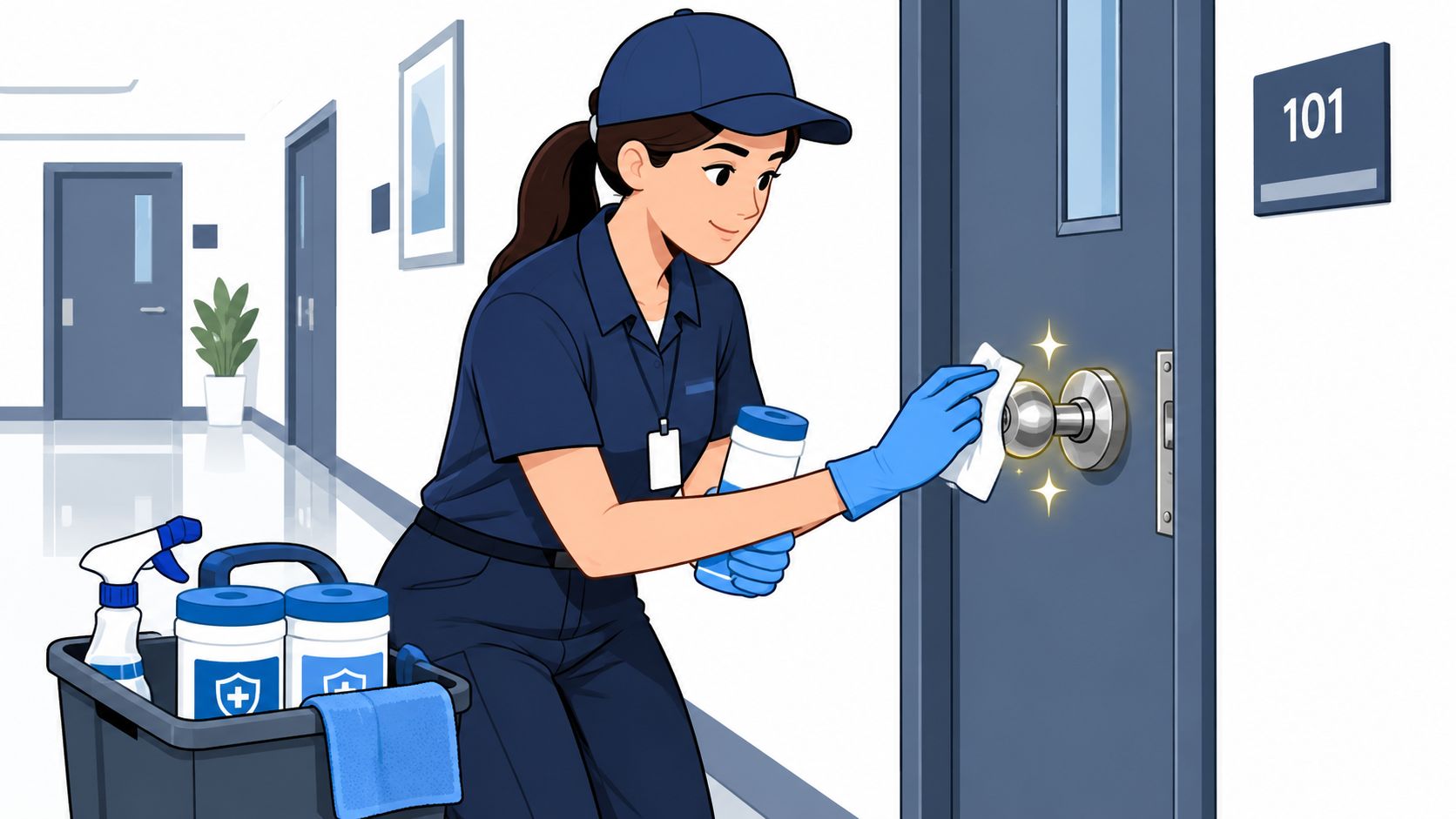
A customer walks into a busy gym, grabs the front-door handle, taps the check-in screen, adjusts a cable machine, and reaches for a locker-room faucet. The facility may look spotless, yet those contact points can decide whether the next visitor feels confident or starts wondering what else has been missed. High touch surface cleaning makes that invisible part of facility management visible, repeatable, and easier to trust.
Cleanliness matters in offices, schools, restaurants, retail stores, and fitness centers because people judge the whole environment through small details. A sticky door pull, a visibly marked treadmill handle, or an untouched payment terminal can undermine confidence faster than a polished lobby can restore it. Cleaning removes soil and residue, while disinfecting addresses microorganisms on appropriately prepared surfaces. Both have a place, but they aren't interchangeable.
A practical program starts by identifying where hands travel, then matching the cleaning method to the risk and the material. Disinfectant wipes help close the operational gap between a scheduled cleaning round and the moment someone needs to reset a shared surface. Product formats and dispensers can be explored through wipes.com's facility wipe options, but the result still depends on correct technique, label directions, and staff follow-through.
Why High Touch Cleaning Defines Facility Trust and Safety
A facility manager rarely receives praise for a clean door handle. Visitors notice the opposite. They notice when a shared surface feels greasy, when a wipe station is empty, or when staff clean a large, visible counter while overlooking the smaller points everyone touches.
That makes high touch cleaning a business issue, not just a housekeeping task. Customers connect visible hygiene with operational discipline. Employees are more likely to trust a workplace that shows a clear cleaning routine. Gym members, diners, students, shoppers, and patients all move through environments where hands, equipment, and surfaces create repeated opportunities for contamination transfer.
The CDC's facility cleaning guidance identifies doorknobs, light switches, counters, desks, phones, keyboards, toilets, faucets, sinks, and shared equipment as examples of high-touch surfaces. It recommends cleaning and/or disinfecting these points more frequently than surfaces with less contact. That principle is simple, but many facilities still organize work around room size or a fixed route instead of actual touch patterns.

The business cost of an invisible gap
A cleaning team can complete a checklist and still miss the surfaces that shape visitor perception. The problem usually isn't laziness. It's a mismatch between the schedule and the way people use the building.
Practical rule: Clean the points that hands repeatedly seek before spending extra time polishing surfaces nobody touches.
Disinfectant wipes are useful because they place a controlled, ready-to-use product near the contact point. A wipe station beside strength equipment, a small supply at reception, or a mobile caddy for janitorial staff reduces the friction between noticing a dirty surface and dealing with it. Wipes don't replace a full cleaning program, but they make rapid response possible between larger service rounds.
The strongest programs combine three elements: a risk-based surface list, a product used according to its label, and visible accountability. The following protocols show how to rank touchpoints, use wipes correctly, and adapt the routine to different facilities without treating every surface as equally urgent.
How to Identify and Prioritize High Touch Zones in Any Facility
Start with a walk-through that follows people, not walls. Enter through the main door, check in, use a restroom, handle shared equipment, visit a workstation, and leave. Mark every point where a person grips, presses, leans, swipes, or adjusts something that another person will use.
The CDC examples provide a useful starting inventory, but the list should reflect the building's actual traffic. In an office, that may mean elevator buttons, desk phones, keyboards, shared printers, and kitchen handles. In a gym, it includes free weights, adjustment pins, cardio controls, locker-room fixtures, railings, and door handles.
Hospital touch-frequency data adds an important lesson. A review of high-touch surfaces describes a 2010 study by Huslage et al. that identified bed rails, the bed surface, a supply cart, an over-bed table, and an intravenous pump as the five most touched hospital surfaces. The review, published in 2017, explains why facilities treat high-touch points as a distinct category, repeated hand contact can increase the chance of transfer between people, equipment, and rooms. See the review of high-touch surfaces in healthcare for that historical context.
Rank contact intensity before surface size
A large lobby floor may collect plenty of dirt, but a smaller elevator button can receive far more hand contact. Prioritize surfaces using questions such as:
- How often is it touched? Repeated contact raises its place on the work list.
- How many people share it? A surface used by successive visitors deserves closer attention than a private workstation.
- Does it connect hand contact with the face, food, or an open wound? That pathway can make a point more transmission-relevant.
- Can staff clean it without damaging the material? Electronics, screens, and delicate finishes need product and technique controls.
- Does visible soil interfere with disinfection? If it does, cleaning must come first.
Equal-frequency wiping sounds thorough, but it can waste labor while leaving more consequential points unattended. A 2026 ICU study found that high-touch items weren't consistently more contaminated than low-touch items, with bacterial load significantly higher only on a narrower set of high-risk items. The ICU study record supports a more disciplined approach, prioritize surfaces according to contact patterns and transmission relevance rather than applying the same intensity everywhere.
Turn the audit into a working map
Create three zones. Priority one includes shared controls, handles, rails, faucets, and equipment contact points. Priority two covers regularly touched but less central surfaces, such as office cabinets or retail baskets. Priority three includes low-contact surfaces that still need routine cleaning but shouldn't displace urgent touchpoint work.
Post the map where supervisors and cleaners can use it. A simple floor plan with numbered points is more useful than a long generic checklist because it tells staff exactly what “complete” means in that building.
The Right Way to Clean and Disinfect High Touch Surfaces With Wipes
A wipe only works when the surface receives enough product for the label's required contact time. Fast passes that leave a surface almost dry may remove fingerprints, but they don't necessarily complete disinfection.
Use this sequence for a shared surface:
- Inspect first. If the area has visible dirt, grease, food residue, or heavy soil, clean it before applying disinfectant. The CDC's cleaning and disinfection instructions say visibly dirty surfaces should be cleaned first, followed by an EPA-registered disinfecting product.
- Choose the correct wipe. Confirm that the product is an EPA registered disinfecting wipe and that its label covers the material and organism claims relevant to your facility.
- Use enough product. Wipe across the surface in an S-pattern, working from the cleaner area toward the dirtier edge. Don't scrub a broad machine panel with a nearly exhausted wipe.
- Keep it visibly wet. The surface must remain visibly wet for the full labeled contact time. If it dries too soon, apply another wipe as the label permits.
- Let it air dry. Don't immediately buff away the product. Drying too early can shorten the time the chemistry has to work.
- Prevent recontamination. Dispose of the wipe, wash or sanitize hands as appropriate, and avoid touching clean controls with used gloves.
One wipe, one defined area: Reusing a wipe across equipment can move soil and microorganisms from one contact point to another.
Make the correct action convenient
Place supplies where the work happens. A gym wipe dispenser beside cardio machines is more effective than a locked cabinet behind the front desk. A janitorial caddy should carry fresh wipes, gloves, waste bags, and a small reference card showing contact-time instructions.
Stocking bulk gym wipes can reduce interruptions, but volume alone won't fix poor placement or uncontrolled use. Set par levels for each zone, inspect dispensers during opening and closing checks, and keep backup cases in a dry, accessible storage area.
Use wipes for gym equipment on handles, adjustment levers, touchscreens, and seat surfaces only when the product label and equipment manufacturer allow it. For yoga studios, dedicated yoga mat wipes can support routine care, but staff should verify compatibility with the mat material and avoid leaving excess moisture where users could slip.
A front-desk counter needs a different rhythm. Clean visible soil, wipe the counter and shared pens, give the disinfectant its required wet time, and handle payment terminals according to the manufacturer's instructions. For a POS area with limited space, the Ergosticks product lineup offers a relevant example of how equipment and workflow design can affect access around check-in and payment points.
For additional surface-specific guidance, see this practical resource on disinfectant wipes for surfaces. The useful lesson is operational, not cosmetic: define the area, use a fresh wipe when the first one is spent, maintain wet contact, and leave the surface undisturbed while the product works.
Cleaning Versus Disinfecting and What the Evidence Shows
Cleaning and disinfecting answer different problems. Cleaning removes soil, oils, and residue that can shield microorganisms or make a surface unpleasant. Disinfecting applies a product intended to reduce microorganisms on a prepared surface, and it depends on product selection, coverage, and contact time.
A detergent-only approach can be appropriate when the objective is routine soil removal and no disinfecting claim is required. It isn't enough when a facility needs a disinfectant's labeled action on a shared contact surface, especially after contamination or in settings with higher infection-control demands. Sanitizing wipes and antibacterial wipes also shouldn't be treated as interchangeable with disinfectant wipes. Read the label and match the product to the task.
A 2024 evidence review reported that intensified disinfecting surface cleaning reduced surface contamination by 94% and was associated with a 35% reduction in colonization and/or infection for MRSA, VRE, C. difficile, and multidrug-resistant Acinetobacter. The same review noted that there is no evidence that surface cleaning alone reduces nosocomial infection rates. Those findings are summarized in the 2024 evidence review on surface disinfection, and they support a careful claim: disinfection can improve surface outcomes, but it isn't a standalone guarantee against facility-acquired infection.
Technique changes the result
A controlled hospital cleaning study published in 2018 measured the effect of procedure choice on non-electromedical high-touch surfaces. After 0.5 hours, the average total viable count fell from 34 CFU per 24 cm² to 21 CFU per 24 cm² with a standard operating procedure, and from 52 CFU per 24 cm² to 15 CFU per 24 cm² with a microfiber mop procedure, according to the controlled hospital cleaning study.
| Cleaning Method | Average CFU per 24 cm² After 0.5 Hours | Sites Failing Hygiene Threshold |
|---|---|---|
| Standard operating procedure | 21, from 34 before cleaning | 18.9% |
| Microfiber mop procedure | 15, from 52 before cleaning | 7.4% |
The difference matters because “cleaned” doesn't describe how the work was performed. Wipe pressure, coverage, cloth contamination, product volume, and wet contact time all affect the result. Reusable cloths can become a transfer problem when teams use the same cloth across rooms or fold it without controlling which surfaces each side contacts.
Use a decision rule, not a product slogan
Use detergent cleaning when you need soil removal and the task doesn't require disinfection. Use a labeled disinfectant when the surface, setting, or incident calls for a disinfecting claim. If a product is marketed as antibacterial or sanitizing, don't assume it carries the same label directions or organism claims as a disinfectant.
The distinction between these processes is also explained in this guide to the difference between cleaning and disinfecting. In every case, follow the label, keep the surface wet for the stated time, and avoid claiming that wipes alone prevent infections.
For broader household surface-care context, the spring clean bedroom guide from Protect-A-Bed also illustrates the value of separating soil removal from the later disinfection step. Commercial facilities need the same discipline, with tighter control over product compatibility, documentation, and staff training.
Facility Specific Playbooks and Smart Ways to Sell Cleanliness
A single cleaning schedule can't serve every building. The right routine follows traffic, shared use, material sensitivity, and the moments when customers form opinions about the facility.
Offices
Office teams should put door handles, elevator buttons, shared printers, kitchen handles, conference-room controls, and reception surfaces on a defined route. Clean visible soil promptly, then disinfect points that receive repeated shared contact according to the product label and the facility's risk assessment.
Don't sell an office manager a case of wipes without a deployment plan. Bundle commercial disinfecting wipes with dispenser placement, refill checks, a surface compatibility guide, and a simple log. The sales message is stronger when it connects the product to a working process, fewer interruptions, clearer accountability, and a more credible visitor experience.
Gyms and fitness centers
The CDC's gym and fitness-facility guidance recommends targeted, more frequent cleaning of free weights, exercise equipment, cardio machines, time clocks, locker rooms, railings, and door handles. It also recommends providing sanitizing disposable wipes and other cleaning materials for shared equipment.
A fitness operator can organize stations by activity: cardio, strength, functional training, stretching, and locker rooms. Market fitness wipes, workout wipes, or gym equipment cleaning wipes as part of a visible hygiene system, not as a loose accessory. Provide wipe access beside the equipment, display a short “wipe after use” message, and train staff to inspect high-use zones instead of waiting for complaints.
For sales teams, ask diagnostic questions. Which equipment receives the most shared contact? Who refills the stations? What happens during peak traffic? Where do members currently leave used towels or wipes? Answers reveal the operational gap that a dispenser, refill program, or bundled supply contract can solve.
Schools, restaurants, and retail
Schools need clear ownership of railings, desks, bathroom fixtures, door hardware, shared devices, and cafeteria touchpoints. Restaurants should separate food-contact requirements from general high-touch cleaning and establish procedures for menus, tables, counters, handles, and POS equipment. Retail stores should focus on baskets, fitting-room hardware, checkout counters, payment terminals, shopping-cart handles, and staff-room touchpoints.
Avoid promising “hygiene ROI” as a guaranteed financial result. Instead, help clients track practical indicators such as completed logs, stocked stations, response time to visible soil, customer comments, and repeated problem areas. A sales proposal that includes training and monitoring gives the buyer something concrete to manage.
The most persuasive offering often combines wipes with gloves, dispensers, refill cases, microfiber tools, signage, and documented procedures. That turns a commodity purchase into a facility hygiene program with visible standards and measurable execution.
Training Staff Monitoring Results and Making Cleanliness Stick
A protocol survives only when staff can perform it during the busiest part of the shift. Training should use the facility's actual handles, machines, counters, and fixtures, not just a classroom demonstration.
Show the difference between a quick soil-removal pass and a complete disinfecting application. Have employees read the label, identify the required wet contact time, cover a defined area with an S-pattern, change wipes when they're spent, and leave the surface wet for the required period. Demonstrate why a reusable cloth can spread residue when staff carry it from one zone to another without changing or folding it correctly.
Coach the work where it happens
Supervisors can run short observation rounds during opening, peak traffic, and closing. Check whether dispensers are stocked, whether staff reach the full handle or control panel, whether used wipes go directly into waste, and whether cleaned surfaces are left undisturbed long enough.
Use a checklist that records the surface, time, responsible person, and any corrective action. Logs aren't proof that every surface was perfectly treated, but they reveal missed shifts, empty stations, and recurring trouble spots. Pair the record with occasional direct observation so staff understand that the aim is consistency, not paperwork.
Train for the rushed moment. If the correct method only works when the facility is quiet, it isn't yet a working method.
Make feedback specific. “The machine wasn't cleaned” is weak coaching. “The handle was covered, but the adjustment pin and control buttons were missed” tells the employee what to change. Recognize thorough work, correct unsafe shortcuts immediately, and revise the route when traffic patterns change.
Keep the system visible
Place small instruction cards near dispensers, use color-coded caddies for different zones, and give new employees a supervised route before assigning independent work. Recheck product compatibility when equipment, flooring, upholstery, or electronic controls change.
For purchasing teams and cleaning suppliers, a wipe offering earns credibility. Point customers toward facility hygiene products and resources at wipes.com alongside clear guidance on EPA registration, surface compatibility, dispenser placement, and contact time. The product matters, but the surrounding habits determine whether it delivers value.
Prioritize the touchpoints people use most, clean visible soil before disinfecting, maintain the label's wet time, and keep supplies where staff and visitors can reach them. Add disinfectant wipes to the daily routine, or build them into your commercial cleaning supply offering, then train and monitor the process until clean contact surfaces become a normal part of how the facility operates.
Leave a Reply