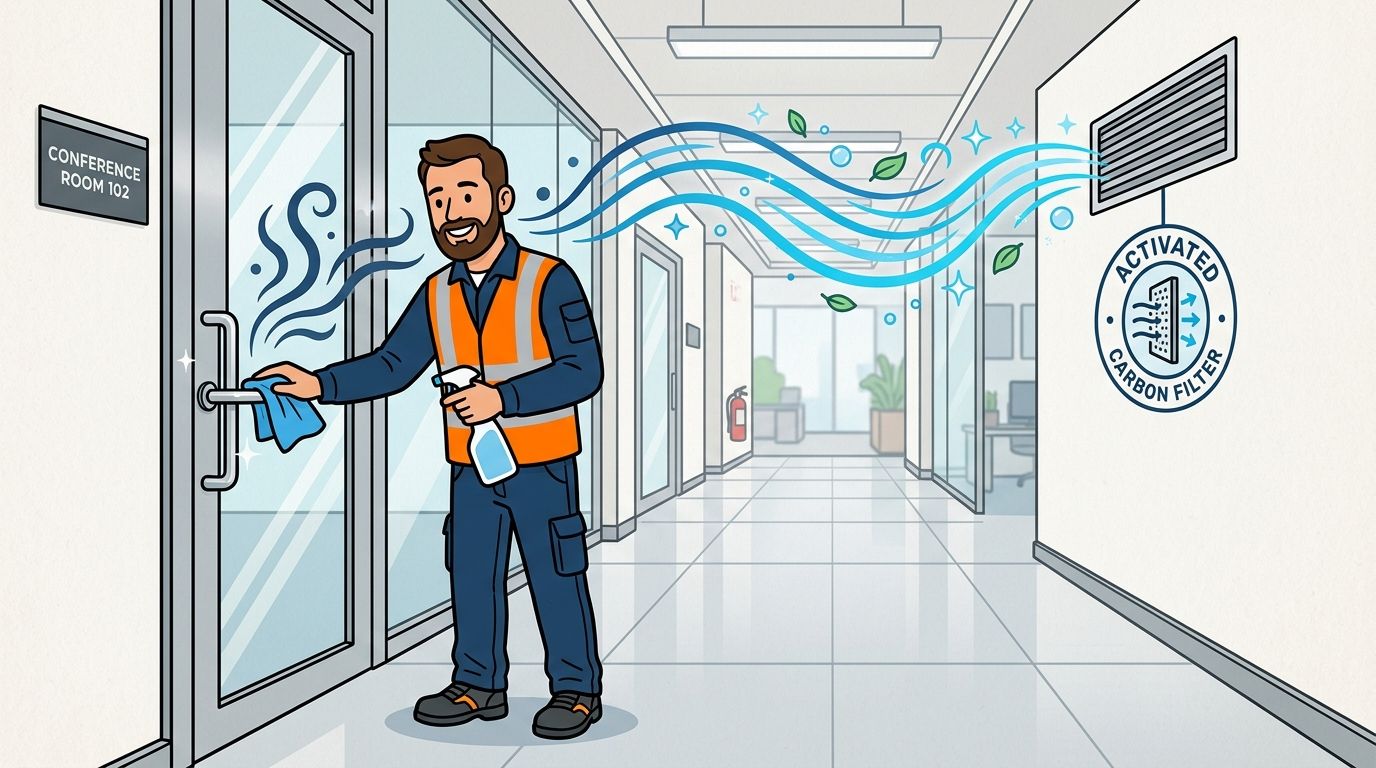
A customer can forgive an outdated paint color or a slow check-in line once. They rarely forgive a bad smell. The moment a restroom, locker room, front desk, or retail aisle smells off, people start making judgments about everything else they can't see.
That's why commercial odor control belongs in the same conversation as sanitation, customer retention, and brand protection. Clean-looking spaces matter. Clean-smelling spaces close the credibility gap. And in busy facilities, the tools that keep odors from building in the first place often include something simple and visible: disinfectant wipes used correctly on the right surfaces, at the right frequency.
Beyond Air Fresheners Why Odor Is a Business Metric
Managers often treat odor like a comfort issue. It's bigger than that. Odor is a signal customers use to decide whether your standards are high or slipping.
That judgment has direct business consequences. Research shows 67% of customers avoid businesses with foul-smelling restrooms, and unpleasant odors are the #2 complaint in hospitality facilities according to Betco's odor management guidance. The same source says facilities that invest in proactive odor management can reduce customer complaints by up to 40% and improve satisfaction scores by 15%.
Odor affects trust before anyone reads a review
People don't separate smell from cleanliness. If a lobby smells stale, they assume the HVAC is neglected. If a gym bench smells sour, they assume the equipment isn't being wiped down. If a checkout counter has a lingering food or trash odor, they assume back-of-house standards are loose too.
That's why odor control isn't just a janitorial line item. It's a revenue protection system.
Practical rule: If customers can smell the problem, they're already rating your operation.
This matters even more in high-turnover spaces like fitness centers, restaurants, retail stores, schools, and offices. In those environments, odor doesn't usually come from one dramatic event. It comes from repeated small misses. Damp surfaces. Dirty touchpoints. Trash lids left open. HVAC filters ignored. Equipment cleaned visually but not disinfected properly.
Air freshener alone won't protect the brand
A fragrance can make an entrance feel more polished. It can't fix a drain problem, sweat-soaked upholstery, bacteria on shared equipment, or residue on restroom fixtures. When managers rely on scent alone, they often create a bigger problem. Guests notice the mix of perfume and underlying odor, which reads as cover-up instead of care.
The better approach is operational. Remove the source. Keep high-touch surfaces clean. Use sanitizing wipes or disinfecting wipes where fast, repeatable surface hygiene matters. Then use ambient scent only if the underlying space is already under control.
For sales teams in the cleaning industry, this is the language that moves the conversation forward. Don't sell wipes as consumables. Sell them as part of a system that helps protect reviews, reduce complaints, and reinforce customer trust.
Pinpointing the Problem A Guide to Odor Source Investigation
Most odor problems get worse because teams treat the symptom first. They spray, mop, and move on. The smell comes back because the actual source never changed.
A useful odor audit starts wide, then narrows. Check the air path first. Then the moisture path. Then the touch path.

Start with the building systems
Before looking at a countertop or weight bench, look at the systems moving air and holding moisture.
Walk the facility and ask:
- Where does the odor appear first: At entry points, in corners, near drains, or only when HVAC cycles on?
- When is it strongest: Opening shift, peak traffic, after cleaning, or after the building sits closed?
- Does airflow carry it: Odors often migrate from trash rooms, restrooms, laundry, break rooms, or damp storage areas into customer-facing zones.
If you manage vehicles, the logic is similar. The same process people use to diagnose and remove car smells applies in buildings too. Track the odor to the material, residue, or moisture source instead of treating the air as the main problem.
Then inspect the touchpoints people forget
Not every odor source is obvious. Some of the most persistent smells come from surfaces that are touched constantly and cleaned too lightly.
High-touch surfaces in commercial facilities, including keyboards, light switches, phones, door handles, elevator buttons, and restroom fixtures, carry significant bacterial loads and require regular cleaning with disinfectant wipes to prevent germ spread, and the CDC recommends regular cleaning of these areas as a core hygiene practice, as summarized by Bunzl Canada's hygiene guidance.
That matters for odor control because bacterial residue, skin oils, food transfer, and moisture all create odor over time. In gyms, this shows up on touchscreens, selector pins, handles, mats, and benches. In offices, it builds on desk phones, shared keyboards, break room appliance handles, and conference room remotes. In restaurants, front-of-house odor often starts on restroom fixtures, condiment stations, and host stand surfaces long before staff notice it.
For hidden residue checks, some teams also use visibility tools like a black light inspection guide to spot buildup on surfaces that look clean under normal lighting.
Odor investigation works best when staff stop asking, “What can we spray?” and start asking, “What is feeding this smell?”
Build a practical odor audit routine
Use a short checklist during rounds:
- Check drains and damp zones: Floor drains, mop closets, locker rooms, under-sink cabinets, and beverage stations often hold the first clue.
- Review soft surfaces: Entry mats, upholstery, towels, mop heads, and porous wall panels trap odor even after visual cleaning.
- Inspect shared equipment: Phones, touchscreens, machine grips, and counters need more than an occasional wipe-down.
- Track complaints by location: Repeated comments tied to one hallway, one restroom bank, or one shift usually reveal a process gap.
- Document what changed: New cleaning chemicals, blocked vents, full trash cycles, or staffing changes can explain why a smell appeared suddenly.
A good audit doesn't just find what smells bad. It tells you which control method will work.
Choosing Your Odor Control Strategy Elimination Over Masking
Once you know where the smell starts, the next decision is strategic. Do you want the space to smell better for an hour, or do you want the complaint to stop coming back?
That's the difference between masking and elimination.

Why masking creates expensive blind spots
In commercial settings, masking has a place, but it's secondary. A light fragrance can support ambiance in a clean lobby or reception area. It shouldn't be your main control plan in a locker room, restroom, food service zone, or healthcare-adjacent space.
The distinction between odor elimination and masking is critical. Eliminators chemically alter odors, while maskers just cover them up. In high-stakes environments, masking can dangerously delay the fix for a hazard. Industry audits show facilities using only maskers report 30% higher repeat odor complaints than those using eliminators, according to State Industrial's explanation of elimination versus masking.
If a sewer note is hidden by fragrance, staff may miss a drain issue. If a musty smell is perfumed over, a leak or mold problem can sit too long. If sweat odor on equipment gets covered instead of removed, members assume the facility doesn't sanitize between uses.
What works in a layered program
Commercial odor control usually works best when managers combine several tools instead of expecting one product to solve everything.
| Method | Mechanism | Best For | Key Consideration |
|---|---|---|---|
| Source elimination | Removes the residue, bacteria, moisture, or material causing the odor | Shared equipment, counters, restroom fixtures, mats, handles, touchpoints | Requires consistent cleaning routines, not occasional resets |
| Activated carbon adsorption | Captures VOCs and sulfur compounds from air streams | Indoor commercial environments with ongoing odor load | Better for air treatment than for dirty surface correction |
| Wet scrubbing or chemical neutralization | Uses acidic or alkaline reactions to neutralize compounds such as hydrogen sulfide or ammonia | High-volume or specialized exhaust applications | More relevant for industrial or heavy-duty environments |
| Biofiltration | Uses microorganisms to break down organic compounds in continuous emissions | Continuous odor streams in larger treatment settings | Works best with proper operating conditions and maintenance |
For indoor commercial environments like restaurants, warehouses, and offices, source mapping should guide whether you use physical, chemical, or biological treatment. Activated carbon handles VOCs and sulfur compounds at medium or low concentrations, wet scrubbers address hydrogen sulfide and ammonia in high-volume streams, and biofilters break down organic compounds in continuous emissions. Multi-stage systems can reach 80–99% removal of odorous compounds, while single-stage systems often fail below 60% when dosing or contact time is poor, according to Torch Air's overview of odor control technologies.
The same source warns against over-relying on masking agents and notes that technical discipline matters, including monthly HVAC filter inspections and quarterly deep cleaning.
Where wipes fit into true elimination
EPA registered disinfecting wipes earn their place. They're not air treatment devices. They're frontline tools for removing the surface contamination that creates odor in the first place.
Use them on:
- Gym equipment contact points: Handles, seats, adjustment pins, touchscreens, and mats.
- Restroom touchpoints: Stall latches, flush handles, faucet handles, dispensers, and counters.
- Retail and office surfaces: POS terminals, phones, light switches, carts, door pulls, and break room appliances.
When selecting wipes, verify the product label. Only EPA-registered products qualify as disinfectants, and safer active ingredients can include hydrogen peroxide, citric acid, lactic acid, and ethanol, as outlined in this facility guide to selecting disinfectant wipes.
If you're sourcing wipes for a facility program, look for commercial disinfecting wipes for high-touch environments that fit your traffic level and dispensing setup.
Decision filter: If the odor is attached to a surface, clean and disinfect the surface. If it's moving through the air, treat the air path too. If it's coming from a leak, drain, or waste process, fix the source before adding scent.
The trade-off managers should accept
Elimination takes more discipline than masking. It asks staff to wipe, inspect, document, and escalate. It usually wins because it solves the complaint instead of decorating it.
For sales professionals, that's also the stronger pitch. Don't compare a tub of wipes to a can of fragrance. Compare a source-removal program to the cost of repeat complaints, poor reviews, and staff time spent chasing the same odor every week.
Facility-Specific Blueprints for Effective Odor Control
Odor control fails when teams copy one routine into every building type. A gym doesn't need the same rhythm as an office. A restaurant doesn't need the same touchpoint strategy as a dealership.
The smart move is to match the odor source, traffic pattern, and cleaning speed to the facility.

Gyms and fitness centers
In a busy fitness center, the problem usually isn't one dramatic smell. It's layers. Sweat on cardio grips. Dampness in locker rooms. Residue on benches and mats. Overflowing towel bins near the end of the day.
For gyms, place a gym wipe dispenser where members pause, not where management wishes they would. That usually means by the cardio floor, at strength zones, and near studio exits. Stock it with gym wipes or gym equipment cleaning wipes that are easy to pull one-handed. If the wipe tears, dries out, or leaves streaks, compliance drops fast.
Focus on three hotspots:
- Equipment contact surfaces: Use wipes for gym equipment between users and during staff rounds.
- Studios and mats: Keep yoga mat wipes or fitness wipes near class exits.
- Locker room touchpoints: Handles, benches, lockers, and restroom fixtures need frequent attention.
In gyms, visible wiping matters. Members judge cleanliness by what they see other members and staff doing.
Restaurants and food-adjacent spaces
Restaurants fight odor from two directions. Front-of-house needs to smell clean and neutral. Back-of-house creates grease, waste, and drain pressure all day.
If kitchen-adjacent odors are persistent, odor control should include pest prevention and waste discipline. Teams dealing with recurring back-of-house risk can learn from The Green Advantage's kitchen pest experts, because odor and pest activity often travel together in commercial kitchens.
Front-of-house priorities are simpler and more visible:
- Restrooms: Treat odor as a guest experience issue, not just a janitorial one.
- Host stands and payment areas: Wipe down touchpoints throughout service.
- Condiment and beverage stations: Clean small spills before they turn into sticky odor sources.
Operators refining restroom strategy may also find value in this guide to commercial restroom deodorizers, especially when choosing between neutralization and fragrance support.
Offices, schools, retail, and dealerships
An office usually smells bad for ordinary reasons. Break room trash. Shared refrigerators. Upholstered seating. Keyboard and phone residue. In schools, the pattern shifts toward heavy-touch surfaces and fast transitions. In retail, it's often fitting rooms, restrooms, carts, and checkout counters. In dealerships, customer lounges and vehicle interiors create a split environment that needs separate routines.
A practical blueprint looks like this:
- Offices: Put disinfectant wipes in conference rooms, break rooms, and copier zones so staff can clean shared touchpoints quickly.
- Schools: Train staff to focus on desk clusters, door hardware, and restroom fixtures during transitions.
- Retail stores: Keep antibacterial wipes or disinfectant wipes close to carts, counters, and fitting room stations.
- Dealerships: Use surface-safe workout wipes or similar fast-access wipes for showroom desks and customer touchpoints, while interior vehicle odor issues get their own detailing process.
Cleanliness programs work better when each zone has one clear owner, one wipe station, and one reset routine tied to traffic instead of the clock alone.
For sellers in the cleaning industry, bundling becomes practical. Don't just offer wipes. Offer dispensers, refill plans, touchpoint maps, and staff signage. That turns a commodity conversation into an operational solution.
Empowering Your Team with Training and Checklists
A facility can buy good products and still smell neglected. That usually happens when staff don't know what to wipe, how long surfaces need to stay wet, or when to escalate a recurring odor instead of cleaning it again.
Training has to be simple enough to repeat on a busy shift.

Teach the why, then the routine
Staff follow standards better when they know the business reason behind them. A wiped-down machine isn't just cleaner. It reassures the next member. A neutral-smelling restroom isn't just pleasant. It protects the brand.
Then make the routine visual and specific.
Use a checklist with plain actions:
- Open shift check: Inspect entrances, restrooms, drains, trash points, and high-touch surfaces before traffic starts.
- Peak traffic reset: Refill wipe stations, empty waste, and wipe shared touchpoints during the busiest window.
- Close shift detail: Clean problem zones that don't get enough dwell time during open hours.
- Escalation trigger: If an odor returns after surface cleaning, staff report it as a maintenance issue, not a cleaning miss.
Use wipes where speed matters
Pre-moistened disinfecting wipes boost janitorial productivity by being ready-to-use, which eliminates chemical mixing time and associated risks. Studies show that providing wipes encourages all employees to perform quick cleaning, preventing cross-contamination from reused cloths, according to Imperial Dade's guidance on pre-moistened disinfecting wipes.
That's a practical advantage in gyms, retail, and offices where problems appear between scheduled cleanings. A tub of commercial disinfecting wipes at the point of use makes spot cleaning more likely than a spray bottle stored in a janitor closet.
Don't skip contact time and frequency decisions
A wipe only disinfects if staff use it as labeled. For disinfectant wipes to kill specific germs, the surface must remain wet for the product's labeled contact time, which varies by product and should be verified on the label or Safety Data Sheet. Facilities with rapid surface turnover should prioritize disinfectants with shorter dwell times, as explained in ServiceMaster Clean's guidance on disinfectant wipes.
For frequency, the baseline should reflect risk and traffic. The CDC states that when no confirmed or suspected COVID-19 cases are present, cleaning high-touch surfaces once daily is usually sufficient, while disinfection should be added in shared spaces during high community transmission, among unvaccinated or low-mask-wearing populations, or when hand hygiene is infrequent. If a sick person was in the facility within the last 24 hours, the space should be both cleaned and disinfected immediately, as summarized in this CDC-aligned explanation of wipe use.
A checklist only works if staff can complete it during real operations. If the routine is too slow, it won't survive peak hours.
For managers, the fix is straightforward. Put wipes where the work happens. Train to the label. Audit the visible touchpoints. Reward consistency, not heroic catch-up cleaning after complaints.
Conclusion Making Cleanliness Your Competitive Edge
Clean facilities don't win trust by looking polished for an hour. They win it by staying fresh through real traffic, real use, and real pressure. That's why commercial odor control works best when managers treat it as a business system, not an air freshener decision.
The strongest programs do three things well. They find the true source. They remove it instead of covering it up. They make daily execution easy with practical tools like disinfectant wipes, sanitizing wipes, or facility-ready wipe stations where staff and guests can use them without friction.
If you own, manage, clean, or sell into commercial spaces, start with the touchpoints people notice first. Restroom fixtures. Entry hardware. Shared equipment. Counters. Mats. Then support that routine with HVAC upkeep, waste discipline, and clear reporting when a smell points to a maintenance issue instead of a surface issue.
A final habit is worth adding to every site walk: ask customers, members, or staff one simple question about freshness. If they hesitate, you've learned something useful before the complaint shows up online.
Prioritize cleanliness daily. Make EPA registered disinfecting wipes, bulk gym wipes, or other fit-for-purpose wipe systems part of your routine or product offering. For more practical sanitation guidance across facilities, visit WipesBlog.com.
Quick cleaning and sanitizing tips to put into practice today
- Restock where usage happens: Put wipes at equipment zones, checkout points, break rooms, and restroom exits.
- Wipe for the full label requirement: If the surface dries too fast, it may be cleaned but not fully disinfected.
- Target odor builders early: Damp handles, mats, touchscreens, and restroom fixtures should never wait for end-of-day cleaning.
- Use fragrance carefully: Add scent only after the source is under control.
- Review complaints by location: Repeating odor comments almost always point to a process gap, not bad luck.
Leave a Reply