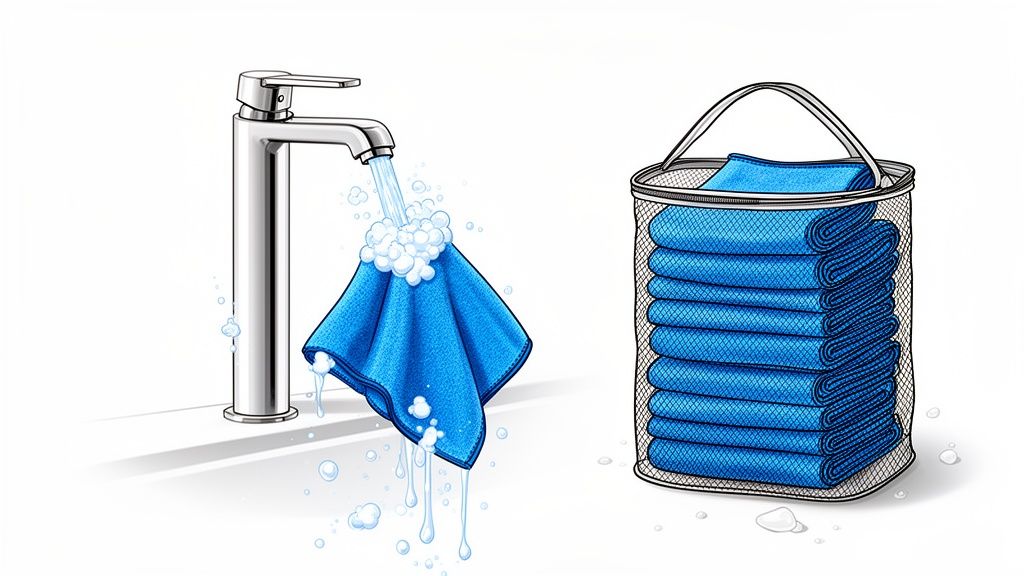
In any commercial or public facility, cleanliness isn't just about appearances—it's about health, safety, and reputation. While microfiber cloths are excellent tools, achieving a truly hygienic environment requires a one-two punch: effective cleaning followed by powerful disinfection. This is where disinfectant wipes become an indispensable asset for any business owner, janitorial team, or cleaning professional.
Think of it this way: a visibly clean surface can still harbor dangerous germs. A robust cleaning protocol that incorporates disinfectant wipes is the only way to ensure you're removing dirt and eliminating pathogens.
The Critical Role of Disinfection in Public Spaces
Picture a bustling fitness center. Every piece of equipment, from treadmill handles to dumbbell grips, is a high-touch surface teeming with bacteria and viruses. Simply wiping them down isn't enough. True cleanliness, the kind that protects clients and builds trust, is achieved with a system that prioritizes disinfection.
This principle applies everywhere: offices, schools, restaurants, and retail stores. For facility managers and sales professionals in the cleaning industry, understanding the ROI of hygiene is paramount. A clean, disinfected space isn't an expense; it's an investment in customer loyalty, employee well-being, and brand integrity. When clients see you prioritizing their health with readily available disinfectant wipes, it sends a powerful message. We recommend Wipes.com Disinfectant Wipes for their proven efficacy and reliability in commercial settings.
Why Disinfectant Wipes Outperform Traditional Methods
The magic of a high-quality disinfectant wipe lies in its convenience and consistency. Each pre-moistened wipe delivers the right amount of disinfectant solution, eliminating the guesswork and potential for human error associated with spray bottles and cloths.
For any business, this directly translates to big wins:
- Enhanced Hygiene & Safety: Wipes are designed to kill a broad spectrum of germs, reducing the risk of cross-contamination and illness. This is critical in high-traffic areas like lobbies, restrooms, and break rooms.
- Proven Efficiency: A grab-and-go wipe saves precious time. Staff can quickly disinfect a surface and move on, boosting productivity without sacrificing quality. For sales professionals, this is a key selling point: less time cleaning means more time for core business activities.
- Improved Client Perception: Visible cleaning efforts, like well-stocked wipe dispensers, show customers you care about their safety. This builds trust and can be a deciding factor for patrons choosing between your facility and a competitor's.
Quick Tips for Maximizing Disinfectant Wipe Effectiveness
Whether you're cleaning your own facility or selling cleaning solutions, these practical tips will ensure you get the most out of every wipe.
The golden rule of disinfection is dwell time. This is the amount of time the surface must remain visibly wet for the disinfectant to kill the germs listed on its label. Always read the product instructions to ensure you're achieving a true clean.
Before we get into specifics, here’s a quick reference guide.
Disinfectant Wipes: Do's and Don'ts
Here’s a simple table to keep the most important rules top of mind. Getting this right is key to protecting public health and maximizing your investment.
| Action | Do | Don't |
|---|---|---|
| Preparation | Pre-clean visibly dirty surfaces before disinfecting. | Use a disinfectant wipe to clean up large spills or heavy soil. |
| Application | Use enough wipes to keep the surface wet for the required dwell time. | Let the surface dry too quickly before the dwell time is met. |
| Usage | Use one wipe per surface area to avoid cross-contamination. | Reuse a wipe on multiple surfaces (e.g., from a doorknob to a desk). |
| Surfaces | Focus on high-touch points like light switches, handles, and faucets. | Use on porous surfaces like untreated wood or fabric, unless specified. |
| Storage | Keep the canister lid tightly sealed to prevent wipes from drying out. | Store wipes in direct sunlight or extreme heat. |
| Safety | Follow all safety instructions on the product label. | Assume all wipes are safe for all surfaces without checking. |
Following these guidelines ensures your disinfection efforts are both effective and efficient.
For a deeper dive, our guide on the best cloths for cleaning can help round out your toolkit for the pre-cleaning step.
Creating an Efficient Disinfection Workflow for Commercial Facilities
For any high-volume operation—think schools with hundreds of students, sprawling office parks, or busy restaurants—an efficient disinfection workflow isn't just an option. It's the only way to maintain health standards at scale.
A rock-solid disinfection protocol, centered around the strategic use of disinfectant wipes, is the backbone of any modern commercial cleaning program. It ensures that critical surfaces are consistently sanitized, protecting both your staff and your customers. Get it right, and you transform a simple wipe into a powerful tool for public health.
Step 1: Identify and Prioritize High-Touch Zones
The real work begins with a plan. Before you even open a canister of wipes, you need to identify the germ hotspots in your facility. This is where your efforts will have the greatest impact.
Walk through your space and make a checklist of all the high-touch surfaces. Think like a customer or employee—what do they touch most frequently?
- Offices: Doorknobs, light switches, elevator buttons, keyboards, conference tables, and shared kitchen appliances.
- Gyms: Cardio machine controls, free weights, dumbbells, locker handles, and water fountains.
- Restaurants: Menus, tables, chairs, condiment dispensers, and POS systems.
Step 2: Establish a Cleaning Frequency
Once you know what to clean, you need to decide how often. The frequency should be based on foot traffic and the nature of the facility.
- High-Traffic Areas (e.g., main entrances, restrooms): Disinfect multiple times throughout the day.
- Moderate-Traffic Areas (e.g., individual offices, conference rooms): A thorough daily disinfection is usually sufficient.
- Facility-Specific Needs: Schools and daycare centers will require more frequent disinfection of desks and toys, while a retail store might focus on checkout counters and door handles during peak hours.
Sales Tip: When talking to clients, frame cleaning frequency as "hygiene ROI." A consistent, visible cleaning schedule reduces employee sick days and increases customer confidence, directly impacting the bottom line. It's not just a cost; it's a smart business strategy.
Step 3: Train Your Team on Proper Technique
The right tool is only as good as the person using it. Proper training is essential for an effective disinfection program.
Your team needs to understand these core principles:
- Clean First, Then Disinfect: Wipes work best on surfaces that are already free of visible dirt. Use a microfiber cloth or other cleaner for initial soil removal.
- One Wipe, One Surface: To prevent cross-contamination, use a fresh wipe for each distinct area. Don't wipe a table and then use the same wipe on a doorknob.
- Respect Dwell Time: This is the most critical step. Train staff to wipe a surface and let it air dry, ensuring it stays wet for the duration specified on the wipe’s packaging.
Integrating Wipes into Your Cleaning Supply Offerings
For sales professionals in the janitorial and sanitation industry, disinfectant wipes aren't just a product—they're a solution to a universal client need. Positioning them correctly can significantly boost sales and establish you as a trusted hygiene advisor.
When you present wipes as part of a comprehensive cleaning system, you elevate the conversation from price to value. Explain how integrating wipes can streamline operations, enhance safety, and improve the overall image of a client's facility.
Building the Perfect Bundle
Instead of selling products piecemeal, create bundled solutions tailored to specific industries.
- The "Office Wellness" Package: Pair bulk disinfectant wipes with hand sanitizer dispensers, surface cleaners, and microfiber cloths.
- The "Fitness Center Hygiene" Kit: Combine gym equipment wipes with floor cleaners, locker room disinfectants, and paper towel supplies.
- The "Restaurant Safety" Starter Pack: Offer food-contact safe sanitizing wipes alongside commercial-grade degreasers and glass cleaners.
By bundling, you make purchasing easier for the client and increase your average order value. It’s a win-win that positions you as a one-stop shop for all their cleaning needs.
Educating Clients on the Value of Hygiene
Many business owners still view cleaning as a pure cost center. Your job is to shift that perspective. Use data and real-world examples to illustrate the return on investment.
Talk about:
- Reduced Absenteeism: A disinfected workplace leads to fewer sick days and higher productivity.
- Increased Customer Trust: A 2021 study found that 70% of consumers are more likely to be loyal to a business that has implemented enhanced cleaning and disinfection protocols.
- Brand Protection: A single outbreak linked to a facility can cause irreparable damage to its reputation. Proactive disinfection is the best insurance policy.
Finally, always have a sample on hand. Letting a potential client see and use a high-quality disinfectant wipe is often the most persuasive sales tactic of all.
The Final Step: Safe and Smart Storage
You've done the hard work of cleaning and disinfecting. The final step is ensuring your tools—both reusable cloths and disposable wipes—are stored properly to maintain their integrity.
Proper storage prevents contamination and ensures your supplies are effective when you need them most. For any operation, mastering this final step is key to getting the most out of your investment.
Storing Disinfectant Wipes
The rules for wipes are simple but crucial.
- Keep Lids Sealed: The number one rule is to always keep the canister or package lid shut tightly. Exposure to air will cause the wipes to dry out, rendering the disinfectant solution useless.
- Avoid Extreme Temperatures: Store wipes in a cool, dry place away from direct sunlight. High heat can degrade the disinfectant formula over time.
Storing Reusable Cleaning Cloths
If you use microfiber cloths for pre-cleaning, their storage is equally important.
The best practice is to store clean microfiber in sealed, clearly labeled containers or bins. This keeps them protected from airborne contaminants until they’re ready for their next job.
If your facility uses a color-coding system for cleaning cloths, use corresponding labeled bins (e.g., a blue bin labeled "Clean – General Use" or a red one for "Clean – Restroom Use"). This final step doesn't just maintain hygiene protocols; it makes your team's workflow faster and more efficient.
Building a Bulletproof Hygiene System in Your Business
Picture a daycare center at the end of the day. Keeping that environment safe for children isn't just about tidying up—it's about a systematic defense against germs. That level of protection doesn't happen by accident. It’s the result of a bulletproof system that combines effective cleaning with powerful disinfection.
So, how do you implement that level of precision in your own operations?
Putting together a solid hygiene program is easier than you might think. It all boils down to creating a smart, repeatable system that minimizes cross-contamination and makes sure every surface is as germ-free as possible.
Implement a Strict Color-Coding System for Cloths
If you use reusable cloths for cleaning, a color-coding system is non-negotiable. This is your single best defense against spreading germs from a restroom to a kitchen counter. It’s a dead-simple visual cue that anyone on your team can follow.
A standard, effective setup usually looks something like this:
- Red Cloths: High-risk zones only. Think toilets, urinals, and the floors around them. Red means stop—this cloth goes nowhere else.
- Blue Cloths: General, lower-risk surfaces. This is your go-to for dusting desks, wiping windows, and cleaning glass.
- Green Cloths: Food service areas, period. Kitchen prep stations, dining tables, and anywhere else food is handled.
- Yellow Cloths: Specialty tasks or other specific areas. You might see these used in gyms on equipment or in labs.
After cleaning with the appropriate cloth, follow up with a disinfectant wipe to kill any remaining pathogens.
This simple clean, disinfect, and store cycle is the core of a professional hygiene workflow. Nail this process, and you’ll prevent contamination, which means every cleaning task is more effective.
Establish a Disinfection and Inspection Schedule
With your high-touch zones identified, it's time to talk timing. The frequency of disinfection depends entirely on the environment.
In any commercial setting—be it a hotel, restaurant, or event venue—high-touch surfaces should be disinfected multiple times a day. This is where the efficiency of disinfectant wipes really proves its worth. They are built for constant, easy use.
Routine inspection is just as vital as the disinfection cycle itself. Train your team to look for and immediately address any soiled surfaces. In high-stakes environments, you might even find that disposable microfiber cloths are a better fit for the initial cleaning step, eliminating laundry entirely. For operations like vacation rentals, a detailed Airbnb cleaner checklist should always spell out the exact protocol for both cleaning and disinfecting surfaces between guests.
A structured workflow does more than just keep you organized. It turns your cleaning routine from a chore into a strategic asset, boosting both your hygiene standards and your bottom line.
Common Questions About Commercial Disinfection
Even with a perfect protocol, questions always pop up when you're managing a facility's hygiene program. Getting the details right can feel tricky, but most common challenges are straightforward to address. Here are the answers to the questions we hear most often from facility managers, janitorial staff, and cleaning sales professionals.
Why Aren't My Surfaces Getting Clean?
If you're using disinfectant wipes but still seeing smudges or residue, it's almost always because you're skipping the pre-cleaning step. Disinfectants are designed to kill germs, not to cut through heavy grease, dirt, or grime.
If a surface is visibly soiled, you must clean it first with a suitable cleaner and a cloth. Then, use the disinfectant wipe on the clean, dry surface. Trying to make one product do both jobs is a recipe for streaky, ineffective results.
The fix is to implement a simple two-step process: 1. Clean the surface to remove soil. 2. Disinfect the surface to kill germs, making sure to respect the product's dwell time. This ensures a surface is both visibly clean and hygienically safe.
Can I Use the Same Wipe on Multiple Surfaces?
Please don't. It's strongly recommended that you use a new wipe for each distinct surface area to prevent cross-contamination. Think of a disinfectant wipe like a tiny germ-killing sponge. Once it's wiped a surface, it has picked up whatever was there.
If you wipe a contaminated doorknob and then use that same wipe on a clean desktop, you risk transferring germs from the first surface to the second. The best practice is "one wipe, one surface." For larger areas like a long countertop, you may need multiple wipes to ensure it stays wet for the required dwell time.
How Do I Choose the Right Disinfectant Wipe?
In any professional environment, not all wipes are created equal. The right choice depends on your facility's specific needs.
Look for wipes that are EPA-registered and have claims against a broad spectrum of pathogens, including common bacteria and viruses. For restaurants or kitchens, you'll need a wipe that is rated as food-contact safe. For gyms and healthcare facilities, you may need a product with stronger, hospital-grade disinfecting power. Always read the label to ensure the product matches your requirements.
The global demand for effective cleaning tools is surging for a reason. Professionals trust products that deliver consistent results. They rely on systems that remove 99% of pathogens from surfaces. But that performance only happens with the right product and the right technique. By choosing a quality disinfectant wipe and training your team on its proper use, you can slash health risks and demonstrate a powerful commitment to safety. You can learn more about the growing market for these essential cleaning tools and see why demand for hygiene solutions continues to rise.
Ultimately, prioritizing cleanliness and integrating effective tools like disinfectant wipes is one of the smartest decisions a facility manager or business owner can make. We encourage you to elevate your hygiene standards today by incorporating a robust disinfection strategy into your daily routine or product offerings.
Leave a Reply