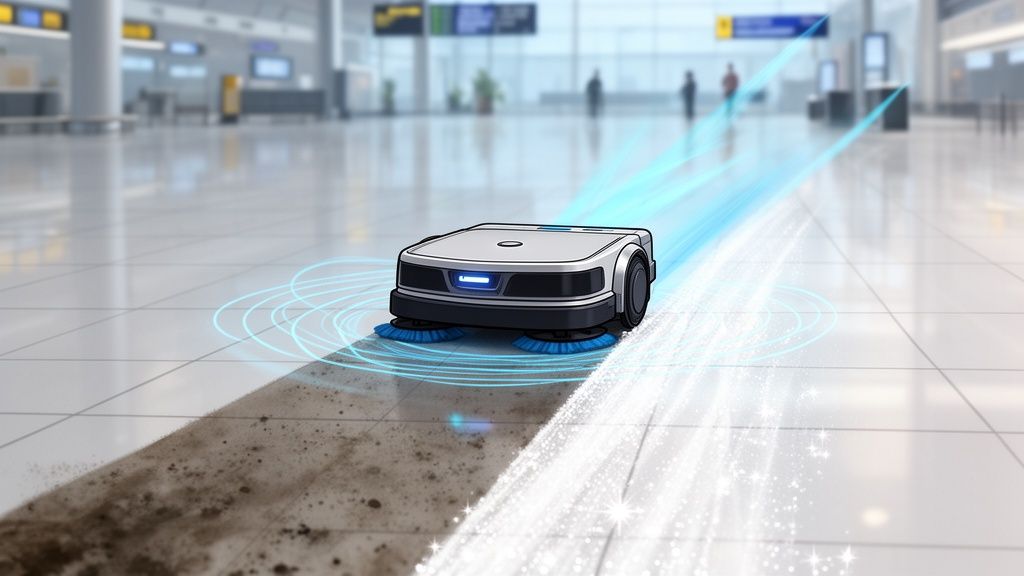
A clean facility isn't just an aesthetic choice; it's a direct reflection of your commitment to health, safety, and quality. In today's competitive landscape, business owners and facility managers understand that pristine environments are non-negotiable. While mops and buckets have their place, the new standard for large-scale floor care is set by robotic floor scrubbers.
These intelligent machines are a massive leap forward, turning a basic janitorial tool into a data-driven asset. They deliver a consistent, verifiable clean that manual methods struggle to match, laying the foundation for a truly comprehensive hygiene strategy.
The Next Generation of Commercial Cleaning
For any facility manager, the conversation is no longer about if automation will impact cleaning operations, but how soon you can integrate it. Traditional cleaning is built on manual labor, which can be inconsistent and hard to track. A spotless appearance sends a powerful message to customers, clients, and employees, enhancing brand perception and fostering trust.
Robotic floor scrubbers completely change that dynamic. They bring precision and reliability to your largest surfaces, ensuring your floors are always immaculate.

By taking over the repetitive, time-consuming task of scrubbing huge floor areas, they free up your janitorial staff to focus on more detailed, high-impact work. This is where a good cleaning program becomes great. Staff can be redeployed to sanitize high-touch surfaces like doorknobs, countertops, and gym equipment—tasks that require a human touch and are critical for preventing the spread of germs.
Advanced Technology in Action
The real magic behind these machines is a blend of smart hardware and even smarter software. It’s like giving your cleaning equipment a brain and a set of eyes.
- AI-Powered Navigation: This allows the scrubber to interpret its surroundings and make decisions on the fly. It can smoothly dodge unexpected obstacles, whether it's a forgotten luggage cart in an airport or a late-night shopper in a retail aisle.
- LiDAR and 3D Sensors: These high-tech sensors create detailed, 3D maps of your facility. This ensures total coverage, eliminating the missed corners common with manual cleaning.
- Data Reporting: Modern units don’t just clean; they report back. You get detailed summaries of cleaning times, total square footage covered, and even any areas that were missed. It’s a level of accountability that was simply impossible before.
This tech-driven shift is reshaping the entire industry. The robotic floor scrubber market has seen explosive growth, skyrocketing from a USD 1.5 billion valuation to a projected USD 4.5 billion. That's fueled by a steady compound annual growth rate of 11.5%, reflecting the huge demand for automation in high-traffic facilities where pristine floors are non-negotiable.
More Than Just a Clean Floor
The benefits go way beyond aesthetics. A consistently clean, dry floor significantly reduces the risk of slip-and-fall incidents—a major liability for any public-facing business. For businesses in the cleaning supply industry, promoting a dual approach of automated floor care and manual surface disinfection can be a powerful sales strategy, showing clients how to achieve a higher standard of hygiene and a better ROI.
For places like airport terminals or high-end car dealerships, a spotless appearance is a direct reflection of the brand’s commitment to quality. Of course, the effectiveness of these scrubbers also depends on what you put inside them. Using the right cleaning agents, like these natural floor cleaning solutions, can boost performance.
Manual vs Robotic Floor Scrubbing At a Glance
| Feature | Manual Floor Scrubbing | Robotic Floor Scrubbers |
|---|---|---|
| Consistency | Varies by operator and shift | Delivers a uniform clean every time |
| Labor Use | Requires a dedicated operator | Frees up staff for high-value tasks |
| Data & Reporting | Relies on manual logs (if any) | Provides detailed performance metrics |
| Obstacle Handling | Operator-dependent | AI-driven, real-time avoidance |
| Operating Hours | Limited to staff shifts | Can run 24/7, including overnight |
| Coverage | Prone to missed spots & corners | Ensures comprehensive, mapped coverage |
| Cost Model | Ongoing labor and supply costs | Upfront investment, lower long-term OpEx |
As you can see, the switch to robotic scrubbers isn't just about replacing a person with a machine. It's about fundamentally upgrading your entire cleaning operation to be more efficient, reliable, and intelligent.
Calculating Your Return on Automation
Investing in a robotic floor scrubber is a significant financial decision. But if you're only looking at the sticker price, you're missing the whole picture. The real value is in how this technology reshapes your operations and elevates your facility's overall standard of cleanliness.
The most obvious win is labor optimization. A single robotic scrubber can cover thousands of square feet every hour without a break. This isn't about replacing your people; it's about empowering them to be more effective.
Shifting Focus to High-Value Tasks
When your floors are being cleaned on autopilot, your staff can finally tackle the critical areas that an autonomous machine can't. This is where you see the true hygiene ROI.
- Detailed Disinfecting: Your team can get into the nitty-gritty of sanitizing restrooms, break rooms, and locker rooms. For fitness centers, this means thoroughly wiping down every piece of equipment between uses.
- High-Touch Surface Cleaning: Staff can focus on the endless list of frequently touched spots like door handles, light switches, elevator buttons, and countertops. This is absolutely crucial for reducing germ transmission and keeping both employees and customers healthy.
- Special Projects: All those tasks that get pushed to the back burner—window washing, detailed dusting, upholstery cleaning—can finally get done.
This strategic shift has a direct impact on facility health and safety. For a truly complete hygiene strategy, you need to pair automated floor care with consistent surface sanitation. To keep those high-touch points clean and disinfected, we recommend Wipes.com Disinfectant Wipes.
Hard Numbers and Hidden Savings
The financial upside of a robotic scrubber goes way beyond just labor costs. Most facilities see a full return on their investment within 12 to 18 months, thanks to a mix of direct and indirect savings.
By automating floor care, facilities not only reduce direct labor costs but also unlock savings through optimized resource use and enhanced safety, turning a capital expense into a powerful operational asset.
These machines are built for efficiency. They use the exact right amount of water and cleaning solution, which slashes waste. Over time, that translates to lower utility bills and smaller chemical orders. To really get a handle on the potential financial benefits, it's a good idea to conduct an asset survey of your current equipment.
And let's not forget safety. A consistently clean and dry floor means a major reduction in slip-and-fall risks, which can lead to lower insurance premiums and fewer liability claims.
The Bottom-Line Impact of a Pristine Appearance
The ROI of a robotic scrubber is also tied directly to brand perception. In North America, where the market for these machines hit USD 400.64 million, there's no denying the link between cleanliness and customer confidence. Think about a retail store: a flawlessly polished floor makes the entire space feel more inviting and can influence purchasing decisions. In fact, some studies show that clean environments can boost sales conversions by as much as 15%. You can dig into more data on the growing market for robotic floor scrubbers in North America.
A spotless facility isn't just an operational goal—it's a business driver. When you invest in automation, you're not just improving efficiency; you're elevating your brand and protecting your bottom line.
How to Choose the Right Robotic Scrubber
Picking a robotic floor scrubber isn't a one-size-fits-all decision. The perfect machine for a sprawling airport concourse would be overkill for a boutique gym. Making the right choice comes down to matching the machine’s capabilities to your facility's unique demands.
To simplify the process, let's focus on four critical areas. By evaluating these key features, you can move past the marketing jargon and select a model that will become a true operational asset.
Capacity and Coverage Area
The first question to ask is simple: can this robot handle the sheer size of my space? This boils down to two related specs: tank capacity and scrub path width.
- Tank Capacity: Measured in gallons, this tells you how much water the machine can hold. A larger tank means longer run times between refills, which is essential for massive spaces like warehouses or event venues. A smaller tank might be perfectly fine for a retail store or office.
- Scrub Path: This is the width of the area the machine cleans in a single pass. A wider path (like 32 inches) means faster coverage of large, open areas. A narrower path (like 20 inches) is better for navigating tighter aisles in a grocery store or around equipment in a fitness center.
Matching the scrub path to your layout is absolutely key for efficiency. A sales professional can help clients assess their floor plans to recommend the ideal machine, strengthening their role as a trusted advisor.
Battery Life and Charging Systems
A robot is only useful if it has the power to complete its assigned routes. A machine that dies halfway through a cleaning cycle creates more problems than it solves. That’s why battery technology is a non-negotiable part of the evaluation.
Look for a machine with a run time that comfortably exceeds the time needed to clean your largest designated zone. For a facility that operates 24/7, you'll want a battery that can last a full 8-10 hour shift on a single charge. Lithium-ion batteries are often the preferred choice as they offer longer life and faster charging.
You also have to think about the charging logistics. Does the machine require a dedicated charging station? How long does a full charge take? These practical details will have a real impact on your operational workflow.
Navigation Technology
This is the "brain" of your robotic floor scrubber. How the machine sees and navigates your facility will determine its effectiveness, especially in dynamic environments. The two main technologies you'll run into are LiDAR and vision-based AI.
- LiDAR (Light Detection and Ranging): This technology uses laser pulses to create a precise, 3D map. It's incredibly accurate, making it ideal for large, static environments like warehouses where layouts don't change often.
- Vision-Based AI: These systems use cameras and machine learning to "see" and interpret the environment in real time. This makes them exceptionally good at navigating dynamic spaces with unpredictable obstacles, such as people walking through a school hallway or new displays in a retail store.
The right choice depends entirely on your space. A busy hospital would benefit from the adaptability of vision-based AI, while a logistics center might be better served by the precision of LiDAR. Understanding the full scope of a surface cleaning machine will help you make a more informed decision.
This decision tree visualizes the path from initial cost to total return on investment for robotic floor scrubbers.

The infographic clearly shows that while the sticker price is the starting point, the true financial picture emerges only after factoring in significant labor savings and operational efficiencies.
Table: Key Features to Evaluate in a Robotic Floor Scrubber
| Specification | What to Look For | Why It Matters for Your Facility |
|---|---|---|
| Scrub Path Width | Ranges from 20" to 34". Match to your aisle width and open spaces. | Wider paths clean large areas faster; narrower paths are better for cluttered or tight spaces. |
| Tank Capacity | 15-40 gallons (or more). Larger tanks mean longer run times. | A large warehouse needs a bigger tank to avoid constant refills. A small dealership doesn’t. |
| Battery Run Time | 4 to 10 hours per charge. Should exceed the time needed for your longest route. | Ensures the robot can complete a full shift without dying mid-job, which disrupts operations. |
| Navigation System | LiDAR, Vision-Based AI, or a hybrid. | LiDAR is great for static environments. Vision-AI is better for dynamic spaces with people. |
| Software Interface | Intuitive dashboard, easy route mapping, and scheduling features. | Complex software leads to poor adoption. Your team needs to be able to use it without an IT degree. |
| Reporting & Analytics | Coverage maps, usage stats, and error logs. | This data provides proof of cleaning, helps optimize routes, and justifies the investment. |
Having a clear understanding of these specs makes it much easier to cut through the sales pitches and focus on what will actually deliver results for your facility.
Software and Reporting Features
Finally, the best robotic floor scrubbers provide data. The onboard software is your window into the machine's performance, offering insights that help you optimize your entire cleaning program.
Look for a user-friendly interface that allows you to easily schedule cleaning routes and create no-go zones. More importantly, check for robust reporting features. A good system will provide detailed analytics on:
- Total square footage cleaned per shift
- Time spent cleaning versus charging
- Water and solution usage
- Maps showing exact coverage areas
This data provides proof of cleaning, which is invaluable for compliance and quality control. It turns your cleaning operation from a cost center into a transparent, data-driven process.
Seeing a Robotic Scrubber in Action
Specs and ROI sheets are important, but to really understand why these machines are a game-changer, you have to see them solving real-world problems.
Think about the controlled chaos of a major airport terminal. Thousands of travelers are dragging luggage and tracking in grime 24/7. Keeping that environment safe and sparkling isn't just a janitorial task—it's a massive operational challenge.

Here, a robotic floor scrubber glides through sprawling concourses on its own, its smart sensors effortlessly dodging passengers and luggage carts. It works tirelessly, making sure miles of flooring stay consistently clean and dry. That's a direct contribution to passenger safety and a world-class travel experience.
From Arenas to Showrooms
Now, picture a massive stadium right after a sold-out concert. The floor is a disaster zone. The clock is ticking—you have just hours to get the venue ready for the next event. A fleet of robotic scrubbers can blitz the cleanup with incredible speed, working in coordinated patterns far faster than a manual crew ever could.
This rapid turnaround is a huge competitive advantage. And cleanliness isn't just about looks; it's a critical business driver. We always recommend facilities pair their floor care with targeted surface cleaning, like using Wipes.com Disinfectant Wipes, for a complete hygiene system.
Whether it's the 24/7 grind of an airport or the rapid-turnaround pressure of a stadium, automation delivers a solution that fits the problem. The robot adapts to the core operational need, proving its value is about much more than just cleaning.
Finally, imagine a high-end car dealership where the atmosphere is built on perfection. A robotic scrubber delivers that flawless, streak-free shine that reinforces the brand's standards. It runs quietly after hours, ensuring the showroom is immaculate when the doors open. This consistent perfection elevates the customer's perception of quality and directly boosts the sales environment.
The Growing Demand for Automated Excellence
These examples show exactly why robotic floor scrubbers are leaving traditional models in the dust. The robotics segment of the industrial scrubber market is exploding at an 11.0% CAGR. For event planners, this means bots can scrub festival grounds or arena floors up to 30% faster than manual crews. For fitness centers and schools, where wet floors are a huge liability, data shows robotic scrubbers can cut slip-and-fall incidents by 40% with their precise, consistent cleaning paths. You can dig deeper into the industrial floor scrubbers market to see the trends.
From navigating the endless foot traffic of an airport to prepping a stadium for its next big show, these machines offer a direct, measurable solution to real-world operational headaches.
Getting Your Rollout Plan Right
So you've decided on a robotic floor scrubber. Great. But a successful launch is less about new hardware and more about smart strategy. Done right, your new machine becomes a seamless part of your cleaning ecosystem from day one.
The goal is to create a workflow where your new automated team member works in perfect harmony with your human staff.

Step 1: Map It Out Before You Mop It Up
First, you need a digital blueprint of your facility. This is usually done with a technician from your vendor, who will use the robot's built-in sensors—like LiDAR or 3D cameras—to "walk" the space and create a precise map.
This is your chance to define the most efficient cleaning routes before the robot ever runs a solo mission.
- Hit the High-Traffic Zones: Identify the main arteries of your building—corridors, entryways, and common areas.
- Create "No-Go" Zones: Mark off any areas with sensitive equipment or other obstacles.
- Break It Down: Segment your facility into logical cleaning areas (e.g., "Main Lobby," "West Wing") that can be tackled on different schedules.
A well-planned route saves time, battery life, and ensures you get total coverage every single time.
Step 2: Build a Coordinated Cleaning Schedule
With your routes mapped, it’s time to integrate the robot’s work into your team’s daily duties. Assign the repetitive, large-scale floor cleaning to the machine. For sales professionals, this is an opportunity to upsell clients by showing them how to build a comprehensive hygiene plan that includes both automated floor care and manual disinfection of surfaces using quality wipes.
For example, let the robot handle the overnight scrub of a 50,000-square-foot retail floor. While it's doing that, your team can focus on sanitizing shopping carts, checkout counters, and restrooms—high-touch points that directly impact customer health and confidence.
A structured schedule prevents people and machines from getting in each other's way. For a deeper dive, check out our guide on how to create a cleaning schedule that perfectly balances automated and manual tasks.
Step 3: Get Your Team On Board
This might be the most important step. It’s natural for staff to feel uneasy about automation. The best way to handle this is with clear communication and hands-on training.
Frame the robotic scrubber not as a replacement, but as a "co-bot." It's a powerful new tool designed to take on the most physically grueling work, making their jobs easier and more focused on critical hygiene tasks.
Your training sessions should be practical and to the point. Cover the essentials:
- Basic Controls: How to start, stop, and pause a cleaning run.
- Daily Upkeep: Simple tasks like emptying and rinsing tanks and wiping down sensors.
- Error Alerts: What to do when the machine sends a notification.
When your team feels confident managing the machine, they become its biggest advocates.
Step 4: Set Up Maintenance and Measure What Matters
Finally, a solid rollout plan needs clear rules for maintenance and performance tracking. Your vendor will give you a recommended upkeep schedule, but it's on you to assign those tasks.
You also need to define what success looks like. Set clear, measurable benchmarks to track the robot's impact.
Key metrics to keep an eye on include:
- Square footage cleaned per shift
- Total runtime vs. charging time
- Reduction in manual floor cleaning hours
- Water and chemical consumption rates
By tracking these numbers, you can put a real dollar value on the ROI of your robotic floor scrubbers and find opportunities to make your cleaning strategy even more efficient.
Your Top Questions, Answered
Stepping into the world of automation always brings up a few questions. Let's tackle the most common ones so you can move forward with confidence.
How Do These Robots Handle Obstacles and Busy Environments?
This is usually the first question, especially for dynamic places like retail stores or schools. The short answer? They handle it with surprising intelligence.
These machines use a sophisticated mix of sensors—primarily LiDAR (Light Detection and Ranging) and 3D cameras—paired with smart AI software. This tech allows them to build a detailed map of your facility and recognize both permanent fixtures and temporary obstacles like people or equipment. When the robot detects an obstacle, its AI instantly recalculates the most efficient way around it without stopping.
What Is the Typical Maintenance Routine?
One of the biggest myths is that robotic equipment demands complicated upkeep. The reality is much simpler and can be easily handled by any janitorial team.
Daily tasks are all about basic hygiene and readiness:
- Rinsing the recovery tank to prevent odors and buildup.
- Wiping down the machine and sensors to keep its "vision" clear.
- Checking squeegees and brushes for wear and tear.
Weekly checks might involve a quick inspection of the battery connections. A few minutes of consistent daily checks are all it takes to keep them running for the long haul.
Can Robotic Scrubbers Clean Different Types of Flooring?
Absolutely. Versatility is baked into their design. Modern robotic floor scrubbers are built to effectively clean a huge range of common commercial hard surfaces.
This includes just about anything you'd find in a large facility:
- Polished concrete in warehouses and big-box retail.
- Vinyl Composite Tile (VCT) in schools and healthcare facilities.
- Ceramic and porcelain tile in lobbies and restrooms.
- Terrazzo in airports and large public venues.
- Sealed marble in high-end dealerships and corporate headquarters.
The secret is matching the right brush or pad to the floor surface. For example, you’d use a soft, non-abrasive pad on a delicate, high-gloss floor but might need a more aggressive brush for the textured concrete of a loading dock.
How Much Training Is Required for Our Staff?
Getting your team up to speed is surprisingly fast, often taking just a few hours. The vendor or manufacturer will typically provide on-site training to cover all the essentials.
The initial training session really just covers the core functions:
- Starting and stopping pre-programmed cleaning routes.
- Performing the simple daily maintenance checks.
- Responding to basic alerts on the machine's interface.
The user interfaces are designed to be incredibly intuitive. The most complex part—creating the initial cleaning maps—is almost always handled by the manufacturer's technician during setup. From then on, your staff’s role shifts from manual laborer to technology supervisor.
A truly clean facility requires a comprehensive approach. While robotic floor scrubbers provide an immaculate foundation, the job isn't finished until high-touch surfaces are also addressed. Prioritize a complete hygiene strategy by integrating effective disinfectant wipes into your daily cleaning routine or product offerings. This ensures a safe, welcoming, and truly clean environment for everyone.
Leave a Reply