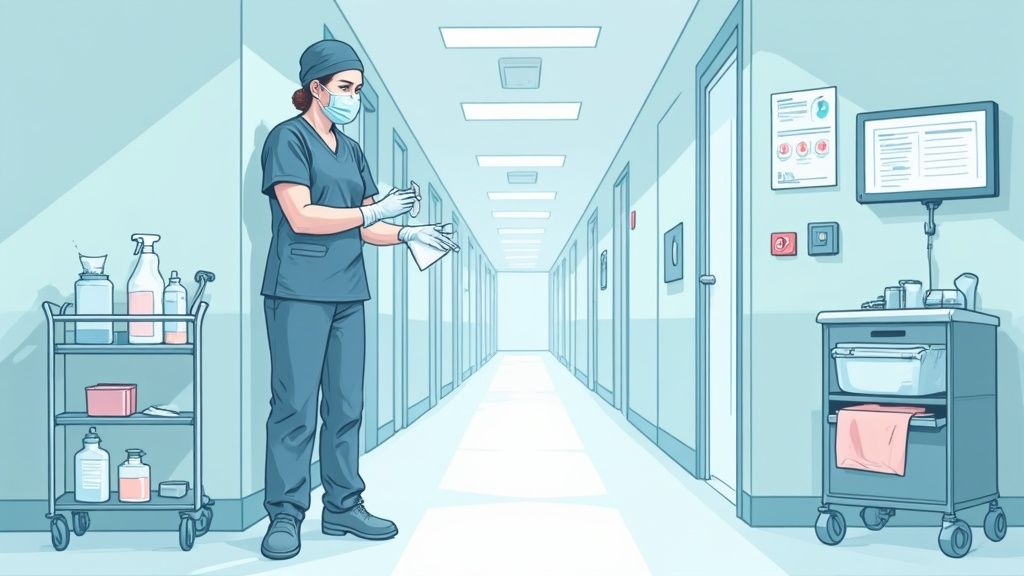
Preventing infections in a healthcare setting is one thing, but that same discipline is now essential for every public space. The game has changed. For business owners, facility managers, and sales professionals, understanding how to prevent healthcare associated infections in commercial environments is no longer optional—it's a critical business strategy. A multi-layered approach combining rigorous cleaning, strategic use of disinfectant wipes, and solid staff training is the new standard.
The core idea? Break the chain of infection before it has a chance to spread. Simple tools like disinfectant wipes are no longer just for hospitals; they're frontline defenders in keeping pathogens at bay in any commercial facility. This isn't just about public health—it’s about building undeniable customer trust.
The Hidden Costs of Unseen Threats in Public Spaces
The conversation around cleanliness has shifted dramatically. A space that looks tidy isn't enough anymore. Customers, employees, and clients now walk in with a different expectation: they want to feel safe in a demonstrably hygienic environment. This puts owners of gyms, offices, stores, and restaurants right on the front lines of public health.

Here's the hard truth: pathogens don't respect boundaries. Germs that cause healthcare-associated infections (HAIs) can thrive on any surface with high foot traffic. This effectively blurs the line between a hospital room and a bustling coffee shop. Every doorknob, credit card terminal, and elevator button is a potential transmission point.
Beyond Appearances: The ROI of Disinfection
A strategic disinfection plan is so much more than a line item on an expense report. Think of it as a powerful business asset with a clear, measurable return on investment. The consequences of cutting corners here go far beyond health risks—they hit your bottom line directly.
A proactive approach to hygiene isn't just about preventing illness—it's about building a resilient business. The small, consistent act of using a disinfectant wipe is a direct investment in your company's reputation, operational stability, and customer loyalty.
Just think about the tangible benefits of making a robust cleaning protocol a priority:
- Fewer Sick Days: A healthier workplace means your team is actually at work. When common areas like break rooms and conference tables are disinfected regularly, the spread of seasonal bugs plummets, keeping everyone more productive.
- Stronger Customer Trust: Visible cleanliness sends a powerful message. When customers see your staff actively wiping down surfaces or find disinfectant wipes available for their own use, their confidence in your brand skyrockets. That trust is what turns a one-time visitor into a loyal regular.
- Bulletproof Brand Reputation: We live in an age of instant online reviews, where a single complaint about cleanliness can do serious damage. Proactive disinfection protects your reputation and makes sure your facility is known for its high standards and commitment to safety.
Smart facility managers understand that the upfront cost of a good disinfection protocol is tiny compared to the long-term benefits. Here's a quick look at the real-world value.
The Real ROI of Proactive Disinfection
| Business Benefit | Impact of Poor Hygiene | Impact of Excellent Hygiene |
|---|---|---|
| Employee Productivity | Increased absenteeism from illness; lower morale. | Fewer sick days; a healthier, more productive team. |
| Customer Loyalty | Customers feel unsafe and don't return. | Builds trust, encouraging repeat business and positive reviews. |
| Brand Reputation | Negative online reviews; perception of being "dirty." | Known as a safe, clean, and professional establishment. |
| Operational Costs | Costs of deep cleaning after an outbreak; potential liability. | Predictable, manageable cleaning costs; reduced risk. |
The math is simple. Investing in prevention is always cheaper, smarter, and better for your brand than reacting to a problem.
The True Cost of Neglecting Hygiene
Even within dedicated healthcare systems, the financial and operational impact of HAIs is staggering. The WHO's Global Report on Infection Prevention and Control highlights a massive economic burden that proves one crucial lesson for every facility manager: prevention is exponentially more cost-effective than reaction.
And it’s not just about direct infections. Other environmental factors can seriously impact the health of a building's occupants. For example, understanding what is Sick Building Syndrome and how to fix it shows how poor air quality and hidden contaminants can create widespread health issues. This just reinforces the need for a truly comprehensive approach to facility wellness.
Ultimately, a solid disinfection strategy isn't optional anymore. It's a non-negotiable part of modern business management and a visible commitment to the well-being of every single person who walks through your doors.
Mastering Your Disinfection Protocol with Wipes
Using a disinfectant wipe seems simple, right? But there’s a huge difference between a casual wipe-down and a scientifically sound disinfection protocol. To truly stop healthcare-associated infections from gaining a foothold, your team needs to master the science behind the wipe. This means leaving guesswork behind and adopting a repeatable process that everyone can execute flawlessly.
The line between just wiping a surface and actually disinfecting it is incredibly fine, and it all comes down to a few critical details that are surprisingly easy to miss. Unfortunately, common mistakes can render all your hard work useless—or worse, actually help spread germs around.
Avoiding Critical Disinfection Errors
One of the most frequent mistakes is using a single wipe across multiple surfaces or for too large an area. A disinfectant wipe isn't a magic sponge; it has a finite capacity. Once it starts to dry out or get visibly soiled, it stops killing germs and starts cross-contaminating. You’re essentially just giving pathogens a free ride from one spot to another.
Another huge one? Ignoring the dwell time. This is the non-negotiable amount of time a surface must stay visibly wet for the disinfectant to do its job and kill the pathogens listed on the label. If you wipe a surface and it dries in five seconds, the disinfectant hasn't had a chance to work.
Key Takeaway: Real disinfection requires the surface to remain wet for the full contact time specified by the manufacturer, which can be anywhere from 30 seconds to several minutes. Always read the label. "Wipe and walk away" simply isn't good enough.
The infographic below really drives home the importance of following a strict process, starting with the basics like personal protective equipment (PPE). It’s a foundational part of any serious cleaning protocol.

This visual is a great reminder that every single step matters, from putting on PPE correctly to applying the disinfectant. It's a system, and skipping one part compromises the whole thing.
Efficiency Hacks for Flawless Execution
Building a great protocol isn’t just about avoiding errors; it’s about working smarter so your team can maintain high standards without getting bogged down.
- The S-Shape Technique: Don't just scrub randomly. Train your staff to wipe in an "S" or zig-zag pattern, starting from the cleanest area and moving toward the dirtiest. It's a simple, methodical approach that prevents you from re-contaminating spots you just cleaned and guarantees full coverage.
- Tiered Cleaning Schedules: Not all surfaces are created equal. High-touch areas need constant attention, while others don't. Create a tiered schedule that targets critical hotspots frequently (e.g., hourly for gym equipment handles, multiple times a day for office coffee pot handles), while secondary surfaces are cleaned on a less intensive cycle. This focuses your team's energy where it counts most.
- Pre-Saturated Wipes: Take the guesswork out of the equation. Using pre-saturated canister wipes ensures a consistent, effective amount of disinfectant is applied every single time. This is key to making sure you actually meet those critical dwell times.
For places like gyms, where equipment sees constant use, these kinds of hacks are essential. Our guide on disinfectant wipes in gyms dives into specific protocols built for these high-turnover environments.
Identifying Your High-Touch Hotspots
A truly effective disinfection plan zeroes in on the surfaces that are touched most often by the most people. These hotspots are the superhighways for germ transmission, so they need the most attention. Go on a "germ hunt" and map out every potential point of contact in your facility—you'll be surprised what you find.
Commonly Missed High-Touch Areas:
- Retail and Restaurants: POS terminals, self-service kiosks, condiment dispensers, chair backs, and menu covers.
- Offices: Shared keyboards in conference rooms, coffee pot handles, microwave buttons, and copy machine control panels.
- Gyms: Free weight handles, treadmill screens, water fountain buttons, and locker handles.
- All Facilities: Light switches, interior door handles, elevator buttons, and hand railings.
Selling the Science of Clean
For those in sales, understanding these details is a game-changer. You're not just selling a product; you're selling a complete solution to a serious problem.
Talk to your clients about hygiene ROI. Explain how a solid disinfection protocol, anchored by quality wipes, can lead to less employee absenteeism and a big boost in customer confidence. Offer to do a quick "hygiene audit" of their space, pointing out the high-touch areas they've been missing. This move instantly establishes your expertise and shows the value you bring.
When you bundle your wipes with training materials on proper usage—like dwell times and the S-shape technique—you’re no longer just a supplier. You’re a partner in infection prevention.
Tailoring Disinfection Strategies for Your Facility
A one-size-fits-all cleaning plan is a recipe for failure. Every commercial space has its own unique rhythm, traffic flow, and set of high-risk surfaces. If you really want to stop healthcare-associated infections from spreading, you have to move beyond generic checklists. The only way to create a genuinely safe environment is with a disinfection blueprint designed specifically for the challenges of your facility.

This means you need to start looking at your gym, office, or store through the eyes of a pathogen. Where do people gather? What surfaces are touched over and over by different hands all day long? Answering these questions will pinpoint your facility's hygiene hotspots and show you exactly where to focus your efforts for the biggest impact.
Blueprints for High-Traffic Environments
Different facilities are fighting different hygiene battles. A gym's biggest challenge is the constant turnover of people on shared equipment. An office, on the other hand, deals with communal spaces used by a more consistent group.
Let's break down some specific, actionable protocols for a few common settings.
For Fitness Centers and Gyms
The very nature of a gym—sweat, shared equipment, and high-touch surfaces—makes it a breeding ground for germs. Your disinfection strategy needs to be relentless and highly visible, not just for safety, but to build member confidence.
- Equipment Between Uses: While a "wipe-down" policy for members is good, staff should still disinfect all machine handles, screens, benches, and free weights at least hourly during peak times.
- Locker Rooms: This is a critical zone. Disinfect locker handles, benches, and faucet taps a minimum of three times daily.
- Shared Items: Yoga mats, resistance bands, and foam rollers must be disinfected after every single use. Set up dedicated stations with disinfectant wipes to make this easy.
For Modern Offices
The shift to hot-desking and collaborative workspaces has thrown a wrench in old-school office cleaning plans. With shared resources as the new norm, your cleaning protocol has to adapt.
- Hot-Desking Areas: At the end of each day, every shared desk, chair, keyboard, and mouse has to be thoroughly disinfected.
- Conference Rooms: After each meeting, wipe down tables, chair arms, remote controls, and even whiteboard markers.
- Communal Kitchens: This is a top priority. Coffee pot handles, microwave buttons, refrigerator doors, and sink taps need to be disinfected multiple times a day.
For Retail and Restaurants
In retail and food service, the customer journey is packed with high-touch interactions. Your disinfection plan needs to follow the customer's path from the moment they walk in.
- Entry Points: Shopping cart and basket handles are the first point of contact. They must be disinfected between each use. This is a highly visible action that builds shopper confidence.
- Checkout Counters: The POS terminal, conveyor belt, and payment card reader are touched by nearly every customer. During busy periods, disinfect these surfaces after every few transactions.
- High-Traffic Zones: Door handles, freezer doors, and self-service kiosks require frequent attention throughout the day.
Sales Tip: When talking to clients, stop saying "cleaning" and start saying "risk management." Frame disinfectant wipes not as a simple supply, but as a strategic tool to protect their most valuable assets: their employees and customers. A targeted plan shows you understand their specific business risks.
To stay ahead of pathogens, many facilities are now integrating advanced air purification systems into their overall strategies. It creates a multi-layered defense that tackles both surface and air quality.
By creating a specific disinfection blueprint for your unique space, you're moving beyond reactive cleaning and into proactive health and safety. It's a visible commitment that shows everyone who walks through your doors that their well-being is your top priority. Make cleanliness a core part of your operations—it’s one of the smartest investments you can make.
Pitching Hygiene as a Business Asset
If you're in the cleaning sales game, it's time to change the channel. Stop talking about disinfectant wipes as just another item on a supply list. Start framing them for what they really are: a strategic tool for managing risk and protecting a brand. Your clients aren't just buying a box of wipes; they're investing in the health of their business, the safety of their team, and the trust of every customer who walks through their door.
The best way to make this pivot is by focusing on “hygiene ROI.” This isn't some fluffy marketing term—it's a straight line connecting a cleaner facility to real-world business results. A smart disinfection plan doesn't just prevent germs from spreading; it directly beefs up the bottom line.
Shift the Conversation From Cost to Investment
Your pitch needs to graduate from product features to business outcomes. A case of high-quality disinfectant wipes costs pennies compared to the price of employee sick days, tanking productivity, or a single scathing online review about a dirty facility.
Arm yourself with these talking points to build a rock-solid case:
- Slash Employee Absenteeism: A clean workplace is a healthy workplace. Regularly disinfecting shared spaces like break rooms, keyboards, and conference tables cuts down on the transmission of everyday bugs that keep staff at home.
- Boost Customer Confidence: Visible cleaning is the new currency of trust. When customers see your client's staff actively wiping down a counter or find wipes available for their own use, their confidence in that brand skyrockets.
- Bulletproof Their Brand Reputation: A clear commitment to hygiene shields a business from negative reviews. It positions them as a responsible, professional establishment, which is a powerful marketing message.
You're not just selling a cleaning supply. You're selling operational continuity. You're selling reputation insurance. You're selling peace of mind. Frame your solution as an essential part of their business strategy, not just an item for the janitor's closet.
Run a Quick Hygiene Audit
One of the most powerful sales tactics is to show, not just tell. Offer to do a quick, informal "hygiene audit" for a prospect. Walk through their space with them and start pointing out all the high-touch surfaces they're probably missing. This move instantly establishes your expertise and makes the gaps in their current plan impossible to ignore.
Keep an eye out for these commonly overlooked germ hotspots:
- In the Office: Shared keyboards, the handle on the coffee pot, microwave buttons.
- At the Gym: Dumbbell handles, treadmill screens, water fountain buttons.
- In a Retail Shop: POS terminals, shopping cart handles, fitting room hooks.
This simple walk-through turns a vague, abstract problem into a visible, urgent need. You'll see the lightbulb go on as the client recognizes their vulnerabilities and sees the value in a more thorough plan.
Create Bundled Solutions They Can’t Refuse
Disinfectant wipes shouldn't be sold in a vacuum. The most successful pros create holistic solutions that make the client's life easier. Bundle your products with services and training to create a complete offer that solves their entire hygiene problem.
Think about offering packages that include:
- Product and Placement Strategy: Advise them on the smartest locations for dispensers to get maximum use from both staff and customers. Think entrances, checkout counters, and common areas.
- Staff Training Tools: Provide simple, visual guides on how to use wipes correctly. A cheat sheet on the "S-shape" wiping technique or a poster explaining the importance of dwell time can make a huge difference.
- Tiered Supply Plans: Set them up on a subscription model so they never have to worry about running out. Create different tiers based on the size of their facility and foot traffic.
This consultative approach transforms you from a simple supplier into a trusted partner. You're the expert helping them prevent infections and build a stronger, more resilient business.
By reframing the conversation around hygiene ROI, showing your value through quick audits, and offering smart, bundled solutions, you can sell cleanliness as the essential business asset it truly is.
It Takes a Village to Keep Things Clean
Real, lasting infection prevention isn’t just about what your cleaning crew does after hours. It’s a group effort. To truly stop healthcare-associated infections from taking hold in your space, you need to build a culture of cleanliness where everyone—from your staff to your customers—plays a part.
When you get this right, your cleaning protocol stops being a background task and becomes a visible, active commitment to health and safety.
Your Team is Your First Line of Defense
The first step is getting your entire team on board. This isn't just for the people with mops and buckets. Every single employee, from the front desk receptionist to the back-office manager, needs to understand the basics of disinfection. And it's not just about showing them how to use a wipe; it’s about explaining the why.
Give Your Staff the ‘Why,’ Not Just the ‘How’
Simple, consistent training can make a huge difference. Teach your staff to spot the high-touch hotspots in their own work areas—the credit card machine at the register, the shared keyboard in the conference room, or the handle on the breakroom coffee pot.
When employees start taking ownership of their immediate environment, you suddenly have dozens of hygiene advocates keeping the space safer all day long. This strategy is echoed at the highest levels of public health.
The WHO's Global Report on Infection Prevention and Control makes it clear: training your workforce is a high-return investment.
Here’s the key: When your staff understands that wiping down a counter isn't just a rule, but a way to protect themselves, their coworkers, and your customers, they switch from passively following orders to actively solving the problem.
Get Your Customers in on the Action
Your efforts shouldn't stop with your team. Bringing customers into the process is a powerful way to show you’re serious about hygiene while improving the overall cleanliness of your facility.
The strategy is simple: make it incredibly easy for them to pitch in.
Placing disinfectant wipe dispensers in highly visible, strategic locations sends a clear signal that you care about their well-being. It’s a small touch that builds a lot of trust.
- In a Gym: Put wipe stations right next to every piece of cardio and strength equipment. Members will absolutely use them to clean surfaces before and after they work out.
- In a Retail Store: Place dispensers near the shopping cart corrals and right at the entrance. It’s a small convenience that makes a great first impression.
- In an Office: Keep canisters in shared spaces like kitchens, copy rooms, and reception areas for both employees and visitors to use.
This approach does more than just get a few extra surfaces wiped down. It makes your hygiene program a visible, tangible part of the customer experience.
By combining clear staff training with easy-to-access tools for customers, you build a powerful culture of shared responsibility. Prioritize this culture and make high-quality disinfectant wipes a cornerstone of your daily routine or product offerings.
Got Questions About Facility Disinfection? We’ve Got Answers.
As you dial in your facility’s cleaning protocols, a few key questions always seem to pop up. Getting straight, practical answers is the best way to make sure your strategy is solid and your team is on the same page. Let's tackle some of the most common ones we hear from managers and business owners.
How Often Should We Really Be Disinfecting High-Touch Surfaces?
The honest answer? It all comes down to foot traffic. There’s no one-size-fits-all schedule.
For your busiest areas, the most frequently touched surfaces need constant attention. Think about door handles, payment terminals, elevator buttons, and shopping cart handles. In a high-traffic commercial space, these should be disinfected several times a day. During your absolute peak hours, it might even need to be hourly.
Surfaces with more moderate contact, like conference tables or reception countertops, can usually be handled with one thorough disinfection per day. The trick is to map your cleaning schedule directly to how your facility is actually used. And always, always ramp up the frequency during cold and flu season—it's the only way to stay ahead of the curve.
Can We Just Use Wipes Instead of Deep Cleaning?
Nope. Think of them as two essential players on the same team. They have different jobs, but you can't win without both.
Disinfectant wipes are your frontline tool for the daily battle. They’re perfect for frequent, targeted hits on high-touch surfaces to kill pathogens throughout the day. But they were never designed to replace a good old-fashioned deep clean that physically removes dirt, grime, and all that organic stuff.
The process has to be done in the right order to work:
- Clean First: Grab a standard cleaner and get rid of all the visible soil and debris from the surface. You can't disinfect a dirty surface.
- Disinfect Second: Now, use a fresh disinfectant wipe. The goal is to get the surface visibly wet.
- Respect the Dwell Time: This is the most important part. Let the surface air dry. Don't wipe it off. This gives the disinfectant the contact time it needs to actually kill the germs.
Wipes are a non-negotiable part of your daily protocol, not a shortcut to skip foundational cleaning.
How Do I Justify a Bigger Budget for Disinfectant Supplies?
You need to change the conversation from cost to investment. When you ask for more money for quality supplies, you’re not talking about an expense—you’re talking about an investment in risk mitigation, brand protection, and keeping the doors open.
The price of a case of premium disinfectant wipes is pocket change compared to the massive costs of employee sick days, lost productivity, or a single scathing online review about cleanliness that torches your reputation.
Frame the budget request as a proactive measure to protect the health and well-being of everyone who walks through your doors—customers and employees alike. This isn't just about cleaning; it's a commitment that strengthens your brand image, improves customer loyalty, and ultimately, protects your bottom line. It's not an expense; it's operational insurance.
What’s the Single Biggest Mistake Teams Make with Wipes?
Without a doubt, it's stretching one wipe too far. The most common—and dangerous—mistake is using the same wipe for a huge area or, even worse, for multiple different surfaces.
A wipe starts losing its power as it dries out and gets loaded up with gunk. When that happens, you hit the point of cross-contamination. You’re no longer killing germs; you're just giving them a free ride from one spot to another.
Train your team on this simple rule: use a fresh wipe for each small, defined area. The surface has to stay wet long enough to meet the product's specified dwell time. If the wipe isn't leaving a wet trail behind it, it’s done. Time to grab a new one. Making this small change is a powerful step toward creating a genuinely safer facility for everyone.
Leave a Reply