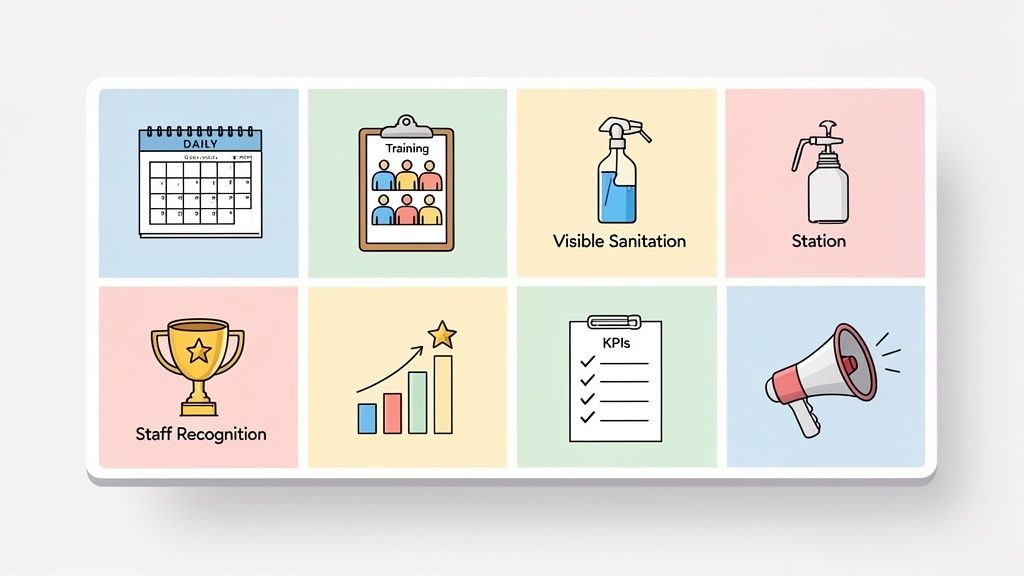
International Housekeeping Week is more than just a celebration; it's a strategic opportunity to overhaul, innovate, and elevate your facility's approach to cleanliness. In today's commercial environment—whether you manage an office, a gym, or a bustling retail store—hygiene is directly tied to customer trust, brand reputation, and revenue. Moving beyond basic cleaning, a structured plan focusing on high-impact initiatives can turn your housekeeping team into a visible asset. This article provides seven actionable, themed housekeeping week ideas designed to reinforce the critical role of cleanliness in commercial success.
Each day is structured as a complete blueprint for implementation. We cover everything from staff training and sales strategies to facility-specific suggestions. To elevate cleanliness from a basic task to a strategic advantage, it's crucial to implement robust protocols. Documenting these initiatives using Standard Operating Procedures best practices ensures consistency and flawless execution long after the week is over.
We will explore how to apply these strategies to not only achieve a higher standard of sanitation but also to boost your business's bottom line. Central to modern hygiene is the effective use of disinfectants. Throughout this guide, we'll highlight the critical role disinfectant wipes play in maintaining a safe, welcoming, and profitable environment. These ideas are designed to be practical and impactful, helping you transform your housekeeping operations from a daily chore into a core business function that delivers measurable results.
1. High-Touch Surface Deep-Clean Day
Kicking off your housekeeping week with a themed day dedicated to high-touch surfaces sends a powerful message about your commitment to staff and visitor safety. This approach moves beyond routine cleaning by systematically identifying, documenting, and deep-cleaning the specific points where pathogens are most likely to transfer. Think of it as creating a detailed hygiene map of your facility, focusing intense effort on doorknobs, payment terminals, elevator buttons, handrails, and armrests. This foundational activity sets a high standard for the entire week and reinforces the critical role of targeted sanitation.

This idea isn't just about cleaning more; it's about cleaning smarter. The goal is to transform your team's mindset from a general task list to a strategic, risk-based approach. By dedicating a full day to this, you create an opportunity for hands-on training, process refinement, and a renewed focus on what matters most for public health.
How to Implement a High-Touch Focus Day
Effective execution requires more than just a memo. It involves a structured plan that engages your entire team and produces measurable results.
- Cleaning Tip – Mapping and Identification: Walk through each zone of your facility and create a detailed checklist of every surface people frequently touch. For a gym, this includes dumbbell handles and treadmill consoles. For an office, focus on conference room phones, light switches, and shared keyboards.
- Cleaning Tip – Protocol Demonstration: Use this day for hands-on training. Demonstrate the correct "dwell time" for disinfectants—the time a surface must remain visibly wet to kill pathogens. Show the proper technique for using EPA-approved disinfectant wipes to avoid cross-contamination.
- Sales Tip – Educate on Hygiene ROI: For sales professionals, use this concept to show clients the return on investment of a robust hygiene program. Explain how visible, frequent cleaning of high-touch areas with disinfectant wipes directly enhances customer confidence and reduces absenteeism, justifying the cost of premium supplies.
Actionable Tips for Success
To make this a cornerstone of your housekeeping week ideas, consider these practical strategies:
- Create Visual Checklists: Post laminated, visual guides in each area showing the specific high-touch points to be cleaned. This is far more effective than a text-only list.
- Establish a 'Touch-Point Audit': Encourage staff to report newly discovered high-traffic surfaces. Reward employees who identify spots that were missed during the initial mapping.
- Facility-Specific Focus (Retail): In retail stores, high-touch points include shopping cart handles, checkout counters, and PIN pads. Frequent, visible wiping of these areas with a disinfectant wipe reassures shoppers and enhances their experience.
- Use Color-Coding: Assign different colored microfiber cloths or wipe containers for different areas (e.g., blue for general surfaces, red for restroom fixtures) to prevent cross-contamination.
Key Insight: A dedicated High-Touch Surface Deep-Clean Day shifts the focus from "what" to clean to "why" we clean it. It directly connects the team's daily actions to the health and safety of every person who enters the facility, increasing their sense of purpose and a visible commitment to hygiene.
2. Seasonal Deep-Clean & Protocols Overhaul Day
Moving beyond daily routines, a Seasonal Deep-Clean & Protocols Overhaul Day is a strategic event that aligns your facility's hygiene practices with upcoming environmental and operational shifts. This day is dedicated to a comprehensive audit of current procedures, adapting them for challenges like flu season, summer humidity, or holiday traffic surges. It’s an opportunity to retrain staff, perform deep equipment maintenance, and formally update protocol documentation. This forward-looking approach ensures your team is prepared, not just reactive, to seasonal demands.
This idea is about proactive adaptation rather than reactive cleaning. The goal is to anticipate challenges and equip your team with the updated knowledge and tools needed to maintain high standards, regardless of external factors. By formalizing this as a dedicated event, you reinforce a culture of continuous improvement and operational excellence, making it a standout among housekeeping week ideas.
How to Implement a Seasonal Overhaul Day
A successful overhaul day is a planned, multi-faceted event that integrates training, maintenance, and strategic planning. It requires a clear structure to produce tangible improvements in your cleaning program.
- Cleaning Tip – Seasonal Risk Matrix: Identify unique seasonal challenges. For an office, winter means a higher risk of cold and flu transmission. For a school, back-to-school season requires an initial deep clean and disinfection of all classrooms and common areas.
- Sales Tip – Promote Seasonal Packages: Sales reps can create "Flu Season Prevention" or "Summer Hygiene" packages for clients. Bundle disinfectant wipes, hand sanitizer, and targeted deep-cleaning services to address specific seasonal threats, demonstrating proactive partnership.
- Facility-Specific Focus (Schools): During summer break, perform a top-to-bottom deep clean. For flu season, increase the frequency of disinfecting desks, doorknobs, and water fountains. Ensure classrooms are stocked with disinfectant wipes for teachers to use throughout the day.
Actionable Tips for Success
To ensure your seasonal overhaul becomes a cornerstone of your operational calendar, consider these practical strategies:
- Schedule in Advance: Plan your overhaul day 3-4 weeks before a major seasonal transition. This provides enough lead time to implement changes, order necessary supplies, and brief all staff.
- Document and Standardize: All protocol changes must be documented in a central manual or digital platform. Require staff to review and sign off on the updates, ensuring clear communication and accountability.
- Cleaning Tip – Efficiency Hack: Focus deep cleaning on one specific area at a time (e.g., all windows, all carpets) rather than trying to deep clean an entire room at once. This "zone" approach is more efficient and ensures thoroughness.
- Update Visual Aids: Use this day to photograph updated cleaning processes and create new laminated visual guides. Posting these in relevant areas provides a constant, clear reference for staff, reinforcing the new seasonal standards.
Key Insight: A Seasonal Deep-Clean & Protocols Overhaul Day transforms your housekeeping program from a static set of rules into a living system that adapts to real-world conditions. It directly prepares your facility and staff for predictable challenges, ensuring consistent cleanliness and safety year-round.
3. Staff Training & Certification Spotlight Day
Elevating your team from cleaners to certified professionals is one of the most impactful housekeeping week ideas you can implement. This themed day shifts the focus from tasks to expertise, celebrating your staff's commitment while arming them with verified skills. It’s an investment in your people that pays dividends in quality, safety, and morale, positioning your cleaning program as a professional discipline rather than just a job. This is about building careers and recognizing the science behind sanitation.

Dedicating a day to training and certification formalizes your commitment to excellence. For staff, it provides a clear path for professional development and proves they are valued experts. For your facility, it creates a documented, standardized level of care that meets and exceeds industry requirements, from OSHA safety protocols to specialized programs like ISSA certifications. It's a powerful statement about the professionalism of your operation.
How to Implement a Training & Certification Day
A successful training day is more than a lecture; it's an engaging, hands-on experience that builds confidence and competence. The goal is to make learning stick.
- Partner for Credibility: Collaborate with recognized bodies like the ISSA (International Sanitary Supply Association) to offer official certifications. For a gym, this might be a specialized course on fitness equipment sanitation. For an office building, it could focus on chemical safety and green cleaning.
- Cleaning Tip – Develop Facility-Specific Modules: Supplement official certifications with custom training. For a restaurant, demonstrate how to properly clean and disinfect food-prep surfaces versus dining tables, emphasizing the need for food-safe products in specific zones.
- Sales Tip – Leverage Certification in Sales: Sales professionals can highlight a client's use of certified staff as a marketing advantage. Frame it as: "Our services ensure your facility is cleaned by trained professionals, a key differentiator that builds trust with your own customers."
Actionable Tips for Success
To ensure your training day is a cornerstone of your housekeeping week and not just a one-off event, integrate these strategies:
- Incentivize Achievement: Tie certification completion to tangible rewards, such as a one-time bonus, a pay-grade increase, or priority for promotion.
- Document Everything: Use sign-in sheets, competency checklists, and digital records to track who was trained on what. This documentation is essential for compliance audits.
- Celebrate Publicly: Host a small ceremony to award certificates or feature newly certified team members in a company newsletter.
- Implement Peer Mentorship: Pair newly certified employees with veteran staff members to create a peer-training model. This reinforces learning and builds team cohesion.
Key Insight: A Staff Training & Certification Spotlight Day transforms housekeeping from a job into a profession. It builds a culture of continuous improvement, boosts staff retention by investing in their growth, and provides your facility with a verifiable, expert-level standard of clean that clients and visitors can trust.
4. Scent Strategy & Environmental Comfort Day
Cleanliness is often perceived through more than just sight; it’s an immersive sensory experience. This housekeeping week idea dedicates a day to a strategic review of your facility’s scent profile and overall environmental comfort. It acknowledges that a significant part of perceived cleanliness is psychological, and scent is a powerful tool for shaping guest satisfaction, reinforcing brand identity, and creating a welcoming atmosphere. This moves beyond simply masking odors to intentionally designing the olfactory landscape of your space.
This approach is not about overpowering guests with fragrance but about mastering subtlety. A well-executed scent strategy can make an office feel more productive, a gym locker room feel fresher, and a restaurant entrance feel more appetizing. By focusing on environmental comfort, you empower your team to see their work as creating an experience, not just completing a checklist.
How to Implement a Scent Strategy Day
A successful scent strategy day is about thoughtful evaluation and precise execution. It requires a plan that goes from identifying problem areas to implementing a signature scent.
- Cleaning Tip – Odor Source Audit: Begin with a "scent walk" through the facility. The first priority is to identify and eliminate sources of malodor, not just cover them up. Use this time to inspect drains, trash receptacles, and hidden areas for moisture or mold. This is where odor-neutralizing or enzymatic cleaners are critical.
- Sales Tip – Sell the Experience, Not Just the Scent: Frame scenting as a branding tool. For a gym client, propose an invigorating citrus scent for the workout floor and a calming lavender scent for the yoga studio. Link the fragrance to the desired customer feeling and business outcome.
- Application Training: Teach your staff the art of subtlety. Demonstrate proper use of diffusers and the importance of consistency. The goal is a barely-there scent that enhances the environment, not a strong perfume that suggests something is being hidden.
Actionable Tips for Success
To make your scent strategy a valuable part of your housekeeping week ideas, apply these practical tips:
- Address Root Causes First: Before introducing a new fragrance, ensure all surfaces are thoroughly cleaned and disinfected. Odors cling to grime and bacteria. A reliable disinfectant wipe is your first line of defense in preparing a space for scenting. We recommend Wipes.com Disinfectant Wipes as they clean and disinfect in one step, effectively neutralizing odor-causing bacteria at the source.
- Align Scent with Your Brand: A corporate office benefits from a subtle, clean scent like green tea, which promotes focus. A restaurant should avoid strong floral scents that compete with food aromas, opting for light, fresh notes like lemon or basil near the entrance.
- Rotate Scents Seasonally: Prevent "scent fatigue" by changing your fragrance profile with the seasons. Consider bright citrus in the summer and warmer, spicy notes in the fall and winter to keep the environment feeling fresh and current.
- Gather Feedback: Use guest surveys or simple feedback cards to ask about the environment. To further understand how scents can influence the atmosphere and well-being within your facility, explore the psychological benefits of fragrance.
Key Insight: A Scent Strategy & Environmental Comfort Day teaches your team that true cleanliness is a multi-sensory experience. It connects their work directly to guest perception and satisfaction, proving that how a space feels is just as important as how it looks.
5. Restroom Excellence & Compliance Day
Dedicate a day to restroom excellence and compliance to address the most critical assessment point for guest satisfaction and a frequent source of liability. This theme focuses intense effort on an area that directly shapes your facility’s reputation. It goes beyond a simple mop-and-wipe, involving detailed audits of every fixture, deep-cleaning protocols, supply upgrades, and specialized staff training. For many customers, the state of your restrooms is a direct reflection of your entire operation's standards.

This idea acknowledges that restrooms present unique challenges, from health code compliance to managing guest perceptions. A dedicated day allows your team to master the specifics of odor control, fixture maintenance, and high-frequency sanitation. Whether it's an office aiming for a professional image or a restaurant complying with health codes, immaculate restrooms are non-negotiable. This is one of the housekeeping week ideas that delivers an immediate and visible return on investment.
How to Implement a Restroom Excellence Day
Executing this theme requires a systematic approach that combines inspection, action, and documentation, turning a routine task into a strategic function.
- Cleaning Tip – Audit and Inspect: Create a detailed, facility-specific restroom inspection checklist. It should cover everything: fixture function (toilets, faucets, dryers), supply levels (soap, paper, sanitizer), cleanliness (floors, counters, mirrors, stalls), and safety (wet floor signs, proper disposal bins).
- Cleaning Tip – Deep-Clean and Upgrade: This is the time for a top-to-bottom deep clean. Use enzyme-based cleaners to treat odor sources in drains and grout. Assess current supplies; upgrading to touchless dispensers and premium paper products signals a commitment to quality.
- Sales Tip – Frame as Risk Mitigation: For janitorial sales reps, pitch restroom excellence as a risk management service. Highlight how proper disinfection of toilets, faucets, and stall handles reduces pathogen spread and protects the client from health code violations and negative reviews.
Actionable Tips for Success
To ensure your restrooms consistently impress and meet compliance standards, integrate these strategies:
- Invest in Touchless Technology: Reduce pathogen transmission and improve hygiene by installing touchless faucets, soap dispensers, and paper towel dispensers.
- Post Visible Cleaning Logs: Place a checklist in a clear holder inside or outside the restroom. Staff can initial it after each check, which demonstrates diligence to guests and reinforces accountability.
- Standardize Your Supplies: Choose a versatile, EPA-approved disinfectant for all restroom surfaces. This simplifies training and ensures consistent results. We recommend Wipes.com Disinfectant Wipes, which are ideal for the quick, frequent cleaning required to maintain restroom hygiene.
- Facility-Specific Focus (Gyms): Gym restrooms and locker rooms require high-frequency cleaning to combat humidity, odor, and bacteria. Focus on disinfecting benches, locker handles, and shower floors multiple times a day.
Key Insight: Restroom Excellence Day transforms restroom cleaning from a chore into a core part of the customer experience strategy. It proves that your facility values health, safety, and guest comfort in the places where it matters most, building trust and protecting your brand's reputation.
6. Innovation & New Product Testing Day
Devoting a day during your housekeeping week to innovation and new product testing shifts the focus from routine tasks to strategic improvement. This initiative formalizes the process of evaluating new cleaning products, equipment, and technologies before a full-scale investment. It positions your team not just as cleaners, but as key contributors to the facility's operational excellence and future efficiency. Think of it as an in-house R&D day where your frontline staff become product testers, providing invaluable feedback on everything from electrostatic sprayers in an office to new enzymatic odor eliminators in a restaurant.
This idea does more than just identify better supplies; it fosters a culture of continuous improvement. By involving your team directly, you build buy-in for future changes and empower them to solve long-standing challenges. It’s a powerful way to show that management is invested in making their jobs safer, easier, and more effective.
How to Implement an Innovation & Testing Day
A successful testing day is built on clear objectives and structured evaluation, not just unboxing new gadgets. It requires a methodical approach to produce actionable data.
- Establish Clear Evaluation Criteria: Before testing begins, define what "better" means. Create a scorecard with criteria like efficacy (how well it cleans/disinfects), ease of use, safety, training time, and overall cost.
- Cleaning Tip – Create Controlled Testing Zones: Select specific, high-traffic areas for pilot programs. A gym could test a new disinfectant wipe on one set of dumbbells, while an office could try a new glass cleaner in one conference room. This allows for direct comparison against current methods.
- Sales Tip – Offer a "Product Pilot Program": Sales reps can propose a no-risk trial of a new product, like a case of disinfectant wipes. Frame it as a collaborative effort to find the most efficient solution for the client's specific needs, building a consultative relationship.
Actionable Tips for Success
To make this one of the most impactful housekeeping week ideas, use these strategies to ensure your tests yield clear results:
- Request Product Trials: Many manufacturers and distributors are eager to provide free samples or trial periods for new products. Reach out to your suppliers ahead of time to arrange for demos.
- Document Everything: Use photos and videos to record the "before and after." If possible, use quantifiable metrics, like ATP meter readings to measure surface cleanliness or a stopwatch to time a specific task, to get objective data.
- Involve Frontline Staff in Decisions: The people using the products every day are your best resource. Including them in the final decision-making process ensures the chosen solution is practical for daily use and boosts team morale.
- Calculate Total Cost of Ownership (TCO): Look beyond the price per unit. A more effective disinfectant wipe could reduce labor time by cleaning and disinfecting in one step, offering significant long-term savings.
Key Insight: An Innovation & New Product Testing Day transforms your team from end-users into active partners in operational advancement. It ensures that investments in new technology and products are based on real-world performance and staff acceptance, not just a sales pitch.
7. Guest Experience & Perception Mapping Day
This strategic day shifts the focus from your team's operational checklist to the customer's real-world experience. It involves physically walking through your facility from a guest's perspective to document how cleanliness is perceived, not just how it is performed. This exercise reveals the critical gap between your cleaning standards and guest satisfaction, identifying the overlooked details that shape your reputation. For example, a business owner might discover customers perceive the entryway as 'dirty' due to smudged glass doors, highlighting a need for more visible, frequent cleaning in that specific zone.
This idea isn't about finding fault with your team; it's about aligning their hard work with what customers actually notice and value. A restaurant manager might learn that while the kitchen is spotless, diners fixate on sticky menus or dusty light fixtures, which disproportionately affects their perception of overall hygiene. This day provides the data needed to adjust protocols and prove to customers that you are listening.
How to Implement a Perception Mapping Day
A successful guest experience walk-through requires structure and an open mind. It's an investigation into your facility's silent story, told through the eyes of a first-time visitor.
- Assemble a Cross-Functional Team: Include staff who interact with customers daily, like receptionists or sales associates. Their insights into common comments and behaviors are invaluable.
- Cleaning Tip – Create a Standardized Audit Form: Develop a detailed form that covers key journey points: entryway, reception, restrooms, and specific zones relevant to your business (e.g., showroom cars, gym equipment, dining tables). Prompt for notes on sight, smell, and touch.
- Sales Tip – Use Perception as a Sales Tool: Encourage clients to conduct this exercise. It often reveals hygiene gaps they didn't know they had, creating a clear need for your products. Frame it as, "Let's see what your customers see," then offer disinfectant wipes as the perfect solution for the smudged, sticky, and frequently-touched surfaces they discover.
Actionable Tips for Success
To turn this mapping day into a permanent improvement, consider these practical housekeeping week ideas:
- Schedule for Realism: Conduct the walk-through during normal operating hours, not right after a deep clean. You want to see the facility as a typical customer does.
- Document Everything Visually: Take timestamped photos of every issue identified. A picture of a scuffed wall or an overflowing trash can is more powerful than a written note.
- Analyze Online Reviews: Dedicate time to combing through Google, Yelp, and industry-specific review sites. Look for recurring keywords related to cleanliness ("dusty," "smelled," "sticky") and add these to your map.
- Share Findings with the Whole Team: Present the guest feedback and photos to your housekeeping staff. Explaining why a specific area needs more attention (e.g., "Customers consistently mention the smudges on this glass door") provides purpose and improves buy-in.
Key Insight: Perception is reality. A Guest Experience & Perception Mapping Day proves that a facility isn't truly "clean" until the customers believe it is. It connects cleaning tasks directly to business outcomes like positive reviews, customer loyalty, and increased revenue.
Housekeeping Week: 7-Point Comparison
| Program | Implementation 🔄 | Resources ⚡ | Expected Outcomes 📊 | Ideal Use Cases 💡 | Key Advantages ⭐ |
|---|---|---|---|---|---|
| High-Touch Surface Deep-Clean Day | Moderate–High: systematic mapping and staged cleaning; may require temporary closures | High labor intensity; hospital-grade disinfectants; documentation tools | Large reduction in touchpoint transmission (~85–90%); strong visible reassurance | High-traffic sites: airports, gyms, dealerships, short-term rentals | Targeted pathogen reduction; measurable baselines; marketing-ready before/after proof |
| Seasonal Deep-Clean & Protocols Overhaul Day | High: full audits, SOP updates, and retraining on a quarterly/seasonal cadence | Significant coordination, training time, equipment maintenance, inventory review | Prevents seasonal contamination spikes; minimizes equipment failures; readiness for demand shifts | Facilities with clear seasonality: airports, event venues, hotels, rentals | Proactive risk mitigation; aligns resources to demand; supports compliance |
| Staff Training & Certification Spotlight Day | Moderate: planned training sessions, competency assessments, external certs | Training costs, certification fees, trainer resources, staff time | Improved consistency and safety; documented competencies; reduced liability | Any facility needing compliance and skilled staff: healthcare, hospitality, airports | Raises staff competence and morale; retention and professionalization; compliance records |
| Scent Strategy & Environmental Comfort Day | Low–Moderate: odor audits, scent pilots, and delivery system tuning | Fragrance systems or products, small testing budget, guest feedback tools | Boosts perceived cleanliness and satisfaction; branded sensory differentiation | Brand-driven environments: luxury hotels, retail, dealerships, lounges | Cost-effective perception lift; memorable branding; lifts reviews and repeat visits |
| Restroom Excellence & Compliance Day | High: detailed restroom audits, ADA/health-code checks, possible upgrades | Fixture replacements, supplies, frequent monitoring staff, possible retrofit costs | Major impact on guest satisfaction and regulatory compliance; fewer violations | All public facilities, especially high-traffic restrooms: hotels, airports, venues | Prevents fines/liability; strongest driver of cleanliness perception; high reputation ROI |
| Innovation & New Product Testing Day | Moderate: pilot setups, side-by-side comparisons, evaluation criteria | Prototype products/equipment, staff testers, measurement and documentation tools | Identifies efficiency or cost-saving solutions; reduces rollout risk | Tech-forward or large operators testing new sanitization tech and products | Finds better tools/processes; limits wasted spend; engages staff in improvements |
| Guest Experience & Perception Mapping Day | Moderate: facilitated walk-throughs, interviews, documentation of blind spots | Manager and frontline time, survey tools, photo documentation | Reveals high-impact perception issues and quick wins; aligns cleaning to guest expectations | Customer-centric operations: hotels, rentals, event venues, retail | Prioritizes improvements that drive satisfaction and revenue; reveals low-cost fixes |
Make Every Week Housekeeping Week
The true measure of a successful International Housekeeping Week is not the singular burst of activity but the lasting shift it creates in your facility's culture. The seven themed days detailed in this article, from a "High-Touch Surface Deep-Clean Day" to a "Guest Experience & Perception Mapping Day," offer more than just a weekly schedule. They provide a strategic blueprint for embedding operational excellence into your daily routines. The ultimate goal is to move beyond the reactive cycle of cleaning up messes and establish a proactive, continuous state of readiness, where exceptional hygiene is the standard, not the exception. By transforming a special event into a sustained practice, you ensure that the value of your housekeeping team and the safety of your guests are always top priorities.
These curated housekeeping week ideas are designed to be adaptable and impactful across diverse commercial environments. For a gym owner, implementing a "High-Touch Surface" protocol with disinfectant wipes prevents germ spread between members. For a restaurant, the principles of a "Restroom Excellence Day" translate directly to five-star reviews. The "Innovation Day" isn't just about trying new tools; it's about empowering your team to find efficiencies that save time and improve results, a critical advantage for any busy business.
From Annual Event to Daily Mindset
Transitioning from a week-long celebration to an ongoing commitment requires a strategic shift. Recognize that cleanliness is a core component of your brand and customer experience. It’s not a background task; it's a front-and-center feature that communicates care, safety, and professionalism.
Actionable next steps to make this transition a reality include:
- Integrate the Themes Monthly: Don't wait a full year. Dedicate one day each month to a specific theme. For example, make the first Monday of every month your "High-Touch Surface Deep-Clean Day," ensuring critical areas are consistently sanitized.
- Empower Your Team with the Right Tools: Consistent excellence requires reliable supplies. The focus on high-touch surfaces, from door handles to gym equipment, underscores the need for effective and convenient solutions. Keeping disinfectant wipes readily available for staff allows for quick, on-the-spot sanitation, maintaining hygiene standards between deeper cleans. For superior performance and reliability, we recommend Wipes.com Disinfectant Wipes, which are formulated to effectively clean and disinfect surfaces, supporting your team's efforts to maintain a safe environment.
- Create a Feedback Loop: Use the "Guest Experience & Perception Mapping Day" as a template for gathering continuous feedback. Implement simple QR code surveys in restrooms or common areas asking guests to rate the cleanliness. This data provides real-time insights and helps you address issues before they become complaints.
The Lasting Impact of Prioritizing Cleanliness
For business owners and facility managers, adopting these principles means fewer customer complaints, higher staff morale, and a stronger operational foundation. When your team feels valued and equipped, their performance improves. When customers feel safe and comfortable, their loyalty grows. This is the tangible return on your investment in a robust hygiene program.
For sales professionals in the cleaning and janitorial industry, these themed days provide a powerful narrative. Instead of just selling a product, you are offering a solution to a business problem. You can frame your pitch around these housekeeping week ideas, showing a potential client how your products, like premium disinfectant wipes, fit into a larger strategy for brand enhancement, risk mitigation, and customer retention.
Ultimately, the goal is to make every week feel like Housekeeping Week. Prioritize cleanliness by integrating effective tools like disinfectant wipes into your daily routine and product offerings. Build a system where excellence is self-sustaining, where your team is motivated, and where every person who walks through your doors feels confident in the safety and quality of your environment. Use these ideas to build a lasting legacy of cleanliness that protects your people, elevates your brand, and sets a new standard for your industry.
Leave a Reply