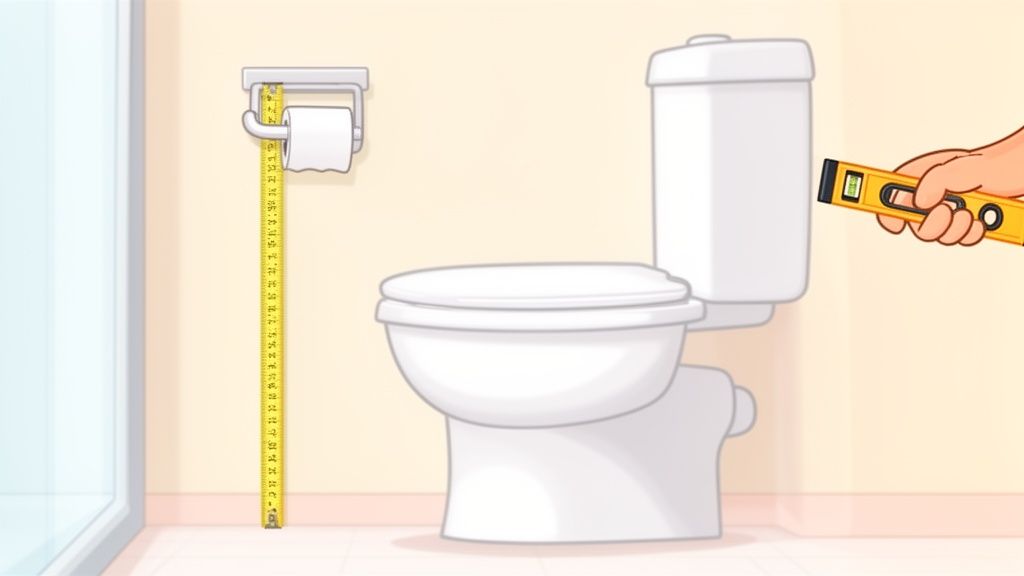
When you’re trying to figure out just how high to hang a toilet paper holder, there’s a number that has stood the test of time: 26 inches (66 cm) from the floor to the very center of the holder. This isn't just a random suggestion; it's the sweet spot.
Pair that height with a forward placement of 8 to 12 inches (20 to 30 cm) measured from the front edge of your toilet bowl. This combination creates the most comfortable and natural reach for most adults, avoiding any awkward twisting or leaning.
The Gold Standard For Toilet Paper Holder Height
Getting the placement right is one of those subtle details that makes a bathroom feel thoughtfully designed. It’s a small touch, but when it’s done right, you notice. This isn’t about following some arbitrary rule—it’s about ergonomics and making a space genuinely comfortable for anyone who uses it.

The 26-inch height and 8-12 inch forward placement have been the go-to measurements since the building codes of the 1970s. This specific setup is designed to optimize reach for 95% of adults sitting on standard 15-17 inch toilets. It's a proven formula you’ll find in plumbing guides everywhere and is used in an estimated 80% of U.S. residential and commercial renovations. For more tips on getting your placement just right, check out the advice on Hitslamhome.com.
Why These Measurements Matter
Proper placement isn't just about convenience; it sends a message about the care and professionalism of a space. In a commercial setting like an office or gym, it reinforces a clean, professional image. A well-placed holder is a small sign of attention to detail that customers absolutely notice and is part of a larger hygiene strategy.
An improperly placed toilet paper holder—too high, too low, or too far back—creates an awkward and uncomfortable experience. It forces a person to twist or strain, which is not just annoying but can be a real accessibility problem.
For a quick reference, here are the universally accepted measurements for a standard, non-ADA toilet paper holder installation.
Standard Toilet Paper Holder Placement at a Glance
| Measurement Parameter | Recommended Distance (Inches) | Recommended Distance (CM) | Key Benefit |
|---|---|---|---|
| Height from Floor | 26 inches | 66 cm | Ideal for easy reach from a seated position. |
| Distance from Toilet | 8-12 inches | 20-30 cm | Prevents awkward twisting and ensures comfort. |
These numbers are your best bet for creating a space that feels intuitive and well-planned, right down to the smallest detail.
Key Factors Influencing Placement
While the 26-inch rule is a fantastic starting point, a few real-world factors might require a slight adjustment.
- User Comfort: The main goal is always effortless access. The holder needs to be within an easy reach that doesn’t require leaning or straining.
- Bathroom Layout: The available wall space and how close it is to other fixtures, like a vanity or a shower door, will naturally guide your final placement.
- Aesthetic Balance: Step back and look. The holder should look visually balanced with the toilet and other nearby elements. It shouldn't feel crammed into a corner or strangely isolated on a large wall.
By keeping these simple principles in mind, you can make sure this small fixture does its job perfectly, enhancing both the function and the feel of the bathroom. It’s all about creating a space that feels intuitive, and this little detail is a critical piece of that puzzle.
Navigating ADA and Commercial Compliance
When you step out of a residential bathroom and into a commercial space, the rules for toilet paper holder placement change completely. In places like offices, gyms, schools, or restaurants, getting the height right isn't just a matter of convenience—it's the law. These facilities fall under the Americans with Disabilities Act (ADA), a set of standards designed to guarantee equal access for everyone.
For any facility manager, business owner, or janitorial professional, knowing these guidelines is a must. Failing to comply can lead to hefty fines, a hit to your reputation, and a genuinely frustrating experience for guests with mobility challenges.
The Core ADA Requirements
The ADA gives very specific measurements that are quite different from what you'd see in a typical home. The entire goal is to make the dispenser reachable from a seated position, especially for someone using a wheelchair.
Here are the key dimensions you absolutely have to follow:
- Height from Floor: The centerline of the toilet paper dispenser must be installed between 19 inches and 44 inches off the finished floor. It’s a wide range, but it’s designed to accommodate different users and fixture styles.
- Forward Placement: The dispenser needs to be mounted 7 to 9 inches in front of the toilet bowl's front edge. This specific forward placement is crucial for an easy, unobstructed reach.
These aren't just friendly suggestions; they are enforceable standards. If you miss these marks, your facility isn’t truly accessible, which creates barriers for a huge portion of the population and opens your business to legal trouble.
Why Compliance Matters More Than You Think
Following ADA standards is about more than just dodging penalties; it shows you’re committed to being inclusive. For commercial spaces, the rules are clear: the dispenser's centerline must be between 19 and 44 inches high and 7-9 inches in front of the toilet, as laid out in the 2010 ADA Standards for Accessible Design.
This ensures accessibility for the 15-20% of Americans living with disabilities, which includes over 3.3 million wheelchair users. Getting it wrong can lead to hygiene issues and even liability claims, which can cost facilities an average of $50,000 per incident. You can find more details on these plumbing and accessibility standards on Plumbersstock.com.
This same dedication to accessibility applies to all the other fixtures in your restroom. For example, getting the height right for hand dryers is just as important for creating a fully compliant space. You might find our detailed guide on setting the correct ADA height for hand dryers helpful. And for other critical fixtures that demand precise placement, you could consult a guide on the best grab bars for your shower.
When you nail these details, you create a safer, more welcoming environment for every single person who walks through your doors. It’s a core part of customer service that builds trust and makes your brand look good.
A Practical Guide to Flawless Installation
Ready to get hands-on? Knowing the right height is only half the battle. A secure, level installation is what makes the difference between a wobbly holder and a professional finish that lasts. This walkthrough will give you the confidence to mount your toilet paper holder perfectly the first time, whether you're working with standard drywall or tricky tile.
Before you even think about drilling, take a few minutes to gather your tools. Having everything you need within arm's reach prevents those frustrating mid-project interruptions and helps you work cleanly and accurately.
Installation Toolkit Checklist
Having the right gear makes this a satisfying five-minute job instead of a half-hour headache. Here’s a quick checklist of what you'll need to get it done right.
| Item Category | Essential Items | Recommended for Pro Finish |
|---|---|---|
| Measuring & Marking | Tape Measure, Pencil | Laser Level (for perfect alignment) |
| Drilling & Fastening | Power Drill, Drill Bit Set | Stud Finder (to locate wood studs) |
| Securing & Finishing | Wall Anchors, Screwdriver | Painter's Tape (for marking on tile) |
Getting a cheap stud finder is a game-changer—it helps you anchor directly into wood for the strongest possible hold.
The Installation Process Demystified
With your tools laid out, you're ready to mount the holder. The old carpenter’s rule applies here: measure twice, drill once.
First, use your tape measure to mark your ideal height (26 inches is the standard) and forward distance from the toilet (8-12 inches). Use a level to make sure the marks for your mounting bracket are perfectly horizontal—nobody likes a crooked roll.
Next, it's time to drill the pilot holes. If you're going into drywall where there isn't a stud, the hole should be just big enough to fit your wall anchor snugly. A gentle tap with a hammer should get it flush with the wall. Now, you can line up the mounting bracket over the anchors and drive in the screws.
A common mistake is over-tightening the screws, which can strip the anchor or even crack the drywall. You want it snug, not strained. Tighten until the bracket is firm and doesn't wiggle, but don’t go overboard. A handheld screwdriver gives you much better control for this final step than a power drill.
This visual guide breaks down the essential ADA rules for height, forward placement, and clearance to ensure accessibility.

As the infographic shows, compliance isn't just about one number. It's about how height, forward reach, and clear space all work together to create an accessible environment.
Tackling Different Wall Surfaces
The type of wall you're working with completely changes your approach. Drywall is pretty forgiving, but tile requires a bit more finesse to avoid cracks.
- For Drywall: Always start with a stud finder. If you can hit a wood stud, you can skip the anchor altogether and get the most secure hold possible. It’s worth the extra 30 seconds to check.
- For Tile: You absolutely need a special glass-and-tile drill bit. To keep the bit from slipping on the slick surface, place a small piece of painter's tape over your mark before you start drilling. Apply slow, steady pressure and let the drill bit do the work.
Once the holder is mounted, give it a gentle tug to make sure it’s solid. A secure installation will easily stand up to daily use in a busy family bathroom or a high-traffic commercial restroom.
What About Unique Bathroom Layouts?
The standard guidelines are a great starting point, but let’s be real—bathrooms are rarely standard. Quirky layouts, special fixtures, and tight corners often mean you have to get creative with where you hang your toilet paper holder. Whether you're dealing with an oversized comfort-height toilet or the tiny footprint of an RV bathroom, you have to adapt.
Functionality should always win over form.
These special cases are where you move beyond the 26-inch rule and find a solution that just feels right for the space.
Adjusting for Comfort-Height Toilets
Comfort-height, or "right height," toilets are becoming more popular, and for good reason. They stand 17 to 19 inches tall, which is a few inches higher than older models. While that doesn't sound like much, it definitely changes your seated position.
To keep the reach natural and ergonomic, you’ll need to raise the holder accordingly. A good rule of thumb is to add 1 to 2 inches to the standard height. Aim for a final placement of 27 to 28 inches from the floor to the holder's center.
This small adjustment ensures the roll is right where you'd expect it, without any awkward bending or reaching down. The forward placement of 8 to 12 inches from the front of the bowl still holds true.
Solutions for Tricky Layouts and Compact Spaces
What happens when there’s no wall next to the toilet? It’s a common problem in powder rooms with pedestal sinks, big open-concept bathrooms, or the cramped quarters of an RV or boat. When a wall-mounted holder is off the table, you have other great options.
- Freestanding Holders: These are the ultimate problem-solvers. They require zero installation and can be moved anywhere you need them for perfect convenience.
- Vanity-Mounted Holders: If there's a vanity cabinet within arm's reach, mounting the holder on its side is a clean and practical fix. Just make sure it still lands within that 8-12 inch forward sweet spot.
- Vertical Holders: In seriously tight spaces, a vertical holder that stacks several rolls can be a lifesaver. It saves precious horizontal real estate while keeping plenty of paper handy.
The best advice I can give? Don't be afraid to break the rules. The real goal is function. Sit on the toilet, close your eyes, and reach for where the paper would feel most natural. That’s your spot.
Special Considerations for High-Moisture Areas
For places like gym changing rooms, pool clubs, or spa restrooms, your strategy needs to shift. Here, it’s all about durability and keeping the paper dry. The last thing a guest wants is a soggy, unusable roll.
The key is to protect the paper from water splash.
Mount holders as far away from showers and sinks as you can while keeping them easily accessible from the toilet. In these high-moisture zones, I always recommend using covered or hooded toilet paper holders. They shield the roll from ambient moisture and splashes, which cuts down on waste and makes for a much better user experience.
Materials matter here, too. Go for stainless steel or other corrosion-resistant finishes that won’t rust in a constantly humid environment.
And of course, cleanliness is non-negotiable in these spaces. High-touch fixtures like toilet paper holders need frequent wipe-downs to keep germs from spreading. For a powerful and efficient clean in damp, high-traffic areas, we recommend Wipes.com Disinfectant Wipes to maintain top-tier hygiene.
Why Holder Placement Is a Business Strategy
It’s easy to write off the height of a toilet paper holder as a trivial detail. But in any commercial space—from a high-end restaurant to a busy retail store—it's a quiet but critical piece of your business strategy. Get it right, and nobody notices. Get it wrong, and you've just created a point of friction for every single guest.
For facility owners and janitorial professionals, correct and accessible placement is an operational game-changer. It directly improves restroom flow, cuts down on paper waste from frustrated pulls, and even lowers cleaning costs. It's a simple fix that saves real time and money.
On the other hand, for a boutique hotel or a short-term rental, it's one of those subtle touches that separates a good stay from a great one. Guests absolutely notice when a space feels thoughtfully designed for their comfort. A well-placed holder is a silent signal that you care about their experience, which is exactly the kind of detail that turns into five-star reviews and a rock-solid reputation for cleanliness.
The Financial Impact of Smart Placement
Thinking through your restroom design isn't just about aesthetics; it has very real financial consequences. When holders are placed correctly—especially when they meet ADA standards—you're creating an environment that’s more efficient and genuinely inclusive. This simple act reduces the risk of accidents and sends a clear message that you’re committed to every guest's well-being.
Public and ADA-compliant restrooms in high-traffic venues have clear rules: toilet paper holders must be placed between 19 to 36 inches from the floor to properly accommodate wheelchair users. Considering that wheelchair users make up 12% of the global population in developed markets, this is a huge segment of your customer base.
Getting this simple measurement right helps slash accessibility violations by an estimated 65%. More importantly, it helps facilities avoid the staggering $75,000 fine per infraction that can be enforced by the U.S. Department of Justice. You can find more insights on these critical compliance measurements on chinatoiletpaper.com.
Connecting Cleanliness and Customer Loyalty
A well-maintained and thoughtfully designed restroom is a direct reflection of your entire brand. It tells customers you take their health and comfort seriously, which is one of the fastest ways to build trust and encourage them to come back. In competitive industries like hospitality and retail, an immaculate restroom can be a powerful, and often overlooked, differentiator.
When a customer walks into a clean, well-stocked, and accessible restroom, their perception of your entire business is elevated. It’s tangible proof that your commitment to quality extends to every corner of your facility.
This laser focus on the guest experience is why so many successful businesses now invest in highly visible cleanliness programs. They've learned that a pristine restroom isn't an expense—it's an investment in brand perception. Dig deeper into this by exploring our detailed breakdown of what makes for exceptional public restroom stalls.
Ultimately, every detail in your facility, right down to the height of the toilet paper holder, shapes the customer journey. When you prioritize cleanliness and thoughtful design, you're not just maintaining a restroom; you're building a stronger, more respected brand. It’s time to see sanitation not as a chore, but as a powerful business driver. Consider integrating disinfectant wipes into your cleaning routine to ensure every high-touch surface is not just clean, but truly sanitized.
Answering Your Top TP Holder Questions
Even the most straightforward DIY project can hit a snag. A weird bathroom layout or an unexpected wall material can leave you scratching your head. Let's tackle some of the most common questions that pop up when you're trying to nail down the perfect spot for your toilet paper holder.
Right Side or Left Side: Which Is Correct?
Honestly? There isn't one. The "correct" side is whichever one is most convenient and easiest to reach from the toilet.
While most people are right-handed, your bathroom's layout is the real boss here. Is there a vanity on the left? A wall on the right? The goal is always comfortable, unobstructed access. In a commercial bathroom, for example, the stall partitions dictate the placement, not which hand people prefer.
What If There's No Wall Within Reach?
This is a classic problem, especially in powder rooms with pedestal sinks or bathrooms where the toilet is floating in the middle of a long wall. When a side wall isn't an option, you don't need to call a contractor. You’ve got a couple of great, no-demolition-required solutions.
- A Freestanding Holder: This is the path of least resistance. It's totally flexible, requires zero installation, and you can move it around until it feels just right.
- A Vanity-Mounted Holder: If you've got a vanity cabinet next to the toilet, mounting the holder on the side is a clean and super practical fix. Just make sure it still lands in that sweet spot of 8-12 inches forward from the front of the toilet bowl.
Here’s the ultimate placement test I tell everyone: Sit on the toilet, close your eyes, and just reach for where you think the toilet paper should be. Your arm will tell you exactly where to install it. It’s almost foolproof.
How Do I Mount a Holder on a Tile Wall?
Drilling into tile definitely requires a little more finesse, but it's totally doable with the right tool. The absolute non-negotiable here is a special glass-and-tile drill bit. Using a standard bit will crack your beautiful tile in a heartbeat.
To keep the bit from wandering when you start, put a small piece of masking tape over your mark—it gives the bit something to grip. Drill slowly and let the bit do the work with light, steady pressure. Once you're through the tile, you might need to switch to a regular bit to drill into the wall stud or drywall behind it.
And please, don't skip the wall anchors. Use high-quality anchors designed for your wall type (drywall, plaster, etc.). This is what keeps the holder from getting wobbly over time from daily yanking. A secure anchor is the difference between a pro-level finish and a holder that rips out of the wall in six months.
Leave a Reply