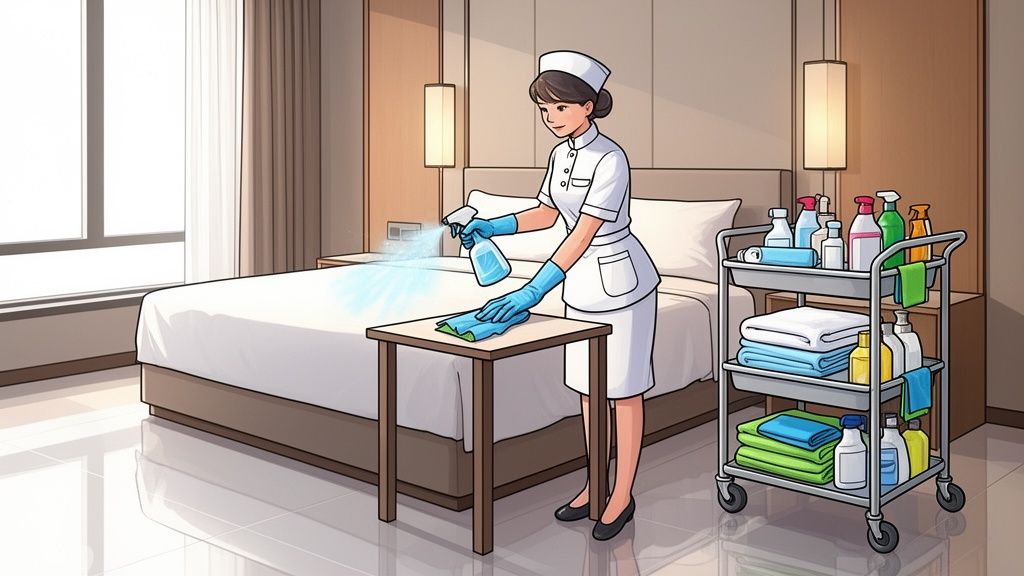
Exceptional cleanliness in commercial and public facilities is the bedrock of the entire customer experience. Whether it's a hotel, office, or gym, it's the first thing a person notices and the last thing they'll forget. A spotless, fresh-smelling environment instantly communicates care, setting a positive, safe, and professional tone.
On the flip side, even one small oversight—a smudge on a mirror, a sticky countertop—can shatter that trust in a second. That bad first impression can easily become a negative review that hurts future bookings or drives clients away.
Why Flawless Cleanliness Is a Commercial Non-Negotiable

In any commercial setting, cleanliness isn't just a task on a list; it’s your most powerful form of non-verbal communication. Long before a hotel guest talks to the concierge, an office employee sits at their desk, or a gym member touches a dumbbell, their impression is formed. That initial feeling directly shapes their satisfaction, what they'll post online, and whether they ever come back.
The link between a pristine facility and a healthy bottom line has never been more direct. Customer expectations have shifted dramatically, with hygiene and sanitation now sitting at the top of their list. This isn't just a hunch; the data backs it up.
Recent studies show that for nearly half of all hotel guests—a full 45%—overall cleanliness and safety protocols are a primary driver in their booking decisions. This proves that your cleaning program is no longer a back-of-house operation. It's a front-facing feature that actively drives revenue and builds trust.
The Real Payoff of Superior Cleaning
When you invest in a meticulous, well-executed cleaning program, you get tangible returns that go far beyond just looking good. A consistently clean environment directly builds your business in a few key ways:
- Drives Customer Loyalty: When people feel safe and comfortable in your space, they're far more likely to become repeat customers. A spotless facility shows you're committed to their well-being, and that builds a level of trust that keeps them coming back.
- Builds a Positive Online Reputation: In the age of Google Reviews, a single mention of "dirty" can scare off hundreds of potential clients. On the other hand, consistent praise for cleanliness becomes a powerful, free marketing tool that boosts your ratings.
- Strengthens Brand Credibility: Flawless cleaning protocols reinforce your brand's promise of quality and excellence. It proves you sweat the small stuff, which reflects positively on every other part of your service.
To make sure your commitment to clean translates into a top-tier reputation, you have to know what your customers are thinking. A solid customer feedback system for hotels or any business is crucial for monitoring satisfaction and fixing issues before they spiral into bad reviews.
At the end of the day, exceptional room cleaning in hotel management, or any facility maintenance, is a strategic investment in your brand's health and financial future. It lays the foundation for a resilient operation that doesn't just meet modern expectations, but confidently exceeds them.
Setting the Stage for an Efficient Clean
A great clean doesn't start when a janitor or housekeeper steps into a room. It starts long before that. The secret to a fast, flawless turnover is all in the prep work—transforming a list of chores into a smooth, professional workflow. When your team is properly equipped and follows a clear plan, they move with confidence. That means fewer delays and better results, every single time.
This whole foundation rests on two things: a perfectly organized supply cart and a safe, respectful way to enter the space. Get these right, and every clean becomes a predictable, high-quality outcome.
Mastering the Cleaning Cart
Stop thinking of the supply cart as just storage. It’s a mobile command center. A well-stocked, logically arranged cart is your single greatest tool for efficiency, period. It cuts out all those time-wasting trips back to the supply closet and puts every single tool within arm's reach.
A messy, disorganized cart is a recipe for frustration and forgotten tasks. To stop this before it starts, every cart needs to be standardized. Check them before every shift. This consistency means any team member can grab any cart and work at the same high standard.
A standard cart setup should include:
- Cleaning Agents: All-purpose cleaners, glass cleaners, bathroom-specific solutions, and disinfectants. A smart move is using color-coded bottles to help staff grab the right product for the job in a split second.
- Essential Tools: A full stock of microfiber cloths (kept separate for different areas), sponges, a toilet brush, and a duster.
- Linens & Supplies: Neatly folded stacks of fresh bed linens and towels for hotels, or paper towels and toilet paper for offices and gyms.
- Waste Removal: Have one large bag for trash and a separate one for soiled linens or used towels. This is non-negotiable for preventing cross-contamination.
Key Takeaway: A standardized cart is more than a convenience; it's a system. By making sure every tool has its place, you reduce the mental load on your staff. This frees them up to focus on the quality of their work instead of hunting for supplies.
The Professional Protocol for Room Entry
How a staff member enters a private or occupied space sets the tone for the entire interaction. It’s a moment that has to balance speed with a deep respect for privacy and, just as importantly, staff safety. A rushed or sloppy entry can lead to incredibly awkward encounters or missed safety checks.
The goal here is simple: confirm the space is empty without startling a guest or employee who might still be inside. This calls for a clear, step-by-step procedure that every single team member follows without exception.
This professional entry protocol should be simple enough to memorize:
- Announce and Knock: Knock firmly three times on the door while clearly announcing, "Housekeeping!" or "Maintenance!"
- Pause and Listen: Wait at least 10-15 seconds. Really listen. Is a TV on? A shower running? Can you hear a voice?
- Repeat the Process: If you hear nothing, knock and announce again. Wait another 10-15 seconds.
- Enter with Caution: If the room is still silent, use your key to slowly crack the door open, announcing one last time as you step inside. Immediately prop the door open with a doorstop—this ensures a clear exit and signals to others that the room is being serviced.
This methodical approach protects everyone. It avoids startling a hotel guest or walking in on an important office meeting. By cementing this systematic foundation, you empower your team to work safely and uphold professional standards.
The Methodical Workflow for a Perfect Clean
Consistency is the engine of quality in commercial cleaning. Without a repeatable, logical system, details get missed, standards slip, and a customer's first impression is ruined. A methodical workflow for room cleaning in hotel settings, or any facility, isn’t about working harder; it’s about working smarter to eliminate cross-contamination and guarantee every corner gets the same high level of attention.
This professional sequence is built on a simple, timeless principle: work from top to bottom, and clean before you disinfect. By following a structured path through the space, your team moves with purpose. Dust and debris from higher surfaces are systematically worked down to the floor, where they're removed last.
To get started, the initial prep work sets the stage for everything that follows.
This initial phase—organizing the cart, entering correctly, and clearing the room—is the foundation for an efficient and disruption-free cleaning process.
The Initial Sweep and Strip
Once safely inside, the first order of business is to get all the used items out. This is a critical first step that removes the primary sources of contamination before any real cleaning begins, creating a blank slate to work with.
Start by stripping all linens from beds and gathering used towels in hotels. In an office, this means clearing wastebaskets and removing any leftover food containers from break areas. They go directly into the designated disposal bag on your cart—never on the floor or furniture, which just spreads germs.
The Top-to-Bottom Cleaning Sequence
With the room cleared, the real cleaning begins. The golden rule is to always work from the highest point in the room downwards. This ensures any dust or particles you dislodge will fall onto surfaces you haven't touched yet.
A proven sequence looks like this:
- Dust High Surfaces: Start with high-level fixtures like ceiling fans, light fixtures, the tops of shelves, and window ledges.
- Clean Vertical Surfaces and Fixtures: Next, move on to cleaning windows, mirrors, and partitions. After that, wipe down all hard surfaces like desks, tables, and countertops.
- Disinfect High-Touch Points: Now, focus on disinfection. Methodically wipe down all the items people touch most, including light switches, thermostats, telephones, remote controls, elevator buttons, and every single handle (door, drawer, and faucet).
- Make the Bed / Restock Supplies: In hotels, make the bed with fresh linens. In offices or gyms, restock paper towels, soap, and other consumables.
- Tackle the Bathroom: The bathroom is always cleaned last to contain its specific germs. Clean the shower, tub, and sink first, then the toilet. When cleaning the toilet, work from the outside in—tank, handle, seat, and finally the bowl.
- Final Floor Care: Once every other surface is done, it’s time for the floors. Vacuum carpets thoroughly or mop hard-surface floors, starting from the furthest corner and working your way out of the room.
Following a consistent sequence is non-negotiable. It creates muscle memory for your staff, drastically reducing the chances of a missed spot and ensuring every customer receives the same impeccable standard of cleanliness.
Efficiency Hacks for a Faster Turnover
While thoroughness is paramount, efficiency is what keeps the entire operation running smoothly. Integrating small hacks into your workflow can save valuable minutes on each room without sacrificing an ounce of quality.
For instance, as soon as you enter, open windows to start airing out the space. As you move through the top-to-bottom sequence, carry all the necessary supplies to avoid backtracking to the cart. For a detailed breakdown of every step, a standardized housekeeping checklist for hotel rooms or a facility cleaning plan can help ensure nothing is ever overlooked.
Upping Your Game with a Disinfection Protocol
A room that looks clean is the bare minimum. In today's world, that's only half the battle. Real customer confidence comes from knowing the space isn't just tidy—it's hygienically safe. This is where a rock-solid disinfection protocol stops being just another step and becomes a powerful statement about your commitment to well-being.
Surface cleaning gets rid of the visible stuff, like dust and grime. But disinfection is what neutralizes the invisible threats—the bacteria and viruses that love to hang out on surfaces. Getting this difference is fundamental. A quick wipe with a damp cloth might make a counter look better, but it does next to nothing against pathogens. For a deeper dive, check out our guide on the difference between cleaning and sanitizing.
This isn't just a best practice; it reflects a massive industry shift. The global hotel cleaning services market was valued at a staggering USD 15 billion in 2023 and is projected to soar because the entire world is doubling down on sanitation.
Target the High-Touch Hotspots
Effective disinfection isn't about spraying everything in sight; it's about precision. You have to focus your efforts on the high-touch surfaces that are basically hubs for germ transmission. Your team's checklist needs to make these areas the top priority for every single turnover.
- Offices: Door handles, light switches, keyboards, mice, conference room phones, and coffee pot handles.
- Gyms: Dumbbell grips, treadmill screens, weight machine pins, and locker handles.
- Restaurants: Menus, salt and pepper shakers, POS screens, and chair backs.
- Hotels: Remote controls, light switches, thermostats, and all handles.
For these hotspots, disinfectant wipes are a game-changer. They come pre-saturated with the perfect amount of cleaning solution, which guarantees a consistent application every time and kills the risk of staff mixing chemicals incorrectly. For busy teams, that kind of efficiency and reliability is gold.
Make Disinfection Part of Your Brand
Your commitment to disinfection shouldn't be a secret. It's a powerful marketing tool that can directly sway customer decisions. When people see that you're serious about their health, it builds an incredible amount of trust and loyalty.
Sales Tip: For professionals in the cleaning industry, educate your clients on the ROI of hygiene. Don't frame disinfectant wipes as an added cost; frame them as an investment in their brand reputation and a way to mitigate risk. A hotel, gym, or office that can confidently advertise its disinfection standards has a serious competitive advantage.
For facility managers and sales teams aiming for maximum efficiency and proven reliability on these critical surfaces, we recommend Wipes.com Disinfectant Wipes. They offer a consistent, easy-to-use solution that empowers staff to uphold the highest standards of hygiene with every clean.
Folding disinfectant wipes into a larger cleaning supply package is a smart sales strategy. Imagine a gym promoting its partnership with a trusted sanitation brand—this tells members the facility's promise of cleanliness is backed by professional-grade products. This focus doesn't just protect customers—it strengthens your brand's reputation for excellence and care.
The Final Touches and Quality Inspection

Once the heavy lifting of deep cleaning and disinfecting is done, the real artistry of housekeeping begins. This is where a space goes from just clean to truly welcoming. It’s all about the final touches—the small, thoughtful details that people absolutely notice and appreciate.
We're moving beyond scrubbing and into staging. The goal is to create an atmosphere of pristine comfort, making every item look like it was placed with intention.
Crafting the Perfect First Impression
You want every customer to feel like they are the very first person to ever step into that space. This is achieved through careful arrangement and setting the right ambiance.
A few small actions make a world of difference:
- Amenity Artistry: Don't just toss toiletries on a hotel counter. Arrange them neatly. Create a clean, organized display with coffee pods, stationery, or other guest items.
- Linen Perfection: In hotels, give the bed one last pass, smoothing out any final wrinkles. Fold towels with precision. A crisp, perfect fold in the bathroom signals luxury and care.
- Climate Control: Set the thermostat to a comfortable, neutral temperature, usually around 70-72°F (21-22°C).
- Lighting and Ambiance: Instead of leaving a room dark, turn on a soft lamp. A warm, inviting glow makes the space feel ready and lived-in, not cold and sterile.
These finishing touches are the signature of a high-quality program. They collectively tell the customer, "We were expecting you."
The Critical Final Inspection
With the room perfectly staged, the final inspection is your last line of defense. This isn't a quick glance; it's a meticulous walkthrough designed to catch the tiny oversights that can ruin an otherwise flawless clean. It's always best to have a second set of eyes, like a supervisor, do this check.
The inspection needs to be systematic and unhurried. You're not just looking for dirt anymore. Now, you're looking at the room through the customer's eyes.
The final inspection is your last chance to make sure the customer experience lives up to your brand's promise. A single stray hair or a smudged mirror can undo all the hard work that came before it.
To keep this process consistent and hold everyone accountable, a comprehensive checklist is non-negotiable.
Your Essential Quality Control Checklist
Whether it's the housekeeper or a supervisor, this final check should be done after taking a short break from the room to reset your perspective.
Upon Entry:
- Does the room smell fresh and neutral? No lingering chemical or stale odors.
- Is the entryway floor spotless?
- Is the door handle and lock wiped clean of fingerprints?
The Main Room:
- Are all surfaces—desks, nightstands, tables—completely free of dust and streaks?
- (Hotels) Is the bed made perfectly? Check for crisp lines and taut sheets.
- Are all light bulbs working? Flip every switch.
- Are the windows and mirrors absolutely free of smudges? Check from different angles.
The Bathroom:
- Is the toilet seat down, ideally with a sanitation band?
- Are the sink, faucet, and counter gleaming under the light?
- Is the shower curtain or glass door spotless and free of water marks?
- Are all amenities neatly arranged and fully stocked?
- Are towels folded perfectly and hung straight?
Beyond the visual check, a crucial final step is knowing how to thoroughly check for bed bugs in hospitality settings. This final, methodical inspection ensures that your standard for room cleaning in hotel and facility excellence is met every single time.
Keeping Up with Today's Customer Expectations
The world never stands still, and customer expectations for a clean space are changing right along with it. In hotels, the old default of automatic, daily housekeeping just isn't the standard anymore. Modern travelers often look for more flexibility and appreciate hotels that are mindful of sustainability.
This new reality requires a much more nimble approach from your team. Forget the rigid daily roster; you are now juggling on-demand cleaning requests, balancing preferences with unpredictable staffing, and making sure everyone understands your policies. It’s a complete pivot from a one-size-fits-all service to a more personalized and efficient operation.
This operational change has had a huge economic ripple effect. Many hotels now clean rooms every two or three days by default. Pre-pandemic data showed most hotels needed around 40% occupancy to break even. With less frequent cleaning services, that magic number has dropped closer to 30%. You can read more about this industry trend and its financial impact.
Weaving in Sustainable Cleaning Practices
Beyond just wanting control over their schedule, today's customers are actively choosing brands that show a real commitment to sustainability. Making your cleaning program more eco-friendly isn't just a feel-good move; it's a smart way to connect with a growing wave of environmentally conscious consumers.
Small, consistent changes can make a big difference:
- Go Green with Your Products: Switch to cleaning agents that are biodegradable and don't rely on harsh chemicals.
- Conserve Every Drop: Train your team on water-saving techniques. For instance, using microfiber mops requires far less water and captures more dirt.
- Slash Your Waste: Opt for concentrated cleaning solutions to drastically cut down on packaging waste, and put a solid recycling program in place.
When you highlight these green initiatives in your marketing, your cleaning program stops being a simple line item. It becomes a valuable brand asset that shows you’re in tune with what modern consumers truly care about.
Why High-Quality Disinfectants Still Reign Supreme
Even with spaces being turned over less frequently, the need for powerful disinfection on high-touch surfaces hasn't gone anywhere. If anything, it’s more important than ever. This is where top-notch disinfectant wipes become one of the most critical tools in your team's cart.
They offer a fast, reliable way to sanitize those key germ hotspots—like light switches, remotes, and door handles—either between full cleans or whenever a guest makes a special request.
By prioritizing effective disinfection and using smart tools like disinfectant wipes, you can deliver a safe, welcoming experience that builds trust and keeps people coming back. Prioritize cleanliness today, and consider how integrating high-quality disinfectant wipes can elevate your daily routine or product offerings.
Common Questions About Commercial Cleaning
Running a tight operation means you hear the same questions over and over. Let’s clear up a few of the most common ones that come up for facility managers, sales teams, and cleaning staff.
How Long Should It Take to Clean a Room?
The magic number everyone quotes for a standard hotel room turnover is 25 to 30 minutes. But that’s a baseline, not a rule.
A room left in perfect shape might take less time, but a hotel suite after a party, a busy conference room, or a high-traffic gym locker room? That's going to push the clock back. The space's size, its condition, and your specific deep-cleaning protocols all play a huge role.
What Is the Difference Between a Full Clean and a Tidy-Up?
Think of it as a reset versus a refresh. A full clean (or turnover) is the complete, top-to-bottom job done after a space is vacated. You're scrubbing the bathroom, disinfecting everything, and getting it ready for the next arrival.
A tidy-up is much lighter, often for hotel stay-overs or a mid-day refresh of an office common area. You’re typically just making the bed, swapping out used towels, emptying trash, and quickly wiping down surfaces to keep the space comfortable.
Sales Tip: Disinfectant wipes are your best friend in both scenarios. They're strong enough for the high-touch disinfection needed in a full clean but fast enough for a quick, efficient sanitization during a tidy-up. This versatility is a key selling point for business owners who need efficiency.
How Should Staff Handle Difficult Stains?
Tough stains on carpets or chairs can be a nightmare. The key is to act fast. Every cleaning cart should have a spot-treatment kit ready to go, because the longer a stain sits, the more it sets.
For everyday surface spills and spots, having a reliable first line of defense is crucial to keeping furniture and fixtures looking pristine. We've seen facilities have great success using Wipes.com Disinfectant Wipes to tackle messes the moment they’re found.
Leave a Reply