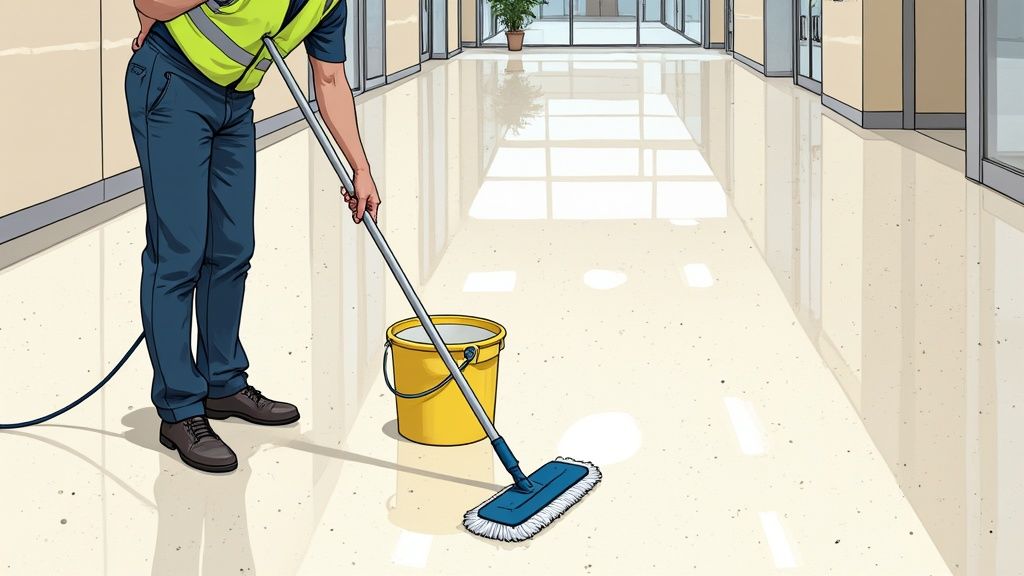
If you're wondering how to clean terrazzo floors in a commercial facility, the answer is simpler than you might think: stick to a consistent, gentle routine. The golden rule is using pH-neutral cleaners and steering clear of harsh, acidic chemicals. This isn't just about cleaning; it’s about protecting a high-value asset and maintaining a professional image that reassures every visitor, client, and employee who walks through your doors.
Maintaining Terrazzo Floors for a Pristine Facility Image
In high-traffic commercial spaces like offices, gyms, schools, and restaurants, flooring is a critical component of the customer experience. A gleaming terrazzo floor communicates professionalism and a commitment to quality. But its legendary durability depends entirely on the right care protocol. A poorly maintained floor doesn't just look dull; it silently suggests neglect, undermining the trust you work so hard to build.
Think of your terrazzo floor as a long-term investment in your brand’s image. A well-maintained surface is a powerful, non-verbal signal that you prioritize cleanliness, safety, and attention to detail. This is especially true for fitness centers and retail stores, where a clean environment directly impacts customer perception and retention.
Why Gentle Cleaning is Non-Negotiable
The secret to proper terrazzo care lies in its composition. As a composite of marble, quartz, or granite chips suspended in a binder, it has specific vulnerabilities. This material has been the go-to for high-traffic areas since the 16th century, and today, it covers over 500 million square feet in U.S. commercial buildings alone.
With a potential lifespan of 75+ years, the one thing that can cut it short is using the wrong chemicals. We, along with every other expert in the field, will tell you to use a pH-neutral cleaner. Anything acidic will etch the marble aggregates, creating permanent dull spots that can only be fixed with expensive restoration work.
The Real ROI of a Proper Cleaning Protocol
Following a smart cleaning plan delivers a significant return on investment that goes way beyond aesthetics. By sticking to the right maintenance procedures, you’re actively preventing the need for disruptive and expensive work like grinding and re-polishing. That means less downtime for your facility.
A well-structured cleaning schedule brings several key benefits to the table:
- Protect Your Asset: You safeguard one of your facility’s most visible and valuable features, ensuring it looks incredible for decades.
- Enhance Safety & Hygiene: A clean floor is free of slip-and-fall hazards. When combined with sanitizing high-touch surfaces, you create a healthier environment for everyone.
- Boost Operational Efficiency: When janitorial staff are trained on correct methods, they work smarter. They'll use the right tools and chemicals, like disinfectant wipes for targeted cleaning, saving time and resources.
- Improve Visitor Perception: A pristine facility reinforces your brand’s commitment to quality. For sales professionals in the cleaning industry, demonstrating this hygiene ROI is a powerful selling point.
For a quick overview, we've put together this simple reference chart for your cleaning crews.
Terrazzo Cleaning Quick Reference
This table summarizes the essential do's and don'ts for daily terrazzo floor care in a commercial setting. Use it as a training tool or a quick reminder for your maintenance staff.
| Action | Recommended Tool or Product | Frequency | Why It Matters for Your Facility |
|---|---|---|---|
| Dust Mopping | Microfiber dust mop (untreated) | Daily | Removes abrasive grit that scratches the surface. Critical for gyms and retail stores with constant foot traffic. |
| Wet Mopping | pH-neutral cleaner (pH 7-10) and clean water | Daily | Safely removes soil without etching marble chips. Essential for maintaining the floor's professional sheen in office lobbies. |
| Spill Cleanup | Absorbent towels, pH-neutral spot cleaner | Immediately | Prevents acidic or staining liquids (like coffee in an office or sports drinks in a gym) from causing permanent damage. |
| Disinfecting | Disinfectant Wipes | As needed | Quickly sanitizes high-touch points and small spills, demonstrating a commitment to health. |
| Avoid Abrasives | No steel wool, scouring pads, or harsh powders | Always | These create micro-scratches that trap dirt and make the floor look permanently hazy. |
| Avoid Acids | No vinegar, ammonia, or acidic bathroom cleaners | Always | Acidic products will chemically burn (etch) the floor, creating dull spots that require re-polishing. |
Following these guidelines consistently is the most cost-effective way to keep your terrazzo looking brand new. It's a proactive strategy that preserves your facility’s appearance, protects your investment, and ensures a safe, welcoming environment for everyone.
Your Daily and Weekly Terrazzo Cleaning Routine
When it comes to terrazzo, consistency isn’t just a good idea—it’s everything. A simple, non-negotiable daily and weekly cleaning schedule is your single most effective strategy for protecting the floor and keeping your facility looking sharp. This is about smart, preventative maintenance that preserves your investment and enhances customer confidence.
The daily mission is simple: get rid of the abrasive grit that every pair of shoes drags in. Those fine particles of sand and dirt act like sandpaper underfoot, slowly but surely dulling your floor's beautiful finish with every single step.
Daily Care: The Microfiber Advantage
For your daily sweep, ditch the old-school cotton string mops. Your best weapon is a large, untreated microfiber dust mop. The fibers are engineered to grab and hold onto fine dust and grit, not just push them around.
In high-traffic facilities like gyms, schools, or busy offices, this isn’t just a once-a-day job. A quick pass during a midday lull can make a huge difference, drastically cutting down on the abrasive material being ground into your sealer.
Weekly Wet Cleaning: Best Practices
The weekly clean is where you tackle the grime that dry mopping can't. The two-bucket mopping system is non-negotiable here. One bucket holds your cleaning solution, while the second holds clean rinse water. This simple setup prevents your team from spreading a grimy film across the floor.
As for the cleaner itself, always use a pH-neutral cleaner. This is critical for cleaning effectively without risking chemical damage to the stone aggregate or the cementitious binder.
Pro-Tip: Remember the 'damp, not wet' rule. Wring the mop out until it’s barely damp. Oversaturating the floor is a rookie mistake that allows water to seep into seams, which can lead to bigger problems.
Beyond the Floor: A Holistic Approach to Cleanliness
A gleaming terrazzo floor sets the stage, but the job isn’t done until the entire space feels clean. From a customer's perspective, after they walk across your pristine floor, they touch door handles, service counters, elevator buttons, and gym equipment.
Integrating disinfectant wipes into your routine closes the loop between a clean appearance and a truly hygienic environment. A quick wipe-down of these high-touch points reinforces your commitment to health and safety—a message every business owner, from a restaurant to a fitness center, wants to send.
- Sales Tip: For cleaning industry professionals, this is a key value-add. Educate clients on the "Hygiene ROI"—how visible cleanliness, including sanitized touchpoints, boosts customer trust and loyalty. Proposing a package that includes both floor care and surface disinfecting with wipes is an easy upsell.
- Efficiency Hack: Equip staff with belt holsters for disinfectant wipes so they can address spills and sanitize touchpoints like handrails or reception desks on the fly, without returning to a supply closet.
To manage your cleaning schedule effectively, it helps to understand the differences between regular and deep cleaning. This knowledge helps you assign daily tasks while scheduling more intensive deep cleans with the right frequency. By taking this complete approach, you elevate your facility's standard from looking clean to being truly, demonstrably clean.
Tackling Deep Cleaning and Stubborn Stains
While daily and weekly routines are the backbone of great terrazzo care, periodic deep cleaning and immediate stain removal are critical for protecting your floors from long-term damage. This is where you move from maintenance to restoration, tackling built-up grime and accidental spills head-on.
For brand new terrazzo or floors that have just survived a major renovation, you're dealing with a different kind of mess. The fine, gritty dust from construction requires a specific approach. A thorough post-construction cleaning is essential to prep the surface for sealing and daily traffic.
The Semi-Annual Deep Clean with an Auto-Scrubber
Twice a year, it's time for a restorative deep clean. An automatic floor scrubber is your best friend for this job. It applies the cleaning solution, scrubs the floor, and vacuums up the dirty water all in one pass, delivering a level of clean a mop and bucket can't match.
But using this machine incorrectly can strip your sealer. Here's how to get it right:
- Choose the Right Pad: Stick with a non-aggressive pad. A soft white or red buffing pad is perfect. Aggressive stripping pads (like black or brown ones) are too abrasive and will tear through the protective sealer.
- Use the Right Cleaner: Fill the auto-scrubber’s tank with your trusted pH-neutral cleaning solution, diluted according to the manufacturer’s instructions.
- Adjust Your Settings: Set the pad pressure to the lowest effective setting. The goal is to lift embedded soil, not grind down the sealer.
Follow these steps, and you'll remove deep-seated dirt without compromising the floor's protective layer.
A Hands-On Guide to Stain Removal
In a busy commercial facility—be it a school cafeteria or an office breakroom—spills are a fact of life. Acting fast with the right technique is everything.
The first rule is to blot, never rub. Rubbing a fresh spill grinds the staining agent deeper into the terrazzo's porous surface. Instead, use a clean, absorbent cloth to gently lift as much of the liquid as possible.
For stubborn, set-in stains, the poultice method is your secret weapon. A poultice is a soft, absorbent paste that pulls the stain out of the terrazzo and into itself.
What Exactly Is a Poultice?
Think of it like a detoxifying facial mask for your floor. You apply a paste made from an absorbent material (like diatomaceous earth or powdered chalk) mixed with a liquid cleaning agent. As the liquid evaporates, it pulls the stain up from deep within the floor.
Creating and Applying an Effective Poultice
Here’s a simple, actionable process for your janitorial team:
- Mix the Paste: Combine your absorbent powder with the right liquid until it forms a thick paste, about the consistency of peanut butter. For organic stains like coffee, use hydrogen peroxide. For oil-based stains, use a solvent like mineral spirits.
- Apply to the Stain: Spread the paste over the entire stain, about a quarter-inch thick.
- Cover and Wait: Cover the poultice with plastic wrap and tape down the edges. This slows down evaporation, giving it more time to work. Let it sit for 24 to 48 hours.
- Remove and Clean: After the waiting period, remove the plastic and let the poultice dry completely. Gently scrape it off, then clean the area with a pH-neutral cleaner and water.
Equipping your team with these deep cleaning and stain removal techniques is crucial. In a school, quick removal of a juice stain prevents a permanent blemish. In a restaurant, immediate action on a grease spill is a safety imperative.
Commercial Terrazzo Stain Removal Cheatsheet
For quick reference on the job, here’s a cheatsheet your team can use to tackle the most common stains found in commercial settings.
| Stain Type (e.g., Coffee, Oil/Grease) | Effective Cleaning Agent | Actionable Removal Steps | Facility-Specific Tip |
|---|---|---|---|
| Coffee, Tea, Wine, Juice (Organic) | Hydrogen Peroxide (3-6%) | Blot immediately. For set stains, create a poultice with peroxide and an absorbent powder. Apply, cover for 24 hours, then scrape and clean. | Crucial for offices and restaurants where these spills are a daily occurrence. |
| Oil, Grease, Tar (Petroleum-Based) | Mineral Spirits or Acetone | Blot excess oil. Mix mineral spirits with absorbent powder to create a poultice. Apply, cover, and let it work for 24-48 hours. Remove when dry and clean. | Essential knowledge for automotive showrooms or manufacturing facilities. Ensure proper ventilation. |
| Ink or Marker | Rubbing Alcohol or Acetone | Dab a clean cloth with rubbing alcohol and gently blot the stain from the outside in. For stubborn spots, a poultice may be needed. | A must-know technique for schools and office environments. Test in an inconspicuous area first. |
| Rust (Metal Furniture, Water) | Commercial Rust Remover (Oxalic Acid-Based) | Apply the commercial rust remover according to product directions. Let it sit for the recommended time, then scrub gently and rinse thoroughly. | Important for gyms with metal equipment or any facility with potential water leaks. |
Having this guide handy empowers your staff to act quickly and correctly, preventing a small spill from becoming a permanent eyesore.
Protecting Your Investment with Sealing and Polishing
Routine cleaning is the bedrock of terrazzo care, but long-term protection requires a smarter strategy. Sealing and polishing guard your floor against the daily grind, ensuring it keeps its sophisticated look for years. Think of this not just as maintenance, but as an investment in your facility’s most visible asset.
Choosing the right protective layer is a critical decision. Your two main options are topical coatings and penetrating sealers.
Choosing the Right Protective Layer
A topical coating, usually an acrylic-based finish, acts like a sacrificial barrier that sits on top of the terrazzo. This is your go-to choice for punishingly high-traffic areas like a retail store or school hallway. It takes the scuffs and scratches so the terrazzo underneath doesn't have to.
On the other hand, a penetrating sealer soaks into the terrazzo's porous structure, protecting it from the inside out. This is perfect for spaces where you want to maintain the natural look of the stone—think of an upscale office lobby. It offers fantastic stain resistance while keeping the authentic feel of the terrazzo intact.
Here's a quick field test to see if it's time to reseal: drop a few beads of water on the floor. If the water beads up, your sealer is still working. If it immediately soaks in, your floor is vulnerable to stains.
The Process of Stripping and Resealing
When a topical coating gets scuffed or worn out, it's time to strip it off and lay down a fresh coat. This is more involved than daily cleaning but is essential for restoring the floor's clarity. The process involves using a chemical floor stripper to dissolve the old finish, scrubbing it off, and then rinsing thoroughly.
Safety is non-negotiable here. Ensure the area is well-ventilated and your crew has the right PPE. Once the floor is dry, apply the new sealer in thin, even coats. For a masterclass on getting that professional-grade shine, check out our deep dive on high-speed buffing techniques.
This visual breaks down the key stages of a deep clean, which is a must-do before sealing or polishing.
This workflow shows that a truly restored floor is a progression from general scrubbing to targeted stain removal before you apply any final protective layers.
Achieving a Natural Shine with Diamond Polishing
For the absolute best in terrazzo restoration, many facilities are now moving to mechanical diamond polishing. This method does away with waxes and topical coatings. Instead, you use a floor machine fitted with diamond-impregnated pads to hone and polish the terrazzo surface itself to a natural, mirror-like finish.
It's a gradual process, starting with coarse-grit diamond pads to grind out scratches and working through progressively finer grits until the floor reflects light on its own.
The payoff for this approach is huge:
- Sustainability: It’s a chemical-free process that creates a durable, long-lasting shine.
- Lower Maintenance: A diamond-polished floor is dense and non-porous, making it highly resistant to stains and a breeze to clean.
- Enhanced Safety: A mechanically polished terrazzo floor isn't slippery. In fact, by getting rid of topical coatings that can get slick when wet, this method often improves slip resistance.
Essential Tools and Costly Mistakes to Avoid
Equipping your team with the right tools isn't just about efficiency; it's about protecting your investment. The right gear makes the job faster, while the wrong products can cause irreversible damage.
The goal is to provide your janitorial staff with a toolkit that is both effective and completely safe for terrazzo. This is how you prevent those costly mistakes that come from grabbing the wrong bottle or machine.
Your Essential Terrazzo Cleaning Toolkit
Building the perfect cleaning arsenal doesn't require a massive budget, just smart choices. Here are the non-negotiable items for proper terrazzo maintenance:
- High-Quality Microfiber Mops: Your #1 tool for daily care. Microfiber's static charge actively grabs and holds onto fine dust and grit.
- Automatic Floor Scrubber: A game-changer for deep cleaning large commercial spaces. It scrubs and vacuums up dirty slurry in one pass.
- Soft Buffing Pads: Pair your auto-scrubber with non-aggressive white or red pads for routine cleaning without stripping the sealer.
- Wet/Dry Vacuum: A must-have for spill response and for picking up rinse water after a deep clean to minimize slip-and-fall hazards.
- pH-Neutral Cleaner: The only cleaning solution that should ever touch your terrazzo. It cleans effectively without the risk of etching.
- Disinfectant Wipes: Invaluable for quick, targeted sanitation of small spills and high-touch surfaces. We often suggest using Wipes.com Disinfectant Wipes for their effectiveness and convenience.
The Definitive ‘Never Use’ List
Knowing what not to use is just as important. The wrong product can cause permanent etching and discoloration in a single application. Train your staff to avoid these items at all costs.
| Prohibited Product | Why It's Harmful to Terrazzo | Real-World Scenario |
|---|---|---|
| Vinegar or Acidic Cleaners | Acids react with the calcium carbonate in marble chips, causing chemical burns (etches) that look like dull, whitish spots. | A well-meaning cleaner uses a vinegar solution in a restaurant lobby, leaving behind a permanently hazy floor that requires professional restoration. |
| All-Purpose Cleaners & Ammonia | These are often highly alkaline and will strip away your floor’s protective sealer, leaving it vulnerable to stains. | An office cleaning crew uses a generic cleaner, stripping the sealer near the entrance. The floor now soaks up dirty water, creating a dark, stained path. |
| Abrasive Powders or Steel Wool | These physically scratch the terrazzo surface, creating a web of micro-scratches that trap dirt and look hazy. | To remove a scuff mark in a gym, a staff member grabs a scouring powder, leaving a swirl of scratches far more visible than the original mark. |
| Oily Sweeping Compounds | The oils in these compounds can penetrate the porous terrazzo, leading to deep-seated stains that are nearly impossible to remove. | A dealership uses an oil-based sweeping compound in its service bay, which gets tracked onto the showroom floor, leaving greasy stains. |
The Unsung Hero of Floor Protection
Finally, one of the most effective "tools" for cleaning terrazzo is a high-quality entrance matting system. A robust system with scraper mats outside and absorbent mats inside can trap up to 85% of the dirt and moisture before it ever touches your floor.
By investing in a proper matting system, you're playing defense. This simple step proactively reduces daily wear and tear, extends the life of your sealer, and cuts down on cleaning frequency. It delivers a massive return on a relatively small investment.
Your Top Terrazzo Care Questions, Answered
Even with a solid daily routine, terrazzo floors can present challenges. Here are the most common questions from facility managers and cleaning crews.
How Often Should We Be Resealing Our Terrazzo Floors?
This depends on foot traffic. A high-traffic retail space with a topical acrylic sealer may need to be stripped and recoated annually. An office lobby with more moderate traffic might get 18 to 24 months out of a fresh coat. If your floor has a penetrating sealer, you might only need to reapply it every 3 to 5 years. The easiest way to tell is the water test: if water beads up, your sealer is working. If it soaks in, it’s time to reseal.
Can I Use a Steam Cleaner on Terrazzo?
Yes, but with caution. Steam can be a fantastic tool for a deep, sanitizing clean. Use a commercial-grade steamer with a proper floor head and keep the machine moving. Don't let it sit in one spot for too long, as concentrated heat can damage the sealer. Think of it as a periodic deep clean, not a replacement for regular mopping.
What's the Best Way to Bring a Dull Terrazzo Floor Back to Life?
When a terrazzo floor looks dull or hazy, the best fix is a professional restoration process called diamond grinding and polishing. This is a mechanical process where a weighted floor machine fitted with diamond-impregnated pads hones and polishes the surface. It starts with a coarser grit to remove damage and works through progressively finer grits to create a stunning, mirror-like shine directly from the stone itself, without any waxes or coatings.
Are Disinfectant Wipes Safe for Quick Spot Cleans?
For a small, isolated spill, a good disinfectant wipe is usually a safe and effective tool. Check the label to ensure it doesn’t contain any harsh acids or bleach. Wipes are perfect for tackling a mess before it sets in, giving you the double benefit of cleaning and sanitizing in one go. This is especially handy in high-traffic commercial areas like gyms, restaurants, and reception desks.
Just remember they are for spot treatments, not cleaning the entire floor. For general maintenance, stick with a properly diluted, pH-neutral liquid cleaner. By integrating smart tools like disinfectant wipes into your comprehensive floor care plan, you can maintain a facility that is not only visually impressive but also genuinely clean and hygienic. Prioritize cleanliness today to protect your investment and elevate your brand's reputation.
Leave a Reply