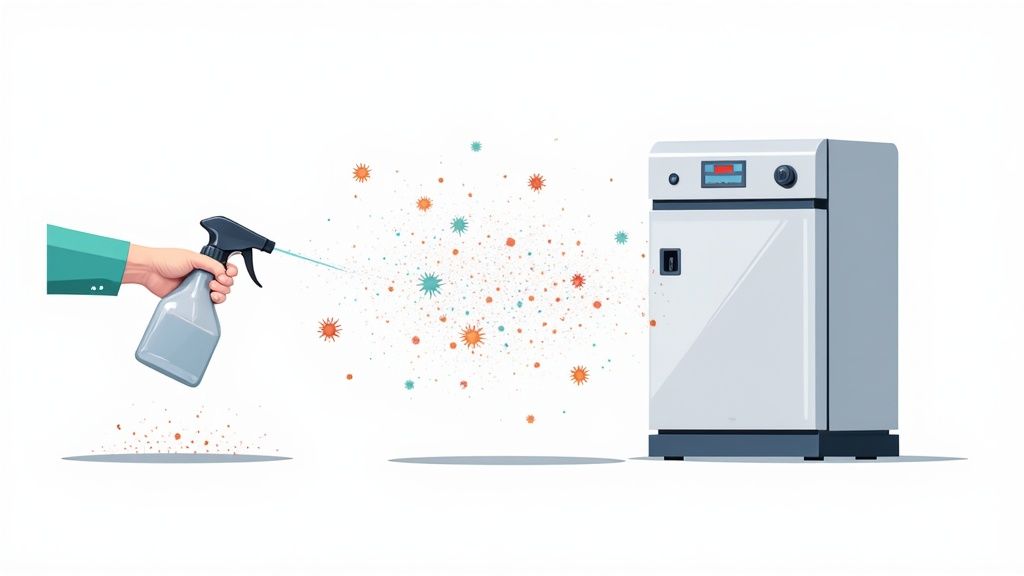
The real difference between disinfecting and sterilizing boils down to one thing: the final kill count. But for business owners and facility managers, the more important question is: which one keeps my people safe, my business running, and my customers confident?
Think of it like this: Disinfecting gets rid of most of the bad guys—the harmful bacteria and viruses on a surface. It's a massive, practical reduction in pathogens. Sterilizing, on the other hand, is a total wipeout. It eliminates all microbial life, including the incredibly tough bacterial spores that disinfectants often leave behind. For most businesses, a smart disinfection strategy is the key to a safer, healthier environment.
A Practical Overview of Disinfecting and Sterilizing
If you're a facility manager, business owner, or anyone in the cleaning game, you’ve probably heard these terms thrown around interchangeably. But in practice, they serve two completely different worlds.
For the vast majority of commercial spaces—think offices, gyms, schools, and retail stores—a smart, consistent disinfection plan is exactly what you need. It’s the practical standard for keeping people safe from everyday germs. Sterilization is the next level, reserved for environments where a single microbe could be catastrophic. We're talking medical cleanrooms, surgical tools, and tattoo parlors.
Key Differences at a Glance
So, when do you choose one over the other? It all comes down to risk. Disinfection is your daily workhorse, knocking down the immediate threat of germs on high-touch surfaces like doorknobs, keyboards, and countertops.
Sterilization is a highly specialized, intensive process. It's not something you do to clean an office, but it's absolutely mandatory in specific, regulated industries where total purity is the only acceptable outcome.
The image below gives you a great visual on how these two processes stack up in terms of germ reduction, the time involved, and what they're designed to eliminate.

As you can see, sterilization achieves a far greater microbial kill (a ≥6-log reduction, which is a scientific way of saying nearly absolute), but it requires serious time and specialized gear. That makes it totally impractical for daily, widespread use in most facilities.
For a grounded look at how different industries apply these principles, it helps to see them in action. For instance, understanding the 3 types of sanitizer solutions for pizzerias shows how even food service settings have specific protocols that align with their own health standards.
To make the choice even clearer, here’s a quick-reference table that breaks down the core differences between disinfecting and sterilizing.
Disinfecting vs Sterilizing at a Glance
This table cuts straight to the chase, comparing the key attributes of each process to help you decide what's right for your facility's needs.
| Attribute | Disinfecting | Sterilizing |
|---|---|---|
| Microbial Kill Rate | Kills most bacteria, viruses, and fungi but not all bacterial spores. | Kills 100% of microorganisms, including all tough bacterial spores. |
| Typical Use Case | High-touch surfaces in public and commercial facilities (doorknobs, gym equipment, office desks). | Medical instruments, laboratory equipment, and tools used in invasive procedures. |
| Common Methods | Chemical agents like disinfectant wipes, sprays (quaternary ammonium, alcohol, bleach). | Autoclave (steam under pressure), ethylene oxide gas, hydrogen peroxide vapor. |
| Regulatory Standard | Governed by EPA standards for disinfectants. | Governed by FDA and CDC standards for medical and critical applications. |
Ultimately, the goal is the same: to create a safe environment. But knowing whether you need to simply knock down the threat or completely annihilate it is the key to getting the job done right.
The Science of Microbial Control
To really get the difference between disinfecting and sterilizing, you have to look at the science—how each one actually attacks and takes out microscopic threats. When you understand the how, from the chemical reactions happening on a disinfectant wipe to the raw power of an autoclave, you can make smarter decisions for your facility. It's the kind of knowledge that lets you manage and explain your hygiene protocols with real confidence.
When you disinfect a surface, you're essentially waging chemical warfare on germs. The goal isn’t total annihilation; it’s to knock the number of pathogens down to a level where they're no longer a serious health risk. Think of it as a targeted strike.

How Disinfecting Neutralizes Pathogens
Most of the disinfectant wipes and sprays you buy rely on potent chemical agents to do the dirty work. One of the most common workhorses is a class of compounds called quaternary ammonium compounds, or "quats" for short. These molecules are basically microbial assassins.
Quats work by going after the outer layer of a microorganism. Picture a bacterium or virus wrapped in a protective cell wall or envelope—quats punch holes right through that barrier. This breach causes the cell's essential contents to leak out, which neutralizes the pathogen and makes it impossible for it to infect anyone. You can dive deeper into the different types of these agents in our guide to professional cleaning chemicals.
But this chemical attack doesn't happen in a split second. And that brings us to the all-important concept of dwell time.
Dwell time is the mandatory period a disinfectant must remain wet on a surface to achieve its advertised kill rate. Wiping something down and immediately drying it off makes the disinfectant almost useless. For most disinfectant wipes, this can be anywhere from 30 seconds to several minutes.
The Uncompromising Power of Sterilization
Sterilization, on the other hand, is absolute. Its goal isn't just to reduce the microbial population but to completely wipe out all forms of microbial life. That includes not only active bacteria and viruses but also their super-resilient dormant forms, known as bacterial spores.
Achieving that total kill requires much more intense methods than a simple chemical wipe. The most common sterilization techniques are heavy hitters:
- Autoclaving: This is the gold standard in many industries. An autoclave uses steam heated to extreme temperatures (typically 121°C or 250°F) under intense pressure. That combination of heat, steam, and pressure is lethal to even the toughest spores.
- Chemical Sterilants: For items that can't handle the heat of an autoclave, powerful chemicals like ethylene oxide gas or hydrogen peroxide vapor come into play. These agents can permeate materials and kill all microbial life without cooking the item itself.
This distinction is absolutely critical in high-risk environments. Take healthcare, for example. The approach is dictated entirely by what an item is used for. The CDC's guidelines are clear: any critical tool that enters sterile body tissue must be sterilized. Anything less introduces a massive risk of spreading serious infections between patients. Disinfection is fine for items that only touch intact skin, which shows you how the level of risk determines the level of microbial control needed.
At the end of the day, the science shows us two different tools for two very different jobs. Disinfection is the practical, everyday strategy for managing microbial risks in public and commercial spaces. Sterilization provides an uncompromising, absolute guarantee of purity for the most critical, high-risk applications.
Smart Disinfection: Your Guide to a Safer Facility
Knowing the difference between disinfecting and sterilizing is one thing, but putting that knowledge to work is what actually keeps your facility safe. Sterilization has its place, but for day-to-day operations in most businesses, a smart disinfection strategy is the practical powerhouse that protects your environment. This isn’t about frantically wiping down every single surface. It's about targeting the right areas, at the right times, with the right tools—like quality disinfectant wipes.
Think of it this way: a proactive approach to disinfection is more than a checklist item. It's a visible promise to your employees, clients, and customers that you take their well-being seriously, and that directly builds trust in your business.

Identifying High-Touch Hotspots
The bedrock of any solid disinfection plan is pinpointing the high-touch surfaces where germs are most likely to jump from one person to another. These spots are basically microbial highways and demand the most frequent attention. The exact hotspots will obviously change depending on your facility, but the core idea is always the same: follow the hands.
Take a moment and trace the daily journey of a customer or employee through your space. What's the first thing they touch? The second? The third? When you build a checklist based on these real-world touchpoints, you ensure your efforts are concentrated where they'll have the biggest impact, making your routine both efficient and effective.
Here are a few facility-specific examples to get you thinking:
-
Offices:
- Door handles, push plates, and elevator buttons
- Shared keyboards, mice, and conference room phones
- Kitchenette appliances like microwave handles and coffee pot buttons
- Copier and printer control panels
-
Gyms and Fitness Centers:
- Dumbbell and barbell grips
- Treadmill and elliptical consoles (screens and handrails)
- Locker room benches, handles, and faucet taps
- Weight machine adjustment pins and seats
-
Retail Stores and Restaurants:
- Shopping cart and basket handles
- Point-of-sale touchscreens and credit card keypads
- Dining tables, condiment dispensers, and menus
- Restroom doors, stall locks, and soap dispensers
Efficiency Tips for a Smarter Cleaning Routine
Let's be honest—a great disinfection plan is one that actually gets done, day in and day out. If the process is too complicated, standards will eventually slip. This is where building efficiency into your routine becomes critical. Disinfectant wipes are a huge help here, offering a pre-measured, grab-and-go solution that cuts out the need for mixing chemicals or lugging around spray bottles.
To get the most out of your team's time, weave these simple but powerful habits into your daily workflow:
- Adopt a 'One Wipe, One Surface' Policy: This is non-negotiable for preventing cross-contamination. Using the same wipe to clean a doorknob and then a tabletop can just spread germs around instead of getting rid of them.
- Schedule Based on Traffic: High-traffic zones like main entrances and restrooms might need attention several times a day. A private office, on the other hand, might be fine with a once-daily wipe-down. Let the foot traffic guide your frequency.
- Respect the Dwell Time: Disinfectants aren't instantaneous. They need time to do their job. Always check the product label for the required dwell time—the amount of time a surface must stay visibly wet to kill the pathogens listed. Wiping a surface dry too soon makes the whole effort pointless.
Key Takeaway: The goal isn't just to clean; it's to break the chain of infection. A well-executed disinfection plan using reliable tools like disinfectant wipes is the most practical way for commercial facilities to manage everyday microbial risks.
Sales Tip: Selling Cleanliness as an Investment
For those in the cleaning industry, the most successful sales approach is framing disinfection as an investment, not an expense. Your clients aren't just buying disinfectant wipes; they are investing in customer confidence, employee wellness, and the reputation of their brand.
When you're talking to potential clients, shift the conversation toward the ROI of a proactive hygiene program. Help them see how visible cleaning efforts—like placing disinfectant wipes out for customers in a gym or for staff in an office—are a tangible sign that you care about their safety. In a competitive market, that simple act builds trust and can be a powerful differentiator.
When Sterilization Is Non-Negotiable
For most commercial facilities, a solid disinfection strategy is the gold standard for keeping everyone safe. But the conversation comparing disinfection and sterilization gets a lot more serious in certain industries. In these high-risk settings, sterilization isn’t just a better option—it’s an absolute, non-negotiable requirement.
Knowing where that line is drawn is crucial. It helps business owners avoid sinking money into processes they don't need while ensuring they're following the rules where it matters most. Think of it this way: disinfection is for managing risk; sterilization is for eliminating it completely.
Industries Where Sterilization Is Mandatory
Some businesses operate under a zero-tolerance policy for microbial life. Why? Because a single surviving spore or virus can lead to severe infections, massive legal blowback, or ruined scientific results. This is where sterilization becomes the only acceptable protocol.
You'll see this in places like:
- Tattoo and Piercing Parlors: Any instrument that breaks the skin—needles, grips, you name it—must be sterilized. This is to prevent the transmission of bloodborne pathogens like Hepatitis B and C.
- Beauty Salons and Spas: Tools like metal nail clippers, cuticle pushers, and tweezers that could come into contact with blood or bodily fluids require sterilization between every single client.
- Specialized Laboratory Environments: In research and diagnostic labs, even one contaminating microbe can wreck an entire experiment or lead to a wrong medical diagnosis. Sterilizing equipment is absolutely essential.
In these fields, grabbing a disinfectant wipe for a critical tool would be a serious violation of health codes and common sense. The risk is just too high.
Regulatory and Safety Implications
For businesses in these sectors, sterilization isn't just a best practice; it's governed by strict standards from bodies like local health departments and OSHA. Failing to comply isn’t a slap on the wrist. It can lead to heavy fines, losing your license, and reputational damage that’s almost impossible to repair.
The legal and safety fallout from getting this wrong is severe. These regulations exist to protect the public from preventable infections, and following them to the letter is a core responsibility for any business owner in these fields.
The need for sterilization over disinfection is crystal clear in healthcare. For any instrument entering a sterile part of the body, even high-level disinfection can fall short. If disinfectants aren't used for the exact right amount of time, they can't reliably kill bacterial spores—a lesson learned from serious infections linked to improperly treated equipment. This highlights the bottom line: when you absolutely have to kill spores, sterilization is the only way. You can learn more about these findings on the CDC’s website on healthcare equipment.
The Critical Role of Spore Elimination
So, why the intense focus on sterilization in these environments? It all comes down to one thing: the ability to kill bacterial spores. Spores are the super-tough, dormant versions of bacteria. They have a hard outer shell that makes them incredibly resistant to chemicals, heat, and drying out.
Pathogens like Clostridium difficile (C. diff) create spores that can sit on a surface for months, easily surviving normal cleaning routines. While disinfection is great against active bacteria and viruses, it often leaves these stubborn spores behind, ready to cause an infection. To get a better handle on this challenge, check out our article on what kills C. diff on surfaces.
Sterilization methods, like using an autoclave with pressurized steam, are designed specifically to destroy these tough spores. They achieve a complete microbial kill that disinfection simply can't promise. This total wipeout is what makes sterilization the mandatory choice for any tool used in an invasive procedure, ensuring the highest possible level of safety for every client and patient.
The Business Case for Proactive Disinfection
Let’s move past the technical differences and talk business. For most facilities, proactive disinfection isn't just another line item on the expense report—it's one of the highest-return investments you can make. Thinking of hygiene as a simple cost completely misses the point. The real costs are hidden in plain sight: employee sick days, lost productivity, and a tarnished brand reputation can quietly bleed a business dry, far exceeding the budget for disinfectant wipes and a solid cleaning schedule.
An effective hygiene strategy is a direct investment in business continuity. It’s a tangible, visible commitment to the safety and well-being of every single person who walks through your doors, from employees to customers.
The Real Cost of a Dirty Facility
The financial fallout from subpar cleaning protocols runs deep. When facility managers and sales teams truly grasp these hidden drains on a business, the value of a robust disinfection program becomes crystal clear. An unclean environment is a silent killer of profits and customer trust.
Here’s how it breaks down:
- Productivity Drain: Common illnesses spread like wildfire in an office or retail space, leading directly to more sick days. This isn't just about absenteeism; it disrupts workflows, delays projects, and forces a ripple effect of burnout as other team members pick up the slack.
- The Unspoken "Yuck" Factor: A customer might not say anything, but a smudged glass door, a sticky countertop, or a dirty restroom instantly damages their perception of your brand. They associate a lack of cleanliness with a lack of professionalism, and they’ll often take their business elsewhere without a word.
- Reputation Damage: In the age of online reviews, a single photo or negative comment about a facility's hygiene can stick around forever. A reputation for being unclean is incredibly difficult to shake and acts as a constant barrier to attracting new customers.
Sales Tip: Shift the Conversation From Expense to ROI
For sales professionals, the goal is to reframe the entire conversation. You're not just selling a box of disinfectant wipes; you're offering a solution that protects a client’s bottom line. When you can show them the potential savings and downstream benefits, you change their perspective on what cleanliness is actually worth.
This isn't just theory—it's backed by hard data from high-stakes environments. A decade-long initiative in hospitals, for example, proved the incredible ROI of better cleaning. By boosting the thorough cleaning of high-touch surfaces from 74.7% to over 90%, these facilities saw a 75% drop in hospital-acquired Clostridium difficile infections and a 55% reduction in surgical site infections. You can dig into these significant findings and the study's impact on public health30833-X/fulltext).
Sales Tip: Position hygiene as a form of business insurance. A small, consistent investment in quality disinfectant wipes and a clear cleaning schedule prevents the much larger, unpredictable costs that come from illness-related downtime and reputational damage.
Actionable Advice for Different Facilities
The business case becomes much stronger when you tailor your approach to a specific environment. Whether you're a facility manager making a budget request or a sales rep pitching a client, focus on the unique needs of their space to make the benefits tangible.
For Gyms and Fitness Centers:
Frame disinfectant wipes as a member retention tool. When members see wipes readily available and watch staff actively cleaning equipment, their confidence skyrockets. This visible commitment to hygiene reduces the "gymtimidation" people feel about germs and creates a far more welcoming atmosphere.
For Offices and Corporate Spaces:
Talk about the "wellness ROI." A clean, disinfected office leads to a healthier workforce, which means fewer sick days and higher productivity across the board. Suggest placing wipes in high-traffic common areas like kitchens, conference rooms, and collaboration spaces as a visible employee wellness perk.
For Retail Stores and Restaurants:
Connect cleanliness directly to the customer experience. In retail, clean checkout counters, shopping carts, and fitting rooms are part of the brand promise. In restaurants, disinfected tables, menus, and condiment stations are non-negotiable signals of a commitment to food safety and guest well-being.
By making proactive disinfection a priority, businesses are doing so much more than just fighting germs. They're building trust, protecting their people, and creating an environment where both customers and employees feel valued and safe. Integrating quality disinfectant wipes into the daily routine is a simple, powerful step toward achieving these critical business goals.
Frequently Asked Questions
Knowing the difference between disinfecting and sterilizing is a huge step. But once you're back on the facility floor, the real-world questions start popping up. We hear the same practical challenges from facility managers, business owners, and sales pros all the time, so let's tackle them head-on.
Here are some direct, no-fluff answers to the questions that come up most often in day-to-day operations.

Can Disinfectant Wipes Be Used on All Surfaces?
While disinfectant wipes are incredibly versatile, they aren't a universal tool for every single surface. The very chemicals that make them tough on germs can be too harsh for certain materials. Always give the product label a quick scan for warnings, but as a rule of thumb, be careful with these:
- Porous or Unsealed Wood: Wipes can strip the finish and cause the wood to warp or swell over time.
- Natural Stone: Materials like marble and granite don't react well to harsh or acidic chemicals, which can leave them etched or dull.
- Electronics: It's fine to disinfect the plastic casings of keyboards and phones, but never use a dripping-wet wipe. Squeeze out all the extra liquid first to keep moisture away from sensitive parts.
- Fabrics and Upholstery: Wipes just aren't made for soft surfaces. They can leave chemical residue behind or even cause discoloration.
For the vast majority of non-porous, hard surfaces—think stainless steel, laminate countertops, sealed wood, and plastics—disinfectant wipes are the perfect tool for the job. That covers most of the high-touch points you’ll find in a commercial space.
How Often Should a Facility Disinfect High-Touch Areas?
There's no magic number here. The right frequency depends entirely on foot traffic and what your facility is used for. A one-size-fits-all schedule is a recipe for failure; you need a flexible approach based on how the space is actually used. The goal is simple: break the chain of germ transmission before it spreads.
Here’s a practical way to think about it:
- High-Traffic Zones (Gyms, Retail Checkouts, Busy Lobbies): These surfaces need to be disinfected multiple times per day. At a gym, that might mean wiping down cardio equipment and free weights every hour during peak times.
- Moderate-Traffic Zones (Corporate Offices, Conference Rooms): A solid disinfection once or twice daily usually does the trick. Hit the doorknobs, shared printers, and kitchenette counters at the beginning and end of each day.
- Low-Traffic Zones (Private Offices, Storage Rooms): Disinfecting these spots a few times a week is generally enough, since they aren't major hubs for germ transfer.
Pro Tip: Your disinfection schedule should be a living document. When cold and flu season hits or you hear about a local illness outbreak, ramp up the frequency across the board. It's a simple way to add an extra layer of protection when it matters most.
What Is the Difference Between Cleaning, Sanitizing, and Disinfecting?
People throw these terms around interchangeably, but they represent three very different levels of germ control. Getting the hierarchy right is key to an effective hygiene plan, as each step sets the stage for the next.
-
Cleaning: This is always step one. Cleaning is about physically removing visible dirt, soil, and grime from a surface with soap (or detergent) and water. It doesn't kill many germs, but it’s a non-negotiable first step. Why? Because disinfectants can't work properly on a dirty surface.
-
Sanitizing: This comes after cleaning. Sanitizing reduces the number of bacteria on a surface to a level considered safe by public health standards. For a product to be called a sanitizer, it has to kill 99.9% of specified bacteria in 30 seconds. This is the standard for food-contact surfaces like restaurant tables and cutting boards.
-
Disinfecting: This is the big step up from sanitizing. Disinfecting kills nearly all germs, including bacteria, viruses, and fungi, on hard, non-porous surfaces. A disinfectant must eliminate 99.999% of targeted pathogens within a specific dwell time, which is usually 5-10 minutes. This is what you need for high-touch surfaces that can harbor nasty viruses like the flu.
In short: you clean to get rid of dirt, you sanitize to lower bacteria to a safe level, and you disinfect to wipe out a broad spectrum of pathogens.
Why Must You Clean Before You Disinfect?
This is probably the most critical—and most overlooked—step in any cleaning routine. Trying to disinfect a dirty surface is like trying to paint a dusty wall. It just doesn't work.
Organic matter like dirt, dust, and grime forms a physical shield, protecting germs from the chemicals in your disinfectant. The active ingredients end up attacking the dirt particles instead of the pathogens you’re actually trying to kill. It makes the entire process inefficient and, in many cases, completely ineffective.
The proper two-step process is non-negotiable:
- Step 1: Clean. Use a detergent to scrub the surface and get rid of all visible soil.
- Step 2: Disinfect. Apply your disinfectant to the clean surface and let it sit for the required dwell time.
Following this order ensures your disinfectant can actually do its job, hitting the kill rate it promises and making your facility genuinely safer. When you make this simple sequence a priority, your hygiene protocol goes from superficial to scientifically sound. Now is the time to elevate your standards. Prioritize a smart, consistent disinfection routine—and consider making high-quality disinfectant wipes a cornerstone of your facility's health and safety strategy.
Leave a Reply