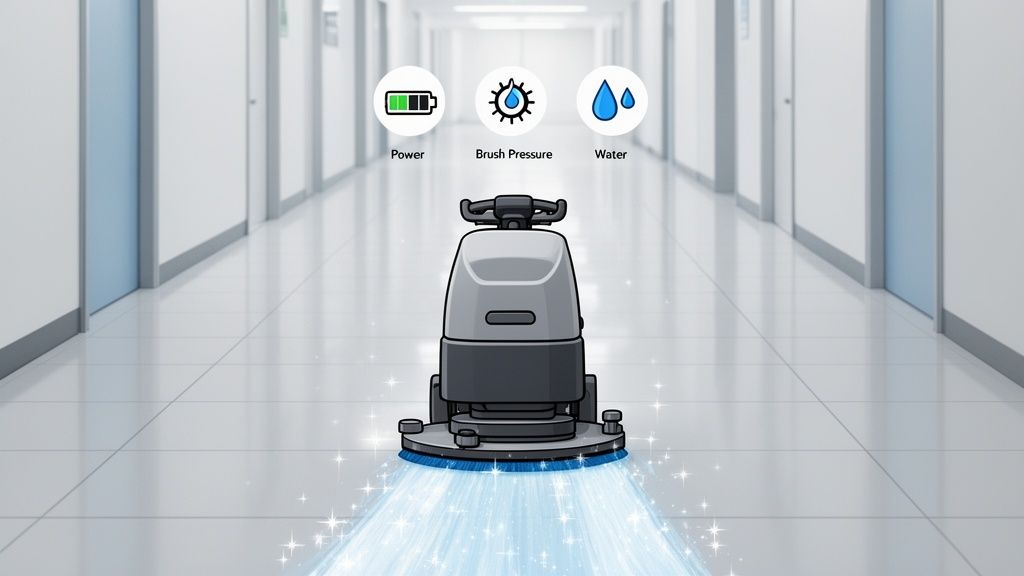
Imagine trying to build a house with a hand-saw and a hammer. You could do it, but upgrading to a power saw and a nail gun would completely change the game. That’s the leap from a traditional mop and bucket to a comprehensive cleaning system—one that pairs a small floor scrubber with high-quality disinfectant wipes. This strategy reframes cleanliness not as an expense, but as a strategic asset for any modern facility.
Compact floor scrubbers are engineered for the tight corners and busy hallways of real-world commercial spaces, making professional-grade cleaning accessible to everyone. But pristine floors are only half the battle. To create a truly hygienic environment that protects health and builds trust, you need a two-pronged approach that tackles every surface, from the ground up.
Your Facility's Unsung Heroes: Scrubbers and Wipes
Think of a small floor scrubber as a power tool for your floors. Just like a power drill drives screws faster and more consistently than a screwdriver, a scrubber delivers a deeper, more uniform clean in a fraction of the time. This isn't just about looks; it's about elevating your entire operation and demonstrating a commitment to health and safety that customers and employees can see and feel.
A pristine floor speaks volumes. In a retail store, it creates a welcoming atmosphere. In a gym, it reinforces a message of wellness. For offices and clinics, it’s a non-negotiable part of building trust. But what about the surfaces people touch every minute? Door handles, countertops, and equipment are critical touchpoints that require their own dedicated solution.
It's clear that pairing automated floor cleaning with manual surface disinfection creates a complete system. Let's look at how a small floor scrubber revolutionizes floor care.
Small Floor Scrubber vs Traditional Mopping
| Attribute | Traditional Mopping | Small Floor Scrubber |
|---|---|---|
| Cleanliness | Pushes dirty water around, leaves residue | Scrubs and vacuums away dirty water for a true clean |
| Drying Time | 15-30 minutes, creating slip hazards | 1-2 minutes, leaving floors almost instantly dry and safe |
| Labor Time | High; slow and physically demanding | Low; covers large areas quickly with minimal effort |
| Consistency | Varies by employee and effort | Delivers a uniform clean every single time |
| Safety | High risk of slip-and-fall incidents on wet floors | Drastically reduces slip-and-fall risks |
| Appearance | Often leaves streaks and hazy film | Results in a brilliant, professional shine |
The comparison makes the choice obvious. A floor scrubber isn't just a better mop—it's a superior approach to facility care that impacts safety, labor costs, and your brand's image.
Boosting Efficiency and Safety
The most immediate benefit you'll notice is the massive jump in efficiency. It's no surprise that walk-behind floor scrubbers have become the champions of small-space cleaning, commanding a huge 44.7% of the market share. They're built specifically for the tight quarters of retail stores, hospitals, and offices, and can cut cleaning time by up to 30% compared to manual mopping. You can dig deeper into these market trends in this report from Data Bridge Market Research.
This efficiency gain translates directly into labor savings. Your staff can cover more ground in less time or be freed up to focus on other critical tasks, like disinfecting high-touch surfaces. For janitorial sales professionals, this is a key selling point: investing in a scrubber allows you to reallocate labor to higher-value hygiene tasks.
A small floor scrubber makes your facility safer by leaving floors almost immediately dry. Unlike mopping, which creates dangerous slip-and-fall hazards, a scrubber’s integrated vacuum and squeegee system removes the dirty water in a single pass.
Creating a Complete Hygiene System
While a small floor scrubber masterfully handles the largest surface in your building, a complete hygiene strategy has to address every touchpoint. Pairing brilliantly clean floors with meticulous surface disinfection creates an environment that visitors can see and feel is safe.
To really nail this, you have to focus on the high-touch areas. Think about all the things people put their hands on every day:
- Offices & Retail: Door handles, push plates, countertops, reception desks, and payment terminals.
- Gyms & Fitness Centers: Equipment grips, dumbbells, touchscreens on cardio machines, and locker handles.
- Schools & Restaurants: Desks, chairs, light switches, elevator buttons, and condiment dispensers.
Folding a robust surface cleaning protocol into your routine is the final piece of the puzzle. By using a small floor scrubber for floors and effective disinfectant wipes for surfaces, you build a comprehensive system that protects health, boosts customer confidence, and elevates your brand. This two-pronged approach turns cleanliness into one of your strongest assets.
Picking the Right Scrubber: Walk-Behind vs. Ride-On and Corded vs. Battery
Choosing the right small floor scrubber is a lot like picking the right vehicle for a job. You wouldn't use a sports car to haul lumber, and a giant pickup truck is overkill for a quick trip to the corner store. In the same way, the machine that’s perfect for a sprawling warehouse floor is all wrong for a tight retail space.
Figuring out the core types—walk-behind versus ride-on and corded versus battery—is the very first step toward making a smart investment. The layout of your facility and its total square footage are the biggest factors here. This simple decision tree shows you exactly when upgrading from a mop to a scrubber becomes a no-brainer for efficiency.

As the flowchart shows, if you need to clean faster and reduce your labor spend, a small floor scrubber is the logical next step. Let’s break down the different models you’ll find out there.
Walk-Behind vs. Compact Ride-On Models
The most common choice for a small floor scrubber is the walk-behind model. The best way to think about it is like the difference between a classic push mower and a small garden tractor.
Walk-behind scrubbers are the push mowers of the cleaning world. Your operator guides the machine from behind, steering it down hallways, through aisles, and around any obstacles. Their smaller size and fantastic maneuverability make them a perfect fit for:
- Retail stores with narrow aisles
- Restaurant dining areas
- Clinic or hospital patient rooms
- Office corridors and lobbies under 15,000 square feet
On the other hand, compact ride-on scrubbers are the garden tractors. An operator sits on the machine, which dramatically speeds up cleaning time and cuts down on fatigue, especially across large, open areas. While they’re bigger than walk-behinds, they are still designed for commercial spaces and are ideal for facilities between 15,000 and 50,000 square feet, like a school gymnasium or a small warehouse.
Productivity is the key metric. A walk-behind unit might clean around 10,000 square feet per hour. A compact ride-on can cover up to 40% more ground in the same amount of time, giving you a huge boost in labor efficiency.
Corded-Electric vs. Battery-Powered Freedom
Your next big decision is how you’ll power the machine. This choice comes down to a trade-off: consistent, unending power versus total operational freedom.
Corded-electric scrubbers plug right into a wall outlet. Their biggest advantage is unlimited runtime—as long as it’s plugged in, it can run. This makes them a solid choice for smaller, contained areas where outlets are easy to find and the cord won’t become a tripping hazard. Think of an auto repair bay or a commercial kitchen after closing time.
Battery-powered scrubbers, however, give you the ultimate flexibility. By cutting the cord, operators can clean anywhere, anytime, without being tethered to a wall or creating a safety risk for customers or staff. This freedom is crucial in places where you have to clean during the day or the layout is complex. A battery model is perfect for weaving through a busy fitness center, navigating a populated airport concourse, or cleaning a hospital hallway without disrupting patient flow. If you're looking to explore other automated cleaning tools, you might find our guide on surface cleaning machines helpful.
Cylindrical vs. Disc Brush Systems
Finally, you need to think about the brush system. This is the part of the machine that does the real work of scrubbing the floor. The two main types are disc and cylindrical, and each one is built for different kinds of surfaces.
Disc (or Pad) Scrubbers: These are the most common type. They use a round, spinning pad to clean, and they absolutely excel on smooth, even surfaces like VCT, polished concrete, or terrazzo. They are perfect for keeping the shine on a showroom floor or cleaning a school hallway.
Cylindrical Brush Scrubbers: These use tube-shaped brushes with bristles that rotate at high speed. Their real superpower is the ability to clean uneven surfaces and get deep into grout lines. This makes them the clear winner for textured tile in a locker room, natural stone with crevices, or any floor where cleaning the grout is a top priority.
Understanding the Specs That Actually Matter
When you’re staring at a spec sheet for a small floor scrubber, the numbers and technical terms can feel like a foreign language. But learning to translate that jargon into real-world performance is the key to choosing a machine that actually solves your facility's problems.
Let's break down the specifications that will have the biggest impact on your daily cleaning operations. Think of it like reading the nutritional info on a food label. You don't need to be a scientist to get it, but knowing what "calories" and "protein" mean helps you make a much better choice. The same logic applies here—understanding these key metrics will empower you to buy the right tool for the job.
Scrub Path and Solution Tank Capacity
The scrub path (or cleaning width) is one of the most important numbers on the sheet. It tells you exactly how wide a path the machine can clean in a single pass. A wider path means you cover more ground, faster. It’s that simple.
- A 17-inch scrub path is your go-to for navigating the tight, cluttered aisles of a convenience store or weaving between desks in a small office.
- A 24-inch path, on the other hand, is built for cleaning a wide-open school gymnasium or a retail showroom, dramatically cutting down on labor time.
Working hand-in-hand with scrub path is the solution tank capacity. This spec tells you how much cleaning solution the machine can hold. A bigger tank means your staff spends less time walking back to the janitor's closet for refills—a massive productivity killer. A small tank in a large area could mean stopping to refill three or four times, adding significant, and unnecessary, time to the job.
Want a quick way to estimate productivity? Here's the formula: (Scrub Path in inches x Speed in mph x 5,280 feet) / 12 inches per foot. This gives you a rough idea of the theoretical square feet per hour a machine can cover, helping you plan labor and budgets more accurately.
Brush Pressure and Decibel Levels
While speed and capacity are all about efficiency, brush pressure is where the real cleaning power comes from. Measured in pounds, this spec shows how much downward force the machine applies to the floor. When you're up against tough, ground-in dirt, higher pressure is your best friend.
For instance, removing stubborn black scuff marks from a high-traffic retail entryway requires way more brush pressure than a light daily clean in an office corridor. If your facility deals with heavy soil, grease, or grime—like in an automotive service bay or a restaurant kitchen—a machine with adjustable or higher brush pressure isn't a nice-to-have; it's a must-have.
Another critical but often overlooked spec is the decibel (dB) level. This simply measures how loud the machine is when it’s running. In an empty warehouse after hours, noise isn't a big deal. But for daytime cleaning in a hospital, office, or retail store, a loud machine is a total non-starter. A scrubber operating at 65 dB or lower is quiet enough to work without disrupting patients, employees, or customers.
The Bigger Picture: Surface Sanitation
A truly hygienic environment needs more than just clean floors. While your new small floor scrubber will create a pristine foundation, it’s crucial to pair it with a solid surface sanitation protocol. After all, a sparkling floor loses its impact if every doorknob and countertop is a hotspot for germs.
For keeping all those high-touch areas pristine and pathogen-free, we recommend Wipes.com Disinfectant Wipes. Integrating this step ensures your facility isn't just clean—it's genuinely healthy.
As the cleaning industry shifts toward more sustainable practices, eco-friendly models are grabbing the spotlight. The demand for green solutions has helped propel the industrial scrubber market from USD 4.27 billion in 2024 to a forecasted USD 6.78 billion by 2030. Compact, battery-operated scrubbers are leading this charge, cutting energy use by 35% and water consumption by up to 40% compared to older models. You can read more about these industrial floor scrubber market trends to see how sustainability is shaping the next generation of equipment.
The Future of Cleaning Is Autonomous
The next frontier in facility maintenance isn’t just about getting floors cleaner; it’s about cleaning them smarter. The entire conversation is shifting away from pure manual labor and toward intelligent automation. And right at the forefront of this movement is the robotic or small floor scrubber.
These aren't some far-off gadgets from a sci-fi movie. They're practical, powerful tools that are already solving some of the biggest cleaning challenges facilities face today.

Imagine a machine that can flawlessly clean a massive airport terminal or a sprawling convention center overnight, all without needing direct human supervision. That’s the reality of autonomous scrubbers. They use a sophisticated blend of AI, LiDAR, and other sensors to navigate complex environments, safely dodging unexpected obstacles like luggage carts or late-night staff with near-perfect accuracy.
A Strategic Solution for Modern Facilities
For facility managers, autonomous scrubbers offer a direct answer to persistent labor shortages and the constant demand for higher, more consistent cleaning standards. By automating the time-consuming task of floor scrubbing, you can free up your valuable human staff to focus on detail-oriented work.
Instead of spending hours walking behind a machine, your team can concentrate on critical tasks that absolutely require a human touch, such as:
- Disinfecting high-touch surfaces like elevator buttons and door handles.
- Performing detailed cleaning in restrooms and break rooms.
- Responding to immediate cleaning needs and guest requests.
This operational shift turns your cleaning crew from a labor force into a specialized hygiene team. The rise of these machines is already revolutionizing overnight cleaning, with the global market for autonomous floor scrubbers projected to hit USD 1,476.26 million by 2026.
These robotic units can slash labor costs by 40-60% and cut solution usage by 30% through smart dispensing, all while their advanced sensors dodge obstacles with 99% accuracy. You can explore more about the autonomous floor scrubber market to understand just how fast it's growing.
Turning Cleaning into a Data-Backed Asset
One of the most powerful features of a robotic floor scrubber is the data it generates. These machines don't just clean; they create detailed, verifiable reports that show exactly where and when they operated.
This data transforms your cleaning operation from a cost center into a strategic, evidence-backed asset. You can definitively prove cleaning compliance, track performance against key metrics, and show stakeholders a tangible return on investment.
For janitorial suppliers and sales professionals, this is a game-changing selling point. You’re no longer just selling a machine; you’re offering a complete cleaning management system. Frame the conversation around ROI—not just in labor savings, but in risk mitigation, an enhanced brand image, and operational intelligence.
Showing a client how a small floor scrubber can provide concrete data is a powerful way to justify the investment. Our detailed article can help you understand more about robotic floor scrubbers and their impact.
By adopting autonomous technology, you’re not just cleaning floors more efficiently. You are investing in a future where cleaning is consistent, verifiable, and a demonstrable contributor to your facility’s success.
Best Practices for a Complete Cleaning Program
Owning great tools is only half the battle; knowing how to use and maintain them is what truly guarantees success. You've invested in a small floor scrubber and stocked up on disinfectant wipes. Now, getting the most out of them—ensuring they are used correctly and consistently—is what delivers real value. This comes down to a mix of solid training, consistent maintenance, and simply cleaning smarter.
By putting clear best practices in place, you’re not just protecting your equipment. You're guaranteeing a flawless, hygienic environment every single time.
Building an Effective Training Program
The single most important factor in your cleaning program's performance is your team. A quick "here's how it works" won't cut it. Comprehensive training is non-negotiable for both scrubbers and surface disinfection, as misuse leads to poor results, damaged equipment, and wasted supplies. A well-rounded training program should always hit these key points.
- Safe & Effective Operation: For scrubbers, this includes proper steering and speed control. For wipes, it means training staff on "dwell time"—the time a surface must remain wet to effectively kill pathogens.
- Machine & Product Specifics: Your team should know how to adjust scrubber water flow and brush pressure. They also need to know which disinfectant wipes are right for different surfaces (e.g., electronics-safe wipes vs. heavy-duty degreasing wipes).
- Emergency & Troubleshooting: For a scrubber, what do you do if it's leaving streaks? (Check the squeegee blade). For wipes, how do you handle a sensitive surface? (Test on an inconspicuous area first). This knowledge saves time and prevents costly mistakes.
Mastering Your Maintenance and Cleaning Routines
Consistent maintenance is the bedrock of a long-lasting scrubber, and consistent routines are the key to effective disinfection. For janitorial sales reps, you can position yourself as a partner by helping clients develop these protocols.
A small floor scrubber that receives consistent care can last 7 to 10 years in a commercial setting. Simple daily and weekly checks are the most effective way to protect your investment and avoid expensive downtime.
Create a clear schedule for scrubber maintenance and a checklist for high-touch surface disinfection. This ensures the scrubber is always ready and that critical disinfection tasks are never missed.
Daily and Weekly Scrubber & Surface Checklist
| Task | Daily | Weekly |
|---|---|---|
| Empty & Rinse Scrubber Tanks | After every use, to prevent odors and buildup. | ✓ |
| Wipe Down Scrubber | After use, wipe the exterior to protect from chemical residue. | ✓ |
| Inspect Scrubber Squeegee Blade | Check for tears or wear. Rotate if one edge is worn. | ✓ |
| Inspect Scrubber Brush/Pad | Check for wear or caked-on debris. Clean after each use. | ✓ |
| Disinfect High-Touch Points | Wipe down all designated surfaces (door handles, counters, etc.) according to frequency plan. | ✓ |
| Check Scrubber Battery | Ensure full charge before use. For wet-cell batteries, check water levels weekly. |
This isn't just busywork. It's the few minutes per day that add years to your equipment's life and ensure your facility meets the highest standards of cleanliness.
Efficiency Hacks and Facility-Specific Tips
Maximizing performance isn't just about maintenance; it's about cleaning smarter. One of the best efficiency hacks is to map out a cleaning route. For scrubbers, start along the outer wall and work inward with overlapping passes. For surface disinfection, create a logical path that moves from cleanest to dirtiest areas to prevent cross-contamination.
Sales Tip for Janitorial Professionals: Offer to help new clients create facility-specific cleaning maps. For a gym, this map would highlight cardio machine touchscreens and dumbbell racks. For an office, it would prioritize reception desks and conference room tables. This value-added service builds customer loyalty. Also, match cleaning solutions to floor types; for example, you need to know about cleaning cement tiles to avoid damage.
So, What's the Real ROI on a Floor Scrubber?
Justifying a big equipment purchase means looking beyond the sticker price. To really understand what a small floor scrubber brings to the table, you need to think about its Return on Investment (ROI). This isn't just about crunching numbers; it's about building a solid business case that shows the long-term financial and operational wins.

The idea is simple: weigh the total cost of owning the machine against all the value it delivers. By the end, you won't just see another expense. You'll see a strategic investment in your facility's future.
The Easy Math: Direct Labor Savings
The most straightforward win you'll see is in labor savings. Start by timing how long it takes your staff to clean a specific area with an old-school mop and bucket. Then, do the same with a small floor scrubber. That difference is your immediate time savings.
Let’s run some quick numbers on a common scenario:
- Manual Mopping: It takes 1 hour to clean a 5,000 sq. ft. area.
- Scrubber Cleaning: It takes just 20 minutes to clean that same space.
Right there, you're saving 40 minutes every single time you clean. If you clean daily and pay your employee $20 an hour, that machine saves you over $4,800 a year in labor alone. A number like that makes the payback period on your investment crystal clear.
The "Hidden" Value of Intangible Benefits
While saving on labor is a huge plus, the intangible benefits often deliver an even bigger ROI. These are the things that don't always show up on a spreadsheet but have a massive impact on your bottom line.
A clean, dry floor is your first line of defense against costly slip-and-fall accidents. A single incident can lead to liability claims, insurance hikes, and reputational damage far exceeding the cost of any cleaning machine.
Think about these less obvious, but critical, returns:
- A Sharper Brand Image: A visibly clean facility tells customers you care. In a gym, a member wiping down equipment with a quality disinfectant wipe feels confident. In a store, a gleaming floor builds trust.
- Happier Customers & Members: Cleanliness is a top driver of customer satisfaction and retention. A member returning to a spotless gym or a shopper entering a clean store is more likely to come back.
- Better Employee Morale: Giving your team professional tools like a scrubber and effective wipes makes their job easier. It shows you respect their work and are investing in a healthy workplace, which boosts morale.
Building Your Business Case
When you're adding up the total cost of ownership and calculating ROI, don't forget to look into options like equipment financing for small business. Financing can make a high-quality machine much more accessible, letting you get the benefits now without a huge upfront capital hit.
Ultimately, a pristine facility isn't an expense—it's a direct contribution to your growth, safety, and success. Investing in a complete hygiene system, from a small floor scrubber to disinfectant wipes, is one of the most effective ways to elevate your operations. Prioritize cleanliness today by integrating these powerful tools into your daily routine or sales offerings.
Frequently Asked Questions About Small Floor Scrubbers
Even after you've done your homework, some practical questions always pop up before you pull the trigger on a new piece of equipment. Let's tackle the most common things business owners and cleaning teams ask when they’re thinking about adding a small floor scrubber to the mix.
How Often Should I Use a Scrubber in My Facility?
The real answer depends entirely on your foot traffic. Think about the busiest spots in your building—a retail store entrance, a restaurant dining room, or a gym’s main workout floor. For those high-traffic zones, daily scrubbing is essential. It’s all about preventing soil from getting ground-in and compacted, which makes it a nightmare to remove later.
On the other hand, lower-traffic areas like office hallways or an event space that’s only used a few times a week might only need a good scrub 2-3 times per week. The goal is to maintain a consistently high standard of clean, not to let things get so bad that you're stuck doing infrequent, back-breaking deep cleans.
Can a Small Floor Scrubber Be Used on Any Hard Floor?
While most small scrubbers are pretty versatile, it is absolutely critical to match the machine's brush or pad to your specific floor type. A one-size-fits-all approach is a recipe for poor results, or worse, damaged flooring.
For smooth surfaces like VCT, polished concrete, or terrazzo, a disc scrubber paired with the right pad (like a red pad for daily cleaning) is perfect for getting that uniform, professional shine.
For uneven surfaces with grout lines, such as textured tile or natural stone, a cylindrical brush scrubber is going to be your best friend. Its bristles are designed to dig deep into those crevices where a flat pad just can't reach.
When in doubt, always check your flooring manufacturer's guidelines before running any new machine or chemical over the surface.
What Is the Typical Lifespan of a Commercial Scrubber?
With the right care, a quality commercial small floor scrubber can be a reliable workhorse for 7 to 10 years. The single biggest factor that determines its lifespan is simple: sticking to a consistent maintenance schedule.
It's the small, daily habits that protect your investment. This means emptying and rinsing both the solution and recovery tanks after every single use, wiping down the machine, and giving the squeegee blade a quick look for any wear and tear. These little steps prevent grime buildup, stop nasty odors before they start, and make sure your machine is always ready to deliver its best performance.
Leave a Reply